Are Word Embedding-based Features Useful for Sarcasm Detection?
Aditya Joshi
1,2,3Vaibhav Tripathi
1Kevin Patel
1Pushpak Bhattacharyya
1Mark Carman
2 1Indian Institute of Technology Bombay, India
2
Monash University, Australia
3IITB-Monash Research Academy, India
{
adityaj,kevin.patel,pb
}
@cse.iitb.ac.in, [email protected]
Abstract
This paper makes a simple increment to state-of-the-art in sarcasm detection research. Existing ap-proaches are unable to capture subtle forms of con-text incongruity which lies at the heart of sarcasm. We explore if prior work can be enhanced using se-mantic similarity/discordance between word embed-dings. We augment word embedding-based features to four feature sets reported in the past. We also ex-periment with four types of word embeddings. We observe an improvement in sarcasm detection, irre-spective of the word embedding used or the original feature set to which our features are augmented. For example, this augmentation results in an improve-ment in F-score of around 4% for three out of these four feature sets, and a minor degradation in case of the fourth, when Word2Vec embeddings are used. Finally, a comparison of the four embeddings shows that Word2Vec and dependency weight-based fea-tures outperform LSA and GloVe, in terms of their benefit to sarcasm detection.
1 Introduction
Sarcasm is a form of verbal irony that is intended to ex-press contempt or ridicule. Linguistic studies show that the notion of context incongruity is at the heart of sar-casm (Ivanko and Pexman, 2003). A popular trend in automatic sarcasm detection is semi-supervised extrac-tion of patterns that capture the underlying context in-congruity (Davidov et al., 2010; Joshi et al., 2015; Riloff et al., 2013). However, techniques to extract these pat-terns rely on sentiment-bearing words and may not cap-ture nuanced forms of sarcasm. Consider the sentence ‘With a sense of humor like that, you could make a liv-ing as a garbage man anywhere in the country.1’ The
speaker makes a subtle, contemptuous remark about the
1All examples in this paper are actual instances from our dataset.
sense of humor of the listener. However, absence of sen-timent words makes the sarcasm in this sentence difficult to capture as features for a classifier.
In this paper, we explore use of word embeddings to capture context incongruity in the absence of sentiment words. The intuition is that word vector-based sim-ilarity/discordance is indicative of semantic
similar-ity which in turn is a handle for context incongrusimilar-ity.
In the case of the ‘sense of humor’ example above, the words ‘sense of humor’ and ‘garbage man’ are seman-tically dissimilar and their presence together in the sen-tence provides a clue to sarcasm. Hence, our set of fea-tures based on word embeddings aim to capture such se-mantic similarity/discordance. Since such sese-mantic simi-larity is but one of the components of context incongruity
andsince existing feature sets rely on sentiment-based features to capture context incongruity, it is imperative that the two be combined for sarcasm detection. Thus, our paper deals with the question:
Can word embedding-based features when augmented to features reported in prior work improve the performance
of sarcasm detection?
To the best of our knowledge, this is the first attempt that uses word embedding-based features to detect sar-casm. In this respect, the paper makes a simple increment to state-of-the-art but opens up a new direction in sarcasm detection research. We establish our hypothesis in case of four past works and four types of word embeddings, to show that the benefit of using word embedding-based features holds across multiple feature sets and word em-beddings.
2 Motivation
In our literature survey of sarcasm detection (Joshi et al., 2016), we observe that a popular trend is semi-supervised extraction of patterns with implicit sentiment. One such work is by Riloff et al. (2013) who give a bootstrap-ping algorithm that discovers a set of positive verbs and
negative/undesirable situations. However, this simplifi-cation (of representing sarcasm merely as positive verbs followed by negative situation) may not capture difficult forms of context incongruity. Consider the sarcastic sen-tence ‘A woman needs a man like a fish needs bicycle’2.
The sarcasm in this sentence is understood from the fact that a fish does not need bicycle - and hence, the sentence ridicules the target ‘a man’. However, this sentence does not contain any sentiment-bearing word. Existing sar-casm detection systems relying on sentiment incongruity (as in the case of our past work reported as Joshi et al. (2015)) may not work well in such cases of sarcasm.
To address this, we use semantic similarity as a han-dle to context incongruity. To do so, we use word vector similarity scores. Consider similarity scores (as given by Word2Vec) between two pairs of words in the sentence above:
similarity(man,woman) = 0.766 similarity(fish,bicycle) = 0.131
Words in one part of this sentence (‘man’ and ‘woman’) are lot more similar than words in another part of the sen-tence (‘fish’ and ‘bicycle’). This semantic discordance can be a clue to presence of context incongruity. Hence, we propose features based on similarity scores between word embeddings of words in a sentence. In general, we wish to capture the most similar and most dissimilar word pairs in the sentence, and use their scores as features for sarcasm detection.
3 Background: Features from prior work
We augment our word embedding-based features to the following four feature sets that have been reported:
1. Liebrecht et al. (2013): They consider unigrams,
bigrams and trigrams as features.
2. Gonz´alez-Ib´anez et al. (2011a): They propose two sets of features: unigrams and dictionary-based. The latter are words from a lexical resource called LIWC. We use words from LIWC that have been annotated as emotion and psychological process words, as described in the original paper.
3. Buschmeier et al. (2014): In addition to
uni-grams, they propose features such as: (a) Hy-perbole (captured by three positive or negative words in a row), (b) Quotation marks and ellipsis, (c) Positive/Negative Sentiment words followed by an exclamation mark or question mark, (d) Posi-tive/Negative Sentiment Scores followed by ellipsis (represented by a ‘...’), (e) Punctuation, (f) Interjec-tions, and (g) Laughter expressions.
2This quote is attributed to Irina Dunn, an Australian writer
(https://en.wikipedia.org/wiki/Irina_Dunn
4. Joshi et al. (2015): In addition to unigrams, they use features based on implicit and explicit incongruity. Implicit incongruity features are patterns with im-plicit sentiment as extracted in a pre-processing step. Explicit incongruity features consist of number of sentiment flips, length of positive and negative sub-sequences and lexical polarity.
4 Word Embedding-based Features
In this section, we now describe our word embedding-based features. We reiterate that these features will be augmented to features from prior works (described in Section 3).
As stated in Section 2, our word embedding-based fea-tures are based on similarity scores between word em-beddings. The similarity score is the cosine similarity between vectors of two words. To illustrate our features, we use our example ‘A woman needs a man like a fish needs a bicycle’. The scores for all pairs of words in this sentence are given in Table 1.
man woman fish needs bicycle
man - 0.766 0.151 0.078 0.229
woman 0.766 - 0.084 0.060 0.229
fish 0.151 0.084 - 0.022 0.130
needs 0.078 0.060 0.022 - 0.060
bicycle 0.229 0.229 0.130 0.060
-Table 1:Similarity scores for all pairs of content words in ‘A woman needs a man like a fish needs bicycle’
Using these similarity scores, we compute two sets of features:
1. Unweighted similarity features (S): We first
com-pute similarity scores for all pairs of words (except stop words). We then return four feature values per sentence.3:
• Maximum score of mostsimilarword pair
• Minimum score of mostsimilarword pair • Maximum score of mostdissimilarword pair
• Minimum score of mostdissimilarword pair For example, in case of the first feature, we consider the most similar word to every word in the sentence, and the corresponding similarity scores. These most similar word scores for each word are indicated in bold in Table 1. Thus, the first feature in case of our example would have the value 0.766 derived from the man-woman pair and the second feature would take the value 0.078 due to the needs-man pair. The other features are computed in a similar manner. 3These feature values consider all words in the sentence,i.e., the
2. Distance-weighted similarity features (WS): Like in the previous case, we first compute similarity scores for all pairs of words (excluding stop-words). For all similarity scores, we divide them by square of distance between the two words. Thus, the simi-larity between terms that are close in the sentence is weighted higher than terms which are distant from one another. Thus, for all possible word pairs, we compute four features:
• Maximum distance-weighted score of most similarword pair
• Minimum distance-weighted score of most
similarword pair
• Maximum distance-weighted score of most
dissimilarword pair
• Minimum distance-weighted score of most dis-similarword pair
These are computed similar to unweighted similarity features.
5 Experiment Setup
We create a dataset consisting of quotes on GoodReads4.
GoodReads describes itself as ‘the world’s largest site for readers and book recommendations.’ The website also allows users to post quotes from books. These quotes are snippets from books labeled by the user with tags of their choice. We download quotes with the tag ‘sarcastic’ as sarcastic quotes, and the ones with ‘philosophy’ as non-sarcastic quotes. Our labels are based on these tags given by users. We ensure that no quote has both these tags. This results in a dataset of 3629 quotes out of which 759 are labeled as sarcastic. This skew is similar to skews observed in datasets on which sarcasm detection experi-ments have been reported in the past (Riloff et al., 2013). We report five-fold cross-validation results on the above dataset. We use SV Mperf by Joachims (2006)
withcas 20, was 3, and loss function as F-score opti-mization. This allows SVM to be learned while optimiz-ing the F-score.
As described above, we compare features given in prior work alongside the augmented versions. This means that for each of the four papers, we experiment with four con-figurations:
1. Features given in paper X
2. Features given in paper X + unweighted similarity features (S)
3. Features given in paper X + weighted similarity fea-tures (WS)
4. Features given in paper X + S+WS (i.e., weighted and unweighted similarity features)
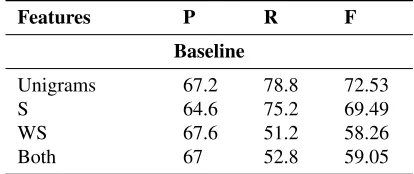
Features P R F
Baseline
[image:3.612.322.529.58.145.2]Unigrams 67.2 78.8 72.53 S 64.6 75.2 69.49 WS 67.6 51.2 58.26 Both 67 52.8 59.05
Table 2:Performance of unigrams versus our similarity-based features using embeddings from Word2Vec
We experiment with four types of word embeddings:
1. LSA: This approach was reported in Landauer and Dumais (1997). We use pre-trained word em-beddings based on LSA5. The vocabulary size is
100,000.
2. GloVe: We use pre-trained vectors avaiable from the GloVe project6. The vocabulary size in this case is
2,195,904.
3. Dependency Weights: We use pre-trained vectors7
weighted using dependency distance, as given in Levy and Goldberg (2014). The vocabulary size is 174,015.
4. Word2Vec: use pre-trained Google word vectors.
These were trained using Word2Vec tool8 on the
Google News corpus. The vocabulary size for Word2Vec is 3,000,000. To interact with these pre-trained vectors, as well as compute various features, we use gensim library ( ˇReh˚uˇrek and Sojka, 2010).
To interact with the first three pre-trained vectors, we use scikit library (Pedregosa et al., 2011).
6 Results
Table 2 shows performance of sarcasm detection when our word embedding-based features are used on their own
i.e, not as augmented features. The embedding in this case is Word2Vec. The four rows show baseline sets of features: unigrams, unweighted similarity using word embeddings (S), weighted similarity using word embed-dings (WS) and both (i.e., unweighted plus weighted sim-ilarities using word embeddings). Using only unigrams as features gives a F-score of 72.53%, while only un-weighted and un-weighted features gives F-score of 69.49% and 58.26% respectively. Thisvalidates our intuition
4www.goodreads.com
5http://www.lingexp.uni-tuebingen.de/z2/
LSAspaces/
6http://nlp.stanford.edu/projects/glove/ 7 https://levyomer.wordpress.com/2014/04/25/
dependency-based-word-embeddings/
LSA GloVe Dependency Weights Word2Vec
P R F P R F P R F P R F
L 73 79 75.8 73 79 75.8 73 79 75.8 73 79 75.8
+S 81.8 78.2 79.95 81.8 79.2 80.47 81.8 78.8 80.27 80.4 80 80.2
+WS 76.2 79.8 77.9 76.2 79.6 77.86 81.4 80.8 81.09 80.8 78.6 79.68 +S+WS 77.6 79.8 78.68 74 79.4 76.60 82 80.4 81.19 81.6 78.2 79.86
G 84.8 73.8 78.91 84.8 73.8 78.91 84.8 73.8 78.91 84.8 73.8 78.91
+S 84.2 74.4 79 84 72.6 77.8 84.4 72 77.7 84 72.8 78 +WS 84.4 73.6 78.63 84 75.2 79.35 84.4 72.6 78.05 83.8 70.2 76.4 +S+WS 84.2 73.6 78.54 84 74 78.68 84.2 72.2 77.73 84 72.8 78
B 81.6 72.2 76.61 81.6 72.2 76.61 81.6 72.2 76.61 81.6 72.2 76.61 +S 78.2 75.6 76.87 80.4 76.2 78.24 81.2 74.6 77.76 81.4 72.6 76.74 +WS 75.8 77.2 76.49 76.6 77 76.79 76.2 76.4 76.29 81.6 73.4 77.28 +S+WS 74.8 77.4 76.07 76.2 78.2 77.18 75.6 78.8 77.16 81 75.4 78.09 J 85.2 74.4 79.43 85.2 74.4 79.43 85.2 74.4 79.43 85.2 74.4 79.43 +S 84.8 73.8 78.91 85.6 74.8 79.83 85.4 74.4 79.52 85.4 74.6 79.63
[image:4.612.79.535.58.303.2]+WS 85.6 75.2 80.06 85.4 72.6 78.48 85.4 73.4 78.94 85.6 73.4 79.03 +S+WS 84.8 73.6 78.8 85.8 75.4 80.26 85.6 74.4 79.6 85.2 73.2 78.74
Table 3:Performance obtained on augmenting word embedding features to features from four prior works, for four word embeddings; L: Liebrecht et al. (2013), G: Gonz´alez-Ib´anez et al. (2011a), B: Buschmeier et al. (2014) , J: Joshi et al. (2015)
that word embedding-based features alone are not sufficient, and should be augmented with other fea-tures.
Following this, we show performance using features presented in four prior works: Buschmeier et al. (2014), Liebrecht et al. (2013), Joshi et al. (2015) and Gonz´alez-Ib´anez et al. (2011a), and compare them with augmented versions in Table 3.
[image:4.612.76.536.58.305.2]Table 3 shows results for four kinds of word embed-dings. All entries in the tables arehigher than the sim-ple unigrams baseline,i.e., F-score for each of the four is higher than unigrams - highlighting that these are bet-ter features for sarcasm detection than simple unigrams. Values in bold indicate the best F-score for a given prior work-embedding type combination. In case of Liebrecht et al. (2013) for Word2Vec, the overall improvement in F-score is 4%. Precision increases by 8% while recall re-mains nearly unchanged. For features given in Gonz´alez-Ib´anez et al. (2011a), there is a negligible degradation of 0.91% when word embedding-based features based on Word2Vec are used. For Buschmeier et al. (2014) for Word2Vec, we observe an improvement in F-score from 76.61% to 78.09%. Precision remains nearly unchanged while recall increases. In case of Joshi et al. (2015) and Word2Vec, we observe a slight improvement of 0.20% when unweighted (S) features are used. This shows that word embedding-based features are useful, across four past works for Word2Vec.
Table 3 also shows that the improvement holds across the four word embedding types as well. The
maxi-mum improvement is observed in case of Liebrecht et al. (2013). It is around 4% in case of LSA, 5% in case of GloVe, 6% in case of Dependency weight-based and 4% in case of Word2Vec. These improvements are not directly comparable because the four embeddings have different vocabularies (since they are trained on different datasets) and vocabulary sizes, their results cannot be di-rectly compared.
Word2Vec LSA GloVe Dep. Wt.
+S 0.835 0.86 0.918 0.978
+WS 1.411 0.255 0.192 1.372
[image:5.612.92.278.189.257.2]+S+WS 1.182 0.24 0.845 0.795
Table 4:Average gain in F-Scores obtained by using intersection of the four word embeddings, for three word embedding feature-types, aug-mented to four prior works; Dep. Wt. indicates vectors learned from dependency-based weights
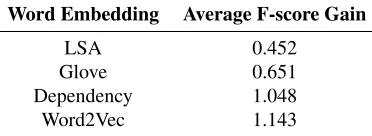
Word Embedding Average F-score Gain
LSA 0.452
Glove 0.651 Dependency 1.048 Word2Vec 1.143
Table 5: Average gain in F-scores for the four types of word embed-dings; These values are computed for a subset of these embeddings consisting of words common to all four
three types of word embedding-based features. Using Dependency-based and Word2Vec embeddings results in a higher improvement in F-score (1.048% and 1.143% respectively) as compared to others.
7 Error Analysis
Some categories of errors made by our system are:
1. Embedding issues due to incorrect senses:
Be-cause words may have multiple senses, some em-beddings lead to error, as in ‘Great. Relationship advice from one of America’s most wanted.’.
2. Contextual sarcasm: Consider the sarcastic quote
‘Oh, and I suppose the apple ate the cheese’. The similarity score between ‘apple’ and ‘cheese’ is 0.4119. This comes up as the maximum similar pair. The most dissimilar pair is ‘suppose’ and ‘apple’ with similarity score of 0.1414. The sarcasm in this sentence can be understood only in context of the complete conversation that it is a part of.
3. Metaphors in non-sarcastic text: Figurative
lan-guage may compare concepts that are not directly re-lated but still have low similarity. Consider the non-sarcastic quote ‘Oh my love, I like to vanish in you like a ripple vanishes in an ocean - slowly, silently and endlessly’. Our system incorrectly predicts this as sarcastic.
8 Related Work
Early sarcasm detection research focused on speech (Tep-perman et al., 2006) and lexical features (Kreuz and Caucci, 2007). Several other features have been proposed
(Kreuz and Caucci, 2007; Joshi et al., 2015; Khattri et al., 2015; Liebrecht et al., 2013; Gonz´alez-Ib´anez et al., 2011a; Rakov and Rosenberg, 2013; Wallace, 2015; Wal-lace et al., 2014; Veale and Hao, 2010; Gonz´alez-Ib´anez et al., 2011b; Reyes et al., 2012). Of particular relevance to our work are papers that aim to first extract patterns relevant to sarcasm detection. Davidov et al. (2010) use a semi-supervised approach that extracts sentiment-bearing patterns for sarcasm detection. Joshi et al. (2015) extract phrases corresponding to implicit incongruity i.e. the sit-uation where sentiment is expressed without use of sen-timent words. Riloff et al. (2013) describe a bootstrap-ping algorithm that iteratively discovers a set of positive verbs and negative situation phrases, which are later used in a sarcasm detection algorithm. Tsur et al. (2010) also perform semi-supervised extraction of patterns for sar-casm detection. The only prior work which uses word embeddings for a related task of sarcasm detection is by Ghosh et al. (2015). They model sarcasm detection as a word sense disambiguation task, and use embeddings to identify whether a word is used in the sarcastic or non-sarcastic sense. Two sense vectors for every word are created: one for literal sense and one for sarcastic sense. The final sense is determined based on the similarity of these sense vectors with the sentence vector.
9 Conclusion
This paper shows the benefit of features based on word embedding for sarcasm detection. We experiment with four past works in sarcasm detection, where we augment our word embedding-based features to their sets of fea-tures. Our features use the similarity score values re-turned by word embeddings, and are of two categories: similarity-based (where we consider maximum/minimum similarity score of most similar/dissimilar word pair re-spectively), and weighted similarity-based (where we weight the maximum/minimum similarity scores of most similar/dissimilar word pairs with the linear distance between the two words in the sentence). We experi-ment with four kinds of word embeddings: LSA, GloVe, Dependency-based and Word2Vec. In case of Word2Vec, for three of these past feature sets to which our features were augmented, we observe an improvement in F-score of at most 5%. Similar improvements are observed in case of other word embeddings. A comparison of the four embeddings shows that Word2Vec and dependency weight-based features outperform LSA and GloVe.
References
Konstantin Buschmeier, Philipp Cimiano, and Roman Klinger. 2014. An impact analysis of features in a classification ap-proach to irony detection in product reviews. InProceedings of the 5th Workshop on Computational Approaches to Sub-jectivity, Sentiment and Social Media Analysis, pages 42–49. Dmitry Davidov, Oren Tsur, and Ari Rappoport. 2010. Semi-supervised recognition of sarcastic sentences in twitter and amazon. InProceedings of the Fourteenth Conference on Computational Natural Language Learning, pages 107–116. Association for Computational Linguistics.
Debanjan Ghosh, Weiwei Guo, and Smaranda Muresan. 2015. Sarcastic or not: Word embeddings to predict the literal or sarcastic meaning of words. InEMNLP.
Roberto Gonz´alez-Ib´anez, Smaranda Muresan, and Nina Wa-cholder. 2011a. Identifying sarcasm in twitter: a closer look. InProceedings of the 49th Annual Meeting of the Association for Computational Linguistics: Human Language Technolo-gies: short papers-Volume 2, pages 581–586. Association for Computational Linguistics.
Roberto Gonz´alez-Ib´anez, Smaranda Muresan, and Nina Wa-cholder. 2011b. Identifying sarcasm in twitter: a closer look. InProceedings of the 49th Annual Meeting of the Association for Computational Linguistics: Human Language Technolo-gies: short papers-Volume 2, pages 581–586. Association for Computational Linguistics.
Stacey L Ivanko and Penny M Pexman. 2003. Context incongruity and irony processing. Discourse Processes, 35(3):241–279.
Thorsten Joachims. 2006. Training linear svms in linear time. InProceedings of the 12th ACM SIGKDD international con-ference on Knowledge discovery and data mining, pages 217–226. ACM.
Aditya Joshi, Vinita Sharma, and Pushpak Bhattacharyya. 2015. Harnessing context incongruity for sarcasm detec-tion. InProceedings of the 53rd Annual Meeting of the As-sociation for Computational Linguistics and the 7th Inter-national Joint Conference on Natural Language Processing, volume 2, pages 757–762.
Aditya Joshi, Pushpak Bhattacharyya, and Mark James Car-man. 2016. Automatic sarcasm detection: A survey. arXiv preprint arXiv:1602.03426.
Anupam Khattri, Aditya Joshi, Pushpak Bhattacharyya, and Mark James Carman. 2015. Your sentiment precedes you: Using an authors historical tweets to predict sarcasm. In 6th Workshop on Computational Approaches to Subjectivity, Sentiment and Social Media Analysis (WASSA), page 25. Roger J Kreuz and Gina M Caucci. 2007. Lexical influences on
the perception of sarcasm. InProceedings of the Workshop on computational approaches to Figurative Language, pages 1–4. Association for Computational Linguistics.
Thomas K Landauer and Susan T. Dumais. 1997. A solution to platos problem: The latent semantic analysis theory of ac-quisition, induction, and representation of knowledge. PSY-CHOLOGICAL REVIEW, 104(2):211–240.
Omer Levy and Yoav Goldberg. 2014. Dependency-based word embeddings. InProceedings of the 52nd Annual Meet-ing of the Association for Computational LMeet-inguistics, ACL
2014, June 22-27, 2014, Baltimore, MD, USA, Volume 2: Short Papers, pages 302–308.
CC Liebrecht, FA Kunneman, and APJ van den Bosch. 2013. The perfect solution for detecting sarcasm in tweets# not. Fabian Pedregosa, Ga¨el Varoquaux, Alexandre Gramfort,
Vin-cent Michel, Bertrand Thirion, Olivier Grisel, Mathieu Blon-del, Peter Prettenhofer, Ron Weiss, Vincent Dubourg, et al. 2011. Scikit-learn: Machine learning in python.The Journal of Machine Learning Research, 12:2825–2830.
Rachel Rakov and Andrew Rosenberg. 2013. ” sure, i did the right thing”: a system for sarcasm detection in speech. In INTERSPEECH, pages 842–846.
Radim ˇReh˚uˇrek and Petr Sojka. 2010. Software Framework for Topic Modelling with Large Corpora. InProceedings of the LREC 2010 Workshop on New Challenges for NLP Frameworks, pages 45–50, Valletta, Malta, May. ELRA. http://is.muni.cz/publication/884893/en. Antonio Reyes, Paolo Rosso, and Davide Buscaldi. 2012.
From humor recognition to irony detection: The figurative language of social media. Data & Knowledge Engineering, 74:1–12.
Ellen Riloff, Ashequl Qadir, Prafulla Surve, Lalindra De Silva, Nathan Gilbert, and Ruihong Huang. 2013. Sarcasm as con-trast between a positive sentiment and negative situation. In EMNLP, pages 704–714.
Joseph Tepperman, David R Traum, and Shrikanth Narayanan. 2006. ” yeah right”: sarcasm recognition for spoken dia-logue systems. InINTERSPEECH. Citeseer.
Oren Tsur, Dmitry Davidov, and Ari Rappoport. 2010. Icwsm-a greIcwsm-at cIcwsm-atchy nIcwsm-ame: Semi-supervised recognition of sIcwsm-arcIcwsm-as- sarcas-tic sentences in online product reviews. InICWSM. Tony Veale and Yanfen Hao. 2010. Detecting ironic intent in
creative comparisons. InECAI, volume 215, pages 765–770. Byron C Wallace, Laura Kertz Do Kook Choe, and Eugene Charniak. 2014. Humans require context to infer ironic in-tent (so computers probably do, too). InProceedings of the Annual Meeting of the Association for Computational Lin-guistics (ACL), pages 512–516.