Abstract
The Boolean satisfiability problem (SAT) has various applications in electronic design automation (EDA) fields such as testing, timing analysis and logic verification. SAT has been typically applied to EDA as follows: 1) formula-tion of the given problem as a SAT instance 2) soluformula-tion of the SAT instance. In this paper, we present a method to simultaneously solve several closely related SAT instances using incremental satisfiability (ISAT). In ISAT, the deci-sion sequence made for a “prefix” function is used to solve another set of functions which have a number of new con-straints (extensions) added to the prefix function. Our experiments show that we can achieve significant gains in total runtime when we use this methodology as opposed to resetting the decision sequences and solving each instance from scratch. Application of ISAT to delay fault testing is presented by formulating incremental path sensitization as an ISAT problem. Non-robust tests for the combinational portion of ISCAS 89 circuits are generated using this method.
I. Introduction
Many electronic design automation (EDA) problems can be cast as instances of Boolean satisfiability (SAT): given a
Boolean function , find an assignment
such that or prove that no such assignment ex-ists. The function is typically expressed in conjunctive normal form (CNF) and the problem is usually solved by a backtracking search algorithm that systematically explores the n-dimensional Boolean space of the variables. Even though it is well known that SAT is NP-complete, recent ad-vances in this field, e.g. [1][13][14], have made it possible to apply SAT to problems of considerable size.
Incremental satisfiability was first considered in [7] but its application was limited to solving one large problem by partitioning it into m partitions where m is the number of clauses and solving them incrementally by adding one clause at a time. In this paper we propose a modification to the incre-mental satisfiability problem suggested in [7], and a corre-sponding modification to the search algorithm, to address a situation that frequently arises in many application domains. The incremental satisfiability (ISAT) problem is: determine the satisfiability of each function in a set of m Boolean
functions that share a
ϕ( )X : 0 1{ , }n→{0 1, }
X* ϕ(X*) = 1
ϕ( )X
ϕi( )X Φ = {ϕi( ) ϕX i( ) ϕX = P( ) ϕX ⋅ Si( )X }
common prefix function but have different suffix functions . We will refer to each such function as an extension of the common prefix . This problem can be obviously cast and solved as m independent SAT problems. Significant computational savings can be realized, however, by solving them “together.” Specifically, a solution is found for the common prefix, which is then extended or slightly modified to obtain solutions to each of the m exten-sions. The maximum benefit from such an approach accrues when is unsatisfiable since that obviates the need to even consider the suffixes to prove that all of the m exten-sions are unsatisfiable. The satisfiability of , on the other hand, is a necessary but not sufficient condition for the satisfiability of its m extensions. The potential savings in this case are harder to predict. In particular, significant savings are still possible if the solutions to each of the m extensions can be found by augmenting the partial solution obtained for the prefix with assignments to previously unassigned vari-ables. A more likely scenario, however, is that the solution to at least some of the extensions can only be obtained by
re-versing existing assignments in the solution found for the
prefix. Fortunately, in the EDA application domain, the size of the prefix is usually much larger than the sizes of each of the suffixes. This means that the performance gain obtained by incremental SAT can be larger than the performance loss from reversing current assignments.
Boolean satisfiability has been widely used for both stuck-at fault testing [9] and delay fault testing [2] of combi-national circuits. In this paper we will apply ISAT to prove the untestability of non-robust delay faults in logic circuits. Test pattern generation for path delay fault has been re-searched heavily recently. Various classifications of delay faults (e.g., robust, non-robust, validatable non-robust etc.) exist. Although robust test is preferred to non-robust test in general, there have been some research results that prove the importance of non-robust test [4][12].
It should be noted that the objective of this paper is not to advocate a certain kind of delay fault model. Non-robust de-lay fault generation was chosen in this paper since it allows for straightforward application of ISAT to EDA problems.
This paper is organized as follows. In Section II incre-mental satisfiability is introduced. The application of ISAT to delay fault testing is presented in Section III. Experimental results and conclusions are presented in Section IV and Sec-tion V, respectively.
ϕP( )X
ϕSi( )X ϕi( )X
ϕP( )X
ϕP( )X
ϕP( )X
On Applying Incremental Satisfiability to Delay Fault Testing
Joonyoung Kim, Jesse Whittemore, João P. Marques-Silva
aand Karem Sakallah
University of Michigan {jykim, jwhitte, karem}@umich.edu
II. Incremental Satisfiability
In this paper we consider Boolean functions represented in Conjunctive Normal Form (CNF). A literal is an occur-rence of a variable or its complement. A clause is a disjunc-tion (OR) of literals. A CNF formula is a conjuncdisjunc-tion (AND) of clauses.
A CNF formula is said to be satisfiable when there is at least one truth assignment to its variables that makes all clauses equal to 1. A CNF formula is said to be unsatisfiable when no such assignment exists.
Let us consider a case when the given Boolean function is found to be satisfiable. If a set of addition-al clauses which represent the function is added to , what can we say about the satisfiability of the overall func-tion ? Note that the satisfiability of is a neces-sary, but not sufficient condition for the satisfiability of . Instead of “resetting” all the decisions made in deriving the solution for , we can resume the search by updating the status of the clauses in against the assignments that were made for the problem for the overlapping portion of the support set.
When we update the new clauses against the current as-signment, there is no need to reverse current assignments un-less some new clause becomes unsatisfied as the following example illustrates.
Example 1
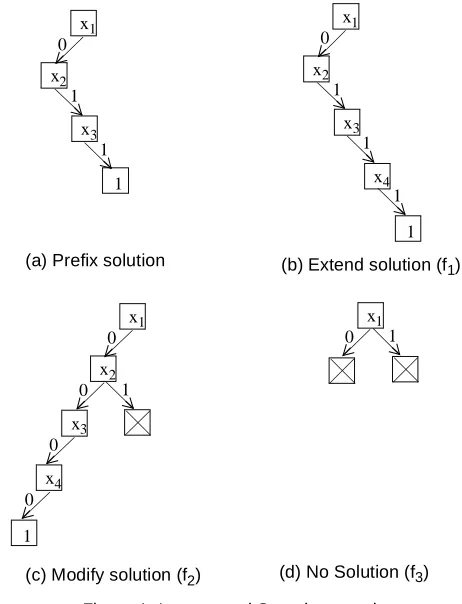
Consider a prefix boolean function . A possi-ble decision tree of the satisfying assignment for this problem is shown in Figure
1(a). Now let us add the clauses
and solve a new prob-lem . The current assignment can be used to up-date the status of the new clauses. As a result, the first clause of , becomes a unit clause (an unresolved clause with only one free literal) and the second clause becomes satisfied. The resulting decision se-quence after satisfying the unit clause is shown in Figure 1(b).
Now let us consider adding a different set of clauses to the prefix function. Let
and . The first clause becomes unsat-isfied when we update the clause with the current assign-ment. The conflict analysis procedure [13] will be triggered and generate a conflict induced clause , which “as-serts” the value of to be 0 under the assignment .The decision sequence for this problem is shown in
Figure 1(c) with assignment .
Finally let us consider adding
to obtain the function (Figure 1 (d)). Not only does the addition of function conflict with current assignments, it makes the overall function unsatisfiable under any assignment. ■
III. ISAT Applied to Delay Fault Testing
Delay fault testing is performed after fabrication of an in-tegrated circuit. There are two widely used fault models, gate delay faults and path delay faults. We will consider the path delay fault model [11] [3] in this paper.
A path delay fault models distributed fault effects on a given path which causes the delay of the path to exceed a specified limit. For each structural path, two path delay faults can be considered, rising and falling transition at the output of the path.
To detect a delay fault, it is common to apply a pair of vectors at the inputs of the circuit and sample the output of the circuit after one clock period. The interval be-tween v1 and v2 must be long enough so that all signals in the circuit can stabilize.
A test for a given delay fault is called robust if the test can detect the given fault independent of the presence of other delay faults in the circuit. A test is called non-robust if the given fault can be masked by the presence of other delay faults in the circuit.
Our experimental results are based on the non-robust de-lay fault testing model. Note that the side input condition of v2 for non-robust faults is exactly the same as the static sen-sitization criterion in timing analysis. Hence if we have an ef-ficient way of checking static sensitizability, it can be readily used as a test pattern generator for non-robust faults.
The approach used in [2] extracts a fan-in cone for each primary output and finds a test for each path to that primary fp(x1, , ,x2 … xn)
fS fP
f = fp⋅fS fP
f fP
fS fP
fP(x1, , ,x2 x3 x4) = (x1+x3)(x2+x3)(x1+x2+x3) x1=0 x, 2=1 x, 3=1
{ }
fS1(x1, , ,x2 x3 x4) = (x2+x4)(x3+x4) f1 = fP⋅fS1
fS1 (x2+x4) x3+x4
( )
fS2(x1, , ,x2 x3 x4) = (x2+x3)(x3+x4) f2 = fP⋅fS2 (x2+x3)
x1+x2
( )
x2 x1=0
{ }
x1=0 x, 2=0 x, 3=0 x, 4=0
{ }
fS3(x1, , ,x2 x3 x4) = (x2+x3)(x1+x3) f3 = fP⋅fS3
[image:2.612.327.558.57.359.2]fS3 f3
Figure 1: Incremental Search example
(b) Extend solution (f1)
(c) Modify solution (f2) (d) No Solution (f3) x2
x1
x3
1
(a) Prefix solution 0
1
1
x2 x1
x3
1 0
1
1
x2 x1
x3 0
x4 1
x1 0
0 0
0
x4
1
1
1
output. This improves on the simplistic path-by-path ap-proach since extraction is performed only once for each pri-mary output. However, both the size of each SAT problem and the number of paths for each primary output can become very large for most practical circuits.
Instead of explicitly enumerating all paths, we can use in-cremental satisfiability to prune away large portions of un-testable faults by applying ISAT to incremental path sensitization as proposed in [5]. Consider a partial path that starts from a primary input g0. If the path P is untestable for delay faults, then all other paths that have P as a prefix can be removed from consideration since these faults are untestable as well. We can use depth first search when choosing paths, backtracking when an un-testable fault is identified. The algorithm is illustrated in Fig-ure 2. We generate consistency functions which enforce consistent assignments to the inputs and output of each gate according to its functionality.
For a gate which realizes a function , we can generate the consistency function by deriving a CNF rep-resentation of .
Example 2
Consider a two input AND gate . The consistency function for this gate can be derived as follows.
Consistency functions of simple two input gates are shown in Table I. Side input constraints are then added to en-force the static sensitization condition which requires side in-puts to assume non-controlling values. Side input conditions of complex gates can be generated using the Boolean differ-ence of the gate function with respect to the on-path input.
The next example illustrates the application of ISAT to the path sensitization problem.
Example 3
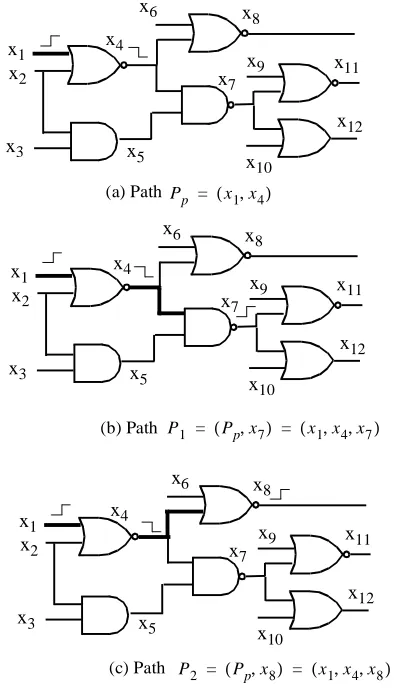
Consider the path with a rising input at in Figure 3. The function that captures non-robust de-lay fault testability of is:
Note that these clauses consist of
• the consistency function of :
• on-path transition constraints:
• side input conditions:
can be satisfied by .
Con-sider next path . Five additional
clauses must be added to yielding: gate type consistency function for z=f(x,y)
AND
OR
NAND
NOR
TA B L E I : Co n s i s t e n c y f u n c t i o n s o f b a s i c g a t e s
x+z
( )(y+z)(x+y+z) x+z
( )(y+z)(x+y+z) x+z
( )(y+z)(x+y+z) x+z
( )(y+z)(x+y+z)
P = (g0, ,l0 …li–1,gi)
z f x( 1, ,… xn)
z⊕f
incremental_search (){ for each PI x
recurse(x, rising); recurse(x, falling); }
recurse(x, direction){ for each fanout(x) y if y is PO
sensitizable path found; else
if (test_sensitization() == SUCCESS) if x is non-inverting
recurse(y, direction); else
recurse(y, inverse(direction)); else
[image:3.612.337.537.62.407.2]return; }
Figure 2: Outline of incremental search
z = xy
z⊕xy zxy+z xy( )
z+xy
( )(z+x+y) z+x
( )(z+y)(z+x+y)
= = =
x1 x2
x6
x3 x
5
x4
x11 x7
x10 x9 x8
x12
Figure 3: Example of partial path sensitization
x1 x2
x6
x3 x
5
x4
x11 x7
x10 x9 x8
x12
x1 x2
x6
x3 x
5
x4
x11 x7
x10 x9 x8
x12
(a) Path
(b) Path
(c) Path
P1 = (Pp,x7) = (x1, ,x4 x7)
P2 = (Pp,x8) = (x1, ,x4 x8) Pp = (x1,x4)
Pp = (x1,x4) x1
f P( )p Pp
f P( )p = ( )x1 (x1+x4)(x2+x4)(x1+x2+x4)( )x4 ( )x2
x4 x1+x4
( )(x2+x4)(x1+x2+x4) x1 ( )( )x4
x2 ( )
f P( )p {x1=1 x, 2=0 x, 4=0}
[image:3.612.69.283.68.161.2] [image:3.612.63.273.489.722.2]This function can easily be shown to be unsatisfiable. Hence we can conclude that all paths that extend from , namely and , are unsensitizable and can be removed from further consideration. The next set of paths considered by the incremental search algorithm would now extend through x8. ■
It is worth noting that there are other approaches to iden-tify non-robust untestable faults such as [6] [10] which use logic implication to identify untestable faults. Even though they are substantially faster than the methods which target paths, they are not complete in that they cannot guarantee 100% identification of untestable faults. A similar method is used in [8] to identify robust dependent and functionally un-sensitizable faults.
IV. Experimental Results
The prototype of the presented algorithm is implemented in C++ and integrated with the SAT solver GRASP [13]. It was run on a workstation with Intel Pentium II 300 MHz CPU and 256 MB of memory running Linux. The result of
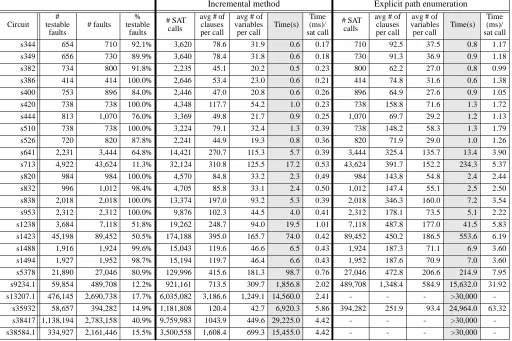
the experiment is shown in Table II.
The first four columns present general information about the benchmark circuits. In the remaining columns, the ber of SAT calls and average problem size in terms of num-ber of variables and clauses for both incremental method and the method in [2] are presented. Average execution time per each SAT call as well as total execution time is also reported. We implemented the algorithm used in [2] for compari-son with our method within our framework; for each path in a circuit, we identify a corresponding formula, add con-straints clauses and solve the SAT problem. Note that in the actual implementation, the CNF formula for the entire circuit is generated only once.
From the experimental results, we can observe that the savings we gain by using incremental satisfiability accrue for circuits with a large number of untestable faults such as s713, s1238, s1423, s9234.1 and below.
Note that our method can generate complete test sets for three circuits (s13207.1, s38417, s38584.1) which we could not finish within the given time limit (30,000 seconds) using the explicit path enumeration method.
It is also worthwhile to note that even though our method requires more SAT calls in general, the time per each SAT call (reported in milliseconds in the table) of our method is significantly smaller than that of the explicit method because f P( )1 = ( )x1 (x1+x4)(x2+x4)(x1+x2+x4)( )x4 ( )x2
x7
( )(x4+x7)(x5+x7)(x4+x5+x7)( )x5
P1 P1,x11
( ) (P1,x12)
Pp
Incremental method Explicit path enumeration
Circuit # testable
faults
# faults % testable
faults
# SAT calls
avg # of clauses per call
avg # of variables per call
Time(s) Time (ms)/ sat call
# SAT calls
avg # of clauses per call
avg # of variables per call
Time(s) Time (ms)/ sat call s344 654 710 92.1% 3,620 78.6 31.9 0.6 0.17 710 92.5 37.5 0.8 1.17 s349 656 730 89.9% 3,640 78.4 31.8 0.6 0.18 730 91.3 36.9 0.9 1.18 s382 734 800 91.8% 2,235 45.1 20.2 0.5 0.23 800 62.2 27.0 0.8 0.99 s386 414 414 100.0% 2,646 53.4 23.0 0.6 0.21 414 74.8 31.6 0.6 1.38 s400 753 896 84.0% 2,446 47.0 20.8 0.6 0.26 896 64.9 27.6 0.9 1.05 s420 738 738 100.0% 4,348 117.7 54.2 1.0 0.23 738 158.8 71.6 1.3 1.72 s444 813 1,070 76.0% 3,369 49.8 21.7 0.9 0.25 1,070 69.7 29.2 1.2 1.13 s510 738 738 100.0% 3,224 79.1 32.4 1.3 0.39 738 148.2 58.3 1.3 1.79 s526 720 820 87.8% 2,241 44.9 19.3 0.8 0.36 820 71.9 29.0 1.0 1.26 s641 2,231 3,444 64.8% 14,421 270.7 115.3 5.7 0.39 3,444 325.4 135.7 13.4 3.90 s713 4,922 43,624 11.3% 32,124 310.8 125.5 17.2 0.53 43,624 391.7 152.2 234.3 5.37 s820 984 984 100.0% 4,570 84.8 33.2 2.3 0.49 984 143.8 54.8 2.4 2.44 s832 996 1,012 98.4% 4,705 85.8 33.1 2.4 0.50 1,012 147.4 55.1 2.5 2.50 s838 2,018 2,018 100.0% 13,374 197.0 93.2 5.3 0.39 2,018 346.3 160.0 7.2 3.54 s953 2,312 2,312 100.0% 9,876 102.3 44.5 4.0 0.41 2,312 178.1 73.5 5.1 2.22 s1238 3,684 7,118 51.8% 19,262 248.7 94.0 19.5 1.01 7,118 487.8 177.0 41.5 5.83 s1423 45,198 89,452 50.5% 174,188 395.0 165.7 74.0 0.42 89,452 450.2 186.5 553.6 6.19 s1488 1,916 1,924 99.6% 15,043 119.6 46.6 6.5 0.43 1,924 187.3 71.1 6.9 3.60 s1494 1,927 1,952 98.7% 15,194 119.7 46.4 6.6 0.43 1,952 187.6 70.9 7.0 3.60 s5378 21,890 27,046 80.9% 129,996 415.6 181.3 98.7 0.76 27,046 472.8 206.6 214.9 7.95 s9234.1 59,854 489,708 12.2% 921,161 713.5 309.7 1,856.8 2.02 489,708 1,348.4 584.9 15,632.0 31.92 s13207.1 476,145 2,690,738 17.7% 6,035,082 3,186.6 1,249.1 14,560.0 2.41 - - - >30,000
-s35932 58,657 394,282 14.9% 1,181,808 120.4 42.7 6,920.3 5.86 394,282 251.9 93.4 24,964.0 63.32 s38417 1,138,194 2,783,158 40.9% 9,759,983 1043.9 449.6 29,225.0 4.42 - - - >30,000 -s38584.1 334,927 2,161,446 15.5% 3,500,558 1,608.4 699.3 15,455.0 4.42 - - - >30,000
[image:4.612.49.561.65.406.2]of the application of ISAT which uses the decision sequence from previous problems.
Also note that average problem size in terms of number of clauses and variables of incremental method is substan-tially smaller than that of explicit method. Although the size of a SAT problem is not necessarily a measure of the diffi-culty of the problem, it is generally considered that larger SAT problems are harder to solve than smaller problems.
V. Conclusions
In this paper, we presented a method of solving incre-mental satisfiability problems (ISAT) which can check the satisfiability of a family of related functions. The application of ISAT to delay fault testing is also presented. Promising re-sults were obtained when we applied this method to the gen-eration of non-robust tests for the combinational part of ISCAS 89 benchmark circuits.
Incremental satisfiability can be applied to the problems in other EDA domains, such as timing analysis and logic ver-ification. We are currently working on applying this method to timing analysis of sequential circuits.
Also, the application of ISAT is not limited to solving CNF based satisfiability problems but can be applied to prob-lems where there are general constraints on Boolean vari-ables that are not expressed in CNF. We are presently implementing the extension of ISAT to general constraints.
References
[1] R. Bayardo Jr. and R. Schrag, “Using CSP Look-Back Techniques to Solve Real-World SAT Instances,” National Conference on Artificial Intelligence, pp. 203-208, 1997.
[2] C. -A. Chen and S. K. Gupta, “A Satisfiability-Based Test Generator for Path Delay Faults in Combina-tional Circuits,” Design Automation Conference, pp. 209-214, 1996.
[3] K. -T. Cheng and H. -C. Chen, “Delay Testing For Non-Robust Untestable Circuits,” International Test Conference, pp. 954-961, 1993.
[4] K. -T. Cheng and H. -C. Chen, “Generation of High Quality Non-Robust Tests for Path Delay Faults,” Design Automation Conference, pp. 365-369, 1994. [5] K. Fuchs, F. Fink and M. H. Schulz, “DYNAMITE:
An Efficient Automatic Test Pattern Generation Sys-tem for Path Delay Faults,” Trans. on CAD, vol. 10, pp. 1323-1335, Oct. 1991.
[6] K. Heragu, J. H. Patel and V. D. Agrawal, “Fast Iden-tification of Untestable Delay Faults Using Implica-tion,” International Conference on Computer Aided Design, pp. 642-647, 1997.
[7] J. N. Hooker, “Solving the Incremental Satisfiability Problem,” Journal of Logic Programming, vol. 15, pp. 177-186, 1993.
[8] S. Kajihara, K. Kinoshita, I. Pomeranz and S. M. Reddy, “A Method for Identifying Robust Dependent
and Functionally Unsensitizable Paths,” International Conference on VLSI Design, pp. 82-87, 1997. [9] J. Kim, J. P. M. Silva, H. Savoj and K. A. Sakallah,
“RID-GRASP: Redundancy Identification and Removal Using GRASP,” International Workshop on Logic Synthesis, 1997.
[10] Z. Li, Y. Min and R. K. Brayton, “Efficient Identifica-tion of Non-Robustly Untestable Path Delay Faults,” International Test Conference, pp. 992-997, 1997. [11] C. J. Lin and S. M. Reddy, “On Delay Fault Testing in
Logic Circuits,” Trans. on CAD, vol. 6, pp. 694-703, 1987.
[12] A. Pierzynska and S. Pilarski, “Non-Robust Versus Robust,” International Test Conference, pp. 123-131, 1995.
[13] J. P. M. Silva and K. A. Sakallah, “GRASP- A New Algorithm for Satisfiability,” International Confer-ence on Computer Aided Design, pp. 220-227, 1996. [14] H. Zhang, “SATO: An Efficient Propositional