Automatic Features for Essay Scoring – An Empirical Study
Fei Dong and Yue Zhang
Singapore University of Technology and Design
fei [email protected] and yue [email protected]
Abstract
Essay scoring is a complicated processing re-quiring analyzing, summarizing and judging expertise. Traditional work on essay scoring focused on automatic handcrafted features, which are expensive yet sparse. Neural mod-els offer a way to learn syntactic and semantic features automatically, which can potentially improve upon discrete features. In this pa-per, we employ convolutional neural network (CNN) for the effect of automatically learn-ing features, and compare the result with the state-of-art discrete baselines. For in-domain and domain-adaptation essay scoring tasks, our neural model empirically outperforms dis-crete models.
1 Introduction
Automatic essay scoring (AES) is the task of build-ing a computer-based gradbuild-ing system, with the aim of reducing the involvement of human raters as far as possible. AES is challenging since it relies not only on grammars, but also on semantics, discourse and pragmatics. Traditional approaches treat AES as a classification (Larkey, 1998; Rudner and Liang, 2002), regression (Attali and Burstein, 2004; Phandi et al., 2015), or ranking classification problem (Yan-nakoudakis et al., 2011; Chen and He, 2013), ad-dressing AES by supervised learning. Features are typically bag-of-words, spelling errors and lengths, such word length, sentence length and essay length, etc. Some grammatical features are considered to assess the quality of essays (Yannakoudakis et al., 2011). A drawback is feature engineering, which can be time-consuming, since features need to be
carefully handcrafted and selected to fit the appro-riate model. A further drawback of manual feature templates is that they are sparse, instantiated by dis-crete pattern-matching. As a result, parsers and se-mantic analyzers are necessary as a preprocessing step to offer syntactic and semantic patterns for fea-ture extraction. Given variable qualities of student essays, such analyzers can be highly unreliable.
Neural network approaches have been shown to be capable of inducing dense syntactic and semantic features automatcially, giving competitive results to manually designed features for several tasks (Kalch-brenner et al., 2014; Johnson and Zhang, 2014; dos Santos and Gatti, 2014). In this paper, we empir-ically investigate a neural network method to learn features automatically for AES, without the need of external pre-processing. In particular, we build a hi-erarchical CNN model, with one lower layer repre-senting sentence structures and one upper layer rep-resenting essay structure based on sentence repre-sentations. We compare automatically-induced fea-tures by the model with state-of-art baseline hand-crafted features. Empirical results show that neural features learned by CNN are very effective in essay scoring task, covering more high-level and abstract information compared to manual feature templates.
2 Related Work
Following the first AES system Project Essay Grade (PEG) been developed in 1966 (Page, 1994), a num-ber of commercial systems have come out, such as IntelliMetric 2, Intelligent Essay Assessor (IEA) (Foltz et al., 1999) and e-rater system (Attali and Burstein, 2004). The e-rater system now plays a
second human rater’s role in the Test of English as a Foreign Language (TOEFL) and Graduate Record Examination (GRE). The e-rater extracts a number of complex features, such as grammatical error and lexical complexity, and uses stepwise linear regres-sion. IEA uses Latent Semantic Analysis (LSA) (Landauer et al., 1998) to create semantic vectors for essays and measure the semantic similarity between the vectors.
In the research literature, Larkey (1998) and Rud-ner and Liang (2002) treat AES as classification us-ing bag-of-words features. Other recent work for-mulates the task as a preference ranking problem (Yannakoudakis et al., 2011; Chen and He, 2013). Yannakoudakis et al. (2011) formulated AES as a pairwise ranking problem by ranking the order of pair essays based on their quality. Features consist of word, POS n-grams features, complex grammati-cal features and so on. Chen and He (2013) formu-lated AES into a listwise ranking problem by con-sidering the order relation among the whole essays and features contain syntactical features, grammar and fluency features as well as content and prompt-specific features. Phandi et al. (2015) use correlated Bayesian Linear Ridge Regression (cBLRR) focus-ing on domain-adaptation tasks. All these previous methods use discrete handcrafted features.
Recently, Alikaniotis et al. (2016) also employ a neural model to learn features for essay scor-ing automatically, which leverages a score-specific word embedding (SSWE) for word representations and a two-layer bidirectional long-short term mem-ory network (LSTM) to learn essay representations. Alikaniotis et al. (2016) show that by combining SSWE, LSTM outperforms traditional SVM model. On the other hand, using LSTM alone does not give significantly more accuracies compared to SVM. This conforms to our preliminary experiments with the LSTM structure. Here, we use CNN without any specific embeddings and show that our neural models could outperform baseline discrete models on both in-domain and cross-domain senarios.
CNN has been used in many NLP applications, such as sequence labeling (Collobert et al., 2011) , sentences modeling (Kalchbrenner et al., 2014), sen-tences classification (Kim, 2014), text categorization (Johnson and Zhang, 2014; Zhang et al., 2015) and sentimental analysis (dos Santos and Gatti, 2014),
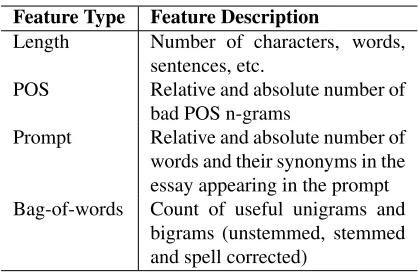
Feature Type Feature Description
Length Number of characters, words, sentences, etc.
POS Relative and absolute number of bad POS n-grams
Prompt Relative and absolute number of words and their synonyms in the essay appearing in the prompt Bag-of-words Count of useful unigrams and
[image:2.612.322.531.55.193.2]bigrams (unstemmed, stemmed and spell corrected)
Table 1:Feature description used by EASE.
etc. In this paper, we explore CNN representa-tion ability for AES tasks on both in-domain and domain-adaptation settings.
3 Baseline
Bayesian Linear Ridge Regression (BLRR) and Support Vector Regression (SVR) (Smola and Vap-nik, 1997) are chosen as state-of-art baselines. Fea-ture templates follow (Phandi et al., 2015), extracted by EASE1, which are briefly listed in Table 1. “Use-ful n-grams” are determined using the Fisher test to separate the good scoring essays and bad scoring es-says. Good essays are essays with a score greater than or equal to the average score, and the remainder are considered as bad scoring essays. The top 201 n-grams with the highest Fisher values are chosen as the bag of features and these top 201 n-grams consti-tute useful n-grams. Correct POS tags are generated using grammatically correct texts, which is done by EASE. The POS tags that are not included in the correct POS tags are treated as bad POS tags, and these bad POS tags make up the “bad POS n-grams” features.
The features tend to be highly useful for the in-domain task since the discrete features of same prompt data share the similar statistics. However, for different prompts, features statistics vary signif-icantly. This raises challenges for discrete feature patterns.
ML-ρ (Phandi et al., 2015) was proposed to ad-dress this issue. It is based on feature augmentation, incorporating explicit correlation into augmented feature spaces. In particular, it expands baseline fea-ture vectorxto beΦs(x) = (ρx,(1−ρ2)1/2x)and
Φt(x) = (x,0p)for source and target domain data
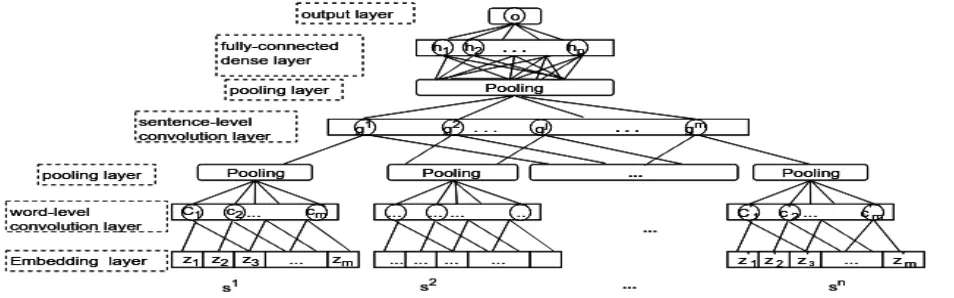
Figure 1:Hierarchical CNN structure
inR2prespectively, withρbeing the correlation be-tween source and target domain data. Then BLRR and maximum likelihood estimation are used to the optimize correlation. All the baseline models re-quire POS-tagging as a pre-processing step, extract-ing syntactic features based on POS-tags.
4 Model
Word Representations We use word embedding with an embedding matrix Ew ∈ Rdw×Vw where
dw is the embedding dimension, andVw represents
words vocabulary size. A word vector zi is
repre-sented by zi = Ewwi where wi is thei-th word in
a sentence. In contrast to the baseline models, our CNN model does not rely on POS-tagging or other pre-processing.
CNN Model We take essay scoring as a regression task and employ a two-layer CNN model, in which one convolutional layer is used to extract sentences representations, and the other is stacked on sentence vectors to learn essays representations. The archi-tecture is depicted in Figure 1. Given an input sen-tencez1,z2, ..., zn, a convolution layer with afilter w ∈ Rh×k is applied to a window of h words to produce n-grams features. For instance, a featureci
is generated from a window of words zi:i+h−1 by
ci = f(w·zi:i+h−1 +b) , b ∈ R is the bias term
andf is the non-linear activation function rectified linear unit (ReLU).
The filter is applied to the all possible win-dows in a sentence to produce a feature map c = [c1, c2, ..., cm−h+1]. For cj of thej-th sentence in
an essay, max-pooling and average pooling func-tion are used to produce the sentence vector sj =
Set #Essays Genre Avg Len. Range Med.
1 1783 ARG 350 2-12 8
2 1800 ARG 350 1-6 3
3 1726 RES 150 0-3 1
4 1772 RES 150 0-3 1
5 1805 RES 150 0-4 2
6 1800 RES 150 0-4 2
7 1569 NAR 250 0-30 16
[image:3.612.70.547.48.197.2]8 723 NAR 650 0-60 36
Table 2:Details of the ASAP data; the last two columns are score range and median scores. For genre, ARG spec-ifiesargumentativeessays, RES meansresponseessays and NAR denotesnarrativeessays.
max{cj} ⊕ avg{cj}. The second convolutional layer takess1,s2,...,snas inputs, followed by
pool-ing layer (max-poolpool-ing and average-poolpool-ing) and a fully-connected hidden layer. The hidden layer di-rectly connects to output layer which generates a score.
5 Experiments
5.1 Setup
Data We use the Automated Student Assessment Prize (ASAP)2 dataset as evaluation data for our task, which contains 8 prompts of different genres as listed in Table 2. The essay scores are scaled into the range from 0 to 1. The settings of data prepara-tion follow (Phandi et al., 2015). We use quadratic weighted kappa (QWK) as the metric. For domain-adaptation (cross-domain) experiments, we follow (Phandi et al., 2015), picking four pairs of essay prompts, namely, 1→2, 3→4, 5→6 and 7→8, where 1→2 denotes prompt 1 as source domain and prompt
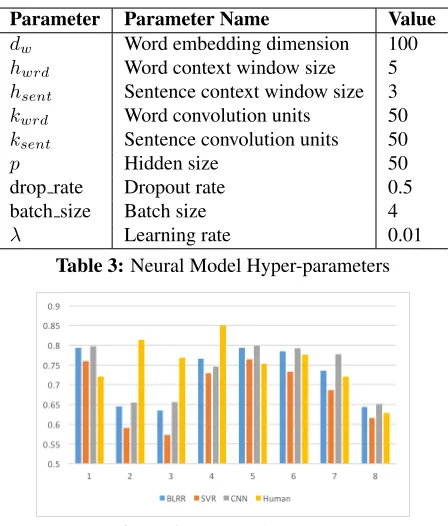
Parameter Parameter Name Value
dw Word embedding dimension 100
hwrd Word context window size 5
hsent Sentence context window size 3
kwrd Word convolution units 50
ksent Sentence convolution units 50
p Hidden size 50
drop rate Dropout rate 0.5
batch size Batch size 4
λ Learning rate 0.01
[image:4.612.74.298.54.317.2]Table 3:Neural Model Hyper-parameters
Figure 2:In-domain results
2 as target domain. All source domain essays are used as training data. Target domain data are ran-domly divided into 5 folds, where one fold is used as test data, and other 4 folds are collected together to sample target domain train data. The sub-sampled sizes are 10, 25, 50, 100, with the larger sampled sets containing the smaller ones. And we repeated sub-sampling 5 times for each target train-ing number to alleviate bias.
Hyper-parameters We use Adagrad for optimiza-tion. Word embeddings are randomly initialized and the hyper-parameter settings are listed in Table 3.
5.2 Results
In-domain The in-domain results are shown in Figure 2. The average values of all 8 prompt sets are listed in Table 4. For the in-domain task, CNN outperforms the baseline model SVR on all prompts of essay sets, and is competitive to BLRR. For the statistical significance, neural model is significantly better than baseline models with the p-value less than10−5 at the confidence level of 95%. The av-erage kappa value over 8 prompts is close to that of human raters.
Cross-domain The domain-adaptation results are shown in Table 5. It can be seen that our CNN
Model BLRR SVR CNN Human
Avg 0.725 0.682 0.734 0.754
[image:4.612.319.533.58.96.2]Std dev 0.0025 0.0033 0.0029 —
Table 4:Indomain average kappa value and standard de-viation over all 8 prompts.
Pairs Method nt= 10 25 50 100
1→2 ML-ρ 0.365 0.437 0.521 0.559
CNN 0.546 0.569 0.563 0.559
3→4 ML-ρ 0.435 0.540 0.590 0.619
CNN 0.628 0.656 0.659 0.662
5→6 ML-ρ 0.415 0.600 0.678 0.718
CNN 0.647 0.700 0.714 0.750
7→8 ML-ρ 0.328 0.438 0.496 0.551
CNN 0.570 0.590 0.568 0.587 Table 5:Cross-domain results.
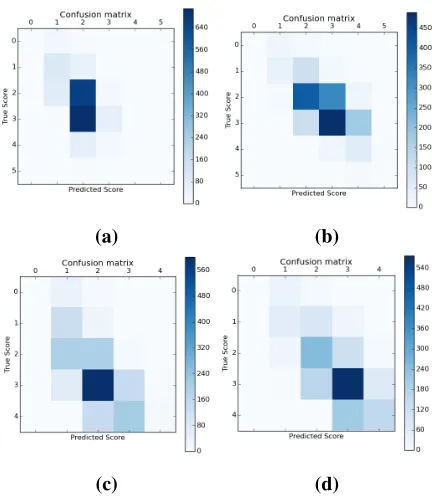
model outperforms ML-ρ on almost all pairs of adaptation experiments. ML-ρ domain-adaptation method’s performance improves as the size of tar-get domain training data increases. However, com-pared to ML-ρ, target training data size has less im-pact on our neural model. Even if the target train-ing size is small, the neural model still gives strong performance. This results from the fact that neu-ral model could learn more high-level and abstract features compared to traditional models with hand-crafted discrete features. We plot the confusion ma-trix between truth and model prediction on test data in Figure 4, which shows that prediction scores of neural model tend to be closer to true values, which is very important in our task.
5.3 Feature Analysis
[image:4.612.316.538.129.243.2](a) (b) (c)
[image:5.612.85.529.63.323.2](d) (e) (f)
Figure 3:Visualization of discrete and neural features using t-SNE (each value represents an essay of the correspond-ing score). Top: Set 4 (3→4), Bottom: Set 6 (5→6). (a) discrete features; (b) ML-ρfeatures,nt = 100; (c) neural
features; (d) discrete features; (e) ML-ρfeatures,nt= 100; (f) neural features.
(a) (b)
(c) (d)
Figure 4:Confusion matrix of true and prediction scores by two different models on test data when target training size nt = 10. (a) ML-ρon 1→2; (b) CNN model on
1→2; (c) ML-ρon 5→6; (d) CNN model on 5→6.
features trained on source prompt are sparse when used directly on the target prompt. This shows that neural features learned by the CNN model can better differentiate essays of different qualities. Without manual templates, such features automatically cap-ture subtle and complex information that is relevant to the task.
6 Conclusion
We empirically investigated a hierarchical CNN model for automatic essay scoring, showing au-tomatically learned features competitive to dis-crete handcrafted features for both in-domain and domain-adaptation tasks. The results demonstrate large potential for deep learning in AES.
Acknowledgments
[image:5.612.77.293.392.640.2]References
Dimitrios Alikaniotis, Helen Yannakoudakis, and Marek Rei. 2016. Automatic text scoring using neural net-works. arXiv preprint arXiv:1606.04289.
Yigal Attali and Jill Burstein. 2004. Automated essay scoring with e-raterR v. 2.0. ETS Research Report
Series, 2004(2):i–21.
Hongbo Chen and Ben He. 2013. Automated essay scoring by maximizing human-machine agreement. In
EMNLP, pages 1741–1752.
Ronan Collobert, Jason Weston, L´eon Bottou, Michael Karlen, Koray Kavukcuoglu, and Pavel Kuksa. 2011. Natural language processing (almost) from scratch.
The Journal of Machine Learning Research, 12:2493–
2537.
C´ıcero Nogueira dos Santos and Maira Gatti. 2014. Deep convolutional neural networks for sentiment analysis of short texts. InCOLING, pages 69–78.
Peter W Foltz, Darrell Laham, and Thomas K Landauer. 1999. Automated essay scoring: Applications to edu-cational technology. Inproceedings of EdMedia, vol-ume 99, pages 40–64.
Rie Johnson and Tong Zhang. 2014. Effective use of word order for text categorization with convolutional neural networks. arXiv preprint arXiv:1412.1058. Nal Kalchbrenner, Edward Grefenstette, and Phil
Blun-som. 2014. A convolutional neural network for mod-elling sentences. arXiv preprint arXiv:1404.2188. Yoon Kim. 2014. Convolutional neural networks for
sen-tence classification. arXiv preprint arXiv:1408.5882. Thomas K Landauer, Peter W Foltz, and Darrell Laham.
1998. An introduction to latent semantic analysis.
Discourse processes, 25(2-3):259–284.
Leah S Larkey. 1998. Automatic essay grading us-ing text categorization techniques. InProceedings of the 21st annual international ACM SIGIR conference on Research and development in information retrieval, pages 90–95. ACM.
Ellis Batten Page. 1994. Computer grading of student prose, using modern concepts and software. The Jour-nal of experimental education, 62(2):127–142. Peter Phandi, Kian Ming A Chai, and Hwee Tou Ng.
2015. Flexible domain adaptation for automated es-say scoring using correlated linear regression. Lawrence M Rudner and Tahung Liang. 2002.
Auto-mated essay scoring using bayes’ theorem. The Jour-nal of Technology, Learning and Assessment, 1(2). Alex Smola and Vladimir Vapnik. 1997. Support vector
regression machines. Advances in neural information processing systems, 9:155–161.
Laurens Van der Maaten and Geoffrey Hinton. 2008. Vi-sualizing data using t-sne. Journal of Machine Learn-ing Research, 9(2579-2605):85.
Helen Yannakoudakis, Ted Briscoe, and Ben Medlock. 2011. A new dataset and method for automatically grading esol texts. InProceedings of the 49th Annual Meeting of the Association for Computational
Linguis-tics: Human Language Technologies-Volume 1, pages
180–189. Association for Computational Linguistics. Xiang Zhang, Junbo Zhao, and Yann LeCun. 2015.