A Maximum Entropy Chinese Character-Based Parser
Xiaoqiang Luo
1101 Kitchawan Road, 23-121 IBM T.J. Watson Research Center
Yorktown Heights, NY 10598
Abstract
The paper presents a maximum entropy Chinese character-based parser trained on the Chinese Treebank (“CTB”
hence-forth). Word-based parse trees in
CTB are first converted into character-based trees, where word-level part-of-speech (POS) tags become constituent labels and character-level tags are
de-rived from word-level POS tags. A
maximum entropy parser is then trained
on the character-based corpus. The
parser does word-segmentation, POS-tagging and parsing in a unified frame-work. An average label F-measure
and word-segmentation F-measure
are achieved by the parser. Our re-sults show that word-level POS tags can improve significantly word-segmentation, but higher-level syntactic strutures are of little use to word segmentation in the max-imum entropy parser. A word-dictionary helps to improve both word-segmentation and parsing accuracy.
1 Introduction: Why Parsing Characters?
After Linguistic Data Consortium (LDC) re-leased the Chinese Treebank (CTB) developed at UPenn (Xia et al., 2000), various statistical Chinese parsers (Bikel and Chiang, 2000; Xu et al., 2002) have been built. Techniques used in parsing En-glish have been shown working fairly well when ap-plied to parsing Chinese text. As there is no word boundary in written Chinese text, CTB is manually
segmented into words and then labeled. Parsers de-scribed in (Bikel and Chiang, 2000) and (Xu et al., 2002) operate at word-level with the assumption that input sentences are pre-segmented.
The paper studies the problem of parsing Chi-nese unsegmented sentences. The first motivation is that a character-based parser can be used directly in natural language applications that operate at char-acter level, whereas a word-based parser requires a separate word-segmenter. The second and more important reason is that the availability of CTB, a large corpus with high quality syntactic annota-tions, provides us with an opportunity to create a highly-accurate word-segmenter. It is widely known that Chinese word-segmentation is a hard problem. There are multiple studies (Wu and Fung, 1994; Sproat et al., 1996; Luo and Roukos, 1996) show-ing that the agreement between two (untrained) na-tive speakers is about upper
to lower
character-based parse tree. Parsing Chinese character streams therefore does effectively word-segmentation, part-of-speech (POS) tagging and constituent labeling at the same time. Since syntactical information influences directly word-segmentation in the pro-posed character-based parser, CTB allows us to test whether or not syntactic information is useful for word-segmentation. A third advantage of parsing Chinese character streams is that Chinese words are more or less an open concept and the out-of-vocabulary (OOV) word rate is high. As morphol-ogy of the Chinese language is limited, extra care is needed to model unknown words when building a word-based model. Xu et al. (2002), for example, uses an independent corpus to derive word classes so that unknown words can be parsed reliably. Chinese characters, on the other hand, are almost closed. To demonstrate the OOV problem, we collect a word and character vocabulary from the first
sen-tences of CTB, and compute their coverages on the corresponding word and character tokenization of the last
of the corpus. The word-based OOV rate is
while the character-based OOV rate is
only
.
The first step of training a character-based parser is to convert word-based parse trees into character-based trees. We derive character-level tags from word-level POS tags and encode word-boundary in-formation with a positional tag. Word-level POSs become a constituent label in character-based trees. A maximum entropy parser (Ratnaparkhi, 1997) parser is then built and tested. Many language-independent feature templates in the English parser can be reused. Lexical features, which are language-dependent, are used to further improve the baseline models trained with language-independent features only. Word-segmentation results will be presented and it will be shown that POSs are very helpful while higher-level syntactic structures are of little use to word-segmentation – at least in the way they are used in the parser.
2 Word-Tree to Character-Tree
CTB is manually segmented and is tokenized at word level. To build a Chinese character parser, we first need to convert word-based parse trees into character trees. A few simple rules are employed in this conversion to encode word boundary informa-tion:
1. Word-level POS tags become labels in charac-ter trees.
2. Character-level tags are inherited from word-level POS tags after appending a positional tag;
3. For single-character words, the positional tag is “s”; for multiple-character words, the first char-acter is appended with a positional tag “b”, last character with a positional tag “e”, and all mid-dle characters with a positional tag “m”.
An example will clarify any ambiguity of the rules. For example, a word-parse tree
“(IP (NP (NP /NR ) (NP /NN
/NN ) ) (VP!
/VV ) " /PU )”
would become
“(IP (NP (NP (NR /nrb /nrm /nre ) ) (NP (NN
/nnb /nne ) (NN
/nnb
/nne ) ) ) (VP (VV
! /vvb
/vve ) ) (PU " /pus ) ).” (1)
Note that the word-level POS “NR” becomes a la-bel of the constituent spanning the three characters “
## ”. The character-level tags of the constituent
“ $$ ” are the lower-cased word-level POS tag
plus a positional letter. Thus, the first character “
” is assigned the tag “nrb” where “nr” is from
the word-level POS tag and “b” denotes the begin-ning character; the second (middle) character “ ”
gets the positional letter “m”, signifying that it is in the middle, and the last character “ ” gets the
posi-tional letter “e”, denoting the end of the word. Other words in the sentence are mapped similarly. After the mapping, the number of terminal tokens of the character tree is larger than that of the word tree.
It is clear that character-level tags encode word boundary information, and chunk-level1 labels are
word-level POS tags. Therefore, parsing a Chi-nese character sentence is effectively doing word-segmentation, POS-tagging and constructing syntac-tic structure at the same time.
3 Model and Features
The maximum entropy parser (Ratnaparkhi, 1997) is used in this study, for it offers the flexibility of inte-grating multiple sources of knowledge into a model. The maximum entropy model decomposes%'&)(+*,.-,
the probability of a parse tree( given a sentence , ,
into the product of probabilities of individual parse
1A chunk is here defined as a constituent whose children are
actions, i.e., / 021 3465
%7&98
3
*,;:<8>=
5
- . The parse
ac-tions8 021
5 are an ordered sequence, where
D+E is the
number of actions associated with the parse( . The
mapping from a parse tree to its unique sequence of actions is 1-to-1. Each parse action is either tag-ginga word,chunkingtagged words, extend-ingan existing constituent to another constituent, or checkingwhether an open constituent should be closed. Each component model takes the expo-nential form:
%7&98
3
*,;:<8 = 3@?A5CB
5
-.F
GHIKJMLONQP NRN
&S,;:<8T= 3@?A5CB
5
:<8
3
-VU
W
&S,;:<8T= 3@?A5CB
5
-:
(2)
where W &S,;:<8 =
3)?A5CB
5
- is a normalization term to
ensure that %7&98
3
*,X:<8>= 3)?A5CB
5
- is a probability, RN
&S,;:<8 = 3@?A5CB
5
:<8
3
- is a feature function (often binary)
andP
N
is the weight ofRN
.
Given a set of features and a corpus of training data, there exist efficient training algorithms (Dar-roch and Ratcliff, 1972; Berger et al., 1996) to find the optimal parameters Y
P
NZ
. The art of building a maximum entropy parser then reduces to choos-ing “good” features. We break features used in this study into two categories. The first set of features are derived from predefined templates. When these templates are applied to training data, features are generated automatically. Since these templates can be used in any language, features generated this way are referred tolanguage-independent features. The second category of features incorporate lexical in-formation into the model and are primarily designed to improve word-segmentation. This set of features are language-dependent since a Chinese word dic-tionary is required.
3.1 Language-Independent Feature Templates
The maximum entropy parser (Ratnaparkhi, 1997) parses a sentence in three phases: (1) it first tags the input sentence. Multiple tag sequences are kept in the search heap for processing in later stages; (2) Tagged tokens are grouped into chunks. It is pos-sible that a tagged token is not in any chunk; (3) A chunked sentence, consisting of a forest of many subtrees, is then used to extend a subtree to a new constituent or join an existing constituent. Each ex-tendingaction is followed by a checking ac-tion which decides whether or not to close the ex-tended constituent. In general, when a parse action
8
3
is carried out, the context information, i.e., the in-put sentence , and preceding parse actions 8 =
3@?A5CB 5 ,
is represented by a forest of subtrees. Feature func-tions operate on the forest context and the next parse action. They are all of the form:
RN2[ &S,X:<8>=
3)?A5CB
5
-\:<8
3
-^]_Fa`
N
&S,X:<8>= 3)?A5CB
5
-cbd&98
3
FO8
N
-\:
(3)
where`
N
&S,;:<8T= 3@?A5CB
5
- is a binary function on the
con-text.
Some notations are needed to present features. We useegf to denote an input terminal token,h<f its
tag (preterminal), i f a chunk, and
G
f a constituent
label, where the index j is relative to the current
subtree: the subtree immediately left to the current is indexed as k
, the second left to the current sub-tree is indexed askml , the subtree immediately to the
right is indexed as
, so on and so forth. n
fop
repre-sents the root label of theqsrt -child of thej2rt subtree.
IfqXu
, the child is counted from right.
With these notations, we are ready to introduce language-independent features, which are broken down as follows:
Tag Features
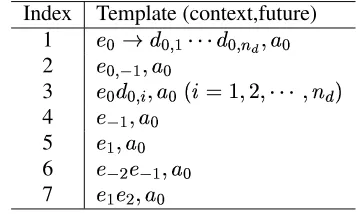
In the tag model, the context consists of a win-dow of five tokens – the token being tagged and two tokens to its left and right – and two tags on the left of the current word. The feature templates are tabulated in Table 1 (to save space, templates are grouped). At training time, feature templates are in-stantiated by the training data. For example, when the template “e
?A5
:vhcw ” is applied to the first
charac-ter of the sample sentence,
“(IP (NP (NP (NR /nrb /nrm /nre ) ) (NP (NN
/nnb /nne ) (NN
/nnb
/nne ) ) ) (VP (VV
! /vvb
/vve ) ) (PU" /pus ) )”,
a feature R &@e
?A5
F *BOUNDARY*:vhvwxFyjAz{|- is
generated. Note that e
?A5 is the token on the left
and in this case, the boundary of the sentence. The template “emw:vh^w ” is instantiated similarly as
R
&@e}wmF ~:vh w FjAz{|-.
Chunk Features
As character-level tags have encoded the chunk label information and the uncertainly about a chunk action is low given character-level tags, we limit the chunk context to a window of three subtrees – the current one plus its left and right subtree. i f in
Index Template (context,future) 1 egfT:vhcw}&@jFkmld:k : : :l-2 egfegf 5 :vh^w&@jF k : -3 egfegf 5 egf:vhcw&@jF kld:k : -4 h ?A5 :vhcw 5 h ? h ?A5 :vh w
Table 1: Tag feature templates: e
f &@j F kmld: : :
:l-: current token (ifjxF
) or *j*rt
to-ken on the left (ifjau
) or right (if j
). h f &@jxF
kmld:k : :
:l-: tag.
a chunk, or the chunk label plus the tag of its right-most child if it is a chunk.
Index Template (context,future) 1 if:<8dw&@jFk : :
-2 i f i f
5
:<8 w &@jF k
:
-Table 2: Chunk feature templates: i f &@jFk
: :
-is the chunk label plus the tag of its right most child if the j2rt tree is a chunk; Otherwise if is the
con-stituent label of thej rt tree.
Again, we use the sentence (1) as an example. As-sume that the current forest of subtrees is
(NR /nrb /nrm /nre ) /nnb /nne
/nnb
/nne! /vvb
/vve" /pus ,
and the current subtree is “ /nnb”, then
instan-tiating the templatei ?A5
:<8w would result in a feature
R
&9i ?A5
FOD jAz
G
:<8dwmFOi`jDD - .
Extend Features
Extend features depend on previous subtree and the two following subtrees. Some features uses child labels of the previous subtree. For example, the in-terpretation of the template on line 4 of Table 3 is that G
?A5
is the root label of the previous subtree,
n
=
?A5
o
?A5CB is the label of the right-most child of the
previous tree, and G
w is the root label of the current
subtree.
Check Features
Most of check feature templates again use con-stituent labels of the surrounding subtrees. The tem-plate on line 1 of Table 4 is unique to the check model. It essentially looks at children of the cur-rent constituent, which is intuitively a strong indica-tion whether or not the current constituent should be closed.
Index Template (context,future)
1 G ?A5 G f:<8w&@jF : :l-2 G ?A5 n = ?A5 o ? f B :<8w}&@jF :l-3 G ?A5 G w G 5 4 G ?A5 n = ?A5 o ?A5CB G w:<8w 5 G ?A5 n = ?A5 o ?A5CB G w G 5 :<8dw 6 G ?A5 n = ?A5 o ?A5CB n = ?A5 o ? B :<8dw
Table 3: Extend feature templates: G fA&@j F k : :
:l- is the root constituent label of the j rt
subtree (relative to the current one); n
= ?A5 o ? f B &@jF
:l- is the label of the j rt rightmost child of the
previous subtree.
Index Template (context,future)
[image:4.612.82.287.50.131.2]1 G wmnwo 52 nwof:<8w 2 G wo ?A5 :<8w 3 G wnwo 3 :<8dw}&@QF :ld: :vj2-4 G ?A5 :<8 w 5 G 5 :<8dw 6 G ? G ?A5 :<8 w 7 G 5 G :<8dw
Table 4: Check feature templates: G
f&@j F k : :
:l- is the constituent label of thej6rt subtree
(relative to the current one).n
=
wo
3B is the
rt child
la-bel of the current constituent.
3.2 Language-Dependent Features
The model described so far does not depend on any Chinese word dictionary. All features derived from templates in Section 3.1 are extracted from training data. A problem is that words not seen in training data may not have “good” features associated with them. Fortunately, the maximum entropy framework makes it relatively easy to incorporate other sources of knowledge into the model. We present a set of language-dependent features in this section, primar-ily for Chinese word segmentation.
The language-dependent features are computed from a word list and training data. Formerly, let be
[image:4.612.335.516.236.343.2]Ta-ble 5. {&@efT:<- tests if the characteremf starts any
word on the list . Similarly, &@emf:< - tests if the
character ef occurs in any position of any word on
the list , and
G
&@e
f
:< - tests if the character e f is
the last position of any word on the list .
Index Template (context,future) 1 {&@ef:<-\:vh^w&@jF kmld:k
:
:
:l-2 &@egfT:<-\:vh^w&@jF¡kmld:k
:
:
:l-3 G
&@egf¢:< -\:vhcw}&@jFkmld:k
:
:
:l-Table 5: Language-dependent lexical features. A word list can be collected to encode different semantic or syntactic information. For example, a list of location names or personal names may help the model to identify unseen city or personal names; Or a closed list of functional words can be collected to represent a particular set of words sharing a POS. This type of features would improve the model ro-bustness since unseen words will share features fired for seen words. We will show shortly that even a relatively small word-list improves significantly the word-segmentation accuracy.
4 Experiments
All experiments reported here are conducted on the latest LDC release of the Chinese Treebank, which consists of about l
£
words. Word parse trees are converted to character trees using the procedure described in Section 2. All traces and functional tags are stripped in training and testing. Two re-sults are reported for the character-based parsers: the F-measure of word segmentation and F-measure of constituent labels. Formally, let¤#¥&@^-\:\¤§¦T&@c- be the
number of words of the rt reference sentence and its
parser output, respectively, and ¨©&@^- be the number
of common words in theCrt sentence of test set, then
the word segmentation F-measure is
ª;«C¬C
F
l
L
3
¨©&@^-L
3
[
¤
¥
&@^-®¯¤
¦
&@^-]
(4)
The F-measure of constituent labels is computed similarly:
ª
p±°² F
l
L
3
D³&@^-L
3
[
.¥&@^-2®$¦>&@^-^]
: (5)
where ¥ &@^- and ¦ &@^- are the number of
con-stituents in the rt reference parse tree and parser
output, respectively, and D´&@c- is the number of
common constituents. Chunk-level labels converted from POS tags (e.g., “NR”, “NN” and “VV” etc in (1)) are included in computing label F-measures for character-based parsers.
4.1 Impact of Training Data
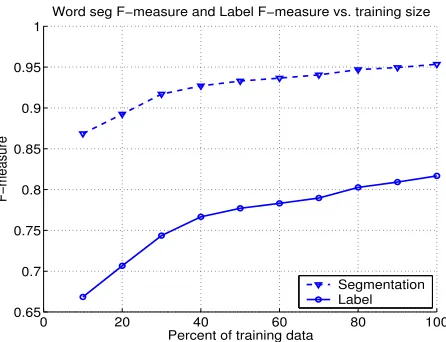
The first question we have is whether CTB is large enough in the sense that the performance saturates. The first set of experiments are intended to answer this question. In these experiments, the first
CTB is used as the training set and the rest
as the test set. We start with
of the training set and increase the training set each time by
[image:5.612.83.289.126.181.2]. Only language-independent features are used in these ex-periments.
Figure 1 shows the word segmentation F-measure and label F-measure versus the amount of training data. As can be seen, F-measures of both word segmentation and constituent label increase mono-tonically as the amount of training data increases. If all training data is used, the word segmentation
F-measure is ¶µ
and label F-measure
. These results show that language-independent fea-tures work fairly well – a major advantage of data-driven statistical approach. The learning curve also shows that the current training size has not reached a saturating point. This indicates that there is room to improve our model by getting more training data.
0 20 40 60 80 100
0.65 0.7 0.75 0.8 0.85 0.9 0.95
1 Word seg F−measure and Label F−measure vs. training size
Percent of training data
F−measure
Segmentation Label
[image:5.612.316.539.478.649.2]4.2 Effect of Lexical Features
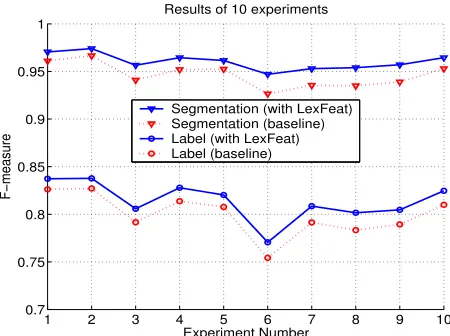
In this section, we present the main parsing results. As it has not been long since the second release of CTB and there is no commonly-agreed training and test set, we divide the entire corpus into 10 equal par-titions and hold each partition as a test set while the rest are used for training. For each training-test con-figuration, a baseline model is trained with only lan-guage independent features. Baseline word segmen-tation and label F-measures are plotted with dotted-line in Figure 2. We then add extra lexical features described in Section 3.1 to the model. Lexical ques-tions are derived from a 58K-entry word list. The word list is broken into 4 sub-lists based on word length, ranging from 2 to 5 characters. Lexical fea-tures are computed by answering one of the three questions in Table 5. Intuitively, these questions would help the model to identify word boundaries, which in turn ought to improve the parser. This is confirmed by results shown in Figure 2. The solid two lines represent results with enhanced lexical questions. As can be seen, lexical questions improve significantly both word segmentation and parsing across all experiments. This is not surprising as lex-ical features derived from the word list are comple-mentary to language-independent features computed from training sentences.
1 2 3 4 5 6 7 8 9 10
0.7 0.75 0.8 0.85 0.9 0.95 1
Experiment Number
F−measure
Results of 10 experiments
Segmentation (with LexFeat) Segmentation (baseline) Label (with LexFeat) Label (baseline)
Figure 2: Parsing and word segmentation
F-measures vs. the experiment numbers. Lines with triangles: segmentation; Lines with circles: label; Dotted-lines: language-independent features only; Solid lines: plus lexical features.
Another observation is that results vary greatly across experiment configurations: for the model
trained with lexical features, the second exper-iment has a label F-measure µd¶
and
word-segmentation F-measure
, while the sixth ex-periment has a label F-measure
and word-segmentation F-measure
. The large variances justify multiple experiment runs. To reduce the vari-ances, we report numbers averaged over the 10 ex-periments in Table 6. Numbers on the row start-ing with “WS” are word-segmentation results, while numbers on the last row are F-measures of con-stituent labels. The second column are average F-measures for the baseline model trained with only language-independent features. The third column contains F-measures for the model trained with extra lexical features. The last column are releative error reduction. The best average word-segmentation
F-measure is
and label F-measure is
. F-measure
baseline LexFeat Relative(%)
WS(%) 94.6 96.0 26
[image:6.612.73.298.416.584.2]Label(%) 80.0 81.4 7
Table 6: WS: word-segmentation. Baseline:
language-independent features. LexFeat: plus lical features. Numbers are averaged over the 10 ex-periments in Figure 2.
4.3 Effect of Syntactic Information on Word-segmentation
Since CTB provides us with full parse trees, we want to know how syntactic information affects word-segmentation. To this end, we devise two sets of experiments:
1. We strip all POS tags and labels in the Chinese Treebank and retain only word boundary infor-mation. To use the same maximum entropy parser, we represent word boundary by dummy constituent label “W”. For example, the sample sentence (1) in Section 2 is represented as:
(W /wb /wm /we ) (W /wb /we ) (W
/wb
/we ) (W! /wb
/we ) (W" /ws ).
2. We remove all labels but retain word-level POS information. The sample sentence above is rep-resented as:
(NR /nrb /nrm /nre ) (NN /nnb /nne
) (NN
/nnb
/nne ) (VV! /vvb
/vve ) (PU
Note that positional tags are used in both setups.
1 2 3 4 5 6 7 8 9 10
0.93 0.935 0.94 0.945 0.95 0.955 0.96 0.965 0.97 0.975
Effect of Syntactic Info on Word Segmentation
Experiment Number
Word−seg F−measure
Word−boundary POS
Full Tree
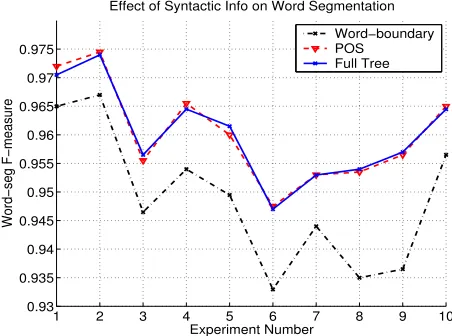
Figure 3: Usefulness of syntactic information: (black) dash-dotted line – word boundaries only, (red) dashed line – POS info, and (blue) solid line – full parse trees.
With these two representations of CTB, we re-peat the 10 experiments of Section 4.2 using the same lexical features. Word-segmentation results are plotted in Figure 3. The model trained with word boundary information has the worst performance, which is not surprising as we would expect infor-mation such as POS tags to help disambiguate word boundaries. What is surprising is that syntactic in-formation beyond POS tags has little effect on word-segmentation – there is practically no difference be-tween the solid line (for the model trained with full parse trees) and the dashed-line (for the model trained with POS information) in Figure 3. This re-sult suggests that most ambiguities of Chinese word boundaries can be resolved at lexical level, and high-level syntactic information does not help much to word segmentation in the current parser.
5 Related Work
Bikel and Chiang (2000) and Xu et al. (2002) con-struct word-based statistical parsers on the first re-lease of Chinese Treebank, which has about 100K words, roughly half of the training data used in this study. Bikel and Chiang (2000) in fact contains two parsers: one is a lexicalized probabilistic context-free grammar (PCFG) similar to (Collins, 1997); the other is based on statistical TAG (Chiang, 2000). About
µ
F-measure is reported in (Bikel and Chi-ang, 2000). Xu et al. (2002) is also based on PCFG,
but enhanced with lexical features derived from the ASBC corpus2. Xu et al. (2002) reports an overall
F-measure
l
when the same training and test set as (Bikel and Chiang, 2000) are used. Since our parser operates at character level, and more training data is used, the best results are not directly compa-rable. The middle point of the learning curve in Fig-ure 1, which is trained with roughly 100K words, is at the same ballpark of (Xu et al., 2002). The con-tribution of this work is that the proposed character-based parser does word-segmentation, POS tagging and parsing in a unified framework. It is the first at-tempt to our knowledge that syntactic information is used in word-segmentation.
Chinese word segmentation is a well-known prob-lem that has been studied extensively (Wu and Fung, 1994; Sproat et al., 1996; Luo and Roukos, 1996) and it is known that human agreement is relatively low. Without knowing and control-ling testing conditions, it is nearly impossible to compare results in a meaningful way. There-fore, we will compare our approach with some related work only without commenting on seg-mentation accuracy. Wu and Tseng (1993) con-tains a good problem statement of Chinese word-segmentation and also outlines a few word-segmentation algorithms. Our method is supervised in that the training data is manually labeled. Palmer (1997) uses transform-based learning (TBL) to correct an initial segmentation. Sproat et al. (1996) employs stochastic finite state machines to find word bound-aries. Luo and Roukos (1996) proposes to use a language model to select from ambiguous word-segmentations. All these work assume that a lexi-con or some manually segmented data or both are available. There are numerous work exploring semi-supervised or unsemi-supervised algorithms to segment Chinese text. Ando and Lee (2003) uses a heuris-tic method that does not require segmented training data. Peng and Schuurmans (2001) learns a lexicon and its unigram probability distribution. The auto-matically learned lexicon is pruned using a mutual information criterion. Peng and Schuurmans (2001) requires a validation set and is therefore semi-supervised.
[image:7.612.72.298.79.247.2]6 Conclusions
We present a maximum entropy Chinese character-based parser which does word-segmentation, POS tagging and parsing in a unified framework. The flexibility of maximum entropy model allows us to integrate into the model knowledge from other sources, together with features derived
automat-ically from training corpus. We have shown
that a relatively small list can reduce word-segmentation error by as much asl
, and a
word-segmentation F-measure
and label F-measure
are obtained by the character-based parser. Our results also show that POS information is very useful for Chinese word-segmentation, but higher-level syntactic information benefits little to word-segmentation.
Acknowledgments
Special thanks go to Hongyan Jing and Judith Hochberg who proofread the paper and corrected many typos and ungrammatical errors. The author is also grateful to the anonymous reviewers for their in-sightful comments and suggestions. This work was partially supported by the Defense Advanced Re-search Projects Agency and monitored by SPAWAR under contract No. N66001-99-2-8916. The views and findings contained in this material are those of the authors and do not necessarily reflect the posi-tion of policy of the Government and no official en-dorsement should be inferred.
References
Rie Kubota Ando and Lillian Lee. 2003. Mostly-unsupervised statistical segmentation of Japanese
Kanji. Natural Language Engineering.
Adam L. Berger, Stephen A. Della Pietra, and Vincent J. Della Pietra. 1996. A maximum entropy approach
to natural language processing. Computational
Lin-guistics, 22(1):39–71, March.
Daniel M. Bikel and David Chiang. 2000. Two statis-tical parsing models applied to the chinese treebank. InProceedings of the Second Chinese Language Pro-cessing Workshop, pages 1–6.
David Chiang. 2000. Statistical parsing with an
automatically-extracted tree adjoining grammar. In
Proc. Annual Meeting of ACL, pages 1–6.
Michael Collins. 1997. Three generative, lexicalised models for statistical parsing. InProc. Annual Meet-ing of ACL, pages 16–23.
J. N. Darroch and D. Ratcliff. 1972. Generalized itera-tive scaling for log-linear model. Ann. Math. Statist., 43:1470–1480.
Xiaoqiang Luo and Salim Roukos. 1996. An iterative al-gorithm to build chinese language models. InProc. of the 34th Annual Meeting of the Association for Com-putational Linguistics, pages 139–143.
David Palmer. 1997. A trainable rule-based algorithm
for word segmentation. InProc. Annual Meeting of
ACL, Madrid.
Fuchun Peng and Dale Schuurmans. 2001.
Self-supervised Chinese word segmentation. InAdvances
in Intelligent Data Analysis, pages 238–247.
Adwait Ratnaparkhi. 1997. A Linear Observed Time Statistical Parser Based on Maximum Entropy
Mod-els. InSecond Conference on Empirical Methods in
Natural Language Processing, pages 1 – 10.
Richard Sproat, Chilin Shih, William Gale, and Nancy
Chang. 1996. A stochastic finite-state
word-segmentation algorithm for Chinese. Computational
Linguistics, 22(3):377–404.
Dekai Wu and Pascale Fung. 1994. Improving chinese tokenization with linguistic filters on statistical lexical
acquisition. InFourth Conference on Applied Natural
Language Processing, pages 180–181, Stuttgart.
Zimin Wu and Gwyneth Tseng. 1993. Chinese text seg-mentation for text retrieval: Achievements and
prob-lems. Journal of The American Society for
Informa-tion Science, 44(9):532–542.
F. Xia, M. Palmer, N. Xue, M.E. Okurowski, J. Kovarik, F.D. Chiou, S. Huang, T. Kroch, and M. Marcus. 2000. Developing guidelines and ensuring consistency for Chinese text annotation. InProc of the 2nd Intl. Conf. on Language Resources and Evaluation (LREC 2000).
Jinxi Xu, Scott Miller, and Ralph Weischedel. 2002. A
statistical parser for Chinese. InProc. Human