Entity Annotation based on Inverse Index Operations
Ganesh Ramakrishnan, Sreeram Balakrishnan, Sachindra Joshi
IBM India Research Labs IIT Delhi, Hauz Khas,
New Delhi, India
{ganramkr, sreevb, jsachind}@in.ibm.com
Abstract
Entity annotation involves attaching a la-bel such as ‘name’ or ‘organization’ to a sequence of tokens in a document. All the current rule-based and machine learning-based approaches for this task operate at the document level. We present a new and generic approach to entity annotation which uses the inverse index typically cre-ated for rapid key-word based searching of a document collection. We define a set of operations on the inverse index that al-lows us to create annotations defined by cascading regular expressions. The entity annotations for an entire document cor-pus can be created purely of the index with no need to access the original docu-ments. Experiments on two publicly avail-able data sets show very significant perfor-mance improvements over the document-based annotators.
1 Introduction
Entity Annotation associates a well-defined label such as ‘person name’, ‘organization’, ‘place’, etc., with a sequence of tokens in unstructured text. The dominant paradigm for annotating a document collection is to annotate each document separately. The computational complexity of an-notating the collection in this paradigm, depends linearly on the number of documents and the cost of annotating each document. More precisely, it depends on the total number of tokens in the doc-ument collection. It is not uncommon to have mil-lions of documents in a collection. Using this par-adigm, it can take hours or days to annotate such big collections even with highly parallel server farms. Another drawback of this paradigm is that the entire document collection needs to be re-processed whenever new annotations are required.
In this paper, we propose an alternative para-digm for entity annotation. We build an index for the tokens in the document collection first. Us-ing a set of operators on the index, we can gener-ate new index entries for sequences of tokens that match any given regular expression. Since a large class of annotators (e.g., GATE (Cunningham et al., 2002)) can be built using cascading regular ex-pressions, this approach allows us to support anno-tation of the document collection purely from the index.
We show both theoretically and experimentally that this approach can lead to substantial reduc-tions in computational complexity, since the order of computation is dependent on the size of the in-dexes and not the number of tokens in the doc-ument collection. In most cases, the index sizes used for computing the annotations will be a small fraction of the total number of tokens.
In (Cho and Rajagopalan, 2002) the authors de-velop a method for speeding up the evaluation of a regular expression ‘R’ on a large text corpus by use of an optimally constructed multi-gram index to filter documents that will match ‘R’. Unfortu-nately, their method requires access to the docu-ment collection for the final match of ‘R’ to the filtered document set, which can be very time con-suming. The other bodies of related prior work concern indexing annotated data (Cooper et al., 2001; Li and Moon, 2001) and methods for doc-ument level annotation (Agichtein and Gravano, 2000; McCallum et al., 2000). The work on index-ing annotated data is not directly relevant, since our method creates the index to the annotations di-rectly as part of the algorithm for computing the annotation. (Eikvil, 1999) has a good survey of existing document level IE methods. The rele-vance to our work is that only a certain class of annotators can be implemented using our method: namely anything that can be implemented using cascading weighted regular expressions.
nately, this is still powerful enough to enable a large class of highly effective entity annotators.
The rest of the paper is organized as follows. In Section 2, we present an overview of the proposed approach for entity annotation. In Section 3, we construct an algorithm for implementing a deter-ministic finite automaton (DFA) using an inverse index of a document collection. We also compare the complexity of this approach against the direct approach of running the DFA over the document collection, and show that under typical conditions, the index-based approach will be an order of mag-nitude faster. In Section 4, we develop an alter-native algorithm which is based on translating the original regular expression directly into an ordered AND/OR graph with an associated set of index level operators. This has the advantage of oper-ating directly on the much more compact regular expressions instead of the equivalent DFA (which can become very large as a result of the NFA to DFA conversion and epsilon removal steps). We provide details of our experiments on two publicly available data sets in Section 5. Finally we present our conclusions in Section 6.
2 Overview
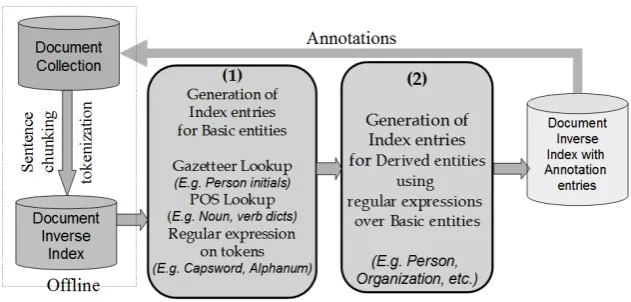
Figure 1 shows the process for entity annotation presented in the paper. A given document collec-tionDis tokenized and segmented into sentences. The tokens are stored in an inverse indexI. The inverse indexI has an ordered listUof the unique tokens u1, u2, ..uW that occur in the collection, whereW is the number of tokens inI. Addition-ally, for each unique token ui, I has a postings listL(ui) =< l1, l2, . . . lcnt(ui) >of locations in D at which ui occurs. cnt(ui) is the length of
L(ui). Each entry lk, in the postings list L(ui), has three fields: (1) a sentence identifier, lk.sid, (2) the begin position of the particular occurrence ofui,lk.f irstand (3) the end position of the same occurrence ofui,lk.last.
We require the input grammar to be the same as that used for named entity annotations in GATE (Cunningham et al., 2002). The GATE architec-ture for text engineering uses the Java Annota-tions Pattern Engine (JAPE) (Cunningham, 1999) for its information extraction task. JAPE is a pat-tern matching language. We support two classes of properties for tokens that are required by gram-mars such as JAPE: (1) orthographic properties such as an uppercase character followed by lower
case characters, and (2) gazetteer (dictionary) con-tainment properties of tokens and token sequences such as ‘location’ and ‘person name’. The set of tokens along with entity types specified by either of these two properties are referred to as Basic Entities. The instances of basic entities specified by orthographic properties must be single tokens. However, instances of basic entities specified us-ing gazetteer containment properties can be token sequences.
The module (1) of our system shown in Fig-ure 1, identifies postings lists for each basic en-tity type. These postings lists are entered as index entries inI for the corresponding types. For ex-ample, if the input rules require tokens/token se-quences that satisfy Capsword or Location Dic-tionary properties, a postings list is created for each of these basic types. Constructing the post-ings list for a basic entity type with some ortho-graphic property is a fairly straightforward task; the postings lists of tokens satisfying the ortho-graphic properties are merged (while retaining the sorted order of each postings list). The mecha-nism for generating the postings list of basic en-tities with gazetteer properties will be developed in the following sections. A rule for NE an-notation may require a token to satisfy multiple properties such as Location Dictionary as well as Capsword. The posting list for tokens that satisfy multiple properties are determined by perform-ing an operationparallelint(L, L0)over the post-ing lists of the correspondpost-ing basic entities. The
parallelint(L, L0)operation returns a posting list such that each entry in the returned list occurs in bothLas well asL0. The module (2) of our sys-tem shown in Figure 1 identifies instances of each annotation type, by performing index-based oper-ations on the postings lists of basic entity types and other tokens.
3 Annotation using Cascading Regular Expressions
Regular expressions over basic entities have been extensively used for NE annotations. The Com-mon Pattern Specification Language (CSPL)1 specifies a standard for describing Annotators that can be implemented by a series of cascading regu-lar expression matches.
Consider a regular expression R over an al-phabetΣ of basic entities, and a token sequence
Figure 1: Overview of the entity annotation process described in this paper
T ={t1, . . . , tW}. The annotation problem aims at determining all matches of regular expression
Rin the token sequence T. Additionally, NE an-notations do not span multiple sentences. We will therefore assume that the length of any annotated token sequence is bounded by ∆, where ∆ can be the maximum sentence length in the document collection of interest. In practice, ∆can be even smaller.
3.1 Computing Annotations using a DFA
Given a regular expression R, we can convert it into a deterministic finite automate (DFA)DR. A DFA is a finite state machine, where for each pair of state and input symbol, there is one and only one transition to a next state. DR starts process-ing of an input sequence from a start statesR, and for each input symbol, it makes a transition to a state given by a transition functionΦR. Whenever
DRlands in an accept state, the symbol sequence till that point is accepted byDR. For simplicity of the document and index algorithms, we will ignore document and sentence boundaries in the follow-ing analysis.
Let@ti,i+∆,1≤i≤W −∆be a subsequence ofT of length∆. On a given input@ti,i+∆,DR will determine all token sequences originating atti that are accepted by the regular expression gram-mar specified through DR. Figure 2 outlines the algorithm findAnnotations that locates all token sequences inT that are accepted byDR.
LetDRhave{S1, . . . , SN} states. We assume that the states have been topologically ordered so thatS1 is the start state. Letα be the time taken to consume a single token and advance the DFA to the next state (this is typically implemented as a table or hash look-up). The time taken by the
al-findAnnotations(T, DR) LetT ={t1, . . . , tW}
fori= 1 toW−∆do
let @ti,i+∆ be a subsequence of length∆ starting fromtiinT
useDRto annotate@ti,i+∆
[image:3.595.141.457.62.213.2]end for
Figure 2: The algorithm for finding all the occur-rences ofRin a token sequenceT.
gorithm findAnnotations can be obtained by sum-ming up the number of times each state is vis-ited as the input tokens are consumed. Clearly, the stateS1 is visitedW times,W being the total number of symbols in the token sequenceT. Let
cnt(Si)give the total number of times the stateSi has been visited. The complexity of this method is:
CD=α
i=N
X
i=1
cnt(Si) =α
"
W+
i=N
X
i=2
cnt(Si)
#
(1)
3.2 Computing Regular Expression Matches using Index
In this section, we present a new approach for find-ing all matches of a regular expressionRin a to-ken sequenceT, based on the inverse indexIofT. The structure of the inverse index was presented in Section 2. We define two operations on postings lists which find use in our annotation algorithm.
1. merge(L, L0): Returns a postings list such that each entry in the returned list occurs either in
LorL0or both. This operation takesO(|L|+|L0|)
time.
subsequences@saand@sbwithin the same sen-tence, such that, L has an entry for @sa and L0
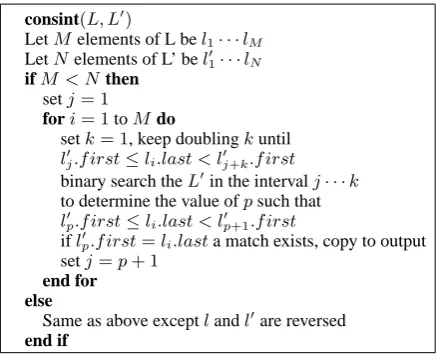
has an entry for @sb. There are several meth-ods for computing this depending on the relative size of L and L0. If they are roughly equal in size, a simple linear pass throughLandL0, anal-ogous to a merge, can be performed. If there is a significant difference in sizes, a more efficient modified binary search algorithm can be imple-mented. The details are shown in Figure 3. The
consint(L, L0)
LetMelements of L bel1· · ·lM LetNelements of L’ bel10· · ·lN
ifM < Nthen
setj= 1 fori= 1toM do
setk= 1, keep doublingkuntil
l0j.f irst≤li.last < l0j+k.f irst binary search theL0in the intervalj· · ·k
to determine the value ofpsuch that
l0p.f irst≤li.last < l0p+1.f irst
ifl0p.f irst=li.lasta match exists, copy to output setj=p+ 1
end for else
Same as above exceptlandl0are reversed
[image:4.595.72.293.229.406.2]end if
Figure 3: The modified binary search algorithm for consint
complexity of this algorithm is determined by the sizeqiof the interval required to satisfylj0.f irst≤
li.last < l0j+qi.f irst (assuming |L| < |L
0|). It
will take an average oflog2(qi) operations to de-termine the size of interval and log2(qi) opera-tions to perform the binary search, giving a to-tal of 2 log2(qi). Let q1· · ·qM be the sequence of intervals. Since the intervals will be at most two times larger than the actual interval between the nearest matches in L0 to L, we can see that |L0| ≤ PM
i=1qi ≤ 2∗ |L0|. Hence the worst case will be reached whenqi = 2|L0|/|L|with a time complexity given by2|L|(log2(|L0|/|L|) + 1), as-suming|L|<|L0|.
To support annotation of a token sequence that matches a regular expression only in the con-text of some regular expression match on its left and/or right, we implement simple extensions to the consint(L1, L2) operator. Details of the ex-tensions are left out from this paper owing to space constraints.
3.3 Implementing a DFA using the Inverse Index
In this section, we present a method that takes a DFA DR and an inverse index I of a token se-quence T, to compute a postings list of subse-quences of length at most∆, that match the regu-lar expressionR.
Let the set S = {S1, . . . , SN} denote the set of states in DR, and let the states be topologi-cally ordered with S1 as the start state. We as-sociate an objectlists,kwith each states∈Sand ∀1 ≤ k ≤ ∆. The objectlists,k is a posting list of all token sequences of length exactlykthat end in state s. The lists,k is initialized to be empty for all states and lengths. We iteratively compute
lists,k for all the states using the algorithm given in Figure 4. The functiondest(Si) returns a set of states, such that for each s ∈ dest(Si), there is an arc from state Si to state s. The function
label(Si, Sj)returns the token associated with the edge(Si, Sj).
fork= 1 to∆do fori= 1 toNdo
fors∈dest(Si) do
ifi== 1then
t=L(label(Si, s))
else
t=consint(listSi,k−1, L(label(Si, s)))
end if
lists,k=merge(lists,k, t)
[image:4.595.307.526.365.487.2]end for end for end for
Figure 4: The algorithm for building the index to all token sequences inT that matchR.
At the end of the algorithm, all token sequences corresponding to postings listslists,i, s ∈ S,1 ≤
i≤∆are sequences that are matched by the reg-ular expressionR.
3.4 Complexity Analysis for the Index-based Approach
The complexity analysis of the algorithm given in Figure 4 is based on the observation that,
Pk=∆
k=1 |listSi,k| = cnt(Si). This holds, since listSi,k contains an entry for all sequences that
visit the stateSiand are of length exactlyk. Sum-ming the length of these lists for a particular state
Si across all the values of k will yield the total number of sequences of length at most∆that visit the stateSi.
oneconsintoperation is given by2β(|listSi,k| ∗ (log(ρijk) + 1))whereβ is a constant that varies with the lower level implementation. ρijk =
|L(label(Si,Sj))|
|listSi,k| is the ratio of the postings list size of the label associated with the arc from Si to
Sj to the list size of Si at step k. Note that
ρijk ≥ 1. Let prev(Si) be the list of pre-decessor states to Si. The time taken by all the merge operations for a state Si at step k is given by γ(log(|prev(Si)|)|listSi,k|)
Assum-ing all the merges are performed simultaneously,
γ(log(|prev(Si)|)is the time taken to create each entry in the final merged list, where γ is a con-stant that varies with the lower level implementa-tion. Note this scales as the log of the number of lists that are being merged.
The total time taken by the algorithm given in Figure 4 can be computed using the time spent on
merge andconsint operations for all states and all lengths. Settingρ¯is = maxkρisk, the total time
CIcan be given as:
CI=
i=N
X
i=2
γlog(|prev(Si)|) + 2β
X
s∈dest(Si)
log( ¯ρis)
cnt(Si)
(2) Note that in deriving Equation 2, we have ig-nored the cost of merging list(Sa, k) for k =
1· · ·∆for the accept states.
3.5 Comparison of Complexities
To simplify further analysis, we can replace
cnt(Si) with f cnt(Si) where f cnt(Si) =
cnt(Si)/W. If we assume that the token distribu-tion statistics of the document collecdistribu-tion remain constant as the number of documents increases, we can also assume thatf cnt(Si) is invariant to
W. Sinceρijk is given by a ratio of list sizes, we can also consider it to be invariant toW. We now assumeα ≈ β ≈ γ since these are implementa-tion specific times for similar low level compute operations. With this assumptions from Equations 1 and 2, the ratioCD/CIcan be approximated by:
1 +PN
i=2f cnt(Si)
PN
i=2
h P
s∈dest(Si)2 log( ¯ρis) + log(|prev(Si)|)
i
f cnt(Si)
(3) The overall ratio of CD to CI is invariant to W and depends on two key factors f cnt(Si) and
P
s∈dest(Si)log( ¯ρis). Iff cnt(Si) 1, the ratio
will be large and the index-based approach will be
much faster. However, if eitherf cnt(Si)starts ap-proaching 1 orP
s∈dest(Si)log( ¯ρis) starts getting
very large (caused by a large fan out fromSi), the direct match using the DFA may be more efficient. Intuitively, this makes sense since the main ben-efit of the index is to eliminate unnecessary hash lookups for tokens do not match the arcs of the DFA. Asf cnt(Si) approaches 1, this assumption breaks down and hence the inherent efficiency of the direct DFA approach, where only a single hash lookup is required per state regardless of the num-ber of destination states, becomes the dominant factor.
3.6 Comparison of Complexities for Simple Dictionary DFA
To illustrate the potential gains from the index-based annotation, consider a simple DFADRwith two states S1 and S2. Let the set of unique to-kensAbe{a, b, c· · ·z}. LetE be the dictionary {a, e, i, o, u}. LetDRhave five arcs fromS1toS2 one for each element inE. The DFADRis a sim-ple acceptor for the dictionaryE, and if run over a token sequenceT drawn fromA, it will match any single token that is inE. For this simple case
f cnt(S2) is just the fraction of tokens that occur inEand hence by definitionf cnt(S2)≤1. Sub-stituting into 3 we get
CD
CI
= 1 +f cnt(S2) 2 log(5)f cnt(S2)
(4)
As long asf cnt(S2)<0.27, this ratio will always be greater than1.
4 Inverse Index-based Annotation using Regular Expressions
lists of all the children nodes. Additionally, each node has two binary properties: isOpt and self-Loop. The first property is set if the regular ex-pression being matched is of the form ‘R?’, where ‘?’ denotes that the regular expression R is op-tional. The second property is set if the regular expression is of the form ‘R+’, where ‘+’ is the Kleen operator denoting one or more occurrences. For the case of ‘R*’, both properties are set.
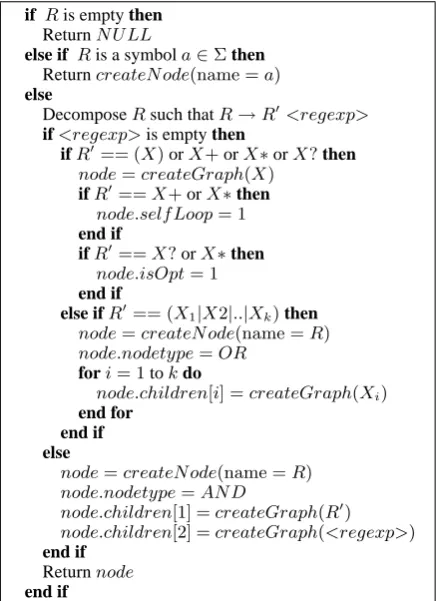
The AND/OR graph is recursively built by scan-ning the regular expression from left to right and identifying every sub-regular expression for which a sub-graph can be built. We use capital letters
R, X to denote regular expressions and small let-ters a, b, c, etc., to denote terminal symbols in the symbol set Σ. Figure 5 details the algorithm used to build the AND/OR graph. Effectively, the AND/OR graph decomposes the computation of the postings list forRinto a ordered set ofmerge
andconsintoperations, such that the outputL(v)
for node v become the input to its parents. The graph specifies the ordering, and by evaluating all the nodes in dependency order, the root node will end up with a postings list that corresponds to the desired regular expression.
if Ris empty then ReturnN U LL
else if Ris a symbola∈Σthen
ReturncreateN ode(name =a) else
DecomposeRsuch thatR→R0<regexp>
if<regexp>is empty then
ifR0== (X)orX+orX∗orX?then
node=createGraph(X)
ifR0==X+orX∗then
node.self Loop= 1
end if
ifR0==X?orX∗then
node.isOpt= 1
end if
else ifR0== (X1|X2|..|Xk)then
node=createN ode(name =R)
node.nodetype=OR
fori= 1tokdo
node.children[i] =createGraph(Xi)
end for end if else
node=createN ode(name =R)
node.nodetype=AN D
node.children[1] =createGraph(R0)
node.children[2] =createGraph(<regexp>) end if
Returnnode
[image:6.595.331.500.67.138.2]end if
[image:6.595.72.292.423.724.2]Figure 5:createGraph(R)
Figure 6: An example regular expression and cor-responding AND/OR graph
4.1 Handling ‘?’ and Kleen Operators
The isOpt and selfLoop properties of a node are set if the corresponding regular expression is of the form R?, R+ orR∗. To handle theR?case we associate a new propertyisOptwith the output listL(v)from nodev, such thatL(v).isOpt= 1
if thev.isOpt= 1. We also define two operations
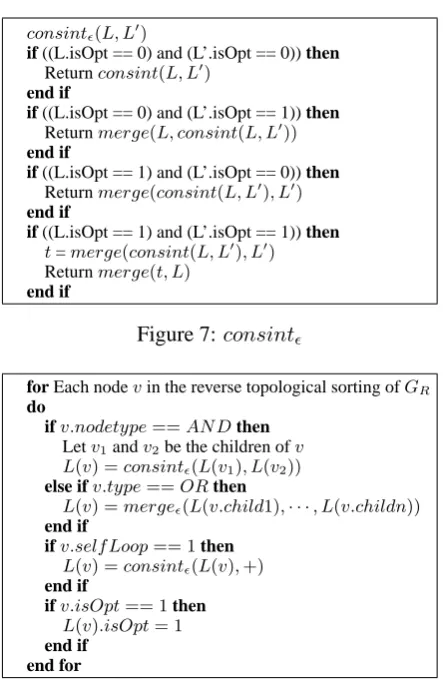
consint in Figure 7 and merge which account for theisOptproperty of their argument lists. For
consint, the generated list has its isOpt set to
1if and only if both the argument lists have their
isOptproperty set to1. Themergeoperation re-mains the same asmerge, except that the resultant list hasisOptset to1 if any of its argument lists hasisOptset to1. The worst case time taken by
consint is bounded by1 consint and2merge operations.
To handle theR+case, we define a new oper-ator consint(L,+)which returns a postings list
L0, such that each entry in the returned list points to a token sequence consisting of all k ∈ [1,∆]
consecutive subsequences@s1,@s2. . .@sk, each
@si,1 ≤ i ≤ k being an entry in L. A sim-ple linear pass through L is sufficient to obtain
consint(L,+). The time complexity of this op-eration is linear in the size ofL0. TheisOpt prop-erty of the result listL0 is set to the same value as its argument listL.
consint(L, L0)
if ((L.isOpt == 0) and (L’.isOpt == 0)) then
Returnconsint(L, L0) end if
if ((L.isOpt == 0) and (L’.isOpt == 1)) then
Returnmerge(L, consint(L, L0)) end if
if ((L.isOpt == 1) and (L’.isOpt == 0)) then
Returnmerge(consint(L, L0), L0) end if
if ((L.isOpt == 1) and (L’.isOpt == 1)) then
t=merge(consint(L, L0), L0)
[image:7.595.71.293.54.396.2]Returnmerge(t, L) end if
Figure 7:consint
for Each nodevin the reverse topological sorting ofGR
do
ifv.nodetype==AN Dthen
Letv1andv2be the children ofv
L(v) =consint(L(v1), L(v2))
else ifv.type==ORthen
L(v) =merge(L(v.child1),· · ·, L(v.childn))
end if
ifv.self Loop== 1then
L(v) =consint(L(v),+)
end if
ifv.isOpt== 1then
L(v).isOpt= 1 end if
end for
Figure 8: The algorithm for computing postings list of a regular expressionRusing the inverse in-dexI and the corresponding AND/OR graphGR
5 Experiments and Results
In this section, we present empirical compari-son of performance of the index-based annotation technique (Section 4) against annotation based on the ‘document paradigm’ using GATE. The exper-iments were performed on two data sets, viz., (i) the enron email data set2and (ii) a combination of Reuters-21578 data set3 and the 20 Newsgroups data set4. After cleaning, the former data set was
2.3GB while the latter was 93 MB in size. Our code is entirely in Java. The experiments were performed on a dual 3.2GHz Xeon server with 4 GB RAM. The code for creation of the index was custom-built in Java. Prior to indexing, the sen-tence segmentation and tokenization of each data set was performed using in-house Java versions of
2http://www.cs.cmu.edu/∼enron/
3
http://www.daviddlewis.com/resources/ testcollections/reuters21578/
4http://people.csail.mit.edu/jrennie/
20Newsgroups/
standard tools5.
5.1 Rule Specification using JAPE
JAPE is a version of CPSL6 (Common Pattern Specification Language). JAPE provides finite state transduction over annotations based on reg-ular expressions. The JAPE grammar requires in-formation from two main resources: (i) a tokenizer and (ii) a gazetteer.
(1) Tokenizer: The tokenizer splits the text into very simple tokens such as numbers, punctuation and words of different types. For example, one might distinguish between words in uppercase and lowercase, and between certain types of punctua-tion. Although the tokenizer is ca pable of much deeper analysis than this, the aim is to limit its work to maximise efficiency, and enable greater flexibility by placing the burden on the grammar rules, which are more adaptable. A rule has a left hand side (LHS) and a right hand side (RHS). The LHS is a regular expression which has to be matched on the input; the RHS describes the an-notations to be added to the Annotation Set. The LHS is separated from the RHS by ’>’. The fol-lowing four operators can be used on the LHS: ’|’, ’?’, ’∗’ and ’+’. The RHS uses ’;’ as a separa-tor between statements that set the values of the different attributes. The following tokenizer rule identifies each character sequence that begins with a letter in upper case and is followed by0or more letters in lower case:
"UPPERCASELETTER" "LOWERCASELETTER"* >>> Token; orth=upperInitial; kind=word;
Each such character sequence will be annotated as type “Token”. The attribute “orth” (orthography) has the value “upperInitial”; the attribute “kind” has the value “word”.
(2) Gazetteer: The gazetteer lists used are plain text files, with one entry per line. Each list rep-resents a set of names, such as names of cities, organizations, days of the week, etc. An index file is used to access these lists; for each list, a ma-jor type is specified and, optionally, a minor type. These lists are compiled into finite state machines. Any text tokens that are matched by these ma-chines will be annotated with features specifying the major and minor types. JAPE grammar rules
5
http://l2r.cs.uiuc.edu/∼cogcomp/
tools.php
6A good description of the original version of this
then specify the types to be identified in particular circumstances.
The JAPE Rule: Each JAPE rule has two parts, separated by “–>”. The LHS consists of an an-notation pattern to be matched; the RHS describes the annotation to be assigned. A basic rule is given as:
Rule::=
<rule> <ident> ( <priority> <integer> )? LeftHandSide ">>>" RightHandSide
(1) Left hand side: On the LHS, the pattern is described in terms of the annotations already as-signed by the tokenizer and gazetteer. The annota-tion pattern may contain regular expression opera-tors (e.g.∗,?,+). There are 3 main ways in which the pattern can be specified:
1. value: specify a string of text, e.g. {Token.string == “of”}
2. attribute: specify the attributes (and values) of a token (or any other annotation), e.g. {Token.kind == number}
3. annotation: specify an annotation type from the gazetteer, e.g. {Lookup.minorType == month}
(2) Right hand side: The RHS consists of de-tails of the annotations and optional features to be created. Annotations matched on the LHS of a rule may be referred to on the RHS by means of labels that are attached to pattern elements. Finally, at-tributes and their corresponding values are added to the annotation. An example of a complete rule is:
Rule: NumbersAndUnit
(({Token.kind=="number"})+:numbers {Token.kind=="unit"})
>>>
:numbers.Name={rule="NumbersAndUnit"}
This says ‘match sequences of numbers followed by a unit; create a Name annotation across the span of the numbers, and attribute rule with value Num-bersAndUnit’.
[image:8.595.335.489.64.266.2]Use of context: Context can be dealt with in the grammar rules in the following way. The pattern to be annotated is always enclosed by a set of round brackets. If preceding context is to be included in the rule, this is placed before this set of brackets. This context is described in exactly the same way as the pattern to be matched. If context follow-ing the pattern needs to be included, it is placed
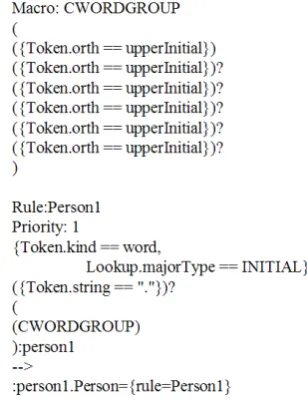
Figure 9: An example JAPE rule used in the ex-periments
after the label given to the annotation. Context is used where a pattern should only be recognised if it occurs in a certain situation, but the context itself does not form part of the pattern to be annotated.
For example, the following rule for ‘email-id’s (assuming an appropriate regular expression for “EMAIL-ADD”) would mean that an email ad-dress would only be recognized if it occurred in-side angled brackets (which would not themselves form part of the entity):
Rule: Emailaddress1 ({Token.string=="<"}) (
{Token.kind==EMAIL-ADD} )
({Token.string==">"}) >>>
:email.Address={kind="email", rule="Emailaddress1"}
5.2 Results
In our first experiment, we performed annotation of the two corpora for4annotation types using2
Table 1 compares the time taken by the index-based annotator against that taken by GATE for the
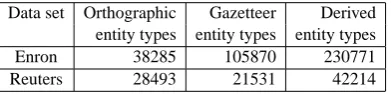
8JAPE rules. The index-based annotator performs 8-13 times faster than GATE. Table 2 splits the time mentioned for the index-based annotator in Table 1 into the time taken for the task of comput-ing postcomput-ings lists for basic entities and derived en-tities (c.f. Section 2) for each of the data sets. We can also observe that a greater speedup is achieved for the larger corpus.
Data set GATE Index-based Enron 4974343 374926 Reuters 752287 92238
Table 1: Time (in milliseconds) for computing an-notations using the two techniques
Data set Orthographic Gazetteer Derived entity types entity types entity types
Enron 38285 105870 230771
[image:9.595.86.282.323.370.2]Reuters 28493 21531 42214
Table 2: Time (in milliseconds) for computing postings lists of entity types
An important advantage of performing annota-tions over the inverse index is that index entries for basic entity types can be preserved and reused for annotation types as additional rules for anno-tation are specified by users. For instance, the in-dex entry for ‘Capsword’ might find reuse in sev-eral annotation rules. As against this, a document-based annotator has to process each document from scratch for every newly introduced annota-tion rule. To verify this, we introduced 1 addi-tional rule for each of the 4 named entity types. In Table 3, we compare the time required by the index-based annotator against that required by GATE for annotating the two corpora using the4
additional rules. We achieve a greater speedup fac-tor of 23-37 for incremental annotation.
[image:9.595.119.247.659.695.2]Data set GATE Index-based Enron 1479954 62227 Reuters 661157 17929
Table 3: Time (in milliseconds) for computing an-notations using the two techniques for the addi-tional4rules
6 Conclusions
In this paper we demonstrated that a suitably con-structed inverse index contains all the necessary information to implement entity annotators that use cascading regular expressions. The approach has the key advantage of not requiring access to the original unstructured data to compute the an-notations. The method uses a basic set of opera-tors on the inverse index to construct indexes to all matches for a regular expression in the tokenized data set. We showed theoretically, that for a DFA implementation, the index approach can be much faster if the index sizes corresponding to the labels on the DFA are a small fraction of the total num-ber of tokens in the data set. We also provided a more efficient index-based implementation that is directly computed from the regular expressions without the need of a DFA conversion and experi-mentally demonstrated the gains.
References
Eugene Agichtein and Luis Gravano. 2000. Snow-ball: Extracting relations from large plain-text col-lections. In Proceedings of the Fifth ACM
Interna-tional Conference on Digital Libraries.
Junghoo Cho and Sridhar Rajagopalan. 2002. A fast regular expression indexing engine. In Proceedings
of the18thInternational Conference on Data
Engi-neering.
Brian Cooper, Neal Sample, Michael J. Franklin, G´ısli R. Hjaltason, and Moshe Shadmon. 2001. A fast index for semistructured data. In The VLDB
Conference, pages 341–350.
H. Cunningham, D. Maynard, K. Bontcheva, and V. Tablan. 2002. GATE: A framework and graph-ical development environment for robust NLP tools and applications.
H. Cunningham. 1999. Jape – a java annotation pat-terns engine.
Line Eikvil. 1999. Information extraction from world wide web - a survey. Technical Report 945, Nor-weigan Computing Center.
Quanzhong Li and Bongki Moon. 2001. Indexing and querying XML data for regular path expressions. In
The VLDB Journal, pages 361–370.
Andrew McCallum, Dayne Freitag, and Fernando Pereira. 2000. Maximum entropy Markov mod-els for information extraction and segmentation. In
Proc. 17th International Conf. on Machine Learn-ing, pages 591–598. Morgan Kaufmann, San