A Qualitative Analysis on Scheduling
Performance in Indian Construction Projects
Manikandan.T1, Krishnamoorthi.B2, Selvamani.S3, Arikaran.K4
Assistant Professor, Department of Civil Engineering, Sembodai Rukmani Varatharajan Engineering College,
Sembodai, Vedaraniyam (Tk), Nagapattinam (Dt), India 1
Under Graduate Final Year Students, Department of Civil Engineering, Sembodai Rukmani Varatharajan Engineering
College, Sembodai, Vedaraniyam (Tk), Nagapattinam (Dt), India 2, 3, 4
ABSTRACT:Delay in construction projects is one of the foremost concerns in the Indian construction industry. The delays to the projects are affecting the economies throughout the world. Delay to projects mean the slowdown of development in all other related fields. Over 40% of Indian construction projects are facing time overrun ranging from 1 to 252 months (Source: MOSPI) the reasons for which are being studied by researchers to suggest possible remedial measures. There is strong evidence of inconsistent performance of the Indian construction projects and the trend is growing rapidly, and projects are reportedly failing across all the key performance measures, including cost, time, and quality performances. This paper identifies 35 attributes responsible for impacting performance of the projects. These attributes were then presented to Indian construction professionals in the form of a questionnaire. This study aims to identify the factors affecting construction projects scheduling and incorporating the critical factors to improve the schedule performance.
KEYWORDS:India, construction industry, delays, scheduling, performance
.
I. INTRODUCTION
The Indian construction industry forms an integral part of the economy and a conduit for a substantial part of its development investment, is poised for growth on account of industrialization, urbanization, economic development, and people rising expectations for improved quality of living. This study aims to identify the attributes that causes delay in construction projects which are responsible for schedule performance. Construction industry contributes towards 40% to 50% of India’s capital expenditure on projects in various sectors such as highway, roads, railways, energy, airport etc., and is the second largest industry in India. The construction industry is a major contributor towards 8% of India’s GDP, both directly and indirectly. Management is the science and art of planning, organizing, leading and controlling the work of organization members and of using all available organization resources to reach stated organizational goals.Construction management deals with economical consumption of the resources available in the least possible time for successful completion of construction project. Men, materials, machinery and money are termed as resources in construction Management.
Majority of infrastructure projects in India are affected by time overruns. These overruns vary from a few months to as high as five or more years, placing the project viability at risk. Survey respondents identified the bottlenecks which affect their projects and the challenges they face in conquering them. These bottlenecks, as enlisted below, are divided into two phases:
II. LITERATUREREVIEW
Sadi A. Assaf et al, (1995) identifies the main causes of delay in large building projects in Saudi Arabia and their relative importance. A survey of a randomly selected sample of 24 contractors, 15 architectural engineering firms (A/E),
and nine owners was undertaken. The survey included 56 causes of delay and the delay factors were grouped into nine major groups.. It was also shown that contractors and A/Es substantially agree on the ranking of the groups of delay factors, whereas contractors and owners, and A/Es and owners do not agree. It was also shown that the financing group of delay factors was ranked the highest by all three parties and that environment was ranked the lowest.
Chua et al, (1999) seeks to distinguish the success factors according to the project objectives of budget, schedule, and quality. The analytic hierarchy process is adopted to determine the relative importance of success related factors. A questionnaire was developed to facilitate systematic data collection in this study. Critical success factors addressing budget performance, schedule performance, quality performance, and overall project success are identified. Comparisons with findings of previous studies using neural network approach are also presented.
Iyer and Jha (2006) studied the critical factors affecting scheduling performance, evidence from Indian construction projects. They identify 55 attributes responsible for impacting performance of the project. These attributes were then presented to the Indian construction professionals in a form of questionnaire. Statistical analysis of response of response on the attributes segregated them into distinct success and failure attributes. Factor analysis of sets of success attributes and failure attributes separately grouped into six critical success and failure attributes. In order to understand the extent of contribution these factors were have on the outcome of a construction projects, a second large questionnaire survey was undertaken. This leads to conclude with two success factor and one failure factor.
III.METHODOLOGYANDDEMOGRAPHICDATA
The research methodology of this is to identify the schedule performance in construction projects. This study is done by extensive literature reviews and to ensure the accuracy of results a questionnaire is prepared for analysis. To evaluate the study the following sequential methodology is created.
1. Literature Review 2. Questionnaire preparation 3. Company Identification 4. Questionnaire Survey 5. Data Collection and Analysis 6. Suggestions and Conclusions
The Relative Important Index (RII) was used herein to determine the respondent’s perceptions of the relative importance of the identified performance factors. The RII (venkatesh et al. 2012 and Enshassi et al. 2009) was computed as:
∑ W
RII = --- A X N
Where,
RII = Relative Important Index, W = weightage given to each factor by Respondents, A = the highest weight, N = the total number of Respondents.
Based on the extensive literature reviews and experts’ advice, a questionnaire is developed by holding 35 attributes related to schedule performance. Responses on the extent of effects of these attributes on schedule were sought on a five point ordinal scale. The extent of their contribution has, however, been observed to vary for a given level of project performance. The analyses results are expected to help project professionals to focus on a few factors and get the optimum results rather than giving attention to all the factors and not getting the proportionate results.
ITEM Very Low Low Moderate High Very high
SCALE 1 2 3 4 5
Table 3.1 ordinal scale used for data measurements Demography of Experience:
All the data were collected based on the demography of respondent’s designations and experience. Data were collected based on extensive literature reviews, pilot studies and questionnaire preparation. Project participants who comes under experience such as below 4 years, between 5-10 years, between 11-20 years and above 21 years and organizations which includes owners, contractors and consultants and their corresponding agencies in which the respondents are involved in this survey.
On designation, 7% of the respondent’s executive engineer, 23% is of assistant engineers, 70% is of site engineers.
Among the organisation of respondents 26% are owners, 67% of contractors and 7% are of consultants. Majority of the respondent’s contractors.
Among the respondents 63% are less than 4 years, 20% of 5-10 years, 13% of 11-20years and 4% are above 21 years. Majority of the respondents are with the experience between less than 4 years.
IV.RESULTSANDDISCUSSIONS
The questionnaire comprised of totally 35 questions under 10 sub divisions such as support by project managers (10 factors), owner and top management support (2 factors), support on projects by monitoring(3 factors), feedback and coordination (3 factors), support by favourable working conditions (3 factors), owners competence (2 factors), conflicts among project participants (4 factors), project managers ignorance (3 factors), doubts of project participants (2 factors) and harsh climatic conditions at site (3 factors). They are given below:
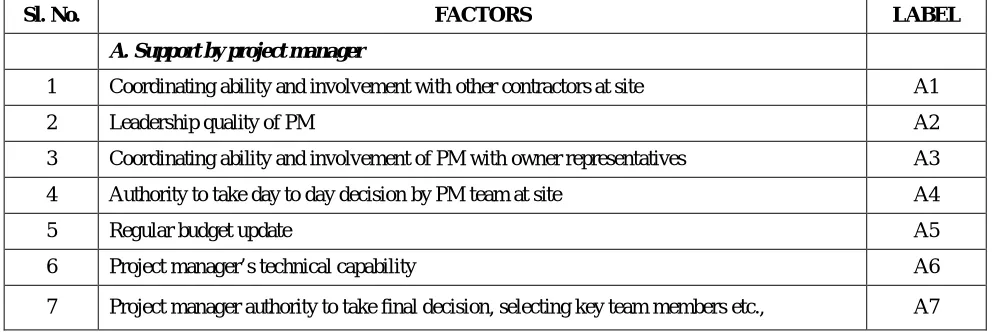
Sl. No. FACTORS LABEL
A. Support by project manager
1 Coordinating ability and involvement with other contractors at site A1
2 Leadership quality of PM A2
3 Coordinating ability and involvement of PM with owner representatives A3
4 Authority to take day to day decision by PM team at site A4
5 Regular budget update A5
6 Project manager’s technical capability A6
8 Coordinating ability and involvement of PM with his team members and subcontractors A8
9 Effective monitoring and feedback by PM A9
10 Commitments of all parties to the project A10
B. Owner and top management support
11 Top management plan and identifying critical activities B11
12 Top management support to PM and project team at site B12
C. Support on projects (monitoring , feedback and coordination)
13 Effective monitoring and feedback by project team members C13
14 Positive attitude of PM and project participants C14
15 Understanding of responsibilities by various project participants C15
D. Support by favourable working condition
16 Scope and nature of work well defined in tender D16
17 Favourable climatic conditions at site D17
18 Monitoring and feedback by client D18
E.Commitment of all project participants
19 Favourable political and economic environment E19
20 Commitment of all parties to project E20
2 F.Owner’s competence
21 Timely decision by the owner or his engineers F21
22 Monitoring and feedback by client F22
G.Conflicts among project participants
23 Tendency to pass on the blame to others G23
24 Conflicts between PM and outside agency i.e., owner, subcontractor etc., G24
25 Conflicts between PM and top management G25
26 Conflicts among team members G26
H.Project manager’s ignorance
27 Ignorance of appropriate planning tool and techniques by PM H27
28 Unwillingness in timely decision by top management H28
29 Lack of understanding of operating procedures by the PM H29
I .Doubts of project participants
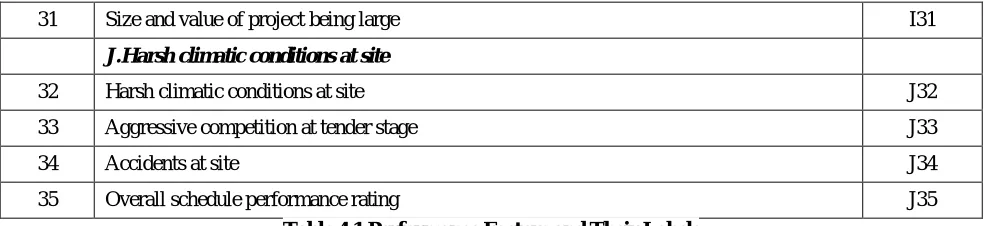
31 Size and value of project being large I31
J.Harsh climatic conditions at site
32 Harsh climatic conditions at site J32
33 Aggressive competition at tender stage J33
34 Accidents at site J34
35 Overall schedule performance rating J35
Table 4.1 Performance Factors and Their Labels
Consolidation of Relative Importance Index between All Respondents with Experience:
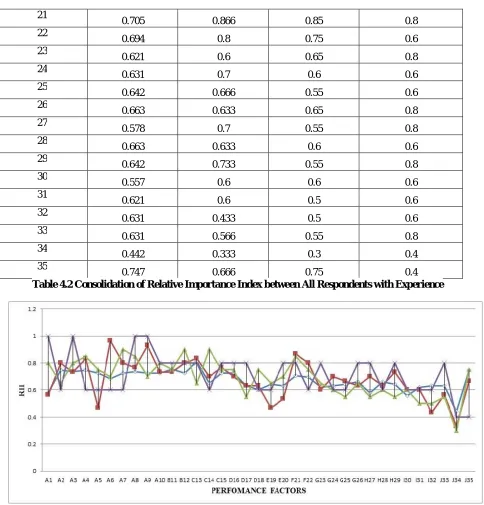
This table provides an adequate information about the consolidation of relative importance index between all respondents with experience:
SI.NO BELOW 4 YEARS EXPERIENCE BETWEEN 5-10 YEARS EXPERIENCE BETWEEN 11-20 YEARS EXPERIENCE
ABOVE 21 YEARS EXPERIENCE
1
0.578 0.566 0.8 1
2
0.747 0.8 0.65 0.6
3
0.736 0.733 0.8 1
4
0.747 0.833 0.85 0.6
5
0.726 0.466 0.75 0.6
6
0.684 0.966 0.7 0.6
7
0.726 0.8 0.9 0.6
8
0.736 0.766 0.85 1
9
0.726 0.933 0.7 1
10
0.726 0.733 0.8 0.8
11
0.757 0.733 0.75 0.8
12
0.726 0.8 0.9 0.8
13
0.81 0.833 0.65 0.8
14
0.652 0.7 0.9 0.6
15
0.726 0.766 0.75 0.8
16
0.726 0.7 0.75 0.8
17
0.631 0.633 0.55 0.8
18
0.6 0.633 0.75 0.6
19
0.642 0.466 0.65 0.6
20
21
0.705 0.866 0.85 0.8
22
0.694 0.8 0.75 0.6
23
0.621 0.6 0.65 0.8
24
0.631 0.7 0.6 0.6
25
0.642 0.666 0.55 0.6
26
0.663 0.633 0.65 0.8
27
0.578 0.7 0.55 0.8
28
0.663 0.633 0.6 0.6
29
0.642 0.733 0.55 0.8
30
0.557 0.6 0.6 0.6
31
0.621 0.6 0.5 0.6
32
0.631 0.433 0.5 0.6
33
0.631 0.566 0.55 0.8
34
0.442 0.333 0.3 0.4
35
0.747 0.666 0.75 0.4
Table 4.2 Consolidation of Relative Importance Index between All Respondents with Experience
V. CONCLUSIONS
The Relative Important Index and Rank of top significant factors affecting the schedule performance by major group perspective.
Sl. No. FACTORS RII RANK
1 Support on projects (Monitoring , feedback and coordination) 0.751 1
2 Support by project manager 0.748 2
3 Owner’s competence 0.739 3
4 Support by favourable working condition 0.734 4
5 owner and top management support 0.725 5
6 Commitment of all project participants 0.719 6
7 Harsh climatic conditions at site 0.698 7
8 Conflicts among project participants 0.659 8
9 Doubts of project participants 0.654 9
10 Project manager’s ignorance 0.652 10
Table 5.1 Rank Validation and Relative Importance Index (RII) on Major Groups
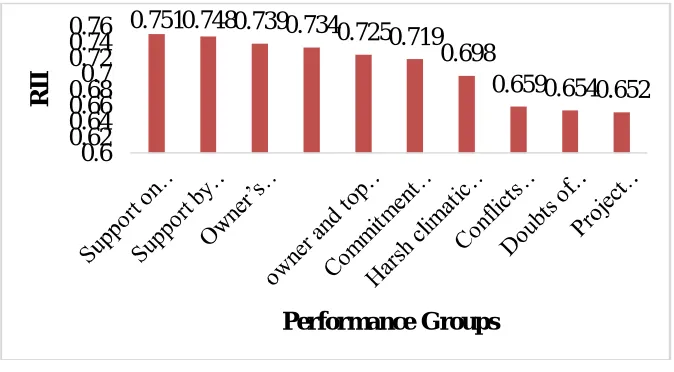
When considering the major groups of schedule performance, support on projects (monitoring, feedback and coordination) is ranked (RII= 0.751) to be in first position. Support by PM (RII= 0.748), Owners competence (RII= 0.739), followed by support by favourable working conditions (RII= 0.734), owner and top management support (RII= 0.725), commitment of all participants (RII= 0.719), harsh climatic conditions at site (RII= 0.698), conflicts among project participants (RII= 0.659), doubts of project participants (RII= 0.654), PM’s ignorance (RII= 0.652) respectively.
Fig 5.1 Performance Groups Vs. Relative Importance Index
The results can be implemented in any construction projects to minimize the construction delays that affect the schedule performance. This study provides a good guidance for managerial intervention and also some guidelines and
0.7510.7480.7390.7340.7250.719
0.698
0.6590.6540.652
0.6
0.62
0.64
0.66
0.68
0.7
0.72
0.74
0.76
R
II
actionable information that Project Managers and other top management officials can utilize to manage their projects for the improvisation of schedule performance.
REFERENCES
1. Sadi A. Assaf., Mohammed Al-Khalil and Nohammed Al-Hazmi., (1995), Causes Of Delay In Large Construction Projects, Journal of Management in Engineering, Vol. 11(2), March/April, pp. 45-50.
2. Abdulazis A. Bubshait and Michael J.Cuningham(1996), Comparison of Delay Analysis Methodologies, Journal of Construction Engineering and Management, Vol. 124(4), July/August.
3. Albert, P.C. Chan., David Scott and Ada, P.L. Chan (2004), Factors Affecting The Success Of A Construction Project, Journal of Construction Engineering and Management, Vol. 130(1), February, pp. 153-155.
4. Chua, D.K.H., Kog, Y.C., Loh, P.K., (1999), Critical Success Factors For Different Project Objectives, Journal of Construction Engineering and Management, Vol. 125(3), May/June, pp. 142-150.
5. Adan Enshassi.,Sherif Mohammed., and Saleh Abushabin (2009), Factors affecting the performance of construction projects in the Gaza Strip, Journal of Civil Engineering and Management, Vol. 15(3), April, pp. 269-280.
6. Pablo Gonzalez., Vicente Gonzalez., keithMolenaar., and Francisco Orozco (2014), Analysis And Causes Of Delay And Time Performance In Construction Projects, Journal of Construction Engineering and Management, Vol. 140(1), January, pp. 1-5.
7. Murat Gunduz., Yasemin Nielsen., and Mustafa Ozdemir (2014), Quantification of Delay Factors Using the Relative Importance Index Method for Construction Projects in Turkey, Journal of Management in Engineering, Vol. 29(2), April, pp. 133-139.
8. Aftab Hameed Memom., ismail Abdul Rahman., and Ade Asmi Abdul Azis(2012), Time and Cost Perfomance in Costruction Projects in Southern and Cenrtal Regions of Penisular Malaysia, International Journal of Advances in Applied Sciences, Vol. 1(1), March, pp. 45-52. 9. Ibrahim, H., Baki, A., and Atan, I., (2012), Optimizing Time Performance for Construction Of Public Building Sector Projects in Peninsular
Malaysia, International Sustainability and Civil Engineering Journal, Vol. 1(1).
10. Iyer, K.C., Jha, K.N., (2006), Critical Factors Affecting Schedule Performance: Evidence Form Indian Construction Projects, Journal of Construction Engineering and Management, Vol. 132(8), August, pp. 871-881.1
11. Van Truong Luu.,Soo Yong Kim., and Huynh Tuan Anh (2007), Improving project management performance of large contractors using benchmarking Approach, International Journal of Project Management, Vol. 26(2007), October, pp. 758-769.