An Analysis of Supply Chain Solution Techniques
for IC Production
Hsi-Kuang Wang and Chueng-Chiu Huang
1
Abstract—an analysis of the supply chain model and solution
for IC industry, including foundry, assembly, and testing, is studied. The studied system focus at contract manufacturing service (CMS) in Taiwan and the theme of supply chain management is building upon the detail execution level but under the long term planning. A perspective contrast between time buckets with time line is propounded for distinguishing the difference of the existing techniques for analyzing and the fissures of the derived solutions. In this study we also propose a scheduling approach of objective driven simulation which contains the properties of Adjust and Revise’’. The approach conducts for rescheduling to achieve the goal of bridging the gap between planning and execution, or theoretical and practical. The related research report has been accomplished in an accompany paper [1].
Keywords—contract manufacturing service, rescheduling,
objective driven simulation.
I. INTRODUCTION
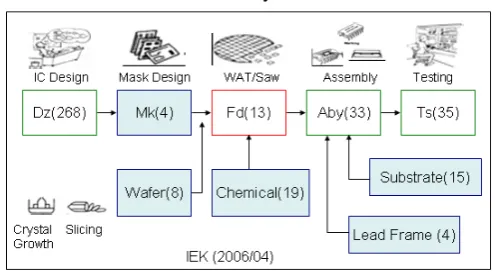
HE supply chain of IC industry is complicated organizational production system in Taiwan, especially for the contract manufacturing service (CMS). With the report of Industrial Technology Research Institute / Industrial Economics and Knowledge Center (IEK), in the end of year 2005, Taiwan has 268 IC Design Houses, 13 Fabrications, 33 Assemblies, and 35 Testing Companies, as shown in Figure 1. Combining the supply of Reticle, Substrate, Wafer, and Chemical, the supply chain of IC industry is formed. For the manufacturing segments of foundry, assembly, and testing, each company has two to a dozen plants. Actually, the number of CMS providers and the complexity of service subdivision are much intricate than the data shows. For example, in the assembly segment there are many small manufacturers provide adhesive, mark respectively, and in testing segment there are providers doing Burn In service individually. Unlike the comprehensive plants as Texas Instrument and Philips, these plants in Taiwan belong to different individual substantial business units. Thus the collaboration among them forms a complex supply chain network. It is also found that the efficiency of such
1
Manuscript received December 22, 2008. The research work was supported by Decision Support Systems Technique Corporation (www.dsst.com.tw) when the second author worked at the institute. Hsi-Kuang Wang is with the Dept of Industrial Management, Oriental Institute Technology, 58, Sec. 2, Sihchuan Rd., Ban-Chau City, Taipei County 220, Taiwan R.O.C. (phone: 886-2-89665492; fax: 886-2-77385461; e-mail: peterwang@ sparqnet.net)
Chueng-Chiu Huang was with Department of Information Management, Tatung University, Taiwan, R.O.C. He is now with the Dept of Industrial Management, Oriental Institute Technology, 58, Sec. 2, Sihchuan Rd., Ban-Chau City, Taipei County 220, Taiwan, R.O.C. (phone: 886-2-89665492; fax: 886-2-77385461; e-mail: fg022@ mail.oit.edu.tw)..
complicated production network in Taiwan is maintaining in the leading position in the world.
In this study, we would like to take apart the discussion of the manufacturing segment into two themes: the front-end: Foundry Fabrication and the back-end: Assembly/Testing (A/T). Since the management subjects and purports are different widely, the explanation will be in section 2. We note that in the back-end production not only has much complicated division of service but also in shorter transient time limitation than the front-end. Most products of the CMS are logic IC, and a regular business model for CMS is Build to Order (BTO). It is same for front-end and back-end manufacturing, and similar to Print Circuit Board, Substrate industries. The key drawback of BTO management for capacities based industries are:
1) The inputs of every segment depend on the actual output of previous segment.
2) There is no inventory for safety stock in products and WIP.
3) The safety net system is found on resource capacity but material, and unlike the property of material, the capacity can’t be deferred for use.
4) The struggle of utilization and Available to Promise (ATP) strongly depends on dispatching, Huang & Wang [1].
5) A situation of small quantities and large number of items as flexible manufacturing system (FMS) with variations in production control results the production plan infirmly in practice.
[image:1.595.306.554.607.744.2]6) The customer service is in accordance with the product delivery, and the cardinal importance of collaboration between customer and service provider is by the release time of the product (wafer start time).
Figure 1. IC Industry Map.
The manufacturing lead time of a lot in foundry takes a wide range from 14 to 180 days with average on 42 days for logic IC, and the uncertainty in production decision process is the most important factor for lead time management. For the back-end A/T manufacturing, the production network is formed by the operation partition into a company but station. That is there are companies provide service for one or few operations but work stations in a company. Moreover, the lead time for A/T is within 6 to 14.8 days on the average of 9.3 days. In the sense of data distribution in statistics, the 95% tail of the lead time is 2.64 times of its average, which denotes a high variation and uncertainty existing. Before the wafer start to be processed on A/T, there are substrates and fixtures will be needed too, and the lead times for producing also takes 7-14 days usually, but mostly these supplies might be prepared in advance.
The customers of foundry, the IC design houses, play the role as the production manager in outside of the supply chain network. They place orders with the CMS of Foundry and A/T, and control the progress of the placed orders as closer as possible. Usually, CMS will provide the information of the orders in detail by current status of each lot; it is thru the shop floor information system (SFIS) or manufacturing execution system (MES) feedback the data from shop floor. However, the visibility of MES information for management purpose is still limited due to the complex characters of IC production. The real time data doesn’t provide the clear image about the future without a proper tool to digest these MES information. A traditional mechanism of handling the future is by planning, which is applied in many ERP and MRP systems. Tools as Statistics and Mathematic Programming are widely used for generating the solution in planning too. Simulation is another tool for developing solution, Simchi-Levi [6], Watson, Sadowski 1997, [8]. However, a plan with period over 1 week coverage by Mathematic Programming and Simulation will turn to be irrational for the uncertainty environment, that is the plan is impractical. On the other hand, the problem of a plan generated by mathematic programming, is the solution will turn to be unstable, Goldratt [2]. Moreover, the approaches of mathematic programming and simulation will have difficulty of connecting with the real time information. Therefore, there is a break between planning and execution, and bridging the gap turns to be an important issue for practice. An announcement made by SAP in October 2002 at Nashville, Tennessee, responded with “Next Generation of Manufacturing Solutions to More Tightly Link Shop Floor with Supply Chain Networks” as their most important research target to achieve, and the result is under tracking so far.
In the following of this article, we will give a description of the observed environment and the problematic issues of foundry, assembly and testing in section 2. A perspective contrast between time bucket and time line is propounded for distinguishing the difference of the existing techniques and the fissures of the derived solutions in section 3. In section 4, we propose a scheduling approach of objective driven simulation which contains the properties of Adjust and Revise to achieve the goal of bridging the gap between
planning and execution. Conclusion and future research theme will be in section 5.
II. SUPPLY CHAIN NETWORK FOR IC INDUSTRY
The manufacturing process of IC industry might be separated into two segments, the end and the back-end. The front-end process includes the masking then foundry to the stage of wafer acceptance test. The back-end includes substrates, assembly, and testing. We will expound individually due to the difference characteristics of each other.
The front-end is a complicate manufacturing, managing, and challenging territory in production process. To understanding the subjects of MES in production: analysis, Job, Resource, and the Routing Sequence, helps model the system. Some IC industry terminologies: Lot, Equipment and Process Flow are given and illustrated in the following:
1) Lot: A lot is same as a job in scheduling. It is a handing unit in a foundry that containing a number of wafers and is a cassette physically. The concrete condition of a cassette might contain at most 25 pieces of 8 inch wafers. Usually an order will be divided into batches by the request partial delivery due dates. Each batch might be divided into several lots depends on the number of wafers. A lot will be granted a priority for affirming its order when a competition appeared to decide the right of using the resources. Moreover, lot in foundry will also contain its recipe, history record. The information will influence its suitability for certain resource or process requirement in its follow-up operations. Every lot might have its own journey.
2) Equipment: An equipment is a machine in scheduling terminology and a resource in simulation. A foundry has hundreds of high unit price machines. These machines have two major characters: First, the I/O of processing and material handling is based on cassettes and the operation is controlled by lot. More than 50% of the resources have 2 ports for cassettes entrance, thus resource of this nature might provide service to two lots at the same time. We note that one of the factors for the uncertainty of the processing time is due to the time length will be determined on the condition of the lot on the other port. Secondary, these resources are in high variant situation, Most of the machines will be inspected at the beginning of the first shift in a day. By the inspection, the functions will be chosen for providing service. The decision of choosing a particular function will depend on the status of the lot and the objectives of ATP or utilization for management.
lot at a step to ensure the operation will be completed within the cycle time. A layer of a product is equivalent to a route of a lot. It denotes the cassette goes through some stations of the foundry one round trip, thus a product containing more layers will have to go through more rounds in the foundry. Each layer will have its lead time. The lead time of a layer is sum of the cycle times of the operations, and a cycle time is the processing time plus its queue time. The length of the processing time is a variable defined as in prior lot definition. The key issue of the cycle time is that the waiting time is controllable but not necessary expectable in advance. The waiting time might be longer or shorter by resource allocation or control protocol for the priorities to be granted to the lots. The exact time length of it waited in queue is not predictable. Because the waiting time of a lot is the summation of these processing times of the other lots in front of it, the length of processing time depends on the combination of the lots in processing and the chosen function of the equipment. By lumping up the lead time of each layer for a lot, the process flow time for a lot can be determined. Intuitively, given the release time plus the process flow time to calculate the expected completion time of the lot. From the raw data of May 2006 of a foundry, we collect the data of 43 types of layer; the average lead times for these layers are from 0.45 to 4.5 days for 42 of them. One type of the layer has the average lead time equals to 10.17 days. The average lead time of these 42 types of layers is 1.68 days with standard deviation 0.72 days.
The control model of cycle time for each step of a lot and WIP quantity for each station is a kernel concept for production controlling at a foundry. Given the arrival time of a lot at a station then add up the cycle time for the step, we might have the operation due date (ODD) for the job of the step at the station. The control manner for production will:
1) Complete the step of a lot by its ODD.
2) Maintain the WIP quantity within the acceptable interval.
3) Match the productivity by the moves of wafer.
With above observations, it shows the control environment for production administration in the foundry basically is by aggregating these stations of parallel machines individually. For each station, where the machines belong to, we observe dynamic real time information of the WIP quantity and the lump up queue times of the lots as the criteria and decision making references. In production control sense, each layer will be the object to observe and manage. The system model of a foundry is actually an aggregation of stations of parallel machines in scheduling domain. In addition, we note the wafers containing in a cassette will have exactly same properties in production process, but it doesn’t mean only a single product inside. On the other hand, same product in different cassettes might have different process requirement due to the different journey. A scenario in the shop floor of a foundry is there are lots of same product in different route state will be produced on same resource. The decision of
choosing the lot to be performed earlier will be different depending on the intention of the management objectives.
For the back-end segment of A/T, the processes and the complexities are shorter and simpler than front-end significantly. Most of the operations in back-end segment are progressed on the resources one item or one category at a time, thus even though the processing recipe might be different by item or category dependent, but the processing times are much stable comparing with these in foundry. However, the queue time in back-end is still remaining at high variation. Usually the cycle time is 2 to 3 times of the processing time, and the lead time is also another 2 to 3 times of the cycle time. The data provided by an assembly manufacturer to its customers shows the lead time; start from the release date to the completion date; for a lot in assembly segment will need 7 days, and the total cycle times is 60 hours, but the entire processing time for these operations is around 24 hours. For most of the cases, processing time depends on the product, equipment, and engineering factors, and the queue time relies on the management and control factors.
Based on the observations of:
1) Varied input process from foundry. 2) Stable processing time for operations. 3) Short production process.
4) The network structure of production service.
There is a control solution suggested opposite to the release time, constant WIP, and cycle time controls for foundry, but the factors of dispatching command and completion time prompt. From dispatch to completion of the lot production is a concept of controlling the whole journey of the lots. That is different from the control on the cycle time of the operation, average WIP at a station, and wafer moves of the utilization. The distinction is that a whole journey control will have stronger linkage of these operations for lots, precisely every two conjunctive operations will have the completion time of the prior one connecting to the release time of the posterior one. In the detail scheduling manner, the system aggregates these queue times of operations for each lot, then by allocating these queue times of and between lots to achieve the objectives of tardiness and utilization for jobs and facilities in individual and global view.
III. A PERSPECTIVE CONTRAST BETWEEN TIME BUCK WITH TIME LINE
senses of time bucket and time line to expound the distinction of these techniques.
A regular way to represent material availability and resources capability by time bucket are the quantities of product completed within a bucket. For example, the quantity of products produced within one year, month, week, day, or hour. But in the sense of time line, the product will be denoted by the jobs progressed during the time period. The two major differences between the two interpretations are explained in the following:
1) Time bucket is a suitable analysis base for the techniques of mathematic programming and statistics. Time line is appropriate for simulation and scheduling.
2) Time bucket is convenient for resulting in long term and stable system, and time line will be easier used to create the dispatches coordinating with the real time information.
The models built on time bucket and their solutions are proper for planning, and on time line will fit to execution. The further drawbacks for time bucket interpretations are:
1) The produced quantities in a bucket do not express the individual journey of products. Precisely, for capacity based lot production, the quantities of products produced within a bucket do not reveal the completion sequence, and the start and completion times for each operation will not be scheduled in detail.
2) In the time bucket, it is difficult to express the waiting time, queue time for lot and idle time for resource. A way to state the interrelation of resource capacity and job operation is the processing time and idle times for both of the machine and the job, Huang and Wang [1]. In other words, it is the cycle time for each operation and the utilization of each resource.
3) The lead time by summing of cycle times of a job is either longer or shorter than a bucket length. The continuity of precedent and successive relation for operations results ambiguous in scheduling, and the straitened situation cannot be improved by modifying the length of bucket. Thus the techniques founded on time bucket will be suitable for plan constructing particularly for mess production contrast to lot production.
The simulation and scheduling tool founded on time line might bridge over the gaps for the drawbacks illustrated in the above. The time line based techniques might fulfil the constraints required by management purpose or limitation as recipe specified and provide the detail information as the start and completion times of operation for job and equipment. It is caused by the discrete event driven and dynamic scheduling properties, thus comprehensible solution are generated for practice. However, when working on the time line to perform the decision process in the future, the behaviour of the objective control will be loss.
IV. SUPPLY CHAIN EXECUTION SOLUTION FOR IC INDUSTRY
Several approaches for the purpose of endowing with the ability of objective control were applied, such as the Rule Base, Gene Algorithm, Expert System, forecasting etc. Basically, these approaches are procuring the information of future for current decision making. However, the defects of prediction on a changeable system by experience and history are stayed in theoretic and practical. Although we might consider the prediction behaviour is a jump in the solution space from current state to a future state with the direction and length by the experience, the key issue is there is no connection and consecutive extension from current state.
Two approaches of bring back the future information are generated naturally, they are step-back and backward then forward. A step-back scheme is taking proper steps toward to the future then moves few steps back with the information that experienced in its forward for making a better decision to the objectives that desired. A backward then forward method, Kim [3], is starting with the backward on the due dates fulfilment or zero tardiness, Mejtsky [4], then following with the opposite sequence of the process to allocate resources to jobs, Watson, Medeiros, Sadowski [8]. The backward scheme progresses at each decision making under the satisfaction of conditions and constraints, and stops when all these rude operations and jobs are scheduled. Then the forward scheme starts and uses the information obtained in backward for adjusting the decision to meet its objectives. The drawback for step-back is the insufficient ability of foreseeing; moreover, there is no guarantee that the system will converge to a stopping situation of performing these jobs completely, that is a dead lock cycle might happen often. The defect for the backward then forward approach is the frequency of performing the scheme, a frequent scheme performing will generate unstable solution likely, and a rare executing will produce disconnected resolution from the real time.
One of the reasonable approaches by concluding these discussions in the above is performing an objective drivable simulation based on the experience result (i.e. the former plan) and referring the new situation information (i.e. shop floor information returned by MES) since last decision making. It might be separated into two rescheduling manners, one is by adjusting the plan with up-to-date information, the other is by performing reschedule substantially, and they are all based on the former plan. A scenario explanation is that running reschedule once a shift with the new jobs released and turning adjustment every two hours by the real time information updated.
V. CONCLUSION AND FUTURE STUDIES
For the highly customized and lot manufacturing industry, the supply chain solution near to execution level is much satisfactory and suitable for implementation comparing with the solution close to plan level. For the foundry production, the solution generated from the above discussion will result feasible no longer than a week it is due to the extreme uncertainty of the production factors as discussed in section 2. The average production lead time is 42 days for a lot, thus the one week information contains incomplete process flow information of lots, which denotes only rare chance for a lot will start and complete within a week. The lots completed in the observed week might provide the information for the consecutive production of assembly as the release schedule. And the others incomplete lot information will be the parts of contributing to the performance index as the WIP, queue time, cycle time, utilization etc. In this research we suggest the supply chain model for IC industry starting with the one week scheduled completion information from foundry then connecting with the assembly and testing, including the unitary operation service providers in the back-end production, by building the model on time line base. We referred the result of backward simulation/scheduling for the objective control, Huang and Wang [1], and the connection of the shop floor information to the supply chain for practice. The connecting technique will need an advance discussion on the architecture design, which is different from the existing simulator Law and Kelton [5]. The further researches will include the control of the dynamic change of the necessary and sufficient condition for the products among manufacturing segments, and the information of execution feedback to a plan for high level and long term controlling purpose.
ACKNOWLEDGMENT
Thank Decision Support Systems Technique Corporation (www.dsst.com.tw) when the authors worked at the institute. The technique results are mostly embedded and demonstrated in the scheduling system namely Advance Factory System (AFS). AFS is currently endorsed in IC and MEMS foundry, and PCB factory.
REFERENCES
[1] C-C, Huang, and H-K, Wang, “Backward Simulation with Multiple Objectives Control”, IAENG ICINDE2009, submitted for publication. [2] Goldratt, E.M., Scheragenheim, E., Ptak, C.A. “Necessary But Not
Sufficient”, North River Press, 2000.
[3] Y-D. Kim, “A Backward Approach in List Scheduling Algorithms for Multi-Machine Tardiness Problems”, Computer Operations Research, Vol. 22, No. 3, pp. 307-319, 1995.
[4] G. Mejtsky, “Backward Simulation and Multiple-Objective Optimization of Job Shop Scheduling with Zero Tardiness and Minimum Makespan”, Proceeding of the 1985 Winter Simulation Conference, 1997, pp. 716-720.
[5] Law, A.M., Kelton, W.D., “Simulation Modeling and Analysis”, McGraw Hill, 2000.
[6] Simchi-Levi, D., “Design & Management the Supply Chain”, McGraw Hill, 2002.
[7] Stevenson, William , “Operations Management”, McGraw Hill, 2005. [8] E. Watson, D. Medeiros, R. Sadowski, “A Simulation-Based Backward