Using a Random Forest Classifier to Compile Bilingual Dictionaries of
Technical Terms from Comparable Corpora
Georgios Kontonatsios1,2 Ioannis Korkontzelos1,2 Jun’ichi Tsujii3 Sophia Ananiadou1,2
National Centre for Text Mining, University of Manchester, Manchester, UK1
School of Computer Science, University of Manchester, Manchester, UK2
Microsoft Research Asia, Beijing, China3
{gkontonatsios,ikorkontzelos,sananiadou}@cs.man.ac.uk [email protected]
Abstract
We describe a machine learning approach, a Random Forest (RF) classifier, that is used to automatically compile bilingual dictionaries of technical terms from com-parable corpora. We evaluate the RF clas-sifier against a popular term alignment method, namely context vectors, and we report an improvement of the translation accuracy. As an application, we use the automatically extracted dictionary in com-bination with a trained Statistical Machine Translation (SMT) system to more accu-rately translate unknown terms. The dic-tionary extraction method described in this paper is freely available1.
1 Background
Bilingual dictionaries of technical terms are im-portant resources for many Natural Language Processing(NLP) tasks includingStatistical Ma-chine Translation(SMT) (Och and Ney, 2003) and Cross-Language Information Retrieval (Balles-teros and Croft, 1997). However, manually cre-ating and updcre-ating such resources is an expensive process. In addition to this, new terms are con-stantly emerging. Especially in the biomedical domain, which is the focus of this work, there is a vast number of neologisms, i.e., newly coined terms, (Pustejovsky et al., 2001).
Early work on bilingual lexicon extraction focused on clean, parallel corpora providing satisfactory results (Melamed, 1997; Kay and R¨oscheisen, 1993). However, parallel corpora are expensive to construct and for some domains and language pairs are scarce resources. For these rea-sons, the focus has shifted to comparable corpora
1http://personalpages.manchester.
ac.uk/postgrad/georgios.kontonatsios/ Software/RF-TermAlign.tar.gz
that are more readily available, more up-to-date, larger and cheaper to construct than parallel data. Comparable corpora are collections of monolin-gual documents in a source and target language that share the same topic, domain and/or docu-ments are from the same period, genre and so forth.
Existing methods for bilingual lexicon extrac-tion from comparable corpora are mainly based on the same principle. They hypothesise that a word and its translation tend to appear in simi-lar lexical context (Fung and Yee, 1998; Rapp, 1999; Morin et al., 2007; Chiao and Zweigen-baum, 2002). Context vector methods are reported to achieve robust performance on terms that occur frequently in the corpus. Chiao and Zweigenbaum (2002) achieved a performance of 94% accuracy on the top 20 candidates when translating high fre-quency, medical terms (frequency of 100 or more). In contrast, Morin and Daille (2010) reported an accuracy of 21% for multi-word terms occurring 20 times or less, noting that translating rare terms is a challenging problem for context vectors.
Kontonatsios et al. (2013) introduced an RF classifier that is able to automatically learn as-sociation rules of textual units between a source and target language. However, they applied their method only on artificially constructed datasets containing an equal number of positive and neg-ative instances. In the case of comparable cor-pora, the datasets are highly unbalanced (givenn, msource and target terms respectively, we need to classifyn×minstances). In this work, we incor-porate the classification margin into the RF model, to allow the method to cope with the skewed dis-tribution of positive and negative instances that oc-curs in comparable corpora.
Our proposed method ranks candidate transla-tions using the classification margin and suggests as the best translation the candidate with the max-imum margin. We evaluate our method on an
English-Spanish comparable corpus of Wikipedia articles that are related to the medical sub-domain of “breast cancer”. Furthermore, we show that dic-tionaries extracted from comparable corpora can be used to dynamically augment an SMT sys-tem in order to better translateOut-of-Vocabulary (OOV)terms.
2 Methodology
A pair of terms in a source and target language is represented as a feature vector where each dimen-sion corresponds to a unique character n-gram. The value of each dimension is 0or1 and desig-nates the occurrence of the corresponding n-gram in the input terms. The feature vectors that we use contain2qdimensions where the firstq dimen-sions correspond to the n-gram features extracted from the source terms and the lastqdimensions to those from the target terms. In the reported experi-ments, we use the 600 (300 source and 300 target) most frequently occurring n-grams.
The underlying mechanism that allows the RF method to learn character gram mappings between terms of a source and target language is the de-cision trees. A node in the dede-cision tree is a unique character n-gram. The nodes are linked through the branches of the trees and therefore the two sub-spaces of q source and q target charac-ter grams are combined. Each decision tree in the forest is constructed as follows: every node is split by considering|φ|random n-gram features of the initial feature set Ω, and a decision tree is fully grown. This process is repeated|τ|times and con-structs|τ|decision trees. We tuned the RF clas-sifier using 140 random trees where we observed a plateau in the classification performance. Fur-thermore, we set the number of random features using|φ|= log2|Ω|+ 1as suggested by Breiman (2001).
The classification margin that we use to rank the candidate translations is calculated by simply subtracting the average number of trees predicting that the input terms are not translations from the average number of decision trees predicting that the terms are mutual translations. A larger classi-fication margin means that more decision trees in the forest classify an instance as a translation pair. For training an RF model, we use a bilingual dictionary of technical terms. When the dictionary lists more than one translation for an English term, we randomly select only one. Negative instances
are created by randomly matching non-translation pairs of terms. We used an equal number of posi-tive and negaposi-tive instances for training the model. Starting from 20,000translation pairs we gener-ated a training dataset of40,000positive and neg-ative instances.
2.1 Baseline method
The context projection method was first pro-posed by (Fung and Yee, 1998; Rapp, 1999) and since then different variations have been suggested (Chiao and Zweigenbaum, 2002; Morin et al., 2007; Andrade et al., 2010; Morin and Prochas-son, 2011). Our implementation more closely follows the context vector method introduced by (Morin and Prochasson, 2011).
As a preprocessing step, stop words are re-moved using an online list 2 and lemmatisation is performed using TreeTagger (Schmid, 1994) on both the English and Spanish part of the compa-rable corpus. Afterwards, the method proceeds in three steps. Firstly, for each source and target term of the comparable corpus, i.e.,i, we collect all lexical units that: (a) occur within a window of3 words around i(a seven-word window) and (b) are listed in the seed bilingual dictionary. The lexical units that satisfy the above two conditions are the dimensions of the context vectors. Each dimension has a value that indicates the correla-tion between the context lexical unit and the term i. In our approach, we use the log-likelihood ra-tio. In the second step, the seed dictionary is used to translate the lexical units of the Spanish context vectors. In this way the Spanish and English vec-tors become comparable. When several transla-tions are listed in the seed dictionary, we consider all of them. In the third step, we compute the con-text similarity, i.e., distance metric, between the vector of an English term to be translated with ev-ery projected, Spanish context vector. For this we use the cosine similarity.
3 Experiments
In this section, we evaluate the two dictionary ex-traction methods, namely context vectors and RF, on a comparable corpus of Wikipedia articles.
rank (MRR) 4 as in previous approaches (Chiao and Zweigenbaum, 2002; Chiao and Zweigen-baum, 2002; Morin and Prochasson, 2011; Morin et al., 2007; Tamura et al., 2012). As a refer-ence list, we use the UMLS metathesaurus5. In addition to this, considering that in several cases the dictionary extraction methods retrieved syn-onymous translations that do not appear in the ref-erence list, we manually inspected the answers. Finally, unlike previous approaches (Chiao and Zweigenbaum, 2002), we do not restrict the test list only to those English terms whose Spanish translations are known to occur in the target cor-pus. In such cases, the performance of dictionary extraction methods have been shown to achieve a lower performance (Tamura et al., 2012).
3.1 Data
We constructed a comparable corpus of Wikipedia articles. For this, we used Wikipedia’s search en-gine 6 and submitted the queries “breast cancer” and “c´ancer de mama” for English and Spanish respectively. From the returned list of Wikipedia pages, we used the1,000top articles for both lan-guages.
The test list contains1,200English single-word terms that were extracted by considering all nouns that occur more than 10 but not more than 200
times and are listed in UMLS. For the Spanish part of the corpus, we considered all nouns as candi-date translations (32,347in total).
[image:3.595.307.514.142.239.2]3.2 Results
Table 1 shows the top-ktranslation accuracy and the MRR of RF and context vectors.
Acc1 Acc10 Acc20 MRR RF 0.41 0.57 0.59 0.47 Cont.
Vectors 0.1 0.21 0.26 0.11
Table 1: top-k translation accuracy and MRR of RF and context vectors on1,200English terms
We observe that the proposed RF method achieves a considerably better top-ktranslation
ac-4MRR = 1
|Q|
PQ
i=1rank1 i where|Q|is the number of English terms for which we are extracting translations and
rankiis the position of the first correct translation from
re-turned list of candidates 5nlm.nih.gov/research/umls
6http://en.wikipedia.org/wiki/Help:Searching
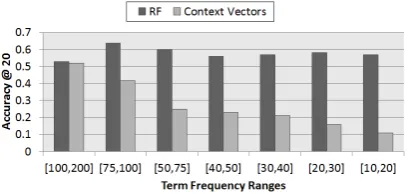
curacy and MRR than the baseline method. More-over, we segmented the 1,200 test terms into 7
frequency ranges 7, from high-frequency to rare terms. Figure 1 shows the translation accuracy at top 20 candidates for the two methods. We note
Figure 1: Translation accuracy of top 20 candi-dates on different frequency ranges
that for high frequency terms, i.e. [100,200] range, the performance achieved by the two methods is similar (53% and 52% for the RF and context vec-tors respectively). However, for lower frequency terms, the translation accuracy of the context vec-tors continuously declines. This confirms that con-text vectors do not behave robustly for rare terms (Morin and Daille, 2010). In contrast, the RF slightly fluctuates over different frequency ranges and presents approximately the same translation accuracy for both frequent and rare terms.
4 Application
As an application of our method, we use the pre-viously extracted dictionaries to on-line augment the phrase table of an SMT system and observe the translation performance on test sentences that contain OOV terms. For the translation probabil-ities in the phrase table, we use the distance met-ric given by the dictionary extraction methods i.e., classification margin and cosine similarity of RF and context vectors respectively, normalised by the uniform probability (if a source term has m candidate translations, we normalise the distance metric by dividing bymas in (Wu et al., 2008) .
4.1 Data and tools
[image:3.595.81.280.542.615.2]ing the SMT and 1K sentences for evaluation. The test sentences contain1,200terms that do not ap-pear in the training parallel corpus. These terms occur in the Wikipedia comparable corpus. Hence, the previously extracted dictionaries list a possible translation. Using the PubMed parallel corpus, we train Moses (Koehn et al., 2007), a phrase-based SMT system.
4.2 Results
[image:4.595.306.529.268.381.2]We evaluated the translation performance of the SMT that uses the dictionary extracted by the RF against the following baselines: (i) Moses using only the training parallel data (Moses), (ii) Moses using the dictionary extracted by context vectors (Moses+context vector). The evaluation metric is BLEU (Papineni et al., 2002).
Table 2 shows the BLEU score achieved by the SMT systems when we append the top-k transla-tions to the phrase table.
BLEU on top-ktranslations
1 10 20
Moses 24.22 24.22 24.22
Moses+
RF 25.32 24.626 24.42
Moses+
Context Vectors 23.88 23.69 23.74
Table 2: Translation performance when adding top-ktranslations to the phrase table
We observe that the best performance is achieved by the RF when we add the top 1 trans-lation with a total gain of1.1 BLEU points over the baseline system. In contrast, context vec-tors decreased the translation performance of the SMT system. This indicates that the dictionary ex-tracted by the context vectors is too noisy and as a result the translation performance dropped. Fur-thermore, it is noted that the augmented SMT sys-tems achieve the highest performance for the top 1 translation while forkgreater than 1, the transla-tion performance decreases. This behaviour is ex-pected since the target language model was trained only on the training Spanish sentences of the par-allel corpus. Hence, the target language model does not have a prior knowledge of the OOV trans-lations and as a result it cannot choose the correct translation amongkcandidates.
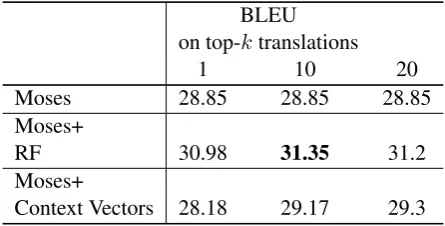
To further investigate the effect of the language model on the translation performance of the aug-mented SMT systems, we conducted an oracle ex-periment. In this ideal setting, we assume a strong language model, that is trained on both training and test Spanish sentences of the parallel corpus, in order to assign a higher probability to a correct translation if it exists in the deployed dictionary. As we observe in Table 3, a strong language model can more accurately select the correct translation among top-kcandidates. The dictionary extracted by the RF improved the translation performance by2.5BLEU points for the top-10candidates and context vectors by0.45for the top-20candidates.
BLEU on top-ktranslations
1 10 20
Moses 28.85 28.85 28.85
Moses+
RF 30.98 31.35 31.2
Moses+
Context Vectors 28.18 29.17 29.3
Table 3: Translation performance when adding top-k translations to the phrase table. SMT sys-tems use a language model trained on training and test Spanish sentences of the parallel corpus.
5 Discussion
In this paper, we presented an RF classifier that is used to extract bilingual dictionaries of techni-cal terms from comparable corpora. We evaluated our method on a comparable corpus of Wikipedia articles. The experimental results showed that our proposed method performs robustly when translat-ing both frequent and rare terms.
As an application, we used the automatically extracted dictionary to augment the phrase table of an SMT system. The results demonstrated an im-provement of the overall translation performance.
6 Acknowledgements
This work was funded by the European Commu-nity’s Seventh Framework Program (FP7/2007-2013) [grant number 318736 (OSSMETER)].
References
Daniel Andrade, Tetsuya Nasukawa, and Jun’ichi Tsu-jii. 2010. Robust measurement and comparison of context similarity for finding translation pairs. In
Proceedings of the 23rd International Conference on
Computational Linguistics, COLING ’10, pages 19–
27, Stroudsburg, PA, USA. Association for Compu-tational Linguistics.
Lisa Ballesteros and W.Bruce Croft. 1997. Phrasal translation and query expansion techniques for cross-language information retrieval. InACM SIGIR
Forum, volume 31, pages 84–91. ACM.
Leo Breiman. 2001. Random Forests. Machine Learn-ing, 45:5–32.
Yun-Chuang Chiao and Pierre Zweigenbaum. 2002. Looking for Candidate Translational Equivalents in Specialized, Comparable Corpora. InInternational Conference on Computational Linguistics.
Pascale Fung and Lo Yuen Yee. 1998. An ir approach for translating new words from nonparallel, compa-rable texts. InProceedings of the 17th international
conference on Computational linguistics-Volume 1,
pages 414–420. Association for Computational Lin-guistics.
Martin Kay and Martin R¨oscheisen. 1993. Text-translation alignment. computational Linguistics, 19(1):121–142.
Philipp Koehn, Hieu Hoang, Alexandra Birch, Chris Callison-Burch, Marcello Federico, Nicola Bertoldi, Brooke Cowan, Wade Shen, Christine Moran, Richard Zens, et al. 2007. Moses: Open source toolkit for statistical machine translation. In Pro-ceedings of the 45th Annual Meeting of the ACL
on Interactive Poster and Demonstration Sessions,
pages 177–180. Association for Computational Lin-guistics.
Georgios Kontonatsios, Ioannis Korkontzelos, Jun’ichi Tsujii, and Sophia Ananiadou. 2013. Using ran-dom forest to recognise translation equivalents of biomedical terms across languages. In Proceed-ings of the Sixth Workshop on Building and Using
Comparable Corpora, pages 95–104. Association
for Computational Linguistics, August.
I. Dan Melamed. 1997. A portable algorithm for map-ping bitext correspondence. In Proceedings of the 35th Annual Meeting of the Association for Com-putational Linguistics and Eighth Conference of the European Chapter of the Association for Computa-tional Linguistics, pages 305–312. Association for Computational Linguistics.
Emmanuel Morin and B´eatrice Daille. 2010. Com-positionality and lexical alignment of multi-word terms. Language Resources and Evaluation, 44(1-2):79–95.
Emmanuel Morin and Emmanuel Prochasson. 2011. Bilingual lexicon extraction from comparable cor-pora enhanced with parallel corcor-pora. InProceedings of the 4th Workshop on Building and Using
Compa-rable Corpora: CompaCompa-rable Corpora and the Web,
pages 27–34, Portland, Oregon, June. Association for Computational Linguistics.
Emmanuel Morin, B´eatrice Daille, Koichi Takeuchi, and Kyo Kageura. 2007. Bilingual terminology mining - using brain, not brawn comparable corpora. InProceedings of the 45th Annual Meeting of the As-sociation of Computational Linguistics, pages 664– 671, Prague, Czech Republic, June. Association for Computational Linguistics.
Franz Josef Och and Hermann Ney. 2003. A sys-tematic comparison of various statistical alignment models. Computational linguistics, 29(1):19–51. Kishore Papineni, Salim Roukos, Todd Ward, and
Wei-Jing Zhu. 2002. Bleu: a method for automatic evaluation of machine translation. InProceedings of the 40th annual meeting on association for compu-tational linguistics, pages 311–318. Association for Computational Linguistics.
James Pustejovsky, Jose Castano, Brent Cochran, Ma-ciej Kotecki, and Michael Morrell. 2001. Au-tomatic extraction of acronym-meaning pairs from medline databases. Studies in health technology and informatics, (1):371–375.
Reinhard Rapp. 1999. Automatic identification of word translations from unrelated english and german corpora. InProceedings of the 37th annual meeting of the Association for Computational Linguistics on
Computational Linguistics, pages 519–526.
Associ-ation for ComputAssoci-ational Linguistics.
Helmut Schmid. 1994. Probabilistic part-of-speech tagging using decision trees. InProceedings of the International Conference on New Methods in
Lan-guage Processing, volume 12, pages 44–49.
Manch-ester, UK.
Akihiro Tamura, Taro Watanabe, and Eiichiro Sumita. 2012. Bilingual lexicon extraction from compara-ble corpora using label propagation. InProceedings of the 2012 Joint Conference on Empirical Methods in Natural Language Processing and Computational
Natural Language Learning, pages 24–36.
Associa-tion for ComputaAssocia-tional Linguistics.
Cuijun Wu, Fei Xia, Louise Deleger, and Imre Solti. 2011. Statistical machine translation for biomedical text: are we there yet? InAMIA Annual
Sympo-sium Proceedings, volume 2011, page 1290.
Ameri-can Medical Informatics Association.