
Event-based Time Label Propagation for Automatic Dating of News Articles
Tao Ge Baobao Chang∗ Sujian Li Zhifang Sui Key Laboratory of Computational Linguistics, Ministry of Education School of Electronics Engineering and Computer Science, Peking University
No.5 Yiheyuan Road, Haidian District, Beijing, P.R.China, 100871 {getao,chbb,lisujian,szf}@pku.edu.cn
Abstract
Since many applications such as timeline sum-maries and temporal IR involving temporal analysis rely on document timestamps, the task of automatic dating of documents has been increasingly important. Instead of using feature-based methods as conventional mod-els, our method attempts to date documents in a year level by exploiting relative tempo-ral relations between documents and events, which are very effective for dating documents. Based on this intuition, we proposed an event-based time label propagation model called confidence boosting in which time label in-formation can be propagated between docu-ments and events on a bipartite graph. The ex-periments show that our event-based propaga-tion model can predict document timestamps in high accuracy and the model combined with a MaxEnt classifier outperforms the state-of-the-art method for this task especially when the size of the training set is small.
1 Introduction
Time is an important dimension of any informa-tion space and can be useful in informainforma-tion re-trieval, question-answering systems and timeline summaries. In the applications involving tempo-ral analysis, document timestamps are very useful. For instance, temporal information retrieval mod-els take into consideration the document’s creation time for document retrieval and ranking (Kalczyn-ski and Chou, 2005; Berberich et al., 2007) for bet-ter dealing with time-sensitive queries; some
infor-∗
Corresponding author
mation retrieval applications such as Google Scholar can list articles published during the time a user specifies for better satisfying users’ needs. In addi-tion, timeline summarization techniques (Hu et al., 2011; Binh Tran et al., 2013) and some event-event ordering models (Chambers and Jurafsky, 2008; Yoshikawa et al., 2009) also rely on the timestamps. Unfortunately, many documents on the web do not have a credible timestamp, as Chambers (2012) re-ported. Therefore, it is significant to date docu-ments, that is to predict document creation time.
One typical method for dating document is based on temporal language models, which were first used for dating by de Jong et al. (2005). They learned language models (unigram) for specific time periods and scored articles with normalized log-likelihood ratio scores. The other typical approach for the task was proposed by Nathanael Chambers (2012). In Chambers’s work, discriminative classifiers – max-imum entropy (MaxEnt) classifiers were used by incorporating linguistic features and temporal con-straints for training, which outperforms the previous temporal language models on a subset of Gigaword Corpus (Graff et al., 2003).
However, the conventional methods have some limitations because they predict creation time of documents mainly based on feature-based models without understanding content of documents, which may lead to wrong predictions in some cases. For instance, assume that D1 and D2 are documents whose content is given as follows:
(D1) Sudan last year accused Eritrea of backing an offensive by rebels in the east-ern border region.
(D2) Two years ago, Sudan accused Er-itrea of backing an offensive by rebels in the eastern border region.
SinceD1andD2share many important features, the previous dating methods are very likely to predict the same timestamp for the two documents. How-ever, it will be easy to infer that the creation time of
D1should be one year earlier than that ofD2if we analyze the content of the two documents.
Unlike the previous methods, this paper exploits relative temporal relations between events and doc-uments for dating docdoc-uments on the basis of an un-derstanding of document content.
It is known that each event in a news article has a relative temporal relation with the document. By analyzing the relative temporal relation, time of the event can be known if we know the document times-tamp; on the other hand, if the time of an event is known, it can also be used to predict the creation time of documents mentioning the event, which can be best demonstrated with the above-mentioned ex-ample ofD1 and D2. In the example, “last year” is an important cue to infer that the event mentioned by the documents occurred in 2002 if we know the timestamp ofD1is 2003. With the information that the event occurred in 2002, it can also be inferred from the temporal expression “Two years ago” that
D2was written in 2004. In this way, the timestamp of the labeled document (D1) is propagated to the unlabeled document (D2) through the event both of them mention, which is the main intuition of this pa-per.
In fact, this intuition seems practical to date doc-uments on the web because web data is very re-dundant. Many documents on the web can be con-nected via events because an event is usually men-tioned by different documents. According to our analysis of a collection of news articles spanning 5 years, it is found that an event is mentioned by 3.44 news articles on average; on the other hand, a doc-ument usually refers to multiple events. Therefore, if one knows a document timestamp, time of events the document mentions can be obtained by analyz-ing the relative temporal relations between the doc-ument and the events. Likewise, if the time of an event is known, then it can be used to predict cre-ation time of the documents which mention it.
Based on the intuition, we proposed an event-based time label propagation model called confi-dence boosting in which timestamps are propagated according to relative temporal relations between documents and events. In this way, documents can be dated with an understanding of content so that this model can date document more credibly. To our knowledge, it is the first time that the relative tempo-ral relations between documents and events are ex-ploited for dating documents, which is proved to be effective by the experimental results.
2 Event-based Time Label Propogation
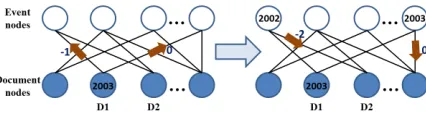
[image:2.612.323.536.341.400.2]As mentioned above, the relative temporal relations between documents and events are useful for dat-ing documents. By analyzdat-ing the temporal relations, even if there are only a small number of documents labeled with timestamps, this information can be propagated to documents connected with them on a bipartite graph using breadth first traversal (BFS).
Figure 1: An example of BFS-based propagation
As shown in figure 1, there are two kinds of nodes in the bipartite graph. A document node is a single document while an event node represents an event. The edge between a document node and an event node means that the document mentions the event. Also, the edge carries the information of the rela-tive temporal relation between the document and the event. The label propagation from nodeito nodej
will occur if BFS condition which is defined as fol-lows is satisfied:
eij ∈E
i∈Landj /∈L (BFS condition)
When the timestamp of i is propagated to j:
Y(j) =Y(i) +δ(i, j)
L=L∪ {j}
whereE is the set of edges of the bipartite graph,
In figure 1, the timestamp of documentD1is 2003, which is known. This information can be propagated to its adjacent nodes i.e. the event nodes it men-tions according to the relative temporal relamen-tions. Then, these event nodes propagate their timestamps to other documents which mention them. By re-peating this process, the timestamp of the document can be propagated to documents which are reachable from the initially labeled document on the bipartite graph.
[image:3.612.113.269.356.421.2]Although the BFS-based propagation process can propagate timestamps from few labeled documents to a large number of unlabeled ones, it has two short-comings for this task. First, once one timestamp is propagated incorrectly, this error will lead to more mistakes in the following propagations. If such an error occurred at the beginning of the propagation process, it would lead to propagation of errors. Sec-ond, BFS-based method cannot address conflict of predictions during propagation, which is shown in figure 2.
Figure 2: Conflict of predictions during propagation
To address the problems of the BFS-based method, we proposed a novel propagation model called confidence boosting model which improves the BFS-based model by optimizing the global con-fidence of the bipartite graph. In the confidence boosting model, every node in the bipartite graph has a confidence which measures the credibility of the predicted timestamp of the node. When the timestamp of a node is propagated to other nodes, its confidence will be also propagated to the tar-get nodes with some loss. The loss of confi-dence is called conficonfi-dence decay. Formally, the confidence decay process is described as follows:
c(j) =c(i)×σ(i, j)
where c(i) denotes confidence of node i and
σ(i, j) is the decay factor from node i to node j. For guaranteeing that timestamps can be propagated on the bipartite graph
cred-ibly, we define the following condition which is called CB (Confidence Boosting) condition:
eij ∈E
c(i)×σ(i, j)> c(j) (CB condition)
In the confidence boosting model, propagation from nodeito nodejwill occur only if CB condition is satisfied. When timestamps are propagated on the bipartite graph, timestamps and confidence of nodes will be updated dynamically. A node with high con-fidence is more active than nodes with low confi-dence to propagate its timestamp because a node with high confidence is more likely to satisfy the CB condition for propagating its timestamp. Moreover, a prediction with low confidence can be corrected by the prediction with high confidence. Therefore, the confidence boosting model can address both prop-agation of errors and conflict of predictions which cannot be tackled by the BFS-based model.
However, there are challenges for running such propagation models in practice. First, the relative temporal relations between documents and events are usually unavailable. Second, events extracted from different documents do not have any connec-tion even if they refer to the same event. There-fore, each event is connected with only one docu-ment in the bipartite graph and thus cannot prop-agate its timestamp to other documents unless we perform event coreference resolution. Third, propa-gations from generic events are very likely to lead to propagation errors because generic events can hap-pen in any year. Also, how to set the confidence and decay factors reasonably in practice for a confidence boosting model is worthy of investigation. All these challenges for the propagation models and their cor-responding solutions will be discussed in Section 3.
3 Details of Event-based Propagation Models
3.1 Event extraction and processing
As mentioned in previous sections, events play a key role in the propagation models. We define an event as a Subject-Predicate-Object (SPO) triple. To tract events from raw text, an open information ex-traction software - ReVerb (Fader et al., 2011) is used. ReVerb is a program that automatically iden-tifies and extracts relationships from English sen-tences. It takes raw text as input and outputs SPO triples which are called extractions.
However, extractions extracted by ReVerb cannot be used directly for our propagation models for three main reasons. First, the relative temporal relations between documents and the extractions are unavail-able. Second, the extractions extracted from differ-ent documdiffer-ents do not have any connection even if they refer to the same event. Third, propagations from generic events are very likely to lead to propa-gation errors.
For addressing the three challenges for the prop-agation models, we first presented a rule-based method for mining the relative temporal relations be-tween extractions and documents in Section 3.1.1. Then, an efficient event coreference resolution method is introduced in Section 3.1.2. Finally, the method for distinguishing specific extractions from generic ones is shown in Section 3.1.3.
3.1.1 Relative temporal relation mining
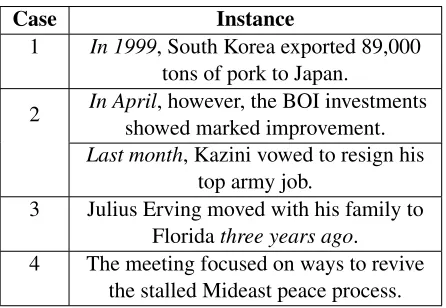
We used a rule-based method to extract temporal expressions and used Stanford parser (De Marneffe et al., 2006) to analyze association between the tem-poral expressions and the extractions. Specifically, we define that an extraction is associated with a tem-poral expression if there is an arc from the predicate of the extraction to the temporal expression in the dependency tree. For a certain extraction, there are the following four cases whose instances are shown in table 1 for handling.
Case 1: The extraction is associated with an
abso-lute temporal expressions with year mentions in the sentence.
In this case, the time of the extraction is equal to the year mention:
Y(ex) =Y earM ention
For the example in table 1,Y(ex) = 1999.
Case 2: The extraction is associated with a relative
temporal expression (not involving year) in the
sen-Case Instance
1 In 1999, South Korea exported 89,000 tons of pork to Japan.
2 In April, however, the BOI investments showed marked improvement.
Last month, Kazini vowed to resign his top army job.
3 Julius Erving moved with his family to Floridathree years ago. 4 The meeting focused on ways to revive
[image:4.612.315.538.55.209.2]the stalled Mideast peace process.
Table 1: Instances of various temporal expressions
tence.
In this case, the time of the extraction is equal to the creation time of the document:
Y(ex) =Y(d)
Case 3: The extraction is associated with a relative
temporal expression (involving specific year gap) in the sentence.
In this case, the time of the extraction is computed as follows:
Y(ex) =Y(d)±Y earGap
For the example in table 1,Y(ex) =Y(d)−3.
Case 4: The extraction is not associated with any
temporal expression in the sentence or the other cases.
In this case, it is difficult to recognize the rela-tive temporal relations. However, timeliness can be leveraged to determine the relations as a heuristic method. It is known that timeliness is an important feature of news so that events reported by a news ar-ticle usually took place a couple of days or weeks before the article was written. Therefore, we heuris-tically consider the year of the extraction is the same with that of its source document in this case:
Y(ex) =Y(d)
the accuracy of each case which will be used as a part of the decay factor in the confidence boosting model.
Case Accuracy
1 0.774(168/217)
2 0.994(844/849)
3 0.836(281/336)
[image:5.612.122.249.105.191.2]4 0.861(1376/1598) Total 0.890(2669/3000)
Table 2: Accuracy of the four cases
We define the set of these determined relative tem-poral relationsRas follows:
R={rd,ex|d=doc(ex), ex∈C2∪C3∪C4}
rd,ex=< d, ex, δ(d, ex)>
δ(d, ex) =−δ(ex, d) ={0,±1,±2,±3, ...}
where Ck is the set of extractions in case k and
doc(ex)is the document which extractionexcomes from. rd,exis a triple describing the relative tempo-ral relation between dand ex. For example, triple
rd,ex =< d, ex,−1 >means that the time of ex-tractionexis one year before the time of document
d.
3.1.2 Event coreference resolution
Extractions from different documents have no connections. However, there are a great number of extractions referring to the same event. For find-ing such coreferential event extractions efficiently, hierarchical agglomerative clustering (HAC) is used to cluster highly similar extractions into one cluster. We use cosine to measure the similarity between ex-tractions and select bag of words as features. Note that it is less meaningful to cluster the extractions from the same document because coreferential ex-tractions from the same document are not helpful for timestamp propagations. For this reason, similarity between extractions from the same documents is set to 0.
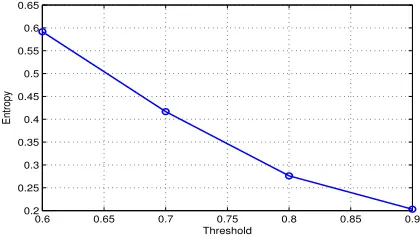
For HAC, selection of threshold is important. If the threshold is set too high, only a few extractions can be clustered despite high purity; on the contrary, if the threshold is set too low, purity of clusters will descend. In fact, selection of threshold is a trade-off between the precision and recall of event corefer-ence resolution. For selecting a suitable threshold,
extractions from documents written in 1995-1999 are used as a development set.
In practice, it is difficult for us to directly evalu-ate the performance of the coreference resolution of event extractions without golden standard which re-quires much labors for manual annotations. Alterna-tively, entropy which measures the purity of clusters is used for evaluation because it can indirectly re-flect the precision of coreference resolution to some extent:
Entropy=−X j
nj
n
X
i
P(i, j)×log2P(i, j)
whereP(i, j)is the probability of finding an extrac-tion whose timestamp isiin the clusterj,nj is the number of items in clusterjandnis the total num-ber of extractions. Note that timestamp of an extrac-tion is assigned based on its document timestamp using the method proposed in Section 3.1.1.
Figure 3 shows the effect of selection of the threshold on cluster performance. It can be found that when the threshold reaches 0.8, the entropy starts descending gently and is low enough. Since we want to find as many coreferential extractions as possible on the premise that the precision is good, the threshold is set to 0.8. Note that extractions which are single in one cluster will be filtered out because they do not have any connections with any other documents.
0.6 0.65 0.7 0.75 0.8 0.85 0.9 0.2
0.25 0.3 0.35 0.4 0.45 0.5 0.55 0.6 0.65
Threshold
[image:5.612.323.533.456.575.2]Entropy
Figure 3: Entropy of clusters under different thresholds
3.1.3 Distinguishing specific events from
generic ones
event and this event may occur in any year. In other words, it is not able to indicate a certain timestamp and thus propagations from a generic event node are very likely to result in propagation errors. In con-trast, the extraction “some of the provinces in China were hit by SARS” refers to a specific event which took place in 2003. For our task, such specific event extractions which are associated with one certain timestamp are desirable. For the sake of distinguish-ing such extractions from the generic ones, a Max-Ent classifier is used to classify extractions as either specific ones or generic ones.
Training Set Generation A training set is
indis-pensable for training a MaxEnt classifier. In order to generate training examples, we performed HAC discussed in Section 3.1.2 for event coreference res-olution on extractions from all documents written in May and June of 1995-1999 and then analyzed each cluster. If extractions in a cluster have different timestamps, then the extractions in this cluster will be labeled as generic extractions (negative); other-wise, extractions in the cluster are labeled as spe-cific ones (positive). In this way, the training set can be generated without manually labeling. To avoid bias of positive and negative examples, we sampled 3,500 positive examples and 3,500 negative exam-ples to train the model.
Feature SelectionThe following features were
se-lected for training:
Named Entities: People and places are often dis-cussed during specific time periods, particularly in news genre. Intuitively, if an extraction contains specific named entities then this extraction is less likely to be a generic event. If an extraction con-tains named entities, types and uninterrupted tokens of the named entities will be included as features.
Numeral: According to our analysis of the train-ing set generated by the above-mentioned method, generic extractions usually contain numerals. For example, the extraction “15 people died in this ac-cident” and the extraction “225 people died in this accident” have the same tokens except numerals and they are labeled as a generic event because they are clustered into one group due to high similarity but they in fact refer to different events happening in different years. Therefore, if an extraction contains numerals, the feature “NUM” will be included.
Bag of words:Bag of words can also be an indicator of specific extractions and generic ones. For exam-ple, an extraction containing ‘stock’, ‘index’, ‘fell’ and ‘exchange’ is probably a generic one.
The model obtained after training can be used to predict whether an extraction is a specific one. We defineP(S = 1|ex) as the probability that an ex-traction is a specific one, which can be provided by the classifier. Extractions whose probability to be a specific one is less than 0.05 are filtered out. For the other extractions, this probability is used as a part of the decay factor in the confidence boosting model, which will be discussed in detail in Section 3.2.
3.2 Confidence boosting
After extracting and processing the event extrac-tions, relative temporal relations between documents and events can be constructed. This can be for-mally represented by a bipartite graph G=hV, Ei. There are two kinds of nodes on the bipartite graph: document nodes and event nodes. Slightly dif-ferent with the event node mentioned in Section 2, an event node in practice is a cluster of coref-erential extractions and it can be connected with multiple document nodes. Note that the bipar-tite graph does not contain any isolate node. For briefness, we define DN ode as the set of docu-ment nodes andEN odeas the set of event nodes. The set of edgesE is formally defined as follows:
E={eij, eji|i∈DN ode, j ∈EN ode, ri,j∈R} whereRis the set of relative temporal relations de-fined as Section 3.1.1.
3.2.1 Confidence and decay factor
As mentioned in Section 2, the confidence of a node measures the credibility of the predicted times-tamp. According to the definition, we set the dence of initially labeled nodes to 1 and set confi-dence of nodes without any timestamp to 0 in prac-tice. When the timestamp of a node is propagated to another node, its confidence will be propagated to the target node with some loss, as discussed in Sec-tion 2. The confidence loss is caused by two factors in practice. The first one is the credibility of the rel-ative temporal relation between two nodes and the other one depends on whether an extraction refers to a specific event.
and extractions we mined using the rule-based method in Section 3.1.1 are not absolutely correct. The credibility of the relations has an effect on the confidence decay. Formally, we usedπ(i, j) to de-note the credibility of the relative temporal relation between nodeiand nodej. The credibility of a rel-ative temporal relation in each case can be estimated through table 2. If the credibility of the relative tem-poral relation between i and j is low, propagation from nodeitojprobably leads to error. Therefore, the confidence loss should be much in this case. On contrary, if the relation is highly credible, it will be less likely that propagation errors occur. Therefore, the confidence loss should be little.
In addition, whether an extraction refers to a generic event or a specific one exerts an impact on the confidence loss. If an extraction refers to a generic event, then the extractions in the same clus-ter with it probably have different timestamps. Since our propagation model assumes that extractions in a cluster are coreferent and thus they should have the same timestamp, propagations from a generic event node are very likely to result in propagation errors. Therefore, the timestamp of a generic event node in fact is less credible for propagations and confi-dence of such event nodes should be low for limiting propagations from the nodes. For this reason, prop-agation from a document node to a generic event node leads to much loss of confidence. We define the probability that an event node refers to a specific event as follows:
P(S= 1|enode) = 1
|C|
X
ex∈C
P(S= 1|ex)
whereCis the set of extractions in the event node and P(S = 1|ex)is the probability that an extrac-tion refers to a specific event, which can be provided by the MaxEnt classifier discussed in Section 3.1.3.
Considering the two factors for confidence loss, we formally define the decay factor by (1).
σ(s, t) = (1)
π(s, t) ift∈DN ode
π(s, t)×P(S= 1|t)otherwise
3.2.2 Confidence boosting algorithm
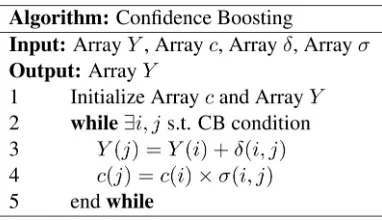
[image:7.612.331.522.57.167.2]In confidence boosting model, the propagation from ito j will occur only if the CB condition is
Figure 4: Algorithm of confidence boosting
satisfied. The confidence boosting propagation pro-cess can be described as figure 4.
Whenever timestamps are propagated to other nodes, the global confidence of the bipartite graph will increase. For this reason, this propagation pro-cess is called confidence boosting. In this model, a node with high confidence is more active than nodes with low confidence to propagate its times-tamp. Moreover, a prediction with low confidence can be corrected by the prediction with high con-fidence. Therefore, the confidence boosting model can alleviate the problem of propagation of errors to some extent and handle conflict of predictions. Thus, it can propagate timestamps more credibly than the BFS-based model. It can also be proved that each node on the bipartite graph must reach the highest confidence it can reach so that the global confidence of the bipartite graph must be optimal when the confidence boosting propagation process ends regardless of propagation orders, which will be discussed in Section 3.2.3.
3.2.3 Proof of the optimality of confidence
boosting
Proof by contradiction can be used to prove that propagation orders do not affect the optimality of the confidence boosting model.
Proof Assume by contradiction that there is some
node that does not reach its highest confidence it can reach when a confidence boosting process in propa-gation orderAends:
∃vts.t.cA(vt)< c∗(vt)
path from the propagation source node v1 to the node vt that leads to the highest confidence of vt, which means thatc∗(vt) =c∗(vt−1)×σ(vt−1, vt),
c∗(vt−1) = c∗(vt−2)×σ(vt−2, vt−1), ..., c∗(v2) =
c∗(v1)×σ(v1, v2). Then according to CB
condi-tion, since cA(vt−1) ×σ(vt−1, vt) ≤ cA(vt) <
c∗(vt) = c∗(vt−1) × σ(vt−1, vt), the inequality
cA(vt−1)< c∗(vt−1)must hold. Similarly, it can be
easily inferred thatcA(vt−2) < c∗(vt−2)and finally
cA(v1)< c∗(v1). Sincev1is the source node whose timestamp is initially labeled and its confidence is 1, the inequalitycA(v1) < c∗(v1) cannot hold. Thus,
the assumption thatcA(vt) < c∗(vt) cannot be sat-isfied. Therefore, it can be proved that each node on the bipartite graph must reach the highest con-fidence it can reach so that the global concon-fidence of the bipartite graph must be optimal when confidence boosting propagation process ends no matter what order time labels are propagated in.
4 Experiments
In this section, we evaluate the performance of our time label propagation models and different auto-matic document dating models on the Gigaword dataset. We first present the experimental setting. Then we show experimental results and perform an analysis.
4.1 Experimental Setting
Dataset To simulate the environment of the web
where data is very redundant, we use all documents written in April, June, July and September of 2000-2004 of Gigaword Corpus as dataset instead of sam-pling a subset of documents from each period. The dataset contains 900,199 news articles.
Pre-processing Many extractions extracted by
Re-Verb are short and uninformative and do not carry any valuable information for propagating temporal information. Also, some extractions do not refer to events which already happened. These extrac-tions may affect the performance of event corefer-ence resolution and the rule-based method proposed in Section 3.1.1 for mining relative temporal rela-tions. Therefore, we filter out these undesirable ex-tractions in advance with a rule-based method. The rules are shown in table 3. This preprocessing re-moves large numbers of “bad” extractions which are
undesirable for our task. As a result, not only com-putation efficiency but also precision of event coref-erence resolution will be improved.
Rule1 If the number of tokens of the
extrac-tion is less than 5 then this extracextrac-tion will be filtered out.
Rule2 If the maximum idf of terms of the
traction is less than 3.0 then this ex-traction will be filtered out.
Rule3 If the tense of the extraction is not past
tense then this extraction will be fil-tered out.
Rule4 If the extraction is the content of
[image:8.612.318.534.111.291.2]di-rect quotation then this extraction will be filtered out.
Table 3: Pre-processing Rules
|DN ode| 550,124 |EN ode| 968,064 |E| 3,104,666
Table 4: Basic information of the bi-partite graph
Basic information of the document-event bipartite graph constructed is shown in table 4.
Evaluation To evaluate the performance of the
propagation models for the task of dating on differ-ent sizes of the training set, we used differdiffer-ent sizes of the labeled documents for training and consid-ered the remaining documents as the test set. Note that the training set is randomly sampled from the dataset. To be more persuasive, we repeated above experiments for five times.
However, in the time label propagation process, not all documents can be labeled. For those doc-uments which cannot be labeled in the process of propagation, a MaxEnt classifier serves as a comple-mentary approach to predict their timestamps. For the MaxEnt classifier, unigrams and named entities are simply selected as features and the initially la-beled documents as well as documents lala-beled dur-ing propagation process are used for traindur-ing.
Initially Labeled 1k 5k 10k 50k 100k 200k 500k
Reached Min 443980 448653 453022 484562 518603 599724 732701
Reached Max 444266 448998 454028 484996 519333 579878 732799
Reached Avg 444107 448742 453786 484622 519110 579835 732758
Prop Ratio 444.1 89.7 45.4 9.7 5.2 2.9 1.5
Prop acc(BFS) 0.438 0.515 0.551 0.646 0.691 0.725 0.775
[image:9.612.105.508.57.156.2]Prop acc(CB) 0.494 0.569 0.603 0.701 0.746 0.776 0.807
Table 5: Performance of Propagation
Initially Labeled 1k 5k 10k 50k 100k 200k 500k
Temporal LMs 0.277 0.323 0.353 0.412 0.422 0.425 0.420
Maxent(Unigrams) 0.326 0.378 0.407 0.486 0.517 0.553 0.590
Maxent(Unigrams+NER) 0.331 0.383 0.418 0.506 0.549 0.590 0.665
Chambers’s 0.331 0.386 0.423 0.524 0.571 0.615 0.690
BFS+Maxent 0.459 0.508 0.533 0.595 0.626 0.658 0.707
CB+Maxent 0.486 0.535 0.559 0.624 0.655 0.685 0.726
Table 6: Overall accuracy of dating models
by Nathanael Chambers (2012). In Chambers’s joint model, the interpolation parameter λ is set to 0.35 which is considered optimal in his work.
4.2 Experimental Results
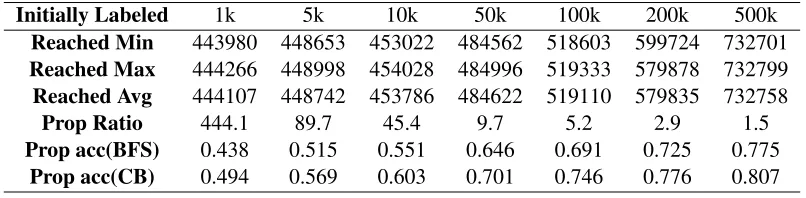
Table 5 shows the performance of propagation mod-els where Reached denotes the number of docu-ments labeled when the propagation process ends,
prop ratioandprop accuracyare defined as follows:
Prop Ratio= #ReachedDocN odes #LabeledDocN odes
Prop Accuracy=
#CorrectDocN odes−#LabeledDocN odes
#ReachedDocN odes−#LabeledDocN odes
where #LabeledDocN odes is the number of ini-tially labeled document nodes which are documents in the training set and#ReachedDocN odesis the number of document nodes labeled when the propa-gation process ends.
Note that prop ratio and accuracy in table 5 are the mean of the prop ratio and accuracy of the five groups of experiments. It is clear that confidence boosting model improves the prop accuracy over BFS-based model. When only 1,000 documents are initially labeled with timestamps, the confidence boosting model can propagate their timestamps to more than 400,000 documents with an accuracy of
0.494, approximately 12.8% relative improvement over the BFS counterpart, which proves effective-ness of the confidence boosting model.
However, as shown in table 5, hardly can the prop-agation process propagate timestamps to all doc-uments. One reason is that the number of docu-ment nodes on the bipartite graph is only 550,124, approximately 61.1% of all documents. The other documents may not mention events which are also mentioned by other documents, which means they are isolate and thus are excluded from the bipartite graph. Also, the event coreference resolution phase does not guarantee finding all coreferential extrac-tions; in other words, recall of event coreference res-olution is not 100%. The other reason is that some documents are unreachable from the initially labeled nodes even if they are in the bipartite graph.
entities and linguistic features as well as temporal constraints will improve the overall accuracy sig-nificantly. However, if the size of the training set is small, these features will not result in much im-provement.
Compared with the previous models, the propaga-tion models predict the document timestamps much more accurately especially in the case where the size of the training set is small. When the size of the training set is 1,000, our BFS-based model and con-fidence boosting model combined with the MaxEnt classifier outperform Chambers’s joint model which is considered the state-of-the-art model for the task of automatic dating of documents by 38.7% and 46.8% relative accuracy respectively. This is be-cause the feature-based methods are not very reli-able especially when the size of the training set is small. In contrast, our propagation models can pre-dict timestamps of documents with an understand-ing of document content, which allows our method to date documents more credibly than the baseline methods. Also, by comparing table 5 with table 6, it can be found that prop accuracy is almost always higher than overall accuracy, which also verifies that the propagation models are more credible for dat-ing document than the feature-based models. More-over, data is so redundant that a great number of documents can be connected with events they share. Therefore, even if a small number of documents are labeled, the labeled information can be propagated to large numbers of articles through the connections between documents and events according to relative time relations. Even if the size of the training set is large, e.g. 500,000, our propagation models still outperform the state-of-the-art dating method. Ad-ditionally, some event nodes on the bipartite graph may be labeled with a timestamp during the process of propagation as a byproduct. The temporal infor-mation of the events would be useful for other tem-poral analysis tasks.
5 Related Work
In addition to work of de Jong et al. (2005) and Chambers (2012) introduced in previous sections, there is also other research focusing on the task of document dating. Kanhabua and Norvag (2009) im-proved temporal language models by incorporating
temporal entropy and search statistics and apply-ing two filterapply-ing techniques to the unigrams in the model. Kumar et al. (2011) is also based on the temporal language models, but more historically-oriented, which models the timeline from the present day back to the 18th century. In addition, they used KL-divergence instead of normalized log likelihood ratio to measure differences between a document and a time period’s language model.
However, these methods are based on tempo-ral language models so they also suffer from the problem of the method of de Jong et al. (2005). Therefore, they inevitably make wrong predictions in some cases, just as mentioned in Section 1. Com-pared with these methods, our event-based propaga-tion models exploit relative temporal relapropaga-tions be-tween documents and events for dating document on a basis of an understanding of document content, which is more reasonable and also proved to be more effective by the experimental results.
6 Conclusion
The main contribution of this paper is exploiting relative temporal relations between events and doc-uments for the document dating task. Different with the conventional work which dates documents with feature-based methods, we proposed an event-based time label propagation model called confi-dence boosting in which timestamps are propagated on a document-event bipartite graph according to relative temporal relations between documents and events for dating documents on a basis of an under-standing of document content. We discussed chal-lenges for the propagation models and gave the cor-responding solutions in detail. The experimental re-sults show that our event-based propagation model can predict document timestamps in high accuracy and the model combined with a MaxEnt classifier outperforms the state-of-the-art method on a data-redundant dataset.
Acknowledgements
References
Klaus Berberich, Srikanta Bedathur, Thomas Neumann, and Gerhard Weikum. 2007. A time machine for text search. In Proceedings of the 30th annual in-ternational ACM SIGIR conference on Research and development in information retrieval, pages 519–526. ACM.
Giang Binh Tran, Mohammad Alrifai, and Dat Quoc Nguyen. 2013. Predicting relevant news events for timeline summaries. InProceedings of the 22nd international conference on World Wide Web compan-ion, pages 91–92. International World Wide Web Con-ferences Steering Committee.
Nathanael Chambers and Dan Jurafsky. 2008. Jointly combining implicit constraints improves temporal or-dering. InProceedings of the Conference on Empir-ical Methods in Natural Language Processing, pages 698–706. Association for Computational Linguistics. Nathanael Chambers. 2012. Labeling documents with
timestamps: Learning from their time expressions. In Proceedings of the 50th Annual Meeting of the Asso-ciation for Computational Linguistics: Long Papers-Volume 1, pages 98–106. Association for Computa-tional Linguistics.
FMG de Jong, Henning Rode, and Djoerd Hiemstra. 2005. Temporal language models for the disclosure of historical text. Royal Netherlands Academy of Arts and Sciences.
Marie-Catherine De Marneffe, Bill MacCartney, Christo-pher D Manning, et al. 2006. Generating typed de-pendency parses from phrase structure parses. In Pro-ceedings of LREC, volume 6, pages 449–454.
Anthony Fader, Stephen Soderland, and Oren Etzioni. 2011. Identifying relations for open information ex-traction. InProceedings of the Conference on Empiri-cal Methods in Natural Language Processing, pages 1535–1545. Association for Computational Linguis-tics.
David Graff, Junbo Kong, Ke Chen, and Kazuaki Maeda. 2003. English gigaword.Linguistic Data Consortium, Philadelphia.
Po Hu, Minlie Huang, Peng Xu, Weichang Li, Adam K Usadi, and Xiaoyan Zhu. 2011. Generating breakpoint-based timeline overview for news topic ret-rospection. InData Mining (ICDM), 2011 IEEE 11th International Conference on, pages 260–269. IEEE. Pawel Jan Kalczynski and Amy Chou. 2005. Temporal
document retrieval model for business news archives. Information processing management, 41(3):635–650. Nattiya Kanhabua and Kjetil Nørv˚ag. 2009.
Us-ing temporal language models for document datUs-ing. In Machine Learning and Knowledge Discovery in Databases, pages 738–741. Springer.
Abhimanu Kumar, Matthew Lease, and Jason Baldridge. 2011. Supervised language modeling for temporal res-olution of texts. InProceedings of the 20th ACM in-ternational conference on Information and knowledge management, pages 2069–2072. ACM.


![endo 11 (Dibenzylamino)tetracyclo[5 4 0 03,10 05,9]undecane 8 one](data:image/gif;base64,R0lGODlhAQABAIAAAP///wAAACH5BAEAAAAALAAAAAABAAEAAAICRAEAOw==)