169
Universal Sentence Encoder for English
Daniel Cera†, Yinfei Yanga†, Sheng-yi Konga, Nan Huaa, Nicole Limtiacob, Rhomni St. Johna, Noah Constanta, Mario Guajardo-C´espedesa, Steve Yuanc,
Chris Tara, Yun-Hsuan Sunga, Brian Stropea, Ray Kurzweila
aGoogle AI
Mountain View, CA
bGoogle AI
New York, NY
cGoogle
Cambridge, MA
Abstract
We present easy-to-use TensorFlow Hub sentence embedding models having good task transfer performance. Model vari-ants allow for trade-offs between accuracy and compute resources. We report the lationship between model complexity, re-sources, and transfer performance. Com-parisons are made with baselines with-out transfer learning and to baselines that incorporate word-level transfer. Transfer learning using sentence-level embeddings is shown to outperform models without transfer learning and often those that use only word-level transfer. We show good transfer task performance with minimal training data and obtain encouraging re-sults on word embedding association tests (WEAT) of model bias.
1 Introduction
We present easy-to-use sentence-level embed-ding models with good transfer task performance even when using remarkably little training data.1 Model engineering characteristics allow for trade-offs between accuracy versus memory and com-pute resource consumption.
2 Model Toolkit
Models are implemented in TensorFlow (Abadi et al., 2016) and are made publicly available on TensorFlow Hub.2 Listing1provides an example
†Corresponding authors:
{cer, yinfeiy}@google.com
1We describe our publicly released models. See Yang
et al.(2018) andHenderson et al.(2017) for additional ar-chitectural details of models similar to those presented here.
2https://www.tensorflow.org/hub/, Apache 2.0 license, with models available as saved TF graphs.
import tensorflow_hub as hub
embed = hub.Module("https://tfhub.dev/google/" "universal-sentence-encoder/2")
embedding = embed(["Hello World!"])
Listing 1: Python sentence embedding code.
code snippet to compute a sentence-level embed-ding from a raw untokenized input string.3The re-sulting embedding can be used directly or incorpo-rated into a downstream model for a specific task.4
3 Encoders
Two sentence encoding models are provided: (i) transformer (Vaswani et al.,2017), which achieves high accuracy at the cost of greater resource con-sumption; (ii) deep averaging network (DAN) (Iyyer et al., 2015), which performs efficient in-ference but with reduced accuracy.
3.1 Transformer
The transformer sentence encoding model con-structs sentence embeddings using the encod-ing sub-graph of the transformer architecture (Vaswani et al., 2017). The encoder uses atten-tion to compute context aware representaatten-tions of words in a sentence that take into account both the ordering and identity of other words. The context aware word representations are averaged together to obtain a sentence-level embedding.
We train for broad coverage using multi-task learning, with the same encoding model support-ing multiple downstream tasks. The task types include: a Skip-Thought like task (Kiros et al.,
3Basic text preprocessing and white-space tokenization is
performed internally. Preprocessing lowercases the text and removes punctuation. OOV items are handled using string hashing to index into 400,000 OOV embeddings.
4Visit https://colab.research.google.com/to try the code
2015);5 conversational response prediction (Hen-derson et al.,2017); and a select supervised classi-fication task that improves sentence embeddings.6 The transformer encoder achieves the best transfer performance. However, this comes at the cost of compute time and memory usage scaling dramati-cally with sentence length.
3.2 Deep Averaging Network (DAN)
The DAN sentence encoding model begins by averaging together word and bi-gram level em-beddings. Sentence embeddings are then obtain by passing the averaged representation through a feedforward deep neural network (DNN). The DAN encoder is trained similar to the transformer encoder. Multitask learning trains a single DAN encoder to support multiple downstream tasks. An advantage of the DAN encoder is that compute time is linear in the length of the input sequence. Similar toIyyer et al.(2015), our results demon-strate that DANs achieve strong baseline perfor-mance on text classification tasks.
3.3 Encoder Training Data
Unsupervised training data are drawn from a va-riety of web sources. The sources are Wikipedia, web news, web question-answer pages and discus-sion forums. We augment unsupervised learning with training on supervised data from the Stanford Natural Language Inference (SNLI) corpus (Bow-man et al.,2015) in order to further improve our representations (Conneau et al.,2017). Since the only supervised training data is SNLI, the models can be used for a wide range of downstream super-vised tasks that do not overlap with this dataset.7
4 Transfer Tasks
This section presents the data used for the transfer learning experiments and word embedding asso-ciation tests (WEAT): (MR) Movie review senti-ment on a five star scale (Pang and Lee, 2005); (CR) Sentiment of customer reviews (Hu and Liu, 2004); (SUBJ) Subjectivity of movie re-views and plot summaries (Pang and Lee, 2004);
5
The Skip-Thought like task replaces the LSTM ( Hochre-iter and Schmidhuber,1997) in the original formulation with a transformer model.
6SNLI (Bowman et al.,2015;Conneau et al.,2017) 7
For questions on downstream evaluations possibly over-lapping with the encoder training data, visit the TF Hub discussion board, https://groups.google.com/a/ tensorflow.org/d/forum/hub, or e-mail the corre-sponding authors.
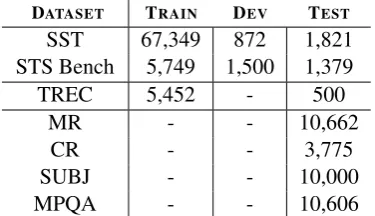
DATASET TRAIN DEV TEST
SST 67,349 872 1,821
STS Bench 5,749 1,500 1,379
TREC 5,452 - 500
MR - - 10,662
CR - - 3,775
SUBJ - - 10,000
[image:2.595.323.511.63.171.2]MPQA - - 10,606
Table 1: Transfer task evaluation sets.
(MPQA) Phrase opinion polarity from news data (Wiebe et al.,2005); (TREC) Fine grained ques-tion classificaques-tion sourced from TREC (Li and Roth,2002); (SST) Binary phrase sentiment clas-sification (Socher et al.,2013); (STS Benchmark) Semantic textual similarity (STS) between sen-tence pairs scored by Pearsonr with human judg-ments (Cer et al.,2017); (WEAT) Word pairs from the psychology literature on implicit association tests (IAT) that are used to characterize model bias (Caliskan et al.,2017).8 Table1gives the number of samples for each transfer task.
5 Transfer Learning Models
For sentence classification transfer tasks, the out-put of the sentence encoders are provided to a task specific DNN. For the pairwise semantic similar-ity task, the similarsimilar-ity of sentence embeddingsu
andvis assessed using−arccos||u|| ||uvv||.9
5.1 Baselines
For each transfer task, we include baselines that only make use of word-level transfer and baselines that make use of no transfer learning at all. For word-level transfer, we incorporate word embed-dings from a word2vec skip-gram model trained on a corpus of news data (Mikolov et al., 2013). The pretrained word embeddings are included as input to two model types: a convolutional neural network model (CNN) (Kim,2014); a DAN. The baselines that use pretrained word embeddings al-low us to contrast word- vs. sentence-level trans-fer. Additional baseline CNN and DAN models are trained without using any pretrained word or sentence embeddings. For reference, we com-pare with InferSent (Conneau et al., 2017) and
8For MR, CR, SUBJ, SST, and TREC we use the
prepa-ration of the data provided byConneau et al.(2017). 9arccos converts cosine similarity into an angular distance
Skip-Thought with layer normalization (Ba et al., 2016) on sentence-classification tasks. On the STS Benchmark, we compare with InferSent and the state-of-the-art neural STS systems CNN (HCTI) (Shao,2017) and gConv (Yang et al.,2018).
5.2 Combined Transfer Models
We explore combining the sentence and word-level transfer models by concatenating their rep-resentations prior to the classification layers. For completeness, we report results providing the clas-sification layers with the concatenating of the sentence-level embeddings and the representations produced by baseline models that do not make use of word-level transfer learning.
6 Experiments
Experiments use our most recent transformer and DAN encoding models.10 Transfer task model hy-perparamaters are tuned using a combination of Vizier (Golovin et al.,2017) and light manual tun-ing. When available, model hyperparameters are tuned using task dev sets. Otherwise, hyperparam-eters are tuned by cross-validation on task train-ing data or the evaluation test data when neither training nor dev data are provided. Training re-peats ten times for each task with randomly ini-tialized weights and we report results by averaging across runs. Transfer learning is important when training data is limited. We explore using vary-ing amounts of trainvary-ing data for SST. Contrastvary-ing the transformer and DAN encoders demonstrates trade-offs in model complexity and the training data required to reach a desired level of task ac-curacy. Finally, to assess bias in our encoders, we evaluate the strength of biased model associations on WEAT. We compare toCaliskan et al. (2017) who discovered that word embeddings reproduce human-like biases on implicit association tasks.
7 Results
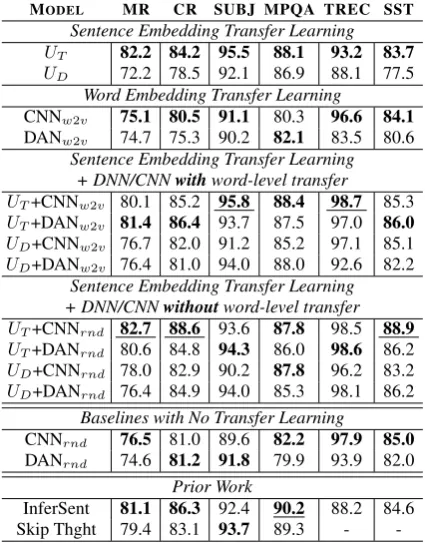
Table2presents results on classification tasks. Us-ing transformer sentence-level embeddUs-ings alone outperforms InferSent on MR, SUBJ, and TREC. The transformer sentence encoder also strictly out-performs the DAN encoder. Models that make use of just the transformer sentence-level embeddings tend to outperform all models that only use word-level transfer, with the exception of TREC and
10universal-sentence-encoder/2 (DAN);
universal-sentence-encoder-large/3 (Transformer).
MODEL MR CR SUBJ MPQA TREC SST
Sentence Embedding Transfer Learning
UT 82.2 84.2 95.5 88.1 93.2 83.7 UD 72.2 78.5 92.1 86.9 88.1 77.5
Word Embedding Transfer Learning
CNNw2v 75.1 80.5 91.1 80.3 96.6 84.1
DANw2v 74.7 75.3 90.2 82.1 83.5 80.6
Sentence Embedding Transfer Learning + DNN/CNNwithword-level transfer
UT+CNNw2v 80.1 85.2 95.8 88.4 98.7 85.3 UT+DANw2v 81.4 86.4 93.7 87.5 97.0 86.0 UD+CNNw2v 76.7 82.0 91.2 85.2 97.1 85.1 UD+DANw2v 76.4 81.0 94.0 88.0 92.6 82.2
Sentence Embedding Transfer Learning + DNN/CNNwithoutword-level transfer
UT+CNNrnd 82.7 88.6 93.6 87.8 98.5 88.9 UT+DANrnd 80.6 84.8 94.3 86.0 98.6 86.2 UD+CNNrnd 78.0 82.9 90.2 87.8 96.2 83.2 UD+DANrnd 76.4 84.9 94.0 85.3 98.1 86.2
Baselines with No Transfer Learning
CNNrnd 76.5 81.0 89.6 82.2 97.9 85.0
DANrnd 74.6 81.2 91.8 79.9 93.9 82.0
Prior Work
InferSent 81.1 86.3 92.4 90.2 88.2 84.6
Skip Thght 79.4 83.1 93.7 89.3 -
-Table 2: Classification tasks. UT uses the trans-former encoder for transfer learning, while UD uses the DAN encoder. DAN/CNNw2v use pre-trained w2v emb. DAN/CNNrnd train rand. init. word emb. on the final classification task.
SST, on which CNNw2v performs better. Trans-fer learning with DAN sentence embeddings tends to outperform a DAN with word-level transfer, ex-cept on MR and SST. Models with sentence- and word-level transfer often outperform similar mod-els with sentence-level transfer alone.
MODEL DEV TEST
Transformer Encoder 0.802 0.766
DAN Encoder 0.760 0.717
Prior Work
gConv (Yang et al.,2018) 0.835 0.808
[image:3.595.310.523.63.335.2]CNN (HCTI) (Shao,2017) 0.834 0.784 InferSent (Conneau et al.,2017) 0.801 0.758
Table 3: STS Benchmark Pearson’s r. Our prior gConv model (Yang et al., 2018) is a variant of our TF Hub transformer model tuned to STS.
[image:3.595.307.528.524.622.2]the performance of state-of-the-art neural models whose representations are fit to the STS task.
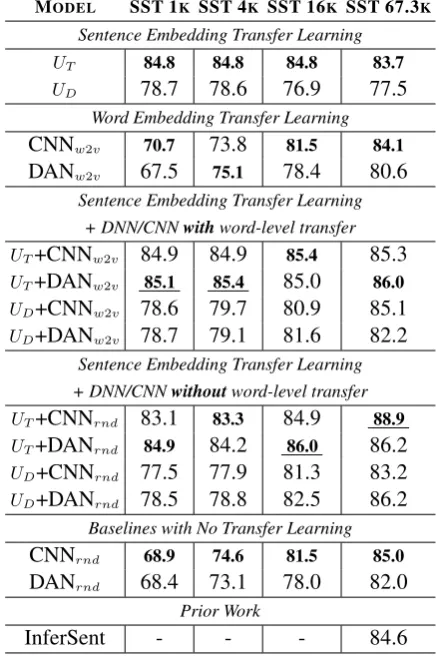
Table4illustrates transfer task performance for varying amounts of training data. With small quantities of training data, sentence-level trans-fer achieves surprisingly good performance. Us-ing only 1k labeled examples and the transformer embeddings for sentence-level transfer surpasses the performance of transfer learning using In-ferSent on the full training set of 67.3k exam-ples. Training with 1k labeled examples and the transformer sentence embeddings surpasses word-level transfer using the full training set, CNNw2v, and approaches the performance of the best model without transfer learning trained on the complete dataset, [email protected]. Transfer learning is not always helpful when there is enough task training data. However, we observe that our best perform-ing model still makes use of transformer sentence-level transfer but combined with a CNN with no word-level transfer,UT+CNNrnd.
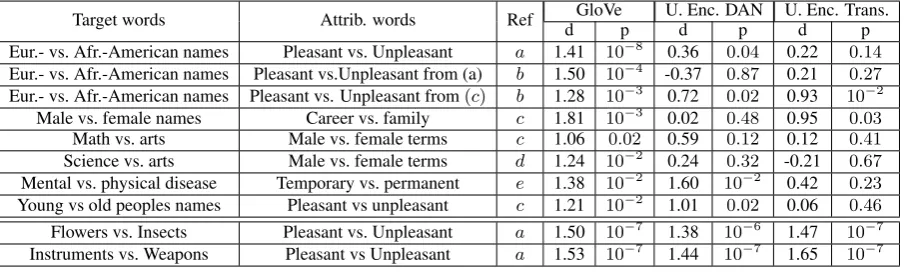
Table 5contrasts Caliskan et al.(2017)’s find-ings on bias within GloVe embeddfind-ings with results from the transformer and DAN encoders. Similar to GloVe, our models reproduce human associa-tions between flowers vs. insects and pleasantness vs. unpleasantness. However, our models demon-strate weaker associations than GloVe for probes targeted at revealing ageism, racism and sexism.11 Differences in word association patterns can be at-tributed to training data composition and the mix-ture of tasks used to train the representations.
8 Resource Usage
This section describes memory and compute re-source usage for the transformer and DAN sen-tence encoding models over different batch sizes and sentence lengths. Figure 1 plots model re-source consumption against sentence length.12
Compute Usage The transformer model time complexity isO(n2)in sentence length, while the
11
The development of our models did not target reducing bias. Researchers and developers are strongly encouraged to independently verify whether biases in their overall model or model components impacts their use case. For resources on ML fairness visit https://developers.google.com/machine-learning/fairness-overview/.
12
All benchmark values are averaged over 25 runs that follow 5 priming runs. CPU and mem. benchmarks are per-formed on a machine with an Intel(R) Xeon(R) Platinum P-8136 CPU @ 2.00GHz CPU. GPU benchmarks use an Intel(R) Xeon(R) CPU E5-2696 v4 @ 2.20GHz CPU and NVIDIA Tesla P100 GPU.
MODEL SST 1K SST 4K SST 16K SST 67.3K
Sentence Embedding Transfer Learning
UT 84.8 84.8 84.8 83.7 UD 78.7 78.6 76.9 77.5
Word Embedding Transfer Learning
CNNw2v 70.7 73.8 81.5 84.1
DANw2v 67.5 75.1 78.4 80.6
Sentence Embedding Transfer Learning + DNN/CNNwithword-level transfer
UT+CNNw2v 84.9 84.9 85.4 85.3 UT+DANw2v 85.1 85.4 85.0 86.0 UD+CNNw2v 78.6 79.7 80.9 85.1
UD+DANw2v 78.7 79.1 81.6 82.2
Sentence Embedding Transfer Learning + DNN/CNNwithoutword-level transfer
UT+CNNrnd 83.1 83.3 84.9 88.9 UT+DANrnd 84.9 84.2 86.0 86.2 UD+CNNrnd 77.5 77.9 81.3 83.2
UD+DANrnd 78.5 78.8 82.5 86.2
Baselines with No Transfer Learning
CNNrnd 68.9 74.6 81.5 85.0
DANrnd 68.4 73.1 78.0 82.0
Prior Work
InferSent - - - 84.6
Table 4: SST performance varying the amount of training data. Model types are the same as Table 2. Using 1k examples,UT transfer learning rivals models trained on the full training set, 67.3k.
DAN model is O(n). As seen in Figure 1 (a-b), for short sentences, the transformer encoding model is only moderately slower than the much simpler DAN model. However, compute time for transformer increases noticeably with sentence length. In contrast, the compute time for the DAN model stays nearly constant across different lengths. When running on GPU, even for large batches and longer sentence lengths, the trans-former model still achieves performance that can be used within an interactive systems.
[image:4.595.306.526.66.396.2](a) CPU Time vs. Sentence Length (b) GPU Time vs. Sentence Length (c) Memory vs. Sentence Length
Figure 1: Resource usage for the Universal Sentence Encoder DAN (USE-D) and Transformer (USE-T) models for different batch sizes and sentence lengths.
Target words Attrib. words Ref GloVe U. Enc. DAN U. Enc. Trans.
d p d p d p
Eur.- vs. Afr.-American names Pleasant vs. Unpleasant a 1.41 10−8 0.36 0.04 0.22 0.14 Eur.- vs. Afr.-American names Pleasant vs.Unpleasant from (a) b 1.50 10−4
-0.37 0.87 0.21 0.27 Eur.- vs. Afr.-American names Pleasant vs. Unpleasant from(c) b 1.28 10−3 0.72 0.02 0.93 10−2
Male vs. female names Career vs. family c 1.81 10−3
0.02 0.48 0.95 0.03
Math vs. arts Male vs. female terms c 1.06 0.02 0.59 0.12 0.12 0.41
Science vs. arts Male vs. female terms d 1.24 10−2 0.24 0.32 -0.21 0.67
Mental vs. physical disease Temporary vs. permanent e 1.38 10−2 1.60 10−2 0.42 0.23
Young vs old peoples names Pleasant vs unpleasant c 1.21 10−2 1.01 0.02 0.06 0.46
Flowers vs. Insects Pleasant vs. Unpleasant a 1.50 10−7 1.38 10−6 1.47 10−7
Instruments vs. Weapons Pleasant vs Unpleasant a 1.53 10−7
1.44 10−7
1.65 10−7
Table 5: WEAT for GloVe vs. our DAN and transformer encoding models. Effect size is reported as Cohen’s d over the mean cosine similarity scores across grouped attribute words. Statistical significance uses one-tailed p-scores. The Ref column indicates the source of the IAT word lists: (a) Greenwald et al.(1998)(b)Bertrand and Mullainathan(2004)(c)Nosek et al.(2002a)(d)Nosek et al.(2002b)(e) Monteith and Pettit(2011).
very short sequences transformer requires almost half as much memory as the DAN model.
9 Conclusion
Our encoding models provide sentence-level em-beddings that demonstrate strong transfer perfor-mance on a number of NLP tasks. The encoding models make different trade-offs regarding accu-racy and model complexity that should be consid-ered when choosing the best one for a particular application. Overall, our sentence-level embed-dings tend to surpass the performance of trans-fer using word-level embeddings alone. Models that make use of sentence- and word-level trans-fer often achieve the best performance. Sentence-level transfer using our models can be exception-ally helpful when limited training data is avail-able. The pre-trained encoding models are pub-licly available for research and use in industry
applications that can benefit from a better under-standing of natural language.
Acknowledgments
We thank our teammates from Descartes, Ai.h and other Google groups for their feedback and sug-gestions. Special thanks goes to Ben Packer and Yoni Halpern for implementing the WEAT assess-ments and discussions on model bias.
References
[image:5.595.74.528.270.406.2]Lei Jimmy Ba, Ryan Kiros, and Geoffrey E. Hinton. 2016.Layer normalization.CoRR, abs/1607.06450.
Marianne Bertrand and Sendhil Mullainathan. 2004. Are emily and greg more employable than lakisha and jamal? a field experiment on labor market discrimination. The American Economic Review, 94(4).
Samuel R. Bowman, Gabor Angeli, Christopher Potts, and Christopher D. Manning. 2015. A large anno-tated corpus for learning natural language inference. InProceedings of EMNLP.
Aylin Caliskan, Joanna J. Bryson, and Arvind Narayanan. 2017. Semantics derived automatically from language corpora contain human-like biases. Science, 356(6334):183–186.
Daniel Cer, Mona Diab, Eneko Agirre, Inigo Lopez-Gazpio, and Lucia Specia. 2017. Semeval-2017 task 1: Semantic textual similarity multilingual and crosslingual focused evaluation. In Proceedings of SemEval-2017.
Alexis Conneau, Douwe Kiela, Holger Schwenk, Loic Barrault, and Antoine Bordes. 2017. Supervised learning of universal sentence representations from natural language inference data. arXiv preprint arXiv:1705.02364.
Daniel Golovin, Benjamin Solnik, Subhodeep Moitra, Greg Kochanski, John Karro, and D. Sculley. 2017.
Google vizier: A service for black-box optimization. InProceedings of KDD ’17.
Anthony G. Greenwald, Debbie E. McGhee, and Jor-dan L. K. Schwartz. 1998. Measuring individual differences in implicit cognition: the implicit asso-ciation test. Journal of personality and social psy-chology, 74(6).
Matthew Henderson, Rami Al-Rfou, Brian Strope, Yun-Hsuan Sung, L´aszl´o Luk´acs, Ruiqi Guo, San-jiv Kumar, Balint Miklos, and Ray Kurzweil. 2017.
Efficient natural language response suggestion for smart reply.CoRR, abs/1705.00652.
Sepp Hochreiter and J¨urgen Schmidhuber. 1997. Long short-term memory. Neural Comput., 9(8):1735– 1780.
Minqing Hu and Bing Liu. 2004. Mining and sum-marizing customer reviews. InProceedings of KDD ’04.
Mohit Iyyer, Varun Manjunatha, Jordan Boyd-Graber, and Hal Daum´e III. 2015. Deep unordered compo-sition rivals syntactic methods for text classification. InProceedings of ACL/IJCNLP.
Yoon Kim. 2014. Convolutional neural networks for sentence classification. InProceedings of EMNLP.
Ryan Kiros, Yukun Zhu, Ruslan R Salakhutdinov, Richard Zemel, Raquel Urtasun, Antonio Torralba, and Sanja Fidler. 2015. Skip-thought vectors. InIn Proceedings of NIPS.
Xin Li and Dan Roth. 2002. Learning question classi-fiers. InProceedings of COLING ’02.
Tomas Mikolov, Ilya Sutskever, Kai Chen, Greg Cor-rado, and Jeffrey Dean. 2013. Distributed represen-tations of words and phrases and their composition-ality. InProceedings of NIPS’13.
Lindsey L. Monteith and Jeremy W. Pettit. 2011. Im-plicit and exIm-plicit stigmatizing attitudes and stereo-types about depression. Journal of Social and Clin-ical Psychology, 30(5).
Brian A. Nosek, Mahzarin R. Banaji, and Anthony G. Greenwald. 2002a. Harvesting implicit group at-titudes and beliefs from a demonstration web site. Group Dynamics, 6(1).
Brian A. Nosek, Mahzarin R. Banaji, and Anthony G Greenwald. 2002b. Math = male, me = female, therefore math me. Journal of Personality and So-cial Psychology,, 83(1).
Bo Pang and Lillian Lee. 2004. A sentimental educa-tion: Sentiment analysis using subjectivity summa-rization based on minimum cuts. InProceedings of the 42nd Meeting of the Association for Computa-tional Linguistics (ACL’04), Main Volume.
Bo Pang and Lillian Lee. 2005. Seeing stars: Ex-ploiting class relationships for sentiment categoriza-tion with respect to rating scales. InProceedings of ACL’05.
Yang Shao. 2017. Hcti at semeval-2017 task 1: Use convolutional neural network to evaluate se-mantic textual similarity. In Proceedings of the 11th International Workshop on Semantic Evalua-tion (SemEval-2017), pages 130–133.
Richard Socher, Alex Perelygin, Jean Wu, Jason Chuang, Christopher D. Manning, Andrew Ng, and Christopher Potts. 2013. Recursive deep models for semantic compositionality over a sentiment tree-bank. InProceedings of EMNLP.
Ashish Vaswani, Noam Shazeer, Niki Parmar, Jakob Uszkoreit, Llion Jones, Aidan N Gomez, Ł ukasz Kaiser, and Illia Polosukhin. 2017. Attention is all you need. InProceedings of NIPS.
Janyce Wiebe, Theresa Wilson, and Claire Cardie. 2005.Annotating expressions of opinions and emo-tions in language. Language Resources and Evalu-ation, 39(2):165–210.