Fear the REAPER: A System for Automatic Multi-Document
Summarization with Reinforcement Learning
Cody Rioux University of Lethbridge Lethbridge, AB, Canada [email protected]
Sadid A. Hasan
Philips Research North America Briarcliff Manor, NY, USA [email protected]
Yllias Chali University of Lethbridge
Lethbridge, AB, Canada [email protected]
Abstract
This paper explores alternate algorithms, reward functions and feature sets for per-forming multi-document summarization using reinforcement learning with a high focus on reproducibility. We show that ROUGE results can be improved using a unigram and bigram similarity metric when training a learner to select sentences for summarization. Learners are trained to summarize document clusters based on various algorithms and reward functions and then evaluated using ROUGE. Our ex-periments show a statistically significant improvement of 1.33%, 1.58%, and 2.25% for 1, 2 and ROUGE-L scores, respectively, when compared with the performance of the state of the art in automatic summarization with re-inforcement learning on the DUC2004 dataset. Furthermore query focused exten-sions of our approach show an improve-ment of 1.37% and 2.31% for ROUGE-2 and ROUGE-SU4 respectively over query focused extensions of the state of the art with reinforcement learning on the DUC2006 dataset.
1 Introduction
The multi-document summarization problem has received much attention recently (Lyngbaek, 2013; Sood, 2013; Qian and Liu, 2013) due to its ability to reduce large quantities of text to a human processable amount as well as its appli-cation in other fields such as question answering (Liu et al., 2008; Chali et al., 2009a; Chali et al., 2009b; Chali et al., 2011b). We expect this trend to further increase as the amount of linguistic data on the web from sources such as social media, wikipedia, and online newswire increases. This
paper focuses specifically on utilizing reinforce-ment learning (Sutton and Barto, 1998; Szepesv, 2009) to create a policy for summarizing clusters of multiple documents related to the same topic.
The task of extractive automated multi-document summarization (Mani, 2001) is to se-lect a subset of textual units, in this case sentences, from the source document cluster to form a sum-mary of the cluster in question. This extractive approach allows the learner to construct a sum-mary without concern for the linguistic quality of the sentences generated, as the source documents are assumed to be of a certain linguistic quality. This paper aims to expand on the techniques used in Ryang and Abekawa (2012) which uses a re-inforcement learner, specificallyT D(λ), to create summaries of document clusters. We achieve this through introducing a new algorithm, varying the feature space and utilizing alternate reward func-tions.
The T D(λ) learner used in Ryang and Abekawa (2012) is a very early reinforcement learning implementation. We explore the option of leveraging more recent research in reinforcement learning algorithms to improve results. To this end we explore the use ofSARSAwhich is a deriva-tive ofT D(λ)that models the action space in ad-dition to the state space modelled byT D(λ). Fur-thermore we explore the use of an algorithm not based on temporal difference methods, but instead on policy iteration techniques. Approximate Pol-icy Iteration (Lagoudakis and Parr, 2003) gener-ates a policy, then evalugener-ates and itergener-ates until con-vergence.
The reward function in Ryang and Abekawa (2012) is a delayed reward based ontf∗idf values. We further explore the reward space by introduc-ing similarity metric calculations used in ROUGE (Lin, 2004) and base our ideas on Saggion et al. (2010). The difference between immediate wards and delayed rewards is that the learner
ceives immediate feedback at every action in the former and feedback only at the end of the episode in the latter. We explore the performance differ-ence of both reward types. Finally we develop query focused extensions to both reward functions and present their results on more recent Document Understanding Conference (DUC) datasets which ran a query focused task.
We first evaluate our systems using the DUC2004 dataset for comparison with the results in Ryang and Abekawa (2012). We then present the results of query focused reward functions against the DUC2006 dataset to provide refer-ence with a more recent dataset and a more recent task, specifically a query-focused summarization task. Evaluations are performed using ROUGE for ROUGE-1, ROUGE-2 and ROUGE-L values for general summarization, while ROUGE-2 and ROUGE-SU4 is used for query-focused summa-rization. Furthermore we selected a small subset of query focused summaries to be subjected to hu-man evaluations and present the results.
Our implementation is named REAPER (Relatedness-focused Extractive Automatic summary Preparation Exploiting Reinfocement learning) thusly for its ability to harvest a docu-ment cluster for ideal sentences for performing the automatic summarization task. REAPER is not just a reward function and feature set, it is a full framework for implementing summarization tasks using reinforcement learning and is avail-able online for experimentation.1 The primary contributions of our experiments are as follows:
• Exploration of T D(λ), SARSA and Ap-proximate Policy Iteration.
• Alternate REAPER reward function. • Alternate REAPER feature set.
• Query focused extensions of automatic sum-marization using reinforcement learning.
2 Previous Work and Motivation
Previous work using reinforcement learning for natural language processing tasks (Branavan et al., 2009; Wan, 2007; Ryang and Abekawa, 2012; Chali et al., 2011a; Chali et al., 2012) inspired us to use a similar approach in our experiments. Ryang and Abekawa (2012) im-plemented a reinforcement learning approach to
1https://github.com/codyrioux/REAPER
multi-document summarization which they named Automatic Summarization using Reinforcement Learning (ASRL). ASRL uses TD(λ)to learn and then execute a policy for summarizing a cluster of documents. The algorithm performs N summa-rizations from a blank state to termination, updat-ing a set of state-value predictions as it does so. From theseN episodes a policy is created using the estimated state-value pairs, this policy greed-ily selects the best action until the summary enters its terminal state. This summary produced is the output of ASRL and is evaluated using ROUGE-1, ROUGE-2, and ROUGE-L (Lin, 2004). The results segment of the paper indicates that ASRL outperforms greedy and integer linear program-ming (ILP) techniques for the same task.
There are two notable details that provide the motivation for our experiments; TD(λ) is rela-tively old as far as reinforcement learning (RL) algorithms are concerned, and the optimal ILP did not outperform ASRL using the same reward func-tion. The intuition gathered from this is that if the optimal ILP algorithm did not outperform the suboptimal ASRL on the ROUGE evaluation, us-ing the same reward function, then there is clearly room for improvement in the reward function’s ability to accurately model values in the state space. Furthermore one may expect to achieve a performance boost exploiting more recent re-search by utilizing an algorithm that intends to improve upon the concepts on which T D(λ) is based. These provide the motivation for the re-mainder of the research preformed.
Query focused multi-document summarization (Li and Li, 2013; Chali and Hasan, 2012b; Yin et al., 2012; Wang et al., 2013) has recently gained much attention due to increasing amounts of tex-tual data, as well as increasingly specific user de-mands for extracting information from said data. This is reflected in the query focused tasks run in the Document Understanding Conference (DUC) and Text Analysis Conference (TAC) over the past decade. This has motivated us to design and im-plement query focused extensions to these rein-forcement learning approaches to summarization.
Abekawa, 2012). However Ryang and Abekawa (2012) found this technique to be ineffective in im-proving ROUGE metrics using a similar reinforce-ment learning approach to this paper, as a result we will not perform any further exploration into the effects of sentence compression.
3 Problem Definition
We use an identical problem definition to Ryang and Abekawa (2012). Assume the given cluster of documents is represented as a set of textual unitsD = {x1, x2,· · · , xn}where|D| = nand
xi represents a single textual unit. Textual units for the purposes of this experiment are the indi-vidual sentences in the document cluster, that is
D=D1∪D2∪ · · · ∪Dmwhere m is the number of documents in the cluster and eachDirepresents a document.
The next necessary component is the score function, which is to be used as the reward for the learner. The functionscore(s) can be applied to anys⊂D.sis a summary of the given document or cluster of documents.
Given these parameters, and a length limitation
kwe can define an optimal summarys∗ as:
s∗=argmax score(s)
where s⊂D and length(s)≤k (1)
It is the objective of our learner to create a pol-icy that produces the optimal summary for its pro-vided document clusterD. Henceforth the length limitations used for general summarization will be 665 bytes, and query focused summarization will use 250 words. These limitations on summary length match those set by the Document Under-standing Conferences associated with the dataset utilized in the respective experiments.
4 Algorithms
T D(λ)andSARSA(Sutton and Barto, 1998) are temporal difference methods in which the primary difference is thatT D(λ) models state value pre-dictions, and SARSA models state-action value predictions. Approximate Policy Iteration (API) follows a different paradigm by iteratively improv-ing a policy for a markov decision process until the policy converges.
4.1 TD(λ)
In the ASRL implementation ofT D(λ)the learn-ing rateαk and temperatureτkdecay as learning progresses with the following equations withkset to the number of learning episodes that had taken place.
αk= 0.001·101/(100 +k1.1) (2)
τk= 1.0∗0.987k−1 (3) One can infer from the decreasing values ofαk that as the number of elapsed episodes increases the learner adjusts itself at a smaller rate. Simi-larly as the temperatureτkdecreases the action se-lection policy becomes greedier and thus performs less exploration, this is evident in (5) below.
Note that unlike traditionalT D(λ) implementa-tions the eligibility traceeresets on every episode. The reasons for this will become evident in the experiments section of the paper in which λ = 1, γ = 1 and thus there is no decay during an episode and complete decay after an episode. The same holds true forSARSAbelow.
The action-value estimationQ(s, a)is approxi-mated as:
Q(s, a) =r+γV(s0) (4) The policy is implemented as such:
policy(a|s;θ;τ) = P eQ(s,a)/τ
a∈AeQ(s,a)/τ (5) Actions are selected probabilistically using soft-max selection (Sutton and Barto, 1998) from a Boltzmann distribution. As the value of τ ap-proaches0the distribution becomes greedier.
4.2 SARSA
SARSAis implemented in a very similar manner and sharesαk,τk,φ(s),m, andpolicy(s)with the
T D(λ) implementation above. SARSA is also a temporal difference algorithm and thus behaves similarly toT D(λ)with the exception that values are estimated not only on the state s but a state-action pair[s, a].
4.3 Approximate Policy Iteration
novelty introduced by (Lagoudakis and Parr, 2003) is that they eschew standard representations for a policy and instead use a classifier to represent the current policyπ. Further details on the algo-rithm can be obtained from Lagoudakis and Parr (2003).
5 Experiments
Our state spaceSis represented simply as a three-tuple[s a f]in whichsis the set of textual units (sentences) that have been added to the summary,
a is a sequence of actions that have been per-formed on the summary andf is a boolean with value 0 representing non-terminal states and 1 rep-resenting a summary that has been terminated.
The individual units in our action space are de-fined as [:insert xi] where xi is a textual unit as described earlier, let us define Di as the set [:in-sertxi] for all xi ∈ DwhereD is the document set. We also have one additional action [:finish] and thus we can define our action space.
A=Di∪ {[:finish]} (6) The actions eligible to be executed on any given statesis defined by a functionactions(A, s):
actions(A, s) = (
[:finish] iflength(s)> k A−at otherwise
(7) The state-action transitions are defined below:
[st, at,0]−−−−−−−→a=insertxi [st∪xi, at∪a ,0] (8)
[st, at,0]−−−−→:finish [st, at,1] (9)
[st, at+1,1]−−→any [st, at,1] (10) Insertion adds both the content of the textual unit xi to the set sas well as the action itself to set a. Conversely finishing does not altersor a
but it flips thef bit to on. Notice from (10) that once a state is terminal any further actions have no effect.
5.1 Feature Space
We present an alternate feature set called REAPER feature set based on the ideas presented in Ryang and Abekawa (2012). Our proposed fea-ture set follows a similar format to the previous
one but depends on the presence of topbigrams
instead oftf∗idf words.
• One bitb∈0,1for each of the topnbigrams
(Manning and Sch¨utze, 1999) present in the summary.
• Coverage ratio calculated as the sum of the bits in the previous feature divided byn.
• Redundancy Ratio calculated as the number of redundant times a bit in the first feature is flipped on, divided byn.
• Length Ratio calculated as length(s)/k
wherekis the length limit.
• Longest common subsequence length.
• Length violation bit. Set to 1 iflength(s) > k
Summaries which exceed the length limitation
kare subject to the same reduction as the ASRL feature set (Ryang and Abekawa, 2012) to an all zero vector with the final bit set to one.
5.2 Reward Function
Our reward function (termed as REAPER reward) is based on the n-gram concurrence score metric, and the longest-common-subsequence recall met-ric contained within ROUGE (Lin, 2004).
reward(s) =
−1, iflength(s)> k score(s) ifsis terminal
0 otherwise
(11)
Where score is defined identically to ASRL, with the exception that Sim is a new equation based on ROUGE metrics.
score(s) = X
xi∈S
λsRel(xi)−
X
xi,xj∈S,i<j
(1−λs)Red(xi, xj)
(12)
Rel(xi) =Sim(xi, D) +P os(xi)−1 (13)
Ryang and Abekawa (2012) experimentally de-termined a value of0.9for theλsparameter. That value is used herein unless otherwise specified.
Simhas been redefined as:
Sim(s) =1∗ngco(1, D, s)+ 4∗ngco(2, D, s)+ 1∗ngco(3, D, s)+ 1∗ngco(4, D, s)+ 1∗rlcs(D, s)
(15)
andngcois the ngram co-occurence score met-ric as defined by Lin (2004).
ngco(n, D, s) = P
r∈DPngram∈rCountmatch(ngram)
P
Sr∈D
P
ngram∈rCount(ngram) (16) Wherenis the n-gram count for example 2 for bigrams, D is the set of documents, and s is the summary in question. Countmatch is the maxi-mum number of times the ngram occurred in either
Dors.
The rlcs(R, S) is also a recall oriented mea-sure based on longest common subsequence (Hirschberg, 1977). Recall was selected as DUC2004 tasks favoured aβvalue for F-Measure (Lin, 2004) high enough that only recall would be considered. lcs is the longest common sub-sequence, and length(D) is the total number of tokens in the reference setD.
rlcs(D, s) = length(D)lcs(D, s) (17)
We are measuring similarity between sentences and our entire reference set, and thusly our Dis the set of documents defined in section 3. This is also a delayed reward as the provided reward is zero until the summary is terminal.
5.2.1 Query Focused Rewards
We have proposed an extension to both reward functions to allow for query focused (QF) summa-rization. We define a functionscore0 which aims to balance the summarization abilities of the re-ward with a preference for selecting textual units related to the provided queryq. Both ASRL and REAPERscore functions have been extended in the following manner whereSimis the same sim-ilarity functions used in equation (13) and (15).
score0(q, s) =βSim(q, s) + (1−β)score(s)
(18)
The parameterβ is a balancing factor between query similarity and overall summary score in which0 <=β <= 1, we used an arbitrarily cho-sen value of0.9in these experiments. In the case of ASRL the parameterqis the vectorized version of the query function withtf∗idf values, and for
Sim qis a sequence of tokens which make up the query, stemmed and stop-words removed.
5.2.2 Immediate Rewards
Finally we also employ immediate versions of the reward functions which behave similarly to their delayed counterparts with the exception that the score is always provided to the caller regardless of the terminal status of states.
reward(s) = (
−1, iflength(s)> k score(s) otherwise
(19)
6 Results
We first present results2of our experiments, spec-ifying parameters, and withholding discussion un-til the following section. We establish a bench-mark using ASRL and other top-scoring sum-marization systems compared with REAPER us-ing ROUGE. For generic multi-document sum-marization we run experiments on all 50 docu-ment clusters, each containing 10 docudocu-ments, of DUC2004 task 2 with parameters for REAPER and ASRL fixed atλ = 1, γ = 1, andk = 665. Sentences were stemmed using a Porter Stemmer (Porter, 1980) and had the ROUGE stop word set removed. All summaries were processed in this manner and then projected back into their original (unstemmed, with stop-words) state and output to disk.
Config R-1 R-2 R-L
REAPER 0.40339 0.11397 0.36574
ASRL 0.39013 0.09479 0.33769
MCKP 0.39033 0.09613 0.34225
PEER65 0.38279 0.09217 0.33099
ILP 0.34712 0.07528 0.31241
[image:5.595.317.517.607.705.2]GREEDY 0.30618 0.06400 0.27507
Table 1: Experimental results with ROUGE-1, ROUGE-2 and ROUGE-L scores on DUC2004.
Table 1 presents results for REAPER, ASRL (Ryang and Abekawa, 2012), MCKP (Takamura and Okumura, 2009), PEER65 (Conroy et al., 2004) , and GREEDY (Ryang and Abekawa, 2012) algorithms on the same task. This allows us to make a direct comparison with the results of Ryang and Abekawa (2012).
REAPER results are shown using the T D(λ)
algorithm, REAPER reward function, and ASRL feature set. This is to establish the validity of the reward function holding all other factors constant. REAPER results for ROUGE-1, ROUGE-2 and ROUGE-L are statistically significant compared to the result set presented in Table 2 of Ryang and Abekawa (2012) usingp <0.01.
Run R-1 R-2 R-L
REAPER 0 0.39536 0.10679 0.35654 REAPER 1 0.40176 0.11048 0.36450 REAPER 2 0.39272 0.11171 0.35766 REAPER 3 0.39505 0.11021 0.35972 REAPER 4 0.40259 0.11396 0.36539 REAPER 5 0.40184 0.11306 0.36391 REAPER 6 0.39311 0.10873 0.35481 REAPER 7 0.39814 0.11001 0.35786 REAPER 8 0.39443 0.10740 0.35586 REAPER 9 0.40233 0.11397 0.36483
[image:6.595.313.519.256.312.2]Average 0.39773 0.11063 0.36018
Table 2: REAPER run 10 times on the DUC2004.
We present the results of 10 runs of REAPER, with REAPER feature set.. As with ASRL, REAPER does not converge on a stable solution which is attributable to the random elements of
T D(λ). Results in all three metrics are again statistically significant compared to ASRL results presented in the Ryang and Abekawa (2012) pa-per. All further REAPER experiments use the bi-gram oriented feature space.
Reward R-1 R-2 R-L
Delayed 0.39773 0.11397 0.36018
Immediate 0.32981 0.07709 0.30003
Table 3: REAPER with delayed and immediate re-wards on DUC2004.
Table 3 shows the performance difference of REAPER when using a delayed and immediate re-ward. The immediate version of REAPER pro-vides feedback on every learning step, unlike the
delayed version which only provides score at the end of the episode.
Features R-1 R-2 R-L
ASRL 0.40339 0.11397 0.36574
REAP ER 0.40259 0.11396 0.36539
Table 4: REAPER with alternate feature spaces on DUC2004.
We can observe the results of using REAPER with various feature sets in Table 4. Experiments were run using REAPER reward,T D(λ), and the specified feature set.
Algorithm R-1 R-2 R-L
T D(λ) 0.39773 0.11063 0.36018
SARSA 0.28287 0.04858 0.26172
AP I 0.29163 0.06570 0.26542
Table 5: REAPER with alternate algorithms on DUC2004.
Table 5 displays the performance of REAPER with alternate algorithms. T D(λ) and SARSA
are run using the delayed reward feature, while
AP I requires an immediate reward and was thus run with the immediate reward.
System R-2 R-SU4
REAP ER 0.07008 0.11689
ASRL 0.05639 0.09379
S24 0.09505 0.15464
[image:6.595.78.284.279.445.2]Baseline 0.04947 0.09788
Table 6: QF-REAPER on DUC2006.
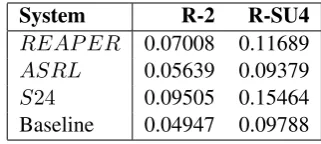
For query-focused multi-document summariza-tion we experimented with the DUC2006 system task, which contained 50 document clusters con-sisting of 25 documents each. Parameters were fixed toλ = 1, γ = 1 andk = 250 words. In Table 6 we can observe the results3 of our query focused systems against DUC2006’s top scorer (S24) for ROUGE-2, and a baseline. The baseline was generated by taking the most recent document in the cluster and outputting the first 250 words.
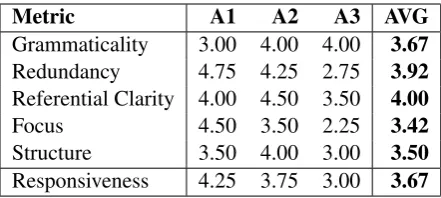
Human Evaluations: We had three native English-speaking human annotators evaluate a set of four randomly chosen summaries produced by REAPER on the DUC2004 dataset.
[image:6.595.334.495.435.507.2]Metric A1 A2 A3 AVG
Grammaticality 3.00 4.00 4.00 3.67
Redundancy 4.75 4.25 2.75 3.92
Referential Clarity 4.00 4.50 3.50 4.00
Focus 4.50 3.50 2.25 3.42
Structure 3.50 4.00 3.00 3.50
[image:7.595.72.293.62.161.2]Responsiveness 4.25 3.75 3.00 3.67
Table 7: Human evaluation scores on DUC2004.
Table 7 shows the evaluation results accord-ing to the DUC2006 human evaluation guidelines. The first five metrics are related entirely to the lin-guistic quality of the summary in question and the final metric, Responsiveness, rates the summary on its relevance to the source documents. Columns represent the average provided by a given annota-tor over the four summaries, and the AVG column represents the average score for all three annota-tors over all four summaries. Score values are an integer between 1 and 5 inclusive.
7 Discussion
First we present a sample of a summary generated from a randomly selected cluster. The following summary was generated from clusterD30017 of the DUC 2004 dataset using REAPER reward with
T D(λ)and REAPER feature space.
A congressman who visited remote parts of North Korea last week said Saturday that the food and health situation there was desperate and de-teriorating, and that millions of North Koreans might have starved to death in the last few years. North Korea is entering its fourth winter of chronic food shortages with its people malnourished and at risk of dying from normally curable illnesses, senior Red Cross officials said Tuesday. More than five years of severe food shortages and a near-total breakdown in the public health system have led to devastating malnutrition in North Korea and prob-ably left an entire generation of children physi-cally and mentally impaired, a new study by in-ternational aid groups has found. Years of food shortages have stunted the growth of millions of North Korean children, with two-thirds of children under age seven suffering malnourishment, U.N. experts said Wednesday. The founder of South Ko-rea’s largest conglomerate plans to visit his native North Korea again next week with a gift of 501 cattle, company officials said Thursday. “There is enough rice.
We can observe that the summary is both syn-tactically sound, and elegantly summarizes the source documents.
Our baseline results table (Table 1) shows REAPER outperforming ASRL in a statistically significant manner on all three ROUGE metrics in question. However we can see from the abso-lute differences in score that very few additional important words were extracted (ROUGE-1) how-ever REAPER showed a significant improvement in the structuring and ordering of those words (ROUGE-2, and ROUGE-L).
The balancing factors used in the REAPER re-ward function are responsible for the behaviour of the reward function, and thus largely responsible for the behaviour of the reinforcement learner. In equation 15 we can see balance numbers of 1, 4, 1, 1, 1 for 1-grams, 2-grams, 3-grams, 4-grams, and LCS respectively. In adjusting these values a user can express a preference for a single metric or a specific mixture of these metrics. Given that the magnitude of scores for n-grams decrease as n in-creases and given that the magnitude of scores for 1-grams is generally 3 to 4 times larger, in our ex-perience, we can see that this specific reward func-tion favours bigram similarity over unigram simi-larity. These balance values can be adjusted to suit the specific needs of a given situation, however we leave exploration of this concept for future work.
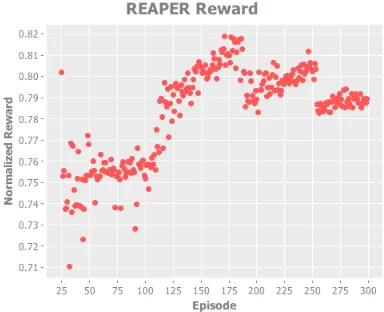
We can observe in Figure 1 that ASRL does not converge on a stable value, and dips towards the
300th episode while in Figure 2 REAPER does not take nearly such a dramatic dip. These fig-ures display average normalized reward for all 50 document clusters on a single run. Furthermore we can observe that ASRL reaches it’s peak re-ward around episode225while REAPER does so around episode175suggesting that REAPER con-verges faster.
7.1 Delayed vs. Immediate Rewards
Figure 1: ASRL normalized reward.
7.2 Feature Space
The feature space experiments in Table 4 seem to imply that REAPER performs similarly with both feature sets. We are confident that an improve-ment could be made through further experiimprove-menta- experimenta-tion. Feature engineering, however, is a very broad field and we plan to pursue this topic in depth in the future.
7.3 Algorithms
T D(λ)significantly outperformed bothSARSA
andAP I in the algorithm comparison. Ryang and Abekawa (2012) conclude that the feature space is largely responsible for the algorithm performance. This is due to the fact that poor states such as those that are too long, or those that contain few impor-tant words will reduce to the same feature set and receive negative rewards collectively. SARSA
loses this benefit as a result of its modelling of state-action pairs.
AP Ion the other hand may have suffered a per-formance loss due to its requirements of an imme-diate reward, this is because when using a delayed reward if the trajectory of a rollout does not reach a terminal state the algorithm will not be able to make any estimations about the value of the state in question. We propose altering the policy iter-ation algorithm to use a trajectory length of one episode instead of a fixed number of actions in or-der to counter the need for an immediate reward function.
7.4 Query Focused Rewards
[image:8.595.76.268.65.219.2]From the ROUGE results in Table 6 we can infer that while REAPER outperformed ASRL on the query focused task, however it is notable that both
Figure 2: REAPER normalized reward.
systems under performed when compared to the top system from the DUC2006 conference.
We can gather from these results that it is not enough to simply naively calculate similarity with the provided query in order to produce a query-focused result. Given that the results produced by the generic summarization task is rather accept-able according to our human evaluations we sug-gest that further research be focused on a proper similarity metric between the query and summary to improve the reward function’s overall ability to score summaries in a query-focused setting.
8 Conclusion and Future Work
We have explored alternate reward functions, fea-ture sets, and algorithms for the task of automatic summarization using reinforcement learning. We have shown that REAPER outperforms ASRL on both generic summarization and the query focused tasks. This suggests the effectiveness of our re-ward function and feature space. Our results also confirm that T D(λ) performs best for this task compared toSARSAandAP I.
metrics in order to improve its ROUGE and human evaluation scores on query-focused tasks.
Acknowledgments
We would like to thank the anonymous review-ers for their useful comments. The research re-ported in this paper was supre-ported by the Nat-ural Sciences and Engineering Research Council (NSERC) of Canada - discovery grant and the Uni-versity of Lethbridge. This work was done when the second author was at the University of Leth-bridge.
References
S . Branavan, H. Chen, L. S. Zettlemoyer, and R. Barzi-lay. 2009. Reinforcement Learning for Mapping Instructions to Actions. In Proceedings of the 47th Annual Meeting of the ACL and the 4th IJCNLP of the AFNLP, pages 82–90.
Y. Chali and S. A. Hasan. 2012a. On the Effectiveness of Using Sentence Compression Models for
Query-Focused Multi-Document Summarization. In
Pro-ceedings of the 24th International Conference on Computational Linguistics (COLING 2012), pages 457–474. Mumbai, India.
Y. Chali and S. A. Hasan. 2012b.
Query-focused Multi-document Summarization: Auto-matic Data Annotations and Supervised Learning
Approaches. Journal of Natural Language
Engi-neering, 18(1):109–145.
Y. Chali, S. A. Hasan, and S. R. Joty. 2009a. Do Auto-matic Annotation Techniques Have Any Impact on
Supervised Complex Question Answering?
Pro-ceedings of the Joint conference of the 47th Annual Meeting of the Association for Computational Lin-guistics (ACL-IJCNLP 2009), pages 329–332. Y. Chali, S. R. Joty, and S. A. Hasan. 2009b.
Com-plex Question Answering: Unsupervised Learning
Approaches and Experiments. Journal of Artificial
Intelligence Research, 35:1–47.
Y. Chali, S. A. Hasan, and K. Imam. 2011a. A Reinforcement Learning Framework for Answering
Complex Questions. In Proceedings of the 16th
International Conference on Intelligent User Inter-faces, pages 307–310. ACM, Palo Alto, CA, USA. Y. Chali, S. A. Hasan, and S. R. Joty. 2011b.
Improv-ing Graph-based Random Walks for Complex Ques-tion Answering Using Syntactic, Shallow Semantic
and Extended String Subsequence Kernels.
Infor-mation Processing and Management (IPM), Special Issue on Question Answering, 47(6):843–855. Y. Chali, S. A. Hasan, and K. Imam. 2012.
Improv-ing the Performance of the Reinforcement Learn-ing Model for AnswerLearn-ing Complex Questions. In
Proceedings of the 21st ACM Conference on Infor-mation and Knowledge Management (CIKM 2012), pages 2499–2502. ACM, Maui, Hawaii, USA. J. Conroy, J. Goldstein, and D. Leary. 2004. Left-Brain
/ Right-Brain Multi-Document Summarization. In
Proceedings of the Document Un- derstanding Con-ference (DUC 2004).
D. S. Hirschberg. 1977. Algorithms for the Longest
Common Subsequence Problem. In Journal of the
ACM, 24(4):664–675, October.
M. Lagoudakis and R. Parr. 2003. Reinforcement learning as classification: Leveraging modern classi-fiers. In Proceedings of the Twentieth International Conference on Machine Learning, 20(1):424. J. Li and S. Li. 2013. A Novel Feature-based Bayesian
Model for Query Focused Multi-document
Summa-rization. In Transactions of the Association for
Computational Linguistics, 1:89–98.
C. Lin and M. Rey. 2003. Improving Summariza-tion Performance by Sentence Compression A Pi-lot Study. In Proceedings of the Sixth International Workshop on Information Retrieval with Asian Lan-guages.
C. Lin. 2004. ROUGE : A Package for Automatic
Evaluation of Summaries. In Information Sciences,
16(1):25–26.
Y. Liu, S. Li, Y. Cao, C. Lin, D. Han, and Y. Yu. 2008. Understanding and Summarizing Answers in Community-Based Question Answering Services.
In COLING ’08 Proceedings of the 22nd Inter-national Conference on Computational Linguistics, 1(August):497–504.
S. Lyngbaek. 2013. SPORK: A Summarization
Pipeline for Online Repositories of Knowledge. M.sc. thesis, California Polytechnic State Univer-sity.
I. Mani. 2001. Automatic Summarization. John
Ben-jamins Publishing.
C. D. Manning and H. Sch¨utze. 1999. Foundations of
Statistical Natural Language Processing, volume 26 of . MIT Press.
M. F. Porter. 1980. An algorithm for suffix stripping.
Program, 14(3):130–137.
X. Qian and Y. Liu. 2013. Fast Joint Compression and
Summarization via Graph Cuts. In Conference on
Empirical Methods in Natural Language Process-ing.
S. Ryang and T. Abekawa. 2012. Framework of Au-tomatic Text Summarization Using Reinforcement
Learning. In Proceedings of the 2012 Joint
H. Saggion, C. Iria, T. M. Juan-Manuel, and E. San-Juan. 2010. Multilingual Summarization
Evalua-tion without Human Models. In COLING ’10
Pro-ceedings of the 23rd International Conference on Computational Linguistics: Posters, 1:1059–1067.
A. Sood. 2013. Towards Summarization of Written
Text Conversations. M.sc. thesis, International Insti-tute of Information Technology, Hyderabad, India.
R. S. Sutton and A. G. Barto. 1998. Reinforcement
Learning: An Introduction. MIT Press.
C. A. Szepesv. 2009. Algorithms for Reinforcement
Learning. Morgan & Claypool Publishers.
H. Takamura and M. Okumura. 2009. Text Summa-rization Model based on Maximum Coverage
Prob-lem and its Variant. In EACL ’09 Proceedings
of the 12th Conference of the European Chapter of the Association for Computational Linguistics, (April):781–789.
X Wan. 2007. Towards an Iterative Reinforcement Ap-proach for Simultaneous Document Summarization
and Keyword Extraction. In Proceedings of the 45th
Annual Meeting of the Association of Computational Linguistics, pages 552–559.
L. Wang, H. Raghavan, V. Castelli, R. Florian, and C. Cardie. 2013. A Sentence Compression Based
Framework to Query-Focused. In Proceedings of
the 51st Annual Meeting of the Association for Com-putational Linguistics, 1:1384–1394.