A Model of Coherence Based on Distributed Sentence Representation
Jiwei Li1and Eduard Hovy3
1Computer Science Department, Stanford University, Stanford, CA 94305, USA 3Language Technology Institute, Carnegie Mellon University, Pittsburgh, PA 15213, USA
[email protected] [email protected]
Abstract
Coherence is what makes a multi-sentence text meaningful, both logically and syn-tactically. To solve the challenge of dering a set of sentences into coherent or-der, existing approaches focus mostly on defining and using sophisticated features to capture the cross-sentence argumenta-tion logic and syntactic relaargumenta-tionships. But both argumentation semantics and cross-sentence syntax (such as coreference and tense rules) are very hard to formalize. In this paper, we introduce a neural network model for the coherence task based on distributed sentence representation. The proposed approach learns a syntactico-semantic representation for sentences au-tomatically, using either recurrent or re-cursive neural networks. The architecture obviated the need for feature engineering, and learns sentence representations, which are to some extent able to capture the ‘rules’ governing coherent sentence struc-ture. The proposed approach outperforms existing baselines and generates the state-of-art performance in standard coherence evaluation tasks1.
1 Introduction
Coherence is a central aspect in natural language processing of multi-sentence texts. It is essen-tial in generating readable text that the text plan-ner compute which ordering of clauses (or sen-tences; we use them interchangeably in this paper) is likely to support understanding and avoid con-fusion. As Mann and Thompson (1988) define it,
A text is coherent when it can be ex-plained what role each clause plays with regard to the whole.
1Code available atstanford.edu/˜jiweil/or by
request from the first author.
Several researchers in the 1980s and 1990s ad-dressed the problem, the most influential of which include: Rhetorical Structure Theory (RST; (Mann and Thompson, 1988)), which defined about 25 relations that govern clause interde-pendencies and ordering and give rise to text tree structures; the stepwise assembly of seman-tic graphs to support adductive inference toward the best explanation (Hobbs et al., 1988); Dis-course Representation Theory (DRT; (Lascarides and Asher, 1991)), a formal semantic model of discourse contexts that constrain coreference and quantification scoping; the model of intention-oriented conversation blocks and their stack-based queueing to model attention flow (Grosz and Sid-ner, 1986), and more recently an inventory of a hundred or so binary inter-clause relations and as-sociated annotated corpus (Penn Discourse Tree-bank. Work in text planning implemented some of these models, especially operationalized RST (Hovy, 1988) and explanation relations (Moore and Paris, 1989) to govern the planning of coher-ent paragraphs. Other computational work defined so called schemas (McKeown, 1985), frames with fixed sequences of clause types to achieve stereo-typical communicative intentions.
Little of this work survives. Modern research tries simply to order a collection of clauses or sen-tences without giving an account of which order(s) is/are coherent or what the overall text structure is. The research focuses on identifying and defin-ing a set of increasdefin-ingly sophisticated features by which algorithms can be trained to propose order-ings. Features being explored include the clause entities, organized into a grid (Lapata and Barzi-lay, 2005; Barzilay and Lapata, 2008), coreference clues to ordering (Elsner and Charniak, 2008), named-entity categories (Eisner and Charniak, 2011), syntactic features (Louis and Nenkova, 2012), and others. Besides being time-intensive (feature engineering usually requites considerable
Figure 1: Illustrations of coherent (positive) vs not-coherent (negative) training examples.
effort and can depend greatly on upstream feature extraction algorithms), it is not immediately ap-parent which aspects of a clause or a coherent text to consider when deciding on ordering. More im-portantly, the features developed to date are still incapable of fully specifying the acceptable order-ing(s) within a context, let alone describe why they are coherent.
Recently, deep architectures, have been applied to various natural language processing tasks (see Section 2). Such deep connectionist architectures learn a dense, low-dimensional representation of their problem in a hierarchical way that is capa-ble of capturing both semantic and syntactic as-pects of tokens (e.g., (Bengio et al., 2006)), en-tities, N-grams (Wang and Manning, 2012), or phrases (Socher et al., 2013). More recent re-searches have begun looking at higher level dis-tributed representations that transcend the token level, such as sentence-level (Le and Mikolov, 2014) or even discourse-level (Kalchbrenner and Blunsom, 2013) aspects. Just as words combine to form meaningful sentences, can we take advan-tage of distributional semantic representations to explore the composition of sentences to form co-herent meanings in paragraphs?
In this paper, we demonstrate that it is feasi-ble to discover the coherent structure of a text using distributed sentence representations learned in a deep learning framework. Specifically, we consider a WINDOW approach for sentences, as
shown in Figure 1, where positive examples are windows of sentences selected from original arti-cles generated by humans, and negatives examples are generated by random replacements2. The
se-mantic representations for terms and sentences are obtained through optimizing the neural network framework based on these positive vs negative
ex-2Our approach is inspired by Collobert et al.’s idea (2011)
that a word and its context form a positive training sample while a random word in that same context gives a negative training sample, when training word embeddings in the deep learning framework.
amples and the proposed model produces state-of-art performance in multiple standard evaluations for coherence models (Barzilay and Lee, 2004).
The rest of this paper is organized as follows: We describe related work in Section 2, then de-scribe how to obtain a distributed representation for sentences in Section 3, and the window compo-sition in Section 4. Experimental results are shown in Section 5, followed by a conclusion.
2 Related Work
Coherence In addition to the early computa-tional work discussed above, local coherence was extensively studied within the modeling frame-work of Centering Theory (Grosz et al., 1995; Walker et al., 1998; Strube and Hahn, 1999; Poe-sio et al., 2004), which provides principles to form a coherence metric (Miltsakaki and Kukich, 2000; Hasler, 2004). Centering approaches suffer from a severe dependence on manually annotated input.
A recent popular approach is the entity grid model introduced by Barzilay and Lapata (2008) , in which sentences are represented by a vec-tor of discourse entities along with their gram-matical roles (e.g., subject or object). Proba-bilities of transitions between adjacent sentences are derived from entity features and then concate-nated to a document vector representation, which is used as input to machine learning classifiers such as SVM. Many frameworks have extended the entity approach, for example, by pre-grouping entities based on semantic relatedness (Filippova and Strube, 2007) or adding more useful types of features such as coreference (Elsner and Char-niak, 2008), named entities (Eisner and CharChar-niak, 2011), and discourse relations (Lin et al., 2011).
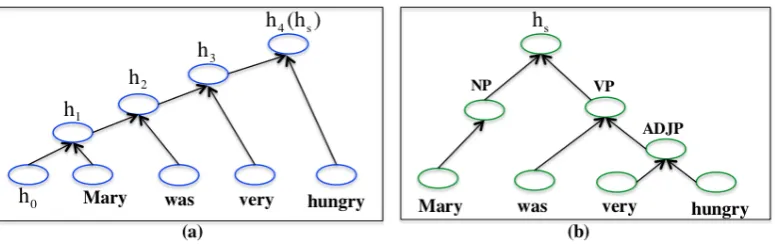
Figure 2: Sentential compositionality obtained from (a) recurrent / (b) recursive neural network. The bottom layer represents word vectors in the sentence. The top layer hs denotes the resulting sentence
vector.
transition rules of different topics.
Recurrent and Recursive Neural Networks In the context of NLP, recurrent neural networks view a sentence as a sequence of tokens and in-corporate information from the past (i.e., preced-ing tokens) (Schuster and Paliwal, 1997; Sutskever et al., 2011) for acquisition of the current output. At each step, the recurrent network takes as input both the output of previous steps and the current token, convolutes the inputs, and forwards the re-sult to the next step. It has been successfully ap-plied to tasks such as language modeling (Mikolov et al., 2010) and spoken language understanding (Mesnil et al., 2013). The advantage of recur-rent network is that it does not depend on exter-nal deeper structure (e.g., parse tree) and is easy to implement. However, in the recurrent framework, long-distance dependencies are difficult to capture due to the vanishing gradient problem (Bengio et al., 1994); two tokens may be structurally close to each other, even though they are far away in word sequence3.
Recursive neural networks comprise another class of architecture, one that relies and operates on structured inputs (e.g., parse trees). It com-putes the representation for each parent based on its children iteratively in a bottom-up fashion. A series of variations have been proposed, each tai-lored to different task-specific requirements, such as Matrix-Vector RNN (Socher et al., 2012) that represents every word as both a vector and a ma-trix, or Recursive Neural Tensor Networks (Socher et al., 2013) that allow the model to have greater
3For example, a verb and its corresponding direct object
can be far away in terms of tokens if many adjectives lies in between, but they are adjacent in the parse tree (Irsoy and Cardie, 2013).
interactions between the input vectors. Many tasks have benefited from this recursive framework, in-cluding parsing (Socher et al., 2011b), sentiment analysis (Socher et al., 2013), and paraphrase de-tection (Socher et al., 2011a).
2.1 Distributed Representations
Both recurrent and recursive networks require a vector representation of each input token. Dis-tributed representations for words were first pro-posed in (Rumelhart et al., 1988) and have been successful for statistical language modeling (El-man, 1990). Various deep learning architectures have been explored to learn these embeddings in an unsupervised manner from a large corpus (Ben-gio et al., 2006; Collobert and Weston, 2008; Mnih and Hinton, 2007; Mikolov et al., 2013), which might have different generalization capabil-ities and are able to capture the semantic mean-ings depending on the specific task at hand. These vector representations can to some extent cap-ture interesting semantic relationships, such as
King−man≈Queue−woman(Mikolov et al., 2010), and recently have been successfully used in various NLP applications, including named en-tity recognition, tagging, segmentation (Wang et al., 2013), and machine translation (e.g.,(Collobert and Weston, 2008; Zou et al., 2013)).
3 Sentence Model
the details of both approaches can be readily found there, we make this section brief and omit the de-tails for brevity.
Let s denote a sentence, comprised of a se-quence of wordss={w1, w2, ..., wns}, wherens
denotes the number of words within sentence s. Each wordw is associated with a specific vector embeddingew = {e1w, e2w, ..., eKw}, whereK
de-notes the dimension of the word embedding. We wish to compute the vector representation for cur-rent sentencehs ={h1s, h2s, ..., hKs }.
Recurrent Sentence Representation (Recur-rent) The recurrent network captures certain general considerations regarding sentential com-positionality. As shown in Figure 2 (a), for sen-tences, recurrent network successively takes word
wiat stepi, combines its vector representationetw
with former inputhi−1from stepi−1, calculates
the resulting current embedding ht, and passes it
to the next step. The standard recurrent network calculateshtas follows:
ht=f(VRecurrent·ht−1+WRecurrent·etw+bRecurrent)
(1) whereWRecurrentandVRecurrentareK×K
ma-trixes. bRecurrent denotesK×1bias vector and
f =tanhis a standard element-wise nonlinearity. Note that calculation for representation at time
t= 1is given by:
h1 =f(VRecurrent·h0+WRecurrent·e1w+bRecurrent)
(2) whereh0denotes the global sentence starting
vec-tor.
Recursive Sentence Representation (Recursive) Recursive sentence representation relies on the structure of parse trees, where each leaf node of the tree corresponds to a word from the original sentence. It computes a representation for each parent node based on its immediate children re-cursively in a bottom-up fashion until reaching the root of the tree. Concretely, for a given parentp
in the tree and its two childrenc1(associated with
vector representationhc1) andc2 (associated with vector representationhc2), standard recursive net-works calculateshpforpas follows:
hp =f(WRecursive·[hc1, hc2] +bRecursive) (3)
where [hc1, hc2] denotes the concatenating vec-tor for children vecvec-tor representationhc1 andhc2.
WRecursive is aK×2Kmatrix and bRecursiveis
the1×Kbias vector. f(·)is tanh function. Recursive neural models compute parent vec-tors iteratively until the root node’s representation is obtained, and use the root embedding to repre-sent the whole repre-sentence, as shown in Figure 2 (b).
4 Coherence Model
The proposed coherence model adopts a window approach (Collobert et al., 2011), in which we train a three-layer neural network based on a slid-ing windows ofLsentences.
4.1 Sentence Convolution
We treat a window of sentences as a cliqueC and associate each clique with a tagyC that takes the
value 1 if coherent, and 0 otherwise4. As shown in
Figure 1, cliques taken from original articles are treated as coherent and those with sentences ran-domly replaced are used as negative examples. .
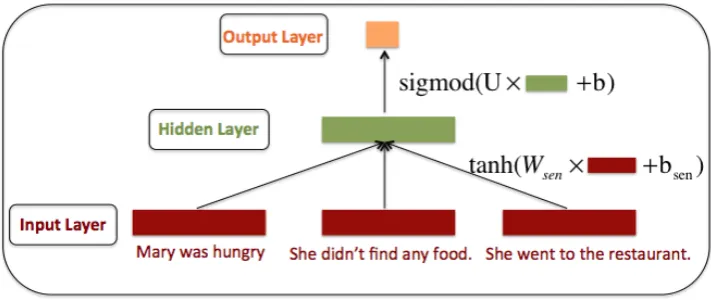
The sentence convolution algorithm adopted in this paper is defined by a three-layer neural net-work, i.e., sentence-level input layer, hidden layer, and overall output layer as shown in Figure 3. For-mally, each cliqueCtakes as input a(L×K)×1 vector hC by concatenating the embeddings of
all its contained sentences, denoted as hC =
[hs1, hs2, ..., hsL]. (Note that if we wish to
clas-sify the first and last sentences and include their context, we require special beginning and ending sentence vectors, which are defined as h<S> for
sstartandh</S>forsendrespectively.)
LetHdenote the number of neurons in the hid-den (second) layer. Then each of the hidhid-den lay-ers takes as inputhCand performs the convolution
using a non-linear tanh function, parametrized by
Wsen and bsen. The concatenating output vector
for hidden layers, defined asqC, can therefore be
rewritten as:
qC =f(Wsen×hC+bsen) (4)
whereWsenis aH×(L×K)dimensional matrix
andbsenis aH×1dimensional bias vector. 4instead of a binary classification (correct/incorrect),
an-other commonly used approach is the contrastive approach that minimizes the score functionmax(0,1−s+sc)
(Col-lobert et al., 2011; Smith and Eisner, 2005). sdenotes the score of a true (coherent) window andscthe score of a
Figure 3: An example of coherence model based on a window of sentences (clique).
The output layer takes as inputqCand generates
a scalar using linear functionUTqC+b. A sigmod
function is then adopted to project the value to a [0,1] probability space, which can be interpreted as the probability of whether one clique is coher-ent or not. The execution at the output layer can be summarized as:
p(yC = 1) =sigmod(UTqC+b) (5)
whereUis anH×1vector andbdenotes the bias. 4.2 Training
In the proposed framework, suppose we have M
training samples, the cost function for recurrent neural network with regularization on the training set is given by:
J(Θ) = M1 X
C∈trainset
{−yClog[p(yC = 1)]
−(1−yC) log[1−p(yC = 1)]}+2QM
X
θ∈Θ
θ2
(6) where
Θ = [WRecurrent, Wsen, Usen]
The regularization part is paralyzed byQto avoid overfitting. A similar loss function is applied to the recursive network with only minor parameter altering that is excluded for brevity.
To minimize the objectiveJ(Θ), we use the di-agonal variant of AdaGrad (Duchi et al., 2011) with minibatches, which is widely applied in deep learning literature (e.g.,(Socher et al., 2011a; Pei et al., 2014)). The learning rate in AdaGrad is adapting differently for different parameters at dif-ferent steps. Concretely, for parameter updates, let
gi
τ denote the subgradient at time step for
param-eterθi, which is obtained from backpropagation5,
the parameter update at time steptis given by:
θτ =θτ−1−Pτ α t=0
p
gi2 τ
gi
τ (7)
whereαdenotes the learning rate and is set to0.01 in our approach. Optimal performance is achieved when batch size is set between 20 and 30.
4.3 Initialization
Elements in Wsen are initialized by randomly
drawing from the uniform distribution [−, ], where = √ √6
H+K×L as suggested in (Collobert
et al., 2011). Wrecurrent, Vrecurrent, Wrecursive
andh0 are initialized by randomly sampling from
a uniform distributionU(−0.2,0.2). All bias vec-tors are initialized with 0. Hidden layer numberH
is set to 100.
Word embeddings {e} are borrowed from Senna (Collobert et al., 2011; Collobert, 2011). The dimension for these embeddings is 50.
5 Experiments
We evaluate the proposed coherence model on two common evaluation approaches adopted in exist-ing work (Barzilay and Lapata, 2008; Louis and Nenkova, 2012; Elsner et al., 2007; Lin et al., 2011): Sentence Ordering and Readability Assess-ment.
5.1 Sentence Ordering
We follow (Barzilay and Lapata, 2008; Louis and Nenkova, 2012; Elsner et al., 2007; Lin et al.,
5For more details on backpropagation through RNNs, see
2011) that all use pairs of articles, one containing the original document order and the other a ran-dom permutation of the sentences from the same document. The pairwise approach is predicated on the assumption that the original article is al-ways more coherent than a random permutation; this assumption has been verified in Lin et al.’s work (2011).
We need to define the coherence score Sd for
a given document d, where d is comprised of a series of sentences,d = {s1, s2, .., sNd}, andNd
denotes the number of sentences withind. Based on our clique definition, documentdis comprised ofNdcliques. Taking window sizeL = 3as
ex-ample, cliques generated from documentdappear as follows:
< sstart, s1, s2>, < s1, s2, s3 >, ...,
< sNd−2, sNd−1, sNd >, < sNd−1, sNd, send >
The coherence score for a given documentSd is
the probability that all cliques withindare coher-ent, which is given by:
Sd=
Y
C∈d
p(yC = 1) (8)
For document pair < d1, d2 > in our task, we
would say documentd1 is more coherent thand2
if
Sd1 > Sd2 (9) 5.1.1 Dataset
We use two corpora that are widely employed for coherence prediction (Barzilay and Lee, 2004; Barzilay and Lapata, 2008; Elsner et al., 2007). One contains reports on airplane accidents from the National Transportation Safety Board and the other contains reports about earthquakes from the Associated Press. These articles are about 10 sentences long and usually exhibit clear sentence structure. For preprocessing, we only lowercase the capital letters to match with tokens in Senna word embeddings. In the recursive network, sen-tences are parsed using the Stanford Parser6 and
then transformed into binary trees. The accident corpus ends up with a vocabulary size of 4758 and an average of 10.6 sentences per document. The earthquake corpus contains 3287 distinct terms and an average of 11.5 sentences per document.
6http://nlp.stanford.edu/software/
lex-parser.shtml
For each of the two corpora, we have 100 arti-cles for training and 100 (accidents) and 99 (earth-quakes) for testing. A maximum of 20 random permutations were generated for each test arti-cle to create the pairwise data (total of 1986 test pairs for the accident corpus and 1956 for earth-quakes)7.
Positive cliques are taken from original training documents. For easy training, rather than creating negative examples by replacing centered sentences randomly, the negative dataset contains cliques where centered sentences are replaced only by other sentences within the same document. 5.1.2 Training and Testing
Despite the numerous parameters in the deep learning framework, we tune only two principal ones for each setting: window size L (tried on {3,5,7}) and regularization parameterQ(tried on {0.01,0.1,0.25,0.5,1.0,1.25,2.0,2.5,5.0}). We trained parameters using 10-fold cross-validation on the training data. Concretely, in each setting, 90 documents were used for training and evalua-tion was done on the remaining articles, following (Louis and Nenkova, 2012). After tuning, the final model was tested on the testing set.
5.1.3 Model Comparison
We report performance of recursive and recurrent networks. We also report results from some popu-lar approaches in the literature, including:
Entity Grid Model : Grid model (Barzilay and Lapata, 2008) obtains the best performance when coreference resolution, expressive syntactic infor-mation, and salience-based features are incorpo-rated. Entity grid models represent each sentence as a column of a grid of features and apply ma-chine learning methods (e.g., SVM) to identify the coherent transitions based on entity features (for details of entity models see (Barzilay and Lapata, 2008)). Results are directly taken from Barzilay and Lapata’s paper (2008).
HMM : Hidden-Markov approach proposed by Louis and Nenkova (2012) to model the state (cluster) transition probability in the coherent con-text using syntactic features. Sentences need to be clustered in advance where the number of clus-ters is tuned as a parameter. We directly take
7Permutations are downloaded from http:
Acci Earthquake Average Recursive 0.864 0.976 0.920 Recurrent 0.840 0.951 0.895 Entity Grid 0.904 0.872 0.888
HMM 0.822 0.938 0.880
HMM+Entity 0.842 0.911 0.877 HMM+Content 0.742 0.953 0.848
Graph 0.846 0.635 0.740
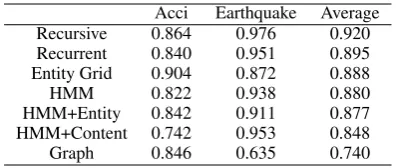
Table 1: Comparison of Different Coherence Frameworks. Reported baseline results are among the best performance regarding each approach is reprinted from prior work from (Barzilay and Lap-ata, 2008; Louis and Nenkova, 2012; Guinaudeau and Strube, 2013).
the results from Louis and Nenkova’s paper and report the best results among different combi-nations of parameter and feature settings8. We
also report performances of models from Louis and Nenkova’s work that combine HMM and en-tity/content models in a unified framework. Graph Based Approach : Guinaudeau and Strube (2013) extended the entity grid model to a bipartite graph representing the text, where the entity transition information needed for local co-herence computation is embedded in the bipartite graph. The Graph Based Approach outperforms the original entity approach in some of feature set-tings (Guinaudeau and Strube, 2013).
As can be seen in Table 1, the proposed frame-works (both recurrent and recursive) obtain state-of-art performance and outperform all existing baselines by a large margin. One interpretation is that the abstract sentence vector representations computed by the deep learning framework is more powerful in capturing exactly the relevant the se-mantic/logical/syntactic features in coherent con-texts than features or other representations devel-oped by human feature engineering are.
Another good quality of the deep learning framework is that it can be trained easily and makes unnecessary the effort required of feature engineering. In contrast, almost all existing base-lines and other coherence methods require sophis-ticated feature selection processes and greatly rely on external feature extraction algorithm.
The recurrent network is easier to implement than the recursive network and does not rely on external resources (i.e., parse trees), but the recur-sive network obtains better performance by
build-8The details for information about parameter and feature
of best setting can be found in (Louis and Nenkova, 2012).
ing the convolution on parse trees rather than sim-ply piling up terms within the sentence, which is in line with common expectation.
Both recurrent and recursive models obtain bet-ter performance on the Earthquake than the Acci-dent dataset. Scrutiny of the corpus reveals that articles reporting earthquakes exhibit a more con-sistent structure: earthquake outbreak, describing the center and intensity of the earthquake, injuries and rescue operations, etc., while accident articles usually exhibit more diverse scenarios.
5.2 Readability Assessment
Barzilay and Lapata (2008) proposed a readability assessment task for stylistic judgments about the difficulty of reading a document. Their approach combines a coherence system with Schwarm and Ostendorf’s (2005) readability features to clas-sify documents into two categories, more read-able (coherent) documents and less readread-able ones. The evaluation accesses the ability to differentiate “easy to read” documents from difficult ones of each model.
5.2.1 Dataset
Barzilay and Lapata’s (2008) data corpus is from the Encyclopedia Britannica and the
Britannica Elementary, the latter being a new version targeted at children. Both versions con-tain 107 articles. TheEncyclopedia Britannica
corpus contains an average of 83.1 sentences per document and theBritannica Elementary
contains 36.6. The encyclopedia lemmas are written by different authors and consequently vary considerably in structure and vocabulary choice. Early researchers assumed that the chil-dren version (Britannica Elementary) is easier to read, hence more coherent than documents in
Encyclopedia Britannica. This is a somewhat questionable assumption that needs further inves-tigation.
5.2.2 Training and Testing
Existing coherence approaches again apply a pair-wise ranking strategy and the article associated with the higher score is considered to be the more readable. As the replacement strategy for gener-ating negative example is apparently not well fit-ted to this task, we adopfit-ted the following training framework: we use all sliding windows of sen-tences from coherent documents (documents from
[image:7.595.82.282.61.145.2]Approach Accuracy
Recurrent 0.803
Recursive 0.828
Graph Approach 0.786
Entity 0.509
S&O 0.786
Entity+S&O 0.888
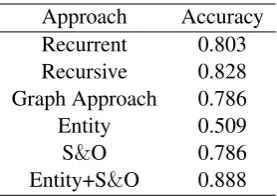
Table 2: Comparison of Different Coherence Frameworks on Readability Assessment. Re-ported baselines results are are taken from (Barzi-lay and Lapata, 2008; Guinaudeau and Strube, 2013). S&O: Schwarm and Ostendorf (2005).
and cliques from Encyclopedia Britannica as negative examples, and again apply Eq. 6 for train-ing and optimization. Durtrain-ing testtrain-ing, we turn to Equations 8 and 9 for pairwise comparison. We adopted five-fold cross-validation in the same way as in (Barzilay and Lapata, 2008; Guinaudeau and Strube, 2013) for fair comparison. Parameters were tuned within each training set also using five-fold cross-validation. Parameters to tune included window size L and regularization parameterQ.
5.3 Results
We report results of the proposed approaches in the work along with entity model (Barzilay and Lapata, 2008) and graph based approach (Elsner and Charniak, 2008) in Table 2. The tabs shows that deep learning approaches again significantly outperform Entry and Global Approach baselines and are nearly comparable to the combination of entity and S&O features. Again, the recursive network outperforms the recurrent network in this task.
6 Conclusion
In this paper, we apply two neural network approaches to the sentence-ordering (coherence) task, using compositional sentence representations learned by recurrent and recursive composition. The proposed approach obtains state-of-art per-formance on the standard coherence evaluation tasks.
Acknowledgements
The authors want to thank Richard Socher and Pradeep Dasigi for the clarification of deep learn-ing techniques. We also thank the three anony-mous EMNLP reviewers for helpful comments.
References
Regina Barzilay and Mirella Lapata. 2008. Modeling local coherence: An entity-based approach. Compu-tational Linguistics, 34(1):1–34.
Regina Barzilay and Lillian Lee. 2004. Catching the drift: Probabilistic content models, with applications to generation and summarization. InHLT-NAACL, pages 113–120.
Yoshua Bengio, Patrice Simard, and Paolo Frasconi. 1994. Learning long-term dependencies with gra-dient descent is difficult. Neural Networks, IEEE Transactions on, 5(2):157–166.
Yoshua Bengio, Holger Schwenk, Jean-S´ebastien Sen´ecal, Fr´ederic Morin, and Jean-Luc Gauvain. 2006. Neural probabilistic language models. In
Innovations in Machine Learning, pages 137–186. Springer.
Ronan Collobert and Jason Weston. 2008. A unified architecture for natural language processing: Deep neural networks with multitask learning. In Pro-ceedings of the 25th international conference on Machine learning, pages 160–167. ACM.
Ronan Collobert, Jason Weston, L´eon Bottou, Michael Karlen, Koray Kavukcuoglu, and Pavel Kuksa. 2011. Natural language processing (almost) from scratch. The Journal of Machine Learning Re-search, 12:2493–2537.
Ronan Collobert. 2011. Deep learning for efficient dis-criminative parsing. InInternational Conference on Artificial Intelligence and Statistics, number EPFL-CONF-192374.
John Duchi, Elad Hazan, and Yoram Singer. 2011. Adaptive subgradient methods for online learning and stochastic optimization. The Journal of Ma-chine Learning Research, 12:2121–2159.
Micha Eisner and Eugene Charniak. 2011. Extending the entity grid with entity-specific features. In Pro-ceedings of the 49th Annual Meeting of the Associ-ation for ComputAssoci-ational Linguistics: Human Lan-guage Technologies: short papers-Volume 2, pages 125–129. Association for Computational Linguis-tics.
Jeffrey L Elman. 1990. Finding structure in time.
Cognitive science, 14(2):179–211.
Micha Elsner and Eugene Charniak. 2008. Coreference-inspired coherence modeling. In
Proceedings of the 46th Annual Meeting of the Association for Computational Linguistics on Hu-man Language Technologies: Short Papers, pages 41–44. Association for Computational Linguistics. Micha Elsner, Joseph L Austerweil, and Eugene
[image:8.595.112.251.61.159.2]Katja Filippova and Michael Strube. 2007. Extend-ing the entity-grid coherence model to semantically related entities. InProceedings of the Eleventh Eu-ropean Workshop on Natural Language Generation, pages 139–142. Association for Computational Lin-guistics.
Barbara J Grosz and Candace L Sidner. 1986. Atten-tion, intentions, and the structure of discourse. Com-putational linguistics, 12(3):175–204.
Barbara J Grosz, Scott Weinstein, and Aravind K Joshi. 1995. Centering: A framework for modeling the lo-cal coherence of discourse. Computational linguis-tics, 21(2):203–225.
Camille Guinaudeau and Michael Strube. 2013. Graph-based local coherence modeling. In Proceed-ings of the 51st Annual Meeting of the Association for Computational Linguistics, pages 93–103. Laura Hasler. 2004. An investigation into the use of
centering transitions for summarisation. In Proceed-ings of the 7th Annual CLUK Research Colloquium, pages 100–107.
Jerry R Hobbs, Mark Stickel, Paul Martin, and Dou-glas Edwards. 1988. Interpretation as abduction. In
Proceedings of the 26th annual meeting on Associ-ation for ComputAssoci-ational Linguistics, pages 95–103. Association for Computational Linguistics.
Eduard H Hovy. 1988. Planning coherent multisenten-tial text. InProceedings of the 26th annual meet-ing on Association for Computational Lmeet-inguistics, pages 163–169. Association for Computational Lin-guistics.
Ozan Irsoy and Claire Cardie. 2013. Bidirectional re-cursive neural networks for token-level labeling with structure. arXiv preprint arXiv:1312.0493.
Nal Kalchbrenner and Phil Blunsom. 2013. Recurrent convolutional neural networks for discourse compo-sitionality.arXiv preprint arXiv:1306.3584. Mirella Lapata and Regina Barzilay. 2005. Automatic
evaluation of text coherence: Models and represen-tations. InIJCAI, volume 5, pages 1085–1090. Alex Lascarides and Nicholas Asher. 1991. Discourse
relations and defeasible knowledge. InProceedings of the 29th annual meeting on Association for Com-putational Linguistics, pages 55–62. Association for Computational Linguistics.
Quoc Le and Tomas Mikolov. 2014. Distributed repre-sentations of sentences and documents.
Ziheng Lin, Hwee Tou Ng, and Min-Yen Kan. 2011. Automatically evaluating text coherence using dis-course relations. In Proceedings of the 49th An-nual Meeting of the Association for Computational Linguistics: Human Language Technologies-Volume 1, pages 997–1006. Association for Computational Linguistics.
Annie Louis and Ani Nenkova. 2012. A coherence model based on syntactic patterns. InProceedings of the 2012 Joint Conference on Empirical Methods in Natural Language Processing and Computational Natural Language Learning, pages 1157–1168. As-sociation for Computational Linguistics.
William C Mann and Sandra A Thompson. 1988. Rhetorical structure theory: Toward a functional the-ory of text organization. Text, 8(3):243–281. Kathleen R McKeown. 1985. Discourse strategies for
generating natural-language text. Artificial Intelli-gence, 27(1):1–41.
Gr´egoire Mesnil, Xiaodong He, Li Deng, and Yoshua Bengio. 2013. Investigation of recurrent-neural-network architectures and learning methods for spo-ken language understanding. Interspeech.
Tomas Mikolov, Martin Karafi´at, Lukas Burget, Jan Cernock`y, and Sanjeev Khudanpur. 2010. Recur-rent neural network based language model. In IN-TERSPEECH, pages 1045–1048.
Tomas Mikolov, Kai Chen, Greg Corrado, and Jef-frey Dean. 2013. Efficient estimation of word representations in vector space. arXiv preprint arXiv:1301.3781.
Eleni Miltsakaki and Karen Kukich. 2000. The role of centering theory’s rough-shift in the teaching and evaluation of writing skills. In Proceedings of the 38th Annual Meeting on Association for Computa-tional Linguistics, pages 408–415. Association for Computational Linguistics.
Andriy Mnih and Geoffrey Hinton. 2007. Three new graphical models for statistical language modelling. InProceedings of the 24th international conference on Machine learning, pages 641–648. ACM.
Johanna D Moore and Cecile L Paris. 1989. Planning text for advisory dialogues. In Proceedings of the 27th annual meeting on Association for Computa-tional Linguistics, pages 203–211. Association for Computational Linguistics.
Wenzhe Pei, Tao Ge, and Chang Baobao. 2014. Max-margin tensor neural network for chinese word seg-mentation. InProceedings of ACL.
Massimo Poesio, Rosemary Stevenson, Barbara Di Eu-genio, and Janet Hitzeman. 2004. Centering: A parametric theory and its instantiations. Computa-tional linguistics, 30(3):309–363.
David E Rumelhart, Geoffrey E Hinton, and Ronald J Williams. 1988. Learning representations by back-propagating errors. MIT Press, Cambridge, MA, USA.
Sarah E Schwarm and Mari Ostendorf. 2005. Read-ing level assessment usRead-ing support vector machines and statistical language models. In Proceedings of the 43rd Annual Meeting on Association for Com-putational Linguistics, pages 523–530. Association for Computational Linguistics.
Noah A Smith and Jason Eisner. 2005. Contrastive estimation: Training log-linear models on unlabeled data. In Proceedings of the 43rd Annual Meeting on Association for Computational Linguistics, pages 354–362. Association for Computational Linguis-tics.
Richard Socher, Christopher D Manning, and An-drew Y Ng. 2010. Learning continuous phrase representations and syntactic parsing with recursive neural networks. InProceedings of the NIPS-2010 Deep Learning and Unsupervised Feature Learning Workshop, pages 1–9.
Richard Socher, Eric H Huang, Jeffrey Pennington, Andrew Y Ng, and Christopher D Manning. 2011a. Dynamic pooling and unfolding recursive autoen-coders for paraphrase detection. In NIPS, vol-ume 24, pages 801–809.
Richard Socher, Cliff C Lin, Chris Manning, and An-drew Y Ng. 2011b. Parsing natural scenes and nat-ural language with recursive nenat-ural networks. In
Proceedings of the 28th International Conference on Machine Learning (ICML-11), pages 129–136.
Richard Socher, Brody Huval, Christopher D Manning, and Andrew Y Ng. 2012. Semantic compositional-ity through recursive matrix-vector spaces. In Pro-ceedings of the 2012 Joint Conference on Empiri-cal Methods in Natural Language Processing and Computational Natural Language Learning, pages 1201–1211. Association for Computational Linguis-tics.
Richard Socher, Alex Perelygin, Jean Y Wu, Jason Chuang, Christopher D Manning, Andrew Y Ng, and Christopher Potts. 2013. Recursive deep mod-els for semantic compositionality over a sentiment treebank. InProceedings of the Conference on Em-pirical Methods in Natural Language Processing (EMNLP), pages 1631–1642.
Michael Strube and Udo Hahn. 1999. Functional centering: Grounding referential coherence in in-formation structure. Computational linguistics, 25(3):309–344.
Ilya Sutskever, James Martens, and Geoffrey E Hin-ton. 2011. Generating text with recurrent neural networks. InProceedings of the 28th International Conference on Machine Learning (ICML-11), pages 1017–1024.
Marilyn A Walker, Aravind Krishna Joshi, and Ellen Friedman Prince. 1998. Centering theory in discourse. Oxford University Press.
Sida Wang and Christopher D Manning. 2012. Base-lines and bigrams: Simple, good sentiment and topic classification. In Proceedings of the 50th Annual Meeting of the Association for Computational Lin-guistics: Short Papers-Volume 2, pages 90–94. As-sociation for Computational Linguistics.
Houfeng Wang, Longkai Zhang, Li Li, He Zhengyan, and Ni Sun. 2013. Improving chinese word seg-mentation on micro-blog using rich punctuations. Will Y Zou, Richard Socher, Daniel Cer, and