Recursive Deep Models for Discourse Parsing
Jiwei Li1, Rumeng Li2and Eduard Hovy3
1Computer Science Department, Stanford University, Stanford, CA 94305, USA 2School of EECS, Peking University, Beijing 100871, P.R. China
3Language Technology Institute, Carnegie Mellon University, Pittsburgh, PA 15213, USA
[email protected] [email protected] [email protected]
Abstract
Text-level discourse parsing remains a challenge: most approaches employ fea-tures that fail to capture the intentional, se-mantic, and syntactic aspects that govern discourse coherence. In this paper, we pro-pose a recursive model for discourse pars-ing that jointly models distributed repre-sentations for clauses, sentences, and en-tire discourses. The learned representa-tions can to some extent learn the seman-tic and intentional import of words and larger discourse units automatically,. The proposed framework obtains comparable performance regarding standard discours-ing parsdiscours-ing evaluations when compared against current state-of-art systems.
1 Introduction
In a coherent text, units (clauses, sentences, and larger multi-clause groupings) are tightly con-nected semantically, syntactically, and logically. Mann and Thompson (1988) define a text to be coherent when it is possible to describe clearly the role that each discourse unit (at any level of grouping) plays with respect to the whole. In a coherent text, no unit is completely isolated. Dis-course parsing tries to identify how the units are connected with each other and thereby uncover the hierarchical structure of the text, from which mul-tiple NLP tasks can benefit, including text sum-marization (Louis et al., 2010), sentence compres-sion (Sporleder and Lapata, 2005) or question-answering (Verberne et al., 2007).
Despite recent progress in automatic discourse segmentation and sentence-level parsing (e.g., (Fisher and Roark, 2007; Joty et al., 2012; Sori-cut and Marcu, 2003), document-level discourse parsing remains a significant challenge. Recent attempts (e.g., (Hernault et al., 2010b; Feng and
Hirst, 2012; Joty et al., 2013)) are still consid-erably inferior when compared to human gold-standard discourse analysis. The challenge stems from the fact that compared with sentence-level dependency parsing, the set of relations between discourse units is less straightforward to define. Because there are no clause-level ‘parts of dis-course’ analogous to word-level parts of speech, there is no discourse-level grammar analogous to sentence-level grammar. To understand how dis-course units are connected, one has to understand the communicative function of each unit, and the role it plays within the context that encapsulates it, taken recursively all the way up for the entire text. Manually developed features relating to words and other syntax-related cues, used in most of the re-cent prevailing approaches (e.g., (Feng and Hirst, 2012; Hernault et al., 2010b)), are insufficient for capturing such nested intentionality.
Recently, deep learning architectures have been applied to various natural language processing tasks (for details see Section 2) and have shown the advantages to capture the relevant semantic and syntactic aspects of units in context. As word distributions are composed to form the meanings of clauses, the goal is to extend distributed clause-level representations to the single- and multi-sentence (discourse) levels, and produce the hier-archical structure of entire texts.
Inspired by this idea, we introduce in this pa-per a deep learning approach for discourse pars-ing. The proposed parsing algorithm relies on a recursive neural network to decide (1) whether two discourse units are connected and if so (2) by what relation they are connected. Concretely, the parsing algorithm takes as input a document of any length, and first obtains the distributed repre-sentation for each of its sentences using recursive convolution based on the sentence parse tree. It then proceeds bottom-up, applying a binary clas-sifier to determine the probability of two adjacent
discourse units being merged to form a new sub-tree followed by a multi-class classifier to select the appropriate discourse relation label, and cal-culates the distributed representation for the sub-tree so formed, gradually unifying subsub-trees un-til a single overall tree spans the entire sentence. The compositional distributed representation en-ables the parser to make accurate parsing decisions and capture relations between different sentences and units. The binary and multi-class classifiers, along with parameters involved in convolution, are jointly trained from a collection of gold-standard discourse structures.
The rest of this paper is organized as follows. We present related work in Section 2 and de-scribe the RST Discourse Treebank in Section 3. The sentence convolution approach is illustrated in Section 4 and the discourse parser model in Sec-tion 5. We report experimental results in SecSec-tion 6 and conclude in Section 7.
2 Related Work
2.1 Discourse Analysis and Parsing
The basis of discourse structure lies in the recog-nition that discourse units (minimally, clauses) are related to one another in principled ways, and that the juxtaposition of two units creates a joint mean-ing larger than either unit’s meanmean-ing alone. In a coherent text this juxtaposition is never random, but serves the speaker’s communicative goals.
Considerable work on linguistic and computa-tional discourse processing in the 1970s and 80s led to the development of several proposals for re-lations that combine units; for a compilation see (Hovy and Maier, 1997). Of these the most influ-ential is Rhetorical Structure Theory RST (Mann and Thompson, 1988) that defines about 25 rela-tions, each containing semantic constraints on its component parts plus a description of the overall functional/semantic effect produced as a unit when the parts have been appropriately connected in the text. For example, the SOLUTIONHOOD relation
connects one unit describing a problem situation with another describing its solution, using phrases such as “the answer is”; in successful communi-cation the reader will understand that a problem is described and its solution is given.
Since there is no syntactic definition of a prob-lem or solution (they can each be stated in a sin-gle clause, a paragraph, or an entire text), one has to characterize discourse units by their
commu-nicative (rhetorical) function. The functions are reflected in text as signals of the author’s inten-tions, and take various forms (including expres-sions such as “therefore”, “for example”, “the an-swer is”, and so on; patterns of tense or pronoun usage; syntactic forms; etc.). The signals govern discourse blocks ranging from a clause to an en-tire text , each one associated with some discourse relation.
In order to build a text’s hierarchical structure, a discourse parser needs to recognize these signals and use them to appropriately compose the rela-tionship and nesting. Early approaches (Marcu, 2000a; LeThanh et al., 2004) rely mainly on overt discourse markers (or cue words) and use hand-coded rules to build text structure trees, bottom-up from clauses to sentences to paragraphs. . . . Since a hierarchical discourse tree structure is analo-gous to a constituency based syntactic tree, mod-ern research explored syntactic parsing techniques (e.g., CKY) for discourse parsing based on mul-tiple text-level or sentence-level features (Soricut and Marcu, 2003; Reitter, 2003; Baldridge and Lascarides, 2005; Subba and Di Eugenio, 2009; Lin et al., 2009; Luong et al., 2014).
A recent prevailing idea for discourse parsing is to train two classifiers, namely a binary struc-ture classifier for determining whether two adja-cent text units should be merged to form a new subtree, followed by a multi-class relation classi-fier for determining which discourse relation label should be assigned to the new subtree. The idea is proposed by Hernault and his colleagues (Duverle and Prendinger, 2009; Hernault et al., 2010a) and followed by other work using more sophisticated features (Feng and Hirst, 2012; Hernault et al., 2010b). Current state-of-art performance for re-lation identification is achieved by the recent rep-resentation learning approach proposed by (Ji and Eisenstein, 2014). The proposed framework pre-sented in this paper is similar to (Ji and Eisenstein, 2014) for transforming the discourse units to the abstract representations.
2.2 Recursive Deep Learning
iteratively in a bottom-up fashion. A series of vari-ations of RNN has been proposed to tailor differ-ent task-specific requiremdiffer-ents, including Matrix-Vector RNN (Socher et al., 2012) that represents every word as both a vector and a matrix, or Recur-sive Neural Tensor Network (Socher et al., 2013) that allows the model to have greater interactions between the input vectors. Many tasks have ben-efited from the recursive framework, including parsing (Socher et al., 2011b), sentiment analysis (Socher et al., 2013), textual entailment (Bowman, 2013), segmentation (Wang and Mansur, 2013; Houfeng et al., 2013), and paraphrase detection (Socher et al., 2011a).
3 The RST Discourse Treebank
There are today two primary alternative discourse treebanks suitable for training data: the Rhetor-ical Structure Theory Discourse Treebank RST-DT (Carlson et al., 2003) and the Penn Discourse Treebank (Prasad et al., 2008). In this paper, we select the former. In RST (Mann and Thompson, 1988), a coherent context or a document is repre-sented as a hierarchical tree structure, the leaves of which are clause-sized units called Elementary Discourse Units (EDUs). Adjacent nodes (siblings in the tree) are linked with discourse relations that are either binary (hypotactic) or multi-child (parat-actic). One child of each hypotactic relation is al-ways more salient (called the NUCLEUS); its
sib-ling (the SATELLITE) is less salient compared and
may be omitted in summarization. Multi-nuclear relations (e.g., CONJUNCTION) exhibit no
distinc-tion of salience between the units.
The RST Discourse Treebank contains 385 an-notated documents (347 for training and 38 for testing) from the Wall Street Journal. A total of 110 fine-grained relations defined in (Marcu, 2000b) are used for tagging relations in RST-DT. They are subtypes of 18 original high-level RST categories. For fair comparison with existing sys-tems, we use in this work the 18 coarse-grained re-lation classes, which with nuclearity attached form a set of 41 distinct relations. Non-binary relations are converted into a cascade of right-branching bi-nary relations.
Conventionally, discourse parsing in RST-DT involves the following sub-tasks: (1) EDU seg-mentation to segment the raw text into EDUs, (2) tree-building. Since the segmentation task is es-sentially clause delimitation and hence relatively
easy (with state-of-art accuracy at most 95%), we focus on the latter problem. We assume that the gold-standard EDU segmentations are already given, as assumed in other past work (Feng and Hirst, 2012).
4 EDU Model
In this section, we describe how we compute the distributed representation for a given sentence based on its parse tree structure and contained words. Our implementation is based on (Socher et al., 2013). As the details can easily be found there, we omit them for brevity.
Letsdenote any given sentence, comprised of a sequence of tokenss= {w1, w2, ..., wns}, where
ns denotes the number of tokens in s. Each to-kenwis associated with a specific vector embed-dingew={e1w, e2w, ..., eKw}, whereKdenotes the dimension of the word embedding. We wish to compute the vector representation hs for current sentence, wherehs={h1s, h2s, ..., hKs }.
Parse trees are obtained using the Stanford Parser1, and each clause is treated as an EDU. For
a given parentpin the tree and its two childrenc1
(associated with vector representationhc1) andc2
(associated with vector representation hc2),
stan-dard recursive networks calculate the vector for parentpas follows:
hp =f(W ·[hc1, hc2] +b) (1)
where[hc1, hc2]denotes the concatenating vector
for children representations hc1 and hc2; W is a
K ×2K matrix and b is the1×K bias vector; and f(·) is the function tanh. Recursive neural models compute parent vectors iteratively until the root node’s representation is obtained, and use the root embedding to represent the whole sentence.
5 Discourse Parsing
Since recent work (Feng and Hirst, 2012; Hernault et al., 2010b) has demonstrated the advantage of combining the binary structure classifier (deter-mining whether two adjacent text units should be merged to form a new subtree) with the multi-class classifier (determining which discourse relation la-bel to assign to the new subtree) over the older single multi-class classifier with the additional la-bel NO-REL, our approach follows the modern
1http://nlp.stanford.edu/software/
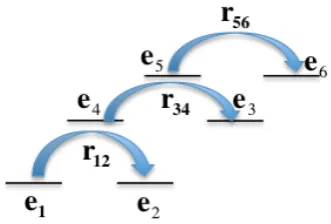
Figure 1: RST Discourse Tree Structure.
strategy but trains binary and multi-class classi-fiers jointly based on the discourse structure tree.
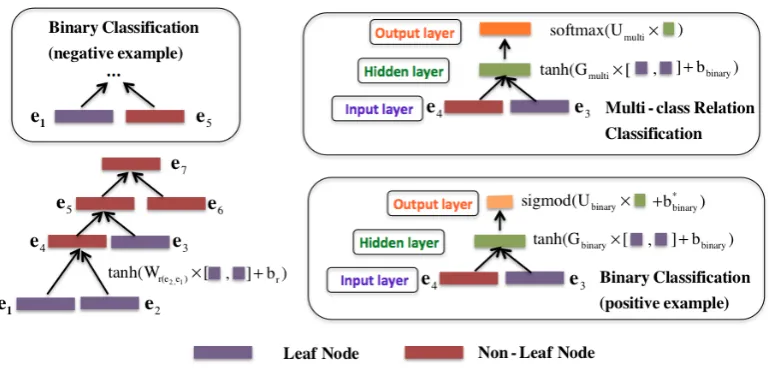
Figure 2 illustrates the structure of a discourse parse tree. Each nodee in the tree is associated with a distributed vector he. e1, e2, e3 and e6
constitute the leaves of trees, the distributed vec-tor representations of which are assumed to be al-ready obtained from convolution in Section 4. Let
Nr denote the number of relations and we have
Nr = 41.
5.1 Binary (Structure) Classification
In this subsection, we train a binary (structure) classifier, which aims to decide whether two EDUs or spans should be merged during discourse tree reconstruction.
Let tbinary(ei, ej) be the binary valued variable indicating whethereiandejare related, or in other words, whether a certain type of discourse rela-tions holds betweenei andej. According to Fig-ure 2, the following pairs constitute the training data for binary classification:
tbinary(e1, e2) = 1, tbinary(e3, e4) = 1, tbinary(e2, e3) = 0, tbinary(e3, e6) = 0, tbinary(e5, e6) = 1
To train the binary classifier, we adopt a three-layer neural network structure, i.e., input three-layer, hidden layer, and output layer. LetH = [hei, hej] denote the concatenating vector for two spans ei andej. We first project the concatenating vector
Hto the hidden layer withNbinaryhidden neurons.
The hidden layer convolutes the input with non-linear tanh function as follows:
Lbinary(ei,ej)=f(Gbinary∗[hei, hej] +bbinary)
whereGbinaryis anNbinary∗2K convolution
ma-trix andbbinarydenotes the bias vector.
The output layer takes as inputLbinary(ei,ej)and gen-erates a scalar using the linear functionUbinary ·
Lbinary(ei,ej)+b. Asigmodfunction is then adopted to project the value to a [0,1] probability space. The execution at the output layer can be summarized as:
p[tbinary(ei, ej) = 1] =g(Ubinary·Lbinary(ei,ej)+b∗binary)
(2) where Ubinary is an Nbinary×1 vector and b∗binary
denotes the bias.g(·)is the sigmod function.
5.2 Multi-class Relation Classification
If tbinary(ei, ej) is determined to be 1, we next use variable r(ei, ej) to denote the index of rela-tion that holds betweenei andej. A multi-class classifier is train based on a three-layer neural net-work, in the similar way as binary classification in Section 5.1. Concretely, a matrixGMultiand bias
vectorbMultiare first adopted to convolute the
con-catenating node vectors to the hidden layer vector
Lmulti
(ei,ej):
Lmulti
(ei,ej)=f(Gmulti∗[hei, hej] +bmulti) (3)
We then compute the posterior probability over labels given the hidden layer vector L using the softmax and obtain theNr dimensional probabil-ity vectorP(e1,e2)for each EDU pair as follows:
S(ei,ej)=Umulti·Lmulti(ei,ej) (4)
P(e1,e2)(i) = Pexp(S(e1,e2)(i))
kexp(S(e1,e2))(k)
(5)
whereUmulti is theNr×2K matrix. Theith ele-ment inP(e1,e2)denotes the probability thatith re-lation holds betweeneiandej. To note, binary and multi-class classifiers are trained independently.
5.3 Distributed Vector for Spans
What is missing in the previous two subsections are the distributed vectors for non-leaf nodes (i.e.,
e4ande5in Figure 1), which serve as structure and
relation classification. Again, we turn to recursive deep learning network to obtain the distributed vector for each node in the tree in a bottom-up fashion.
Similar as for sentence parse-tree level compo-sitionally, we extend a standard recursive neural network by associating each type of relations r
Figure 2: System Overview.
The representation for each node within the tree is calculated based on the representations for its chil-dren in a bottom-up fashion. Concretely, for a par-ent nodep, given the distributed representationhei for left child, hej for right child, and the relation
r(e1, e2), its distributed vectorhp is calculated as follows:
hp =f(Wr(e1,e2)·[hei, hej] +br(e1,e2)) (6)
where br(e1,e2) is the bias vector and f(·) is the non-linear tanh function.
To note, our approach does not make any dis-tinction between within-sentence text spans and cross-sentence text spans, different from (Feng and Hirst, 2012; Joty et al., 2013)
5.4 Cost Function
The parameters to optimize include
sentence-level convolution parameters [W, b],
discourse-level convolution parameters
[{Wr},{br}], binary classification parameters [Gbinary, bbinary, Ubinary, b∗binary], and multi-class
parameters[Gmulti, bmulti, Umulti].
Suppose we have M1 binary training samples
andM2multi-class training examples (M2 equals
the number of positive examples in M1, which
is also the non-leaf nodes within the training dis-course trees). The cost function for our framework with regularization on the training set is given by:
J(Θbinary) =
X
(ei,ej)∈{binary}
Jbinary(ei, ej)
+Qbinary·
X
θ∈Θbinary θ2
(7)
J(Θmulti) =
X
(ei,ej)∈{multi}
Jmulti(ei, ej)
+Qmulti·
X
θ∈Θmulti θ2
(8) where
Jbinary(ei, ej) =−t(ei, ej) logp(t(ei, ej) = 1) −(1−t(ei, ej)) log[1−p(t(ei, ej) = 1)]
Jmulti(ei, ej) =−log[p(r(ei, ej) =r)]
(9)
5.5 Backward Propagation
The derivative for parameters involved is com-puted through backward propagation. Here we illustrate how we compute the derivative of
Jmulti(ei, ej)with respect to different parameters. For each pair of nodes (ei, ej) ∈ multi, we associate it with a Nr dimensional binary vector
R(ei, ej), which denotes the ground truth vector with a 1 at the correct labelr(ei, ej)and all other entries 0. Integrating softmax error vector, for any parameterθ, the derivative ofJmulti(ei, ej)with re-spect toθis given by:
∂Jmulti(ei, ej)
∂θ = [P(ei,ej)−R(ei,ej)]⊗
∂S(ei,ej) ∂θ
5.6 Additional Features
When determining the structure/multi relation be-tween individual EDUs, additional features are also considered, the usefulness of which has been illustrated in a bunch of existing work (Feng and Hirst, 2012; Hernault et al., 2010b; Joty et al., 2012). We consider the following simple text-level features:
• Tokens at the beginning and end of the EDUs. • POS at the beginning and end of the EDUs.
• Whether two EDUs are in the same sentence.
5.7 Optimization
We use the diagonal variant of AdaGrad (Duchi et al., 2011) with minibatches, which is widely ap-plied in deep learning literature (e.g.,(Socher et al., 2011a; Pei et al., 2014)). The learning rate in AdaGrad is adapted differently for different pa-rameters at different steps. Concretely, letgi
τ de-note the subgradient at time step tfor parameter
θi obtained from backpropagation, the parameter update at time steptis given by:
θτ =θτ−1− Pτ α
t=0
p
gτi2giτ (11)
whereαdenotes the learning rate and is set to0.01 in our approach.
Elements in {Wr}, W, Gbinary, Gmulti, Ubinary,
Umulti are initialized by randomly drawing from
the uniform distribution[−, ], where is calcu-lated as suggested in (Collobert et al., 2011). All bias vectors are initialized with 0. Word embed-dings{e}are borrowed from Senna (Collobert et al., 2011; Collobert, 2011).
5.8 Inference
For inference, the goal is to find the most proba-ble discourse tree given the EDUs within the doc-ument. Existing inference approach basically in-clude the approach adopted in (Feng and Hirst, 2012; Hernault et al., 2010b) that merges the most likely spans at each step and SPADE (Fisher and Roark, 2007) that first finds the tree structure that is globally optimal, then assigns the most probable relations to the internal nodes.
In this paper, we implement a probabilistic CKY-like bottom-up algorithm for computing the most likely parse tree using dynamic program-ming as are adopted in (Joty et al., 2012; Joty
et al., 2013; Jurafsky and Martin, 2000) for the search of global optimum. For a document with
n EDUs, as different relations are characterized with different compositions (thus leading to dif-ferent vectors), we use aNr×n×ndynamic pro-gramming table P r, the cell P r[r, i, j] of which represents the span contained EDUs from i to j
and stores the probability that relationr holds be-tween the two spans within i to j. P r[r, i, j]is computed as follows:
P r[r, i, j] =maxr1,r2,kP r[r1, i, k]·P r[r2, k, j]
×P(tbinary(e[i,k], e[k,j]) = 1)
×P(r(e[i,k], e[k,j]) = 1)
(12) At each merging step, a distributed vector for the merged point is calculated according to Eq. 13 for different relations. The CKY-like algorithms finds the global optimal. To note, the worst-case run-ning time of our inference algorithm is O(N2
rn3), where ndenotes the number of sentences within the document, which is much slower than the greedy search. In this work, for simplification, we simplify the framework by maintaining the top 10 options at each step.
6 Experiments
A measure of the performance of the system is realized by comparing the structure and labeling of the RS-tree produced by our algorithm to gold-standard annotations.
Standard evaluation of discourse parsing output computes the ratio of the number of identical tree constituents shared in the generated RS-trees and the gold-standard trees against the total number of constituents in the generated discourse trees2,
which is further divided to three matrices: Span
(on the blank tree structure), nuclearity (on the tree structure with nuclearity indication), and rela-tion(on the tree structure with rhetorical relation indication but no nuclearity indication).
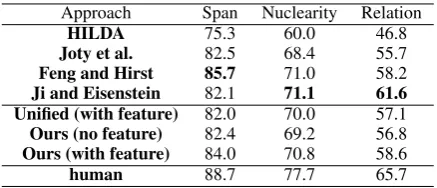
Approach Span Nuclearity Relation HILDA 75.3 60.0 46.8 Joty et al. 82.5 68.4 55.7 Feng and Hirst 85.7 71.0 58.2 Ji and Eisenstein 82.1 71.1 61.6 Unified (with feature) 82.0 70.0 57.1 Ours (no feature) 82.4 69.2 56.8 Ours (with feature) 84.0 70.8 58.6 human 88.7 77.7 65.7
Table 1: Performances for different approaches. Performances for baselines are reprinted from (Joty et al., 2013; Feng and Hirst, 2014; Ji and Eisenstein, 2014).
Also, we do not train a separate classifier forNU -CLEUSandSATELLITEidentification. The
nucle-arity decision is made based on the relation type produced by the multi-class classifier.
6.1 Parameter Tuning
The regularization parameter Q constitutes the only parameter to tune in our framework. We tune it on the 347 training documents. Concretely, we employ a five-fold cross validation on the RST dataset and tune Q on 5 different values: 0.01, 0.1, 0.5, 1.5, 2.5. The final model was tested on the testing set after parameter tuning.
6.2 Baselines
We compare our model against the following currently prevailing discourse parsing baselines:
HILDA A discourse parser based on support vector machine classification introduced by Her-nault et al. (HerHer-nault et al., 2010b). HILDA uses the binary and multi-class classifier to reconstruct the tree structure in a greedy way, where the most likely nodes are merged at each step. The results for HILDA are obtained by running the system with default settings on the same inputs we provided to our system.
Joty et al The discourse parser introduced by Joty et al. (Joty et al., 2013). It relies on CRF and combines intra-sentential and multi-sentential parsers in two different ways. Joty et al. adopt the global optimal inference as in our work. We reported the performance from their paper (Joty et al., 2013).
Feng and Hirst The linear-time discourse parser introduced in (Feng and Hirst, 2014) which
relies on two linear-chain CRFs to obtain a se-quence of discourse constituents.
Ji and Eisenstein The shift-reduce discourse parser introduced in (Ji and Eisenstein, 2014) which parses document by relying on the dis-tributed representations obtained from deep learn-ing framework.
Additionally, we implemented a simplified ver-sion of our model called unified where we use a unified convolutional function with unified pa-rameters[Wsen, bsen]for span vector computation. Concretely, for a parent node p, given the dis-tributed representation hei for left child, hej for right child, and the relation r(e1, e2), rather than
taking the inter relation between two children, its distributed vectorhpis calculated:
hp=f(Wsen·[hei, hej] +bsen) (13)
6.3 Performance
Performances for different models approaches re-ported in Table 1. And as we can observe, al-though the proposed framework obtains compa-rable result compared with existing state-of-state performances regarding all evaluating parameters for discourse parsing. Specifically, as for the three measures, no system achieves top performance on all three, though some systems outperform all oth-ers for one of the measures. The proposed system achieves high overall performance on all three, al-though it does not achieve top score on any mea-sure. The system gets a little bit performance boost by considering text-level features illustrated in Section 5.6. The simplified version of the orig-inal model underperforms against the origorig-inal ap-proach due to lack of expressive power in convo-lution. Performance plummets when different re-lations are uniformly treated, which illustrates the importance of taking into consideration different types of relations in the span convolution proce-dure.
7 Conclusion
In this paper, we describe an RST-style text-level discourse parser based on a neural network model. The incorporation of sentence-level distributed vectors for discourse analysis obtains compara-ble performance compared with current state-of-art discourse parsing system.
tasks, such as implicit discourse relation identifi-cation or dialogue analysis. Further, once the tree structure for a document can be determined, the vector for the entire document can be obtained in bottom-up fashion, as in this paper. One can now investigate whether the discourse parse tree is useful for acquiring a single document-level vector representation, which would benefit mul-tiple tasks, such as document classification or macro-sentiment analysis.
Acknowledgements
The authors want to thank Vanessa Wei Feng and Shafiq Joty for helpful discussions regarding RST dataset. We also want to thank Richard Socher, Zhengyan He and Pradeep Dasigi for the clarifica-tion of deep learning techniques.
References
Jason Baldridge and Alex Lascarides. 2005. Proba-bilistic head-driven parsing for discourse structure. InProceedings of the Ninth Conference on Compu-tational Natural Language Learning, pages 96–103. Association for Computational Linguistics.
Samuel R Bowman. 2013. Can recursive neural tensor networks learn logical reasoning? arXiv preprint arXiv:1312.6192.
Lynn Carlson, Daniel Marcu, and Mary Ellen Okurowski. 2003. Building a discourse-tagged cor-pus in the framework of rhetorical structure theory. Springer.
Ronan Collobert, Jason Weston, L´eon Bottou, Michael Karlen, Koray Kavukcuoglu, and Pavel Kuksa. 2011. Natural language processing (almost) from scratch. The Journal of Machine Learning Re-search, 12:2493–2537.
Ronan Collobert. 2011. Deep learning for efficient dis-criminative parsing. InInternational Conference on Artificial Intelligence and Statistics, number EPFL-CONF-192374.
John Duchi, Elad Hazan, and Yoram Singer. 2011. Adaptive subgradient methods for online learning and stochastic optimization. The Journal of Ma-chine Learning Research, 12:2121–2159.
David A Duverle and Helmut Prendinger. 2009. A novel discourse parser based on support vector ma-chine classification. In Proceedings of the Joint Conference of the 47th Annual Meeting of the ACL and the 4th International Joint Conference on Natu-ral Language Processing of the AFNLP: Volume 2-Volume 2, pages 665–673. Association for Compu-tational Linguistics.
Vanessa Wei Feng and Graeme Hirst. 2012. Text-level discourse parsing with rich linguistic fea-tures. In Proceedings of the 50th Annual Meeting of the Association for Computational Linguistics: Long Papers-Volume 1, pages 60–68. Association for Computational Linguistics.
Vanessa Wei Feng and Graeme Hirst. 2014. A lin-ear time bottom-up discourse parser with constraints and post-editing. InACL.
Seeger Fisher and Brian Roark. 2007. The utility of parse-derived features for automatic discourse seg-mentation. InANNUAL MEETING-ASSOCIATION
FOR COMPUTATIONAL LINGUISTICS,
vol-ume 45, page 488.
Christoph Goller and Andreas Kuchler. 1996. Learn-ing task-dependent distributed representations by backpropagation through structure. InNeural Net-works, 1996., IEEE International Conference on, volume 1, pages 347–352. IEEE.
Hugo Hernault, Danushka Bollegala, and Mitsuru Ishizuka. 2010a. A semi-supervised approach to improve classification of infrequent discourse rela-tions using feature vector extension. InProceedings of the 2010 Conference on Empirical Methods in Natural Language Processing, pages 399–409. As-sociation for Computational Linguistics.
Hugo Hernault, Helmut Prendinger, Mitsuru Ishizuka, et al. 2010b. Hilda: a discourse parser using sup-port vector machine classification. Dialogue & Dis-course, 1(3).
Wang Houfeng, Longkai Zhang, and Ni Sun. 2013. Improving chinese word segmentation on micro-blog using rich punctuations.
Eduard H Hovy and Elisabeth Maier. 1997. Parsimo-nious or profligate: How many and which discourse structure relations. Discourse Processes.
Yangfeng Ji and Jacob Eisenstein. 2014. Representa-tion learning for text-level discourse parsing.
Shafiq Joty, Giuseppe Carenini, and Raymond T Ng. 2012. A novel discriminative framework for sentence-level discourse analysis. In Proceedings of the 2012 Joint Conference on Empirical Methods in Natural Language Processing and Computational Natural Language Learning, pages 904–915. Asso-ciation for Computational Linguistics.
Shafiq Joty, Giuseppe Carenini, Raymond Ng, and Yashar Mehdad. 2013. Combining intra-and multi-sentential rhetorical parsing for document-level dis-course analysis. InProceedings of the 51st annual meeting of the association for computational lin-guistics (ACL), pages 486–496.
Huong LeThanh, Geetha Abeysinghe, and Christian Huyck. 2004. Generating discourse structures for written texts. In Proceedings of the 20th inter-national conference on Computational Linguistics, page 329. Association for Computational Linguis-tics.
Ziheng Lin, Min-Yen Kan, and Hwee Tou Ng. 2009. Recognizing implicit discourse relations in the penn discourse treebank. InProceedings of the 2009 Con-ference on Empirical Methods in Natural Language Processing: Volume 1-Volume 1, pages 343–351. Association for Computational Linguistics.
Annie Louis, Aravind Joshi, and Ani Nenkova. 2010. Discourse indicators for content selection in summa-rization. InProceedings of the 11th Annual Meeting of the Special Interest Group on Discourse and Di-alogue, pages 147–156. Association for Computa-tional Linguistics.
Minh-Thang Luong, Michael C Frank, and Mark John-son. 2014. Parsing entire discourses as very long strings: Capturing topic continuity in grounded lan-guage learning.
William C Mann and Sandra A Thompson. 1988. Rhetorical structure theory: Toward a functional the-ory of text organization. Text, 8(3):243–281.
Daniel Marcu. 2000a. The rhetorical parsing of unre-stricted texts: A surface-based approach. Computa-tional Linguistics, 26(3):395–448.
Daniel Marcu. 2000b. The theory and practice of dis-course parsing and summarization. MIT Press.
Wenzhe Pei, Tao Ge, and Chang Baobao. 2014. Max-margin tensor neural network for chinese word seg-mentation. InProceedings of ACL.
Rashmi Prasad, Nikhil Dinesh, Alan Lee, Eleni Milt-sakaki, Livio Robaldo, Aravind K Joshi, and Bon-nie L Webber. 2008. The penn discourse treebank 2.0. InLREC. Citeseer.
David Reitter. 2003. Simple signals for complex rhetorics: On rhetorical analysis with rich-feature support vector models. InLDV Forum, volume 18, pages 38–52.
Richard Socher, Christopher D Manning, and An-drew Y Ng. 2010. Learning continuous phrase representations and syntactic parsing with recursive neural networks. InProceedings of the NIPS-2010 Deep Learning and Unsupervised Feature Learning Workshop, pages 1–9.
Richard Socher, Eric H Huang, Jeffrey Pennington, Andrew Y Ng, and Christopher D Manning. 2011a. Dynamic pooling and unfolding recursive autoen-coders for paraphrase detection. In NIPS, vol-ume 24, pages 801–809.
Richard Socher, Cliff C Lin, Chris Manning, and An-drew Y Ng. 2011b. Parsing natural scenes and nat-ural language with recursive nenat-ural networks. In Proceedings of the 28th International Conference on Machine Learning (ICML-11), pages 129–136. Richard Socher, Brody Huval, Christopher D Manning,
and Andrew Y Ng. 2012. Semantic compositional-ity through recursive matrix-vector spaces. In Pro-ceedings of the 2012 Joint Conference on Empiri-cal Methods in Natural Language Processing and Computational Natural Language Learning, pages 1201–1211. Association for Computational Linguis-tics.
Richard Socher, Alex Perelygin, Jean Y Wu, Jason Chuang, Christopher D Manning, Andrew Y Ng, and Christopher Potts. 2013. Recursive deep mod-els for semantic compositionality over a sentiment treebank. InProceedings of the Conference on Em-pirical Methods in Natural Language Processing (EMNLP), pages 1631–1642.
Radu Soricut and Daniel Marcu. 2003. Sentence level discourse parsing using syntactic and lexical infor-mation. In Proceedings of the 2003 Conference of the North American Chapter of the Association for Computational Linguistics on Human Language Technology-Volume 1, pages 149–156. Association for Computational Linguistics.
Caroline Sporleder and Mirella Lapata. 2005. Dis-course chunking and its application to sentence com-pression. InProceedings of the conference on Hu-man Language Technology and Empirical Methods in Natural Language Processing, pages 257–264. Association for Computational Linguistics.
Rajen Subba and Barbara Di Eugenio. 2009. An effec-tive discourse parser that uses rich linguistic infor-mation. InProceedings of Human Language Tech-nologies: The 2009 Annual Conference of the North American Chapter of the Association for Computa-tional Linguistics, pages 566–574. Association for Computational Linguistics.