UPDATE
amdahl
for employees and families of Amdahl Corporation
UPDATE
directions
features
contents
20,000 Gates and 20 MIPS A look at 20 years of innovation with Bruce Beebe and Dave Brewer.
The Beginning and Continuing Pride
Amdahl's roOts and some employee impressions
from the early years. Eastward Ho
Tales of territorial expansion on the U.S. high-tech froncier.
Persistence Makes a Splash I A sale entices some Amdahl managers to take a swim in the Mississippi River.
4
7
13
16
Signs of the Times 18 A look at Amdahl's media campaigns over the y·ears.
Milestones 20
Twenty years of events, products and people. Ten Out of Ten
Keeping customers has been the secret to the Canadian FBU's growing success.
Europe: Spreading the Good News Building a customer base on outstanding services and the "choices" Amdahl brought to the marketplace. Number 1 Pacific Highway
The Pacific Basin has nine offices located in six countries ... and they're not stopping yet! True Stories
Dispelling Amdahl's quality myths. Products and Profits
A comparison of our revenue base (between 1990 and 1985) including a brief description of our current product line.
Sixth Generation-Shattering the MIPS Barrier
Amdahl announces a new series of processors and shatters the MIPS barrier once again.
22
25
28
30 32
34
Amdahl's Manufacturing Process 36 A diagram of the 5995 manufacturing process.
Earning Credibility- One Step at a Time 38 Jack Lewis looks at 13 years of Amdahl challenges. For Twenty Years, We've Delivered 39 Joe Zemke renects on the quality and commitment that has made Amdahl strong.
On the Cover
.... In 1975, Amdahl's innovative chip design for the 470 contained 100 gates each (top photo-graph). Two decades later, each chip on the MCC board in Amdahl's latest products, the 5995 Processor Series, has up to 100 times that amount.
Suggestions for articles can be mailed to Amdahl· Update,
m/s 300,1250 East Arques Avenue, P.O Box 3470, 94088.
Acknowledgments
Amdahl and UTS are registered trademarks and MDF is a trademark of Amdahl Corporation. UNIX is a trademark of AT&T. IBM is a registered trademark and Hiberbatch, MVS and VM are trademarks of the
International Business Machines Corporation. Learjet is a trademark of Gates Learjet Corporation. Amdahl Corporation is an Equal Opportunity
Employer.
EDITOR Sherry Bussey
CONTRIBUTING EDITOR Karla Swatek
WRITERS Diane Blomgren Kathy Jacobsen Terilyn Monroe
ART DIRECTOR Michael Mc Cann
DESIGN ASSISTANT Sal Randazzo
PHOTOGRAPHERS Pat Cashmore Brian Rutherford
PRODUCTION ASSISTANTS Devin Igarashi Deryck Santiago
ILLUSTRATORS Christine Benjamin Chris Blanton Michael McCann Deryck Santiago
PAGE 7
amdahl
Special thanks for background research:
John Challinor, Dan Chomko, Frans De Hollander,
Gary Doyle, Pat Duffy, Gillian Greening, Johannes
Hauvik, Roger Heath, Mike Kennedy, Marcel
Ledergerder, Pauline McLaughlin, Ulla Nyberg,
Bill O'Connell, Bill Stewart, Claude Theard, Sean Traynor, Herma Van Gisteren, Marie-Louise Van
>--
Q) c c "0 C , c Q) Q)-
Q) c c Q) .0 E Q) > o c~ • I
: ~
:-I
alwannovys ation knowing what is risky businessyou're . It doingisn't , it isn't always doing the right thing, but it is learning from your mistakesand improving on them. In an interview
conducted just days before Amdahl
re-vealed its sixth generation of products,
these first generation employees revealed
how Amdahl has forged innovations in both the technology business and the
"people" business.
How did you first make your way to Amdahl?
Bruce: After going Chapter 11 at a startup called MASCOR, Dave and I were virtually on the street when Gene Amdahl came along with a new opportunity. When you're looking at it from that perspec-tive ... it's real easy! We had worked with Gene at IBM®, so we had some
acquain-tance with one another. It really wasn't a
difficult decision to make.
Gene felt that the large end of the market wasn't being aggressively
pur-sued because IBM's technology was al-ways designed to address the midrange,
where most of the dollars were. To create a high-end machine, they just tried to
stretch that midrange technology. Gene thought if you designed the technology
specifically for a high-.end machine, you could be much more successful. He first tried to convince IBM of this. When he was unsuccessful, he decided to do it himself-and Amdahl Corporation was born.
Gene's vision was a very small
ma-chine, because small meant fast, and very
high performance-certainly the success of the 470® was wrapped around the tech-nology behind its 100 gate LSI. The
ex-ates
A Look at
20
Years of
Innovation with Bruce Beebe
and Dave Brewer
pectation the first day we heard about the
machine was 20,000 gates and 20 MIPS.
But as we sorted through it, 12 MIPS
became the next goal, and when we actu-ally implemented it the result was about
three MIPS. In those days, no one
mea-sured these things very accurately. Any-way, we significantly missed our vision, yet we were well ahead of the competition.
Hln the early days, everyone was working on the same thing practically within shouting distance and the uniformity of goals was good, the team spirit was good. The challenge for today is to maintain that kind of feeling and that kind of energy with the enormous groups of people that we have."
What about the tools used then? We now make the majority of our
develop-menttools ....
Dave: And we made our own then. But they ran on IBM 1130s-we did all of
the design files on punch cards that we would feed into the machine, and the machine would process them and give out wire lists. And we had a router to
produce artwork for the chips and boards.
Bruce: We also had the hardware Logic
Simulator. We had this thing about as
long as a freight train built out of
technol-ogy that was one generation older than the LSI. We did that because you could
never build out of the LSI and get it right
the first time. So we built it out of this
older generation technology that was very changeable.
Each week we'd isolate design
prob-lems on the machine and on the week-end we'd implement Engineering Changes (ECs)forthe problems we'd found. We'd
tear the machine down and change all
these wires on the back panels and then we'd put the machine back together at
the end of the weekend and try to bring it back up again. We got to the point where we spent Monday-Thursday just trying
to get the machine to run again, and then
we'd have only one day to work on it before we'd have to take it down for ECs again. The hardware logic simulator was a great concept, but we didn't spend enough time engineering it.
How much storage did the original 470 have?
Bruce: We may have been all the way
up to eight megabytes of memory in full
configuration-less than PC-class stuff
these days.
Thinking about the areas of responsibil-ity such a small group of people had in the early days, how many people would cover comparable design areas now?
Dave: Glenn Grant, Mike Clements,
Richard Bishop, and Dick Tobias were
the lead designers in each of the major areas such as the I-unit and the S-unit,
and they probably had 6-8 folks working
for them in each unit. So, when we first
started out about 25 people were working on the design.
My guess is, a little later on there were
probably 50 people where there are 500
people now. Design Automation then was probably 4-5 people, and now it's 150.
4-5 people then, and the comparable group now is probably 40-50. And of course, we do many things now that we didn't do then. We didn't have anything called Macrocode then, so that's all new. Diag-nostics, that's a big organization now.
Bruce: Things are also complicated
much more now because our design groups are working on several different product generations at the same time.
Was the idea of upgradeability a goal from the beginning?
Dave: No.Thatjust kind ofhappened.
Bruce: I guess the first "upgrade" was
the
V/8.
The V/7 was a new machine, with a redesigned S-unit (storage sys -tem). With theV/8
we just went in and honed the cycle time of theV/7.
The idea of upgrades wasn't originally a part of our strategy-it fell out of what we did to squeeze more performance out of the same basic design.Dave: You could almost say we were
sloppy with the
V/6-we
didn't spend a lot of time trying to get the most perfor-mance we could out of the technology-we technology-were so far ahead of the competition.It really wasn't necessary to squeeze it
harder. And then we went back and
squeezed it and went from a 32.5 nano-second cycle time to, I think, a 24 or 26.
What about factors like manufac-turability and user-friendliness? How big a part did they play in the initial design?
Dave: Amdahl was a classic engin eer-ing-driven company, which meant that we ignored all of that. We got ourselves in
deep weeds because of this. The bond-ing of the fine wires to the back of the Multiple Chip Carriers, something we do easily now, was a technique no one had ever done before. We bought some bonders and hired a bunch of people and got all set up to manufacture before we were really ready. The company had a very big setback because of this-in fact, we very nearly went out of business in 1974.
When was Fujitsu first involved?
Bruce: In November, 1971 some ini
-tial meetings were held, but those were focused on Fujitsu making a financial investment rather than development. They were trying to understand what we had.
Dave: Bruce and I first went over there
in February of 1972, and very soon after they sent a team of about a dozen people over here. They were really bright guys, very good at what they did. I was always impressed with how easily they adapted to us. I can remember playing touch foot-ball with them, and of course they had never played football before, but they picked it up very quickly.
Bruce: And the entire Fujitsu co
ntin-gent learned to drive in the Amdahl park-ing lot. We had fun working together.
Were they doing the same kind of design work as you were?
Dave: They were sharing offices and
working elbow to elbow. They worked long and hard, and then they went off and held their own meetings because they were not only trying to help us get our
directions
[image:5.611.23.582.494.771.2]design done, they were also trying to figure out how they were going to use the machine once they got it back to Japan.
Bruce: As far as managing them went,
we first tried to take a typical Amdahl organization chart and plug the Japanese into appropriate organizations based on their skills. This didn't work, because they are very hierarchical in their man-agement structures. We ended up having one of the lead Japanese being the group leader for 2-3 junior Japanese engineers. The senior level person would work with the Amdahl engineers and any commu-nications to the junior guys would be worked through him.
We allowed the Fujitsu group to orga-nize their way and then we built a bridge between the two organizations. It wasn't a serious problem, we just had to go through that learning experience.
When the 580 came around. the next generation. what was done differently?
Bruce: We started talking about that
technology in 1977. The chips were four times bigger-400 gates per chip. It was also a bigger board, 11x11 chips, 121 ver-sus 42. More layers. Yet it was still an extension of the V series.
Dave: To me, the remarkable thing
about the 580 was that we didn't do much differently, and that was our mistake. With the 470, we had an inherently more reliable technology than the competition, so with the 580 we said "okay, we'll make a machine about as reliable as the
V/6
>-Q) c c "0 Q) ~ "0 c :J .c: c Q) Q)
....
Q) c c Q) .c E Q) > 0 c; i'
because that worked well the last time."
Then the other guy leapfrogged us. For all the vendors in those days, the
dominating factor in outages was design flaws- you sent them over to customers without getting all the bugs out and ended up debugging them for the first year on the customer's floor. We did it and so did IBM-except that they began to develop better means of testing internally.
So what did we do to change that?
Bruce: Implemented a lot more disc
i-plined testing. Now we're doing much more simulation and design checking.
Is it easier to develop machines now than it was then? Today's machines are much more complex, of course, but we have so many more tools ....
Dave: There's one big difference that we have now that we didn't have then. Then we could fail. Now we can't. Ifwe fail now we have 8,500 people and I don't know how many investors riding on this. In those days, we had a handful of ven
-ture capitalists who understood the high risks of the business. If they hit one in ten they were happy. So we took all sorts of risks, in retrospect, that we'd never do
now.
Does that conservative philosophy carry over into the engineering arena? Are we risk averse in the design work we do now?
Dave: Not at all. In fact, it's the opp o-site. We have to press the technology very hard, a lot harder than we did then.
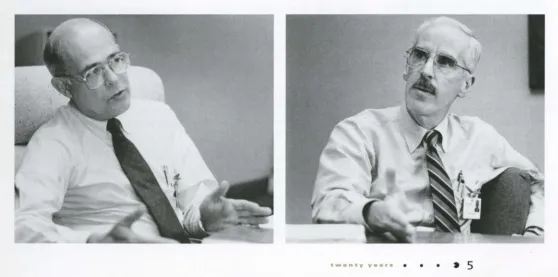
From a shared office at the IBM Poughkeepsie,
NY Development Facility to their current respec-tive positions as Senior Vice President, Product Operations and Vice President, Processor Products, Bruce Beebe (left) and Dave Brewer have ridden on the leading edge of inno
-vation-and they've seen a lot of changes in twenty years with Amdahl.
For example, a lot of the circuitry that we
put in now is for recovery. I don't think
we had anything in the V /6 for r ecov-ery-maybe a 30 percent recovery at a
maximum.
Our conservative attitude today has
much more to do with schedule. I don't know what our first schedule was back in 1970-probably shipping in 1973. And
we shipped in 1975. We just couldn't
afford to do that now.
Bruce: You could examine this gr
a-phically if you compared the principles of operation or the design rules that we had then with what exists today. Then, the
design rules were probably a half-dozen sheets of paper where there would be a one-inch notebook today. And you'd find this order of magnitude and change in
complexity in every area of processor design.
Some people say that mainframes are heading toward extinction, but we're certainly not building our business based on that assumption. Where do you see them going in the next ten years or so?
Dave: Within ten years, I think we'll
see some extremely powerful single chip machines. The advantage is that you get
a tremendous amount of performance for
a very low cost, so the whole balance of
the market changes.
Bruce: The requirement to manage
huge amounts of data is not going to go away. Therefore, the need for something
very large to manage large amounts of
data is still going to be there.
Is it still fun?
Dave: For me, the "fun" issue now has a lot more to do with people than it does with technology. We've gotten to the point where we need to get large groups of people working together well. In the early days, everyone was working on the same thing practically within shouting distance and the communication was good, the uniformity of goals was good, the team spirit was good. The challenge for
today is to maintain that kind of feeling and that kind of energy with the eno
r-mous groups of people that we have.·
Bruce: Human Resource organizations say they are in the people business. Bal
o-ney. We're all in the people business, and if we think we're in the technology busi
-ness and not the people business we're
not going to grow the company right.
Getting and keeping the right people is
•
of Amdahl Corporation goes back to
e-rm{~{)trs
when some computer executives
de-cided to form a new division solely dedicated to
exploring the potential of large-scale processors.
Several
IBM satellite sites were established to
de-velop ideas independently. One of these, the Advanced Computer
Systems (ACS) division, was launched in Menlo Park, California
and some of their most talented employees- including Bruce
Beebe, Glenn Grant and Dick Tobias- were assigned to the
project. The ideas that grew out of their work formed the
corner-stone of the Amdahl Corporation.
I
---~---~--
>-+"'
Q)
C C
"0
Q)
"0 c
.r: ,
c
Q) Q)
+"'
Q)
C C
Q)
.c
E Q) >
o
c
co
As ACS was being founded Dr. Gene Amdahl,
architect of System 360 computers (the predecessor
to the 370 System) was given the opportunity to
work wherever he desired. Enticed by the
chal-lenge of exploring new architectures for large
computers, Gene chose to work at ACS.
The driving force for the ACS team was to show
that there was a technology and an architecture
that could be made that had a higher performance
than anything else IBM
®
had yet developed.
But that ACS goal was never achieved at IBM.
Another technology was selected, and in 1969 the
ACS group began focusing on disc products.
How-ever, that change didn't interest some of the
engi-neers. A handful of ACS employees-Bruce,
Glenn, Dick and Mike Clements-left to form a
start-up company, MASCOR, in order to pursue
their dream of producing a faster mainframe that
could be sold for a competitive price. Later they
were joined by Jim Henry, Bruce Beebe, Dave
Brewer and Rudy Bovier. MASCOR also attracted
others interested in large system architecture
including Russ Young, Lyle Topham, Richard
-
Bishop, Reed Larsen and supporting technicians,
Jim Meyer and Warren Yenney.
Meanwhile Gene Amdahl, who had also left ACS,
went to Europe as a guest lecturer at a NATO
summer school focusing on large-scale systems.
During this time Gene pondered what had gone
wrong at ACS. When he returned, he gathered
some of his former colleagues together for a lunch
at the Santa Clara Ramada Inn. There he unveiled
his plans to form a new company.
"The timing was right for the project," states Glenn
Grant. "MASCOR was faltering due to lack of
funding and there were several antitrust suits filed
that opened opportunites in the computer industry.
Everything seemed to be pointing in the direction
that this was an idea that could make it- and
Gene Amdahl's enthusiasm for the project made it
feel possible."
On January 4, 1971, Amdahl Corporation opened
its doors for business when 18 new employees,
including the recruits from MASCOR, joined the
existing employees (Amdahl Corporation had been
formed in October, 1970 and there were four
employees, including Gene Amdahl, before the new
year) for their first day of work.
It
was a hard five years later, with an investment
of over $50-million, before the first product was
shipped. Despite this long development time and
tremendous financial investment, the dream of
making a significant impact on the computer
industry kept the challenges from becoming
over-whelming. Today, that same entrepreneurial spirit,
pride and personal dedication that produced
Amdahl's first computer continues to grow as we
expand our product line and services.
BILL TARANGIOLI
"When I joined Amdahl in 1974 we were planning to move to the four new buildings on 'East' Arques." At that time East Arques was only a gravel road.
"Even though we were only moving 350 people, half the number you would find in just one building today, it was a big effort. We were definitely learning as we went along.
"I remember upstairs from Building A you could see the construction of Great America. There was a big dirt mound where H Building is now. In those days pheasants and rabbits weren't uncommon sights.
"In 16 years, Amdahl has never quit changing. In many ways it is like a different company today. It's a lot more stable-and now we have products to sell. Back then, we really didn't know what the future would look like. And I'm sure no one thought we would become the size we are today. We just thought of ourselves as a small company."
JIM MEYER
"My original Amdahl business card didn't have a title on it, that way I could become whatever I needed to be that day." Hired on February 21. 1971, Jim was the first line employee in the Drafting Department, but with a quick change of hats he would also become the representative for the Mechanical Engineering Department or the Machine Shop.
"With Amdahl's first machine we were working on some very innovative
connection layers on the circuit boards. We started with eight and then finally moved to ten different layers- this presented some unique problems in terms of how the space would be used and how the physical connections would be made. The Electrical Engineers would bring me the 'needs' and I would figure out the physical concept. We came up with
the solution of putting the connections on the internal boards and the wires out the back- so they could be changed easily."
Jim also designed Amdahl's first tool. "We had contracted with a vendor to crimp the chips so they would fit onto the chip-carrier. But when they came back all of them were incorrect and wouldn't fit the space that we had allowed. So I devised a tool, out of some scrap brass from my garage, that would put the proper crimp on the edge and allow the chip to fit the board. I lost only one in the process-the first one while I was learning to use the tool!"
.I
---~~~---~~--- >-+-'
Q)
C
C
"0
Q)
~
C ::J L ,
C
Q) Q)
+-'
Q)
C
C
Q)
.L:l
E
Q)
> o c
Q ..
-...
.
, I
DAVE ANDERSON
·When I started at Amdahl I was too young to know how risky it was." Dave Anderson, vice president of Advanced Systems, began his Amdahl career on October 4, 1971. "I was originally recruited to work on the console, which I did for a couple of
years. Then I progressed to system integration-setting up the 'unit test floor' as we called it back then. What was amazing is that I worked on aspects of the project that today they wouldn't let me anywhere near. I did lots of different things and so did everyone else. Today we've got a dozen specialists to handle those things.
"Being at Key has made me realize again how much Amdahl has grown and how sophisticated we've become, both in terms of how we think about things and also how complicated we are in our processes. My challenge at Key has been to try to retain some of the lightness of foot of a start-up while instilling some of the stability of a large organization. And I'm also striving to integrate some of what I've learned at Key, such as shorter cycle times, back into Amdahl."
RICHARD BISHOP
Richard Bishop, director of
Advanced Systems Planning, was a member of the original group that started at Amdahl on January 4,1971.
He managed the design groups working on the 1/0 unit and the Systems console for the first 470. "My recollections of the early days are not very rosy-personal sacrifice by many and 70 to 90 hour workweeks. At times the responsibility was overwhelming. But eventually, we were successful and that was very satisfying.
"When I think back to the beginning, it seemed beyond expectation that we would become a Fortune 500 company. But now, when I think about the future, I believe that there is better opportunity than ever.
MARSHA SCHNEIDER
"When I began at Amdahl in 1972 it was a unique environment. We didn't really have a product then, but it felt like an established company. We had a mission we were working towards. We all believed in the goal and each of us, no matter if you were on the manufacturing floor, in payroll or whatever, knew what you did made a difference."
"The early days of selling (1976-771 felt like a war zone. Our salesmen would go out and march up that
hill-often returning with empty briefcases-and we all felt it. It was like a family, we shared. When contracts began to be signed we all savored the success, everyone from Engineering to the receptionists and the people in manufacturing."
Marsha is currently the District Administration manager for the Western Region. During the 18 years Marsha has been with the company she has seen Amdahl grow from when she was the only secretary for Manufacturing to our current presence worldwide. "We've proven that we can survive in a very competitive industry. Amdahl has also retained its concern for the employees' welfare, making it a quality place to work."
BIG
BOXES
Mainframe Vendors Packing Some Surprises
p"
the beginning __ _
SHERMAN LEE
"Our original I-unit design team consisted of four engineers and a manager, Glenn Grant." Sherman Lee was hired in July, 1972 to work on the instruction unit design for the APS System that eventually became Amdahl's first product, the 470. "I remember the design team for the whole machine could fit inside a conference room.
"It was a totally different design
environment back then. Our logic drawings were done by hand using templates. I remember getting my first automated design tool-an electric eraser. It was quite a kick and it really helped with the tedious parts of my job. Once the design was finalized,
then you still had to map it into a form the computer would recognize-the connections were assigned numbers that were recorded on key-punch cards and then the stacks of cards were fed into the computer.
•
>-(I) c c
C :J
.r:: c (I) (I)
-
(I) c cQ)
.c
E
Q)
>
o
c
N
...
EILEEN JENKINS
"I was hired as an assembler when they were just beginning to build the manufacturing floor at Kern Avenue." Eileen started on March 6, 1972 and was the third assembler hired. "Manufacturing was just a big open room then .
"When we had a deadline everyone worked very hard. I remem-ber one programmer had brought in a cot and his sleeping bag and was basically living at the plant so that we could meet the schedule. And he wasn't the only one-we weren't working for the
money, in fact at that time I was working for three dollars an hour, but it was the challenge. The spirit was there and it was very catchy."
Eileen is currently the document technician for Computer Systems Architecture but over the years has been in several different work groups. "I've always sought out positions where I can be a strong individual contributor and Amdahl has provided me with opportunities where I can grow. It is up to the individual employee to put in his or her own contribution-in the best way he or she knows how.
I feel fortunate that I've always been able to work around people that are dedicated to our products and to the success of the company."
LYLE TOPHAM
"There were about 22 of us, 18 from a failing start-up company, MASCOR, who gathered on January 4, 1971. Gene Amdahl described to us his dream of what Amdahl Corporation would design and build-the cycle time, the machine footprint size and its power requirements.
"In the beginning the company was so small to be taking on the industry giant, but we had confidence in the technology and in each other.
Very much like today, we were in the forefront of technology so the sophisticated equipment required to test our components and assemblies couldn't be purchased but had to be custom designed and built by us. For each new technology we have designed and built chip testers, automatic curve tracers, wire verifiers and other unique test systems.
"Working at Amdahl has always been a challenge because we are competing against the industry giant on the forefront of technology. Twenty years later, it's great to be participating in this continuing contest."
ALLEN BUSKIRK
"We used to look down on the reverse engineers. We thought they were kind of funny, in fact. We designed through principals and many of us, the new folks like myself, had never seen the insides of an IBM'" machine." Allen Buskirk was one of Amdahl's first college recruits-he had interviewed with MASCOR and then reinterviewed with the newly established Amdahl Corporation. He joined Amdahl on June 7, 1971 and has spent most of his career in computer development, working on hardware design. Since the 580, he has been focusing on system reliability issues. "Even though IBM's logic drawings were publicly available we didn't have them. We felt we had a strong architecture and just wanted to implement it, so we weren't too concerned about how IBM had done it internally."
"Consequently we were very innovative, particularly in respect to things like the cache memory. For example, on the 580 we used a virtually addressed memory cache which was the first commer-cial application of that theoretical concept. I can actually remember reading an engineering paper at the time that said that it would never work. We smiled as we built the 580.
"We learned a lot of lessons in those days that have shaped how we do business today. We learned to work with our vendors to ensure we would get components that help make our machines reliable. And we've been willing to listen to our customer
Number
1
Pacific Highway
The Pacific Basin is Amdahl's third
largest Field Business Unit (FBU)
with nine offices located across six
countries. Somewhat propheticall
y
the address of its headquarters is
"Number 1 Pacific Highway."
>-+-' (1) C C "0 (1) "0 c , c (1) (1) +-' (1) C C (1) .0 E (1) > o c
Southern Bells ... and Shells
Like many other early Amdahl employees, Ollie Nutt was really faced with two decisions when he
was deciding whether or not to join Amdahl. First,
was he willing to leave IBM? Second, was Amdahl a
place he might want to work? "I thought IBM was
the best-I'd spent 10 years there," he reflects. "I got a call from Amdahl, and out of curiosity met with
them at Texas A&M." He then visited Sunnyvale, and liked what he saw. "I realized that if I thought IBM was the best and I could
success-fully compete against them ... hey, let's go out and run them a good race!" Ollie says.
In Big Blue's Backyard
Like Charlie Pratt, Wayne McIntyre left IBM in
Chicago to come to Amdahl in January, 1976. As the
second full-time Account Executive, Wayne worked out of his home basement for the first few weeks, and was able to set up many contacts despite a
four-year-old daughter who thought every phone call was
for her.
Wayne fondly recalls his early sales strategies. "We didn't really have time in those days to make a
long-term kind of sales pitch," Wayne
says. "What we had to find were prospec-tive customer sites where you strike a "I slept on the decision and was gone the
next day."
In January, 1976 Ollie joined Amdahl as the Regional Manager for what is now the South Central Region, building that territory from one person up. "At that time," says Ollie "training for field man-agers consisted of coming to Sunnyvale
and roaming around talking to various people to find out about the product."
"I had no problem getting
in to see people. They had
a basic curiosity-'what
are these crazy people up
to that think they can
compete against IBM?'''
spark, kindle it rapidly, and get into a serious business conversation before IBM people had a chance to see you in the hallway and send the alarm back to Armonk!"
Working Together
From early on, all the regions worked extremely close together. Everything they developed, from presentation materials to sales strategies, was a team effort. "The
regions also worked together to get the best people they could," Ollie says. "For After his "training course," Ollie went
back to Houston and rented Amdahl's
first office in that region. For six weeks,
Ollie booked himself solid making sales calls. "I had no problem getting in to see people," he recalls,
"They had a basic curiosity-'what are these crazy
people up to that think they can compete against
IBM?' To do business with us, they had to gather up
a lot of courage to take what was obviously a risk at
the time.
"But we had a very sound product. I would talk to prospects and say 'If you'll give me one open-minded
hour, we'll talk about our product and compare it to competitive offerings. I think I can convince you
that we have something superior.' So I would go
through the pitch, and ask them one question at the
end of the hour-'If you had a choice between putting in an IBM 370/168 or an IBM 470V/6, which
decision would you make?' I could get people to say very easily 'Yes, if they were both IBM labels, the 470 is obviously the superior machine.' The
chal-lenge was to have them feel confident in Amdahl.
"For the better part of the first 12-18 months, we built the staffup in Houston-sales, marketing, and support people-and then we were opening other
offices roughly every six months during the first three years," Ollie continues. "We were able to sell and install three systems by the end of 1976 (all were in Tulsa and Kansas City), and all three are still good Amdahl customers. We had much success in the
early years with the oil companies, most notably
Shell and Exxon. We also had some good success with state agencies and universities in Texas."
example, I knew Dave Beamer and I helped to get
him placed into our Chicago office. We had Charlie
Pratt out here, and Milt Nelson in New York. "I recognized that if someone sold one in Chi-cago, that helped me because then I could use them
as a reference. We all covered enormous amounts of
physical distance. In 1976 we sold and installed 27 systems, with only about seven salespeople on board.
We couldn't have done that with those seven people
operating individually."
Within the regions, teams of sales and support
people were also learning to work together. "I re-member going on sales calls with Milt Nelson in
New York," says former SE, now Staff Software
Engineer Larry Hardiman, who joined Amdahl in November, 1975. "He didn't know much about the technical side of the business, and I didn't know
about sales. At first, we just didn't understand what the other was trying to achieve, but we soon learned to work together."
NASA. Besides first· time install jitters, working in the heart of New York created its own anxieties,
Solid Support
John Matthews, director of Technical Support
and one of Amdahl's earliest Field Engineers,
ex-plains the excitement and sense of purpose that
characterized the work environment of Amdahl's
early U.S. customer support organization. "In the
early days, the data center guys' jobs were on the
line every bit as much as Amdahl's," he says. "If
they approved the purchase of the less costly, faster Amdahl machine and it worked, they'd be heroes.
But if they spent all that money and Amdahl folded,
or the machine didn't run, they could get fired."
The young customer support group had a specific
mission: planning for future field support, working on 470 bringup, and writing manuals for the 470.
The service technicians even influenced the engineers
to change part of the design so that it would be easier
to repair.
Jane Bonneson, hired in Minneapolis in 1977,
was the first woman hired as a Systems Engineer
(SE). "It was really amazing back then. I got help
from both the Amdahl people and our customers.
They were all incredibly positive and it was
unbe-lievably fun,"she says. But we were like May tag
repairmen-waiting for calls."
Customer Service manager Ed Cardinal, was a
former IBM technician from Detroit who found Big
Blue too conservative for his free-wheeling style. Ed
served as the backbone of Amdahl's early install
teams, and recalls getting most of his sleep in the
early days on data center consoles during round the
clock installations. "Customers loved Amdahl's
en-thusiasm," Ed says. "We worked hard, and did
ev-erything we could to meet their needs."
Problems of all sizes, shapes and colors-lit
er-ally-beset the early installations. When the 470
was installed at Texas A&M University (P-3), the university did not like the red-orange color of the machine because it was the same as the school colors
.. After the Install": An early Customer Services team takes a post-maintenance breather. Many technicians recall getting most of their sleep in those days on top of computer consoles.
"Salesman Emeritus"
Charlie Pratt receives one of the many outstanding sales awards he has earned over the years from former Amdahl sales manager Jim Dutton.
of the University of Texas, A&M's biggest rival.
Before the Amdahl FEs could comprehend the
magnitude of this complaint, the data center direc-tor had removed all of the 470's panels and rushed them to a local Cadillac dealer for a custom paint job. The financial situation on the home front was
sometimes tight. Larry recalls a period when
Ac-counting was so slow in reimbursing employees for
expenses that some field engineers were having a
hard time paying their bills. "When Dr. Amdahl,
who was calling on a local customer, caught wind of
this," Larry says, "Accounting sped up their
pro-cesses. 'It's okay to prioritize,' Dr. Amdahl said, 'but
you can't not pay the people who are maintaining
our machines for customers.'"
Sometimes it wasn't money that was lacking. "I
remember getting a call from a stranded SE we had
hired fresh out of school," Larry says. "He had
completed his Sunnyvale training course and had
been shipped out to a Hartford, Connecticut
cus-tomer site. He arrived at the airport but couldn't get
any farther-they wouldn't give him a rental car
since he was under 25."
Occasionally there were other concerns as well.
"When we installed at the AT&T Piscataway site
(P-22), someone forgot to order a cable, and eventu-ally the machine failed," John
remembers. "The director of
the data center was very
up-set. He came by one morning
and asked me if I wanted to
have a cu p of coffee. I said yes.
When we got to the cafeteria,
he said, 'Do you still have the
boxes this thing came in?' I
said, 'Yes, I have them.' He
said, 'Well, just pack it up and send it back. It was a
good try, but it didn't work.'
"We tried to talk to him, but he wouldn't listen.
All he said was, 'I'm about to retire and you guys are going to mess up my retirement.' I quickly called
Headquarters. The next morning Gene White was
meeting with the data center director. When Gene
walked out of the office, he was smiling. Instead of
throwing us out, AT&T had decided to purchase
another machine."
Twenty years later, these Amdahl pioneers are
pressing eastward towards yet more unexplored
ter-ritory. This time it's the Far East, where they face not only the same challenge from a well- dug-in
competitor, but the additional hurdle of crossing
cultural barriers that make state lines look like cracks
in a sidewalk.
Eastward,
ho_
>--
Cll c c, c Cll Cll
-
Cllc
c
Cll .D
E
Cll
> o c
.' ID
.
...
Ii
persistence, a few
account executives
account executives
take a swim.
P
robably one of the mostde-manding tasks for a new
Ac-count Executive is to sell an
account to a long term
pro-spective customer who for years has
re-lied on competitors. With this in mind,
Rosemont Regional Director of
Market-ing Dan Chomko proposed a unique
challenge duringan obviously unguarded
moment to Minneapolis Account
Execu-tive (AE) Joe Donovan. "If you sell to
this prospect,
I'll
personally come toMinneapolis and jump in the Mississippi
River," proclaimed Dan one November
day in 1989.
As the Amdahl Account Executive for
this large Midwestern financial firm from
1980 to 1984, Dan had never been able to
sell them anything-not even a
presenta-tion! Nineteen seventy-seven was the
last time a successful contact was made
with this customer when they purchased
a 4 70V /6. "I thought their mold was 'true
blue' and was skeptical that they would
ever change ..
.!
guess the timing was neverright," explains Dan. However, despite
these doubts, Dan knew this was an
im-portant account for us to win. "This is the
largest and most influential financial
in-stitution in the upper midwest. Getting
1
Ithis account would potentially lead to
other sales because of their prestige."
The history of this pursued account
does not stop here. Looking back at the
mid 80s, other AEs pitched their
award-winning proposals only to lose the
ac-count to our competitors. From 1984 to
1986, Larry Murtha was one of those
account exectives who used his best sales
tactics in the hopes of obtaining a
con-tract with this prospective customer. "Try
as we did, nothing worked. We were never
able to effectively get the Amdahl story
across," says Larry. Despite these efforts
the customer was not "sold" on Amdahl
until Joe Donovan took over the account.
"We simply were not going to give up.
We kept going back to the customer
looking for opportunities," explains Joe.
Finally, after years of persistence and
a few Account Executives, this customer
decided that the Amdahl solution was in
fact the best solution. The team of Joe
and Bob Wagner (Minneapolis' Regional
Systems Engineers) worked closely with
all levels of the customer organization
to ensure that Amdahl's upcoming rec
-ommendations and proposal met the
cus-tomer's needs. "We focused on customer
requirements and direction, Amdahl's
commitment and support, the value of
MAKES A SPLASH!
competition and the performance and
flexibility of Amdahl's 5990 system with
its Multiple Domain Feature™ (MDF),"
explains Joe.
"We simply were not going to give up. We kept going back to the customer looking for
opportunities. "
In the midst of digesting this
infor-mation, the customer visited Amdahl's
Sunnyvale Headquarters for an
exten-sive Executive Briefing. The reasons for
these meetings were two-fold: to help
Amdahl executives better understand
the customer's needs while also allowing
its executives to more fully understand
Amdahl's past, present and future.
More than 10 years after the original
contact was drawn up, the customer signed
a new contract and soon after, a 5990-500
system with MDF was installed. The
customer was so impressed with the
sys-tem and Amdahl's service that they've
already upgraded it to a 5990-1400.
But what ever happened with Dan
Chomko's challenge?
"We had no intention of letting him
off the hook," Larry explains. "We
an-nounced Dan's challenge at our next
Regional Sales meeting just to make sure
both ends of the bargain were fulfilled."
As all good managers do, Dan
immedi-ately enlisted the support of his s
uperi-ors, namely, Tony DeMory, North
Cen-tral Regional vice president and Dave
Wright, vice president of Commercial
Sales. Tony and David agreed to take the
plunge along with Dan. After all, how
could they say no in front of a
semi-annual sales meeting with over 100 eager
AEs looking on?
The date of the big event was set:
August 17. To honor the occasion, Dan,
Tony and Dave were presented with
tailor-made sets of official river jumpingtrunks
-in symbolic red-from Jane Bonnesen,
systems engineer. "The trunks were a
terrific way to tie everything
together-the jump, everyone's hard work, and the
contract," says Dan.
The entire Minneapolis office turned
out for the festivities that day. Cheers
from the crowd came as Dan, Tony and
Dave fearlessly jumped off a pontoon
boat into the cold, murky waters of the
Mississippi River. As the courageous three
were jumping, Joe chuckled at one tiny
oversight-"We forgot to ask them ifthey
knew how to swim.
"The jump was a great way to
cel-ebrate," concludes Joe, "but the best part
was knowing that we were able to meet
this customer's needs and that we can
work on fostering relationships with their
data center personnel."
As for Dan, he has become more
judi-cious in "voicing" his opinion about our
chances at new prospects. "Our guys did
a terrific selling job with the key words
being perseverance and professionalism.
They flat out-marketed our competitors
and when that happens, I'm happy to
take a swim!" he exclaims.
Might this be a new motivation tool for all Sales Managers?
>-Q) c c -0 Q) -0 C :::J
.c ,
c Q) Q) Q) c c Q) .0 E Q) > o c
co
'._
...
.
, I
Signs of the Times
What do cats, chip cooling towers,
Matryoshka dolls, wooden ducks and
blue ribbons have in common?
They all have represented Amdahl in
our information campaigns at one time
or another.
Over the past 15 years, many creative tools have been used to tell the Amdahl story. Be it animate or inanimate objects, one message always shines throug
h-quality in everything we do.
In the first years after the 470 was developed and shipped, Amdahl relied
on word-of-mouth and industry coverage to promote name recognition. When mass media campaigns began to be used, they addressed the primary question that
pre-vailed in the marketplace-"Is Amdahl
going to last?"
The company's campaigns were used
to communicate the existence,
accom-plishments and capabilities of Amdahl. "Early on, we had to say to our target markets 'YES,' Amdahl will be around in the next 5, 10, 20 years," says Jeff Finn,
manager, Corporate Communications.
The Cat in the Bag campaign best
de-scribes Amdahl's period of infancy in the industry. Its caption read: "This phe-nomenon is not only unusual, it's also
untold. Until now." In 1983, this bold
statement opened the eyes of many-the secret was out of the bag.
Soon to follow, Amdahl embarked on
direct mail campaigns. The year 1984
was marked by the distribution of
paper-weights containing chip cooling towers that were sent to the key decision ma-kers at current and prospective customer sites. The Heart of the Giant advertising campaign, which emphasized the
tech-You
can'" a
goad
Idea
IIIIwII.
Ew-I'""I_ ... ... .... -'>imut . . . ~ ...,..,.""I~ .... ,.",-.. 1 ... . - - 0 1 _ 0 1 ....
wwW'._.--..,...IIIM ... _ _ ._
-"'
... ...
----
...
...
- - ....
.--
"'~IiN_
-'
__--_
~ ... ......."""'"-...
. -..
.,...-....
_--..,..-...-... .., .... o..-~
r _ _ _
lIIio_ ... ...
f7"1' .. _ _ _ ... _
~-.-.-
.. ....
_ i o ... _ . . ...
... .·..,_ ••
..
-~ u ...._ ..... 7'iIN".,...,_
...
~.~ ...-...
...
,.-...
...
,.."...
...
-... ..._
....
.
.... _ _ ... 11,...
... 111& ... _) _ _
...-...~-...
--...
STORAGE COffT1DI.ER GETS 30 BRAINS.
'
.
-
_
..
...
_
....
....
---
-.--::::.:::..---.~ ~--
..
---, ... _ _ . . . . _ Io _ _ ~ ... tl .. .n_ ...
...
_...
_
._
..._
-1:.:"
-...
... -:::==-"::':'::::",":::"...
...
=
..
::-.100 _ _ """.100 ....-. ....-_
.
"""'--... __ ~ .. ft_ __ ... _ .. -...,..
_ 01--'''_. _ _ ~ _ .. , _ .... _ _ _ ..
-
-
...
...
..
.....__
.-. .._
..._-_':!-~::=;;'''::w..-:::t' ;:e.~ __
=, ...
t"""-'"nological advantage of the chip cooling
towers, accompanied this distribution. "We
had a very gratifying response to the mailing
of the paperweight containing the
cool-ing tower from a 5890," says Jack Lewis,
chief executive officer. "By all indica-tions, most data processing executives who received the gift kept it on their desk as a constant reminder of Amdahl."
In 1986, the Matryoshka doll (a
Rus-sian toy that opens at the waist to reveal a series of successively smaller dolls)
re-vealed an im portant message--only Amdahl
offered mainframes within mainframes. The Multiple Domain Feature™, a cost-efficient hardware solution that allows
---1&
....
_
...
-
---
...-
...---
-_
... _ _""----
...-
. . .'
---
t.oo _ _ . 10<>. .. _ . _ ... _ - , ...._ .... w. ... ,... _ _ _ _ _ , ... ~ ... _ _ .... _ r~ ..
11, ........ _
-."-....
-
,
... -~ ...-the use of two or more operating systems at the same time on one mainframe, was
highlighted with this campaign. "Our main
objective was to create a clear, concise
image of who Amdahl was and how it was changing the industry," explains Jeff.
Another direct mail piece illustrating
our uniqueness and dedication to service and quality was developed by Amdahl
Canada Limited in 1990. More than 350
hand-carved wooden ducks were mailed
to senior customer and prospective cus-tomer executives. The package also inclu -ded an Amdahl corporate brochure and a personal letter from Amdahl Canada
0.00 _ _ .... _
-
...
--.
-
... ...--_
... """.... ~~-.-.
-
...._---Uooo _ _ _ ' _ . . . , .. _ _ _
-
...
,..._._
...-_"' .... 1\_ ... _ -. .... .-,.. ..
00.... --... ~
Jooo<o*-olo ... _ - - ... - . .
=-~
;..S'::::.
~_ ... _ _ _ _ 00"".
... _ 0 0 ,.. ... "' _ _
OO~_IRUUI)I~ _ _ ... _~ ...
--,.~
..
--. ..._ _ .... Col ... ook_UO .... ... -... -~_. __ 'I.
=.":!"!:::."l::::!"" :'c!!:.!.,:",~m. .... 1T
~_Ied.RlllScooI.
Ats
under
an alrplane_
And
comes
4
to
a
box.
The "wild duck" theme typified the
individual spirit, endless quest to
con-quer new horizons and the commitment
to excellence that Amdahl exemplifies.
The direct mail advertising campaign, or
'the duck mailing' as it has been
affec-tionately labeled, was developed by Jim
Johnson, director of Marketing, Amdahl
Canada Limited, and John Challinor,
manager, Communications and
Corpo-rate Programs. The purpose was to create
a level of awareness about Amdahl in the
minds of the key senior executives in
organizations that comprise Canada's
top 200 users of large scale mainframe
"Our main objective was to create a
clear, concise image of who Amdahl
was and how it was changing the
industry."
systems. "We get letters almost every
day from senior executives expressing
their appreciation and complimenting the
quality, creativity and symbolism of this
decoy mailing. You can be assured that
every time they look at that duck in their
office or in their home, they will think
of Amdahl. And, the next time an
Amdahl recommendation comes across
their desk, they won't ask who we are," explains Jim.
According to Jeff, "After almost a
de-cade of proving our technical
capabili-ties, our leading concern today has moved
to service. Our willingness to work with
our customers on a one-to-one basis clearly
differentiates us from our competitors."
Service is the concern of most customers
in the nineties. According to a recent
Fortune magazine article, 'Service,
ser-vice, service' is what customers, both large
and small, want from a company.
Early in 1990, the Blue Ribbon
adver-tising campaign, based on the results of
the 1989 Datapro Satisfaction Survey of Mainframe Computer Users, concentrated
on this aspect of the business. "This
cam-paign not only demonstrated that we will
go that extra mile, but at the same time
displayed the diversity of our products," states Jeff. The campaign, appearing in the Wall Street Journal and various trade
publications, was met with a very
favor-able response as it demonstrated Amdahl
earning the highest ratings in 19 of the 25
performance categories-proving once
again we are not a "me too" company.
No matter what type of campaign or
media tool is used, when the opportunity
arises, Amdahl is there to educate the
public, our customers and prospective
customers about our unique strengths and
to highlight the impact we have had on
the large-systems industry.
Terilyn Monroe
. : - I .. . - -. ~ "
'-• • • I • • • I • • • " • • •
1969
The world has only one e choice.
1970
"A Red Letter Year," Amdahl Corporation
formed in October.
1971
Work on the Execution, Instruction, and Storage units begins on January 4th.
1972
Amdahl forms a financial and working partnership with Fujitsu Limited.
LSI Operating System Good Test completed.
Amdahl hires its first manufacturing
employees.
August-IBM annouces virtual memory
availability, sending Amdahl engineers back to drawing board.
1974
February-Gene White is hired as a business consultant and in August becomes
president of Amdahl Corporation.
1975
Amdahl Corporation has spent nearly
$50-million dollars on development and production before first product is released.
470V/6 introduced, Amdahl's first product.
NASA buys an Amdahl computer, with 1 MB
of memory, and becomes first customer.
Amdahl engineers introduce first Large
Scale Integration Technology to achieve
speeds measured in trillions of seconds.
1976
Amdahl international offices open: Amdahl
Canada is closely followed by Amdahl Deutschland.
The first 470 contracted in Europe goes to a Norwegian customer.
1977
470V/7 announced (50-70 percent faster
than the V/6). First large-scale upgradeable
mainframe. (Product enhancement will
become an Amdahl hallmark.)
United Kingdom office opens in Hounslow, England.
Amdahl stock listed on the
American Stock Exchange.
edit Suisse becomes first A ahl customer in Switzerland.
ack Lewis recruited from Xerox Business
Systems to become chief operating officer.
Qantas purchases two 470 achines and becomes first Amdahl mer in the Pacific Basin.
1978
Third model, 470V/8, announced (25 percent faster than V/7).
1 OOth 470V/6 installed.
Amdahl Ireland, Limited formed
and Dublin manufacturing plant opens.
First two-for-one stock split.
Amdahl France office formed
in March, 1978.
1979
470 Accelerator announced (boosts 470V/7
performance)-an innovation that enables
smaller class 470V/7 users to periodically
increase workloads.
Amdahl product line reaches
six available models.
Over 300 470 series systems installed in 13 different countries.
The first 470Vl81eaves Systems Test.
Number of employees on December 31-3,658.
Scan/Benelux Region established.
. .
.
.
".
. . .
.
. ..
1980
Training centers open in response to
increasing demand for customer education services.
Research and Development expenditures
rise 60% over the previous year.
Revenues reach $394,351,000. 580 Se· Processor announc d 100 percent faster than the 470V/8 and uses less floor space.
First front-end Communications Pfi ssor, 4705, announced.
Second public offering, $55-million
raised in common stock.
October 20, a new 200,000 square foot manufacturing facility opens in Swords,
Ireland.
470th shipment of 470 system,
October 30th.
1981
100th 470 built in Ireland and installed in Europe.
UTS introduced commercially.
Amdahl listed on London Stock Exchange. $370-million multi-currency credit agreement with an international banking firm established.
Amdahl Federal Services Corporation
is officially incorporated.
First Day on the Green drew record-breaking
crowd of 1100+ employees.
Corporate Computer Center sets record-99 percent availability ... downtime averages
less than 9.6 hours per week out of 960 operating hours per week.
"E
Research and Development expenditures
are $81,276,000.
Peripheral Products Division formed.
6000 Series DASD announced.
Amdahl Communications Systems Division formed.
4400 Series Network Concentrators
announced.
Amdahl makes Fortune 500 list.
First two production models of the new 5860 product line delivered to Systems Test
exactly on schedule.
Customer Satisfaction Research Institute
rates Amdahl superior in customer services.
Expansion of the Support System Development's mailbox system: in operation since 1980.
First shipment 580 product line in August.
1983
Revenues jump to $777,680,000-68 percent higher than 1982.
Amdahl's first full year of shipping storage devices, DASD (Direct Access Storage Devices).
Research and Development expenditures hit the hundred million dollar mark, $10 ,728000.
580/XA (extended architectur~ announced. First 580 shipped from Ireland plant.
Amdahl Pacific Basin Field Business Unit established.
Second two-for-one stock split.
Number of employees: 6.400.
Amdahl receives United Way's highest award, the Award of Excellence.
Quality Improvement Process formally introduced.
Amdahl runs first ad campaign, ''The Amdahl Phenomenon", in May.
Communication Industry Region formed.
1984
1100/1200 Vector Processors announced (up to 533 megaflops).
6880 Storage Controller/6380DASD announced (new cache controller and doubled capacity).
Multiple Domain Feature introduced.
Laser and robotic technology used to build 580s.
AMDAC locations ihcrease to include sites in London and Columbia, Maryland.
Amdahl purchase Dogmersfield Park-the new site for European Headquarters.
Polylekniskrevy, a Norwegian PUbliCal ln,
names Amdahl "Computer Company of the Year."
1985
E. Joseph Zemke hired as chief operating officer. Jack Lewis promoted to chief executive officer.
5890 Series Processors announced (up to 80 percent faster than the fastest 580).
6380E DASD announced (double the capacity of 6380).
500/1400 Vector Processors announced (up to 1.14 gigaflops).
First 580 with MDF installed in Europe goes to Primdata in Sweden.
Manufacturing facilities in Swords and Sunnyvale expanded.
Revenues hit $862,032,000.
•
•
1986
6380E announced-double capacity disk
storage system. (Response time improved by a factor of 10).
580th 580 and 100th MDF installed.
First stand-alone version of UTS announced. Revenues rise to $966,349,000.
Amdahl is included in Standard and Poors Composite Stock Price Index.
10,000th DASD unit shipped.
The first 5890 installations and certifications conducted at a testing facility in Minnesota. Princess Anne opens Amdahl's European Headquarters at Dogmersfield Park. Later the same year Amdahl wins Environmental Planning Award for this facility.
Business Week- Amdahl ranks 52 out of 100 largest US companies ranked by stock market valuation.
•
•
1987
First billion-dollar year-$1 ,505,000,000. Current Climate Survey started.
5890-190 Uniprocessor announced.
Amdahl Ireland plant doubles in size.
Computerworld, Information Week, MIS Week, Datamation run ads for Amdahl highlighting Storage Products, EPS courses and the Multiple Domain Feature.
Mercury News ranks Amdahl 6th largest Silicon Valley company in terms of sales and net worth.
1988
Amdahl unveils new 5990 models.
Over 300 engineers contributed to its design and development over a four-year period. $223 million spent on research and design.
5890-390E two-way Multiprocessor
announced.
6100 Storage Processor developed .
6380J and 6380K DASD announced.
4745 Series Communications Processors announced (100 percent more throughput than 4705) ..
Revenues reach $1,801,000,000.
New Marketing support group, Corporate System Engineers, established.
mployees worldwide.
receives the Crosby Quality Fanatics Award.
Two ducks make the Amdahl HQ pond their spring retreat.
t""anty year • •
1989
Amdahl Television Network airs its first broadcast.
New generation of network management products, Network Processor Series, announced.
Key Computers Laboratories acquired.
Amail goes into full production.
General availability of UTS 2.0.
7300 Series of processors announced. Amdahl's first UNIX based processor.
Amdahl opens an office in Aus i .
Amdahl spends $277 million fo and develop
October 17, the Iggest Earthquake since 1906 rocks the Bay Area. Amdahl's Customer Services Representatives work around the clock to respond to customers' needs.
Revenues surpass the $2-billion mark.
1990
ATN used to broadcast U.S. field kickoff.
Move-Page Facility and Hiperbatch capabilities implemented on 5990 and 5890E mainframes.
I reland plant recognized by local government for outstanding factory premises.
Via distributorship agreements, Fujitsu installs Amdahl computers in Korea and Japan.
Amdahl begins preparation work on the Malcolm Baldrige Award application.
The first non-U.S. installation of a 5990-350 went to Wusternrot, a savings and loan institution in Austria.
New High-Performance Storage subsystem, the 6110, announced and ships 35 units in the first three weeks.
Amdahl announces its 6th generation of mainframes-the 5995 Series processors
-Of the first 10 Amdahl
Canadian Customers-all are
still on the roster today.
What's the
secret
to
their
success? Service, Service,
and more ...
From the beginning Cana-dian customers have shown an enthusiasm for Amdahl prod-ucts. Accord i ng to Charlie Pratt,
Ten
Out
0
Ten
Amdahl's first account executive for the Western Region (which in 1976 included all of Canada), the first machine installed at the University of Alberta was bought-not sold. In fact, the University had been interested in Amdahl's design from the begin-ning and was involved during the research and de-velopment stages of the original product.They received the fifth machine produced and the first piece of Amdahl equipment installed outside of the United States (U.S.).
The installation was handled by a Sunnyvale team, headed up by Ed Cardinal, then, senior field engineer. Shortly after, Ian Lanouette, a Canadian expatriate who had been working in Engineering Bring-up, was assigned to the University of Alberta to replace two local FEs that had resigned.
"Charlie Pratt continued to make sales in Canada, adding the private railroad company, Canadian Pa-cific and a service bureau, 1ST, as the next two accounts," states Ian. (Phil Lemay was the founder and president ofIST until he resigned to join Amdahl in 1978.)
"Later in '76 when Amdahl Canada (the first international
subsidiary of Amdahl Corpora
-tion) was founded, I was the first employee on their records," recalls Ian. "I remember our Christmas party that year was held in Toronto and Amdahl U.S. flew some AMDAC tech -nicians up to cover the accounts so we could all attend. It was a small group, but it had a real entrepreneurial spirit."
One of the first accounts in Toronto was the Bank of Montreal. Leon Hoppel, who started with Amdahl in June of 1976 remembers, "The Bank of
Montreal needed a lot of processing power in a
single engine machine and Amdahl had the largest, fastest uniprocessor. They ran their highest priority job-the on-line banking- on one Amdahl 470V/6. Service was the key! The customer felt that the Canadian economy could be affected if the macine was down more than four hours and sometimes used this notion to motivate the FEs.
"In those days the machines weren't as reliable -though the Amdahl computers were the best ava il-able-as well as the fastest," continues Leon. "Early customers referred to thcm as 'screamers'.
"We were the 'white
knights' who saved the
customers. Now problems
are being designed out of
the product, which is very
good for Amdahl, but it is
changing the role of the
field engineers.
"Now things are much bet-ter. People think differently
aboutcomputers. The workloads have increased substantially and become more critical. They're dependent on it worki ng 24 hours a day and down time is allotted once a year."
During the early days the Canadian organization attracted employees who enjoyed the at-mosphere and feeling of a start-up company. "We were able to hire some very experienced people because they were given the freedom to do what they felt needed to be done to solve a customer problem," states Jack Cowan, sen ior FE also hired in June, 1976. "We were the 'white knights' who saved the customers. Now problems are being designed out of the product, which is very good for Amdahl, but it is changing the role of the field engineers. The FEs are having to find new direction and meaning to their jobs."
"Amdahl was a very results-oriented company from the beginning," recalls Mike Taylor, former field manager for Central and Western Canada (re-cently named a vice president in the Open Systems group). "You did whatever it took to get the job done. Consequently there was a lot offlying to move parts around. I remember one night having to get a part from Vancouver to Toronto. I was able to con-vince a charter airline company to send out one of their planes during the middle of the night and give us credit to do it-even though they had never done