End-to-end Relation Extraction using Neural Networks and Markov
Logic Networks
Sachin Pawar1,2, Pushpak Bhattacharyya2, and Girish K. Palshikar1 1TCS Research, Tata Consultancy Services, Pune
2Indian Institute of Technology Bombay, Mumbai {sachin7.p,gk.palshikar}@tcs.com
Abstract
End-to-end relation extraction refers to identifying boundaries of entity mentions, entity types of these mentions and appro-priate semantic relation for each pair of mentions. Traditionally, separate predic-tive models were trained for each of these tasks and were used in a “pipeline” fash-ion where output of one model is fed as input to another. But it was observed that addressing some of these tasks jointly re-sults in better performance. We propose a single, joint neural network based model to carry out all the three tasks of bound-ary identification, entity type classifica-tion and relaclassifica-tion type classificaclassifica-tion. This model is referred to as “All Word Pairs” model (AWP-NN) as it assigns an appro-priate label to each word pair in a given sentence for performing end-to-end rela-tion extracrela-tion. We also propose to re-fine output of the AWP-NN model by us-ing inference in Markov Logic Networks (MLN) so that additional domain knowl-edge can be effectively incorporated. We demonstrate effectiveness of our approach by achieving better end-to-end relation ex-traction performance than all 4 previous joint modelling approaches, on the stan-dard dataset of ACE 2004.
1 Introduction
The task of relation extraction (RE) deals with identifying whether any pre-defined semantic re-lation holds between a pair ofentity mentions in the given sentence. Pure relation extraction tech-niques (Zhou et al., 2005; Jiang and Zhai, 2007; Bunescu and Mooney, 2005; Qian et al., 2008) assume that for a sentence, gold-standard entity
mentions (i.e. boundaries as well as types) in it are known. In contrast, end-to-end relation extraction deals with plain sentences without assuming any knowledge of entity mentions in them. The task of end-to-end relation extraction consists of three sub-tasks: i) identifying boundaries of entity men-tions, ii) identifying entity types of these mentions and iii) identifying appropriate semantic relation for each pair of mentions. First two sub-tasks correspond to the Entity Detection and Tracking task defined by the the Automatic Content Extrac-tion (ACE) program (Doddington et al., 2004) and the third sub-task corresponds to the Relation De-tection and Characterization (RDC) task. ACE standard defined 7 entity types1: PER (person),
ORG (organization), LOC (location), GPE (geo-political entity), FAC (facility), VEH (vehicle) and WEA (weapon). It also defined 7 coarse level relation types2: EMP-ORG (employment),
PER-SOC (personal/social), PHYS (physical), GPE-AFF (GPE affiliation), OTHER-GPE-AFF (PER/ORG affiliation), ART (agent-artifact) and DISC (dis-course).
Traditionally, the three sub-tasks of end-to-end relation extraction are carried out serially in a “pipeline” fashion. In this case, the errors in any sub-task affect subsequent sub-tasks. Another dis-advantage of this “pipeline” approach is that it allows only one-way information flow, i.e. the knowledge about entities is used for identifying re-lations but not vice versa. Hence to overcome this problem, several approaches (Roth and Yih, 2004; Roth and Yih, 2002; Singh et al., 2013; Li and Ji, 2014) were proposed which carried out these sub-tasks jointly rather than in “pipeline” manner.
We propose a new approach which combines
1www.ldc.upenn.edu/sites/www.ldc. upenn.edu/files/english-edt-v4.2.6.pdf
2www.ldc.upenn.edu/sites/www.ldc. upenn.edu/files/english-rdc-v4.3.2.PDF
Entity Mention Boundaries Entity Type
His (0,0) PER
sister (1,1) PER
Mary Jones (2,3) PER
United Kingdom (7,8) GPE
Table 1: Expected output of end-to-end relation extraction system for entity mentions
the powers of Neural Networks and Markov Logic Networks to jointly address all the three sub-tasks of end-to-end relation extraction. We design the “All Word Pairs” neural network model (AWP-NN) which reduces solution of these three sub-tasks to predicting an appropriate label for each word pair in a given sentence. End-to-end rela-tion extracrela-tion output can then be constructed eas-ily from these labels of word pairs. Moreover, as a separate prediction is made for each word pair, there may be some inconsistencies among the labels. We address this problem by refining the predictions of AWP-NN by using inference in Markov Logic Networks so that some of the in-consistencies in word pair labels can be removed at the sentence level.
The specific contributions of this work are : i) modelling boundary detection problem by intro-ducing a special relation type WEM and ii) a sin-gle, joint neural network model for all three sub-tasks of end-to-end relation extraction. The paper is organized as follows. Section 2 provides a de-tailed problem definition. Section 3 describes our AWP-NN model in detail, followed by Section 4 which describes how the predictions of AWP-NN model are revised using inference in MLNs. Sec-tion 5 provides experimental results and analysis. Finally, we conclude in Section 6 with a short note on future work.
2 Problem Definition
Given a sentence as an input, an end-to-end rela-tion extracrela-tion system should produce a list of en-tity mentions within it. For each enen-tity mention, its boundaries and entity type should be identi-fied. Also, for each pair of valid entity mentions, it should decide whether any pre-defined semantic relation holds between them.
Consider the sentence : His0 sister1
Mary2 Jones3 went4 to5 the6 United7
Kingdom8 .9 Here, end-to-end relation
extrac-tion should produce the output as shown in the tables 1 and 2.
Entity Mention Pair Relation Type
His,sister PER-SOC
His,Mary Jones PER-SOC
sister,United Kingdom PHYS
Mary Jones,United Kingdom PHYS Table 2: Expected output of end-to-end relation extraction system for relations
3 All Word Pairs Model (AWP-NN) We propose a single, joint model for addressing all three sub-tasks of end-to-end relation extrac-tion : i) identifying boundaries of entity menextrac-tions, ii) identifying entity types of these mentions and iii) identifying appropriate semantic relation for each pair of mentions. We refer to this model as AWP-NN, i.e. All Word Pairs model using Neu-ral Networks. Here, annotations of all these three sub-tasks can be represented by assigning an ap-propriate label to each pair of words. It is not nec-essary to assign label to all possible word pairs; ratherithword is paired withjthword only when
j ≥ i. AWP-NN model is motivated from the table representation idea proposed by Miwa and Sasaki (2014) but differs significantly from it in following ways:
1. boundary identification is modelled with the help of a special relation type (WEM) instead of BIO (Begin, Inside, Other) encoding or BILOU (Begin,Inside,Last,Unit,Other) en-coding
2. neural network model for prediction of ap-propriate label for each word pair instead of structured prediction
Labels predicted by the AWP-NN model for each word pair can then be used to construct the end-to-end relation extraction output as described in tables 1 and 2.
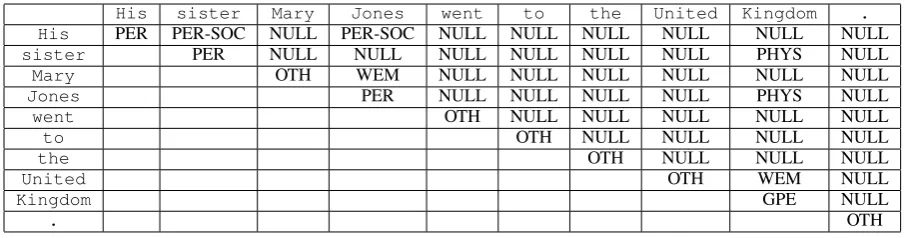
Consider the example sentence from Section 2. Table 3 shows true annotations of all word pairs in this sentence as required for training the AWP-NN model. Labels used for these annotations can be grouped into the following 5 logical clusters:
1. PER, ORG, GPE, LOC, FAC, VEH and WEA : Represent entity type of head word of an entity mention when both the words in a word pair are the same
His sister Mary Jones went to the United Kingdom .
His PER PER-SOC NULL PER-SOC NULL NULL NULL NULL NULL NULL
sister PER NULL NULL NULL NULL NULL NULL PHYS NULL
Mary OTH WEM NULL NULL NULL NULL NULL NULL
Jones PER NULL NULL NULL NULL PHYS NULL
went OTH NULL NULL NULL NULL NULL
to OTH NULL NULL NULL NULL
the OTH NULL NULL NULL
United OTH WEM NULL
Kingdom GPE NULL
[image:3.595.70.523.61.180.2]. OTH
Table 3: Annotation of all word pairs as per the AWP-NN model
3. ORG, PHYS, OTHER-AFF, EMP-ORG-R, PHYS-R, OTHER-AFF-R3,
PER-SOC, GPE-AFF and ART : Represent rela-tion type betweenhead wordsof any two en-tity mentions
4. NULL : Indicates that no pre-defined seman-tic relation exists between the words in the word pair
5. WEM (Within Entity Mention) : Indicates that the words in the word pair belong to the same entity mention and one of the word is thehead wordof that mention
3.1 Features for the AWP-NN model
Previous work (Zhou et al., 2005; Jiang and Zhai, 2007; Bunescu and Mooney, 2005; Qian et al., 2008) in relation extraction establishes the im-portance of both lexical and syntactic features. Hence, we designed features to capture informa-tion about word sequences, POS tags and depen-dency structure. As each word pair constitutes a separate instance for classification, features are of three types: i) features characterizing individ-ual word in a word pair, ii) features characterizing properties of both the words at a time and iii) fea-tures based on feedback, i.e. predictions of pre-ceding instances.
3.1.1 Individual word features
These features are generated separately for both the words in a word pair.
1. Word itself and its POS tag
2. Previous word and previous POS tag 3. Next word and next POS tag
4. Parent / Governor of the word in the depen-dency tree, the corresponding dependepen-dency relation type and POS tag of the parent
3EMP-ORG-R, PHYS-R and OTHER-AFF-R correspond to relation types EMP-ORG, PHYS and OTHER-AFF in the reverse direction, respectively.
3.1.2 Word pair features
These features are generated for a word pair (say hWi, Wji) as a whole.
1. Words distance (WD): Number of words in the sentence between the wordsWi andWj
2. Tree distance (TD): Number of words on the path leading fromWi toWj in the sentence’s de-pendency tree
3. Common Ancestor (CA): Lowest common an-cestor of the two words in the dependency tree 4. Ancestor Position (AP): It indicates the posi-tion of the common ancestor with respect to the two words of a word pair. Different possible po-sitions of the ancestor are - left ofWi, Wi itself, betweenWiandWj,Wjitself and right ofWj. 5. Dependency Path (DP1, DP2,· · · , DPK) :
Se-quence of dependency relation types (ignoring di-rections) on the dependency path leading fromWi toWj in the sentence’s dependency tree.
3.1.3 Feedback features
These features are based on predictions of the preceding instances. Unlike other sequence la-belling problems such as Named Entity Recog-nition where each word gets a label and there is natural order / sequence of instances (i.e. words), there is no natural order / sequence of instances (i.e. word pairs) for AWP-NN model. Hence, for each instance we identify its two preceding instances and define two corresponding feedback features (F B1 andF B2). LethWi, Wjibe an in-stance representing a word pair in a sentence hav-ingN words such that1 ≤ i, j ≤ N andi ≤ j. There are following two cases for identifying two preceding instances ofhWi, Wji:
• Ifi=jthen both the preceding instances are same i.e. hWi−1, Wi−1i. Feedback features: F B1=F B2 =LabelOf(hWi−1, Wi−1i)
hWi, Wii andhWj, Wji. Feedback features:
F B1 = LabelOf(hWi, Wii) and F B2 = LabelOf(hWj, Wji)
Label predictions of the preceding instances are then represented using one-hot encoding and used as features. During training, true labels of the pre-ceding instances are used but while decoding, the predicted labels of these instances are used. Hence during decoding, predictions for word pairs of the formhWi, Wii(diagonal word pairs in the table 3) are obtained first, starting fromi = 1toN. Pre-dictions of other word pairs can be obtained later, as predictions of their preceding instances would then be available.
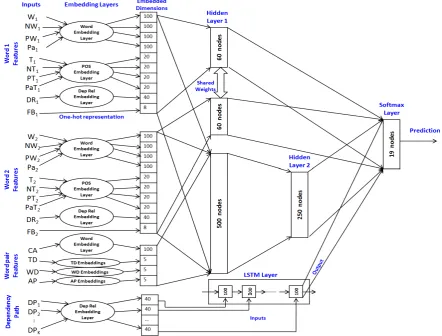
3.2 Architecture of the AWP-NN model Figure 1 shows various major components in the architecture of the AWP-NN model.
3.2.1 Embedding Layers
Most of the features used by the model are discrete in nature such as words, POS tags, dependency re-lation types and ancestor position. These discrete features have to be mapped to some numerical rep-resentation andembeddinglayers are used for this purpose. We have employed following embedding layers to represent various types of features: Word embedding layer: It maps each word to a real-valued vector of some fixed dimen-sions. We initialize this layer with thepre-trained 100 dimensional GloVe word vectors4 learned on
Wikipedia corpus. All the different features which are expressed in the form of words (W1, W2, NW1, P W1, NW2, P W2, P a1, P a2 andCA in
the figure 1) share thesameword embedding layer. During training, the initial embeddings get fine-tunedfor our supervised classification task. POS embedding layer: It maps each distinct POS tag to some real-valued vector representation. All the different features which are expressed in the form of POS tags (T1,T2,NT1,P T1,NT2,P T2, P aT1 and P aT2 in the figure 1) share the same
embedding layer.
Dependency relation type embedding layer: It maps each distinct dependency relation type to some real-valued vector representation. Both the features based on dependency types (DR1, DR2, DP1,· · ·, DPK in the figure 1) also share thesameembedding layer.
4http://nlp.stanford.edu/projects/glove/
AP embedding layer: It maps each distinct an-cestor position to some real-valued vector repre-sentation.
WD/TD embedding layer: Even though word distance (WD) and tree distance (TD) are numer-ical features, we used embeddings to represent each distinct value for them as range of values of these features is large. It was observed to be better than directly providing them as inputs to the neural network.
In our experiments, we used 20 dimensions for POS embeddings, 40 for dependency relation type embeddings and 5 dimensions for AP, WD and TD embeddings. Unlike word embeddings these were initialized randomly during training.
3.2.2 Hidden Layers
First hidden layer is divided in 3 parts. First two parts of 60 nodes each are connected to only the features capturing first and second word, re-spectively. These nodes are expected to capture higher level abstract features of both the words separately. In order to force these two parts to learn similar abstract features, the weights matrix is shared among them. The third part of the first hidden layer consisting of 500 nodes is connected to all the input features except dependency path, i.e. individual word features of two words, word pair features and feedback features. Output of this part is further given as input to the second hidden layer of 250 units. Output of the second hidden layer is fed to the final softmax layer. Also, out-puts of the first two parts of the first hidden layer are directly connected to the final softmax layer. As the dependency path is represented as a se-quence of dependency relation types, it is fed to a separate LSTM layer. Output of the LSTM layer is directly connected to the final softmax layer. Soft-max layer consists of 19 nodes, each representing one of the possible prediction label described ear-lier.
4 Inference using Markov Logic Networks
Figure 1: AWP-NN model architecture for predicting appropriate label for the given word pair. (W1, W2:
words in the word pair;NW1, P W1, NW2, P W2, NT1, P T1, NT2, P T2: next and previous words/POS
tags ofW1andW2;P a1, DR1, P a2, DR2: parents and corresponding dependency relation types ofW1
andW2in the dependency tree;P aT1, P aT2: POS tags of the parents ofW1andW2;F B1, F B2:
Pre-dictions of the preceding instances;CA: Lowest common ancestor ofW1andW2in the dependency tree; T D: Tree distance;W D: Words distance;AP: Ancestor position;DP1, DP2,· · · , DPK: Sequence of dependency relation types on the dependency path leading fromW1toW2; Embedding layers for words,
POS and dependency relations are shown separately for clarity, but are shared throughout the network.
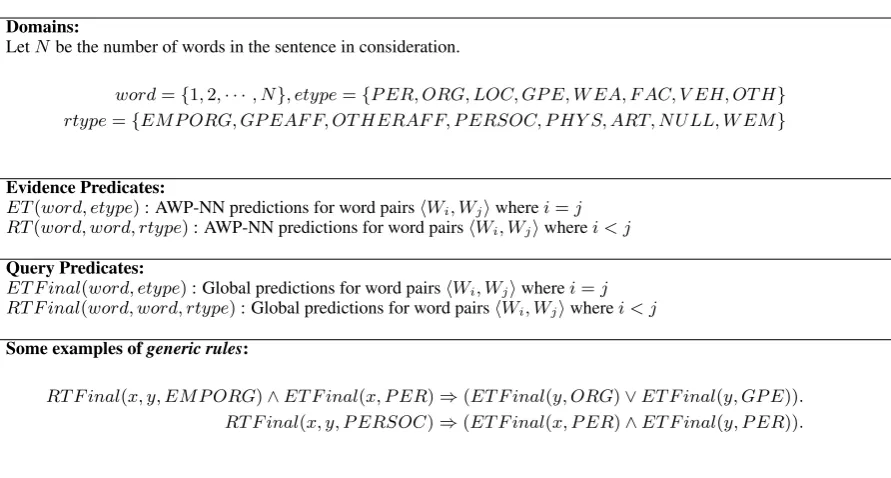
predicting relation types. Outputs of these classi-fiers may be inconsistent. E.g., if PER-SOC rela-tion is predicted by the local relarela-tion classifier for an entity pair and the local entity classifier predicts entity type as ORG for one of the entity mentions, then there is an inconsistency. Because PER-SOC relation can only exist between two PER entity mentions. Such domain knowledge can be easily incorporated in the form of first-order logic rules in MLN. For each sentence, predictions of individ-ual classifiers are represented in an MLN as first-order logic rules where weights of these rules are proportional to the prediction probabilities. The consistency constraints among the relation types and entity types can be represented in the form of first-order logic rules with infinite weights. Now,
the inference in such an MLN generates a globally consistent output with maximum weighted satisfi-ability of the rules.
Domains:
LetNbe the number of words in the sentence in consideration.
word={1,2,· · ·, N}, etype={P ER, ORG, LOC, GP E, W EA, F AC, V EH, OT H}
rtype={EMP ORG, GP EAF F, OT HERAF F, P ERSOC, P HY S, ART, NULL, W EM}
Evidence Predicates:
ET(word, etype): AWP-NN predictions for word pairshWi, Wjiwherei=j
RT(word, word, rtype): AWP-NN predictions for word pairshWi, Wjiwherei < j Query Predicates:
ET F inal(word, etype): Global predictions for word pairshWi, Wjiwherei=j
RT F inal(word, word, rtype): Global predictions for word pairshWi, Wjiwherei < j Some examples ofgeneric rules:
[image:6.595.75.521.54.293.2]RT F inal(x, y, EMP ORG)∧ET F inal(x, P ER)⇒(ET F inal(y, ORG)∨ET F inal(y, GP E)). RT F inal(x, y, P ERSOC)⇒(ET F inal(x, P ER)∧ET F inal(y, P ER)).
Table 4: Domains and Predicates used for constructing MLN for any given sentence
is paired with itself (diagonal entries in table 3), asentitytype predictions. Whereas all other word pairs where a word is paired with any subsequent word in the sentence, are considered as relation type predictions. Table 4 describes the domains and predicates required for generating an MLN for any given sentence. Unlike Pawar et al. (2016) which considers all predicted mentions in their
entitydomain, we consider all words in ourword
domain. But to keep the size of the MLN in check, we keep only those words in the word domain which are part of interestingword pairs. A word pair is aninterestingword pair, if it can potentially represent a relation i.e. if AWP-NN model assigns a probability more than some threshold (say0.01) for any non-NULL relation type. All thegeneric rules(with infinite weights) described in (Pawar et al., 2016) are used for imposing constraints among the relation and entity types. Also, we added fol-lowing additionalgeneric rulesfor specifying con-straints for ourW EM relation type, which cap-tures information about mention boundaries.
RT F inal(x, y, W EM)⇒
(ET F inal(x, OT H)∨ET F inal(y, OT H)). RT F inal(x, y, W EM)⇒
(!ET F inal(x, OT H)∨!ET F inal(y, OT H)).
By definition, the WEM relation holds between a head word of an entity mention and other words of that entity mention. Additionally, head word of an entity mention is labelled with appropriate entity
label and other words are labelled with entity type OTH. The above rules state that if there is WEM relation between two words xandy then at least one of them should have label OTH and at least one of them should have entity type label, i.e. a label from domainetypeother than OTH.
Similarly, all the sentence-specific rules (with finite weights proportional to AWP-NN predic-tion probabilities) described in (Pawar et al., 2016) are also generated for representing predictions of the AWP-NN model. We useConstant Multiplier (CM) as the weights assignment strategy. Follow-ing rule would be generated for each entity typeE
(from etypes) for each word pair hWi, Wii, with the weight10·P rAW P−NN(E|hWi, Wii)where
Emaxis the predicted entity type with the highest probability:
ET(i, Emax)⇔ET F inal(i, E)
Similarly, following rule would be generated for each relation type R (from rtypes) for each word pair hWi, Wji, with the weight 10 ·
P rAW P−NN(R|hWi, Wji) where Rmax is the predicted relation type with the highest probabil-ity:
RT(i, Rmax)⇔RT F inal(i, R)
inference in this MLN with ET and RT as evi-dence predicates based on AWP-NN’s predictions.
5 Experimental Analysis 5.1 Dataset
ACE 2004 dataset (Doddington et al., 2004) is the most widely used dataset5 for reporting relation
extraction performance. We use this dataset to demonstrate effectiveness of our approach for end-to-end relation extraction using AWP-NN model and MLN inference. We perform 5-fold cross-validation on this dataset where the folds are formed at the document level. We follow the same assumptions made by (Chan and Roth, 2011; Li and Ji, 2014; Pawar et al., 2016), which are - ignore the DISC relation, do not consider im-plicit relations (resulting due to intra-sentence co-references) as false positives and use coarse-level entity and relation types.
Direction of Relations: Out of 6 coarse-level relation types that we are considering, we need not model direction for relation types PER-SOC, GPE-AFF and ART. Because in case of these rela-tions, given the entity types of their arguments, the direction of relation is not necessary or becomes implicit. As PER-SOC is a social relation between two PER entity mentions, the direction is not nec-essary. For GPE-AFF, as entity type of one of the arguments is always GPE, the direction becomes implicit. Also, the relation type ART always holds between an agent (PER, ORG or GPE) and an ar-tifact (FAC, WEA or VEH), hence the direction is implicit. Whereas for relation like EMP-ORG which also represents subsidiary relationship be-tween two ORG entity mentions, it is important to model the relation direction explicitly. Consider following sentence fragments:
• ..the fisheries section of the Gulf Coast Research Laboratory..
• ..company that owned Road & Track..
Here, EMP-ORG relation exists between ORG entity mentions fisheries section and Gulf Coast Research Laboratory. Whereas,
EMP-ORG-R relation holds betweenthat andRoad & Track.
Hence, we consider 9 distinct relation types: EMP-ORG, EMP-ORG-R, PHYS, PHYS-R, OTHER-AFF, OTHER-AFF-R, PER-SOC,
5We haven’t yet acquired a more recent ACE 2005 dataset
GPE-AFF and ART. Hence, the overall dataset contained 4074 instances6of valid relation types.
5.2 Implementation details
We used Keras (Chollet, 2015) for implementing our AWP-NN model. The model was trained for 40 epochs using batch size of 64 instances. We used Dropout (Srivastava et al., 2014) for regu-larization with probability 0.5 for hidden layers and 0.1 for embedding layers. We used the tool Alchemy7 for MLN inference. The value of K
(maximum length of dependency path, see Figure 1) was set to be 4, hence all word pairs having length of dependency path more than 4 were as-sumed to have NULL label.
5.3 Results
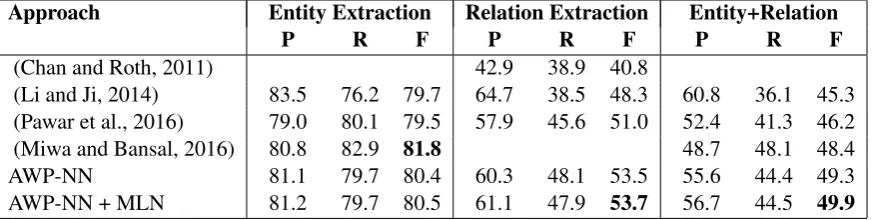
Table 5 shows the comparative performances (in terms of micro-F1 measure) for various ap-proaches. The results are divided in three different sections:
1. only entity extraction: It includes boundary identification as well as entity type classification. 2. only relation extraction: It includes relation type classification for each pair of predicted en-tity mentions. It is a relaxed version of end-to-end relation extraction problem where correct re-lation label for an entity mention pair is counted as a true positive even if entity types of one or both the mentions are identified incorrectly.
3.entity+relation extraction:It is end-to-end re-lation extraction which includes boundary identifi-cation, entity type classification and relation type classification. Here, correct relation label for an entity mention pair is counted as a true positive only if boundaries and entity types of both the mentions are identified correctly.
It can be observed in the table 5 that end-to-end relation extraction performance of our AWP-NN model is better than all the 4 previous ap-proaches (Chan and Roth, 2011; Li and Ji, 2014; Pawar et al., 2016; Miwa and Bansal, 2016) on the ACE 2004 dataset. However, the AWP-NN+MLN approach which uses MLN inference to revise AWP-NN predictions during decoding, achieves the best performance.
6279 instances of type DISC were not considered. Addi-tionally, 21 relation instances were not contained in a single sentence as per our sentence detection algorithm.
Approach Entity Extraction Relation Extraction Entity+Relation
P R F P R F P R F
(Chan and Roth, 2011) 42.9 38.9 40.8
(Li and Ji, 2014) 83.5 76.2 79.7 64.7 38.5 48.3 60.8 36.1 45.3 (Pawar et al., 2016) 79.0 80.1 79.5 57.9 45.6 51.0 52.4 41.3 46.2
(Miwa and Bansal, 2016) 80.8 82.9 81.8 48.7 48.1 48.4
AWP-NN 81.1 79.7 80.4 60.3 48.1 53.5 55.6 44.4 49.3
[image:8.595.74.511.63.173.2]AWP-NN + MLN 81.2 79.7 80.5 61.1 47.9 53.7 56.7 44.5 49.9
Table 5: Performance of various approaches on the ACE 2004 dataset. The numbers are micro-averaged and obtained after 5-fold cross-validation. Actual folds used by each algorithm may differ.
5.3.1 Statistical Significance
As neural networks are initialized randomly, if we train a neural network model multiple times, dif-ferent predictions are obtained each time. Hence, it is important to establish the statistical signifi-cance of the performance. We train our AWP-NN model30 times independently and obtain30 dif-ferent values for precision, recall and F1 score. The numbers shown in table 5 are average val-ues over these 30 runs. Also, in order to estab-lish that the F1 score of AWP-NN model is signif-icantly higher than the best previous F1 score of
48.4% (by Miwa and Bansal (2016)), we conduct one tailed one sample t-test. Here, mean and stan-dard deviation of sample of30F1 scores by AWP-NN are49.3and0.44, respectively. This leads to p-value of1.23×10−12, hence establishing the
sta-tistical significance of AWP-NN’s performance.
5.4 Analysis of results 5.4.1 Effect of using MLN
We analyzed the effect of using MLN by ob-serving the individual sentences where errors of AWP-NN were being corrected by MLN. As an example, consider the following sentence:
Lemieux0 rescued1 his2 team3 from4
bankruptcy5 last6 season7 by8
exchanging9 deferred10 salary11
for12 an13 ownership14 stake15 .16
End-to-end relation extraction output produced by the AWP-NN model for this sentence is shown in the tables 6 and 7. Only error in this output is that entity type of the mentionteamshould be ORG instead of PER as it refers to some profes-sional team. After MLN inference, the entity type of team is corrected to ORG. This happens cause of high-confidence EMP-ORG relations be-tweenLemieuxandteamand betweenhisand team. As both Lemieuxand his are of type
PER with high confidence, global inference using MLN8 forces type ofteamto be ORG to ensure
compatibility of relation and entity types.
Entity Mention Boundaries Entity Type
Lemieux (0,0) PER
his (2,2) PER
team (3,3) PER
Table 6: End-to-end relation extraction output (en-tity mentions) produced by the AWP-NN model
Entity Mention Pair Relation Type
Lemieux,team EMP-ORG
his,team EMP-ORG
Table 7: End-to-end relation extraction output (re-lations) produced by the AWP-NN model
The AWP-NN model was able to outperform (see table 5) all 4 previous approaches without the help of MLN. One reason behind this may be that the AWP-NN model itself was sufficient to learn most of the dependencies among the en-tity and relation types. However, MLN helped to improve the performance of AWP-NN by0.6F1. Though considerable improvement was observed in the precision value, the recall improvement was not significant. In other words, MLN was ob-served to be more effective for reducing false pos-itives than false negatives.
5.4.2 Difficult to identify entities
We observed that for some entity mentions, it is very difficult to identify their entity types as the key information required for identification lies outside the current sentence. Currently, our approach does not use any information outside the sentences, such as document level co-reference
information. Usually these difficult to classify entity mentions are pronoun mentions. Some examples are as follows:
1. Though, I think that if they could stifle the entire peace process at the moment, then that is what they’d like to do.
2. It is a partially victory for both sides.
Here, in the first sentence, it is difficult to iden-tify (even for humans) whether entity type of they is PER (e.g. set of leaders) or GPE (e.g. countries). Also, in the second sentence, entity type ofsidescan be any of PER, ORG or GPE depending on the context. In future, we plan to capture document level information for correctly predicting types of such mentions.
6 Related Work
There have been multiple lines of research for jointly modelling and extracting entities and re-lations. Integer Linear Programming (ILP) based approaches (Roth and Yih, 2004; Roth and Yih, 2007) were the earliest ones. Here, various lo-cal decisions are associated with suitable “cost” values and they are represented using an integer linear program. The optimal solution to this inte-ger linear program provides the best global output. Another significant lines of research were Prob-abilistic Graphical Models (Roth and Yih, 2002; Singh et al., 2013), Card-pyramid parsing (Kate and Mooney, 2010) and Structured Prediction (Li and Ji, 2014; Li et al., 2014; Miwa and Sasaki, 2014).
Four previous approaches (Miwa and Sasaki, 2014; Li and Ji, 2014; Pawar et al., 2016; Miwa and Bansal, 2016) are the most similar to our ap-proach in the sense that they all address the prob-lem of end-to-end relation extraction without as-suming gold-standard entity mention boundaries like the earlier approaches. Our idea of labelling “all word pairs” is similar to the table representa-tion idea of Miwa and Sasaki (2014). The major difference is that they identify boundaries of men-tions through BIO encoding of labels whereas we try to capture boundaries by treating them as an additional relation type WEM. Also, they perform structured prediction with beam search to find op-timal label assignment to the table, whereas we opt for neural network based classification. The idea of using MLNs to incorporate domain
knowl-edge and perform joint inference to obtain glob-ally consistent output was proposed by Pawar et al. (2016). The current state-of-the-art approach for end-to-end relation extraction is by Miwa and Bansal (2016), who employ LSTM-RNN based model for addressing this problem.
7 Conclusion and Future Work
We proposed a novel approach for end-to-end re-lation extraction which carries out its all three sub-tasks (identifying entity mention boundaries, their entity types and relations among them) jointly by using a neural network based model. We proposed a “All Word Pairs” neural network model (AWP-NN) which reduces solution of these three sub-tasks to predicting an appropriate label for each word pair in a given sentence. End-to-end relation extraction output is then constructed from these la-bels of word pairs. We further improved output of the AWP-NN model by using inference in Markov Logic Networks so that some of the inconsisten-cies in word pair labels can be removed at the sen-tence level.
We demonstrated effectiveness of our ap-proaches (AWP-NN and AWP-NN+MLN) on the standard dataset of ACE 2004. They outper-formed all 4 previously reported joint modelling approaches (Chan and Roth, 2011; Li and Ji, 2014; Pawar et al., 2016; Miwa and Bansal, 2016) for end-to-end relation extraction. Since all three sub-tasks share the same AWP-NN model parameters, many inter-task dependencies are captured effec-tively by the AWP-NN itself (without MLN) and this can be validated by the fact that AWP-NN it-self performs better than all other joint models. However, MLN certainly helps to further improve the end-to-end relation extraction performance by correcting some errors in predictions of the AWP-NN model.
References
Razvan Bunescu and Raymond Mooney. 2005. A shortest path dependency kernel for relation extrac-tion. InProceedings of Human Language Technol-ogy Conference and Conference on Empirical Meth-ods in Natural Language Processing, pages 724– 731, Vancouver, British Columbia, Canada, October. Association for Computational Linguistics.
Yee Seng Chan and Dan Roth. 2011. Exploiting syntactico-semantic structures for relation extrac-tion. InProceedings of the 49th Annual Meeting of the Association for Computational Linguistics: Hu-man Language Technologies, pages 551–560, Port-land, Oregon, USA, June. Association for Computa-tional Linguistics.
Franois Chollet. 2015. keras. https://github.
com/fchollet/keras.
George R Doddington, Alexis Mitchell, Mark A Przy-bocki, Lance A Ramshaw, Stephanie Strassel, and Ralph M Weischedel. 2004. The Automatic Content Extraction (ACE) Program-Tasks, Data, and Evalu-ation. InLREC, volume 2, page 1.
Jing Jiang and ChengXiang Zhai. 2007. A system-atic exploration of the feature space for relation ex-traction. In Human Language Technologies 2007: The Conference of the North American Chapter of the Association for Computational Linguistics; Pro-ceedings of the Main Conference, pages 113–120, Rochester, New York, April. Association for Com-putational Linguistics.
Rohit J. Kate and Raymond Mooney. 2010. Joint en-tity and relation extraction using card-pyramid pars-ing. InProceedings of the Fourteenth Conference on Computational Natural Language Learning, pages 203–212, Uppsala, Sweden, July. Association for Computational Linguistics.
Qi Li and Heng Ji. 2014. Incremental joint extrac-tion of entity menextrac-tions and relaextrac-tions. In Proceed-ings of the 52nd Annual Meeting of the Association for Computational Linguistics (Volume 1: Long Pa-pers), pages 402–412, Baltimore, Maryland, June. Association for Computational Linguistics.
Qi Li, Heng Ji, Yu HONG, and Sujian Li. 2014. Constructing information networks using one single model. In Proceedings of the 2014 Conference on Empirical Methods in Natural Language Processing (EMNLP), pages 1846–1851, Doha, Qatar, October. Association for Computational Linguistics.
Makoto Miwa and Mohit Bansal. 2016. End-to-end re-lation extraction using lstms on sequences and tree structures. InProceedings of the 54th Annual Meet-ing of the Association for Computational LMeet-inguis- Linguis-tics (Volume 1: Long Papers), pages 1105–1116, Berlin, Germany, August. Association for Compu-tational Linguistics.
Makoto Miwa and Yutaka Sasaki. 2014. Modeling joint entity and relation extraction with table repre-sentation. InProceedings of the 2014 Conference on Empirical Methods in Natural Language Processing (EMNLP), pages 1858–1869, Doha, Qatar, October. Association for Computational Linguistics.
Sachin Pawar, Pushpak Bhattacharyya, and Girish Pal-shikar. 2016. End-to-end relation extraction using markov logic networks. InProceedings of the 17th International Conference on Intelligent Text Pro-cessing and Computational Linguistics (CICLing 2016), LNCS 9624. Springer.
Longhua Qian, Guodong Zhou, Fang Kong, Qiaom-ing Zhu, and Peide Qian. 2008. ExploitQiaom-ing con-stituent dependencies for tree kernel-based semantic relation extraction. In Proceedings of the 22nd In-ternational Conference on Computational Linguis-tics (Coling 2008), pages 697–704, Manchester, UK, August. Coling 2008 Organizing Committee. Matthew Richardson and Pedro Domingos. 2006.
Markov Logic Networks. Machine learning, 62(1-2):107–136.
Dan Roth and Wen-tau Yih. 2002. Probabilistic rea-soning for entity & relation recognition. In Proceed-ings of the 19th international conference on Compu-tational linguistics-Volume 1, pages 1–7. ACL. Dan Roth and Wen-tau Yih. 2004. A linear
program-ming formulation for global inference in natural lan-guage tasks. In Hwee Tou Ng and Ellen Riloff, ed-itors,HLT-NAACL 2004 Workshop: Eighth Confer-ence on Computational Natural Language Learning (CoNLL-2004), pages 1–8, Boston, Massachusetts, USA, May 6 - May 7. Association for Computa-tional Linguistics.
Dan Roth and Wen-tau Yih. 2007. Global inference for entity and relation identification via a linear pro-gramming formulation. Introduction to statistical relational learning, pages 553–580.
Sameer Singh, Sebastian Riedel, Brian Martin, Jiaping Zheng, and Andrew McCallum. 2013. Joint infer-ence of entities, relations, and coreferinfer-ence. In Pro-ceedings of the 2013 workshop on Automated knowl-edge base construction, pages 1–6. ACM.
Nitish Srivastava, Geoffrey E Hinton, Alex Krizhevsky, Ilya Sutskever, and Ruslan Salakhutdinov. 2014. Dropout: a simple way to prevent neural networks from overfitting. Journal of Machine Learning Re-search, 15(1):1929–1958.