Reading to Learn: Constructing Features from Semantic Abstracts
Jacob Eisenstein∗ James Clarke† Dan Goldwasser† Dan Roth∗†
∗Beckman Institute for Advanced Science and Technology,†Department of Computer Science
University of Illinois Urbana, IL 61801
{jacobe,clarkeje,goldwas1,danr}@illinois.edu
Abstract
Machine learning offers a range of tools for training systems from data, but these methods are only as good as the underly-ing representation. This paper proposes to acquire representations for machine learn-ing by readlearn-ing text written to accommo-date human learning. We propose a novel form of semantic analysis called read-ing to learn, where the goal is to obtain a high-level semantic abstract of multi-ple documents in a representation that fa-cilitates learning. We obtain this abstract through a generative model that requires no labeled data, instead leveraging repe-tition across multiple documents. The se-mantic abstract is converted into a trans-formed feature space for learning, result-ing in improved generalization on a rela-tional learning task.
1 Introduction
Machine learning offers a range of powerful tools for training systems to act in complex environ-ments, but these methods depend on a well-chosen representation for features. For learning to suc-ceed the representation often must be crafted with knowledge about the application domain. This poses a bottleneck, requiring expertise in both ma-chine learning and the application domain. How-ever, domain experts often express their knowl-edge through text; one direct expression is through text designed to aid human learning. In this paper we exploit text written by domain experts in or-der to build a more expressive representation for learning. We term this approachreading to learn.
The following scenario demonstrates the moti-vation for reading to learn. Imagine an agent given a task within its world/environment. The agent has no prior knowledge of the task but can perceive the world through low-level sensors. Learning directly from the sensors may be difficult, as interesting
tasks typically require a complex combination of sensors. Our goal is to acquire domain knowledge through the semantic analysis of text, so as to pro-duce higher-level relations through combinations of sensors.
As a concrete example consider the problem of learning how to make legal moves in Freecell soli-taire. Relevant sensors may indicate if an object is a card or a freecell, whether a card is a certain value, and whether two values are in sequence. Although it is possible to express the rules with a combination of sensors, learning this combina-tion is difficult. Text can facilitate learning by pro-viding relations at the appropriate level of gen-eralization. For example, the sentence: “You can place a card on an empty freecell,” suggests not only which sensors are useful together but also how these sensors should be linked. Assuming the sensors are represented as predicates, one possi-ble relation this sentence suggests is: r(x, y) =
card(x)∧freecell(y)∧empty(y). Armed with this new relation the agent’s learning task may be simpler. Throughout the paper we refer to low-level sensory input assensororpredicate, and to a higher level concept as alogical formulaor re-lation.
Our approach to semantic analysis does not re-quire a complete semantic representation of the text. We merely wish to acquire a semantic ab-stractof a document or document collection, and use the discovered relations to facilitate data-driven learning. This will allow us to directly eval-uate the contribution of the extracted relations for learning.
We develop an approach to recover semantic ab-stracts that uses minimal supervision: we assume only a very small set of lexicalglosses, which map from words to sensors. This marks a substantial departure from previous work on semantic pars-ing, which requires either annotations of the mean-ings of each individual sentence (Zettlemoyer and Collins, 2005; Liang et al., 2009), or alignments of sentences to grounded representations of the
world (Chen and Mooney, 2008). For the purpose of learning, this approach may be inapplicable, as such text is often written at a high level of abstrac-tion that permits no grounded representaabstrac-tion.
There are two properties of our setting that make unsupervised learning feasible. First, it is not necessary to extract a semantic representation of each individual sentence, but rather a summary of the semantics of the document collection. Er-rors in the semantic abstract are not fatal, as long it guides the learning component towards a more useful representation. Second, we can exploit rep-etition across documents, which should generally express the same underlying meaning. Logical for-mulae that are well-supported by multiple docu-ments are especially likely to be useful.
The rest of this paper describes our approach for recovering semantic abstracts and outlines how we apply and evaluate this approach on the Free-cell domain. The paper contributes the following key ideas: (1) Interpreting abstract “instructional” text, written at a level that does not correspond to concrete sensory inputs in the world, so that no grounded representation is possible, (2) read-ing to learn, a new setting in which extracted se-mantic representations are evaluated by whether they facilitate learning; (3) abstractive semantic summarization, aimed at capturing broad seman-tic properties of a multi-document dataset, rather than a semantic parse of individual sentences; (4) a novel, minimally-supervised generative model for semantic analysis which leverages both lexical and syntactic properties of text.
2 Approach Overview
We describe our approach to text analysis as mul-tidocument semantic abstraction, with the goal of discovering a compact set of logical formulae to explain the text in a document collection. To this end, we develop a novel generative model in which natural language sentences (e.g., “You can always place cards in empty freecells”) are stochastically generated from logical formulae (e.g.,card(x)∧
freecell(y)∧empty(y)). We formally define a generative process that reflects our intuitions about the relationship between formulae and sen-tences (Section 3), and perform sampling-based inference to recover the formulae most likely to have generated the observed data (Section 4). The topN such formulae can then be added as addi-tional predicates for relaaddi-tional learning.
Our semantic representation consists of con-junctions ofliterals, each of which includes a sin-gle predicate(e.g.,empty) and one or more
vari-ables(e.g.,x). Predicates describe atomic seman-tic concepts, while variables construct networks of relationships between them. While the impor-tance of the predicates is obvious, the variable assignments also exert a crucial influence on the semantics of the conjunction: modifying a sin-gle variable in the formula above fromempty(y) to empty(x) yields a formula that is trivially false for all groundings (since cards can never be empty).
Thus, our generative model must account for the influence of both predicates and variables on the sentences in the documents. A natural choice is to use the predicates to influence the lexical items, while letting the variables determine the syntac-tic structure. For example, the formulacard(x)∧
freecell(y)∧empty(y)contains three pred-icates and two variables. The predpred-icates influence the lexical items in a direct way: we expect that sentences generated from this formula will include a member of the gloss set for each predicate – the sentence “Put the cards on the empty free-cells” should be more likely than “Columns are constructed by playing cards in alternating colors.” The impact of the variables on the generative process is more subtle. The sharing of the variable
y suggests a relationship between the predicates
freecellandempty. This should be realized in the syntactic structure of the sentence. Model-ing syntax usModel-ing a dependency tree, we expect that the glosses for predicates that share terms will ap-pear in compact sub-trees, while predicates that do not share terms should be more distant. One pos-sible surface realization of this logical formula is the sentence, “Put the card on the empty freecell,” whose dependency parse is shown in the left tree of Figure 1. The glossesemptyandfreecellare im-mediately adjacent, whilecardis more remote.
We develop two metrics that quantify the com-pactness of a set of variable assignments with respect to a dependency tree: excess terms, and
shared terms. The number of excess terms in a subtree is the number of unique terms assigned to words in the subtree, minus the maximum arity of any predicate in the subtree. Shared terms arise whenever a node has multiple subtrees which each contain the same variable. We will use the alterna-tive alignments in Figure 1 to provide a more de-tailed explanation. In each tree, the variables are written in the nodes belonging to the associated lexical items; variables are written over arrows to indicate membership in some node in the subtree.
Put
card on
freecell
the empty
the
X
X
X XXX
X XX
XX
X
X
X
Y XXY
X XY
XY
Y
X
Y
Y XYY
X YY
YY
Y
X
Y
Z XYZ
X YZ
YZ
Z
[image:3.595.81.519.70.289.2]Dependency tree Alignment A Alignment B Alignment C Alignment D
Figure 1: A dependency parse and four different variable assignments. Each literal is aligned to a word (a node in the graph), and the associated variables are written in the box. Variables belonging to descendant nodes are written over the arrows.
card(x)∧freecell(x)∧empty(x), has zero excess terms in every subtree; there is a total of one variable, and all the predicates are unary. In Align-ment B,card(x)∧freecell(x)∧empty(y), there are excess terms at the root, and in the top two subtrees on the right-hand side. Alignment C contains an excess term at only the root node. Even though it contains the same number of unique variables as Alignment B, it is not penal-ized as harshly because the alignment of variables better corresponds to the syntactic structure. Alignment D contains the greatest number of excess terms: two at the root of the tree, and one in each of the top two subtrees on the right side.
Shared Terms According to the excess term metric, the best choice is simply to introduce as few variables as possible. For this reason, we also penalizeshared terms which occur when a node has subtree children that share a variable. In Fig-ure 1, Alignments A and B each contain a shared term at the top node; Alignments C and D contain no shared terms.
Overall, we note that Alignment B is penalized on both metrics, as it contains both excess terms and shared terms; the syntactic structure of the sentence makes such a variable assignment rela-tively improbable.
card(x) & freecell(y) & empty(y)
f(y) e(y) c(x)
f(y) e(y) c(x)
Put the card on the empty freecell (a)
(b)
(c)
(d)
(e)
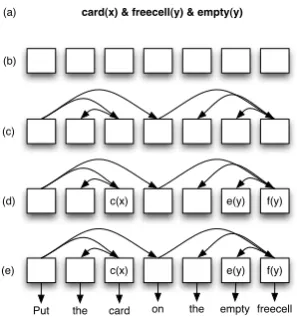
Figure 2: A graphical depiction of the generative process by which sentences are produced from for-mulae
3 Generative Model
These intuitions are formalized in a generative account of how sentences are stochastically pro-duced from a set of logical formulae. This gener-ative story guides an inference procedure for re-covering logical formulae that are likely to have generated any observed set of texts, which is de-scribed in Section 4.
[image:3.595.341.490.367.526.2]de-fines a non-parametric mixture model, and has the effect of adaptively selecting the appropriate num-ber of formulae to explain the observed sentences in the corpus.1 We then draw the sentence length
from some distribution over positive integers; as the sentence length is always observed, we need not define the distribution (step (b)). In step (c), a dependency tree is drawn from a uniform distribu-tion over spanning trees with a number of nodes equal to the length of the sentence. In step (d) we draw an alignment of the literals inf to nodes in the dependency tree, written at(f). The
distribu-tion over alignments is described in Secdistribu-tion 3.1. Finally, the aligned literals are used to generate the words at each slot in the dependency tree. A more formal definition of this process is as follows:
• Drawλ, the expected number of literals per formula, from a Gamma distributionG(u, v).
• Draw an infinite set of formulaef. For each formulafi,
– Draw the formula length #|fi| from a
Poisson distribution,ni∼Poisson(λ).
– Draw ni literals from a uniform
distri-bution.
• Drawπ, an infinite multinomial distribution over formulae:π ∼ GEM(π0), where GEM
refers to the stick-breaking prior (Sethura-man, 1994) and π0 = 1 is the
concentra-tion parameter. By attaching the multinomial
π to the infinite set of formulae f, we cre-ate a Dirichlet process. This is conventionally writtenDP(π0, G0), where the base
distribu-tionG0encodes only the distribution over the
number of literals, Poisson(λ).
• For each ofDdocuments, draw the number of sentencesT ∼Poisson. For each of theT
sentences in the document,
– Draw a formulaf ∼DP(π0, G0)from
the Dirichlet Process described above.
– Draw a sentence length#|s| ∼Poisson.
– Draw a dependency grapht(a spanning tree of size#|s|) from a uniform distri-bution.
– Draw an alignment at(f), an injective
mapping from literals in f to nodes in the dependency structuret. The distribu-tion over alignments is described in Sec-tion 3.1.
1There are many recent applications of Dirichlet
pro-cesses in natural language processing, e.g. Goldwater et al. (2006).
– Draw the sentence s from the formula
f and the alignment a(f). For each word token wi ∈ s is drawn from p(wi|at(f, i)), where at(f, i) indicates
the (possibly empty) literal assigned to slot i in the alignment at(f)
(Sec-tion 3.2).
3.1 Distribution over Alignments
The distribution over alignments reflects our intu-ition that when literals share variables, they will be aligned to word slots that are nearby in the de-pendency structure; literals that do not share vari-ables should be more distant. This is formalized by applying the concepts of excess terms and shared terms defined in Section 2. After computing the number of excess and shared terms in each sub-treeti, we can compute a local score (LS) for that
subtree:
LS(at(f);ti) = α·NShared(at(f), ti)
+β·NExcess(at(f), ti)·height(ti).
This scoring function can be applied recursively to each subtree int; the overall score of the tree is the recursive sum,
score(at(f);t) =LS(at(f);t)+ n X
i
score(at(f);ti),
(1) whereti indicates theith subtree oft. We
hypoth-esize a generative process that produces all possi-ble alignments, scores them usingscore(at(f);t),
and selects an alignment with probability,
p(at(f))∝exp{−score(at(f);t)}. (2)
In our experiments, we define the parametersα = 1, β= 1.
3.2 Generation of Lexical Items
4 Inference
This section describes a sampling-based inference procedure for obtaining a set of formulae f that explain the observed textsand dependency struc-tures t. We perform Gibbs sampling over the formulae assigned to each sentence. Using the Chinese Restaurant Process interpretation of the Dirichlet Process (Aldous, 1985), we marginalize
π, the infinite multinomial over all possible for-mulae: at each sampling step we select either an existing formula, or stochastically generate a new formula. After each full round of Gibbs sampling, a set of Metropolis-Hastings moves are applied to explore modifications of the formulae. This proce-dure converges on a stationary Markov chain cen-tered on a set of formulae that cohere well with the lexical and syntactic properties of the text.
4.1 Assigning Sentences to Formulae
For each sentencesiand dependency treeti, a
hid-den variableyi indicates the index of the formula
that generates the text. We can resampleyi using
Gibbs sampling. In the non-parametric setting,yi
ranges over all non-negative integers; the Chinese Restaurant Process formulation marginalizes the infinite-dimensional parameterπ, yielding a prior based on the counts for each “active” formula (to which at least one other sentence is assigned), and a pseudo-count representing all non-active formu-lae. GivenKformulae, the prior on selecting for-mulajis:
p(yi=j|y−i, π0)∝
(
n−i(j) j < K
π0 j=K, (3)
wherey−i refers to the assignments of allyother
thanyiandn−i refers to the counts over these
as-signments. Eachj < K identifies an existing for-mula inf, to which at least one other sentence is assigned. Whenj =K, this means a new formula
f∗must be generated.
To perform Gibbs sampling, we draw from the posterior distribution overyi,
p(yi|si, tif, f∗,y−i, π0)∝
p(yi|y−i, π0)p(si, ti|yi,f, f∗),
where the first term is the prior defined in Equa-tion 3 and the latter term is the likelihood of gener-ating the parsed sentencehsi, tiifrom the formula
indexed byyi.
To compute the probability of a parsed sentence given a formula, we sum over alignments,
p(s, t|f) = X at(f)
p(s, t,at(f)|f)
= X
at(f)
p(s|at(f))p(t,at(f)|f)
= X
at(f)
p(s|at(f))p(at(f)|t, f)p(t|f),
(4)
applying the chain rule and independence assump-tions from the generative model. The result is a product of three terms: the likelihood of the lexi-cal items given the aligned predicates (defined in Section 3.2; the likelihood of the alignment given the dependency tree and formula (defined in equa-tion 2), and the probability of the dependency tree given the formula, which is uniform.
Equation 4 takes a sum across alignments, but most of the probability mass of p(s|at(f)) will
be concentrated on alignments in which predicates cover words that gloss them. Thus, we can apply an approximation,
p(s, t|f)≈ XN
at(f)
p(s|at(f))p(at(f)|t, f)p(t|f),
(5)
in which we drawN samples in which predicates are aligned to their glosses whenever possible.
Similarly, Equation 2 quantifies the likelihood of an alignment only to a constant of proportional-ity; again, a sum over possible alignments is nec-essary. We do not expect the prior on alignments to be strongly peaked like the sentence likelihood, so we approximate the normalization term by sam-plingMalignments at random and extrapolating:
p(at(f)|t, f)∝q(at(f);t)
= P q(at(f);t)
a0
t(f)q(a0t(f);t)
≈ #|aM0t(f)|PMq(at(f);t)
a0
t(f)q(a 0 t(f);t)
,
whereq(at(f);t) = exp{−score(at(f);t)},
de-fined in Equation 2. In our experiments, we setN
4.1.1 Generating new formulae
Chinese Restaurant Process sampling requires the generation of new candidate formulae at each re-sampling stage. To generate a new formula, we first sample the number of literals. As described in the generative story (Section 3), the number of literals is drawn from a Poisson distribution with parameter θ. We treat θ as unknown and marginalize, using the Gamma hyperpriorG(u, v). Due to Poisson-Gamma conjugacy, this marginal-ization can be performed analytically, yielding a Negative-Binomial distribution with parameters
hu+Pi#|fi|,(1+K+v)−1i, wherePi#|fi|is
the sum of the number of literals in each formula, andK is the number of formulae which generate at least one sentence. In this sense, the hyperpriors
uandvact as pseudo counts. We setu= 3, v= 1, reflecting a weak prior expectation of three literals per predicate.
After drawing the size of the formula, the predi-cates are selected from a uniform random distribu-tion. Finally, the terms are assigned: at each slot, we reuse a previous term with probability0.5, un-less none is available; otherwise a new term is gen-erated.
4.2 Proposing changes to formulae
The assignment resampling procedure has the ability to generate new formulae, thus exploring the space of relational features. However, to ex-plore this space more rapidly, we introduce four Metropolis-Hastings moves that modify existing formulae (Gilks, 1995): adding a literal, deleting a literal, substituting a literal, and rearranging the terms of the formula. For each proposed move, we recompute the joint likelihood of the formula and all aligned sentences. The move is stochastically accepted based on the ratio of the joint likelihoods of the new and old configurations, multiplied by a Hastings correction.
The joint likelihood with respect to formula f
is computed as p(s,t, f) = p(f)Qip(si, ti|f).
The prior onf considers only the number of liter-als, using a Negative-Binomial distribution as de-scribed in section 4.1.1. The likelihoodp(si, ti|f)
is given in equation 4. The Hastings correction is ˜
p(f0 → f)/p˜(f → f0), with p˜(f → f0)
indicat-ing the probability of proposindicat-ing a move from f
tof0,andp˜(f0 → f)indicating the probability of
proposing the reverse move. The Hastings correc-tions depend on the arity of the predicates being added and removed; the derivation is straightfor-ward but tedious. We plan to release a technical report with complete details.
4.3 Summary of inference
The final inference procedure iterates between Gibbs sampling of assignments of formulae to sentences, and manipulating the formulae through Metropolis-Hastings moves. A full iteration com-prises proposing a move to each formula, and then using Gibbs sampling to reconsider all assign-ments. If a formula no longer has any sentences assigned to it, then it is dropped from the active set, and can no longer be selected in Gibbs sam-pling – this is standard in the Chinese Restaurant Process.
Five separate Markov chains are maintained in parallel. To allow the sampling procedure to con-verge to a stationary distribution, each chain be-gins with 100 iterations of “burn-in” sampling, without storing the output. At this point, we per-form another 100 iterations, storing the state at the end of each iteration.2All formulae are ranked
ac-cording to the cumulative number of sentences to which they are assigned (across all five Markov chains), aggregating the counts for multiple in-stances of identical formulae. This yields a ranked list of formulae which will be used in our frame-work as features for relational learning.
5 Evaluation
Our experimental setup is designed to evaluate the quality of the semantic abstraction performed by our model. The logical formulae obtained by our system are applied as features for relational learn-ing of the rules of the game of Freecell solitaire. We investigate whether these features enable bet-ter generalization given varying number of train-ing examples of Freecell game states. We also quantify the specific role of syntax, lexical choice, and feature expressivity in learning performance. This section describes the details of this evalua-tion.
5.1 Relational Learning
We perform relational learning using Inductive Logic Programming (ILP), which constructs gen-eralized rules by assembling smaller logical for-mulae to explain observed propositional exam-ples (Muggleton, 1995). The lowest level formu-lae consist of basic sensors that describe the en-vironment. ILP’s expressivity enables it to build complex conjunctions of these building blocks, but at the cost of tractability. Our evaluation asks whether the logical formulae abstracted from text
2Sampling for more iterations was not found to affect
Predicate Glosses
card(x) card
tableau(x) column, tableau
freecell(x) freecell, cell
homecell(x) foundation, cell, homecell
value(x,y) ace, king, rank, 8, 3, 7, lowest, highest
successor(x,y) higher, sequence, sequential
color(x,y) black, red, color
suit(x,y) suit, club, diamond, spade, heart
on(x,y) onto
top(x,y) bottom, available, top
empty(x) empty
Table 1: Predicates in the Freecell world model, with natural language glosses obtained from the development set text.
can transform the representation to facilitate learn-ing. We compare against both the sensor-level rep-resentation as well as richer reprep-resentations that do not benefit from the full power of our model’s se-mantic analysis.
The ALEPH3 ILP system, which is primarily based on PROGOL (Muggleton, 1995), was used to induce the rules of game. The search parame-ters remained constant for all experiments.
5.2 Resources
There are four types of resources required to work in the reading-to-learn setting: a world model, in-structional text, a small set of glosses that map from text to elements of the world model, and la-beled examples of correct and incorrect actions in the world. In our experiments, we consider the domain of Freecell solitaire, a popular card game (Morehead and Mott-Smith, 1983) in which cards are moved between various types of loca-tions, depending on their suit and rank. We now describe the resources for the Freecell domain in more detail.
World Model Freecell solitaire can be described formally using first order logic; we consider a slightly modified version of the representation from the Planning Domain Definition Language (PDDL), which is used in automatic game-playing competitions. Specifically, there are 87 constants: 52 cards, 16 locations, 13 values, four suits, and two colors. These constants are combined with a fixed set of 11 predicates, listed in Table 1.
Instructional Text Our approach relies on text that describes how to operate in the Freecell soli-taire domain. A total of five instruction sets were
3Freely available from http://www.comlab.ox.
ac.uk/activities/machinelearning/Aleph/
obtained from the Internet. Due to the popular-ity of the Microsoft implementation of Freecell, instructions often contain information specific to playing Freecell on a computer. We manually re-moved sentences which did not focus on the card aspects of Freecell (e.g., how to set up the board and information regarding where to click to move cards). In order to use our semantic abstraction model, the instructions were part-of-speech tagged with the Stanford POS Tagger (Toutanova and Manning, 2000) and dependency parses were ob-tained using Malt (Nivre, 2006).
Glosses Our reading to learn setting requires a small set of glosses, which are surface forms com-monly used to represent predicates from the world model. We envision an application scenario in which a designer manually specifies a few glosses for each predicate. However, for the purposes of evaluation, it would be unprincipled for the exper-imenters to handcraft the ideal set of glosses. In-stead, we gathered a development set of text and annotated the lexical mentions of the world model predicates in text. This annotation is used to ob-tain glosses to apply to the evaluation text. This approximates a scenario in which the designer has a reasonable idea of how the domain will be de-scribed in text, but no prior knowledge of the spe-cific details of the text instructions. Our exper-iments used glosses that occurred two or more times in the instructions: this yields a total of 32 glosses for 11 predicates, as shown in Table 1.
Evaluation game data Ultimately, the seman-tic abstraction obtained from the text is applied to learning on labeled examples of correct and incorrect actions in the world model. For evalu-ation, we automatically generated a set of move scenarios: game states with one positive example (a legal move) and one negative example (an ille-gal move). To avoid bias in the data we generate an equal number of move scenarios from each of three types: moves to the freecells, homecells, and tableaux. For our experiments we vary the number of move scenarios in the training set; the develop-ment and test sets consist of 900 and 1500 move scenarios respectively.
5.3 Evaluation Settings
Sec-tion 4.3). The NO-SYNTAXfeature set is obtained from a variant of our model in which the in-fluence of syntax is removed by setting parame-ters α, β = 0. The SENSORS-ONLY feature set uses only the sensor-level predicates. Finally, the RELATIONAL-RANDOMfeature set is constructed by replacing each feature in the FULL-MODELset with a randomly generated relational feature of identical expressivity (each predicate is replaced by a randomly chosen alternative with identical arity; terms are also assigned randomly). This en-sures that any performance gains obtained by our model were not due merely to the greater expres-sivity of its relational features. The number of fea-tures included in each scenario is tuned on a de-velopment set of test examples.
The performance metric assesses the ability of the ILP learner to classify proposed Freecell moves as legal or illegal. As the evaluation set contains an equal number of positive and negative examples, accuracy is the appropriate metric. The training scenarios are randomly generated; we re-peat each run 50 times and average our results. For the RELATIONAL-RANDOMfeature set – in which predicates and terms are chosen randomly – we also regenerate the formulae per run.
6 Results
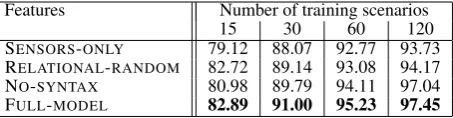
Table 2 shows a comparison of the results using the setup described above. Our FULL -MODEL achieves the best performance at ev-ery training set size, consistently outperforming the SENSORS-ONLY representation by an abso-lute difference of three to four percent. This demonstrates the semantic abstract obtained by our model does indeed facilitate machine learning in this domain.
RELATIONAL-RANDOM provides a baseline of relational features with equal expressivity to those chosen by our model, but with the predicates and terms selected randomly. We consistently outper-form this baseline, demonstrate that the improve-ment obtained over the sensors only representation is not due merely to the added expressivity of our features.
The third row compares against NO-SYNTAX, a crippled version of our model that incorpo-rates lexical features but not the syntactic struc-ture. The results are stronger than the SENSORS -ONLY and RELATIONAL-RANDOM baselines, but still weaker than our full system. This demon-strates the syntactic features incorporated by our model result in better semantic representations of the underlying text.
Features Number of training scenarios
15 30 60 120
[image:8.595.311.538.63.122.2]SENSORS-ONLY 79.12 88.07 92.77 93.73 RELATIONAL-RANDOM 82.72 89.14 93.08 94.17 NO-SYNTAX 80.98 89.79 94.11 97.04 FULL-MODEL 82.89 91.00 95.23 97.45
Table 2: Results as number of training examples varied. Each value represents the accuracy of the induced rules obtained with the given feature set.
card(x1)∧tableau(x2) card(x1)∧freecell(x2) homecell(x1)∧value(x2,x3) empty(x1)∧freecell(x1) card(x1)∧top(x1,x2) card(x1)∧homecell(x2) freecell(x1)∧homecell(x2) card(x1)∧tableau(x1) card(x1)∧top(x2,x1) homecell(x1)
card(x1)∧homecell(x1) color(x1,x2)∧value(x3,x4) suit(x1,x2)∧value(x3,x4) value(x1,x2)∧value(x3,x4) homecell(x1)∧successor(x2,x3)
Figure 3: The top 15 features recovered by the se-mantic abstraction of our full model.
Figure 3 shows the top 15 formulae recovered by the full model running on the evaluation text. Features such as empty(x1) ∧ freecell(x1)
are useful because they reuse variables to ensure that objects have key properties – in this case, en-suring that a freecell is empty. Other features, such ashomecell(x1) ∧value(x2,x3), help to
fo-cus the search on useful conjunctions of predicates (in Freecell, the legality of playing a card on a homecell depends on the value of the card). Note that three of these 15 formulae are trivially use-less, in that they are always false: e.g.,card(x1) ∧ tableau(x1). This illustrates the importance
of term assignment in obtaining useful features for learning. In the NO-SYNTAX system, which ignores the relationship between term assignment and syntactic structure, eight of the top 15 formu-lae were trivially useless due to term incompatibil-ity.
7 Related Work
Language Interpretation Instructional text de-scribes generalized statements about entities in the domain and the way they interact, thus the text does not correspond directly to concrete sen-sory inputs in the world (i.e., a specific world state). Our interpretation captures these general-izations as first-order logic statements that can be evaluated given a specific state. This contrasts to previous work which interprets “directions” and thus assumes a direct correspondence between text and world state (Branavan et al., 2009; Chen and Mooney, 2008).
Supervision Our work avoids supervision in the form of labeled examples, using only a minimal set of natural language glosses per predicate. Pre-vious work also considered the supervision signal obtained by interpreting natural language in the context of a formal domain. Branavan et al. (2009) use feedback from a world model as a supervi-sion signal. Chen and Mooney (2008) use tempo-ral alignment of text and grounded descriptions of the world state. In these approaches, concrete do-main entities are grounded in language interpreta-tion, and therefore require only a propositional se-mantic representation. Previous approaches for in-terpreting generalized natural language statements are trained from labeled examples (Zettlemoyer and Collins, 2005; Lu et al., 2008).
Level of analysis We aim for an abstractive
semantic summary across multiple documents,
whereas other approaches attempt to produce log-ical forms for individual sentences (Zettlemoyer and Collins, 2005; Ge and Mooney, 2005). We avoid the requirement that each sentence have a meaningful interpretation within the domain, al-lowing us to handle relatively unstructured text.
Evaluation We do not evaluate the representa-tions obtained by our model; rather we assess whether these representations improve learning performance. This is similar to work on Geo-Query (Wong and Mooney, 2007; Ge and Mooney, 2005), and also to recent work on following step-by-step directions (Branavan et al., 2009). While these evaluations are performed on the basis of in-dividual sentences, actions, or system responses, we evaluate the holistic semantic analysis obtained by our system.
Model We treat surface text as generated from a latent semantic description. Lu et al. (2008) ap-ply a generative model, but require a complete derivation from semantics to the lexical represen-tation, while we favor a more flexible semantic
analysis that can be learned without annotation and applied to noisy text. More similar is the work of Liang et al. (2009), which models the gener-ation of semantically-relevant fields using lexical and discourse features. Our approach differs by accounting for syntax, which enables a more ex-pressive semantic representation that includes un-grounded variables.
Relational learning The output of our semantic analysis is applied to learning in a structured rela-tional space, using ILP. A key difficulty with ILP is that the increased expressivity dramatically ex-pands the hypothesis space, and it is widely agreed that some learning bias is required for ILP to be tractable (N´edellec et al., 1996; Cumby and Roth, 2003). Our work can be viewed as a new method for acquiring such bias from text; moreover, our approach is not specialized for ILP and may be used to transform the feature space in other forms of relational learning as well (Roth and Yih, 2001; Cumby and Roth, 2003; Richardson and Domin-gos, 2006).
8 Conclusion
This paper demonstrates a new setting for seman-tic analysis, which we termreading to learn. We handle text which describes the world in gen-eral terms rather than refereing to concrete enti-ties in the domain. We obtain a semantic abstract of multiple documents, using a novel, minimally-supervised generative model that accounts for both syntax and lexical choice. The semantic abstract is represented as a set of predicate logic formu-lae, which are applied as higher-order features for learning. We demonstrate that these features im-prove learning performance, and that both the lex-ical and syntactic aspects of our model yield sub-stantial contributions.
In the current setup, we produce an “overgener-ated” semantic representation comprised of useful features for learning but also some false positives. Learning in our system can be seen as the process of pruning this representation by selecting useful formulae based on interaction with the training data. In the future we hope to explore ways to in-terleave semantic analysis with exploration of the learning domain, by using the environment as a supervision signal for linguistic analysis.
References
Aldous, David J. 1985. Exchangeability and re-lated topics.Lecture Notes in Math1117:1–198. Branavan, S. R. K., Harr Chen, Luke Zettle-moyer, and Regina Barzilay. 2009. Reinforce-ment learning for mapping instructions to ac-tions. In Proceedings of the Joint Conference of the Association for Computational Linguis-tics and International Joint Conference on Nat-ural Language Processing Processing (ACL-IJCNLP 2009). Singapore.
Chen, David L. and Raymond J. Mooney. 2008. Learning to sportscast: A test of grounded lan-guage acquisition. In Proceedings of 25th In-ternational Conference on Machine Learning (ICML 2008). Helsinki, Finland, pages 128– 135.
Cumby, Chad and Dan Roth. 2003. On kernel methods for relational learning. In Proceed-ings of the Twentieth International Conference (ICML 2003). Washington, DC, pages 107–114. Downey, Doug, Oren Etzioni, and Stephen Soder-land. 2005. A probabilistic model of redun-dancy in information extraction. InProceedings of the International Joint Conference on Arti-ficial Intelligence (IJCAI 2005). pages 1034– 1041.
Ferguson, Thomas S. 1973. A bayesian analysis of some nonparametric problems. The Annals of Statistics1(2):209–230.
Ge, Ruifang and Raymond J. Mooney. 2005. A statistical semantic parser that integrates syn-tax and semantics. In Proceedings of the Ninth Conference on Computational Natural Language Learning (CoNLL-2005). Ann Arbor, MI, pages 128–135.
Gilks, Walter R. 1995. Markov Chain Monte Carlo in Practice. Chapman & Hall/CRC. Goldwater, Sharon, Thomas L. Griffiths, and Mark
Johnson. 2006. Contextual dependencies in un-supervised word segmentation. InProceedings of the 21st International Conference on Compu-tational Linguistics and 44th Annual Meeting of the Association for Computational Linguistics (COLING-ACL 2006). Sydney, Australia, pages 673–680.
Liang, Percy, Michael Jordan, and Dan Klein. 2009. Learning semantic correspondences with less supervision. In Proceedings of the Joint Conference of the Association for Computa-tional Linguistics and InternaComputa-tional Joint
Con-ference on Natural Language Processing Pro-cessing (ACL-IJCNLP 2009). Singapore. Lu, Wei, Hwee Tou Ng, Wee Sun Lee, and Luke S.
Zettlemoyer. 2008. A generative model for parsing natural language to meaning representa-tions. InProceedings of Empirical Methods in
Natural Language Processing (EMNLP 2008).
Honolulu, Hawaii, pages 783–792.
Morehead, Albert H. and Geoffrey Mott-Smith. 1983. The Complete Book of Solitaire and Pa-tience Games. Bantam.
Muggleton, Stephen. 1995. Inverse entailment and progol. New Generation Computing Journal
13:245–286.
N´edellec, C., C. Rouveirol, H. Ad´e, F. Bergadano, and B. Tausend. 1996. Declarative bias in ILP. In L. De Raedt, editor, Advances in Inductive Logic Programming, IOS Press, pages 82–103. Nivre, Joakim. 2006. Inductive dependency
pars-ing. Springer.
Richardson, Matthew and Pedro Domingos. 2006. Markov logic networks. Machine Learning
62:107–136.
Roth, Dan and Wen-tau Yih. 2001. Relational learning via propositional algorithms: An infor-mation extraction case study. InProceedings of the International Joint Conference on Artificial Intelligence (IJCAI 2001). pages 1257–1263. Sethuraman, Jayaram. 1994. A constructive
def-inition of dirichlet priors. Statistica Sinica
4(2):639–650.
Toutanova, Kristina and Christopher D. Manning. 2000. Enriching the knowledge sources used in a maximum entropy part-of-speech tagger.
In Proceedings of the Joint SIGDAT
Confer-ence on Empirical Methods in Natural Lan-guage Processing and Very Large Corpora
(EMNLP/VLC-2000). pages 63–70.
Wong, Yuk Wah and Raymond J. Mooney. 2007. Learning synchronous grammars for semantic parsing with lambda calculus. InProceedings of the 45th Annual Meeting of the Association for Computational Linguistics (ACL 2007). Prague, Czech Republic, pages 128–135.