
357
BAG: Bi-directional Attention Entity Graph Convolutional Network for
Multi-hop Reasoning Question Answering
Yu Cao1 Meng Fang2 Dacheng Tao1
1UBTECH Sydney AI Center, School of Computer Science, FEIT, The University of Sydney
2Tencent Robotics X, China
[email protected], [email protected], [email protected]
Abstract
Multi-hop reasoning question answering re-quires deep comprehension of relationships between various documents and queries. We propose a Bi-directional Attention Entity Graph Convolutional Network (BAG), lever-aging relationships between nodes in an en-tity graph and attention information between a query and the entity graph, to solve this task. Graph convolutional networks are used to ob-tain a relation-aware representation of nodes for entity graphs built from documents with multi-level features. Bidirectional attention is then applied on graphs and queries to gener-ate a query-aware nodes representation, which will be used for the final prediction. Experi-mental evaluation shows BAG achieves state-of-the-art accuracy performance on the QAn-garoo WIKIHOP dataset.
1 Introduction
Question Answering (QA) and Machine Com-prehension (MC) tasks have drawn significant attention during the past years. The proposal of large-scale single-document-based QA/MC datasets, such as SQuAD (Rajpurkar et al.,2016), CNN/Daily mail (Hermann et al., 2015), makes training available for end-to-end deep neural mod-els, such as BiDAF (Seo et al.,2016), DCN (Xiong et al., 2016) and SAN (Liu et al., 2017). How-ever, gaps still exist between these datasets and real-world applications. For example, reasoning is constrained to a single paragraph, or even part of it. Extended work was done to meet practical de-mand, such as DrQA (Chen et al.,2017) answering a SQuAD question based on the whole Wikipedia instead of single paragraph. Besides, latest large-scale datasets, e.g. TriviaQA (Joshi et al.,2017) and NarrativeQA (Koˇcisk`y et al., 2018), address this limitation by introducing multiple documents, ensuring reasoning cannot be done within local in-formation. Although those datasets are fairly chal-lenging, reasoning are within one document.
In many scenarios, we need to comprehend the relationships of entities across documents before answering questions. Therefore, reading compre-hension tasks with multiple hops were proposed to make it available for machine to tackle such problems, e.g. QAngaroo task (Welbl et al.,2018). Each sample in QAngaroo contains multiple sup-porting documents, and the goal is selecting the correct answer from a set of candidates for a query. Most queries cannot be answered depending on a single document, and multi-step reasoning chains across documents are needed. Therefore, it is pos-sible that understanding a part of paragraphs loses effectiveness for multi-hop inference, which posts a huge challenge for previous models. Some base-line models, e.g. BiDAF (Seo et al., 2016) and FastQA (Weissenborn et al.,2017), which are pop-ular for single-document QA, suffer dramatical ac-curacy decline in this task.
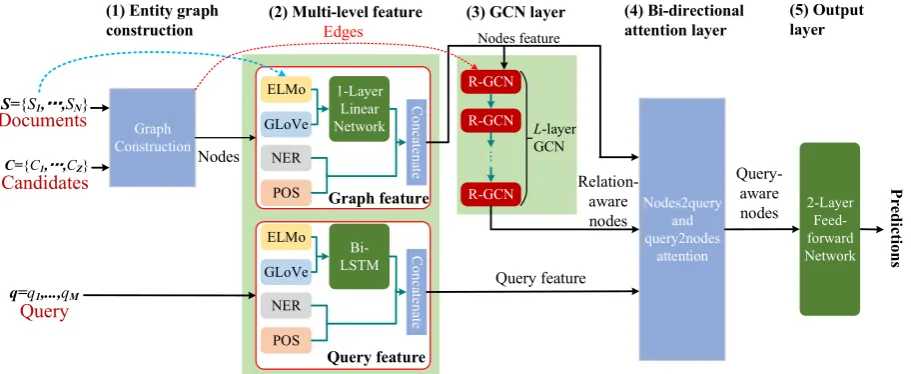
In this paper, we propose a new graph-based QA model, named Bi-directional Attention Entity Graph convolutional network (BAG). Documents are transformed into a graph in which nodes are entities and edges are relationships between them. The graph is then imported into graph convolu-tional networks (GCNs) to learn relation-aware representation of nodes. Furthermore, we intro-duce a new bi-directional attention between the graph and a query with multi-level features to de-rive the mutual information for final prediction.
Experimental results demonstrate that BAG achieves state-of-the-art performance on the WIK-IHOP dataset. Ablation test also shows BAG ben-efits from the bi-directional attention, multi-level features and graph convolutional networks.
Our contributions can be summarized as:
• Applying a bi-directional attention between graphs and queries to learn query-aware rep-resentation for reading comprehension.
S={S1, ,SN}
q=q1,...,qM
C={C1, ,CZ}
Candidates Documents
Query
Graph Construction (1) Entity graph construction
ELMo
GLoVe
NER
POS
1-Layer Linear Network
P
re
dict
io
ns
Conc
ate
na
te
ELMo
GLoVe
NER
POS
Bi-LSTM Conc
ate
na
te
(2) Multi-level feature
R-GCN
L-layer GCN
R-GCN
R-GCN
...
Nodes2query and query2nodes
attention
2-Layer Feed-forward Network (3) GCN layer (4) Bi-directional
attention layer
(5) Output layer
Graph feature
Query feature
Nodes
Nodes feature
Query feature
Relation-aware nodes
Query-aware nodes
[image:2.595.73.529.62.249.2]Edges
Figure 1: Framework of BAG model.
2 Related Work
Recently coreference and graph-based models are studied for multi-hop QA (Dhingra et al., 2018;
Santoro et al.,2017). Coref-GRU (Dhingra et al.,
2018) uses coreferences among tokens in docu-ments. However, it is still limited by the long-distance relation propagation capability of RNNs. Besides, graph is proved to be an efficient way to represent complex relationships among objects and derive relational information (Santoro et al.,
2017). MHQA-GRN (Song et al., 2018) and Entity-GCN (De Cao et al.,2018) construct entity graphs based on documents to learn more compact representation for multi-hop reasoning and derive answers from graph networks. However, both of them care less about input features and the atten-tion between queries and graph nodes.
Attention has been proven to be an essen-tial mechanism to promote the performance of NLP tasks in previous work (Bahdanau et al.,
2014; Sukhbaatar et al., 2015). In addition, bi-directional attention (Seo et al., 2016) shows its superiority to vanilla mutual attention because it provides complementary information to each other for both contexts and queries. However, little work exploits the attention between graphs and queries.
3 BAG Model
We first formally define the multiple-hop QA task, taking QAngaroo (Welbl et al., 2018) WIKIHOP data as an example, There is a set S contain-ing N supporting documents, a query q with M
tokens and a set of answer candidates C. Our goal is to find the correct answer index a. Giv-ing a triple-style queryq = (country, kepahiang),
it means which country does kepahiang belongs to. Then answer candidates are provided, e.g.
C = {Indonesia,Malaysia}. There are multiple supporting documents but not all of them are re-lated to reasoning, e.g. Kephiang is a regency in Bengkulu,Bengkulu is one of provinces of Indone-sia,Jambi is a province of Indonesia. We can de-rive the correct candidate isIndonesia, i.e. a= 0, based on reasoning hops in former two documents. We show the proposed BAG model in Figure1. It contains five modules: (1) entity graph construc-tion, (2) multi-level feature layer, (3) GCN layer, (4) bi-directional attention and (5) output layer.
3.1 Entity Graph Construction
We construct an entity graph based on Entity-GCN (De Cao et al.,2018), which means all men-tions of candidates found out in documents are used as nodes in the graph. Undirected edges are defined according to positional properties of every node pair. There are two kinds of edges included: 1) cross-document edge, for every node pair with the same entity string located in different docu-ments; 2) within-document edge, for every node pair located in the same document.
Nodes in an entity graph can be found out via simple string matching. This approach can sim-plify calculation as well as make sure all rele-vant entities are included in the graph. Picked out along possible reasoning chains during dataset generating (Welbl et al., 2018), answer candi-dates have contained all related entities for an-swering. Finally, We can obtain a set ofT nodes
{ni},1≤i≤T and corresponding edges among
3.2 Multi-level Features
We represent both nodes and queries using multi-level features as shown in Figure1(2). We first use pretrained word embeddings to represent tokens, such as GLoVe (Pennington et al.,2014) because nodes and queries are composed of tokens. Then contextual-level feature is used to offset the defi-ciency of GLoVe. Note that only part of tokens are remained during graph construction because we only extract entities as nodes. Thus contextual information around these entities in original doc-ument becomes essential for indicating relations between tokens and we use higher-level informa-tion for nodes except for token-level feature.
We use ELMo (Peters et al.,2018) as contextu-alized word representations, modeling both com-plex word characteristics and contextual linguistic conditions. It should be noted that ELMo features for nodes are calculated based on original docu-ments, then truncated according to the position in-dices of nodes. Token-level and context-level fea-tures will be concatenated and encoded to make a further comprehension. Since a node may contain more than one token, we average features among tokens to generate a feature vector for each node before encoding it. It will be transformed into the encoded node feature via a 1-layer linear network. Different from nodes, we represent a query by directly using a bidirectional LSTM (Bi-LSTM) whose output in each step is used as encoded query features. And both linear network and LSTM have the same output dimensiondˆ.
In addition, we add two manual features to reflect the semantic properties of tokens, which are named-entity recognition (NER) and part-of-speech (POS). The complete featurefn ∈ RT×d,
fq∈RM×dfor both nodes and queries will be the concatenation of corresponding encoded features, NER embedding and POS embedding, whered=
ˆ
d+dP OS+dN ER.
3.3 GCN Layer
In order to realize multi-hop reasoning, we use a Relational Graph Convolutional Network (R-GCN) (Schlichtkrull et al., 2018) that can prop-agate message across different entity nodes in graphs and generate transformed representation of original ones. The R-GCN is employed to han-dle high-relational data characteristics and make use of different edge types. Atlth layer, given the hidden statehli ∈ Rdof node i, the hidden states
hlj ∈ Rd, j ∈ {N
i} and relations RNi of all its neighbors (d is the hidden state dimension), the hidden state in the next layer can be obtained via
hli+1=σ( X
r∈RNi
X
j∈Ni
1 ci,r
Wrlhlj+W0lhli), (1)
whereci,ris a normalization constant|Ni|,Wrl ∈
Rd×dstands a relation-specific weight matrix and
W0l∈Rd×dstands a general weight.
Similar to Entity-GCN (De Cao et al.,2018), we apply a gate on update vectoruli and hidden state
hli of current node by a linear transformationfs,
wli =σ(fs(concat(uli, hli)), (2)
in whichul
i can be obtained via (1) without
sig-moid function. Then it will be used for updating weights for the hidden statehli+1of the same node in next layer,
hli+1=wiltanh(uli) + (1−wil)hli. (3)
We stack such networks for Llayers in which all parameters are shared. The information of each node will be propagated up to L-node distance away, generating L-hop-reasoning relation-aware representation of nodes. The initial input will be mutli-level nodes featuresfn ={fni},0≤i≤T and edgese={eij}in the graph.
3.4 Bi-directional Attention Between a Graph and a Query
Bi-directional attention is responsible for generat-ing the mutual information between a graph and a query. In BiDAF (Seo et al.,2016), attention is applied to sequence data in QA tasks such as sup-porting texts. However, we also find it works well between graph nodes and queries. It generates query-aware node representations that can provide more reasoning information for prediction.
What differs in BAG is that attention is applied for graphs as shown in Figure1(4). The similarity matrixS∈RT×Mis calculated via
S= avg−1fa(concat(hn, fq, hn◦fq)), (4)
in which hn ∈ RT×d is all node representations obtained from the last GCN layer,fq ∈ RM×dis the query feature matrix after encoding, dis the dimension for both query feature and transformed node representation,fais a linear transformation,
Unlike the context-to-query attention in BiDAF, we introduce a node-to-query attention ean2q ∈ RT×d, which signifies the query tokens that have the highest relevancy for each node using
e
an2q= softmaxcol(S)·fq, (5)
where softmaxcol means performing softmax function across the column, and ·stands for ma-trix multiplication.
At the same time, we also design query-to-node attentioneaq2n ∈ RM×dwhich signifies the nodes that are most related to each token in the query via
e
aq2n= dup(softmax(maxcol(S)))>·fn, (6)
in whichmaxcolis the maximum function applied on across column of a matrix, which will trans-formSintoR1×M. Then functiondupwill dupli-cate it forT times into shapeRT×M. fn ∈RT×d is the original node feature before GCN layer.
Our bi-directional attention layer is the con-catenation of the original nodes feature, nodes-to-query attention, the element-wise multiplication of nodes feature and nodes-to-query attention, and multiplication of nodes feature and query-to-nodes attention. It should be noted that the relation-aware nodes representation from GCN layer is just used to calculate the similarity matrix, and origi-nal node feature is used in rest calculation to ob-tain more general complementary information be-tween graph and query. Edges are not taken in ac-count because they are discrete and combined with nodes in GCN layer. The output is defined as
ea= concat(fn,ean2q, fn◦aen2q, fn◦eaq2n). (7)
3.5 Output layer
A 2-layer fully connect feed-forward network is employed to generate the final prediction, with
tanhas the activation function in each layer. Soft-max will be applied among the output. It uses query-aware representation of nodes from the at-tention layer as input, and its output is regarded as the probability of each node becoming answer. Since each candidate may appear several times in the graph, the probability of each candidate is the sum of all corresponding nodes. The loss function is defined as the cross entropy between the gold answer and its predicted probability.
4 Experiment
We used both unmasked and masked versions of the QAngaroo WIKIHOP dataset (Welbl et al.,
2018) and followed its basic setting, in which masked version used specific tokens such as
MASK1 to replace original candidates tokens in documents. There are 43,738, 5,129 and 2,451 ex-amples in the training set, the development set and the test set respectively, and test set is not public.
In the implementation1, we used standard ELMo with a 1024 dimension representation. Be-sides, 300-dimension GLoVe pre-trained embed-dings from 840B Web crawl data were used as token-level features. We used spaCy to provide additional 8-dimension NER and POS features. The dimension of the 1-layer linear network for nodes in multi-level feature module was 512 with
tanhas activation function. A 2-layer Bi-LSTM was employed for queries whose hidden state size is 256. Then the feature dimension isd= 512 + 8 + 8 = 528. The GCN layer numberLwas set as 5. And the unit number of intermediate layers in output layer was256.
In addition, the number of nodes and the query length were truncated as 500 and 25 respectively for normalized computation. Dropout with rate
0.2 was applied before GCN layer. Adam opti-mizer is employed with initial learning rate 2 × 10⁻⁴, which will be halved for every 5 epochs, With batch size 32. It took about 14 hours for 50-epoch training on two GTX1080Ti GPUs us-ing pre-built and pre-processed graph data gener-ated from original corpus, which can significantly decrease the training time.
We consider the following baseline models: FastQA (Weissenborn et al., 2017), BiDAF (Seo et al., 2016), Coref-GRU (Dhingra et al.,
2018), MHQA-GRN (Song et al., 2018), Entity-GCN (De Cao et al., 2018). Former three mod-els are RNN-based modmod-els, while coreference re-lationship is involved in Coref-GRU. The last two models are graph-based models specially designed for multi-hop QA tasks.
As shown in Table1, we collected three kinds of results. The dev and test results stand for the origi-nal validation and test sets respectively, noting that the test set is not public. In addition, we divide the original validation set of masked version into two parts evenly, one as a split validation set for tun-ing model and the other one as a split test set. The test1results are for the split test set.
Our BAG model achieves state-of-the art
per-1Source code is available onhttps://github.com/
formance on both unmasked and masked data2, with accuracy 69.0% on the test set, which is 1.4% higher in value than previous best model Entity-GCN. It is significant superior than FastQA and BiDAF due to leveraging of relationship informa-tion given by the graph and abandoning some dis-tracting context in multiple documents. Although Coref-GRU extends GRU with coreference rela-tionships, it is still not enough for multi-hop be-cause hop relationships are not limited to coref-erence, entities with the same strings also existed across documents which can be used for reason-ing. Both MHQA-GRN and Entity-GCN utilize graph networks to resolve relations among entities in documents. However, the lack of attention and complementary features limits their performance. Therefore our BAG model achieves the best per-formance under all data configurations. It is no-ticed that BAG only gets a small promotion on masked data. We argue that the reason is the at-tention between masks and queries generating less useful information compared to unmasked ones.
Moreover, ablation experimental results on un-masked version of the WIKIHOP dev set are given in Table 2. Once we remove the bi-directional attention and put the concatenation of nodes and queries directly into the output layer, it shows significant performance drop with more than3%, proving the necessity of attention for reasoning in multi-hop QA. If we use linear-transformation-based single attentiona=hnWafqgiven in (
Lu-ong et al.,2015) instead of our bi-directional at-tention, the accuracy drops with2%, which means attention bi-directionality also contributes to the performance improvement. The similar condition will appear if we remove GCN, but use raw nodes as input for the attention layer.
In addition, if edge types are no longer con-sidered, which makes R-GCN degraded to vanilla GCN, noticeable accuracy loss about2%appears. The absence of multi-level features will also cause degradation. The removal of semantic-level fea-tures causes slight decline on the performance, in-cluding NER and POS features. Further removal of ELMo feature will causes a dramatical drop, which reflects the insufficiency of only using word embeddings as features for nodes and that contex-tual information is very important.
2The paper was written on early Dec. 2018, during that
time Entity-GCN is the best public model, and only one anonymous model is better than it.
Models Unmasked Masked
dev test dev test1
FastQA 27.2∗ 25.7 38.0∗ 48.3
BiDAF 49.7∗ 42.9 59.8∗ 57.5
Coref-GRU† 56.0∗ 59.3 -
-MHQA-GRN‡ 62.8∗ 65.4 -
-Entity-GCN 64.8∗ 67.6 70.5∗ 68.1
[image:5.595.311.524.62.174.2]BAG 66.5 69.0 70.9 68.9
Table 1: The performance of different models on both masked and unmasked version of WIKIHOP dataset. ([*] Results reported in original papers, others are ob-tained by official code. [†] Masked data is not suitable for coreference parsing. [‡] Some results are missing due to unavailability of source code.)
Models Unmasked
Without Attention 63.1
Using Single Attention 64.5
Without GCN 63.3
Without edge type 63.9
Without NER, POS 66.0
+Without ELMo 60.5
Full Model 66.5
Table 2: Ablation test results of BAG model on the unmasked validation set of the WIKIHOP dataset.
5 Conclusion
We propose a Bi-directional Attention entity Graph convolutional network (BAG) for multi-hop reasoning QA tasks. Regarding task char-acteristics, graph convolutional networks (GCNs) are efficient to handle relationships among enti-ties in documents. We demonstrate that both bi-directional attention between nodes and queries and multi-level features are necessary for such tasks. The former one aims to obtain query-aware node representation for answering, while the lat-ter one provides contextual comprehension of iso-lated nodes in graphs. Our experimental results not only demonstrate the effectiveness of two pro-posed modules, but also show BAG achieves state-of-the-art performance on the WIKIHOP dataset.
Our future work will be making use of more complex relations between entities and building graphs in more general way without candidates.
Acknowledgements
[image:5.595.329.504.260.371.2]References
Dzmitry Bahdanau, Kyunghyun Cho, and Yoshua Ben-gio. 2014. Neural machine translation by jointly learning to align and translate. arXiv preprint arXiv:1409.0473.
Danqi Chen, Adam Fisch, Jason Weston, and An-toine Bordes. 2017. Reading wikipedia to an-swer open-domain questions. arXiv preprint arXiv:1704.00051.
Nicola De Cao, Wilker Aziz, and Ivan Titov. 2018. Question answering by reasoning across documents with graph convolutional networks. arXiv preprint arXiv:1808.09920.
Bhuwan Dhingra, Qiao Jin, Zhilin Yang, William W Cohen, and Ruslan Salakhutdinov. 2018. Neural models for reasoning over multiple mentions using coreference. arXiv preprint arXiv:1804.05922.
Karl Moritz Hermann, Tomas Kocisky, Edward Grefenstette, Lasse Espeholt, Will Kay, Mustafa Su-leyman, and Phil Blunsom. 2015. Teaching ma-chines to read and comprehend. InAdvances in Neu-ral Information Processing Systems, pages 1693– 1701.
Mandar Joshi, Eunsol Choi, Daniel S Weld, and Luke Zettlemoyer. 2017. Triviaqa: A large scale distantly supervised challenge dataset for reading comprehen-sion.arXiv preprint arXiv:1705.03551.
Tom´aˇs Koˇcisk`y, Jonathan Schwarz, Phil Blunsom, Chris Dyer, Karl Moritz Hermann, G´aabor Melis, and Edward Grefenstette. 2018. The narrativeqa reading comprehension challenge. Transactions of the Association of Computational Linguistics, 6:317–328.
Xiaodong Liu, Yelong Shen, Kevin Duh, and Jian-feng Gao. 2017. Stochastic answer networks for machine reading comprehension. arXiv preprint arXiv:1712.03556.
Minh-Thang Luong, Hieu Pham, and Christopher D Manning. 2015. Effective approaches to attention-based neural machine translation. arXiv preprint arXiv:1508.04025.
Jeffrey Pennington, Richard Socher, and Christopher Manning. 2014. Glove: Global vectors for word representation. InProceedings of the 2014 confer-ence on empirical methods in natural language pro-cessing (EMNLP), pages 1532–1543.
Matthew E Peters, Mark Neumann, Mohit Iyyer, Matt Gardner, Christopher Clark, Kenton Lee, and Luke Zettlemoyer. 2018. Deep contextualized word rep-resentations. arXiv preprint arXiv:1802.05365.
Pranav Rajpurkar, Jian Zhang, Konstantin Lopyrev, and Percy Liang. 2016. Squad: 100,000+ questions for machine comprehension of text. arXiv preprint arXiv:1606.05250.
Adam Santoro, David Raposo, David G Barrett, Ma-teusz Malinowski, Razvan Pascanu, Peter Battaglia, and Timothy Lillicrap. 2017. A simple neural net-work module for relational reasoning. InAdvances in neural information processing systems, pages 4967–4976.
Michael Schlichtkrull, Thomas N Kipf, Peter Bloem, Rianne van den Berg, Ivan Titov, and Max Welling. 2018. Modeling relational data with graph convolu-tional networks. InEuropean Semantic Web Confer-ence, pages 593–607. Springer.
Minjoon Seo, Aniruddha Kembhavi, Ali Farhadi, and Hannaneh Hajishirzi. 2016. Bidirectional attention flow for machine comprehension. arXiv preprint arXiv:1611.01603.
Linfeng Song, Zhiguo Wang, Mo Yu, Yue Zhang, Radu Florian, and Daniel Gildea. 2018. Exploring graph-structured passage representation for multi-hop reading comprehension with graph neural net-works. arXiv preprint arXiv:1809.02040.
Sainbayar Sukhbaatar, Jason Weston, Rob Fergus, et al. 2015. End-to-end memory networks. InAdvances in neural information processing systems, pages 2440–2448.
Dirk Weissenborn, Georg Wiese, and Laura Seiffe. 2017. Fastqa: A simple and efficient neu-ral architecture for question answering. CoRR, abs/1703.04816.
Johannes Welbl, Pontus Stenetorp, and Sebastian Riedel. 2018. Constructing datasets for multi-hop reading comprehension across documents. Transac-tions of the Association of Computational Linguis-tics, 6:287–302.
![Table 1: The performance of different models on bothmasked and unmasked version of WIKIHOP dataset.([*] Results reported in original papers, others are ob-tained by official code](https://thumb-us.123doks.com/thumbv2/123dok_us/1383029.672422/5.595.329.504.260.371/performance-different-bothmasked-unmasked-wikihop-results-reported-ofcial.webp)
