1689
Unifying Human and Statistical Evaluation for
Natural Language Generation
Tatsunori B. Hashimoto*1,2 Hugh Zhang*1 Percy Liang1,2 (* equal contribution)
1Department of Computer Science 2Department of Statistics
Stanford University
{thashim,hughz}@stanford.edu [email protected]
Abstract
How can we measure whether a natural lan-guage generation system produces both high quality and diverse outputs? Human evalu-ation captures quality but not diversity, as it does not catch models that simply plagiarize from the training set. On the other hand, sta-tistical evaluation (i.e., perplexity) captures di-versity but not quality, as models that occa-sionally emit low quality samples would be in-sufficiently penalized. In this paper, we pro-pose a unified framework which evaluates both diversity and quality, based on the optimal er-ror rate of predicting whether a sentence is human- or machine-generated. We demon-strate that this error rate can be efficiently es-timated by combining human and statistical evaluation, using an evaluation metric which we call HUSE. On summarization and chit-chat dialogue, we show that (i) HUSE detects diversity defects which fool pure human evalu-ation and that (ii) techniques such as annealing for improving quality actually decrease HUSE due to decreased diversity.
1 Introduction
Generating text is a core part of many NLP tasks such as image captioning (Lin et al.,2014), open-domain dialogue (Sordoni et al.,2015), story gen-eration (Roemmele, 2016), and summarization (Nallapati et al., 2016). However, proper evalu-ation of natural language generevalu-ation has proven difficult (Liu et al.,2016; Novikova et al., 2017; Chaganty et al.,2018). A good evaluation metric should not only capture thequalityof generation, but also the diversity of generation, which is es-pecially crucial for creative, open-ended tasks like dialogue or story generation.
Human evaluation, which is often viewed as the
gold standard evaluation, captures quality but fails to capture diversity. As an example, for language
Reference
Model Probability (pmodel)
Agassi bows out of Australian open Agassi withdraws from Australian open
Sharon has stroke for stroke Cleared coach facing another grilling from British swim bosses
Model Generations Reference
Human Judg
men
[image:1.595.310.534.221.334.2]t
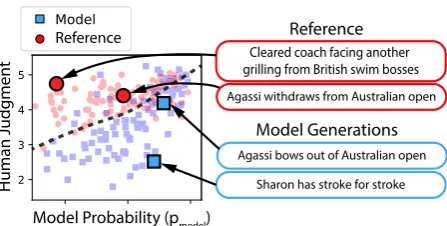
Figure 1: HUSE is twice the classification error of dis-tinguishing reference and generated text based on hu-man judgment scores and model probabilities. HUSE identifies samples with defects in quality (Sharon has stroke. . .) and diversity (Cleared coach facing. . .).
modeling, a model that directly plagiarizes sen-tences from the training set would pass the hu-man quality bar but would have zero generaliza-tion ability and thus have inadequate diversity. On the other hand, statistical evaluation—i.e., per-plexity on a reference test set—captures diversity, as it ensures a model must assign reasonable prob-ability to novel sentences, but perplexity provides an inadequate measure of quality (Theis et al., 2015). For example, modifying a perfect model by removing its ability to generate even a single test sentence results ininfiniteperplexity even though the model is still near-perfect. Automatic metrics such as BLEU (Papineni et al.,2002) and ROUGE (Lin and Rey, 2004) capture quality better than perplexity but still correlate poorly with human evaluation and fail to capture diversity (Novikova et al.,2017;Chaganty et al.,2018).
out-puts. This gives the illusion that a single model is high-quality and diverse, while the reality is that it shows we can have either a diverse model (when sampling from the distribution used to compute perplexity)ora high-quality model (when beam-searching).
In this paper, we define the idealized evaluation metric as twice the error of theoptimal
discrimi-natorfor classifying sentences as coming from the
reference distribution or the model (Section2). If a model generates gibberish (low quality), the op-timal discriminator can classify these accurately as coming from the model. If the reference distribu-tion contains sentences the model cannot generate (low diversity), the optimal discriminator can clas-sify these accurately as coming from the reference. Unfortunately, the optimal discriminator is un-available. Human discriminators cannot capture diversity effectively, and learned discriminators— e.g., from a Generative Adversarial Network (Goodfellow et al.,2014) or one trained on human judgments (Lowe et al.,2017)—are too unreliable to use for rigorous evaluation.
Our key result (Section3) is based on the obser-vation that the optimal classifier depends only on two numbers: the probability of a sentence under the model and the probability under the reference distribution. The former can be computed directly from the model, and we show that the latter can be well-approximated by human judgment scores. The resulting two-dimensional space is illustrated in Figure 1. We apply a simplek-nearest neigh-bor classifier in this space and define Human Uni-fied with Statistical Evaluation (HUSE) as twice the leave-one-out error of this classifier.
We apply HUSE to four natural language gen-eration tasks (Section 5): language modeling, chitchat dialogue, story generation, and summa-rization. First, we show that human evaluation alone is insufficient to discriminate model genera-tions from the references, leading to inflated esti-mates of model performance. In contrast, HUSE is able to reveal deficiencies of current models. We also show that common techniques for improv-ing sample quality such as annealimprov-ing actually in-crease distinguishability between the model and reference due to losses in diversity.
2 Optimal Discriminator
Consider a natural language generation task where the model is given a contextx(e.g., a dialogue
his-tory) drawn from some priorp(x)and must output a distribution over possible sentences pmodel(y | x). We define an idealized evaluation metric based on whether pmodel is close to a reference
distri-butionpref, which is generally human-generated.1 Specifically, consider a random variable y drawn from either the reference or the model based on an indicatorz∼Bernoulli 12:
y|x, z∼
(
pref(y|x) ifz= 1
pmodel(y|x) ifz= 0. (1)
Define L∗ to be twice the lowest possible error over any discriminator f that attempts to deter-minezbased onxandy:
L∗def= 2 inf
f P[f(x, y)6=z]. (2)
L∗ measures similarity betweenpmodelandpref; it is 0 ifpmodelandprefare disjoint and 1 if they are identical.2
Obstacles. Unfortunately,L∗is unattainable be-cause it requires computing the optimal discrim-inator. In the spirit of the Turing Test, we could consider using the error rate of a human dis-criminatorfhuminstead, often considered the gold standard for evaluation. However, while humans might have knowledge ofpref, they do not have full knowledge ofpmodeland thus would have difficul-ties determining which sentences a modelcannot
generate.
As a concrete example, suppose pref placed a uniform distribution over some set S. Without knowledge ofpmodelthe most sensible discrimina-tor is to predict z = 1 (reference) when y ∈ S. This discriminator achieves the same classification error of 0.5 for both the perfect model pmodel = prefand one which can only return a singley∈S. We could try to revealpmodelto humans by show-ing multiple samples simultaneously, but this is expensive and, as we will later see, unnecessary.
Another option is to learnf over an expressive class of functions such as neural networks on data
1
While some tasks only care about quality and thus only requirepmodel to place mass onsomehigh qualityy, we de-mand thatpmodelplaces mass onallhigh qualityyas given by pref. This diversity is important for open-ended tasks such as dialogue or story generation. Also note thatprefneed not be the human distribution, or match the training distribution. It can be defined as the distribution given by experts.
2
Note that L∗ is a linear function of the to-tal variational divergence: kpmodel − prefkTV
def = P
x,yp(x)|pmodel(y|x)−pref(y|x)| = 1 − L ∗
sampled frompmodelandpref. This is analogous to learning the discriminator in a Generative Adver-sarial Network (GAN) (Goodfellow et al., 2014) or learning an evaluation metric from human judg-ments (Lowe et al.,2017). However, as(x, y)are high-dimensional objects, training a good classi-fier is extremely difficult (and perhaps not signif-icantly easier than solving the original generation problem). Indeed, learned evaluation metrics do not generalize very well (Lowe et al.,2017; Cha-ganty et al.,2018). Unlike these approaches which seek to replace human evaluation, our focus will instead be on combining human and automatic sta-tistical evaluation to estimate theoptimalclassifier error.
3 Human Unified with Statistical Evaluation (HUSE)
Our key result is that the optimal discriminator de-pends on (x, y) only through a two-dimensional sufficient statistic (Section3.1), motivating an ap-proximation which we call HUSE (Section3.2).
For any feature map φ that maps (x, y) to φ(x, y) ∈Rd, define the evaluation scoreL(φ)to be twice the error rate of the optimal discriminator that depends on(x, y)onlythroughφ:
L(φ)def= 2 inf
f P[f(φ(x, y))6=z]. (3)
Note that the evaluation score L(φ) given by a feature mapφoptimizes over all functions that depend on φ(3). Thus, the more information φ contains, the lowerL(φ)is. This has two impli-cations: First, any feature mapφyields an (opti-mistic)upper boundonL∗(2), meaning thatL(φ)
might be able detect when a model is poor but can-not certify that it is good. Second, adding features toφcan only improve this bound.
3.1 Two features suffice
Let us consider the following two-dimensional feature map:
φopt(x, y)
def
= [pref(y|x), pmodel(y|x)]. (4)
From the arguments above, it is clear that L(φopt) ≥ L∗, but perhaps more surprisingly, we actually have equality:
Proposition 1. The two-dimensional feature map
φopt achieves the optimal discriminator score:
L(φopt) =L∗.
Proof We compute the true posterior over z given x, y. Since p(z = 1) = p(z = 0) = 12, p(y | x, z = 1) = pref(y | x) andp(y | x, z =
0) =pmodel(y|x), by Bayes’ rule:
p(z= 1|x, y) = pref(y|x)
pref(y|x) +pmodel(y|x) .
The optimal discriminator simply predictsz = 1
ifpref(y|x)> pmodel(y|x)andz= 0otherwise. In other words, the decision boundary is given by φopt(x, y)1> φopt(x, y)2.
More generally, we can obtain this equality with a wider class ofφ. It will hold exactly for any in-vertible transformation of φopt (Appendix Corol-lary 1), and approximately for any φ which has high mutual information withφopt(Appendix The-orem 1). This means that we can substitute pref with noisy, possibly un-normalized estimates and still obtain accurate estimates ofL∗.
3.2 HUSE features
While we can directly computepmodel(y | x) for many probabilistic models,pref(y|x)is unattain-able, soL(φopt)is not computable. However, the
wisdom of the crowds (Surowiecki, 2004; Ungar
et al., 2012) suggests that pooling together the judgments of many humans can often produce sur-prisingly reliable estimates of real-world probabil-ities such aspref(y | x), even if no individual hu-man is particularly reliable. With this motivation, we ask Amazon Mechanical Turk workers to rate a sentence from 1–5 based on how “typical” it is as a way to estimatepref(y |x). (see AppendixA.3 for more details). We define HJ(x, y)to be the av-erage response over 20 crowdworkers. Figure 2 shows that for a language modeling task on the Reddit corpus,3 HJ(x, y)strongly correlates with the actual log-frequency ofy in the corpus. The high correlation suggests that human judgments HJ(x, y)are a good surrogate forlogpref.
In addition, we found that rather than using the model probability pmodel(y | x) directly as a feature, normalizing by sentence length len(y)
yielded lower (tighter) scores. We therefore define the HUSE features as follows:
φhuse(x, y)
def =
logpmodel(y|x)
len(y) ,HJ(x, y)
,
(5)
3We used the Reddit corpus due to crowdworker
100 101 102 103 104 105 106
Frequency in Reddit corpus (log scale)
1.0 1.5 2.0 2.5 3.0 3.5 4.0 4.5 5.0
Human Judgment (HJ) Score
Figure 2: On the Reddit corpus, human judgment (HJ) of the “typicality” of a sentencey correlates strongly (r= 0.92) with its frequency in the corpus, suggesting that HJ is a good surrogate forlogpref. Error bars at the
90% confidence interval.
and define the (population) HUSE score as L(φhuse).
3.3 Guarantees derived from HUSE
We now show that the HUSE score satisfies two nice properties: (i) HUSE does at least as well as human evaluation and (ii) a low HUSE score is
sufficientto show that a model is far from the ref-erence distribution.
To show (i), consider a feature map that only in-cludes human evaluation: φhj(x, y)
def
= [HJ(x, y)]. Becauseφhusealso incorporates human evaluation, L(φhuse)is always tighter (lower) than the human discriminator errorL(φhj):
Proposition 1 (Relationship between HUSE, hu-man evaluation, and optimal scores).
L(φhj)≥L(φhuse)≥L∗. (6)
Furthermore, the main difference between L(φhuse) andL∗ is that the former uses HJ(x, y) and the latter uses pref. But as we argued using Figure2, HJ(x, y)is strongly correlated withpref, and good approximations toprefprovide approxi-mation guarantees forL(φhuse) (Appendix Theo-rem1).
4 Evaluating models with HUSE
In this section, we show how we can estimate the error rateL(φ)from finite data (Section4.1). We then show how the HUSE estimate( ˆL(φhuse))can be decomposed into a score that measures qual-ity (HUSE-Q) and a score that measures diver-sity (HUSE-D), which allows us to study quality-diversity tradeoffs (Section4.2).
4.1 Learning a discriminator
For any feature mapφ, we show how to produce an estimate of L(φ). Fix ncontexts x1, . . . , xn.
First, we drawnexamplesy1, . . . , ynfrom the
ref-erence distributionpref(y | x), which are usually human-generated sentences from a test set. We also drawnexamplesy10, . . . , yn0 from the model pmodel(y |x) we wish to evaluate. Next, for each of the2nexamples(x, y), we compute the feature map φ(x, y), which might involve evaluating the model probabilitypmodel(y|x)as well as collect-ing human judgments HJ(x, y) from crowdwork-ers.
Finally, we compute the leave-one-out error of a classifier that tries to predict whether a given ex-ample(x, y)comes from the reference distribution (z= 1) or the model (z= 0).
The classification problems for HUSE are two-dimensional, which allows us to accurately esti-mate error rates using ak-nearest neighbors clas-sifier. We opt to use nearest neighbors classifiers as they are simple, require no training, and can asymptotically capture arbitrary continuous deci-sion boundaries. Specifically, we setk = 16and define neighbors usingL2 distances over the
fea-ture vectorsφ(x, y)scaled componentwise to have unit variance. The overall procedure for comput-ing the estimateLˆ(φ)is formally defined in Algo-rithm1.
Algorithm 1Estimating error rates underφ
Require: Feature mapφ, number of neighborsk Contextsx1, . . . , xn
Reference outputsy1, . . . , yn
Model outputsy01, . . . , yn0 1: Construct dataset:
D=
n [
i=1
{(φ(xi, yi),1),(φ(xi, yi0),0)}
2: Lˆ(φ)def= leave-one-out error ofk-NN onD
4.2 Quality-diversity decomposition
We now define the (empirical)HUSE scoreusing the feature mapφhuse:
HUSEdef= ˆL(φhuse). (7)
alone:
HUSE-Qdef= ˆL(φhj). (8)
Since humans can detect quality defects in a model, any increase in error from removing pmodel must come from a model’s lack of diver-sity. Therefore, we define the diversity component (HUSE-D) as follows:
HUSE-Ddef= 1 +HUSE−HUSE-Q, (9)
which implies the decomposition(1−HUSE-D)+ (1−HUSE-Q) = 1−HUSE. As long as the dis-criminators are non-degenerate (obtaining better performance than chance and HUSE>HUSE-Q), all scores are contained in[0,1]. Here, HUSE-D= 1 implies that the model suffers no diversity de-fects, while HUSE-D= 0indicates that the exam-ples could be discriminated perfectly due to a lack of diversity.
5 Experiments
5.1 Experimental setup
We use HUSE to evaluate three different types of single-sentence natural language generation tasks: (i) unconditional and high entropy (language mod-eling); (ii) conditional and high entropy (story generation, chit-chat dialogue); and (iii) condi-tional and low entropy (summarization). We show that HUSE provides a direct and interpretable measure of diversity on high-entropy tasks, while also serving as a useful model diagnostic on low-entropy ones.
The four tasks along with the datasets and mod-els are as follows:
• Summarization: Giganews story to head-line dataset and the pre-trained model from Gehrmann et al. (2018). The dataset con-sists of 3.8 million news story-headline pairs. Examples from this dataset are shown in Ta-ble2.
• Story generation: Last sentence generation for ROC stories (Mostafazadeh et al.,2016) consisting of 96,198 examples of partially written four-sentence stories as input, and a single sentence which completes the story as the target. We use a standard OpenNMT model with global attention (Klein et al., 2017).
Q
ualit
y
(HUSE-Q
)
[image:5.595.310.534.68.194.2]Diversity (HUSE-D)
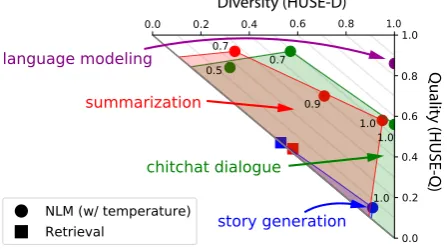
Figure 3: Tradeoffs between HUSE-D and HUSE-Q. Points are models and color indicates task. Neural models (circle) generate using temperature annealing (point labels indicate temperature). Models closer to the top right are superior, and gray diagonal lines in-dicate equivalent HUSE. A shaded region for a task indicates models which are strictly dominated (worse HUSE with the same HUSE-D-HUSE-Q proportion). Annealing can trade-off between diversity and quality but cannot easily increase the underlying model perfor-mance (HUSE).
• Language modeling: One billion word benchmark pre-trained language model from Jozefowicz et al. (2016). The task consists of generating a single sentence from the one billion word newswire text distribution.
• Chit-chat dialogue: Two-turn chit-chat di-alogue dataset consisting of 37.3 million comment-response pairs from Reddit (Ap-pendixA.4). Comments are generally short (5–15 tokens) and cover a single topic (e.g. given “wow how did i not notice that”, the re-sponse is “you were focusing on other things its understandable”). We train a convolu-tional model using fairseq (Gehring et al., 2017).
For all the tasks, we train neural models and evaluate their diversity-quality tradeoffs as we change the decoding scheme for generation. Our primary evaluation concerns diversity trade-offs involvingtemperature annealingwhich is a gen-eration technique applicable to any probabilis-tic model that generates words sequentially. In temperature annealed models, we sample a word w proportional to p1/t(w) where p is the model
Score Summarization Story generation Chit-chat dialogue LM t= 1.0 t= 0.7 t= 1.0 Retrieval t= 1.0 t= 0.7 t= 1.0
HUSE 0.53 0.26 0.06 0.00 0.56 0.49 0.86
HUSE-Q 0.58 0.92 0.15 0.47 0.56 0.92 0.88
[image:6.595.82.514.64.144.2]HUSE-D 0.95 0.34 0.91 0.53 1.00 0.57 1.02
Table 1: Performance achieved by the best models on the four tasks, as measured by overall goodness-of-fit (HUSE), sample quality (HUSE-Q) and diversity (HUSE-D). The scale for HUSE and HUSE-Q ranges from 0.0 (completely distinguishable from reference) to 1.0 (indistinguishable from reference) where the implied classifica-tion error is HUSE/2. HUSE-D may exceed 1.0 with small sample sizes when HUSE-Q>HUSE.
under diverse.
As a non-neural baseline, we also consider re-trieval based models based on Apache solr on a few tasks. For this approach, we retrieve the single most relevant response from the training set using the BM25 similarity metric on inputs. Such models are known to perform well in tasks with complex outputs such as program generation (Hayati et al.,2018;Hashimoto et al.,2018) and style transfer (Li et al.,2018).
For cost reasons, we did not measure certain combinations of task and generation mechanisms. We did not measure retrieval for chit-chat dia-logue, as we observed its outputs were lower qual-ity than a low-temperature neural model. We also did not anneal language models, as the generation quality from the language model was already high, and our goal was to show that they achieved high HUSE. Our set of measurements, while not com-prehensive, generally covers the available quality-diversity tradeoffs for conditional tasks.
Finally, we collect human judgments HJ(x, y)
as per Section 4.1 where we query 20 Amazon Mechanical Turk crowdworkers for typicality rat-ings on 100 reference and 100 model sentences. Since our models generate UNK (unknown and out-of-vocabulary) tokens, we instructed crowd-workers to treat UNK tokens as rare, but appro-priate words for the context.
5.2 Overall results
The HUSE scores across the four tasks vary widely. Table 1 shows that single-sentence lan-guage models are nearly indistinguishable, with HUSE = 0.86 and implied discriminator error of
43%.
In contrast, both summarization and dialogue are highly distinguishable (HUSE≈0.5) with rel-atively low quality when sampled from t = 1.0. Human evaluation alone (HUSE-Q) would
sug-gest that using temperature annealing(t= 0.7)to emphasize high-probability outputs substantially improves the model (HUSE-Q goes from0.58 to
0.92for summarization and0.56 to0.92for dia-logue). However, we find that this increase in sam-ple quality comes at the cost of diversity (HUSE-D goes from0.95to0.34for summarization and1.0
to0.57 for dialogue). Examining the achievable HUSE and diversity tradeoffs in Figure 3 shows that mechanisms such as annealing which improve sample quality actually degrade HUSE due to se-vere losses in diversity.
We find that all generation schemes and models are inadequate for story generation on ROC sto-ries. The original model (t = 1.0) is very easily distinguishable by a human (HUSE-Q = 0.15), corresponding to a discriminator error of7%. The retrieval models can improve this to HUSE-Q = 0.47, but this comes at the expense of diversity.
Finally, we observe that directly sampling from the model (t = 1.0) is always diverse. This suggests that human evaluation is an appropriate evaluation for generation systems that are directly sampled (rather than beam-searched).
5.3 Model error analysis with HUSE
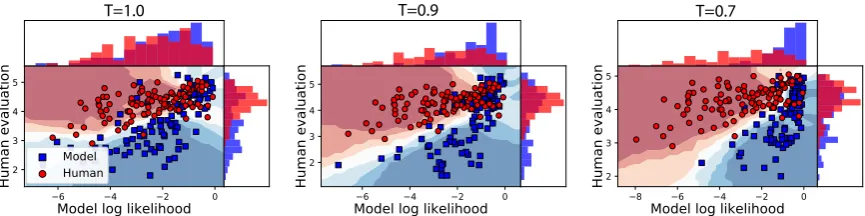
Since HUSE is estimated from a two-dimensional classification problem, we can directly visualize the classification problem to understand defects in both model quality and diversity.
Figure 4 shows both reference points φhuse(xi, yi) (blue squares) and model points
φhuse(xi, yi0) (red circles) for the summarization
task. The shaded areas indicate the decision boundary of the16-nearest neighbor classifier.
es-T=1.0 T=0.9 T=0.7
Figure 4: The two-dimensional classification problem in Algorithm1on the summarization task with different softmax temperatures (three panels). Each point represents a reference sentenceφhuse(xi, yi)or model-generated
sentenceφhuse(xi, yi0). The color denotes the source of the sentence (z), shading is the classification confidence of
the nearest neighbor classifier.
sentially indistinguishable. Examining the sam-ples in this top-right region reveals that these are news stories with short headlines such as “Nadal pulls out of Sydney International” which can be reliably generated even at t = 1.0. However, the model frequently generates low quality sam-ples that can easily be distinguished such as “two new vaccines in the poor countries were effective against go-it-alone study says” (Table2).
At lower temperatures oft = 0.9andt = 0.7, the boundary shifts towards becoming diagonal. Although the distribution is no longer directly sep-arable on human judgment, the two distributions are clearly separable with the inclusion ofpmodel.
[image:7.595.311.528.254.358.2]Using Figure 4, we can identify individual ex-amples which were correctly and incorrectly clas-sified based onpmodel and HJ. Table2shows ex-amples of both quality failures and diversity fail-ures identified by HUSE. For example, the “di-versity failure” table shows that the summarization model (t= 0.7) has an extremely low probability of generating some reference sentences (“NFL’s bills shake up front office”) and is thus under-diverse. Closer examination of the model shows that the probability of generating “front office” is low, since it is an unusual way to refer to the president and general manager. Improving these models on the diversity failures will require that the model understand more subtle paraphrases. We can also identify model successes, where the model outputs are indistinguishable from the ref-erence in terms of quality (“Agassi bows out of Australian Open after injury”), and the model as-signs high probability to the reference (“Agassi withdraws from Australian Open”).
Figure 5: Estimates of HUSE are robust to small test set size, but generally require≈20crowdworker mea-surements for each example.
5.4 HUSE stability
Since HUSE depends on human crowdworker an-notations, one might ask if it is possible to reduce either the number of annotated examples, or num-ber of distinct crowdworkers for each example. We show that for low-quality models, substantially fewer annotations are needed.
Figure 5 shows the result of subsampling our original data of 200 sentences and 20 crowdwork-ers and estimating HUSE. First, we find that us-ing 50 test set examples (Figure 5, left) is of-ten sufficient to give accurate estimates of HUSE. Next, we find that the necessary number of crowd-workers per example depends heavily on the task. Easily distinguishable tasks (story generation), re-quire only 10 crowdworkers, while less distin-guishable tasks (summarization) require more than 20 crowdworkers to obtain accurate estimates.
6 Related work
hu-Quality failure logpmodel HJ Context: Two new vaccines have been shown effective against rotavirus, which is responsible for a
half-million infant deaths in poor countries each year, research studies published Wednes-day said.
Model Two new vaccines in the poor countries were effective against go-it-alone study says -2.3 2.6
Reference New vaccines for key<UNK>virus shown effective -4.0 4.3
Diversity failure
Context: The Buffalo Bills sacked Tom Donahoe as president and general manager on Wednesday, fulfilling expectations of a shake-up after another failure to make the National Football League playoffs.
Model Bills sack<UNK>as president GM and general manager -0.9 4.3
Reference NFL’s Bills shake up front office. -5.1 4.3
Model is indistinguishable
Context: US veteran and eight-time Grand Slam winner Andre Agassi has withdrawn from this month’s Australian Open due to a nagging ankle injury, his management team announced Thursday.
Model Agassi bows out of Australian Open after injury. -1.4 5.3
[image:8.595.83.513.67.295.2]Reference Agassi withdraws from Australian Open. -0.3 4.9
Table 2: Example reference and model outputs (capitalization added for readability) corresponding to Figure4
(summarization task) that were shown to crowdworkers (left column). Crowdworkers were shown samples from the model (including the<UNK>token) and returned human judgments (right column). Using human judgments and the model probability, we can identify several types of failures. Quality failures are examples that are classified by human judgment. Diversity failures are examples that are classified by model probabilities. Finally some examples are not easily classified, as they have similar human judgment and model probability scores.
man evaluation, fourteen measure human evalua-tion and a diversity metric such as perplexity or n-gram diversity, and six do not evaluate using hu-man judgments.
While perplexity and n-gram counts can in principleevaluate diversity, their practical imple-mentations suffer from serious drawbacks. When human evaluation and perplexity are both eval-uated, they are almost always done on separate models—human evaluations are done on beam-searched output, while perplexity is computed on the softmax outputs. This makes it appear as if the models can simultaneously generate high quality outputs while also being diverse, when in fact they can only be one at a time based on whether they sample or run beam search.
On the other hand, n-gram diversity was pro-posed byLi et al.(2016) to identify models with the generic utterance problem where models re-peat phrases such as ‘I don’t know’. Unfortu-nately, n-gram diversity is computed across con-texts by counting the number of unique n-grams generated, and so does not measure a model’s abil-ity to generate multiple valid utterances at any sin-gle context. In particular, a model which only outputs a single memorized utterance per context
(e.g., via memorization or retrieval) can still have high n-gram diversity as long as the memorized sentences differ across contexts.
Finally,allexisting diversity measures are com-puted separately from human evaluation. This results in two incomparable evaluation metrics, which prevent us from reasoning about tradeoffs between diversity and quality. In contrast, HUSE allows us to make precise statements about the tradeoffs between model quality and diversity be-cause it is a single metric which decomposes into diversity and quality terms.
Related evaluations of diversity. The impor-tance of diverse responses has previously been ac-knowledged for summarization (Nenkova et al., 2007) and information retrieval (Clarke et al., 2008). Our work differs in considering a single
evaluation measure that captures quality and di-versity applicable toanygeneration task.
and Mitamura, 2011) have adapted such metrics to high entropy generative environments, they are still significantly inferior to the human judgments they attempt to mimic.
Caccia et al. (2018) recently examined the di-versity and quality tradeoffs for different language model architectures on synthetic datasets. How-ever, as their approach relies on measuring log-likelihoods under both the model and reference distributions, it cannot be applied to real data where pref is unavailable. Our main conceptual contribution overcomes this by showing that HJ is an acceptable proxy forpref.
Sajjadi et al.(2018) also examines diversity and quality (which they call precision and recall) in the context of generative image models. How-ever, they rely on assuming that pref and pmodel can be estimated accurately using the Fr´echet Inception Distance (FID) (Heusel et al., 2017). HUSE avoids such assumptions and instead di-rectly leverages human judgments, resulting in a simple and reliable metric more suitable for use as a gold-standard.
Estimating optimal classification error. Eval-uating a model by estimating its optimal classifi-cation error has been considered by several earlier works (Olsson et al., 2018;Kannan and Vinyals, 2016;Li et al.,2017;Bruni and Fernandez,2017; Bowman et al., 2016). However, these meth-ods have focused on classifying sentences directly, which is quite challenging to do reliably. Exist-ing adversarial evaluation methods do not yet re-liably outperform human classification (Kannan and Vinyals, 2016;Bruni and Fernandez, 2017). We propose the use of both human evaluation and model probabilities as part of the adversarial eval-uation framework, and demonstrate that the re-sulting classifier reliably outperforms humans and captures both the sample quality and diversity of a model.
Distributional divergence estimation. Our proposed evaluation metric is closely related to the total variation distance which has been studied extensively in the distribution testing literature. It is known that total variation distance estimates have pessimistic minimax estimation rates in high dimensions (Balakrishnan and Wasserman, 2017). Our work overcomes this by utilizing pmodeland an estimate ofpref. Other approaches to distributional testing include the maximum mean
discrepancy (MMD) and Wasserstein distances, but these approaches require knowledge of a ground truth metric or kernel space (Tolstikhin et al., 2016;Singh et al., 2018). Although such divergences are easier to estimate than the total variation distance from samples, the implied con-vergence rates are still too slow to be practically useful.
7 Discussion
In this paper, we demonstrate that the current gold standard of human evaluation does not penalize under-diverse models. To remedy this, we pro-pose HUSE, a general purpro-pose evaluation strat-egy which can be applied to any model for which we can calculate a model’s sampling probabilities. HUSE is an upper bound on the optimal classifica-tion error of distinguishing reference and model-generated text, andneverdoes worse than human classification. HUSE leverages both model proba-bilities and human judgments, ensuring that mod-els which do well on the metric are both high-quality and diverse.
Our work can be viewed as a “superhuman ver-sion” of the classic Turing Test (Turing, 1950). Instead of relying on just a human classifier, we approximate theoptimalclassifier, which can uti-lize information about the model in addition to the reference. We also modify the classification prob-lem and seek to identify whether a sample comes from a (potentially superhuman) reference distri-bution, rather than the human distribution. These two changes lead to tractable, rigorous estimators which can quantify tradeoffs between model qual-ity and diversqual-ity on a wide range of generation tasks.
Acknowledgements. We would like to thank Arun Chaganty, Robin Jia, and Peng Qi for exten-sive comments and feedback on the paper. This work was funded by DARPA CwC program under ARO prime contract no. W911NF-15-1-0462.
Reproducibility. All code, data, and ex-periments are available on the CodaLab
platform at https://worksheets.
codalab.org/worksheets/
References
S. Balakrishnan and L. Wasserman. 2017. Hypothesis testing for high-dimensional multinomials: A selec-tive review. arXiv preprint arXiv:1712.06120.
S. R. Bowman, L. Vilnis, O. Vinyals, A. M. Dai, R. Jozefowicz, and S. Bengio. 2016. Generating sentences from a continuous space. In Computa-tional Natural Language Learning (CoNLL), pages 10–21.
E. Bruni and R. Fernandez. 2017. Adversarial evalua-tion for open-domain dialogue generaevalua-tion. In Pro-ceedings of the SIGDIAL 2017 Conference.
M. Caccia, L. Caccia, W. Fedus, H. Larochelle, J. Pineau, and L. Charlin. 2018. Language gans falling short. arXiv preprint arXiv:1811.02549.
A. Chaganty, S. Mussmann, and P. Liang. 2018. The price of debiasing automatic metrics in natural lan-guage evaluation. InAssociation for Computational Linguistics (ACL).
C. L. A. Clarke, M. Kolla, G. V. Cormack, O. Vech-tomova, A. Ashkan, S. B¨uttcher, and I. MacKinnon. 2008. Novelty and diversity in information retrieval evaluation. InACM SIGIR.
M. Feder and N. Merhav. 1994. Relations between en-tropy and error probability. IEEE Transactions on Information Theory, 40:259–266.
M. Galley, C. Brockett, A. Sordoni, Y. Ji, M. Auli, C. Quirk, M. Mitchell, J. Gao, and B. Dolan. 2015. deltableu: A discriminative metric for gen-eration tasks with intrinsically diverse targets. arXiv preprint arXiv:1506.06863.
J. Gehring, M. Auli, D. Grangier, D. Yarats, and Y. N. Dauphin. 2017. Convolutional sequence to se-quence learning. arXiv preprint arXiv:1705.03122.
S. Gehrmann, Y. Deng, and A. M. Rush. 2018. Bottom-up abstractive summarization. In Empirical Meth-ods in Natural Language Processing (EMNLP).
I. J. Goodfellow, J. Pouget-Abadie, M. Mirza, B. Xu, D. Warde-Farley, S. Ozair, A. Courville, and Y. Ben-gio. 2014. Generative adversarial nets. In Ad-vances in Neural Information Processing Systems (NeurIPS).
T. Hashimoto, K. Guu, Y. Oren, and P. Liang. 2018. A retrieve-and-edit framework for predicting struc-tured outputs. In Advances in Neural Information Processing Systems (NeurIPS).
S. A. Hayati, R. Olivier, P. Avvaru, P. Yin, A. Tomasic, and G. Neubig. 2018. Retrieval-based neural code generation. InEmpirical Methods in Natural Lan-guage Processing (EMNLP).
M. Heusel, H. Ramsauer, T. Unterthiner, B. Nessler, and S. Hochreiter. 2017. Gans trained by a two time-scale update rule converge to a local nash equilib-rium. In Advances in Neural Information Process-ing Systems (NeurIPS).
R. Jozefowicz, O. Vinyals, M. Schuster, N. Shazeer, and Y. Wu. 2016. Exploring the limits of language modeling. arXiv preprint arXiv:1602.02410.
A. Kannan and O. Vinyals. 2016. Adversarial evalua-tion of dialogue models. InNIPS 2016 Workshop on Adversarial Training.
G. Klein, Y. Kim, Y. Deng, J. Senellart, and A. M. Rush. 2017. Opennmt: Open-source toolkit for neural machine translation. arXiv preprint arXiv:1701.02810.
A. Lavie and M. Denkowski. 2009. The meteor met-ric for automatic evaluation of machine translation.
Machine Translation, 23.
J. Li, M. Galley, C. Brockett, J. Gao, and W. B. Dolan. 2016. A diversity-promoting objective func-tion for neural conversafunc-tion models. InHuman Lan-guage Technology and North American Association for Computational Linguistics (HLT/NAACL), pages 110–119.
J. Li, R. Jia, H. He, and P. Liang. 2018. Delete, retrieve, generate: A simple approach to sentiment and style transfer. InNorth American Association for Compu-tational Linguistics (NAACL).
J. Li, W. Monroe, T. Shi, A. Ritter, and D. Jurafsky. 2017. Adversarial learning for neural dialogue gen-eration. arXiv preprint arXiv:1701.06547.
C. Lin and M. Rey. 2004. Looking for a few good met-rics: ROUGE and its evaluation. In NTCIR Work-shop.
T. Lin, M. Maire, S. Belongie, J. Hays, P. Perona, D. Ramanan, P. Doll’ar, and C. L. Zitnick. 2014. Microsoft COCO: Common objects in context. In
European Conference on Computer Vision (ECCV), pages 740–755.
C. Liu, R. Lowe, I. V. Serban, M. Noseworthy, L. Char-lin, and J. Pineau. 2016. How NOT to evaluate your dialogue system: An empirical study of unsuper-vised evaluation metrics for dialogue response gen-eration. InEmpirical Methods in Natural Language Processing (EMNLP).
R. Lowe, M. Noseworthy, I. V. Serban, N. Angelard-Gontier, Y. Bengio, and J. Pineau. 2017. Towards an automatic turing test: Learning to evaluate dia-logue responses. InAssociation for Computational Linguistics (ACL).
American Association for Computational Linguis-tics (NAACL).
R. Nallapati, B. Zhou, C. Gulcehre, B. Xiang, et al. 2016. Abstractive text summarization us-ing sequence-to-sequence rnns and beyond. arXiv preprint arXiv:1602.06023.
A. Nenkova, R. J. Passonneau, and K. McKeown. 2007. The pyramid method: Incorporating human content selection variation in summarization evaluation. In
ACM Transactions on Speech and Language Pro-cessing.
J. Novikova, O. Duˇsek, A. C. Curry, and V. Rieser. 2017. Why we need new evaluation metrics for NLG. InEmpirical Methods in Natural Language Processing (EMNLP).
C. Olsson, S. Bhupatiraju, T. Brown, A. Odena, and I. Goodfellow. 2018. Skill rating for generative models. arXiv preprint arXiv:1808.04888.
K. Papineni, S. Roukos, T. Ward, and W. Zhu. 2002. BLEU: A method for automatic evaluation of ma-chine translation. InAssociation for Computational Linguistics (ACL).
M. Roemmele. 2016. Writing stories with help from recurrent neural networks. In Association for the Advancement of Artificial Intelligence (AAAI).
M. S. M. Sajjadi, O. Bachem, M. Lucic, O. Bous-quet, and S. Gelly. 2018. Assessing generative models via precision and recall. arXiv preprint arXiv:1806.00035.
H. Shima and T. Mitamura. 2011. Diversity-aware evaluation for paraphrase patterns. In Empir-ical Methods in Natural Language Processing (EMNLP).
S. Singh, A. Uppal, B. Li, C. Li, M. Zaheer, and B. Poc-zos. 2018. Nonparametric density estimation under adversarial losses. InAdvances in Neural Informa-tion Processing Systems (NeurIPS), pages 246–257.
A. Sordoni, M. Galley, M. Auli, C. Brockett, Y. Ji, M. Mitchell, J. Nie, J. Gao, and B. Dolan. 2015. A neural network approach to context-sensitive generation of conversational responses. In North American Association for Computational Linguis-tics (NAACL).
H. Sun and M. Zhou. 2012. Joint learning of a dual SMT system for paraphrase generation. In Associa-tion for ComputaAssocia-tional Linguistics (ACL).
J. Surowiecki. 2004. The wisdom of crowds: Why the many are smarter than the few and how collective wisdom shapes business, economies, societies, and nations. Doubleday and Co.
L. Theis, A. van den Oord, and M. Bethge. 2015. A note on the evaluation of generative models. arXiv preprint arXiv:1511.01844.
I. Tolstikhin, B. K. Sriperumbudur, and B. Scholkopf. 2016. Minimax estimation of maximum mean dis-crepancy with radial kernels. InAdvances in Neural Information Processing Systems (NeurIPS), pages 1930–1938.
A. M. Turing. 1950. Computing machinery and intelli-gence.Mind, 49:433–460.
A Appendix
A.1 Relationship between total variation distance and optimal discriminator error
This is a standard result, replicated here for com-pleteness:
Proposition 2. The total variation distance is re-lated to the optimal discriminator error as fol-lows: kpmodel−prefkTV= 1−L∗.
Proof Fix anyx. Defineay def
= pref(y |x)and
by def
= pmodel(y | x). Let S
def
= {y : ay < by}
be the y where the pmodel assigns higher proba-bility than pref, and define A def= P
y∈Say and
B def= P
y∈Sby be the aggregated probabilities.
OnS, the optimal discriminator should returnz= 0 (model). This is an error when z = 1, which occurs with probability 12A. Analogously, on the complement ofS, the error probability (whenz= 0) is 12(1−B). The total contribution toL∗is thus A+ (1−B). The rest follows from algebra:
kpmodel−prefkTV=
1
2kpmodel−prefk1 (10)
= 1
2[(B−A) + (1−A)−(1−B)] (11) =B−A= (1−L∗). (12)
A.2 Approximation error fromφfeatures
Theorem 1. LetL∗andL(φ)be the optimal clas-sification error and optimal error under feature
mapφrespectively. Then,
L∗≤L(φ)≤L∗+ 2(1−2−I)
whereI def= I(Zopt;φopt(X, Y) | φ(X, Y))is the conditional mutual information in bits andZoptis
the prediction of the optimal classifier.
Proof The lower bound falls out of the defini-tion of L∗. To prove the upper bound, a variant of the entropy lower bound by Feder and Merhav (Feder and Merhav,1994) shows that the error rate for predicting Zopt, via the optimal f(φ(X, Y))
follows
P(f(φ(X, Y))6=Zopt)
≤1−2I(Zopt;φ(X,Y))−H(Zopt). (13)
Now expand the mutual information using the chain rule
I(Zopt;φ(X, Y)) =I(Zopt;φopt(X, Y), φ(X, Y))
−I(Zopt;φopt(X, Y)|φ(X, Y))
=−I(Zopt;φopt(X, Y)|φ(X, Y)) +H(Zopt).
The last line follows from the fact thatZoptis a
de-terministic function ofφopt (Proposition1). Sub-stituting this into the inequality gives the bound,
P(f(φ(X, Y))=6 Zopt)≤1−2−I
withI =I(Zopt;φopt(X, Y)|φ(X, Y)).
Finally, note that Zopt incurs L∗/2
er-ror, and we disagree with Zopt at most a
P(f(φ(X, Y)) 6= Zopt) fraction of time.
Assuming that we get every one of these dis-agreements wrong gives an upper bound of L∗/2 +P(f(φ(X, Y))6=Zopt)onL(φ)/2.
A straightforward corollary is that whenever φ is an invertible function of φopt, the condi-tional mutual information is zero, and therefore the above inequalities become an equality.
Corollary 1. Wheneverφis an invertible function ofφopt,L(φ) =L∗.
A.3 Amazon Mechanical Turk for human judgments
In order to show that HUSE can be reliably es-timated even with simple crowdsourcing tech-niques, we used a single uniform task design where we asked Amazon Mechanical Turk work-ers to rate the typicality of a sentence from 0–5. We defined 0 as invalid (grammatically or factu-ally incorrect) and 5 as ‘very typical’. HJ(x, y)
is defined as the average score that crowdwork-ers assign to a response y given the context x. We did not perform substantial filtering or quali-fication checks beyond HIT acceptance rate (HIT Approval rate greater than 95 percent and number of HITs approved greater than 50 and location is USA). We constructed each HIT to be 25 exam-ples, and paid one dollar per HIT.
Figure 6: Amazon Mechanical Turk survey design for eliciting human judgment scores HJ in the summarization task.
for hard tasks such as summarization at least twenty replicates are needed (Section5.4). Man-ual inspection suggests that up to 20% of the col-lected data are low-quality but that this noise is un-correlated with the sentence being rated and out-weighed by a larger majority of honest and rea-sonably accurate data. Even if the data quality is low, HUSE is still a valid upper bound (i.e. models with low HUSE are guaranteed to be distinguish-able from humans). Thus the models which we identify as having low-HUSE are reliably distin-guishable regardless of the crowdworker quality.
A.4 Reddit Dataset