Proceedings of NAACL-HLT 2019, pages 4119–4128 4119
Data Augmentation for Context-Sensitive Neural Lemmatization
Using Inflection Tables and Raw Text
Toms Bergmanis
School of Informatics University of Edinburgh
Sharon Goldwater
School of Informatics University of Edinburgh
Abstract
Lemmatization aims to reduce the sparse data problem by relating the inflected forms of a word to its dictionary form. Using context can help, both for unseen and ambiguous words. Yet most context-sensitive approaches require full lemma-annotated sentences for training, which may be scarce or unavailable in low-resource languages. In addition (as shown here), in a low-resource setting, a lemmatizer can learn more from n labeled examples of distinct words (types) than from n (contigu-ous) labeled tokens, since the latter contain far fewer distinct types. To combine the ef-ficiency of type-based learning with the ben-efits of context, we propose a way to train a context-sensitive lemmatizer with little or no labeled corpus data, using inflection tables from the UniMorph project and raw text exam-ples from Wikipedia that provide sentence con-texts for the unambiguous UniMorph ples. Despite these being unambiguous exam-ples, the model successfully generalizes from them, leading to improved results (both over-all, and especially on unseen words) in com-parison to a baseline that does not use context.
1 Introduction
Many lemmatizers work on isolated wordforms (Wicentowski,2002;Dreyer et al.,2008;Rastogi et al., 2016; Makarov and Clematide, 2018b,a). Lemmatizing in context can improve accuracy on ambiguous and unseen words (Bergmanis and Goldwater, 2018), but most systems for context-sensitive lemmatization must train on complete sen-tences labeled with POS and/or morphological tags as well as lemmas, and have only been tested with 20k-300k training tokens (Chrupała et al., 2008;
M¨uller et al.,2015;Chakrabarty et al.,2017).1
1The smallest of these corpora contains 20k tokens of
Bengali annotated only with lemmas, whichChakrabarty et al.
(2017) reported took around two person months to create.
Intuitively, though, sentence-annotated data is inefficient for training a lemmatizer, especially in low-resource settings. Training on (say) 1000 word types will provide far more information about a language’s morphology than training on 1000 con-tiguous tokens, where fewer types are represented. As noted above, sentence data can help with am-biguous and unseen words, but we show here that when data is scarce, this effect is small relative to the benefit of seeing more word types.2 Mo-tivated by this result, we propose a training data augmentation method that combines the efficiency of type-based learning and the expressive power of a context-sensitive model.3 We use Lematus
(Bergmanis and Goldwater,2018), a state-of-the-art lemmatizer that learns from lemma-annotated words in their N-character contexts. No predic-tions about surrounding words are used, so fully annotated training sentences are not needed. We exploit this fact by combining two sources of train-ing data: 1k lemma-annotated types (with con-texts) from the Universal Dependency Treebank (UDT) v2.24(Nivre et al.,2017), plus examples ob-tained by findingunambiguousword-lemma pairs in inflection tables from the Universal Morphology (UM) project5and collecting sentence contexts for them from Wikipedia. Although these examples are noisy and biased, we show that they improve lemmatization accuracy in experiments on 10 lan-guages, and that the use of context helps, both overall and especially on unseen words.
2 Method
Lematus(Bergmanis and Goldwater, 2018) is a neural sequence-to-sequence model with attention
2Garrette et al.(2013) found the same for POS tagging. 3
Code and data: https://bitbucket.org/ tomsbergmanis/data_augumentation_um_wiki
4
http://hdl.handle.net/11234/1-2837
inspired by the re-inflection model of Kann and Sch¨utze (2016), which won the 2016 SIGMOR-PHON shared task (Cotterell et al., 2016). It is built using the Nematus machine translation toolkit,6 which uses the architecture ofSennrich et al.(2017): a 2-layer bidirectional GRU encoder and a 2-layer decoder with a conditional GRU ( Sen-nrich et al.,2017) in the first layer and a GRU in the second layer.
Lematus takes as input a character sequence rep-resenting the wordform in itsN-character context, and outputs the characters of the lemma. Special in-put symbols are used to represent the left and right boundary of the target wordform (<lc>, <rc>) and other word boundaries (<s>). For example, if N = 15, the system trained on Latvian would be expected to produce the characters of the lemma
cel¸ˇs(meaningroad) given input such as:
s a k a <s> p a ˇs v a l d ¯ı b u <lc> c e l¸ u <rc>
u n <s> i e l u <s> r e ´g i s t r
When N = 0 (Lematus 0-ch), no context is used, making Lematus 0-ch comparable to other systems that do not model context (Dreyer et al.,
2008;Rastogi et al.,2016;Makarov and Clematide,
2018b,a). In our experiments we use both Lematus 0-ch andLematus 20-ch(20 characters of context), which was the best-performing system reported by
Bergmanis and Goldwater(2018).
2.1 Data Augmentation
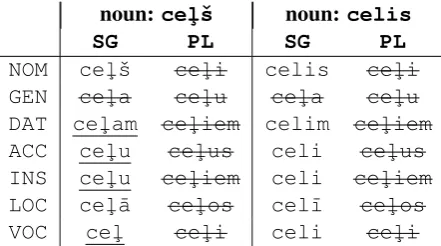
Our data augmentation method uses UM inflec-tion tables and creates addiinflec-tional training exam-ples by finding Wikipedia sentences that use the inflected wordforms in context, pairing them with their lemma as shown in the inflection table. How-ever, we cannot use all the words in the tables be-cause some of them are ambiguous: for example, Figure1shows that the formcel¸icould be lem-matized either ascel¸ˇsorcelis. Since we don’t know which would be correct for any particular Wikipedia example, we only collect examples for forms which are unambiguous according to the UM tables. However, this method is only as good as the coverage of the UM tables. For example, if UM doesn’t include a table for the Latvian verb
celt, then the underlined forms in Table1would be incorrectly labeled as unambiguous.
6Code for Nematus: https://github.com/
EdinburghNLP/nematus, Code for Lematus:
https://bitbucket.org/tomsbergmanis/ lematus.git
noun:cel¸ˇs noun:celis
SG PL SG PL
[image:2.595.309.530.66.189.2]NOM cel¸ˇs cel¸i celis cel¸i GEN cel¸a cel¸u cel¸a cel¸u DAT cel¸am cel¸iem celim cel¸iem ACC cel¸u cel¸us celi cel¸us INS cel¸u cel¸iem celi cel¸iem LOC cel¸¯a cel¸os cel¯ı cel¸os VOC cel¸ cel¸i celi cel¸i
Table 1: Example UM inflection tables for Latvian nouns cel¸ˇs (road) andcelis (knee). The crossed out forms are examples of evidently ambiguous forms that are not used for data augmentation because of being shared by the two lemmas. The underlined forms ap-pear unambiguous in this toy example but actually con-flict with inflections of the verbcelt(to lift).
There are several other issues with this method that could potentially limit its usefulness. First, the UM tables only include verbs, nouns and adjectives, whereas we test the system on UDT data, which includes all parts of speech. Second, by excluding ambiguous forms, we may be restricting the added examples to a non-representative subset of the po-tential inflections, or the system may simply ignore the context because it isn’t needed for these exam-ples. Finally, there are some annotation differences between UM and UDT.7Despite all of these issues, however, we show below that the added examples and their contexts do actually help.
3 Experimental Setup
Baselines and Training Parameters We use four baselines: (1) Lemming8 (M¨uller et al.,
2015) is a context-sensitive system that uses log-linear models to jointly tag and lemmatize the data, and is trained on sentences annotated with both lemmas and POS tags. (2) The hard monotonic attention model (HMAM)9(Makarov and Clematide, 2018b) is a neural sequence-to-sequence model with a hard attention mechanism that advances through the sequence monotonically. It is trained on word-lemma pairs (without context)
7
Recent efforts to unify the two resources have mostly focused on validating dataset schema (McCarthy et al.,2018), leaving conflicts in word lemmas unresolved. We estimated (by counting types that are unambiguous in each dataset but have different lemmas across them) that annotation inconsis-tencies affect up to 1% of types in the languages we used.
8
http://cistern.cis.lmu.de/lemming
9https://github.com/ZurichNLP/
with character-level alignments learned in a prepro-cessing step using an alignment model, and it has proved to be competitive in low resource scenarios. (3) Our naiveBaselineoutputs the most frequent lemma (or one lemma at random from the options that are equally frequent) for words observed in training. For unseen words it outputs the wordform itself. (4) We also try a baseline data augmentation approach (AE Aug Baseline) inspired by Bergma-nis et al. (2017) and Kann and Sch¨utze (2017), who showed that adding training examples where the network simply learns to auto-encode corpus words can improve morphological inflection results in low-resource settings. The AE Aug Baseline is a variant of Lematus 0-ch which augments the UDT lemmatization examples by auto-encoding the inflected forms of the UM examples (i.e., it just treats them as corpus words). Comparing AE Aug Baseline to Lematus 0-ch augmented with UM lemma-inflection examples tells us whether using the UM lemma information helps more than simply auto-encoding more inflected examples.
To train the models we use the default settings for Lemming and the suggested lemmatization pa-rameters for HMAM. We mainly follow the hy-perparameters used byBergmanis and Goldwater
(2018) for Lematus; details are in AppendixB.
Languages and Training Data We conduct pre-liminary experiments on five development lan-guages: Estonian, Finnish, Latvian, Polish, and Russian. In our final experiments we also add Bul-garian, Czech, Romanian, Swedish and Turkish. We vary the amount and type of training data (types vs. tokens, UDT only, UM only, or UDT plus up to 10k UM examples), as described in Section4.
To obtainN UM-based training examples, we select the first N unambiguous UM types (with their sentence contexts) from shuffled Wikipedia sentences. For experiments withj >1examples per type, we first find all UM types with at least jsentence contexts in Wikipedia and then choose theN distinct types and theirjcontexts uniformly at random.
Evaluation To evaluate models’ ability to lem-matize wordforms in their sentence context we followBergmanis and Goldwater(2018) and use the full UDT development and test sets. Unlike
Bergmanis and Goldwater(2018) who reported to-ken level lemmatization exact match accuracy, we reporttype-levelmicro averaged lemmatization
ex-Ambig. Unseen All
T
ok
ens
Baseline 41.0 26.6 31.0
Lemming 38.2 48.3 50.6
HMAM 41.4 50.2 52.1
Lematus 0-ch 39.9 43.7 46.8
Lematus 20-ch 38.4 42.8 45.8
T
ypes
Baseline 45.0 26.6 32.4
Lemming N/A N/A N/A
HMAM 41.8 53.7 56.3
Lematus 0-ch 42.5 53.7 55.1
[image:3.595.320.515.63.187.2]Lematus 20-ch 43.1 51.7 54.9
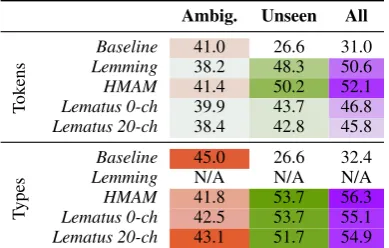
Table 2: Average type level lemmatization exact match accuracy on five development languages in type and to-ken based training data scenarios. Colour-scale is com-puted over the wholeAmbig. column and over all but
Baselinerows for the other columns.
act match accuracy. This measure better reflects improvements on unseen words, which tend to be rare but are more important (since a most-frequent-lemma baseline does very well on seen words, as shown byBergmanis and Goldwater(2018)).
We separately report performance on unseen and ambiguous tokens. For a fair comparison across scenarios with different training sets, we count as unseen only words that are not ambiguous and are absent fromalltraining sets/scenarios introduced in Section4. Due to the small training sets, between 70-90% of dev set types are classed as unseen in each language. We define a type as ambiguous if the empirical entropy over its lemmas is greater than 0.1 in the full original UDT training splits.10 According to this measure, only 1.2-5.3% of dev set types are classed as ambiguous in each language.
Significance Testing All systems are trained and tested on ten languages. To test for statistically significant differences between the results of two systems we use a Monte Carlo method: for each set of results (i.e. a set of 10 numerical values) we generate 10000 random samples, where each sample swaps the results of the two systems for each language with a probability of0.5. We then obtain a p-value as the proportion of samples for which the difference on average was at least as large as the difference observed in our experiments.
4 Experiments, Results, and Discussion
Types vs. Tokens and Context in Very Low Re-source Settings We compare training on the first
10This measure,
adjusted ambiguity, was defined byKirefu
Figure 1: Average type level lemmatization exact match accuracy on unseen words of five development languages. X-axis: thousands of types in training data.
1k tokens vs. first 1k distinct types of the UDT training sets. Table 2 shows that if only 1k ex-amples are available, using types is clearly better for all systems. Although Lematus does relatively poorly on the token data, it benefits the most from switching to types, putting it on par with HMAM and suggesting is it likely to benefit more from ad-ditional type data. Lemming requires token-based data, but does worse than HMAM (a context-free method) in the token-based setting, and we also see no benefit from context in comparing Lematus 20-ch vs Lematus 0-ch. So overall, in this very low-resource scenario with no data augmentation, context does not appear to help.
Using UM + Wikipedia Only We now try train-ing only on UM + Wikipedia examples, rather than examples from UDT. We use 1k, 2k or 5k unam-biguous types from UM with a single example con-text from Wikipedia for each. With 5k types we also try adding more example contexts (2, 3, or 5 examples for each type).
Figure1presents the results (for unseen words only). As with the UDT experiments, there is little difference between Lematus 2ch and Lematus 0-ch in the smallest data setting. However, when the number of training types increases to 5k, the bene-fits of context begin to show, with Lematus 20-ch yielding a 1.6% statistically significant (p <0.001) improvement over Lematus 0-ch. The results for increasing the number of examples per type are numerically higher than the one-example case, but the differences are not statistically significant.
It is worth noting that the accuracy even with 5k UM types is considerably lower than the accuracy of the model trained on only 1k UDT types (see Table 2). We believe this discrepancy is due to the issues of biased/incomplete data noted above.
DEVELOPMENT TEST
Ambig .
Unseen All All
1k UDT types (No augmentation)
Baseline 49.1 30.8 36.7
-HMAM 46.3 58.9†‡ 61.5†‡ 62.6†‡
Lematus 0-ch 46.5 55.0 58.5 59.1‡
Lematus 20-ch 45.0 54.3 57.7 57.7
1k UDT types + 1k UM types
Baseline 45.9 30.8 38.4
-AE Aug Baseline 45.6 57.5 60.4 60.8
HMAM 45.9 60.2 64.2 64.3
Lematus 0-ch 46.6 59.0 63.4 63.6
Lematus 20-ch 49.8∗ 61.7∗† 65.5∗† 65.3†
1k UDT types + 5k UM types
Baseline 55.4∗†‡ 30.7 41.7
-AE Aug Baseline 46.0 58.8 61.3 61.6
HMAM 46.7 60.8 65.7 65.7
Lematus 0-ch 46.2 61.5 66.1 66.4
Lematus 20-ch 48.6 65.4∗† 69.2∗† 69.5∗†
1k UDT types + 10k UM types
Baseline 54.9∗† 31.2 43.5
-AE Aug Baseline 46.3 58.6 61.2 61.7
HMAM 45.4 60.8 65.5 65.3
Lematus 0-ch 45.5 62.1 66.4 66.4
Lematus 20-ch 49.5∗ 66.7∗† 70.6∗† 70.9∗†
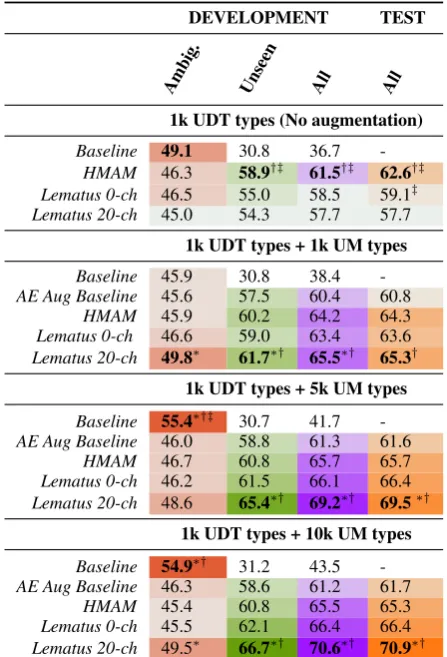
Table 3: Average lemmatization accuracy for all 10 languages, trained on 1k UDT types (No aug.), or 1k UDT plus 1k, 5k, or 10k UM types with contexts from Wikipedia. The numerically highest scores in each data setting are bold; ∗, †, and‡ indicate statistically significant improvements over HMAM (Makarov and Clematide, 2018b), Lematus 0-ch and 20-ch, respec-tively (allp <0.05; see text for details). Colour-scale is computed over the wholeAmbig. column and over all butBaselinerows for the other columns.
For example, we analyzed the Latvian data and found that the available tables for nouns, verbs, and adjectives give rise to 78 paradigm slots. The 17 POS tags in UDT give rise to about 10 times as many paradigm slots, although only 448 are present in the unseen words of the dev set. Of these, 197 are represented amongst the 1k UDT training types, whereas only 25 are included in the 1k UM training types. As a result, about72%of the unseen types of dev set have no representative of their paradigm slot in 1k types of UM, whereas this figure is only
17%for the 1k types of UDT.
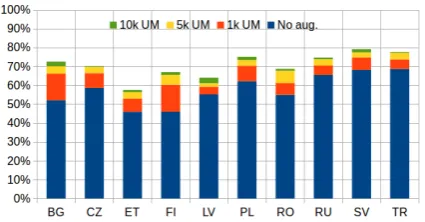
[image:4.595.76.294.64.190.2]Figure 2: Lematus 20-ch lemmatization accuracy for each language on all types in the dev sets.
types with contexts from Wikipedia.
Table3summarizes the results, showing that de-spite the lower quality of the UM + Wikipedia ex-amples, using them improves results of all systems, and more so with more examples. Improvements are especially strong for unseen types, which consti-tute more than 70% of types in the dev set. Further-more, the benefit of the additional UM examples is above and beyond the effect of auto-encoding (AE Aug Baseline) for all systems in all data scenarios.
Considering the two context-free models, HMAM does better on the un-augmented 1k UDT data, but (as predicted by our results above) it bene-fits less from data augmentation than does Lematus 0-ch, so with added data they are statistically equiv-alent (p= 0.07on the test set with 10k UM).
More importantly, Lematus 20-ch begins to out-perform the context-free models with as few as 1k UM + Wikipedia examples, and the difference in-creases with more examples, eventually reaching over 4% better on the test set than the next best model (Lematus 0-ch) when 10k UM + Wikipedia examples are used (p <0.001) This indicates that the system can learn useful contextual cues even from unambiguous training examples.
Finally, Figure2gives a breakdown of Lematus 20-ch dev set accuracy for individual languages, showing that data augmentation helps consistently, although results suggest diminishing returns.
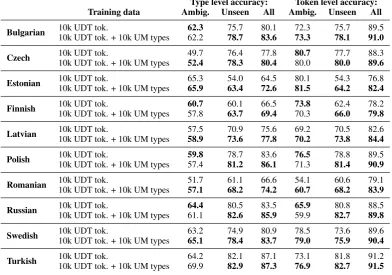
Data Augmentation in Medium Resource Set-ting To examine the extent to which augmented data can help in the medium resource setting of 10k continuous tokens of UDT used in previous work, we followBergmanis and Goldwater(2018) and train Lematus 20-ch models for all ten languages using the first 10k tokens of UDT and compare them with models trained on 10k tokens of UDT augmented with 10k UM types. To provide a better comparison of our results, we report both the type and the token level development set accuracy. First
Type accuracy: Ambig. Unseen All
1k UDT+10k UM 49.5 66.7 70.6 10k UDT tok. 59.6 71.4 76.6 10k UDT tok.+10k UM 60.8 75.1 80.1 Token accuracy: Ambig. Uns. All
[image:5.595.312.521.64.163.2]1k UDT+10k UM 55.5 66.5 77.0 10k UDT tok. 72.4 72.5 85.3 10k UDT tok.+10k UM 72.3 75.3 87.3
Table 4: Lematus 20-ch average lemmatization type and token accuracy for all 10 languages, trained on 1k UDT types, 1k UDT augmented with 10k UM types, 10k UDT continuous tokens, or 10k UDT continuous tokens augmented with 10k UM types. Unless speci-fied otherwise data consists of distinct types.
of all, Table4shows that training on 10k continu-ous tokens of UDT yields a token level accuracy that is about 8% higher than when using the 1k types of UDT augmented with 10k UM types—the best-performing data augmentation systems (see Table3). Again, we believe this performance gap is due to the issues with the biased/incomplete data noted above. For example, we analyzed errors that were unique to the model trained on the Latvian augmented data and found that 41% of the errors were due to wrongly lemmatized words other than nouns, verbs, and adjectives—the three POSs with available inflection tables in UM. For instance, im-properly lemmatized pronouns amounted to 14% of the errors on the Latvian dev set. Table4also shows that UM examples with Wikipedia contexts benefit lemmatization not only in the low but also the medium resource setting, yielding statistically significant type and token level accuracy gains over models trained on 10k UDT continuous tokens alone (for both Unseen and Allp <0.001).
5 Conclusion
References
Joakim Nivre et al. 2017. Universal dependencies 2.0 CoNLL 2017 shared task development and test data. LINDAT/CLARIN digital library at the Institute of Formal and Applied Linguistics, Charles University.
Toms Bergmanis and Sharon Goldwater. 2018. Con-text Sensitive Neural Lemmatization with Lematus. InProceedings of the Conference of the North Amer-ican Chapter of the Association for Computational Linguistics: Human Language Technologies.
Toms Bergmanis, Katharina Kann, Hinrich Sch¨utze, and Sharon Goldwater. 2017. Training Data Aug-mentation for Low-Resource Morphological Inflec-tion. InProceedings of the CoNLL-SIGMORPHON 2017 Shared Task: Universal Morphological Rein-flection, Vancouver, Canada. Association for Com-putational Linguistics.
Abhisek Chakrabarty, Onkar Arun Pandit, and Utpal Garain. 2017. Context Sensitive Lemmatization Us-ing Two Successive Bidirectional Gated Recurrent Networks. InProceedings of the 55th Annual Meet-ing of the Association for Computational LMeet-inguistics (Volume 1: Long Papers), pages 1481–1491, Van-couver, Canada. Association for Computational Lin-guistics.
Grzegorz Chrupała, Georgiana Dinu, and Josef van Genabith. 2008. Learning Morphology with Mor-fette. In Proceedings of the Sixth International Conference on Language Resources and Evaluation (LREC’08), Marrakech, Morocco. European Lan-guage Resources Association (ELRA).
Ryan Cotterell, Christo Kirov, John Sylak-Glassman, David Yarowsky, Jason Eisner, and Mans Hulden. 2016. The SIGMORPHON 2016 shared taskmor-phological reinflection. InProceedings of the 14th SIGMORPHON Workshop on Computational Re-search in Phonetics, Phonology, and Morphology, pages 10–22.
Markus Dreyer, Jason R Smith, and Jason Eisner. 2008. Latent-Variable Modeling of String Transductions with Finite-State Methods. InProceedings of the conference on empirical methods in natural lan-guage processing, pages 1080–1089. Association for Computational Linguistics.
Dan Garrette, Jason Mielens, and Jason Baldridge. 2013. Real-world semi-supervised learning of pos-taggers for low-resource languages. InProceedings of the 51st Annual Meeting of the Association for Computational Linguistics (Volume 1: Long Papers), volume 1, pages 583–592.
Katharina Kann and Hinrich Sch¨utze. 2016. MED: The LMU system for the SIGMORPHON 2016 shared task on morphological reinflection. InProceedings of ACL. Association for Computational Linguistics.
Katharina Kann and Hinrich Sch¨utze. 2017. Unlabeled Data for Morphological Generation With Character-Based Sequence-to-Sequence Models. In Proceed-ings of the First Workshop on Subword and Charac-ter Level Models in NLP, pages 76–81.
Faheem Kirefu. 2018. Exploring Context Represen-tations for Neural Lemmatisation. Master’s thesis, University of Edinburgh.
Philipp Koehn, Hieu Hoang, Alexandra Birch, Chris Callison-Burch, Marcello Federico, Nicola Bertoldi, Brooke Cowan, Wade Shen, Christine Moran, Richard Zens, et al. 2007. Moses: Open source toolkit for statistical machine translation. In Pro-ceedings of the 45th annual meeting of the associ-ation for computassoci-ational linguistics companion vol-ume proceedings of the demo and poster sessions, pages 177–180.
Peter Makarov and Simon Clematide. 2018a. Imitation Learning for Neural Morphological String Transduc-tion. In Proceedings of the 2018 Conference on Empirical Methods in Natural Language Processing, pages 2877–2882.
Peter Makarov and Simon Clematide. 2018b. Neural Transition-based String Transduction for Limited-Resource Setting in Morphology. InProceedings of the 27th International Conference on Computational Linguistics, pages 83–93.
Arya D McCarthy, Miikka Silfverberg, Ryan Cotterell, Mans Hulden, and David Yarowsky. 2018. Marrying Universal Dependencies and Universal Morphology. In Proceedings of the Second Workshop on Univer-sal Dependencies (UDW 2018), pages 91–101.
Thomas M¨uller, Ryan Cotterell, Alexander Fraser, and Hinrich Sch¨utze. 2015. Joint Lemmatization and Morphological Tagging with Lemming. In Proceed-ings of the 2015 Conference on Empirical Meth-ods in Natural Language Processing, pages 2268– 2274, Lisbon, Portugal. Association for Computa-tional Linguistics.
Lutz Prechelt. 1998. Early Stopping-but When? Neu-ral Networks: Tricks of the trade, pages 553–553.
Ofir Press and Lior Wolf. 2017. Using the Output Em-bedding to Improve Language Models. In Proceed-ings of the 15th Conference of the European Chap-ter of the Association for Computational Linguistics: Volume 2, Short Papers, volume 2, pages 157–163.
Pushpendre Rastogi, Ryan Cotterell, and Jason Eisner. 2016. Weighting Finite-State Transductions With Neural Context. In Proceedings of the 2016 Con-ference of the North American Chapter of the Asso-ciation for Computational Linguistics: Human Lan-guage Technologies, pages 623–633.
2017. Nematus: a toolkit for neural machine trans-lation. CoRR, abs/1703.04357.
Richard Wicentowski. 2002. Modeling and learning multilingual inflectional morphology in a minimally supervised framework. Ph.D. thesis, Johns Hopkins University.
A Lematus Training
Lematus is implemented using theNematus ma-chine translation toolkit11. We use default training parameters of Lematus as specified by Bergma-nis and Goldwater(2018) except for early stopping with patience (Prechelt,1998) which we increase to 20. Similar toBergmanis and Goldwater(2018) we use the first epochs as a burn-in period, after which we validate the current model by its lemmatization exact match accuracy on thefirst 3k instancesof development set and save this model if it performs better than the previous best model. We choose a burn-in period of 20 and validation interval of 5 epochs for models that we train on datasets up to 2k instances and a burn-in period of 10 and valida-tion interval of 2 epochs for others. As we work with considerably smaller datasets than Bergma-nis and Goldwater(2018) we reduce the effective model size and increase the rate of convergence by tying the input embeddings of the encoder, the decoder and the softmax output embeddings (Press and Wolf,2017).
B Data Preparation
Wikipedia database dumps contain XML structured articles that are formatted using thewikitextmarkup language. To obtain wordforms in their sentence context we 1) useWikiExtractor12to extract plain text from Wikipedia database dumps, followed by scripts fromMosesstatistical machine translation system13 (Koehn et al.,2007) to 2) split text into sentences (split-sentences.perl), and 3) extract sep-arate tokens (tokenizer.perl). Finally, we shuffle the extracted sentences to encourage homogeneous type distribution across the entire text.
11
https://github.com/EdinburghNLP/ nematus
12
https://github.com/attardi/ wikiextractor
13https://github.com/moses-smt/
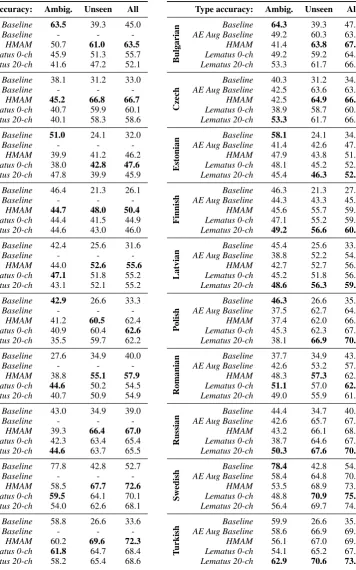
C Result Breakdown by Language
Type accuracy: Ambig. Unseen All
Bulgarian
Baseline 63.5 39.3 45.0
AE Aug Baseline - -
-HMAM 50.7 61.0 63.5
Lematus 0-ch 45.9 51.3 55.7
Lematus 20-ch 41.6 47.2 52.1
Czech
Baseline 38.1 31.2 33.0
AE Aug Baseline - -
-HMAM 45.2 66.8 66.7
Lematus 0-ch 40.7 59.9 60.1
Lematus 20-ch 40.1 58.3 58.6
Estonian
Baseline 51.0 24.1 32.0
AE Aug Baseline - -
-HMAM 39.9 41.2 46.2
Lematus 0-ch 38.0 42.8 47.6
Lematus 20-ch 47.8 39.9 45.9
Finnish
Baseline 46.4 21.3 26.1
AE Aug Baseline - -
-HMAM 44.7 48.0 50.4
Lematus 0-ch 44.4 41.5 44.9
Lematus 20-ch 44.6 43.0 46.0
Latvian
Baseline 42.4 25.6 31.6
AE Aug Baseline - -
-HMAM 44.0 52.6 55.6
Lematus 0-ch 47.1 51.8 55.2
Lematus 20-ch 43.1 52.1 55.2
P
olish
Baseline 42.9 26.6 33.3
AE Aug Baseline - -
-HMAM 41.2 60.5 62.4
Lematus 0-ch 40.9 60.4 62.6
Lematus 20-ch 35.5 59.7 62.2
Romanian
Baseline 27.6 34.9 40.0
AE Aug Baseline - -
-HMAM 38.8 55.1 57.9
Lematus 0-ch 44.6 50.2 54.5
Lematus 20-ch 40.7 50.9 54.9
Russian
Baseline 43.0 34.9 39.0
AE Aug Baseline - -
-HMAM 39.3 66.4 67.0
Lematus 0-ch 42.3 63.4 65.4
Lematus 20-ch 44.6 63.7 65.5
Swedish
Baseline 77.8 42.8 52.7
AE Aug Baseline - -
-HMAM 58.5 67.7 72.6
Lematus 0-ch 59.5 64.1 70.1
Lematus 20-ch 54.0 62.6 68.1
T
urkish
Baseline 58.8 26.6 33.6
AE Aug Baseline - -
-HMAM 60.2 69.6 72.3
Lematus 0-ch 61.8 64.7 68.4
[image:8.595.85.288.93.661.2]Lematus 20-ch 58.2 65.4 68.6
Table 5: Individual type level lemmatization ac-curacy for all 10 languages on development set, trained on1k UDT types (no augmentation)with contexts from Wikipedia. The numerically highest scores for each language are bold. For the summary of results see Table3.
Type accuracy: Ambig. Unseen All
Bulgarian
Baseline 64.3 39.3 47.2
AE Aug Baseline 49.2 60.3 63.3
HMAM 41.4 63.8 67.4
Lematus 0-ch 49.2 59.2 64.2
Lematus 20-ch 53.3 61.7 66.2
Czech
Baseline 40.3 31.2 34.2
AE Aug Baseline 42.5 63.6 63.6
HMAM 42.5 64.9 66.6
Lematus 0-ch 38.9 58.7 60.9
Lematus 20-ch 53.3 61.7 66.2
Estonian
Baseline 58.1 24.1 34.4
AE Aug Baseline 41.4 42.6 47.4
HMAM 47.9 43.8 51.4
Lematus 0-ch 48.1 45.2 52.5
Lematus 20-ch 45.4 46.3 52.9
Finnish
Baseline 46.3 21.3 27.4
AE Aug Baseline 44.3 43.3 45.5
HMAM 45.6 55.7 59.3
Lematus 0-ch 47.1 55.2 59.3
Lematus 20-ch 49.2 56.6 60.3
Latvian
Baseline 45.4 25.6 33.7
AE Aug Baseline 38.8 52.2 54.9
HMAM 42.7 52.7 56.9
Lematus 0-ch 45.2 51.8 56.4
Lematus 20-ch 48.6 56.3 59.2
P
olish
Baseline 46.3 26.6 35.4
AE Aug Baseline 37.5 62.7 64.8
HMAM 37.4 62.0 66.4
Lematus 0-ch 45.3 62.3 67.1
Lematus 20-ch 38.1 66.9 70.3
Romanian
Baseline 37.7 34.9 43.3
AE Aug Baseline 42.6 53.2 57.0
HMAM 48.3 57.3 62.7
Lematus 0-ch 51.1 57.0 62.8
Lematus 20-ch 49.0 55.9 61.2
Russian
Baseline 44.4 34.7 40.6
AE Aug Baseline 42.6 65.7 67.1
HMAM 43.2 66.1 68.3
Lematus 0-ch 38.7 64.6 67.3
Lematus 20-ch 50.3 67.6 70.4
Swedish
Baseline 78.4 42.8 54.2
AE Aug Baseline 58.4 64.8 70.3
HMAM 53.5 68.9 73.8
Lematus 0-ch 48.8 70.9 75.4
Lematus 20-ch 56.4 69.7 74.8
T
urkish
Baseline 59.9 26.6 35.5
AE Aug Baseline 58.6 66.9 69.9
HMAM 56.1 67.0 69.4
Lematus 0-ch 54.1 65.2 67.8
[image:8.595.140.497.97.668.2]Lematus 20-ch 62.9 70.6 73.7
Type accuracy: Ambig. Unseen All
Bulgarian
Baseline 67.2% 39.3% 50.0%
AE Aug Baseline 47.9% 62.6% 65.0%
HMAM 44.3% 68.2% 72.1%
Lematus 0-ch 43.1% 67.0% 71.1%
Lematus 20-ch 50.4% 65.9% 70.0%
Czech
Baseline 43.0% 31.2% 36.8%
AE Aug Baseline 43.2% 66.9% 66.6%
HMAM 41.0% 61.9% 64.7%
Lematus 0-ch 39.5% 61.6% 64.4%
Lematus 20-ch 42.6% 68.4% 69.7%
Estonian
Baseline 62.9% 24.1% 37.1%
AE Aug Baseline 43.1% 40.3% 45.3%
HMAM 48.0% 44.9% 53.3%
Lematus 0-ch 51.3% 45.2% 53.5%
Lematus 20-ch 48.6% 49.7% 56.3%
Finnish
Baseline 49.4% 21.3% 30.3%
AE Aug Baseline 42.5% 44.9% 47.6%
HMAM 44.0% 58.4% 62.5%
Lematus 0-ch 45.9% 60.8% 64.7%
Lematus 20-ch 52.5% 61.9% 65.5%
Latvian
Baseline 45.6% 25.6% 35.9%
AE Aug Baseline 39.6% 53.4% 55.3%
HMAM 45.2% 52.3% 57.6%
Lematus 0-ch 43.8% 54.5% 59.1%
Lematus 20-ch 44.7% 57.6% 61.1%
P
olish
Baseline 50.4% 26.6% 39.2%
AE Aug Baseline 38.8% 64.1% 66.2%
HMAM 41.6% 62.3% 68.4%
Lematus 0-ch 43.3% 65.2% 70.7%
Lematus 20-ch 40.3% 69.7% 73.4%
Romanian
Baseline 44.3% 34.9% 47.9%
AE Aug Baseline 41.3% 54.9% 58.4%
HMAM 50.2% 58.4% 65.6%
Lematus 0-ch 51.4% 60.8% 67.2%
Lematus 20-ch 47.9% 62.6% 67.7%
Russian
Baseline 48.5% 34.7% 44.4%
AE Aug Baseline 42.1% 65.5% 66.5%
HMAM 46.4% 65.5% 69.7%
Lematus 0-ch 40.5% 64.4% 68.5%
Lematus 20-ch 42.7% 71.1% 73.8%
Swedish
Baseline 80.6% 42.8% 58.0%
AE Aug Baseline 58.7% 67.3% 71.4%
HMAM 51.9% 72.6% 77.7%
Lematus 0-ch 49.1% 71.4% 76.2%
Lematus 20-ch 49.5% 72.3% 77.4%
T
urkish
Baseline 61.8% 26.6% 37.9%
AE Aug Baseline 62.8% 68.5% 71.2%
HMAM 54.2% 63.6% 65.7%
Lematus 0-ch 53.6% 63.9% 65.5%
Lematus 20-ch 67.1% 74.6% 77.2%
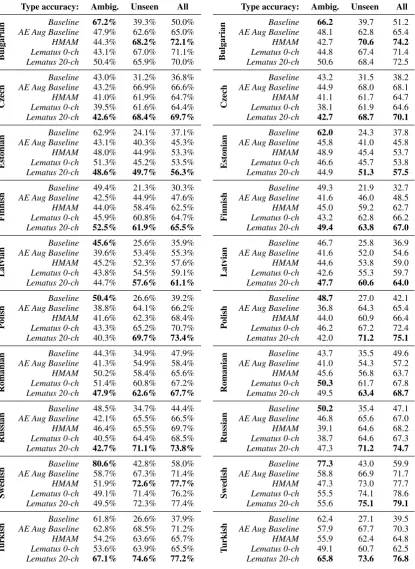
Table 7: Individual type level lemmatization ac-curacy for all 10 languages on development set, trained on1k UDT types plus 5k UM typeswith contexts from Wikipedia. The numerically highest scores for each language are bold. For the summary of results see Table3.
Type accuracy: Ambig. Unseen All
Bulgarian
Baseline 66.2 39.7 51.2
AE Aug Baseline 48.1 62.8 65.4
HMAM 42.7 70.6 74.2
Lematus 0-ch 44.8 67.4 71.4
Lematus 20-ch 50.6 68.4 72.5
Czech
Baseline 43.2 31.5 38.2
AE Aug Baseline 44.9 68.0 68.1
HMAM 41.1 61.7 64.7
Lematus 0-ch 38.1 61.9 64.6
Lematus 20-ch 42.7 68.7 70.1
Estonian
Baseline 62.0 24.3 37.8
AE Aug Baseline 45.8 41.0 45.8
HMAM 48.9 45.4 53.7
Lematus 0-ch 46.6 45.7 53.8
Lematus 20-ch 44.9 51.3 57.5
Finnish
Baseline 49.3 21.9 32.7
AE Aug Baseline 41.6 46.0 48.5
HMAM 45.0 59.2 62.7
Lematus 0-ch 43.2 62.8 66.2
Lematus 20-ch 49.4 63.8 67.0
Latvian
Baseline 46.7 25.8 36.9
AE Aug Baseline 41.6 52.0 54.6
HMAM 44.6 53.8 59.0
Lematus 0-ch 42.6 55.3 59.7
Lematus 20-ch 47.7 60.6 64.0
P
olish
Baseline 48.7 27.0 42.1
AE Aug Baseline 36.8 64.3 65.4
HMAM 44.0 60.9 66.4
Lematus 0-ch 46.2 67.2 72.4
Lematus 20-ch 42.0 71.2 75.1
Romanian
Baseline 43.7 35.5 49.6
AE Aug Baseline 41.0 54.3 57.2
HMAM 45.6 56.8 63.7
Lematus 0-ch 50.3 61.7 67.8
Lematus 20-ch 49.5 63.4 68.7
Russian
Baseline 50.2 35.4 47.1
AE Aug Baseline 46.8 65.6 67.0
HMAM 39.1 64.6 68.2
Lematus 0-ch 38.7 64.6 67.3
Lematus 20-ch 47.3 71.2 74.7
Swedish
Baseline 77.3 43.0 59.9
AE Aug Baseline 58.8 66.9 71.7
HMAM 47.3 73.0 77.7
Lematus 0-ch 55.5 74.1 78.6
Lematus 20-ch 55.6 75.1 79.1
T
urkish
Baseline 62.4 27.1 39.5
AE Aug Baseline 57.9 67.7 70.3
HMAM 55.9 62.4 64.8
Lematus 0-ch 49.1 60.7 62.5
[image:9.595.94.510.90.660.2]Lematus 20-ch 65.8 73.6 76.8
Type level accuracy: Token level accuracy: Training data Ambig. Unseen All Ambig. Unseen All
Bulgarian 10k UDT tok. 62.3 75.7 80.1 72.3 75.7 89.5
10k UDT tok. + 10k UM types 62.2 78.7 83.6 73.3 78.1 91.0
Czech 10k UDT tok. 49.7 76.4 77.8 80.7 77.7 88.3
10k UDT tok. + 10k UM types 52.4 78.3 80.4 80.0 80.0 89.6
Estonian 10k UDT tok. 65.3 54.0 64.5 80.1 54.3 76.8
10k UDT tok. + 10k UM types 65.9 63.4 72.6 81.5 64.2 82.4
Finnish 10k UDT tok. 60.7 60.1 66.5 73.8 62.4 78.2
10k UDT tok. + 10k UM types 57.8 63.7 69.4 70.3 66.0 79.8
Latvian 10k UDT tok. 57.5 70.9 75.6 69.2 70.5 82.6
10k UDT tok. + 10k UM types 58.9 73.6 77.8 70.2 73.8 84.4
Polish 10k UDT tok. 59.8 78.7 83.6 76.5 78.8 89.5
10k UDT tok. + 10k UM types 57.4 81.2 86.1 71.3 81.4 90.9
Romanian 10k UDT tok. 51.7 61.1 66.6 54.1 60.6 79.1
10k UDT tok. + 10k UM types 57.1 68.2 74.2 60.7 68.2 83.9
Russian 10k UDT tok. 64.4 80.5 83.5 65.9 80.8 88.5
10k UDT tok. + 10k UM types 61.1 82.6 85.9 59.9 82.7 89.8
Swedish 10k UDT tok. 63.2 74.9 80.9 78.5 73.6 89.6
10k UDT tok. + 10k UM types 65.1 78.4 83.7 79.0 75.9 90.4
Turkish 10k UDT tok. 64.2 82.1 87.1 73.1 81.8 91.2
[image:10.595.103.496.257.532.2]10k UDT tok. + 10k UM types 69.9 82.9 87.3 76.9 82.7 91.5