Large-scale evaluation of dependency-based DSMs:
Are they worth the effort?
Gabriella Lapesa
Institute for Natural Language Processing University of Stuttgart
Stefan Evert Corpus Linguistics Group
FAU Erlangen-N¨urnberg
Abstract
This paper presents a large-scale evaluation study of dependency-based distributional semantic models. We evaluate dependency-filtered and dependency-structured DSMs in a number of standard semantic similarity tasks, systematically exploring their param-eter space in order to give them a “fair shot” against window-based models. Our results show that properly tuned window-based DSMs still outperform the dependency-based models in most tasks. There appears to be little need for the language-dependent resources and computational cost
associ-ated with syntactic analysis.1
1 Introduction
Distributional semantic models (DSMs) based on syntactic dependency relations (Pad´o and Lapata, 2007; Baroni and Lenci, 2010) represent a more linguistically informed version of the widely-used window-based DSMs (Sahlgren, 2006; Bullinaria and Levy, 2007; Bullinaria and Levy, 2012). Both types of DSMs operationalize the meaning of a
target word t as a set of co-occurrence patterns
extracted from language corpora. While window-based DSMs adopt a surface-oriented perspective (two words co-occur if they appear within a certain span, e.g. of 4 tokens), dependency-based DSMs
adopt a syntactic perspective on co-occurrence:
“nearness” is defined by the presence of a syntactic relation between target and features (e.g. direct ob-ject, subob-ject, adjectival modifier), which may also correspond to a path along several edges of a depen-dency graph. If syntactic relations are only used to determine co-occurrence contexts, we talk of
1The analysis presented in this paper is complemented by
supplementary materials, which are available for download at http://www.linguistik.fau.de/dsmeval/.
dependency-filteredDSMs; if the type of relation is explicitly encoded in the context features (e.g.
“subj dog”), we talk ofdependency-typedDSMs.
The fortune of syntax-based models in distri-butional semantics has been mixed. Early work on dependency-filtered (Pad´o and Lapata, 2007) or dependency-typed (Rothenh¨ausler and Sch¨utze, 2009; Baroni and Lenci, 2010) DSMs indicated that syntax-based semantic representations are in-deed superior. These evaluation studies, however, were restricted to a specific corpus (BNC in Pad´o and Lapata (2007)) or task (noun clustering in Rothenh¨ausler and Sch¨utze (2009)), or based on a very specific notion of co-occurrence (Baroni and
Lenci, 2010)2. Meanwhile, extensive evaluation
studies and parameter tuning led to significant im-provements in the performance of window-based models (Bullinaria and Levy, 2007; Bullinaria and Levy, 2012; Lapesa and Evert, 2014) to the point that dependency-based DSMs currently hold the state-of-the-art only in very few standard seman-tic similarity tasks; see Baroni et al. (2014) and Lapesa and Evert (2014) for an overview of the state of the art. Among recent comparative evalua-tion studies, only Kiela and Clark (2014) attempt a direct comparison between the parameter spaces of window-based and syntax-based DSMs: once again, window-based models are found to perform better (with the exception of models built from the large Google Books N-gram corpus), but the scope of this comparison is rather limited.
The aim of this paper is to establish a fair ground for the comparison between window-based and dependency-based DSMs. To that end, we take as a reference point the large parameter set evaluated by
2Among the dependency-based DSMs evaluated by Baroni
and Lenci (2010), the best performing one relies on type-based co-occurrence: the co-occurrence strength between a target and a context is quantified as the number of different patterns in which they occur.
Lapesa and Evert (2014) and Lapesa et al. (2014) for window-based models. We carry out a parallel evaluation for dependency-based DSMs using the same tasks, datasets, parameters – adding some pa-rameters specific to syntax-based models (such as the parser used and the type of allowed dependency relations) – and model selection methodology, al-lowing for a direct comparison of the results.
We address the question of whether dependency-based models can significantly improve DSM per-formance if the parameters are properly set, and whether the degree of the improvement justifies the increased complexity of the extraction process. In either case, a more thorough understanding of the parameter space will be beneficial for applications that prefer dependency-based DSMs on general grounds, e.g. because of an integration with syntac-tic structure (Erk et al., 2010). While the evalua-tion reported here does not encompass predict-type models, we believe that our findings also apply to the usefulness of dependency information in neural word embeddings (Levy and Goldberg, 2014).
2 Evaluation setting
Tasks & Datasets Our evaluation covers all tasks and datasets used by Lapesa and Evert (2014) and Lapesa et al. (2014). For space reasons, we present detailed results for one
representa-tive dataset from each task3: the TOEFL
syn-onym testdataset (Landauer and Dumais, 1997) for the multiple-choice synonymy task
(perfor-mance: accuracy); theGeneralized Event
Knowl-edge(McRae and Matzuki, 2009) dataset (GEK),
a collection of 402 triples (target, consistent prime, inconsistent prime), for the multiple-choice
seman-tic priming task (performance: accuracy)4; the
WordSim-353 (WS353) dataset, which contains 353 noun pairs with similarity/relatedness ratings (Finkelstein et al., 2002) for the task of predicting human similarity ratings (performance: Pearson’s
r); and theAlmuhareb-Poesio(AP) dataset,
con-taining 402 nouns grouped into 21 semantic classes (Almuhareb, 2006) for the noun clustering task
3If more than one dataset was available for a task, we
pre-ferred larger datasets (for which results are more reliable). Results for all datasets will be made available in the supple-mentary materials.
4In contrast to the paradigmatic relation targeted by
TOEFL (i.e., synonymy), the GEK dataset focuses on related-ness of a more syntagmatic nature. See Lapesa et al. (2014) for more details on this dataset.
(performance: cluster purity5).
DSM parameters We employ a large vocabu-lary of target words (27,522 lemma types), based on the vocabulary of Distributional Memory (Ba-roni and Lenci, 2010) and extended to cover all items in our datasets. After extracting dependency paths from the source corpora, the DSMs were
com-piled using the UCS toolkit6and thewordspace
package for R (Evert, 2014). We evaluate the fol-lowing parameters:
Source corpus(abbreviated in the plots as
cor-pus): BNC7, WaCkypedia EN, and ukWaC8;
Format of dependency relations (dep.style): Basic vs. collapsed with propagation of conjuncts (De Marneffe et al., 2006; De Marneffe and Man-ning, 2008);
Annotation pipeline (parser): TreeTagger (Schmid, 1995) and MALT parser (Nivre, 2003) vs. bidirectional POS tagger and Neural Network parser of Stanford CoreNLP (Chen and Manning, 2014);
Path length (path.length): we include paths with a maximum length of 1, 2, 3, 4 or 5 edges;
Type of dependency relations (dep.type): paths composed only of core dependencies (main actants of the sentence) vs. paths that also allow external dependencies (inter-clausal relations and conjuncts);
Threshold for context selection(orig.dim): we select the 5k, 10k, 20k, 50k, or 100k most frequent context dimensions;
Score for feature weighting(score): frequency, tf.idf, Dice coefficient, simple log-likelihood,
Mu-tual Information (MI), t-score, or z-score;9
Feature transformation (transformation): an
additional square root, sigmoid (tanh), or
logarith-mic transformation applied to feature scores vs. no transformation;
Number of latent SVD dimensions(red.dim): we project vectors into 1000 dimensions using ran-domized SVD (Halko et al., 2009), then select the first 100, 300, 500, 700, or 900 latent dimensions;
Number of skipped SVD dimensions
(dim.skip): exclude the first 0, 50 or 100 latent
5Based onk-medoids clustering (Kaufman and Rousseeuw,
1990, Ch. 2) with standard parameter settings.
6http://www.collocations.de/software.html 7http://www.natcorp.ox.ac.uk/
8Both ukWaC and WaCkypedia EN are available from
http://wacky.sslmit.unibo.it/doku.php?id=corpora.
9All methods use sparse non-negative variants; e.g. our MI
dimensions (e.g., those with the highest singular values); previous work on window-based DSMs (Bullinaria and Levy, 2012; Lapesa and Evert, 2014; Lapesa et al., 2014) showed that model performance improves when the initial components of the reduced matrix (i.e., those with the highest variance) are discarded.
Distance metric (metric): cosine distance (i.e. the angle between vectors) vs. Manhattan distance;
Index of distributional relatedness(rel.index):
the semantic relatedness of wordsaandbin a DSM
is quantified either by their metric distanced(a, b)
or by neighbor rank (rank ofbamong the neighbors
ofafor TOEFL and GEK, mean oflog rank(a, b)
andlog rank(b, a)for WS353 and AP).
Among the evaluated parameters, parser,
dep.typeanddep.styleare specific to
dependency-based DSMs.Path.lengthis the dependency-based
equivalent of window size in a bag-of-words DSM.
The comparison betweenfiltered vs. typedDSMs
can be considered roughly equivalent to the com-parison between undirected and directed windows in a bag-of-words DSM. All the other parameters are shared with window-based DSMs.
Evaluation methodology We tested all pos-sible combinations of the parameters described above, resulting in a total of 806400 runs per model class (filtered vs. typed), which were generated and evaluated on a large HPC cluster within ap-proximately 6 weeks. To meaningfully interpret the evaluation results, we apply a model selection methodology that is sensitive to parameter interac-tions and robust to overfitting. Following Lapesa and Evert (2013), we analyze the influence of in-dividual parameters and their interactions using general linear models with performance (accuracy, correlation, purity) as a dependent variable and the model parameters as independent variables, includ-ing all two-way interactions. Analysis of variance – which is straightforward for our full factorial design – is used to quantify the impact of each parameter or interaction. Robust optimal parameter settings are identified with the help of effect displays (Fox, 2003), which show the partial effect of one or two parameters by marginalizing over all other param-eters. Unlike coefficient estimates, they allow an intuitive interpretation of the effect sizes of cate-gorical variables irrespective of the dummy coding scheme used.
3 Results
As model runs without dimensionality reduction performed consistently worse than the correspond-ing SVD-reduced runs, we only report results for the latter in this paper.
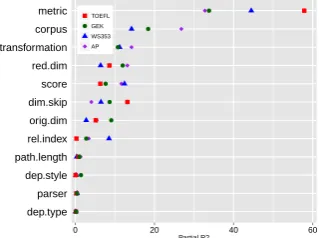
Impact of parameters We use a feature ab-lation approach to assess which parameters have the strongest impact on model performance. The ablation value of a parameter is the proportion of variance accounted for by the parameter together with all its interactions (corresponding to the
reduc-tion in adjustedR2of the model fit if the parameter
were left out). Figures 1 and 2 visualize the feature ablation values of all evaluated parameters in the dependency-filtered and dependency-typed setting,
respectively. Table 1 showsR2for the full model
as well as all major interactions (partialR2 >1%).
● ●
● ● ●
● ●
● ●
● ● ●
parser dep.style dep.type orig.dim path.length rel.index dim.skip red.dim corpus transformation score metric
0 10 20 30 40
Partial R2
●
[image:3.595.338.497.322.442.2]TOEFL GEK WS353 AP
Figure 1: Feature ablation (dependency-filtered)
● ●
● ●
● ● ●
●
● ●
● ●
dep.type parser dep.style path.length rel.index orig.dim dim.skip score red.dim transformation corpus metric
0 20 40 60
Partial R2
●
[image:3.595.337.497.476.595.2]TOEFL GEK WS353 AP
Figure 2: Feature ablation (dependency-typed)
Filtered Typed
T G W A T G W A
Full model 88 83 88 83 89 84 90 88 score×transf 8.3 7.8 11.2 8.6 2.4 3.5 5.0 5.7 score×metric 1.3 1.5 1.5 1.8 – – – – corpus×metric – – – – – – 1.0 4.6 metric×red.dim – 2.5 1.4 – – 2.0 1.3 4.7 metric×dim.skip 4.0 1.0 1.1 3.4 4.9 1.6 2.2 1.2 metric×orig.dim 1.0 2.0 1.2 – 3.3 6.6 2.0 2.3
Table 1: R2of full model and major interactions
[image:3.595.308.526.624.719.2]●
● ●
40 50 60 70 80
bnc wacky ukwac
dataset ●
[image:4.595.100.498.62.272.2]TOEFL GEK WS353 AP
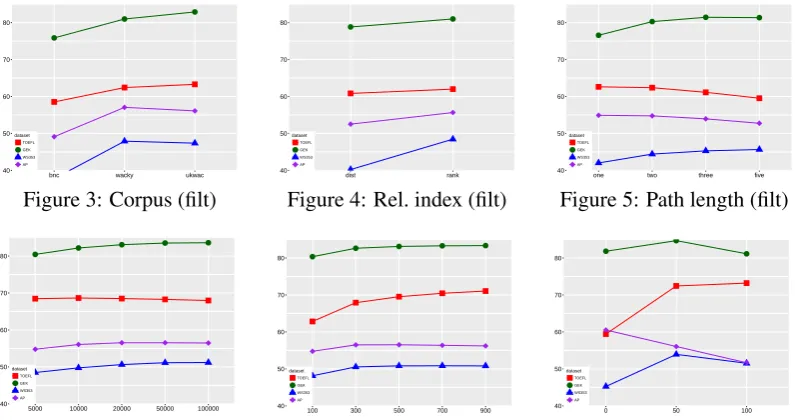
Figure 3: Corpus (filt)
● ●
40 50 60 70 80
dist rank
dataset ●
TOEFL GEK WS353 AP
Figure 4: Rel. index (filt)
●
● ● ●
40 50 60 70 80
one two three five
dataset ●
TOEFL GEK WS353 AP
Figure 5: Path length (filt)
● ●
● ● ●
40 50 60 70 80
5000 10000 20000 50000 100000 dataset
●
TOEFL GEK WS353 AP
Figure 6: Context dim. (filt)
●
● ● ● ●
40 50 60 70 80
100 300 500 700 900
dataset ●
TOEFL GEK WS353 AP
Figure 7: Red. SVD dim. (filt)
●
●
●
40 50 60 70 80
0 50 100
dataset ●
TOEFL GEK WS353 AP
Figure 8: Skip SVD dim. (filt)
Parameters can be divided into three groups.
First, a group of parameters with a strong
im-pact on model performance, which is dominated bymetricin both settings.Metricalso has strong interactions with many other parameters. Further
parameters in this group are scoreand
transfor-mation, again with a strong interaction across all datasets and both settings (Lapesa and Evert (2014) found this interaction to be the strongest also for
window-based DSMs), as well ascorpus. Second,
a group of parameters with anintermediateimpact
includes the two SVD-related parameters (red.dim
anddim.skip) and, to a lesser extent, the number
of context dimensions (orig.dim) and the
related-ness index (rel.index). Path.length only affects
dependency-filtered models on the GEK dataset (that directly involves syntagmatic relatedness) and, but to a lesser extent, on AP (which encodes co-hyponymy). It is almost irrelevant in a dependency-typed setting. This is probably due to the fact that direct dependency relations already capture the “core” of the semantic space and the informa-tion contributed by longer paths is neutralized by
the additional noise. Third, a group ofirrelevant
parameters, which comprises the details of the
de-pendency scheme (dep.styleanddep.type) as well
as theparserused.
Best parameter values In this section, we identify the best parameter settings by inspect-ing partial effect plots. We focus on dependency-filtered models because they consistently achieve better results and only discuss the dependency-typed ones when the best parameters are
differ-ent. As for window-based DSMs, the Manhattan
metricalways performs much worse than cosine distance; the different behaviour of the two metrics also accounts for most of the interactions listed in table 1. We therefore exclude runs with Manhattan metric from further analysis and the effect plots
below. The two biggercorporaare always a better
choice (figure 3), with a preference for ukWaC in
the multiple choice tasks. Neighbor rank (figure
4) outperforms distance, but the increased com-putational cost may only be justified for AP and WS353; the effect is much stronger for unreduced
models in all tasks. As far aspath length(figure
5) is concerned, datasets containing syntagmatic (GEK) or non-attributional relatedness (WS353) need longer paths to reach optimal performance.
While the TOEFL task only requires 5kcontext
di-mensions(figure 6), more dimensions are necessary for AP and WS353 (20k and 50k) and even more for GEK (100k). Performance in all tasks improves
with an increasing number ofreduced dimensions,
but 300 appear to be sufficient for AP and WS353
(figure 7);skippingthe first 50 latent dimensions is
beneficial for all tasks except AP (figure 8). The
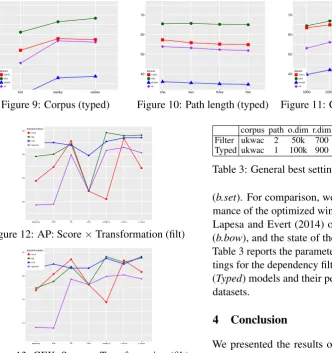
strong interaction betweenscoreand
transforma-tion, displayed in figure 12 for AP dataset and in
figure 13 for GEK, indicates a preference for sim-ple log-likelihood with log transformation or MI without any transformation (similar tendencies to AP hold for the remaining datasets). Parameters which are not explanatory can be set to the most
”economic” value: MALT forparser, basic for
●
● ●
40 50 60 70
bnc wacky ukwac
dataset
●
TOEFL GEK WS353 AP
Figure 9: Corpus (typed)
● ● ● ●
40 50 60 70
one two three five
dataset
●
TOEFL GEK WS353 AP
Figure 10: Path length (typed)
● ●
● ● ●
40 50 60 70
5000 10000 20000 50000 100000
dataset
●
TOEFL GEK WS353 AP
Figure 11: Context dim. (typed)
● ● ●
● ●
● ●
45 50 55 60
frequency tf.idf MI Dice simple−ll t−score z−score
transformation
●
none log root sigmoid
Figure 12: AP: Score×Transformation (filt)
● ●
●
● ●
● ●
70 75 80 85
frequency tf.idf MI Dice simple−ll t−score z−score
transformation
●
none log root sigmoid
Figure 13: GEK: Score×Transformation (filt)
models. Preference forcorpusremains on bigger
corpora (figure 9). Figure 10 reveals that longer paths are detrimental (only exception being GEK’s minor improvement with paths of length two).
Fig-ure 11 shows that the highest number of context
dimensions(100k) is necessary for all tasks.
Dependency filtered
corpus path o.dim r.dim d.sk b.set b.bow soa TOEFL ukwac 1 5k 900 100 85 92.5 100 GEK ukwac 3 100k 700 50 92.6 97.0 – WS wacky 5 50k 300 50 0.67 0.68 0.81 AP wacky 1 20k 300 0 69.6 69.0 79.0
Dependency typed
[image:5.595.94.427.63.417.2]corpus path o.dim r.dim d.sk b.set b.bow soa TOEFL wacky 1 100k 900 100 81.2 92.5 100 GEK ukwac 2 100k 900 50 86.8 97.0 – WS ukwac 1 100k 700 50 0.62 0.68 0.81 AP wacky 1 100k 300 0 71.9 69.0 79.0
Table 2: Best parameter settings for each task, com-pared with window-based DSM and state-of-the-art
Best settings Table 2 reports the robustly opti-mal parameter settings for dependency-filtered and
dependency-based models10and their perfomance
10Common parameters: parser: MALT; dep.style: basic;
dep.type: core; score: simple log-likelihood; transformation:
corpus path o.dim r.dim d.sk T G W A Filter ukwac 2 50k 700 50 86.2 90.1 0.67 65.4 Typed ukwac 1 100k 900 50 77.5 82.1 0.62 69.4
Table 3: General best settings (filtered and typed)
(b.set). For comparison, we also show the perfor-mance of the optimized window-based DSM from Lapesa and Evert (2014) or Lapesa et al. (2014) (b.bow), and the state of the art for the task (soa). Table 3 reports the parameter values of general
set-tings for the dependency filtered (Filter) and typed
(Typed) models and their performance on the four datasets.
4 Conclusion
We presented the results of a large-scale evalua-tion study of syntax-based DSMs. We show that, even after extensive parameter tuning, syntax-based DSMs outperform comparable window-based mod-els only in one task out of four (noun cluster-ing). We found many similarities to window-based DSMs: a significant core of the parameter space (metric, score, transformation, relatedness index) is common to both types of models, in terms of their impact on performance as well as the best parameter values; path length trades off between paradigmatic similarity and non-attributional relat-edness, in the same way window-size does; most tasks require more SVD dimensions than are com-monly used, and synonymy is better modeled by discarding the first SVD dimensions. It is left for future work to establish to what extent our
con-clusions generalize to different languages11and to
more linguistically challenging tasks (e.g., predic-tion of thematic fit ratings).
log; metric: cosine; rel.index: rank.
11For example, DSM evaluation on German reveals a mixed
[image:5.595.74.287.533.655.2]Acknowledgements
We are grateful to the three anonymous review-ers, whose comments helped improve our paper. Gabriella Lapesa’s research is funded by the DFG Collaborative Research Centre SFB 732.
References
Abdulrahman Almuhareb. 2006.Attributes in Lexical Acquisition. Ph.D. thesis, University of Essex. Marco Baroni and Alessandro Lenci. 2010.
Distri-butional memory: A general framework for corpus-based semantics. Computational Linguistics, 36(4):1– 49.
Marco Baroni, Georgiana Dinu, and Germ´an Kruszewski. 2014. Don’t count, predict! a systematic comparison of context-counting vs. context-predicting semantic vectors. InProceedings of the 52nd Annual Meeting of the Association for Computational Linguistics (Volume 1: Long Papers), pages 238–247.
Stefan Bott and Sabine Schulte im Walde. 2015. Ex-ploiting fine-grained syntactic transfer features to predict the compositionality of german particle verbs. InProceedings of the 11th International Conference on Computational Semantics, pages 34–39.
John A. Bullinaria and Joseph P. Levy. 2007. Extracting semantic representations from word co-occurrence statistics: A computational study. Behavior Research Methods, 39:510–526.
John A. Bullinaria and Joseph P. Levy. 2012. Extracting semantic representations from word co-occurrence statistics: stop-lists, stemming and SVD. Behavior Research Methods, 44:890–907.
Danqi Chen and Christopher D. Manning. 2014. A fast and accurate dependency parser using neural networks. InProceedings of EMNLP 2014.
Marie-Catherine De Marneffe and Christopher D. Man-ning. 2008. Stanford typed dependencies manual (revised for the Stanford parser v3.5.1 in February 2015). Technical report, Stanford University. Marie-Catherine De Marneffe, Bill MacCartney, and
Christopher D. Manning. 2006. Generating typed dependency parses from phrase structure parses. In
Proceedings of LREC 2006, pages 449–454. Katrin Erk, Sebastian Pad´o, and Ulrike Pad´o. 2010. A
flexible, corpus-driven model of regular and inverse selectional preferences. Computational Linguistics, 36(4):723–763.
Stefan Evert. 2014. Distributional semantics in R with the wordspace package. InProceedings of COLING 2014, the 25th International Conference on Compu-tational Linguistics: System Demonstrations, pages 110–114, Dublin, Ireland.
Lev Finkelstein, Evgeniy Gabrilovich, Yossi Matias, Ehud Rivlin, Zach Solan, Gadi Wolfman, and Ey-tan Ruppin. 2002. Placing search in context: The concept revisited. ACM Transactions on Information Systems, 20(1):116–131.
John Fox. 2003. Effect displays in R for generalised lin-ear models.Journal of Statistical Software, 8(15):1– 27.
Nathan Halko, Per-Gunnar Martinsson, and Joel A. Tropp. 2009. Finding structure with randomness: Stochastic algorithms for constructing approximate matrix decompositions. Technical Report 2009-05, ACM, California Institute of Technology.
Leonard Kaufman and Peter J. Rousseeuw. 1990. Find-ing groups in data: an introduction to cluster analy-sis. John Wiley and Sons.
Douwe Kiela and Stephen Clark. 2014. A systematic study of semantic vector space model parameters. In
Proceedings of EACL 2014, Workshop on Continu-ous Vector Space Models and their Compositionality (CVSC), pages 21–30, Gothenburg, Sweden. Thomas K. Landauer and Susan T. Dumais. 1997. A
solution to Plato’s problem: The latent semantic anal-ysis theory of the acquisition, induction, and rep-resentation of knowledge. Psychological Review, 104:211–240.
Gabriella Lapesa and Stefan Evert. 2013. Evaluating neighbor rank and distance measures as predictors of semantic priming. In Proceedings of the ACL Workshop on Cognitive Modeling and Computational Linguistics (CMCL 2013), pages 66–74, Sofia, Bul-garia.
Gabriella Lapesa and Stefan Evert. 2014. A large scale evaluation of distributional semantic models: Parameters, interactions and model selection. Trans-actions of the Association for Computational Linguis-tics (TACL), 2:531–545.
Gabriella Lapesa, Stefan Evert, and Sabine Schulte im Walde. 2014. Contrasting syntagmatic and paradig-matic relations: Insights from distributional seman-tic models. InProceedings of the Third Joint Con-ference on Lexical and Computational Semantics (*SEM 2014), pages 160–170, Dublin, Ireland. Omer Levy and Yoav Goldberg. 2014.
Dependency-based word embeddings. InProceedings of the 52nd Annual Meeting of the Association for Computational Linguistics (Short Papers), pages 302–308.
Ken McRae and Kazunaga Matzuki. 2009. People use their knowledge of common events to understand language, and do so as quickly as possible. Language and Linguistics Compass, 3(6):1417–1429.
Sebastian Pad´o and Mirella Lapata. 2007. Dependency-based construction of semantic space models. Com-putational Linguistics, 33(2):161–199.
Klaus Rothenh¨ausler and Hinrich Sch¨utze. 2009. Unsu-pervised classification with dependency based word spaces. InProceedings of the EACL 2009 Workshop on GEMS: GEometical Models of Natural Language Semantics, pages 17–24, Athens, Greece.
Magnus Sahlgren. 2006. The Word-Space Model: Us-ing distributional analysis to represent syntagmatic and paradigmatic relations between words in high-dimensional vector spaces. Ph.D. thesis, University of Stockolm.
Helmut Schmid. 1995. Improvements in part-of-speech tagging with an application to German. In Proceed-ings of the ACL SIGDAT-Workshop.