Walking in the shoes of others: Critical reflection in
community sport management and physical activity
WOODHOUSE, Donna <http://orcid.org/0000-0002-7140-9423> and
CHERRINGTON, James
Available from Sheffield Hallam University Research Archive (SHURA) at:
http://shura.shu.ac.uk/17683/
This document is the author deposited version. You are advised to consult the
publisher's version if you wish to cite from it.
Published version
WOODHOUSE, Donna and CHERRINGTON, James (2018). Walking in the shoes of
others: Critical reflection in community sport management and physical activity. In:
WILSON, Robert and PLATTS, Chris, (eds.) Managing and developing community
sport. London, Routledge, 30-44.
Copyright and re-use policy
See
http://shura.shu.ac.uk/information.html
Walking in the Shoes of Others: Critical Reflection in Community Sport Management and Physical Activity.
This chapter will help you to:
question the assumption that sport automatically does social good
understand how community sport initiatives can address social issues when carried out by more reflective, open-minded practitioners
develop your sociological imagination, a tool kit of skills and ideas that will help you plan and manage effective community sport initiatives
INTRODUCTION
As a student studying sport, the chances are that sport is something you love. Typically, you will have been introduced to sport by a parent, or ‘father figure’ and from a young age you will have received a great deal of support, both financially and emotionally, so you can pursue your interests. If you are especially good at sport you may have tasted success, having competed for your city, county or country. However, it is worth remembering that not everybody will recognise themselves in this story. If you are a woman, have a 'disability', are homeless or are seeking asylum, it is unlikely that your memories of sport are quite as positive. In fact, figures from Sport England (2016) suggest that the majority of people in the UK (57%) would find it difficult to relate to your situation. Furthermore, as much as you may be loath to admit it, it is likely that even someone as sporty as yourself might be able to identify things about sport that are irritating or off-putting, with things such as excessive competition, public humiliation, anxieties about body image and a confusion about rules cited as the biggest challenges to mass participation (ibid, 2016).
What is the sociological imagination?
We all have imaginations. We can drift off in class and imagine ourselves into a hammock on a tropical island where robot butlers bring us cold drinks. We can picture ourselves running out of the tunnel onto a pitch and lifting the trophy at the end of the game. That’s base level imagining; the sociological imagination is much more sophisticated and will provide you with the ability to think, and act, differently and to stand out from the crowd.
Sociology provides students of all sports disciplines with a different way of thinking about the world. Our sociological imaginations help us understand that our personal experiences are connected to broader public issues. After 9/11, the author Ian McEwan said ‘Imagining what it is like to be someone other than yourself is at the core of our humanity. It is the essence of compassion, and it is the beginning of morality’ (Guardian 2001). The sociological imagination allows us not just to describe sport but to understand and change it because it gets us to examine ourselves, others and the institutions that manage and deliver sport.
Mills (1999) tells us that sociological imagination allows people to understand their ‘private troubles’ in terms of ‘public issues.’ To give a concrete example, our private trouble may be that we are worried about losing an important sporting competition; this is influenced by the public issue of having a performance-orientated culture, which organises sport around leagues and tables, which removes much of the enjoyment from physical activity and means that only those with 'winning' bodies/mentalities can take part and succeed. It is sometimes difficult to make connections between public and private, to make links the way sociologists do between different components of society. We lead relatively privileged lives and, as we revel in our sporting success, we forget that whilst our life is good, others are excluded. We may say to ourselves that we’re successful because we work hard and that if others worked hard they could be just as successful. However, it’s only when we look at the wider societal picture that we develop our sociological imagination, the ability to place yourself in someone else’s shoes and understand their behaviours, which gives us the chance to bring about change.
Government has invested heavily in sport for decades, yet, as we have seen above, the majority of people still do not engage with it and our levels of physical and mental health continue to decline. We have to rethink how we deliver sport in a society which has changed significantly and will continue to do so, with, for example, new forms of media and technology competing for our attention and creating a more sedentary population. To keep on doing what we’ve been doing shows a lack of sociological imagination. This chapter will help you to think and act differently.
Torkildson (2010) outlines two approaches to sport provision. The first, which is most common in the UK, he calls social planning. This approach is ‘top down’, meaning projects are developed by those in positions of power, such as politicians and National Governing Bodies (NGBs) who emphasise the importance of management and administration. This rigidly organised delivery of sport can exclude many who would be attracted to more flexible delivery, in terms of venues, times of day, variety of sports etc….. that better fit with the kind of lives we live today. The short term nature of some projects, caused by time limited funding, exacerbates the shortcomings of this approach. Anxious not to ‘fail’ as funding might be cut and keen to be portrayed as having made an impact quickly, this style of working is also risk averse, with organisations and staff loathe to experiment with new activities as positive results may take longer to demonstrate. There are also issues around staff skills and attitudes which lock people into particular ways of working. Sennett (2004) highlights the lack of mutual respect between staff and participants which is present in much of this type of provision. The deep rooted traditions of sports development approaches, within NGBs, local authorities, and also undergraduate degrees, means that much delivery is still ‘trapped behind a mask of outdated, out of touch values’ (Haywood and Kew 1989 p188).
Key to addressing this skills gap is the cultural intermediary, someone who acts as a bridge between the socially excluded and those in positions of power such as the police or local authority. They are involved in Torkildson’s second approach, community development, which recognises the knowledge and skills of local people and promotes self-help. The role of the worker here is not to dictate what should be provided but rather to act as an animateur (Baldry 1976) energising local people, developing their capacity and encouraging social cohesion. This model examines peoples’ lives and responds to the increasingly diverse needs of the population, in terms of, for example, ethnicity and age. In short, it uses the sociological imagination to help individuals address their private troubles e.g. gaining skills to become more employable in the context of the public issue of a struggling economy. This community sport approach recognises the failure of sport to reach significant numbers of people, despite decades of policy efforts. Crucially, it acknowledges that sport reflects wider social inequalities, and works with local people to identify needs, rather than assuming what problems and solutions are.
Working in partnership is seen as a way of responding to change and addressing social issues, government still urging us to ‘marshal the contributions of the public, private and voluntary sectors, and of communities’ (Government, Section 2.30, 2001). Partnership working neatly demonstrates the idea of sociological imagination, with local organisations and individuals working to address broad social issues such as crime, obesity and the rise in those experiencing mental health issues. Partnerships vary from informal groupings of agencies and community representatives to the very formal and legally binding. From the 1990s, it has been the way of working in terms of boosting sustainability and improving services, with one of its main objectives being dealing with major social issues, such as crime and physical inactivity.
Partnerships are made up of stakeholders, each of which should play an active role. Some councils have found sharing control and resources, letting go of power, difficult. Sometimes, communities struggle to embrace partnership working, as they see agencies such as councils, as the problem, rather than as the solution. Community involvement can also develop social capital but requires good communication and investing time to create respect. We’ll illustrate the value of partnership later with our case studies.
[image:5.612.73.547.351.637.2]In terms of the delivery of sport projects, within a community setting, we identify three styles.
Table 1: A Taxonomy of Projects
Category Approach Characteristics
Dominant (the most common in the UK)
Sports Development
Sport for sport’s sake Activity driven
Mass participation Structured/standardised ‘Expert’ driven
Fixed term national/regional programmes Institutional
Residual (now less common)
Social Control
Sport to deliver social outcomes Targeted
Focused on control/management Disciplinarian
Emergent e.g. Positive Futures, discussed later (most in line with using sociological imagination)
Social Inclusion
Addressing disadvantage
Personal and social development Flexible, outreach
Broader, non sports, activities Long term participant focused Community based and led Adapted from Crabbe et al (2006)
disengagement with school, located against a social backdrop of a pressured education system. Those adopting this style possess a wider range of skills than those involved in facility management and traditional sports development. The approach acknowledges the limitations of sport, and draws on research, rather than using ‘common sense’ or tradition as justification for working in certain ways. Indeed, the claim that sport can solve social problems by encouraging self-discipline, adherence to rules and responsibility for self and others is common, yet research provides little evidence to support claims that sport reduces ‘deviant’ behaviour (Coakley 2002).
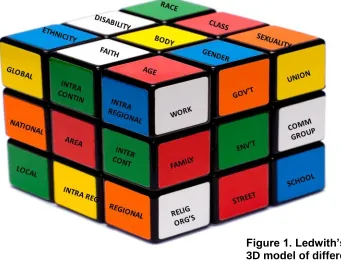
In community management settings, the sociological imagination allows us to understand the multitude of ways in which local, national and international issues intertwine to prevent peoples' participation in any given activity. In outlining what she calls a pedagogy of difference, Ledwith (1997) uses a three dimensional model represented below:
[image:6.612.146.487.272.535.2]On the top face of the cube are the markers of identity used by individuals and groups to differentiate one person from another, often described as social formations. These are the factors that emerge through social interaction, and in the context of sport, for better or worse, are used to make judgements about people who participate. On the right side are the contextual or environmental factors, such as family influence, school and workplace that structure our daily experience and give meaning to our sporting activities. Finally, on the left side are the levels of influence, through local and national to international, that show the various ways in which our participation in a particular activity is conditioned by various levels of social interaction, from seemingly mundane conversations with a neighbour in the street (private), to the international trends that influence how we participate and think about a particular activity (public).
The potential of this model is that is teaches community development workers to question things (in our case sport) in more complex and inter-related ways. For example, research has shown that gendered attitudes (top face) towards sport often begin in physical education (right face), as girls are taught to behave in 'feminine' ways that exclude their participation from physically demanding, competitive and contact sports in favour of those that are more 'graceful' and cognitive. Such attitudes become normalised and are reinforced by everyday conversations and interactions, for example from patronising comments about women 'not understanding the offside rule' to wolf whistling and unsolicited sexual comments when females go swimming. As they grow older, these attitudes are also present in other environments (right face) such as the workplace, which further cement their acceptance. However, we know that attitudes towards women in the Western world can be different to those from parts of Asia and Africa, so it is important to consider the needs and motivations of different ‘types’ of women when developing and managing sports (left face).
It is clear that changes in society, such as having to move to find work and the increase of technology based leisure pursuits such as gaming, have lead to us lead more individualised existences which can negatively impact on the way we engage with sport and reduce our awareness of the ways our lives are linked to others. We must be alert to the complexities of the lives of the people we are working with and trying to work with, as well as really understanding the places where they live. We must be critical thinkers, people who always question how things are done, being conscious of our personal biases and how the traditions of sport might please and favour us but work to the detriment of others.
FOOTBALL UNITES, RACISM DIVIDES (FURD): HELPING PEOPLE TO BELONG 925 FURD is a Sheffield voluntary sector (often called the third sector) organisation which tackles racism within football and wider society. It was established in 1995 by Sheffield United FC fans concerned about instances of racial abuse in and around the stadium. FURD is based in an electoral ward that is the third most populous of 28 in terms of Black Minority Ethnic (BME) residents in a city where 19.2% of the population is BME, rising from 10.8% in the previous Census (www.sheffield.gov.uk). The organisation works to increase BME participation in football in terms of players, spectators and employees. As with many third sector organisations, it has sought funding from a variety of local, national and international sources, such as the local authority, Football Foundation and European Union. FURD is one of the founding members of Football Against Racism in Europe, a coalition of anti-racist groups. Using sociological imagination to connect issues, it builds partnerships and creates networks, linking the local/private to the international/public. FURD’s partners include professional sports clubs, the County FA, local schools, the local authority and Sheffield Hallam University.
Together groups, for instance, offer opportunities to play football, try different kinds of dance, access computers and take English classes to people who are referred by agencies or who simply turn up, having seen local publicity or heard about the project through word of mouth. Engaging with changes in society, it also carries out research, such as the Football and Connected Communities project, which examines the role of football in the lives of young people, the increasing cost of watching live football, rising engagement with football through the media and footballers as role models. FURD has hosted a Positive Future project and takes Streetkick, a portable football game, to neighbourhoods to engage hard to reach young people; the kind of flexible delivery we mentioned earlier that brings sport to people rather than expecting people to go to sport. Demonstrating yet more flexibility, as well as football, the organisation uses music via its Soundkickers project, has recording and dance studios, a gym and IT facilities.
The project then is about more than simply football coaching. Sport and non sport activities, are used as hooks to bring together socially excluded individuals and groups, and also a variety of agencies, to generate a sense of community, a sense of belonging. Some activities are delivered at their purpose built venue, but there is also outreach, with the organisation going into the community to create networks and reach those who are isolated. FURD operates 7 days a week, delivering at times that best fit with local people. As well as regular programmes, activities and events are run responding to immediate need, or connecting to other events e.g. screenings of world cup games at their base or a redoubling of outreach and cohesion work at times of local or national racial tension. It encourages volunteering, so that participants can gain skills and then move into paid work addressing the private trouble of low skills and unemployment experienced against the public backdrop of a global economic crisis. Volunteers bring with them a huge amount of local knowledge and, as well known faces in the community, can draw on high levels of trust and respect. Each year, FURD hosts a number of work placements for sports students from Sheffield Hallam University, helping to raise their awareness of social issues, to stimulate their sociological imaginations and help equip them with skills which make them more employable.
The idea of community is key to the organisation’s work, whether applied to the streets around its base, the global community or the local and international football communities. It could be argued that in a time of, for many, increased social and geographical mobility, neighbourhood has become less important and that we are able to belong to a number of communities simultaneously, and to leave and join them. Bauman (2001) though talks about our nostalgia for community, of our continuing need to experience warmth and togtherness, something which can be difficult in our fast paced society. Projects like FURD can help disparate, isolated people and groups to find common ground through the activities it runs, to feel welcomed.
there is evidence that sport creates a sense of belonging for some people, promoting social inclusion, the process by which people are able to participate fully economically, socially and culturally in society. Woodhouse and Conricode (2016) carried out research with FURD and talk of how football offers escapism to refugee and asylum seekers there and can help to build relationships with other local people. Football then, because of its accessibility and familiarity, is something which offers those at the project common ground with others; the opportunity to feel part of something.
POSITIVE FUTURES (PF): BUILDING SOCIAL CAPITAL 1157
Launched in 2000, PF is a national sports-based social inclusion programme for people aged 10-19. Rather than aiming to merely ‘divert’ participants from crime by providing large doses of sport, PF attempts to address the many inter-connected private issues participants have by equipping them with skills which will create opportunities for them. Despite being a national programme with a clear overarching strategy, PF is locally designed, delivered and managed. Projects reject the hierarchical 'top-down' approach, discussed earlier, in favour of a more organic 'bottom-up' one, where staff consult local people and agencies, building lasting relationships with them which allows for the delivery of bespoke activities. PF has identified the importance of its staff having trust, empathy and respect, drawing on their sociological imaginations, as the crucial factor in ensuring the development of sustainable, successful projects, not staff possession of sports skills.
Originally managed by the Home Office, PF is an example of targeted provision. It works with those considered at risk of offending, aiming to reduce crime and drug and alcohol misuse, as well as preventing serious youth violence. Recognising that education is key to developing social capital, projects aim to steer participants into education, training or employment. PF is now run by Catch 22, a social business itself born of the merging of organisations, with partnership key to its operation. The approximately 100 projects use arts, sport, physical activity, social enterprise and education. PF ended as a national programme in 2013, but handing control to local partners was always part of the plan, an attempt to move from centralised provision to projects which were locally responsive and funded in a sustained fashion.
PF draws heavily on Hellison’s (2010) social responsibility model in which young people are seen not as a problem but as resources with strengths that can be built on. Projects influenced by this model provide significant, sustained local contact with caring adults in what for many participants may be their only physically and psychologically safe environment. Whilst many traditional diversionary sport projects set targets and are only available for a short time, the number of participants is kept small and participation over a long period is encouraged to promote belonging and sustained development.
having a positive impact on the young person’s behaviour, reducing anti social behaviour or improving their school attendance for example, the improved sense of belonging created can have a positive impact on the local area e.g. reducing levels of fear of crime. Participants gain qualifications, making them more employable or helping them back into education. Rather than a focus on the acquisition of sporting skills, the aim is to build ‘soft skills,’ such as better sociability and communication, and to instil ambition. PF employs a sophisticated monitoring and evaluation system which allows for a personalised mapping of a person’s journey and provides evidence which organisations can use for future funding bids, in terms of demonstrating that projects are value for money.
Its effectiveness is in large part down to this focus on the local, in terms of identifying need, staffing, recruiting volunteers and providing appropriate activities and venues. One worker talks of providing realistic aspirations and helping participants to achieve these ‘my background definitely helps: "I show them where I’m coming from and they’re like “wow, I can do this too”’ (Woodhouse 2005). This demonstrates the value of sociological imagination, of being able to see life through the eyes of participants and to share with them the experience of what you need to do to succeed in wider society. This can be contrasted with staff brought in from other agencies, using more traditional delivery styles, as evidenced by a health workshop with one young person saying: 'I asked the posh one if she'd ever taken drugs and she said she hadn't. How can she tell us about drugs when she knows jack shit?’ (ibid).
Staff are what we call cultural intermediaries, people who act as a bridge between agencies such as schools and the police and the socially excluded young people helping them to gain the social capital which we mentioned earlier, through education and employment. Staff are seen by young people as different to adult authority figures such as teachers or police officers, are seen as providing guidance and support rather than asserting their power. Staff are characters almost e.g. the buddy, the joker and the geezer (Crabbe et al, 2005). They use their sociological imaginations to address issues that participants face and, in demonstrating that they know the area and are aware of the complex issues facing young people who live there, mutual respect and trust is built. Project workers have credibility. Essentially, PF is based on relationships. Staff who do not have the skills of a cultural intermediary are not able to help young people reach their potential, in fact, their approach can have a detrimental effect. ‘They have got to have respect for the staff… but likewise the staff have got to have respect for the young people: We had a session on Tuesday [and] the member of staff had no respect for the kids and it was just chaos…very negative towards the kids, didn’t want to be there and the kids pick up on it straight away…She has probably taken them back about three steps’ (Woodhouse 2005).
non traditional sports, such as parkour or winter sports. Activities are delivered at local authority and private leisure venues, in parks, in schools, at professional sports clubs, theatres, dance studios, and climbing centres; residentials are also used.
PF is an example of using local knowledge and skills to encourage long term involvement and the progression of participants. Activities are delivered by credible staff, some of whom started out as participants so are able to demonstrate to young people attending that their lives can change too. Workers make links between the private troubles of those who attend projects and the public issues which cause these and then go on to help participants change their behaviours so they improve their prospects.
THE MENTRO ALLAN/VENTURE OUT INITIATIVE: ENCOURAGING PEOPLE TO THINK (AND FEEL) DIFFERENTLY 1362
Based in Wales between 2005-2010, The Mentro Allan programme was a part of a UK-wide programme which used outdoor environments to engage a range of underrepresented groups in physical activity, including the over 50s, young single mothers, people with physical disabilities and/or mental health problems, carers, young people, and BME communities. From the outset, these groups were targeted as they demonstrated higher-than-average levels of inactivity (WHS, 2014) nationally, which in the case of the over 50s was over twice as high (48%) as those between 16-21 (21%). However, perhaps more worrying is that many of the groups listed, particularly those from BME backgrounds, were much more likely to experience other social problems such as crime, ill-health (both physical and mental) substance abuse and suicide (ONS, 2012). As such, the Mentro Allan programme was funded to help address some of these issues, and was supported in doing so by a range of local and national partners, including Sport Wales, Countryside Council for Wales, National Public Health Service, Wales Council for Voluntary Action and the Welsh Local Government Association.
The uniqueness of Mentro Allan’s approach to community sport management was evidenced in both its relationship with its participants and its overall philosophy toward ‘sport’. For instance, the initiative was defined as a participatory action research project (PAR) which was committed to making a positive, long-term difference in the lives of those involved. Such methods, write Ledwith and Springett (2010 p16) put participants at the heart of the issue, in ways that ‘give more local people voice and the confidence to take autonomous control of their lives’. Like those case studies we have already identified, they encourage facilitators and participants to become more critical about their roles and positions within society, and to see their work as going beyond the physiological benefits of physical activity to consider its social (i.e friendships), cultural (i.e closer families, less racial discrimination), spiritual (i.e enhanced feelings of confidence and self-worth) and political (i.e lower levels of crime/obesity) contributions. The sociological imagination was therefore a key part of this process.
options for participation and risk upsetting those individuals who have turned their backs on more traditional, organised forms of sport. This was a particularly important consideration for the project organisers, given the poor participation rates of many of the target groups. Instead, a range of informal, outdoor activities such walking and woodland activities, treasure hunts, cycling, survival skills, rock climbing, water-sports and orienteering were developed to include a wider range of people, many of which were conveniently located within Wales’ surrounding natural landscapes.
These activities, often defined as 'lifestyle sports' or 'alternative physical activities' have a range of benefits when it comes to engaging groups who have struggled to 'fit in' with mainstream sport and/or society (see Cherrington and Gregory, 2017). They also work well with the approach to community sport development that we have talked about throughout this chapter. For instance, they are much more informal, containing few of the rules and limitations that are placed upon participations in traditional sporting environments. This may work well when trying to engage under-18s or over 50s, many of whom, because of the way they are treated elsewhere, are reluctant to be told what to do. They can be risky, often involving a battle against the 'elements', which can be great when you are trying to empower somebody, such as a young, single mother to try something new and discover their personal potential. Finally, they can relieve much of the psychological stress that comes with living in a city, which has obvious potential regarding the treatment of certain mental illnesses. In fact, research has shown that 'green exercise' can reduce feelings of anxiety and depression by as much as 71% (Mind, 2015).
Such thoughts were shared by many of the beneficiaries who took part in the Mentro Allan project. Individuals talked about the sensory pleasures of the natural environments such as the smell of flowers and the sound of running water, and often expressed a preference for natural rather than man [sic] - made environments: 'I like seeing the world. I want to see it [world] as nature intended it, not as people in the world muck it up' (Allen-Collinson and Leledaki, 2015:463). This was particularly important for participants with physical disabilities, such as those with limited vision, as the outdoor activity was able to stimulate a range of senses (i.e. the wind and rain blowing against their face) that would be unavailable in more artificial environments. Equally, participants also commented on the 'freedom' available in the outdoors, and the therapeutic effect of being away from technology such as computers and televisions: 'Well it's where we're all one isn't it? Regardless of the fact that we've got all this technology…but we're still part of nature, aren't we? (Ibid:463). This suggests that physical activity cannot be promoted as an end in itself, and must be offered alongside wider social benefits such as those outlined above. In some areas in which these activities were run, this approach lead to a 14% increase in physical activity, which is no mean feat.
I could go there and speak to the kids themselves, just mingle with them and play pool with them etc. and then try to get them to talk to you, rather than go as an appearance of an official
An important element of this approach was the development of mutual respect between the participants and the project workers, in that both parties understood that they had something to learn from one another, which is an important element of the sociological imagination. This reflected the work of Antonio Gramsci (1971) who suggested that every person has the intellectual capacity to bring about positive change. This was especially important when we consider the backgrounds of many of Mentro Allan's target groups, who may not have had positive experiences with institutional and/or familial authority figures such as teachers, police officers and parents. Where barriers were in place that prevented beneficiaries from attending certain activities, every effort was made by the staff to ensure that these barriers were overcome. For instance, those with mental health conditions were encouraged to attend 'mixed sessions', to avoid exposing their condition, car-shares were organised for those who struggled with transport, and where possible interpreters were arranged for those individuals for whom English was not their first language.
Doing things in this way is not easy, and the methods/activities adopted by Mentro Allan presented numerous challenges at every stage of the community management process. For example in the current economic climate, care workers are being asked to work longer hours for less money, which made it difficult for Mentro Allan to encourage them to spend time with the partipants in order to build positive relationships. The lack of available time and poor wages also made care workers reluctant to undertake the relevant training and take many of the ‘risks’ often associated with outdoor activity. Problems also arose when engaging particular groups in these environments. For instance, young people were often reluctant to wear appropriate outdoor clothing for fear of appearing ‘unfashionable’, BME women refused to travel alone due to cultural values regarding gender, and individuals on welfare benefits, particularly those with a mental health condition, were anxious about engaging in public physical activity for fear of being accused of benefit ‘scrounging’ (i.e. you are on a mountain bike, why are you claiming benefits?). However, by engaging with their ‘sociological imaginations’, planners were able to come up with a range of simple yet effective solutions to these problems, including staff training, the use of ‘doorstep’ locations and adopting a ‘graduated approach’ to ensure that people developed their confidence and fitness over time. In doing this, Mentro Allan was able to actively challenge negative stereotypes whilst ensuring maximum buy-in to each activity.
Conclusion – so what’s in it for you? 890
sociologically is not easy, some people will see you as awkward, and the solutions you come up with will rarely offer quick-fixes. A scientist can establish pretty quickly how to improve
someone’s performance on the running track and an accountant might be able to offer you a range of ways of improving the finance of your football club, but we are not going to find a solution to social exclusion overnight. There are few millionaire sociologists, but you’re not going to become full time sociologists; you’re going to use your sociological imagination in whatever your role is.
When you use your sociological imagination, you consider your life and the lives of others in social context and see how all of our lives are connected, which should encourage you to consider the consequences of your own actions or inaction Research has consistently shown that the more equally wealth is distributed within a society, the more healthy that society is likely to be. For instance, according to Wilkinson and Pickett (2010), babies born in the USA (the second least equal developed nation) are twice as likely to die in their first year than babies in Japan (the most equal), and life expectancy in Sweden (fourth most equal) is three years greater than in the USA. This is just a selection of indicators that tell the same story, from fighting and bullying amongst children to imprisonment rates and the level of social innovation. A strong sociological imagination may be of direct benefit to you when it comes to creating a healthier and happier life for yourself and others.
In addition, thinking sociologically about sport will undoubtedly make you more employable. As we highlighted earlier, society, and with it the sport industry, is becoming increasingly complex. Sport and leisure providers have to cater for a much larger variety of interests and tastes, and being able to understand these nuances and deliver meaningful sporting experiences is a valuable employability skill. You will be able to communicate with people from a range of different backgrounds, will develop the emotional intelligence to understand and empathise with the experiences of people very different from yourself, and most importantly, will be able to facilitate change in a way that is beneficial to those you are trying to empower. Ultimately, this will impact on your sense self as you become more at home with difference and more confident about your ability to continue developing.
Finally, and perhaps most importantly, you will be able to make one of the most difficult admissions that anyone who is deeply passionate about sport (as a supporter or participant) will ever have to make. You will be able to admit that sport is flawed, and with any luck you will think twice before you prescribe sport as a solution to societal problems. Indeed, as we hope to have shown throughout this chapter, there are instances where, under the right circumstances, sport can be an extremely positive way to connect people from different backgrounds or to stimulate a range of senses that may be difficult to connect with in other contexts. It may get people who engage in deviant or criminal activity to think about their behaviour and to become more socially responsible. However, for every success story there is another example of how sport was adopted when other activities, such as writing, music production or gardening may have been more appropriate. Hopefully, having engaged with this chapter, this is something that you will now have the humility and maturity to consider.
Review questions 191
At school, did one of your classmates dread PE? Would you now be able to use your sociological imagination to better understand why they hated having to take part? Perhaps they were embarrassed because they were over-weight or couldn’t afford the ‘right’ brand of kit?
Think of a time, maybe playing a team sport, when you felt a team mate wasn’t trying hard enough? Would you now be able to use your sociological imagination to think that their performance may have been affected by problems at home? Perhaps a parent had lost their job or they knew they’d shortly be moving to a ‘better’ school to increase their chances of achieving higher grades?
In both of these examples, can you see the public issues? There are obesity and the pressure to buy brands because of the commercialisation of sport in the first example and the economic crisis and pressure to go to university in the second.
Would you now be able to encourage and support your team mate or class mate? Would you be able to turn your understanding into actions and improve their lives? If so, how would you go about doing this?
Further reading 462
Hylton, K. (2013). Sport Development: Policy, Process and Practice (Third edition). London: Routledge.
Spracklen, K. (2014). Exploring Sports and Society: a Critical Introduction for Students. London: Palgrave
References
Baldry H. (1976). Leisure and the Community: conference proceedings. Birmingham University, December 10-11th, for the LSA
Bauman, Z. (2001) Community: Seeking Safety in an Insecure World, Cambridge: Polity.
Cherrington, J. and Gregory, M. (2017). Where Nature and Culture Coalesce: The Social, Cultural and Political Impact of Outdoor Recreation in Sheffield. In D. Turner and S. Carnicelli (eds) Lifestyle Sport and Public Policy. London: Routledge. pp. 100-117.
Coakley, J (2002). Using sports to control deviance and violence among youths: Let's be critical and cautious In Gatz, M, Messner, M and Ball-Rokeach, S (Eds.) Paradoxes of youth and sport (pp13- 30). NY: SUNY Press.
Collins, M. (2014) Sport and Social Exclusion. London: Routledge
Crabbe, T. with Bailey, G. Blackshaw, T. Brown, A. Choak, C. Gidley, B., Mellor, G. O’Connor, K. Slater, I. and Woodhouse, D. (2005). Getting to Know You: First Interim National Positive Futures Case Study Research Report. London, Home Office
Crabbe, T. with Bailey, G. Blackshaw, T. Brown, A. Choak, C. Gidley, B., Mellor, G. O’Connor, K. Slater, I. and Woodhouse, D. (2006) Knowing the Score. Positive Futures Case Study Research: Final Report For the Home Office
Government White Paper (2001) ‘Strong Leadership – Quality Public Services’ London:HMSO Gramsci, A (1971), Selections form the Prison Notebook, ed. and trans. Hoare, Q & owell Smith, G. London: Lawrence and Wishart
Haywood, L. and Kew, F. (1989) ‘Community Recreation: New Wine in Old Bottles,’ in P. Bramham, I. Henry, H. Mommaas, and H. van der Poel, (Eds.) Leisure and Urban Processes. Critical Studies of Leisure Policy in Western European Cities, London:Routledge.
Hellison, D (2010). Teaching responsibility through physical activity. Leeds: Human Kinetics Ledwith, M. (2005). Community development: A critical approach. Bristol: The Policy Press Ledwith, M; Springett, J (2010) Participatory Practice. Community-Based Action for Transformative Change. Bristol: The Policy Press.
McEwan, I (2001) Guardian, 15th September
Mills, CW (1999). The Sociological Imagination. Oxford: Oxford University Press. Mind (2013). Ecotherapy. London: Mind.
ONS (2012). Mental Health of Children, Adolescents and Adults. London: Office for National Statistics.
Putnam, R. D. (2001). Bowling Alone: The Collapse and Revival of American Community. New York: Simon and Schuster
Sennett, R (2004) Respect: the formation of character in a world of inequality. London, Penguin Spracklen, K, Long, J and & Hylton, K. (2015) Leisure opportunities and new migrant communities: challenging the contribution of sport. Leisure Studies, 34, 114-129
Torkildsen, G. (2010) Leisure & Recreation Management. London: Routledge Woodhouse, D. (2005) unpublished field notes
http://www.theguardian.com/society/2002/jan/15/socialexclusion1
https://www.sheffield.gov.uk/your-city-council/sheffield-profile/population-and-health/2011-census/ward-populations.html
WHS (2015). World Health Statistics 2015: Global Health Indicators. World Health Organisation: Copenhagen.
Wilkinson, R. & Pickett, K. (2009). The Spirit Level: Why Greater Equality Makes Societies Stronger. London: Bloomsbury.