technical skills in junior rugby league?
MORLEY, D <http://orcid.org/0000-0002-4389-8573>, OGILVIE, P, TILL, K, ROTHWELL, Martyn <http://orcid.org/0000-0002-3545-0066>, O'CONNOR, D and MCKENNA, J
Available from Sheffield Hallam University Research Archive (SHURA) at:
http://shura.shu.ac.uk/14753/
This document is the author deposited version. You are advised to consult the publisher's version if you wish to cite from it.
Published version
MORLEY, D, OGILVIE, P, TILL, K, ROTHWELL, Martyn, O'CONNOR, D and MCKENNA, J (2016). Does modifying competition affect the frequency of technical skills in junior rugby league? International Journal of Sports Science and Coaching, 11 (6), 810-818.
Copyright and re-use policy
See http://shura.shu.ac.uk/information.html
Original article 1
Title: Does modifying competition affect the frequency of technical skills in junior rugby 2
league? 3
Authors: 4
David Morley1, Paul Ogilvie2, Kevin Till2, Martyn Rothwell3, Wayne Cotton4, Donna O’Connor4 and 5
Jim McKenna2 6
1
School of Education, Leisure and Sport Studies, Liverpool John Moores University, Liverpool, UK 7
2
Carnegie Faculty of Sport & Education, Leeds Beckett University, Leeds, UK 8
3
Academy of Sport & Physical Activity, Sheffield Hallam University, Sheffield, UK 9
4
Faculty of Education and Social Work, University of Sydney, Sydney, Australia 10
11
Corresponding author: 12
David Morley, School of Education, Leisure and Sport Studies, Liverpool John Moores University, 13
Liverpool, L17 6BD, UK. 14
Email: [email protected] 15
16
Acknowledgement 17
This work was supported by the Rugby Football League. 18
19
20
21
22
23
24
Abstract 1
The technical demands of games can be affected by changing the number of players, pitch 2
size and rules. This controlled trial compared the frequency of technical skills between a 3
'traditional' and newly introduced systematically 'modified' game of primary rugby league. A 4
total of 475 primary rugby league players (Under 7s - 9s) were filmed playing traditional 5
(n=49) and modified (n= 249) formats. Notational analysis examined the frequency of 6
technical skills (e.g., number of passes) within 'traditional' and 'modified' games. At each age 7
category, multivariate analysis of variance indicated the clear superiority of the 'modified' 8
game for the frequency of technical skills (e.g., Under 7s total skill opportunities - 9
'traditional' = 342.9±47.0; 'modified' = 449.4±93.3, d=1.44, p<0.001). Systematically 10
modifying the competitive game is an effective way to increase skill opportunities for 11
children within rugby league. Future research should examine the outcomes of modifying 12
games in optimizing skill development in youth sport. 13
14
Keywords 15
Technical skills, skill analysis, competitive games, children’s sport, rugby league 16
17
18
19
20
21
Introduction
1
Importance of skill opportunities for children playing sport 2
Positive, early, sport experiences for children are considered vital to sustaining participation 3
and fostering a lifelong love of sport and physical activity [1]. Furthermore, it is suggested 4
that a ‘Lifespan’ perspective of movement development begins with an early and crucial 5
phase of developing technical skills that forms the foundation of subsequent participation in 6
sport [2]. There is evidence to suggest that learning and improving sport skills are the most 7
prominent reasons why children participate [3], while sports participation is enjoyed more 8
when children feel competent in performing sport-specific skills [4]. Even though evidence 9
suggests that modified games in practice situations provide a platform to ensure children 10
develop and possess the prerequisite skills to flourish in sport [5, 6], less is known about the 11
contribution that competitive games can make in developing these skills. 12
The nature of competition in youth sports 13
Organised competition demands concentration and effort, provides children with an 14
opportunity to develop tactical awareness and is highly rated by elite athletes for developing 15
skill execution and physical fitness [7]. 'Sampling' a range of sports has been recommended 16
in order to facilitate the transfer of technical skills that then become more portable, less 17
defined by the sport and more useful for the developing child [8]. Recommendations have 18
also been made to reduce the amount of competition in early sport experiences in order to 19
avoid 'burnout' caused by anxiety and burden related to participation in competition [9,10]. 20
While the literature focuses predominantly on children's participation in competition and 21
more specifically offers guidance for elite or talented junior athletes [11, 12], there is very 22
little empirical research on whether traditional, non-modified, competition is meeting the 23
scaling down adult competitive games serves the technical developmental needs of children 1
[9]. 2
Modifying games 3
Systematically modifying games to emphasise players’ use of key developmental skills is not 4
new; physiological, technical and tactical demands have been extensively examined across a 5
range of sports such as soccer, basketball and rugby league [6, 13, 14, 15], although the 6
majority of studies concentrate on elite populations. A recent review suggested that studies 7
measuring the effect of modified games on the technical demands of sports are relatively 8
scarce and existing work is dominated by assessing the impact of small-sided games on 9
young adults at recreational and elite level, using relatively small sample sizes, with limited 10
duration and within a practice-type game situation [16]. 11
In studies of modified games, Burton and colleagues [17, 18] modified youth flag 12
football for children aged 8-9 years. Using a smaller ball and implementing a 3-second rule 13
whereby players could not attack for 2 seconds after receiving a pass, scoring increased from 14
745 points during the season to 1158 points in the modified game. Furthermore, almost twice 15
as many players scored a goal (47%), as in the previous season (27%). These results are 16
important since participants typically regard offensive skills as offering most fun within 17
sport; the likelihood is that increased intrinsic motivation results [19]. 18
While the majority of empirical studies that explore the impact of modifying 19
competitive games come from the USA, game modifications are also commonly employed by 20
National Governing Bodies of sport in the British Isles [20, 21, 22, 23]. Although there is 21
little empirical evidence of the effectiveness of these modified games with young children, 22
examples from rugby and soccer are the exceptions. Thomas [24] used notational analysis 23
resulted in 55% more runs with the ball, more than twice as many successful passes and 1
scoring nearly twice as many tries. In soccer, a study comparing a 4v4 and 8v8 game played 2
within Premier League Academies (players’ m age=7 years) showed that the total number of 3
ball contacts was 2.8 times greater in the 4v4 than the 8v8 game [25]. 4
Context, aim and hypothesis 5
In 2012, the National Governing Body for Rugby League in England - the Rugby Football 6
League (RFL) - instigated a review of rugby league for players aged 5-11 years. The review 7
was prompted by growing concerns about the lack of children’s meaningful experiences 8
during match-play, decreasing retention rates, and a sense that the game favored the more 9
physically developed child [26, 27]. In response, the authors were commissioned to research 10
the impact of a newly introduced 'modified' game in comparison to the 'traditional' primary 11
rugby league game being played at the time [28]. 12
To redress the shortfalls in existing evidence, this study aimed to compare a modified 13
game with a traditional game in a competitive setting, featuring a large sample of players, 14
over a sustained playing period. Moreover, the new modified game explicitly aimed to offer 15
more skill development opportunities, which provided a meaningful and measurable outcome 16
[29]. This study is highly relevant as it has the potential to enhance understanding of how to 17
systematically optimize playing environments so children develop their skills during initial 18
experiences of sport. The hypothesis was that a modified game would increase the frequency 19
of players demonstrating technical skills in comparison to the traditional primary rugby 20
league game. 21
Methods
22
A technical group was established comprising RFL staff with expertise in coaching children. 1
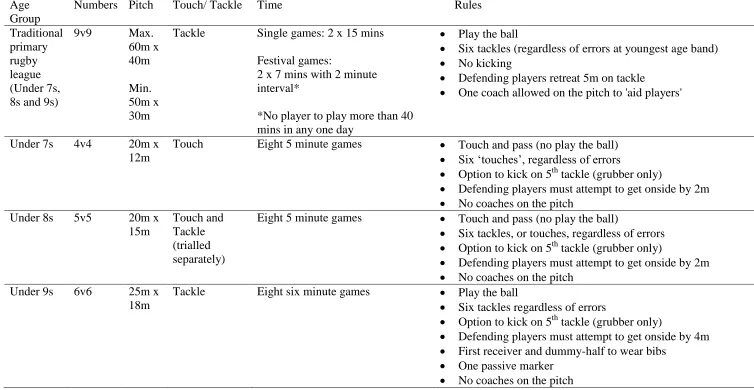
This group designed the modifications for the modified game, as demonstrated in Table 1, 2
which consisted of changes to the size of the pitch, the use of a 'touch' or 'full' tackle, playing 3
time and rules. To ascertain the impact of the modified game in comparison to the traditional 4
primary rugby league game 17 key variables were identified by the technical group as being 5
critical to junior players’ skill development within rugby league. Given that the appropriate 6
age for safely introducing the full tackle to primary rugby league players is contested [28], 7
the Under 8s game contained 'full' and 'touch' variants of the tackle to offer a comparative 8
assessment of skill opportunities in both. 9
***Insert Table 1 here*** 10
The 'traditional' primary rugby league game is a modified version of the adult 13-a-side 11
game, with teams playing competitive home and away fixtures. Compared to the adult game, 12
traditional primary rugby league requires nine players on each side, playing 15 minutes per 13
half using a modified pitch of minimum size 50m x 30m, to a maximum of 60m x 40m. 14
Game rules are as for full international matches with the exception of no scrums, no kicking 15
in play or at goal, no running from dummy half, and a reduced defensive retreat, from 10m to 16
5m. Informed consent and assent, and local ethics committee approval, was provided before 17
the commencement of the research. 18
Participants 19
Comparisons of traditional and modified games were achieved by observing 475 children, 20
aged 6-9 years, within three different age groups (Under 7s (n=108), Under 8s (n=223) and 21
Under 9s (n=144)), from 12 Community Rugby League clubs over 10-weeks of competitive 22
play. Within the 10 weeks, traditional (n=49, yielding 1496 minutes of footage) and modified 23
and 20 minutes of play. Participants were filmed playing the traditional game in their existing 1
fixtures schedule, whether competing at their home or away venue and the modified game 2
midweek, at a location central to the participating clubs, based on each team competing 3
against every other team. 4
Notational analysis 5
Notational analysis of technical skills [30], as shown in Table 1, was used to capture any 6
differences between the traditional and modified versions of rugby league. Based on the 7
technical group's advice, four key areas were identified to explore how well the modified 8
game influenced opportunities for: 9
1. Specific skill development; passes, catches, kicks, tackles and ‘around the world’ runs 10
2. Offensive action; crossing the advantage/defensive line, line breaks and tries scored 11
3. Replicating patterns of play found in the full game; total plays, completed sets 12
4. Overall frequency of skill development; total skill opportunities. 13
All of the technical skills notated were typical skills found within Rugby League apart from 14
'around the world runs'. The research team created this term to describe the pattern of a player 15
running with the ball perpendicular to the opposition before running straight in an attempt to 16
penetrate the defence. Fieldworkers used these areas to annotate game footage and were blind 17
to the purpose of the study so as to avoid coding bias. The accuracy of their notation was 18
established by comparing outcomes from coders simultaneously watching and coding a 5-19
minute game of primary rugby league. This training process was repeated until an analysis of 20
the inter-observer reliability produced an interclass correlation coefficient of 1.00 (n = 27; 21
95% CI = 0.99–0.1.00), indicating excellent agreement between the responder’s observations. 22
Data generated by the notational process was analysed using the Statistical Package for the 1
Social Sciences (SPSS Inc., Chicago, Illinois, USA). To make comparisons under consistent 2
conditions, the means for all variables were scaled to a 30-minute period to control for time. 3
To reduce bias, outliers identified by the maximum normed residual test were removed (p = 4
0.05). 5
Initially, a series of one-way multivariate analysis of variance (MANOVA) tests explored the 6
differences between traditional and modified games at each age category (i.e., Under 7s, 8s 7
and 9s). Preliminary assumption testing confirmed no serious violations of checks for 8
normality, linearity, univariate and multivariate outliers, homogeneity of variance covariance 9
matrices, and multicollinearity. Effect sizes using partial eta squared (η2
) were used for the 10
MANOVA with further Cohen’s d effect sizes considered for individual variables. 11
To align our reporting of effect sizes with other educational literature, effect sizes were 12
reported as negative d values if a reverse effect was observed [31]. Using a modification to 13
the effect size scale of Cohen [32], z-scores were assessed against this profile; 0 to 0.2 was 14
considered to be a trivial effect, 0.2 to 0.6 small, 0.6 to 1.2 moderate, 1.2 to 2.0 large, and a z-15
score of >2.0 represented a very large effect [33]. 16
Results
17
Across every age group, there were statistically significant advantages resulting from the 18
‘modified’ over the ‘traditional’ game structure. The initial results from the one-way 19
between-groups MANOVA revealed that there was an overall significant (F17, 60 = 19.96, p <
20
0.001; Wilks’ Lambda = 0.15; η2= 0.85) difference in the Under 7s age category, Under 8s 21
(F17, 58 = 5.91, p < 0.001; Wilks’ Lambda = 0.36; η2= 0.63) and Under 9s (F17, 43 = 5.86, p <
22
0.001; Wilks’ Lambda = 0.30 η2
A detailed breakdown of the dependent variables across the age categories is shown in 1
Table 2. The table shows that for Under 7s the modified game had a large or very large 2
positive effect on the total number of (i) plays, (ii) skill opportunities, (iii) passes and catches, 3
(iv) around the world runs, (v) times a team crossed the advantage line and the defensive line 4
and (vi) completed sets of tackles and (vii) the percentage of effective tackles. The table also 5
reveals that the percentage of effective passes and catches did not reduce despite an increase 6
in the number of skill events performed in the game. Similar results, although less strong, 7
were seen with the Under 8s modified game. However, a small and moderate negative effect 8
was seen in the percentage of effective passes and catches respectively. Likewise, in the 9
Under 9s game the modified rules also had a positive moderate effect on the total number of 10
(i) plays, (ii) skill opportunities, (iii) completed tackles, (iv) around the world runs, (v) line 11
breaks, (vi) completed sets and (vii) tries scored. The number of times the ball was knocked 12
on in the modified game also decreased significantly. 13
***Insert Table 2 here*** 14
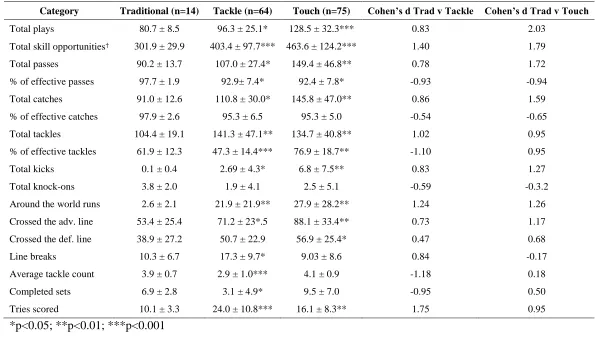
In the three different Under 8 rules that were trialed separately to investigate the influence of 15
different tackling regimes (traditional, modified tackle and modified touch) there was a 16
statistically significant difference between the rules on the combined dependent variables, (F 17
34, 262 = 7.58, p < 0.001; Wilks’ Lambda = 0.25; η2= 0.50). A detailed breakdown of the
18
dependent variables and how they vary across three different rules types in the Under 8s can 19
be seen in Table 3. The table reveals (i) more technical skills in the modified tackle rules and 20
(ii) even more in the modified touch rules, although (iii) there was a moderate decrease in the 21
effectiveness of the skills performed (passes, catches and tackles). 22
***Insert Table 3 here*** 23
Discussion
1
This study offers a rare comparative examination of the differences in the frequency of 2
technical skills within a traditional and modified game setting in competitive junior rugby 3
league. Powerful and almost universal differences favored the modified game, which was 4
designed to increase the number of opportunities to execute different skills when compared 5
with the traditional game. These findings reflect the majority of previous studies that 6
demonstrated an increase in the number of technical skills when modifications were made in 7
similar sports and with a similar age range of participants [18, 24, 25]. 8
Overall, the modified game clearly impacted in a range of key areas related to the 9
study aims. Effects were strongest with Under 7 and Under 8 players, particularly for the 10
total number of technical skills performed. More specifically, the modified game featured 11
more passes, catches, plays and effective tackles, with players crossing the advantage and 12
defensive lines and scoring more frequently than in the traditional game. These increases in 13
offensive action are of particular significance when considering previous evidence suggesting 14
that children enjoy this element of the game and that enjoyment is one of the main reasons 15
cited for children’s participation in sport [3, 19]. Given that previous research has established 16
a positive relationship between movement competence and subsequent participation in 17
physical activity and sport [5, 34], the sweep of these results suggests that, by offering more 18
opportunities for technical skills to be developed, the systematically modified game is likely 19
to retain more players in the game and prepare them for future experiences in sport, more 20
effectively than the traditional game format. 21
Moreover, individual age-group differences merit further discussion. In Under 7s, the 22
modified game produced fewer knock-ons - even with more pass receives. This may result 23
from players feeling less pressurized than in the traditional game, where knocking-on a 24
produced substantially more ‘around the world runs’ and more examples of crossing both 1
defensive lines than the traditional game; this is an interesting finding. Given that penetrating 2
the defence is a core tactical construct of any invasion game, players playing the traditional 3
game may use the most direct route to achieve this by employing a straight line of running. It 4
is possible that 'around the world runs' allow young players the space and time to make a 5
decision about the best way to penetrate the defence. Further research is needed to establish 6
immediate and long-term issues around any such decision-making. 7
At Under 8s, in the ‘full tackle’ version, over the ‘touch’ version, fewer overall technical 8
skills were performed. It is likely that the ‘touch’ takes less time to perform than the full 9
tackle, creating more time to perform other technical skills. Certainly, the ‘touch’ game 10
showed more plays, passes, receives, examples of crossing the advantage line and completed 11
sets than the ‘full tackle’ matches. There were also significantly more kicks in ‘touch’ 12
compared to ‘full tackle’ and more tackles in ‘full tackle’ matches. This may be linked to the 13
increase in running time found in ‘touch’, which is likely to decrease opportunities for being 14
‘touch’ tackled. 15
Having more line breaks in Under 8s ‘full tackle’ may be explained by the 16
comparative ease of making a ‘touch’, resulting in fewer line breaks. More tries were scored 17
in the ‘full tackle’; completing a full tackle may cause at least two players to fall to the 18
ground giving them less chance to retreat to make a further contribution to defending. With 19
more players on the ground at the full tackle, attackers will have more space, meaning that 20
more tries are likely. In general terms, these results suggest that skills are being practiced to 21
similar levels, regardless of tackle conditions. Thus, the ‘full tackle’ can be employed at 22
Under 8s without detrimental effect on these skill opportunities, although other physiological 23
and maturational considerations would still require consideration so as to protect the players 24
Under 9 games illustrated fewest differences between game conditions. This impact 1
may link to the limited number of changes made to their ‘traditional’ game, compared to the 2
many that the modified game represented for younger age groups. Even though there were 3
fewer differences between game conditions in the Under 9 game, compared to the Under 7s 4
and Under 8s, there were still more counts of technical skills in the modified game than in 5
traditional play. For Under 9s, the modified game brought more tries, more tackles and 6
‘around the world runs’ than in the traditional game. Interestingly, the number of ‘knock-ons’ 7
was twice that of the traditional game, again suggesting the possibility that players feel more 8
pressure when a mistake loses possession. What could be inferred from the lack of 9
differences between the two variants of the Under 9 game is that where modifications are 10
minimal, the resultant impact on the game is equally minimal. 11
This study is not without its limitations. The research design did not identify the 12
specific modifications that generated specific changes in skill events. For example, was it the 13
reduction in space or players that lead to more passes? This is particularly important in light 14
of previous research findings suggesting specific modifications create specific outcomes. For 15
example, reducing the size of the playing field, whilst affecting physiological responses, had 16
minimal influence on the volume or quality of skill executions, albeit with junior and senior 17
elite rugby league players [15]. A constraints-led approach, which looks to identify how 18
various constraints can affect competitive experiences, may prove fruitful for identifying the 19
impact of specific playing modifications [35]. The different sample sizes and length of 20
interventions across the three age groups may have also affected the results, although the 21
reality of the fieldwork environment suggests that these anomalies will be typically 22
encountered in the majority of natural settings. 23
Conclusions
By demonstrating the positive effects of modified games in increasing the frequency of 1
technical skills in competitive events, this study supports existing research [18, 24]. 2
Importantly, the current study provides comparative data in actual competitive settings, 3
which is an important improvement in terms of existing research design. Furthermore, the 4
inclusion of an expert group from the RFL within the research design proved a valuable 5
resource in enhancing the meaningfulness and validity of the research. The scale and 6
magnitude of the increases in technical skills that resulted from deploying the modified 7
variant of junior rugby league is likely to produce players better equipped to transition into 8
adult sport; whether at the recreational or performance level. Clearly, the modified game 9
enhanced athlete engagement by generating more offensive technical skills, than was found 10
in the traditional game. All National Governing Bodies of sport and coaches should review 11
their current junior versions of their sport and consider introducing and evaluating modified 12
games to ensure players are exposed to optimal technical skill development opportunities. 13
Further research is needed to determine which aspects of a modified game produce which 14
specific direct outcomes for participants. 15
Acknowledgements 16
The Rugby Football League funded this study. Thank you to the RFL and all of the 17
participants in the study for allowing us to develop an understanding of this crucial area of 18
work. 19
References 20
1. Kirk D. Physical education, youth sport and lifelong participation: the importance of early 21
learning experiences. Eur Phys Ed Rev, 2005; 12: 239-255. 22
2. Gallahue D, Ozmun J and Goodway J. Understanding Motor Development: Infants, 23
3. Weiss MR, Amorose AJ, and Kipp LE. Youth motivation and participation in sport and 1
physical activity. In: Ryan RM (ed.) The Oxford handbook of human motivation. Oxford: 2
Oxford University Press, 2012. 3
4. Rottensteiner C, Laakso L, Pihlaja T and Konttinen, N. Personal reasons for withdrawal 4
from team sports and the influences of significant others among youth athletes. Int J Sports 5
Sci Coach, 2013; 6: 19-32. 6
5. Ford P, De Ste Croix M, Lloyd R, Meyers R, Moosavi, SJ, Oliver, J, Till K and Williams 7
C. The long-term athlete development model: Physiological evidence and application. J 8
Sports Sci, 2011; 29: 389-402. 9
6. Klusemann MJ, Pyne DB, Foster C, and Drinkwater, E. Optimising technical skills and 10
physical loading in small-sided basketball games. J Sports Sci, 2012; 30: 1463-1471. 11
7. Côté J, Baker J, and Abernethy, B. From play to practice: A developmental framework for 12
the acquisition of expertise in team sports. In: Stakes JL and Ericsson KA (eds) Expert 13
Performance in Sport: Advances in Research on Sport Expertise. Champaign, IL: Human 14
Kinetics, 2003. 15
8. Côté J, Lidor R and Hackfort D. ISSP position stand: To sample or to specialize? Seven 16
postulates about youth sport activities that lead to continued participation and elite 17
performance. Int J Sport Ex Psych, 2009; 7: 7–17. 18
9. Capranica L, and Millard-Stafford ML. Youth sport specialization: How to manage 19
competition and training? Int J Sports Phys Per, 2011; 6: 572-579. 20
10. Wall M and Côté J. Developmental activities that lead to dropout and investment in sport. 21
11. Mountjoy M, Armstrong N, Bizzini L, et al. IOC consensus statement: Training the elite 1
child athlete. Brit J Sports Med, 2008; 42: 163-164. 2
12. Vaeyens R, Lenoir M, Williams AM, Philippaerts RM. Talent identification and 3
development programmes in sport: Current models and future directions. Sports Med, 2008; 4
38: 703-714. 5
13. Castelão D, Garganta J, Santos R, and Teoldo, I. Comparison of tactical behaviour and 6
performance of youth soccer players in 3v3 and 5v5 small-sided games. Int J Perform Anal 7
Sport, 2014; 14: 801-813. 8
14. Dellal A, Chamari K, Owen AL, et al. Influence of technical instructions on the 9
physiological and physical demands of small-sided soccer games. Eur J Sport Sci, 2011; 11: 10
341-346. 11
15. Gabbett TJ, Abernethy B and Jenkins DG. Influence of field size on the physiological and 12
skill demands of small-sided games in junior and senior rugby league players. J Strength 13
Cond Res, 2012; 26: 487-491. 14
16. Halouani J, Chtourou H, Gabbett T, et al. Small-sided games in team sports training: A 15
brief review. J Strength Cond Res, 2014; 28: 3594-3618. 16
17. Burton D, Gillham A, and Hammermeister, J. Competitive engineering: structural 17
climate modifications to enhance youth athletes’ competitive experience. Int J Sports Coach, 18
2011; 6: 201-217. 19
18. Burton D, O’Connell K, Gillham AD, et al. More cheers and fewer tears: Examining the 20
impact of competitive engineering on scoring and attrition in youth flag football. Int J Sports 21
19. Coakley J. Play, games and sport: developmental implications for young people. J Sport 1
Behav, 1980; 3: 99-118. 2
20. Irish Football Association. Small-Sided Games Strategy 2013/14. Dublin: Irish Football 3
Association, 2013. 4
21. England Netball High 5 Rules. http://www.englandnetball.co.uk/my-game/High_5 (2012, 5
accessed 14 July 2015). 6
22. The Football Association. The FA Football Development Programme Mini-Soccer 7
Handbook. London: The Football Association, 2008. 8
23. Rugby Football Union. New Rules of Play. 9
http://www.rfu.com/managingrugby/newrulesofplay (2013, accessed 14 July 2015). 10
24. Thomas, G. Introducing children to rugby: Shaping the game, retaining players and 11
developing talent. PhD thesis, Exeter University, UK, 2013. 12
25. Jones S. and Drust, B. Physiological and technical demands of 4v4 and 8v8 games in elite 13
youth soccer players, Kinesiol, 2007; 39: 150-156. 14
26. Rugby Football League (RFL). Primary rugby league review. Leeds: RFL, 2013. 15
27. Rugby Football League (RFL). RFL Retention and acquisition report. Leeds: RFL, 2013. 16
28. Rugby Football League (RFL). Primary rugby league rule book: Version 2012. Leeds: 17
RFL, 2012. 18
29. Arias JL, Argudo FM and Alonso JI. Review of rule modification in sport. J Sports Sci 19
30. Hughes M, and Bartlett R. What is performance analysis? In: Hughes M and Franks IM. 1
(eds) The essentials of performance analysis: an introduction. London: Routledge, 2008. 2
31. Hattie J. Visible learning: A Synthesis of over 800 meta-analyses relating to achievement. 3
London: Routledge, 2009. 4
32. Cohen J. Statistical power analysis for the behavioral sciences (2nd ed.). New Jersey: 5
Lawrence Erlbaum, 1988. 6
33. Hopkins WG. New view of statistics. 7
http://www.sportsci.org/resource/stats/effectmag.html (2002, accessed 15 July 2015). 8
34. Barnett LM, Van Beurden E, Morgan PJ, et al. Does childhood motor skill proficiency 9
predict adolescent fitness? Med Sci Sports Ex, 2008; 40: 2137-214. 10
35. Passos P, Araújo D, Davids K, et al. Manipulating task constraints to improve tactical 11
knowledge and collective decision making in rugby union. In: Renshaw I, Davids K and 12
Geert JPS (eds) Motor learning in practice: A constraints- led approach. London: Routledge, 13
Table 1. Under-7s, under-8s and under-9s (all use size 3 ball)
1
Age Group
Numbers Pitch Touch/ Tackle Time Rules
Traditional primary rugby league (Under 7s, 8s and 9s)
9v9 Max. 60m x 40m
Min. 50m x 30m
Tackle Single games: 2 x 15 mins
Festival games:
2 x 7 mins with 2 minute interval*
*No player to play more than 40 mins in any one day
Play the ball
Six tackles (regardless of errors at youngest age band) No kicking
Defending players retreat 5m on tackle
One coach allowed on the pitch to 'aid players'
Under 7s 4v4 20m x 12m
Touch Eight 5 minute games Touch and pass (no play the ball) Six ‘touches’, regardless of errors
Option to kick on 5th tackle (grubber only)
Defending players must attempt to get onside by 2m No coaches on the pitch
Under 8s 5v5 20m x 15m
Touch and Tackle (trialled separately)
Eight 5 minute games Touch and pass (no play the ball)
Six tackles, or touches, regardless of errors Option to kick on 5th tackle (grubber only)
Defending players must attempt to get onside by 2m No coaches on the pitch
Under 9s 6v6 25m x 18m
Tackle Eight six minute games Play the ball
Six tackles regardless of errors
Option to kick on 5th tackle (grubber only)
Defending players must attempt to get onside by 4m First receiver and dummy-half to wear bibs
Table 2. Comparison between Traditional and Modified Games at the Under 7s, 8s and 9s age categories
1
Under 7s Under 8s Under 9s
Category Traditional
(n=22)
Modified
(n=63)
Cohen’s
d
Traditional
(n=14)
Modified
(n=139)
Cohen’s
d
Traditional
(n=15)
Modified
(n=47)
Cohen’s
d
Total plays 86.7 ± 12.7 138.2 ± 27.0*** 2.44 80.7 ± 8.5 113.7 ± 33.2*** 1.36 89.8 ± 8.4 97.5 ± 14.2 0.66
Total skill opportunities 342.9 ± 47.0 449.4 ± 93.3*** 1.44 301.9 ± 29.9 435.7 ± 116.3*** 1.58 343.1 ± 38.3 388.1 ± 73.1* 0.77
Total passes 99.6 ± 13.9 149.4 ± 33.9*** 1.92 90.2 ± 13.7 129.7 ± 44.3** 1.21 113.3 ± 13.7 114.8 ± 29.1 0.06
% of effective passes 96.4 ± 3.2 96.3 ± 6.6 -0.02 97.7 ± 1.9 92.7 ± 7.6* -0.91 98.4 ± 2.0 97.1 ± 3.8 -0.44
Total catches 100.2 ± 12.4 142.9 ± 33.2*** 1.71 91.0 ± 12.6 129.6 ± 43.6** 1.20 111.5 ± 13.5 110.1 ± 21.4 -0.08
% of effective catches 96.3 ± 3.3 95.9 ± 4.6 -0.12 97.9 ± 2.6 95.3 ± 5.7 -0.59 98.0 ± 1.6 95.2 ± 4.5* -0.84
Total tackles 122.5 ± 30.9 131.7 ± 28.9 0.30 104.4 ± 19.1 137.8 ± 43.8** 0.98 108.8 ± 28.2 133.8 ± 33.9* 0.80
% of effective tackles 55.5 ± 17.2 86.5 ± 15.5*** 1.89 61.9 ± 12.3 63.3 ± 22.4 0.07 72.5 ± 17.7 57.8 ± 13.2** -0.94
Total kicks 0.0 ± 0.0 4.5 ± 4.9*** 1.30 0.1 ± 0.4 4.9 ± 6.5** 1.03 0.1 ± 0.4 0.7 ± 1.7 0.46
Total knock-ons 4.6 ± 5.8 1.4 ± 2.8** -0.71 3.8 ± 2.0 2.2 ± 4.7 -0.42 6.7 ± 2.6 3.4 ± 5.3* -0.79
Around the world runs 16.6 ± 19.4 67.8 ± 29.7** 2.04 2.6 ± 2.1 25.1 ± 25.6** 1.23 13.2 ± 5.8 26.3 ± 21.8* 0.82
Crossed the adv. line 56.7 ± 14.6 113.2 ± 27.3*** 2.58 53.4 ± 25.4 80.3 ± 30.3** 0.96 78.6 ± 3.2 74.2 ± 15.4 -0.31
Crossed the def. line 24.1 ± 12.4 64.1 ± 22.8*** 2.18 38.9 ± 27.2 54.1 ± 24.4* 0.58 49.1 ± 16.3 39.9 ± 13.8* -0.61
Line breaks 4.95 ± 5.3 6.16 ± 7.8 0.18 10.3 ± 6.7 12.8 ± 10.0 0.29 3.8 ± 1.7 8.7 ± 7.6* 0.89
Average tackle count 4.5 ± 0.5 4.3 ± 0.7 -0.33 3.9 ± 0.7 3.6 ± 1.1 -0.33 4.2 ± 0.3 4.1 ± 0.7 -0.17
Completed sets 8.0 ± 2.9 13.4 ± 5.7*** 1.19 6.9 ± 2.8 6.6 ± 6.9 -0.06 6.7 ± 1.3 8.3 ± 3.8 0.56
Tries scored 9.7 ± 4.3 12.7 ± 7.4 0.49 10.1 ± 3.3 19.8 ± 10.3*** 1.27 6.4 ± 2.3 12.9 ± 6.5*** 1.32
*p<0.05; **p<0.01; ***p<0.001 2
3
Table 3: Comparison between Traditional, Touch and Tackle Modified Games at the Under 8s Age Category
1
Category Traditional (n=14) Tackle (n=64) Touch (n=75) Cohen’s d Trad v Tackle Cohen’s d Trad v Touch
Total plays 80.7 ± 8.5 96.3 ± 25.1* 128.5 ± 32.3*** 0.83 2.03
Total skill opportunities† 301.9 ± 29.9 403.4 ± 97.7*** 463.6 ± 124.2*** 1.40 1.79
Total passes 90.2 ± 13.7 107.0 ± 27.4* 149.4 ± 46.8** 0.78 1.72
% of effective passes 97.7 ± 1.9 92.9± 7.4* 92.4 ± 7.8* -0.93 -0.94
Total catches 91.0 ± 12.6 110.8 ± 30.0* 145.8 ± 47.0** 0.86 1.59
% of effective catches 97.9 ± 2.6 95.3 ± 6.5 95.3 ± 5.0 -0.54 -0.65
Total tackles 104.4 ± 19.1 141.3 ± 47.1** 134.7 ± 40.8** 1.02 0.95
% of effective tackles 61.9 ± 12.3 47.3 ± 14.4*** 76.9 ± 18.7** -1.10 0.95
Total kicks 0.1 ± 0.4 2.69 ± 4.3* 6.8 ± 7.5** 0.83 1.27
Total knock-ons 3.8 ± 2.0 1.9 ± 4.1 2.5 ± 5.1 -0.59 -0.3.2
Around the world runs 2.6 ± 2.1 21.9 ± 21.9** 27.9 ± 28.2** 1.24 1.26
Crossed the adv. line 53.4 ± 25.4 71.2 ± 23*.5 88.1 ± 33.4** 0.73 1.17
Crossed the def. line 38.9 ± 27.2 50.7 ± 22.9 56.9 ± 25.4* 0.47 0.68
Line breaks 10.3 ± 6.7 17.3 ± 9.7* 9.03 ± 8.6 0.84 -0.17
Average tackle count 3.9 ± 0.7 2.9 ± 1.0*** 4.1 ± 0.9 -1.18 0.18
Completed sets 6.9 ± 2.8 3.1 ± 4.9* 9.5 ± 7.0 -0.95 0.50
Tries scored 10.1 ± 3.3 24.0 ± 10.8*** 16.1 ± 8.3** 1.75 0.95
*p<0.05; **p<0.01; ***p<0.001 2