Developing and evaluating research-informed instruction
about energy in Cyprus high schools.
ORFANIDOU, Dora.
Available from Sheffield Hallam University Research Archive (SHURA) at:
http://shura.shu.ac.uk/20150/
This document is the author deposited version. You are advised to consult the
publisher's version if you wish to cite from it.
Published version
ORFANIDOU, Dora. (2014). Developing and evaluating research-informed
instruction about energy in Cyprus high schools. Doctoral, Sheffield Hallam
University (United Kingdom)..
Copyright and re-use policy
See
http://shura.shu.ac.uk/information.html
I Learning and Information Services | Adseiis Centre, City Campus
! snetfieid S1 1WD
ProQuest Number: 10697457
All rights reserved
INFORMATION TO ALL USERS
The quality of this reproduction is dependent upon the quality of the copy submitted.
In the unlikely event that the author did not send a com plete manuscript and there are missing pages, these will be noted. Also, if material had to be removed,
a note will indicate the deletion.
uest
ProQuest 10697457
Published by ProQuest LLC(2017). Copyright of the Dissertation is held by the Author.
All rights reserved.
This work is protected against unauthorized copying under Title 17, United States C ode Microform Edition © ProQuest LLC.
ProQuest LLC.
789 East Eisenhower Parkway P.O. Box 1346
Developing and Evaluating Research-Informed Instruction about
Energy in Cyprus High Schools
Dora Orfanidou
A thesis submitted in partial fulfilment of the requirements of
Sheffield Hallam University
for the degree of Doctor of Philosophy
ACKNOWLEDGEMENTS
I would like to express my gratefulness to my supervisors Professor John Leach and Dr Mark Boylan for their constant and multimodal support in the completion of this doctoral thesis. I am particularly grateful for their kindness to take over this thesis after the untimely passing away of my initial supervisor, memorable Professor Phil Scott, and for very patiently deal with all the difficulties I encountered as a result of the unfortunate loss, for its completion.
ABSTRACT
There is an extensive academic literature documenting students’ pre-instructional interpretations of phenomena and events, showing that these interpretations are not consistent with ‘energy’ as used in physics. Furthermore, there is evidence showing that teaching does not always result in students’ interpretations becoming consistent with teaching. This evidence has been collected across many decades and in many countries.
This thesis presents a theoretical rationale for the design, implementation and evaluation of a teaching sequence aiming to promote conceptual understanding of the concept of energy to 15-16 years old physics students in Cyprus. Students’ pre-instructional ideas about energy were investigated and were found to be consistent with those reported in the international literature. A design study was conducted with the aim of improving students’ conceptual understanding compared to that might be expected from physics teaching usually conducted in Cyprus.
Among the perspectives and the methods critically reviewed to inform the design, the perspective set out by Leach and Scott (2002) drawing on the concept of Learning Demand was chosen. Furthermore, the energy ideas proposed within the SPT11-14 project (2006) were used as a basis for the development of the theoretical framework of the teaching sequence.
The research questions for the study were as follows:
RQl.What concepts of energy are used by a Cypriot cohort of upper high school students prior to teaching?
RQ2. How do the conceptions and learning of the sub-cohort of Cypriot students taught through the research-informed approach compare with those following ‘normal teaching’ after instruction?
RQ3. How do the understandings of the energy concept, of a small sub-group of students, develop during the lessons of the research-informed approach?
The study involved thirty six Cypriot students in two classes of an urban upper secondary school. One of the classes acted as an intervention group, receiving the ‘new’ teaching sequence whilst the comparison group followed normal teaching.
For addressing RQ1, data were collected through a pre-test administered to all participant students. Pre-test data and data collected through a post-test also administered to all participant students were used to test the comparative effectiveness of the teaching, thereby addressing RQ2. To address RQ3, data collected from a small number of experimental students through pre and post-test, two short-length diagnostic probes, two interviews and through an interview conducted with the experimental teacher were used.
Analysis of data allowed for the following answers to each research question:
RQ2: The students’ understandings of the concept of energy taught through the research-informed approach were significantly higher after instruction compared with those following ‘normal teaching’.
RQ3: The students’ understandings of the concept of energy through the lessons of the research-informed approach were developed in a manner consistent with the intended aims of the teaching.
TABLE OF CONTENTS
Acknowledgments...i
Abstract...ii
Table of contents... iv
List of Tables...x
List of Figures...xiii
CHAPTER 1-INTRODUCTION...1
1.1 THE ORIENTATION OF THIS STYDY... 1
1.2 THE CONCEPT OF ENERGY... 3
1.3 THE PERSPECTIVE ON ENERGY TAKEN IN THIS STUDY... 4
1.4 ENERGY IN THE CONTEXT OF SCIENCE EDUCATION RESEARCH 5 1.5 THE DESIGN OF THE RESEARCH-INFORMED TEACHING SEQUENCE FOR ENERGY... 7
1.6 OVERVIEW OF THE DOCTORAL THESIS...8
CHAPTER 2-LITERATURE REVIEW... 10
2.0 INTRODUCTION...10
I. THE STUDENTS’ ALTERNATIVE INTERPRETATIONS ABOUT ENERGY 10 2.1 ENERGY AND ANIMATE OBJECTS-THE ANTHROPOCENTRIC MODEL... 11
2.2 ENERGY AS A SOURCE OF ACTIVITY-THE DEPOSITORY MODEL 11 2.3 ENERGY, MOVEMENT AND FORCE-THE ACTIVITY MODEL... 12
2.4 ENERGY AS A FUEL-THE FUNCTIONAL MODEL...13
2.5 ENERGY AS A FLUID, AN INGREDIENT OR A PRODUCT-THE FLOW- TRANSFER, INGREDIENT AND PRODUCT MODELS...14
2.6 CONSERVATION OF ENERGY... 14
2.7 OVER ALTERNATIVE INTERPRETATIONS ABOUT ENERGY... 16
II. PERSPECTIVES ON THE ENERGY CONCEPT AND APPROACHES TO THE TEACHING AND LEARNING OF ENERGY... 17
2.8 ENERGY IS THE ABILITY OF DOING WORK...17
2.8.1 DISCUSSION... 21
2.9 ENERGY AS A QUASI-MATERIAL...22
2.9.1 DISCUSSION... 29
2.9.2 INSTRUCTIONAL APPROACHES DEVELOPED FROM THE SUBSTANCE LIKE CONSIDERATION OF ENERGY...31
2.9.3 DISCUSSION... 33
2.10 ENERGY TRANSFORMATIONS VS ENERGY TRANSFER... 34
2.10.1 DISCUSSION... 39
2.11 ENERGY AS A CAUSAL AGENT...41
2.11.1 ENERGY IS THE CAUSE OF CHANGES...41
2.11.4 DISCUSSION...46
2.11.5 INSTRUCTIONAL APPROACHES DEVELOPED FROM THE IDEA OF DIFFERENCES...49
2.11.6 DISCUSSION...56
2.12 ENERGY WITHIN THE CONTEXT OF PHILOSOPHY AND THE HISTORY OF SCIENCE...56
2.12.1 DISCUSSION... 61
2.13 ENERGY IS AN ABSTRACT MATHEMATICAL QUANTITY... 64
2.14 SUMMARY... 69
CHAPTER 3-RESEARCH METHODOLOGY...74
3.0 INTRODUCTION...74
3.1 AIM OF THE RESEARCH...74
3.2 RESEARCH APPROACH...76
3.3 OVERVIEW OF THE RESEARCH...79
3.4 PARTICIPANTS... 82
3.5 DATA COLLECTION... 85
3.5.1 DATA COLLECTION INSTRUMENTS...85
3.5.1.1 WRITTEN QUESTIONNAIRES... 85
3.5.1.2 INDIVIDUAL INTERVIEWS...92
3.5.1.3 VIDEO RECORDINGS...95
3.5.2 RELIABILITY AND VALIDITY OF THE DATA COLLECTION INSTRUMENTS... 95
3.6 DATA ANALYSIS...96
3.6.1 WRITTEN QUESTIONNAIRES...96
3.6.2 INDIVIDUAL INTERVIEWS...103
3.6.3 VIDEO RECORDINGS...104
3.7 ETHICAL CONSIDERATIONS... 105
3.8 SUMMARY...109
CHAPTER 4-THE DESIGN OF TEACHING SEQUENCE: METHODOLOGICAL BASIS AND PRACTICAL DECISIONS...113
4.0 INTRODUCTION... 113
4.1 CYPRUS EDUCATIONAL SYSTEM...114
4.2 OVERVIEW OF THE DESIGN BRIEF OF THE PROPOSED INNOVATIVE INSTRUCTIONAL SEQUENCE FOR ENERGY...117
4.3 ENERGY IN THE CYPRUS EDUCATIONAL SYSTEM...118
4.4 DISCUSSION OF ENERGY IN THE CYPRUS NATIONAL CURRICULUM...120
4.5 EVIDENCE-INFORMED DESIGN OF SCIENCE INSTRUCTIONAL INTERVENTIONS... 121
4.6 THEORETICAL FRAMEWORK FOR ENERGY: FOUR PREREQUISITES... 126
4.7 PROPOSED THEORETICAL FRAMEWORK...127
4.9 OVERVIEW OF THE DESIGN AND DEVELOPMENT PROCEDURE OF
THE RESEARCH-INFORMED TEACHING SEQUENCE... 145
4.10 THE DESIGN BRIEF WHICH THE TEACHING SEQUENCE ADDRESSED... 151
4.10.1 SCHOOL SCIENCE KNOWLEDGE TO BE TAUGHT... 152
4.10.2 STUDENTS’ ‘EVERYDAY’ VIEWS ABOUT ENERGY AND RELATED PROCEDURES... 152
4.10.3 LEARNING DEMANDS... 154
4.10.4 DESIGN OF TEACHING INTERVENTION...156
4.11 AN ACCOUNT OF CONDUCTING THE INSTRUCTIONAL INTERVENTION...175
CHAPTER 5-EVALUATION OF THE TEACHING: FINDINGS FOR RQ1 AND RQ2... 181
5.0 INTRODUCTION...181
5.1 PRE-INSTRUCTIONAL STAGE...182
PART A...184
5.1.1 STUDENTS’ INITIAL PERFORMANCE IN FORMULATING A PHYSICAL DESCRIPTION OF A PROCESS WHICH TAKES PLACE IN A PHYSICAL SYSTEM... 184
5.1.2 STUDENTS’ INITIAL VIEWS IN INTERPRETING THE CHANGES OBSERVED IN A PHYSICAL SYSTEM...186
5.1.3 STUDENTS’ INITIAL VIEWS ABOUT ENERGY AT THE BEGINNING OF A PHYSICAL PROCESS...190
5.1.4 STUDENTS’ INITIAL VIEWS ABOUT ENERGY AT THE END OF A PHYSICAL PROCESS...195
5.1.5 STUDENTS’ INITIAL VIEWS ABOUT THE AMOUNT OF ENERGY AT THE BEGINNING AND THE END OF A PHYSICAL PROCES...199
5.1.6 STUDENTS’ INITIAL PERFORMANCE IN FORMULATING AN ENERGY DESCRIPTION OF A PHYSICAL PROCESS WHICH TAKES PLACE IN A PHYSICAL SYSTEM... 202
PART B... 207
5.1.7 STUDENTS’ INITIAL VIEWS ABOUT THE ENERGY CONCEPT... 207
5.1.8 ESTABLISHMENT OF THE EQUIVALENCY OF THE EXPERIMENTAL AND THE COMPARISON GROUP AT PRE-INSTRUCTIONAL STAGE... 219
5.2 POST-INSTRUCTIONAL STAGE...219
PART A... 220
5.2.2 STUDENTS’ PERFORMANCE IN INTERPRETING THE CHANGES
OBSERVED IN A PHYSICAL SYSTEM AFTER INSTRUCTION... 222
5.2.3 STUDENTS’ VIEWS ABOUT THE ENERGY STORE AT THE BEGINNING OF A PHYSICAL PROCESS AFTER INSTRUCTION...227
5.2.4 STUDENTS’ VIEWS ABOUT ENERGY STORE AT THE BEGINNING OF A PHYSICAL PROCESS AFTER INSTRUCTION...231
5.2.5 STUDENTS’ VIEWS ABOUT THE ASPECT OF ENERGY CONSERVATION AFTER INSTRUCTION... 235
5.2.6 STUDENTS’ PERFORMANCE IN FORMULATING AN ENERGY DESCRIPTION OF A PHYSICAL PROCESS WHICH TAKES PLACE IN A PHYSICAL SYSTEM AFTER INSTRUCTION...237
PART B... 244
5.2.7 STUDENTS’ ABILITY IN TRANSFERRING THE ACQUIRED KNOWLEDGE ON THE ENERGY CONCEPT IN NOVEL PHYSICAL SYSTEMS AND TO APPLY IT TO NUMERICAL PROBLEMS...244
5.3 COMPARISON OF EXPERIMENTAL GROUP RESULTS REVEALED FROM THE CORRESPONDING QUESTIONS OF POST-TEST PART A AND PART B... 264
5.3.1 STUDENTS’ VIEWS ABOUT AN ENERGY STORE AT THE BEGINNING OF A PHYSICAL PROCESS...264
5 .3 .2 STUDENTS’ VIEWS ABOUT AN ENERGY STORE AT THE END OF A PHYSICAL PROCESS...265
5.3.3 STUDENTS’ VIEWS ABOUT THE ASPECT OF ENERGY CONSERVATION...266
5 .3 .4 STUDENTS’ VIEWS ABOUT THE ASPECT OF ENERGY DEGRADATION..268
5.4 SUMMARY-DISCUSSION...r ...269
CHAPTER 6-EVALUATION OF THE TEACHING: FINDINGS FOR RQ3 273 6.0 INTRODUCTION... 273
I. CASE STUDY... 273
STUDENT 1: Nicolas...274
6.1.1 Ba c k g r o u n d...2 7 4 6 .1 .2 ENERGY LEARNING PROFILE... 275
6.1.3 THE STUDENTS’ RESPONSE TO THE ‘NEW’ APPROACH...287
STUDENT 2: Andria...288
6.2.1 Ba c k g r o u n d... 288
6.2.2 ENERGY LEARNING PROFILE...288
6.2.3 THE STUDENTS’ RESPONSE TO THE ‘NEW’ APPROACH... 302
STUDENT 3: Amalia...303
6.3.1 Ba c k g r o u n d...303
6.3.2 ENERGY LEARNING PROFILE... 6.3.3 THE STUDENTS’ RESPONSE TO THE ‘NEW’ APPROACH,
,303 ,319
S T U D E N T 4: A n d re a s...3 1 9
6.4.1 Ba c k g r o u n d...319 6 .4 .2 ENERGY LEARNING PROFILE...319 6.4.3 THE STUDENTS’ RESPONSE TO THE ‘NEW’ APPROACH...328
II. T E A C H E R R E S P O N S E S T O T H E E X P E R IM E N T A L T E A C H IN G ...3 2 9
6.5.1 SUCCESSFUL ASPECTS OF THE TEACHING SEQUENCE...329 6 .5 .2 ASPECTS OF THE TEACHING SEQUENCE WHICH NEED TO UNDERGO
IMPROVEMENTS...334 6.5.3 THE TEACHER’S REFLECTIONS ON STUDENTS’ RESPONSE TO THE ‘NEW’
APPROACH... 338 6 .5 .4 ASPECTS OF THE TEACHING SEQUENCE ON WHICH SOME MORE EMPHASIS SHOULD BE PLACED BY THE TEACHER... 341 6.5.5 THE TEACHER’S OVERALL VIEW ABOUT THE TEACHING SEQUENCE... 3 42
S U M M A R Y -D I S C U S S I O N ... 3 4 3
CHAPTER 7-SUMMARY OF THE FINDINGS AND DISCUSSION... 345
7 .0 IN T R O D U C T IO N ...3 4 5 7.1 A R E V IE W O F T H E A N S W E R S T O T H E R E S E A R C H Q U E S T IO N S IN T H E
L IG H T O F T H E F IN D IN G S F R O M T H E S T U D Y ... 3 4 8 7.1.1 FIRST RESEARCH QUESTION: ‘WHAT ARE THE CONCEPTIONS ABOUT THE CONCEPT OF
ENERGY USED BY A CYPRIOT COHORT OF UPPER HIGH SCHOOL STUDENTS PRIOR TO TEACHING?’...348 7 .1 .2 SECOND RESEARCH QUESTION: ‘HOW DO THE CONCEPTIONS AND LEARNING OF THE
SUB-COHORT OF CYPRIOT STUDENTS TAUGHT THROUGH THE RESEARCH-INFORMED APPROACH COMPARE WITH THOSE FOLLOWING ‘NORMAL TEACHING’ AFTER
INSTRUCTION?’... 349 7.1.3 THIRD RESEARCH QUESTION: ‘HOW DO THE UNDERSTANDINGS OF THE ENERGY
CONCEPT, OF A SMALL SUB-GROUP OF STUDENTS, DEVELOP DURING THE LESSONS OF THE RESEARCH-INFORMED APPROACH?’...351 7 .1 .4 ISSUES ARISING FROM THE CASE STUDIES...353 7 .2 S T R E N G T H S O F T H E IN N O V A T IV E R E S E A R C H -IN F O R M E D T E A C H IN G
A P P R O A C H ...3 5 5 7.2.1 THEORETICAL FRAMEWORK... 355 7 .2 .2 STUDENT LEARNING...356 7.2.3
TEACHING...358 7 .3 W E A K N E S S E S O F T H E I N N O V A T IV E R E S E A R C H -IN F O R M E D
7.5 IMPLICATIONS/RECOMMENDATIONS ARISING FORM THE
STUDY...369
References...374
Appendix A-Pre-test-questionnaires... 379
Appendix B -Post-test- questionnaires... 382
Appendix C-First-short length diagnostic probe... 386
Appendix D-Second-short length diagnostic probe... 388
Appendix E-First interview protocol... 390
Appendix F-Second interview protocol...394
Appendix G-Model correct responses for pre-test questions...398
Appendix H-Coding scheme of energy models...401
Appendix I-Model correct responses for post-test questions according to ‘new approach’... 402
Appendix J-Model correct responses for post-test questions according to ‘normal approach’...404
Appendix K-Model correct responses for first short-length diagnostic probe questions... 406
Appendix L-Model correct responses for second short-length diagnostic probe questions... 408
Appendix M-Model correct responses for first interview protocol... 410
Appendix N-Model correct responses for second interview protocol... 411
Appendix O-Design briefs: A detailed design specification for establishing and communicating knowledge about instruction of specific content...412
Appendix P-Energy in the Cyprus Educational System... 415
On CD
LIST OF TABLES
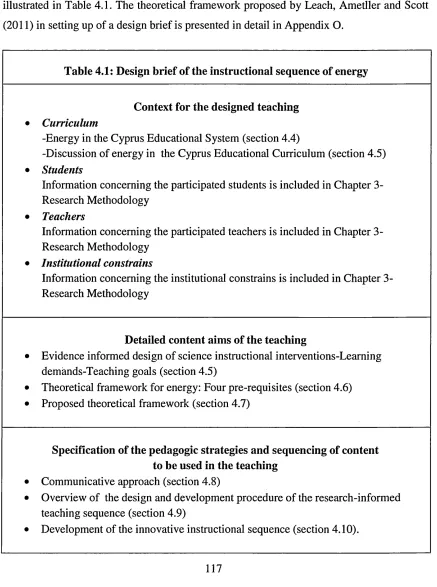
Table 3.1: Rubric for the analysis of video recorded lessons...104 Table 4.1: Design brief of the instructional sequence of energy...117 Table 4.2: Cyprus National Curriculum for Physics for the first grade of upper
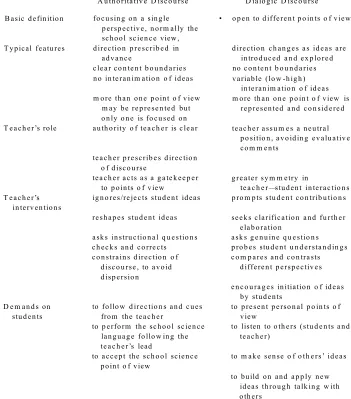
secondary school...118 Table 4.3: Key features of authoritative and dialogic discourse...138 Table 5.1: Categories of initial responses describing physically the event of the
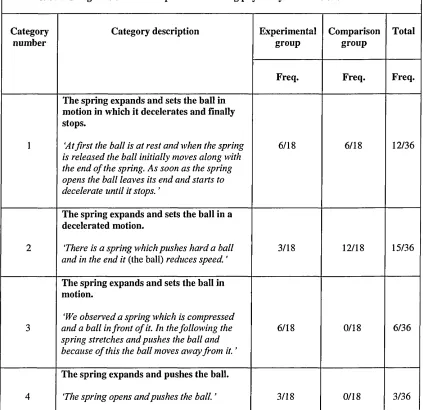
simulation... 184 Table 5.2: Students’ initial performance in formulating a physical description of the
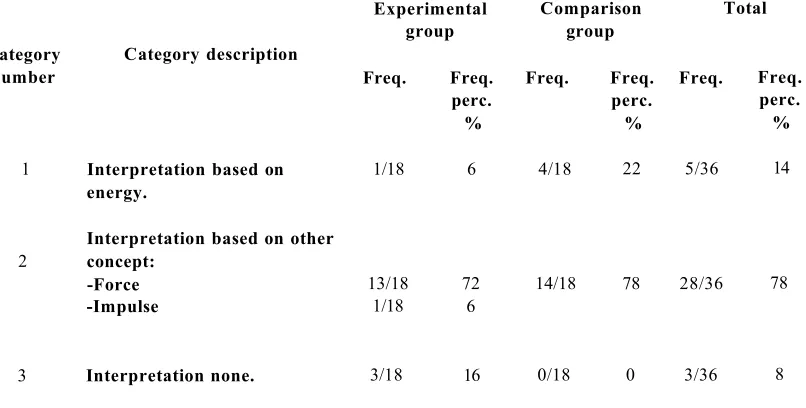
event of the simulation... 185 Table 5.3: Categories of initial responses interpreting the event of the simulation... 186 Table 5.4: Students’ initial performance in formulating an energy description of the
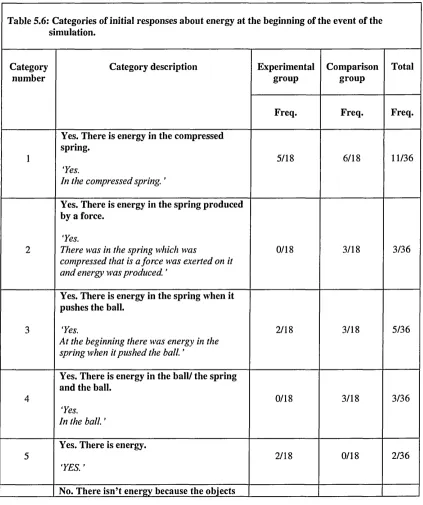
event of the simulation...188 Table 5.5: Results of Fisher’s Exact Test about the number of students in the two groups who initially used energy in their interpretations... 189 Table 5.6: Categories of initial responses about energy at the beginning of the event of
the
simulation...190 Table 5.7: Students’ initial views about energy at the beginning of the event of the
simulation... 191 Table 5.8: Categories of initial responses stating and justifying correctly/incorrectly that there is energy at the beginning... 192 Table 5.9: Results of Fisher’s Exact Test about the number of students in the two groups who stated and justified correctly that there is energy at the beginning 194 Table 5.10: Categories of initial responses about energy at the end of the event of the
simulation...195 Table 5.11: Students’ initial views about energy at the end of the event of the
simulation...196 Table 5.12: Categories of initial responses stating and justifying correctly/incorrectly
that there is energy at the end... 197 Table 5.13: Results of Fisher’s Exact Test about the number of students in the two
groups who initially stated and justified correctly/incorrectly that there is energy at the end...199 Table 5.14: Categories of initial responses about energy at the beginning and the end of
the event of the simulation... 200 Table 5.15: Students’ initial views about energy conservation...200 Table 5.16: Results of Fisher’s Exact Test about the number of students in the two
groups who stated initially that energy is conserved...202 Table 5.17: Categories of initial responses formulating a scientifically or an alternative
oriented energy description... 203 Table 5.18: Student’s initial views about energy degradation...205 Table 5.19: Results of Fisher’s Exact Test about the number of students in the two
Table5.21: Categories of responses about the energy of a battery...209
Table 5.22: Categories of responses about the energy of a runner...211
Table 5.23: Categories of responses about the energy of a book on a shelf...213
Table 5.24: Categories of responses about the energy of a barrel of petrol... 215
Table 5.25: Categories of responses about the energy of a stretched elastic band 217 Table 5.26: Categories of responses describing physically the event of the simulation after instruction... 220
Table 5.27: Students’ performance in formulating a physical description of the event of the simulation after instruction... 221
Table 5.28: Categories of responses interpreting the event of the simulation after instruction...222
Table 5.29: Students’ performance in formulating an energy description of the event of the simulation after instruction... 224
Table 5.30: Results of Fisher’s Exact Test about the number of students in the two groups who used energy in their interpretations after instruction...225
Table 5.31: Students’ performance in formulating an energy description through correct reasoning...226
Table 5.32: Categories of responses about energy at the beginning of the event of the simulation after instruction...227
Table 5.33: Students’ views about energy at the beginning of the event of the simulation after instruction... 228
Table 5.34: Categories of responses stating and justifying correctly/incorrectly that there is energy at the beginning after instruction... 229
Table 5.35: Results of Fisher’s Exact Test about the number of students in the two groups who stated that there is energy at the beginning...230
Table 5.36: Categories of responses about energy at the end of the event of the simulation after instruction... 231
Table 5.37: Students’ views about energy at the end of the event of the simulation after instruction...232
Table 5.38: Categories of responses stating and justifying correctly/incorrectly that there is energy at the end after instruction... 233
Table 5.39: Results of Fisher’s Exact Test about the number of students in the two groups who stated and justified correctly that there is energy at the end after instruction... 234
Table 5.40: Categories of responses about energy at the beginning and the end after instruction...235
Table 5.41: Students’ views about energy conservation after instruction... 236
Table 5.42: Results of Fisher’s Exact Test about the number of students in the two groups who stated that energy is conserved after instruction... 237
Table 5.43: Categories of responses formulating a scientifically or an alternative oriented energy description after instruction... 238
Table 5.44: Categories of responses formulating an energy description according to the ‘New7‘Forms7‘Conservation’ conceptual framework...240
Table 5.46: Results of Fisher’s Exact Test about the number of students in the two groups who stated that energy is degraded after instruction... 243 Table 5.47: Categories of responses about the amount of energy at the beginning of the
event of the first image... 244 Table 5.48: Students’ views about energy at the beginning of the event of the first
image...245 Table 5.49: Categories of responses stating and justifying correctly/incorrectly that there is energy at the beginning of the event of the first image...246 Table 5.50: Categories of responses about the energy at the beginning and the end of the event of the first image...247 Table 5.51: Students’ views about the conservation of energy of the system of the first
image...248 Table 5.52: Categories of responses formulating an energy description of the event of
the first image...249 Table 5.53: Students’ views about the degradation of the energy of the system of the
first image...251 Table 5.54: Categories of responses in which the mechanical working-kinetic store
theorem is used... 252 Table 5.55: Categories of responses about the amount of energy at the beginning of the
event of the second image... 254 Table 5.56: Students’ views about energy at the beginning of the event of the second
image...255 Table 5.57: Categories of responses about the place at which energy is initially
stored...256 Table 5.58: Categories of responses about energy at the end of the event of the second
image...257 Table 5.59: Students’ views about energy at the end of the event of the second
image...258 Table 5.60: Categories of responses about the amount of energy at the end of the event
of the second image...259 Table 5.61: Categories of responses in which the conservation of mechanical store
theorem is used... 260 Table 5.62: Categories of responses formulating an energy description of the event of
the second image... 262 Table 5.63: Students’ views about the degradation of the energy of the system of the
second image...263 Table 5.64: Student’s views about the store aspect of energy across all three
systems...264 Table 5.65: Students’ views about the transfer aspect of energy across all three
systems...266 Table 5.66: Students’ views about the conservation aspect of energy across all three
systems...267 Table 5.67: Students’ views about the degradation of energy across all three
LIST OF FIGURES
Figure 1.1: Overview of the doctoral thesis...9
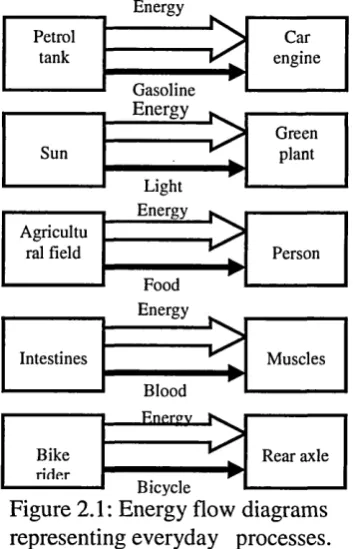
Figure 2.1: Energy flow diagrams representing everyday processes...24
Figure 2.2: An example of a system with a returnable energy carrier... 25
Figure 2.3: An example of a system with a returnable energy carrier... 25
Figure 2.4: An example of a system with receivers... 26
Figure 2.5: General form of a flow diagram... 30
Figure 2.6: The theoretical framework for energy proposed by Duit... 32
Figure 2.7: The systems included in the questionnaire and the interview protocol 37 Figure 2.8: Equivalent terms used for energy within the social, school and scientific context... 45
Figure 2.9: Abstract representations illustrating the preparation of a cup of ‘instant’ coffee... 49
Figure 2.10: Abstract representations illustrating heating and cooling procedures...50
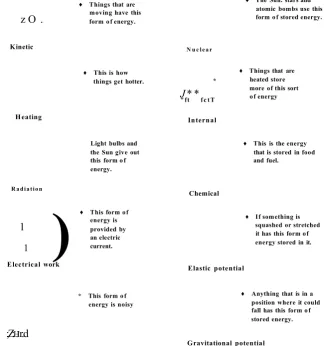
Figure 2.11: Visual representations and definitions of forms of energy... 54
Figure 2.12: An example of a section of an energy chain... 54
Figure 2.13: An example of a simple energy chain...55
Figure 2.14: General form of an energy chain representing the energy conservation 55 Figure 2.15: An example of an energy chain... 55
Figure 2.16: An example of a more complicated energy chain... 55
Figure 2.17: Structure plan of the proposed activity sequence...59
Figure 2.18: Cards of some forms of energy in storage and processes of transferring energy...60
Figure 2.19: An example of verbal and graphical energy interpretation of the changes observed in the system...61
Figure 2.20: Representations of energy stores... 65
Figure 2.21: Four pathways with which energy can be shifted...65
Figure 2.22: Physical and energy description of a process... 66
Figure 2.23: Snapshots for the start and the end of a process...67
Figure 2.24: Sankey diagram... 67
Figure 2.25: A Sankey diagram for a complex system... 68
Figure 2.26: (a) An energy chain, (b) Energy description by a sequence of states...69
Figure 3.1: Teaching intervention and data collection phase of experimental group 81 Figure 3.2: Teaching intervention and data collection phase of comparison group 82 Figure 3.3: Snapshots of the process which takes place in the simulation... 88
Figure 3.4: Coding scheme of post-test part B quantitative questions...101
Figure 4.1: The Educational System of Cyprus...116
Figure 4.2: Representations of selected energy stores...129
Figure 4.3: An example of Sankey diagram...133
Figure 4.4: Full Sequence Energy Diagram...134
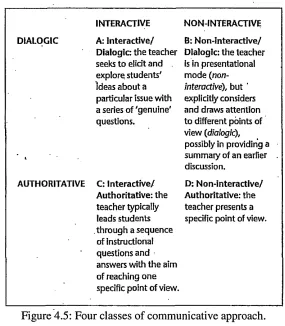
Figure 4.5: Four classes of communicative approach...139
Figure 4.6: Snapshots of Page 1 of simulation Sim 3... 141
Figure 4.7: Snapshots of Page 2 of simulation Sim 3... 142
Figure 4.8: Snapshots of Page 3 of simulation Sim 3... 143
Figure 4.9: Development procedure of the research-informed teaching sequence... 145 Figure 4.10: Structure of the research-informed teaching sequence...147 Figure 4.11: Structure of the ‘normal’ teaching sequence... 148 Figure 5.1: Total number of students who formulated a full, a partially full or an
incomplete physical description...185 Figure 5.2: Number of students who formulated a full, a partially full or an incomplete
physical description...186 Figure 5.3: Total number of students who formulated an energy-based or a non-energy
based interpretation for the event of the simulation... 188 Figure 5.4: Number of students who formulated an energy-based or a non-energy based
interpretation for the event of the simulation... 189 Figure 5.5: Total number of students who stated that there is or there isn’t energy in the
system at the beginning of the event of the simulation... 191 Figure 5.6: Number of students who stated that there is or there isn’t energy in the
system at the beginning of the event of the simulation... 192 Figure 5.7: Total number of students who stated that there is energy in the system at the
beginning of the event and justified correctly their statement... 193 Figure 5.8: Number of students who stated that there is energy in the system at the
beginning of the event and justified correctly their statement... 193 Figure 5.9: Total number of students who stated that there is or there isn’t energy at the
end of the event of the simulation...196 Figure 5.10: Number of students who stated that there is or there isn’t energy at the end
of the event of the simulation...197 Figure 5.11: Total number of students who stated that there is energy at the end of the
event and justified correctly their statement... 198 Figure 5.12: Number of students who stated that there is energy at the end of the event
and justified correctly their statement... 198 Figure 5.13: Total number of students who stated that energy is/is not conserved...201 Figure 5.14: Number of students who stated that energy is/is not conserved...201 Figure 5.15: Total number of students who formulated a scientific or an alternative
oriented energy description...204 Figure 5.16: Number of students who formulated a scientific or an alternative oriented
energy description... 204 Figure 5.17: Total number of students who stated that energy is/is not degraded...205 Figure 5.18: Number of students who stated that energy is/is not degraded...206 Figure 5.19: Total number of students who expressed ideas about the energy of the
system within the correct/activity/functional model... 208 Figure 5.20: Number of students who expressed ideas about the energy of the system
within the correct/activity/functional model... 209 Figure 5.21: Total number of students who expressed ideas about the energy of the
system within the depository/activity model... 210 Figure 5.22: Number of students who expressed ideas about the energy of the system
within the depository/activity model... 211 Figure 5.23: Total number of students who expressed ideas about the energy of the
Figure 5.24: Number of students who expressed ideas about the energy of the system within the correct/anthropocentric model... 213 Figure 5.25: Total number of students who expressed ideas about the energy of the
system within the activity model... 214 Figure 5.26: Number of students who expressed ideas about the energy of the system
within the activity model... 214 Figure 5.27: Total number of students who expressed ideas about the energy of the
system within the depository/activity model...216 Figure 5.28: Number of students who expressed ideas about the energy of the system
within the depository/activity model...216 Figure 5.29: Total number of students who expressed ideas about the energy of the
system within the correct/activity model... 218 Figure 5.30: Number of students who expressed ideas about the energy of the system
within the correct/activity model... 218 Figure 5.31: Number of students who formulated a full, a partially full or an incomplete
physical description...221 Figure 5.32: Number of students who formulated an energy-based or a non-energy
based interpretation of the event of the simulation... 225 Figure 5.33: Number of students who formulated a full and correct, a partially full and
correct or an incorrect energy-based interpretation... 226 Figure 5.34: Number of students who stated that there is/isn’t energy in the system at
the beginning of the event of the simulation...229 Figure 5.35: Number of students who stated that there is energy in the system at the
beginning of the event and justified correctly/incorrectly their statement.230 Figure 5.36: Number of students who stated that there is/isn’t energy in the system at
the end of the event of the simulation...233 Figure 5.37: Number of students who stated that there is energy in the system at the end
of the event and justified correctly/incorrectly their statement...234 Figure 5.38: Number of students who stated that energy is/is not conserved...236 Figure 5.39: Number of students who formulated a scientific or an alternative oriented
energy description... 239 Figure 5.40: Number of students who formulated an energy description according to the
‘New7‘Forms7‘Conservation’ conceptual framework...241 Figure 5.41: Number of students who stated that energy is/is not degraded...242 Figure 5.42: Number of students who stated that there is/isn’t energy in the system at
the beginning of the event of the image...246 Figure 5.43: Number of students who stated that there is energy in the system at the
beginning and justified correctly/incorrectly their statement... 247 Figure 5.44: Number of students who stated that energy is/is not conserved...249 Figure 5.45: Number of students who stated that energy is/is not degraded...252 Figure 5.46: Number of students who used correctly/incorrectly the mechanical
working-kinetic store theorem...253 Figure 5.47: Number of students who stated that there is/isn’t energy at the beginning of
the event of the image...255
Figure 5.48: Number of students who stated that there is energy in the chemical
store...256 Figure 5.49: Number of students who stated that there is/isn’t energy at the top of the
coin’s flight...258 Figure 5.50: Number of students who stated that there is energy at the top of the coin’s
flight and justified correctly/incorrectly their response...259 Figure 5.51: Number of students who used correctly/incorrectly the conservation of
mechanical store theorem... 261 Figure 5.52: Number of students who stated that energy is/is not degraded...263 Figure 5.53: Number of students who stated that there is/isn’t energy in the system at
the beginning of the physical process...265 Figure 5.54: Number of students who stated that there is energy in the system at the
beginning and justified correctly/incorrectly their response... 266 Figure 5.55: Number of students who stated that the energy of the system is/is not
conserved...267 Figure 5.56: Number of students who stated that the energy of the system is/is not
^ n u y i t r i - i m r u u u c u u n
CHAPTER 1-
INTRODUCTION
In this introductory chapter, the orientation of the work conducted in this doctoral thesis as a design study is presented. The aims and the research questions of the study are stated.
Then, the perspective on energy taken in this study is defined, which is consistent with Feynman’s abstract perspective.
This is followed by a brief presentation of energy within the context of international science education research. Research activity mainly followed two pathways: the investigation o f students’ accounts o f energy; and the development and evaluation of approaches to teaching energy. Furthermore, the teaching of energy within a Cyprus education context takes place according to the ‘forms’ approach.
The focus is then turned on a brief presentation of the design of the research- informed teaching sequence for energy proposed in this doctoral thesis. The designing of the teaching approach drawn upon the research evidence-informed design for science instructional interventions, the learning demand design tool and the energy ideas proposed within the SPT11-14 project.
The chapter concludes with an overview of the doctoral thesis.
1.1 THE ORIENTATION OF THIS STUDY
This doctoral thesis presents a theoretical rationale for the design, implementation and evaluation of an innovative research-informed teaching sequence aimed at promoting conceptual understanding of the concept of energy to upper secondary school Cypriot students aged 15-16 years old.
The study carried out in this thesis is within the tradition o f ‘design research’. It sets out the design of a teaching intervention and also an evaluation of its implementation in terms of students’ learning.
In setting up the design study, extensive research work found in the international science education literature reporting on the students’ interpretations on phenomena and events prior to formal teaching was reviewed. The students’ pre-instructional interpretations about energy reported in the international literature were compared with those of the Cypriot students and found to be consistent.
Chapter 1 -introduction
The international literature was searched for research work reporting on perspectives and methods to draw upon the design of the research-informed teaching sequence for energy and the design of the study. Among all insights gained by the critical review of perspectives and methods, the perspective set out by Leach, Scott and associates (Ametller, Leach and Scott, 2007; Leach and Scott, 2003; Scott, Leach, Hind and Lewis, 2006) was chosen. This informed design decisions at a fine grain size for both the content and the pedagogic strategies. Content-related decisions were informed by the Learning Demand design tool (Leach and Scott, 2002). In addition, the energy ideas proposed within the SPT11-14 project (2006) were used as a basis for the development of the theoretical framework of the teaching sequence. Furthermore, designing of the study included the testing of the relative effectiveness of the research-informed teaching sequence to promote conceptual understanding of the concept of energy compared to that might be expected teaching through the current Cyprus Curriculum for energy.
Therefore, the aims of the study were to:
• Review the international literature on teaching and learning about the concept of energy.
• Identify the key teaching and learning demands associated with the energy concept as described in the Cyprus National Curriculum for age 15-16 year. • Develop a research-informed instructional sequence to address these teaching
and learning demands.
• Implement and evaluate the instructional sequence.
• Review the overall strengths and weaknesses of the sequence including the views of the teacher.
The research questions for the study were as follows:
RQ1. What concepts of energy are used by a Cypriot cohort of upper high school students prior to teaching?
Chapter 1-Introduction
RQ3. How do the understandings of the energy concept, of a small sub-group of students, develop during the lessons of the research-informed approach?
To address the first research question, data were collected with the use of a pre-test administered to students of both the experimental and the comparison group. Pre-test data and data collected through a post-test also administered to students of both groups, were used to test the relative effectiveness of the teaching and thus addressing the second research question. For the third research question, data was collected from a small number of intervention students through pre and post test, two short-length diagnostic probes and two interviews and from an interview with the experimental teacher.
I.2 THE CONCEPT OF ENERGY
Energy is perhaps the most fundamental of scientific concepts and currently holds a crucial role in the natural sciences, technology and wider society in coming to understand and control issues such as energy supply, the economics of transportation and nutrition.
The term ‘energy’ derives from the Greek word svspysia (energeia) which means ‘action’, ‘activity’, ‘movement’, ‘operation’ or ‘work’ (see, for example: Anagnostou, 2004, p. 402, Stamatakos, 1972, p. 338). Etymologically, svspysia is the abstract noun of the ancient compound adjective svspyog (energos) the two components of which
sv+spyov mean ‘in work’ (see, for example: Anagnostou, 2004, p. 402).
Energeia was used as a technical term for the first time by Aristotle in 4th century B.C. In his works Nicomachean Ethics I.viiil098b33 and Metaphysics VIII-IX energeia is discussed in the sense of activity or being at work. In various places of Eudemian Ethics II.il 218b and Nicomachean Ethics I.viii 1098b33, he contrasts energeia with Svvapig
(dynamis) which means ‘force’ or ‘power’ and s&g (hexis) in the sense of activity or operation. Furthermore, in Metaphysics IX.iii 1047a energeia is compared to mvrjaig
(kinesis) which means ‘movement’ and sometimes has the sense of change (Peters, 1967, p. 55-56).
Chapter 1-Introduction
Despite its significance, energy is one of the most difficult and confusing of concepts, both to teach and to learn for deep understanding. One of the main reasons for these difficulties is that the word ‘energy’ is omnipresent in ‘everyday language’ and used in various ways which often are not consistent with, or even contradictory to, its scientific meaning (Solomon, 1983). As an example, energy in ‘everyday language’ is often associated with movement, force and activity, meanings which were attributed to it since the times of Aristotle.
A second main reason for attendant difficulties during the instruction and conceptual understanding of energy is its abstract nature; energy cannot be directly perceived or measured. Feynman, the famous Nobel Prize award-winning physicist admits that: ‘It is important to realize that in physics today, we have no knowledge of what energy is'
(Feynman, 1963, p. 4-2). In addition, due to its abstract nature, it would be fair to say that no simple and brief definition broadly accepted by scientists and science educators has been formulated so far. Perez and Pujol (2007, p. 569) state that: ‘Pedagogical practice shows that it is difficult to adopt a simple and direct definition like ‘energy is ...’.’ and they suggest that: ‘Rather, the concept of energy can not be presented and discussed out of its historical context. In order to understand really what energy is requires time: the concept is progressively grasped by observing that in every evolution of an isolated system an abstract quantity depending on the physical state of the studied system is conserved’.
1.3 THE PERSPECTIVE ON ENERGY TAKEN IN THIS STUDY
Physicist Richard Feynman, during a lecture to undergraduate students in 1961 at the California Institute of Technology, defined energy as follows:
Chapter 1-Introduction
Many physicists and physics educators agree with this view (see, for example: Warren, 1982), some others don’t (see, for example: Falk and Herrmann, 1979, Schmidt, 1982); they defend the position of a substance-like nature of energy which can be stored in a system or flow from one part of a system to other(s) or from one system to another. Warren (1982) characterized the former view as the ‘conceptualistic’ (Warren, 1982, p. 295) view of energy whereas the latter as the ‘materialistic’ view of energy.
Nevertheless, the conceptualistic view of energy was formulated by Feynman fifty years ago. Since then, physics science has made many and great steps of progress and has gained insights in domains of modern physics such as quantum and particle physics. Within these domains, the classical, as it could be characterized, conceptualistic view of energy might no longer really valid; it might most probably undergone a fundamental revision. Furthermore, these perspectives are extended far beyond the borders of school physics and thus, they would be no further discussed. The view of energy taken in this study is consistent with Feynman’s abstract perspective where conservation is the key property.
1.4 ENERGY IN THE CONTEXT OF SCIENCE EDUCATION RESEARCH
Energy as a scientific concept of crucial importance has attracted much interest within the science education research community over the past three decades and this focus remains until the present. Research activity has mainly followed two pathways: the investigation of students’ accounts of energy; and the formulation and evaluation of teaching approaches aimed at the effective instruction of energy.
Studies following the first pathway have revealed a set of alternative interpretations that students of a wide range of ages and across various nationalities use prior to, and often after, the formal instruction of energy. For students, energy is conceptualized as: (a) something which is exclusively associated with animate objects, (b) a causal agent in specific objects, (c) something associated with force and movement, (d) a fuel, (e) a fluid, (g) an ingredient or, (f) a product (see Chapter 2 for a full account).
Furthermore, findings from pre-testing data analysis carried out in the study presented in this doctoral thesis, suggest that little progress has been made in the direction of
Chapter 1-Introduction
energy education. Students tend to use the same alternative interpretations about energy as they did thirty years ago.
A review of the studies following the second research pathway (see Chapter 2) reveals that many attempts were made at the formulation of theoretical frameworks and the development of innovative teaching approaches to teach energy. However, a critical evaluation of these proposals has shown that these, in many cases, have failed in their main aim which is, to establish conceptual understanding of the concept of energy.
This failure in establishing conceptual understanding might be attributed to two main reasons. First, to the fact that some of them were based on a model of energy which is inconsistent with currently accepted scientific views for energy. One such example is the ‘forms’ of energy approach. Although there is evidence for the effectiveness of the approach, its theoretical framework includes considerable scientific inconsistencies (see Chapter 2).
The second reason is that other proposals were developed on scientifically consistent but difficult theoretical frameworks which made them inaccessible to many school students and thus inappropriate for school physics curricula. An example of such an intellectually challenging theoretical framework was proposed by Ogborn (1986) according to which, the occurrence of changes should not be attributed to energy but to entropy or free energy. As a process takes place in a physical system, energy is involved in the occurrence of a change whereas entropy or free energy is what decides whether or not the change will occur. The difficulty of this theoretical framework lies in the fact that it suggests the instruction of a difficult concept such as energy, through the use of an advanced physical law, that of the Second Law of Thermodynamics, with the pre requisite of understanding an even more difficult and abstract concept, that of entropy or free energy.
Lstiapter l -iniroaucuon
to the ‘forms’ of energy approach. In particular, in the first grade of upper secondary school the traditional approach is followed; this includes the introduction of the concept of work and the mechanical forms of energy, the kinetic and the potential (gravitational and elastic) and the introduction of the energy conservation principle of mechanics. Moreover, emphasis is placed on the quantitative application of the conservation principle of mechanics in the analysis of energy problems.
1.5 THE DESIGN OF THE RESEARCH-INFORMED TEACHING SEQUENCE
FOR ENERGY
The teaching sequence proposed in this doctoral thesis was developed according to research evidence-informed design of science instructional interventions (Scott, Leach, Hind and Lewis, 2006). Within this design, the development of the research-informed teaching sequence followed a four-step scheme as follows:
In the first step, the school energy knowledge to be taught was defined through the development of the theoretical framework of the teaching sequence. For this purpose, studies found in the international science education literature, reporting on approaches and theoretical frameworks aiming to teach the concept of energy were critically reviewed. Among all insights gained, the energy ideas proposed within the SPT11-14 project (2006) were selected as the basis on which the theoretical framework was developed. In the development process, the SPT energy model underwent considerable developments and innovations such as the elimination, modification and substitution of a series of elements proposed which were considered as sources of creating misconceptions, confusion or of difficulty in grasping the indented knowledge. Furthermore, the content of the current Cyprus energy curriculum was taken into consideration.
The second step included the consideration of how energy is conceptualized in the students’ pre-instructional reasoning. A great number of studies found in the international literature, investigating the students’ pre-instructional interpretations about energy were reviewed. Then, the Cypriot students’ pre-instructional interpretations about energy were collected and compared with those reported in international literature were found to be consistent.
v^nupier x-lriiruuuLuun
In the third step, the learning demands concerning the energy concept were identified. These were revealed by appraising the differences between the theoretical framework for energy set up in the first step and the Cypriot students’ pre-instructional interpretations about energy considered in the second step.
In the fourth and last step, the teaching interventions addressing each of the learning demands revealed in the third step were designed and developed. This process included: the identification of the teaching goals addressing each specific energy idea, the development of a sequence of activities through the specific teaching goals be addressed, and, the specification of how these activities might be linked with appropriate classroom talk. A review of interactive teaching approaches reported in the international literature resulted in selecting the Communicative Approach (Mortimer and Scott, 2003). Then, each activity was linked with one of four classes of communicative approach which considered as appropriate to be used. Furthermore, the most of the activities included the use of computer simulations especially created to support the teaching goals addressed and all were supported by worksheets developed for each of these activities.
The research-informed teaching sequence was implemented with thirty six Cypriot students aged 15-16 years-old in two intact classes of an urban high school in Limassol, Cyprus. One of the classes acted as the experimental group, receiving the ‘new’ teaching sequence whilst the comparison group followed normal teaching. In this way, the innovative teaching sequence was evaluated on the grounds of its effectiveness in establishing conceptual understanding, in comparison with normal teaching. Findings of data analysis strongly point towards the relative effectiveness of the instructional sequence.
1.6 OVERVIEW OF THE DOCTORAL THESIS
l,n a p ie r 1 -inirouucuuri
Chapter 1: Introduction
C hapter 2: Literature Review
C hapter 3: Research methodology
Chapter 4: The design of the teaching sequence: Methodological basis and practical decisions
C hapter 5: Evaluation of the teaching-Findings for RQ1 and RQ2
C hapter 6: Evaluation of the teaching- Findings for RQ3
Chapter 7: Summary of the findings and discussion
It sets out the conceptualisation of the whole study, plus methodological decisions about evaluation.
It sets out the rationale for the design, and accounts for actual design decisions in the teaching intervention.
The evaluation of the implementation of the research-informed teaching sequence continues following that carried out in Chapter 5 and concludes.
It sets out an evaluation of the implementation of the research-informed teaching sequence. This continues in the next Chapter 6.
It sets out the orientation of the doctoral thesis as a design study and a brief description of the work done following this scheme.
It sets out the literature on students’ interpretations of phenomena and events were scientific interpretation draws upon energy, plus literature on approaches to teaching energy.
It sets out a summary of the design and evaluation work done, a methodological critique, discussion on the implications of the study on energy education, both in a Cyprus and an international context and finally, recommendations for further study are formulated.
Figure 1.1: Overview of the doctoral thesis.
l,nupiei z- m e r u iu r e n tv ie w
CHAPTER 2-
LITERATURE REVIEW
This chapter presents a review of extensive academic work concerning energy found in the international science education literature.
In the first part, studies reporting on the students’ alternative interpretations about energy are reviewed. These were conducted across a few decades and in many nationalities.
In the second part, studies reporting on theoretical frameworks and approaches for teaching energy are reviewed and critically discussed.
2.0 INTRODUCTION
Energy as one of fundamental scientific concepts included in science education curricula has been the subject of extensive research studies. The studies carried out have mainly focused on the investigation of the students’ alternative interpretations of phenomena and events where scientific interpretation draws upon energy and on the formulation and development of innovative teaching approaches aimed at the effective instruction of energy.
In this chapter, the international science education literature concerning energy is reviewed. First, studies reporting on the students’ alternative interpretations about energy are considered. Discussion is then turned to a critical review of studies reporting on proposals for teaching and learning the energy concept.
I. THE STUDENTS ALTERNATIVE INTERPRETATIONS ABOUT ENERGY Results from research on primary, secondary and university students and even pre service teachers’ understandings of energy revealed a set of alternative interpretations and difficulties prior and even after instruction. Gilbert and Pope (1986) categorized alternative interpretations about energy into the following conceptual models:
(a) anthropocentric, (b) depository, (c) activity, (d) functional, (e) flow-transfer, (f) ingredient and (g ) product.
K sriuyitf ^ - l ^ i ie r u i u f e i x c v i e v v
2.1 Ene r g ya n d a n im a t e o b je c t s-Th e An t h r o p o c e n t r ic Mo d e l
Several studies undertaken with a range of students of all age levels revealed that energy is associated with animate objects and in particular with human beings. Watts and Gilbert (1985) identified a ‘human centered’ framework for energy according to which energy is associated mainly with humans or with objects to which they attributed human characteristics. Black and Solomon (1983) reported a shift away from ‘living associations’ of energy with age. In a study with students aged 11-13 years, they found that while the notion was prevalent among youngest students, many students began to expand their perceptions of energy into a more general conceptual framework in which ‘non-living’ associations such as electricity, power stations, moving objects, lighting and fire were included. Furthermore, Solomon (1983) noted that girls associate energy with animate objects in a greater proportion than boys.
Solomon (1983), in studying students’ responses classified them into four themes two of which relate to the anthropocentric model. These are:
• vitalism, a notion which has its origin in eighteenth century according to which energy is considered as something indispensable for life;
• activity, according to which humans need energy to move.
In a study carried out by Stead (1980), students expressed views on energy within the notions of vitalism and activity. Moreover, they expressed the notion that energy is related to fitness and strength stating that without energy human beings would be tired, unfit or listless. In addition, they considered that non-living objects do not need energy.
Human-centered views about energy are not expressed only by students but also by adults. In a study conducted by Kruger (1990) aimed at the investigation of pre-service primary teachers’ views on energy it revealed that many of them had the notions of vitalism and activity.
2.2 En e r g y a sa so u r c e o fa c t iv it y-Th e De p o sit o r y Mo d e l
According to the depository model, certain objects, materials or devices such as fuels, food and batteries can deposit or re-deposit energy, need energy or expend the energy they get. Energy is considered as a causal agent which is stored in certain objects
Lfiapter z-Literature Keview
(Gilbert and Pope, 1982; Trumper, 1990a; Watts and Gilbert, 1985). In a study conducted by Solomon (1983) it was found that some students related energy with machines, or some kinds of work to an input of energy coming from electricity or another ‘kind’ of fuel. Ault et al. (1988) also report a framework in which some objects are thought by students as sources of energy in which it is stored.
The depository model was also identified by Kruger (1990) in a study with pre-service primary teachers. In their responses, the teachers seemed to consider energy as a ‘hidden force’ which remains as such waiting to be used.
2.3 En e r g y, m o v e m e n ta n d f o r c e-Th e Ac t iv it y Mo d el
Within the activity model, energy is associated with movement, force and activity. Stead (1980) found that students who associated energy with movement considered that there is energy only in inanimate moving objects whereas in the case of non-moving objects, that they could not have energy. Watts and Gilbert (1983) reported similar findings and added that in many cases, the movement itself was perceived as energy. Gilbert and Pope (1982) in their turn reported that movement was often considered as a way for energy to be expressed. Watts (1983b) also identified a similar framework for energy within which energy is associated with obvious activity with movement being specified as the reason for energy being involved. Furthermore, the association between energy and movement was also reported by Solomon (1983a).
The notions that there is no energy in non-moving objects and that energy is associated with movement and activity was also identified by Kruger (1990) in a study with pre service primary teachers. Some teachers expressed the view that the amount of kinetic energy of a moving object does not depend on its speed whereas other teachers perceived friction and gravity as energy. Finally, it was revealed that many teachers seemed to confuse ‘energy’ with ‘force’ while some others used the two concepts as synonymous.
2.4 En e r g ya sa f u e l-Th e Fu n c t io n a l Mo d e l
The notion of energy as a fuel, the resources of which are limited, seems to be prevalent among students worldwide. Solomon (1983a) found that one of the students’ most common responses related to shortage of energy in the future and the need for new energy sources to be found in order for the needs of the planet to be satisfied. The researcher classified these responses in an individual category which she named ‘energy shortage’. Duit (1981) also identified the use of ‘energy crisis’ in some students’ responses whereas a considerable number associated energy with power plants. In a later study with students from Germany and Philippines in grades 7-10, Duit (1984) found that in German students’ responses energy was closely associated with fuels and electricity; however, associations of this kind were not identified in Philippine students’ responses. Furthermore, Ault et al. (1988) also noted a similar view for energy considered as a fuel.
A study carried out by Stead (1980) revealed that many students used in their responses the word ‘energy’ as synonymous with the word ‘fuel’. Furthermore, as the researcher remarks, the use in everyday language of the phrases ‘energy crisis’ and ‘conserve energy’ which actually mean ‘fuel crisis’ and ‘fuel conservation’ led the students to the belief that fuel is energy.
Watts (1983a) identified ‘functional’ energy as another framework for energy according to which, energy is considered as a general kind of fuel. Within the functional framework, energy is mainly associated with its applications; it is considered by students as something necessary for things to work, specifically by technical appliances, and associated with processes which make human life comfortable.
Another view expressed by some pre-service primary students in a study carried out by Kruger (1990) was that energy comes from the sun.
2.5 En e r g y a s a f l u id, a n in g r e d ie n t o r a p r o d u c t- Th e Fl o w-t r a n sf e r,
In g r e d ie n t a n d Pr o d u c t Mo d el s
Three further models are identified by Watts and Gilbert (1985), that of energy as a fluid, an ingredient or a ‘by-product’.
According to the ‘flow transfer’ framework, energy is considered as a fluid which can be ‘put in’, ‘given’, ‘transported’ or ‘flow’ from one object to another. The notion of energy as a fluid is also reported by Duit (1981) and Gayford (1986) and by Orfanidou (2007) in a later study with first year primary education university students. As Orfanidou (2007) noted, a frequent notion in the students’ interpretations was that energy can be ‘released’ from one part of a system and flow to another part or parts of it. Furthermore, the idea of energy as a substance in nature quantity was reported and by Stead (1980).
Within the ‘ingredient’ framework, energy is associated with fluids or ingredients and is considered as a reactive rather than a causal agent which remains dormant in them until it is released suddenly by a trigger. Furthermore, energy is considered to arise all of a sudden as a result of a kind of combination of ingredients.
Turning to the ‘product’ framework, energy is viewed as a ‘by-product’ of a situation, as a relatively short-lived product which is generated, is active and then disappears or fades.
2.6 Co n se r v a t io no f e n e r g y
K s f l U y i G t U l U f C- IV C - K t c v v
that even in the 15-16 year old group only one third of the students were certain of this response.
Duit (1981) reports that a study which he conducted with students aged 12-14 years revealed that they do not see a need for the idea of conservation. In explaining their responses, none of the students made use of energy conservation before instruction whereas after instruction, only a few mentioned it. Furthermore, the students tended to explain in terms of observable features of the system under study. As Duit suggests, students prefer to use ideas gained from everyday experience rather than scientific ideas such as energy, taught in science lessons.
The findings reported by Driver and Warrington (1985) supported those of Duit. A study which they carried out with students aged 13-18 years, all of whom had been exposed to energy conservation instruction, revealed that only a few students used interpretations in terms of energy conservation in their responses. Moreover, the researchers found that although the students were able to use energy conservation, they tended to give interpretations using some more conceptually obvious ideas rather than the energy conservation given a free choice.
Brook and Driver (1984) also reported that only a few students made use of the conservation of energy idea. In addition, they found that many students preferred to focus on tangible features of the system under study instead of using energy ideas, even when they were explicitly directed to do so.
Black and Solomon (1983) found that students encounter considerable difficulty in integrating the scientific idea of conservation of energy with their everyday experience. They suggest that this difficulty might be attributed to the contradictory way the scientific words ‘energy’ and ‘conservation’ are used in everyday language. Furthermore, they report that when the students were asked to describe fully in terms of energy the bouncing of a ball, some students, although they recognized the conservation of energy principle, intuitively stated that energy could be lost. In addition, only a few students used the energy conservation idea whereas a considerable number stated that since energy cannot be destroyed, it must be stored in some way, or that it must turn up again in its original form.
Ault et al. (1988) noted that the ‘energy gets used up’ view according to which things go until energy is used up or fuel is consumed appears frequently in the students’ responses. In their turn, Goldring and Osborn (1994) report that in many students’ responses, the notion that ‘conservation of energy’ actually means ‘save energy’ was included whereas others expressed the view that energy is conservable only within a laboratory.
Difficulties concerning the conservation of energy idea were also identified among university students and prospective science educators. For example, Liu et al. (2002) reported that university chemical engineering students failed to use the conservation of energy principle in interpreting the temperature change in solution processes.
In a study with first year primary education university students, Orfanidou (2007) found that only a negligible number used energy conservation in their interpretations prior to instruction. The students were asked to describe fully the changes observed in a system in which a football player was shown to kick a ball and set it in a decelerated motion on a horizontal plane and finally stop at a small distance. Half of the students stated that at the end, the energy of the system is stored in the same amount and form, in the place or places in which it was initially stored. According to the researcher, this view suggests little understanding of the conservation of energy idea. As discussed earlier, similar findings were reported also by Black and Solomon (1983). Moreover, a considerable number of students expressed the view that energy is not conserved through expressions such as ‘energy disappears’ or ‘energy stops to exist’ in their interpretations.
A study carried out by Kruger (1990) with pre-service primary teachers revealed that many of them considered energy as a non-conservable quantity.
2.7 Ot h e r a l t e r n a t iv ein t e r p r e t a t io n sa b o u t en e r g y
Further research revealed additional alternative interpretations which are not classified in any of the models for energy presented earlier. These are presented in the following.
• whenever there is an energy transfer, mechanical working is done; • mechanical working ‘produces’ force and;
In a study carried out with university students, Orfanidou (2007) identified student ideas that:
• ‘pressure’ is stored in a compressed spring;
• mechanical working done by the weight of an object (or the force exerted by a worker on an object) is proportional to the effort made by the worker when lifting up the object;
• mechanical working done by the weight of an object (or by another force exerted on the object), during its movement from one vertical position to another, depends on the path followed by the object between the two positions;
• the amount of energy in a gravitational store of the system object-Earth is proportional to the effort made by a worker when lifting up the object;
• the amount of energy in a gravitational store of the system object-Earth depends on the path followed by the object when moving from its initial to its final vertical position;
• energy is stored only in a gravitational store of the system object-Earth during the vertical movement of an object.
Furthermore, Kruger (1994) identified what he refers to as a ‘theocratic view’ of energy among pre-service science teachers. A few teachers used metaphysical interpretations in their responses according to which, energy comes from God.
II. PERSPECTIVES ON THE ENERGY CONCEPT AND APPROACHES TO
THE TEACHING AND LEARNING OF ENERGY.
In this section, various proposals for teaching and learning of the concept of energy and the discussion conducted about their effectiveness among researchers are presented and critically discussed.
2.8 ENERGY IS THE ABILITY OF DOING WORK
Warren in a series of articles (1982, 1983, 1986, 1991) argues for a conceptual view of energy within the context of school physics. According to Warren:
‘In science there is a mathematical abstraction, called energy, which is the capacity of a body or system for doing work (in the scientific meaning of the word) by ideal processes. Different kinds of energy are defined in terms of the properties of systems which would enable them to do work directly or indirectly in some ideal way’(Warren, 1991, p. 8).
‘... its importance lies in the fact that for all phenomena hitherto studied thoroughly a rigorous law of conservation is found to be applicable’ (Warren, 1982, p. 295).
Elsewhere he states that:
‘Energy is an abstraction used in theoretical analysis of phenomena, and is not a commodity, a phenomenon or a sensation. The only way in which one can have ‘experience’ of energy is by using the concept in an analysis or calculation’ (Warren, 1983, p. 210).
In expanding his reasoning, he describes a few examples one of which is the following (Warren, 1983, p. 210):
‘When a body of mass m is raised through a distance x above the ground it is said to have acquired a potential energy mgx. According to current teaching methods this energy is a ‘substance’ which has been put into the body. Actually nothing has been put into the body, which is unchanged except in position. If it is allowed to return to the ground the gravitational field o f the earth will do work on it equal to mgx. That is, potential energy is
not something in the body. It is an abstract quantity, the calculation of which helps us to predict what will happen when the body returns to the ground’.
Warren makes a distinction between the concept of energy and the concept of work; he stresses that energy is ‘a quantitative measure of the condition of a system whilst work is a process. Energy may be transformed or transmitted (or both) by means of work, but it cannot be transformed into it’ (Warren, 1982, p. 296). In explaining the distinction that he makes between energy and work, he gives the following exam