Content-aware tweet location inference using quadtree
spatial partitioning and jaccard-cosine word embedding
AJAO, O, BHOWMIK, Deepayan <http://orcid.org/0000-0003-1762-1578> and
ZARGARI, Shahrzad <http://orcid.org/0000-0001-6511-7646>
Available from Sheffield Hallam University Research Archive (SHURA) at:
http://shura.shu.ac.uk/23724/
This document is the author deposited version. You are advised to consult the
publisher's version if you wish to cite from it.
Published version
AJAO, O, BHOWMIK, Deepayan and ZARGARI, Shahrzad (2018). Content-aware
tweet location inference using quadtree spatial partitioning and jaccard-cosine word
embedding. In: ASONAM 2018 : Proceedings of the 2018 IEEE/ACM International
Conference on Advances in Social Networks Analysis and Mining. IEEE, 1116-1123.
Copyright and re-use policy
See
http://shura.shu.ac.uk/information.html
Content-Aware Tweet Location Inference
using Quadtree Spatial Partitioning and
Jaccard-Cosine Word Embedding
Oluwaseun Ajao
Sheffield Hallam UniversityUnited Kingdom [email protected]
Deepayan Bhowmik
University of StirlingUnited Kingdom [email protected]
Shahrzad Zargari
Sheffield Hallam UniversityUnited Kingdom [email protected]
tracking of the online users also has benefits relating public safety and security.
The growing threat of online crimes ranging from messages focused at propagating hatred, to cyberbullying and spread of fake news and false information for the purpose of promoting malicious selfish intentions; personal or political gains have continued to cause governments, corporate organisations and individuals cause for concern. Social media is a good tool for the promotion of information but the fact that it is uncensored -stemming from the notion of freedom of speech which obtains in most democracies tend to be abused. It is crucial that law enforcement bodies are able to track down the location of these offenders and the origin of these messages to curtail their spread before they begin to ‘infect‘ the behaviours and actions of other online users.
The large footprint of Twitter makes it an important mar-ketplace for advertisers to reach their consumers, and serve as projection platforms for the government to its citizens. Knowl-edge of users who interact on Twitter may be quite useful for organisations that render these services. There exist third party domains and other sources such as knowledge bases. These sources amongst others are useful for estimating user locations [4]. However, they may be unreliable and insufficient for effectively estimating the location of users. This brings the need to infer locations from transmitted messages solely based on the content alongside other relevant metadata information captured with the tweets such as user description and time zone information etc.
In this paper we propose a novel non-uniform grid-based approach for location inference from Twitter messages com-bining quadtree spatial partitions and semantic understanding using Natural Language Processing (NLP). The contributions made in this work is given as follows.
• A discriminative grid-based approach for the determina-tion of tweet locadetermina-tions based on the content,
• A Quadtree spatial indexing technique for inferring loca-tions based on variable nodes,
• A NLP based hybrid word embedding model consisting of Cosine and Jaccard similarity measures [5] for
dimen-Abstract—Inferring locationsfromusertextson socialmedia
platforms is a non-trivial and challenging problem relating
to public safety. We propose a novel non-uniform grid-based
approach for location inference from Twitter messages using
Quadtreespatialpartitions.Theproposedalgorithmusesnatural
language processing (NLP) for semantic understanding and
incorporates Cosine similarity andJaccard similarity measures
for feature vector extraction and dimensionality reduction. We
chose Twitterasourexperimental socialmediaplatform dueto
its popularity and effectiveness for the dissemination of news
and stories about recent events happening around the world.
Our approachisthefirsto fi tsk indt om akel ocationinference
fromtweetsusingQuadtreespatialpartitionsandNLP,inhybrid
word-vector representations. The proposed algorithm achieved
significantc lassificationac curacyan dou tperformed
state-of-the-art grid-based content-only location inference methods by up
to 24%in correctly predicting tweetlocations withina 161km
radius and by 300km in median error distance on benchmark
datasets.
I. INTRODUCTION
The task of inferring user locations on Twitter as well as mostsocialmediaplatformsisnon-trivialspurringtheinterests of many researchers in the fieldo fa rtificialintelligence, computer science and behavioural sciences alike for almost a decade. Studies show that only less than 2% of Twitter users discloseor geotag thelocation of tweets [1][2] dueto fearsofbeingtrackedbyonlinepredatorsthuspreservingtheir personalsafetyorbyadvertisersthatusecookiestocontinually send themoftentimesunsolicitedproductadvertisements that havebeen personalisedtotheir trackedlocation.Somesocial media sites even offer tailored location-based services such as Snapchatoffering anewaddition called SnapMap1 where onecantrack thelocation offriendsusing theApp andeven know the statusof their current activity including if theyare sleepingorinriddingacarorshopping.Theseinformationare quite privateandthe usersmaynot evenbe awaretheyhave provided such information which could lead to stalking and posing threats especially for children [3]. However location
1www.snapchat.com
sionality reduction in the feature vector, and representa-tion [6].
• Improvement in grid-based location inference based solely on the content of Twitter messages.
A functional block diagram of the proposed algorithm is depicted in Fig. 1. In the remainder of this paper Section II gives related works in the field of location inference and NLP, Section III gives description of the methodology used during the experiment. Analysis and results are presented in Section IV while Section V gives the conclusions.
II. RELATEDWORKS
Location inference also referred to in literature as Geoloca-tion PredicGeoloca-tionhas enjoyed a fair amount of research interests by several authors working within the space. A few works have been written on the inference of location of Twitter users. The one most related to this work is the [7] where the authors estimated user locations solely based on the content of their messages using supervised classification. The work extracted local words from the messages of users with the assumption that users from specific geographic locations would normally use words that are local to that geographic location. For example the word howdywhich ishelloin English would be considered to be more frequently used in the US state of Texas. However, the authors did not actively seek out to recognise entities such the names of people, places and organisation within twitter messages as part of their location inference technique unlike our proposal in this work. It should be noted that some of such local words they identified could also be geo-entities, for instance their probabilistic method identified the worducsb to show a peak distribution around the state of California as this was the abbreviation for the University of California located in the city of Santa Barbara.
Location inference and privacy of geo-spatial data have always been an area of concern. Krumm [21] examined the identification of users from web search data and was able to successfully identify their locations to the granularity level of home addresses from GPS data. This is was possible due to the very high degree of correctness that GPS data typically offers. However, the availability of location information is not always guaranteed which introduce additional challenges. Our approach aims to address this issue by inferring the user locations to a city-level accuracy by analysing user texts available from social media. Privacy continues to be an emerging area of research discussion [20] with people choosing to hide their online identities to keep an anonymous profile from other users and in some cases for the safety and the fear of being trolled online by cyberbullies especially in the social media and Twitter in particular.
Han et al.[22] used words referred as Location Indicative Words (LIWs) and provided a spatial clue to indicate the whereabouts of the users. It was proposed that users were more likely to be successful in preserving their privacy if they refrain from mentioning these LIWs in their online conversations and also to actively delete location meta data from their online footprint. This seems far from being realistic as users will
most likely be tracked by the social media platforms who passively collect and retain time-stamped information such as time-zones and IP addresses of their users, Most of these meta data is then made available to the public via the Twitter API and can be linked it to the users who created them. Other works done in the field can be found in [11] that proposed a method which learns association from locations and keywords from previous user messages to predict subsequent messages. The challenge with this method is that to effectively train a location classifier the past tweets of a user would have to be collected and analysed and may be prove to be technically infeasible because at the moment the Twitter REST API only allows the retrieval of the last 3200 messages of any user. Secondly there is the possibility that users can relocate over time from one city to another or even from one country and time zone to another. Thus online themes and conversations that they tweet about today may be different tomorrow. Our approach is not user-specific and relies on word-usage and geo-entities associated with locations.
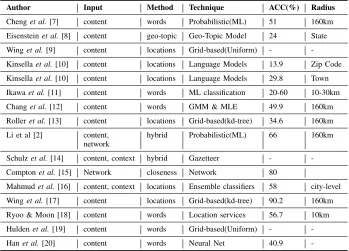
Jurgens [23] applied label propagation of location assign-ments to the knowledge of locations. The work relied on the friends connections also known as their ego network locations including self-reported ones found in the free-text fields of the user profiles. Comptonet al.[15] inferred location from the friends network with known locations. Their work presented the largest dataset utilised till date for the training and testing of their location inference classifier accounting for tweets captured from over 100 million Twitter users. Chang et al. [12] used Gaussian mixture models and maximum likelihood estimation (MLE) which is purely content-based in addition to the use of local words distribution within messages. Mahmudet al.[16] used an ensemble of statistical and heuristic classifiers. Their approach also followed a hybrid of both tweet content and social network profile information including the friends networks. Ajaoet al.[4] gave an insight into a range of clues for estimating user locations in addition to the message content. They outlined three various locations that had been inferred in on Twitter including tweeting location, user home residence and message context that have mentions or references to certain geographical locations or points of interests. Various partitioning algorithms are proposed in the literature to infer Tweet locations including k-dimensional trees [13], [17] or uniform grids [9], [19]. A further breakdown of reported results from related works is presented in Table I. We believe the task of location inference from tweets and other sources that involves the use of text, relies on natural language processing models and machine learning techniques to understand the semantics. There are over 500 million messages sent by Twitter users each day2. Thus, it is humanly impossible to manually sift through the contents of these mes-sages and make meaning of them. NLP models such as word embedding and pattern recognition capabilities of machine learning models are useful in the identification of patterns [24] within the text. This helps in machine understanding of the
Fig. 1. Functional diagram illustrating the tweets location inference task.
TABLE I
METHODS ANDOUTCOMES FROMRELATEDWORKS INTWITTERLOCATIONINFERENCE
Author Input Method Technique ACC(%) Radius
Chenget al.[7] content words Probabilistic(ML) 51 160km
Eisensteinet al.[8] content geo-topic Geo-Topic Model 24 State
Winget al.[9] content locations Grid-based(Uniform) -
-Kinsellaet al.[10] content locations Language Models 13.9 Zip Code
Kinsellaet al.[10] content locations Language Models 29.8 Town
Ikawaet al.[11] content words ML classification 20-60 10-30km
Changet al.[12] content words GMM & MLE 49.9 160km
Rolleret al.[13] content locations Grid-based(kd-tree) 34.6 160km
Li et al [2] content, network
hybrid Probabilistic(ML) 66 160km
Schulzet al.[14] content, context hybrid Gazetteer -
-Comptonet al.[15] Network closeness Network 80
Mahmudet al.[16] content, context locations Ensemble classifiers 58 city-level
Winget al.[17] content locations Grid-based(kd-tree) 90.2 160km
Ryoo & Moon [18] content words Location services 56.7 10km
Huldenet al.[19] content words Grid-based(Uniform) -
-Hanet al.[20] content words Neural Net 40.9
-human language and drawing insights suitable for the process. NLP methods applied in this work includes the use of the continuous bag of word (CBOW) model [25] for embedding the words into vectors. Additionally, Jaccard similarity and Cosine distance of word vectors [5], [26] was computed for feature extraction and word dimensionality reduction to get prediction-relevant text. To the best of our knowledge our approach is the first to use Quadtree spatial indexes combining with NLP for content-aware location prediction on Twitter.
III. METHODOLOGY
We propose a new grid-based approach for location infer-ence from Twitter messages using quadtree spatial partitions. The proposed algorithm incorporates Cosine similarity and Jaccard similarity measures for NLP-based feature vector extraction and dimensionality reduction. The summary of the illustration of our approach towards content-based location inference is given in Fig. 1 and described in detail in this section.
A. Feature Vector Creation using NLP
The proposed work incorporates natural language process-ing methods in creatprocess-ing the feature vector. This includes word embedding, where the words are converted to numbers in order to process them effectively and forming the vector
Fig. 2. Methods of Word Embedding in Natural Language Processing
representation of those words. There are two broad cate-gories of word embedding namely,a)frequency-based andb) prediction-based word embeddings as seen in Fig. 2. Available models for word embedding include the continuous bag-of-words CBOW model [27], Word2vec model [25] and Glove model [28]. Prediction based word embedding techniques such as word2vec are proved to be the state-of-the-art technique and have the advantages over deterministic methods such as conventional bag-of-words or count vectors. These also have the ability to incorporate neural networks improves their performance compared to their predecessors. For our work we adopted theword2vecmodel proposed in [25].
[image:4.612.132.481.154.405.2]0 2 4 6 8 10 12 14 16 0 1 Pr ec isi on
Uniform Grids - 4x4
0 10 20 30 40 50
0.0 0.2 0.4 0.6 0.8
1.0 Uniform Grids - 8x8
0 20 40 60 80 100 120 140 Grids 0.0 0.2 0.4 0.6 0.8 1.0 Pr ec isi on
0 20 40 60 80 100 120 140 Grids 0.0 0.2 0.4 0.6 0.8 1.0 0.5 1.0 1.5 2.0 2.5 3.0 3.5 4.0 4.5 5.0 0.0 0.5 1.0 1.5 2.0 2.5 3.0 3.5 4.0 4.5 Log Cou nt 0.0 0.5 1.0 1.5 2.0 2.5 3.0 3.5 4.0 4.5 Uniform Grids - 16x16
0.0 0.5 1.0 1.5 2.0 2.5 3.0 3.5 4.0 4.5 Log Cou nt
Uniform Grids - 32x32
[image:5.612.370.500.54.186.2]Precision LogCount
Fig. 3. Interaction between precision and log of uniform grid counts
includes following three central steps:
Calculation of linear vector: Linear vector calculations are
implemented on feature vectors using word2vec. An example of this is King - Man + Woman = Queen. This is inherent in the fact that once words are con-verted into vectors they lend themselves to algebraic and mathematical operations thus revealing the association and relationships that exist between them. In the above example the gender is the relationship between them.
Identification of synonyms used in the messages: Words
that have the same semantic meaning are given the same representation. In essence it looks out for word synonyms avoids redundancy and significantly reduces the size of the feature vector and computing time. For example the two sentencesS1 = {That is a small thing}
and S2 = {That is a little thing} will be considered the
same, thus improving the effectiveness of their respective word-vector representation.
Determination of similarity threshold: Similarity
thresholds can be specified where the distance between the feature vectors is measured with the cosine similarity functions (described in Eq. (1) and Eq. (2)). In this regard, words that have similar syntactic appearance but were however mis-spelt, exaggerated or abbreviated would be recognised and given the same representation within the vector space. This can be achieved by the cosine function to compare their similarity with the English language dictionary. For example, Yeeeees is equivalent to Yes orGooooood is recognised asGood.
In order to measure the closeness between the word feature vectors we have used two types of similarity measures [5]: a) Cosine similarityandb) Jaccard similarityas described below. Considering two non-zero vectors, pandq, each having com-ponent values 1,2, ...n, their cosine similarity (Simc(p, q))
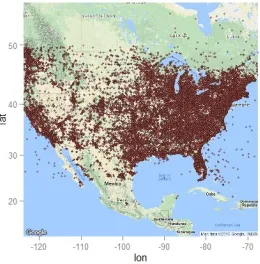
[image:5.612.55.295.60.237.2]Fig. 4. Geo-located US Tweets partitioned with our Quadtree algorithm
Fig. 5. US cities with population over 5,000.
can be calculated as:
Simc(p, q) =
p.q
kpk2.kqk2 = n P
i=1 pi.qi
s n P i=1 p2 i. s n P i=1 q2 i . (1)
For the same vectors the Jaccard similarity (Simj(p, q)) is calculated by:
Simj(p, q) = |p∩q|
|p∪q|. (2)
B. Sparsity of Tweets and Quadtree
[image:5.612.339.507.207.361.2]Fig. 6. Spatial partitioning method illustrating decomposition and equivalent Quadtree representation of an object
such issue. Fig. 3 shows the correlation between the number of tweets within each of the grids namely 4x4, 8x8, 16x16 and 32x32 all done using the uniform spatial partitioning method. The precision value was plot against each of the 4 split grids. We found a direct relationship between the log-value of the counts of observations each uniformly partitioned grid and their precision. This implies the presence of a bias favouring highly populated grids while the less populated ones got lower precision. Following this observation, we chose to cluster the dataset in a discriminatory manner now dependent on the counts of observations within each grid. This created more effective labeled training dataset for the classifiers.
1) Quadtree Data Partitioning: Quadtree is a hierarchi-cal data structure and partitioning technique for efficiently organizes data in a pre-defined discriminative manner. As a result, we find it suitable in addressing the bias mentioned earlier in this section. Quadtree illustration is given in Fig. 6. The object is first decomposed into four quadrants or nodes; numbered 1,2,3 and 4. Nodes 2 and 3 are further split based on spatial interest into 4 leaves each. Quadtrees effectively handle spatial querying of geographic data [31] and proven applications in the areas of collision detection and image processing [30]. We employ the method because in the area of location inference application of the algorithm would be to query the location of users around a predefined radius or some location of interest such as a geo-political region. This method fulfills this requirement and as such within a conventional database ultimately support searches, insertions and deletions within the parent and leaf nodes of the dataset.
Another advantage that the Quadtree method has over uniform grids is also the time saved in implementation as the nodes with little or no data points can be easily dropped from the query. Our implementation considered a variable resolution constraint which can be adjusted. For empirical purposes and during the decomposition process we set the maximum number of points in each grid in multiples of 5,000 or lesser, i.e., 10000, 15000, 20000 etc. As the dataset is now more fairly split across more grids we observe significant correlation between the log values of the grid counts as well as improvement in the level of accuracy, AED, MED further described in Section IV.
2) Tweet based bias removal: In addition to the Quadtree partitioning we also use a population based bias removal
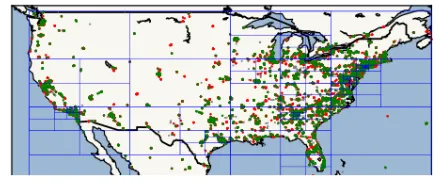
Fig. 7. Geo-located US Tweets partitioned with our Quadtree algorithm
technique. The geo-spatial visualisation of the US tweets (refer Fig. 4) indicates more visible activities towards the North East of the country; this bears a true resemblance of Fig. 5 which illustrates the population of the United States [32] as discussed earlier. This implies that there is a bias favoring a larger count size as opposed to less dense grids. This is clearly a problem due to the sparse distribution of the tweets and as we see from the geographical map, tweets on the East coast (around New York etc tend to have normally a larger population density and thus more user tweets are included in the training data for this purpose). In order to further remove this bias we used a weighted measurements of the outcome and incorporated this within the measurement metric as discussed in Section IV. Fig. 7 was generated using our Quadtree structure.
C. Training of Location Classifier
[image:6.612.74.276.51.157.2]dataset. With a multinomial event model, samples (feature vectors) represent the frequencies with which certain events have been generated by a multinomial (p1, ..., pn) where pi is the probability that eventi occurs (or K such multinomials in the multiclass case). A feature vector X = (x1, ..., xn) is then a histogram xi, with counting the number of times event i was observed in a particular instance. This is the event model typically used for document classification, with events representing the occurrence of a word in a single document (see bag of words assumption). The likelihood of observing a histogramxis given by:
p(x|Ck) =
(P
ixi)! Q
ixi! Y
i
pkxi
i (3)
2) Logistic Regression: Also known as the Maximum En-tropy or Logit classifier is a regression model where the de-pendent variable(s) are categorical; In the generalized additive form consider a set of independent variables X1, X2, ..., Xp predicting a likely outcome (Y) withfj(f1, f2, ..., fp) unspec-ified smooth functions. The model is given as:
log
µ(X) 1−µ(X)
=α+f1(X1) +f2(X2) +...+fp(Xp) (4)
In our experiment the Logit classifier outperformed all the classifiers in terms of precision, accuracy and recall. We use the L2-penalty as it is more robust and handles sparse data well; A phenomena that is quite common with geo-located Twitter data sets. We did not implement dual or primal formulation as the number of samples far exceeded the number of the features in the task. We adopt a balanced class scaling applied to handle the L2 penalty. We set the maximum number of iterations at 100.
IV. RESULTS ANDDISCUSSIONS
This section describes the measurement metrics that were used for evaluation of our proposed method, the results and related discussions.
A. Data
Two datasets were used in training our MNB and LOGIT classifiers and evaluation of our technique. These include the UTGEO-Small Dataset [13]. This consists of 670,000 geolocated Twitter messages from the continental United States. The GEOTEXT dataset by [8] was also used. This had approximately 380,0000 geotagged US tweets.
B. Data Analysis: Measuring Classifier Efficiency
After the texts were cleaned the resultant vector was signif-icantly reduced. Afterwards matrices were parsed into word vectors before the machine learning task was performed on them. Given a set of geo-tagged tweets Ti ={t1, t2, ..., tN} with ground truth location of ActualLoci and a predicted location ExpectedLoci. We evaluate the classifiers perfor-mance using the Average Error Distance (AED), Median Error Distance (MED)and Distance-Based Accuracy.
1) Calculating Error Distance: In calculating the error distance (in km) between the predicted and actual location we apply the Haversine formula [33], [34] also known as the Great Circle Distance between any two geo-coordinates on the earth’s surface assuming an spherical shape of the Earth. This method was chosen as we found suitable and stable in determining the distance estimation of several diverse and closely located geo-coordinate pairs.
2) Average Error Distance: The average error distance (AED) measures the arithmetic average error of predictions for the messages within the dataset, however it should be noted that this metric can be easily skewed by large ranges of values within the dataset and would particularly be unreliable if there where a presence of an anomaly in the training of the classifier. The AED for the classifier is given thus:
AED= 1 |N|
N X
i=1
({|ActualLoci−ExpectedLoci|}). (5)
3) Median Error Distance: The median error distance (MED) overcomes the limitation of the AED by considering only the error values close to the median. We find this to be most reliable and gives a truer indication of the performance. This is represented as:
M ED=M edianDistance{|ActualLoci, ExpectedLoci|}. (6)
4) Distance-Based Accuracy: Accuracy levels at a set dis-tance and more specifically around a disdis-tance d is a renowned benchmark and this was applied in this work also. It is estimated as the ratio of correctly predicted location with an error margin less thand= 161km compared to the entire tweets count
ACC@161 = {|ActualLoci−ExpectedLoci|} ≤161km
|N| .
(7)
C. Experimental Results and Discussion
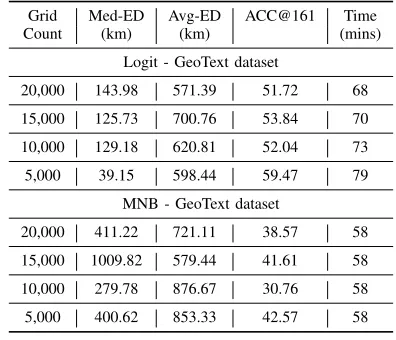
The summary performance of our method, measured against various metrics such as average error distance (AED) as cal-culated in Eq. (5), median error distance (MED) and predicted accuracy to the nearest 161km from Eq. (6) and Eq. (7) respectively are shown in Table IV. A detailed breakdown of each of the classifiers (MNB) and (Logit) for both GEOTEXT datasets is given in Table II while that of the UTGEO-Small dataset is given in Table III.
TABLE II
QUADTREE-BASED CLASSIFICATION SHOWINGERRORDISTANCE AND COMPUTETIME FOR TWO DIFFERENT CLASSIFIERS ONGEOTEXT
DATASET
Grid Med-ED Avg-ED ACC@161 Time
Count (km) (km) (mins)
Logit - GeoText dataset
20,000 143.98 571.39 51.72 68
15,000 125.73 700.76 53.84 70
10,000 129.18 620.81 52.04 73
5,000 39.15 598.44 59.47 79
MNB - GeoText dataset
20,000 411.22 721.11 38.57 58
15,000 1009.82 579.44 41.61 58
10,000 279.78 876.67 30.76 58
5,000 400.62 853.33 42.57 58
TABLE III
QUADTREE-BASED CLASSIFICATION SHOWINGERRORDISTANCE AND COMPUTETIME FOR TWO DIFFERENT CLASSIFIERS ONUTGEO-SMALL
DATASET
Grid Med-ED Avg-ED ACC@161 Time
Count (km) (km) (mins)
Logit - UTGeo-small dataset
20,000 249.45 833.10 43.70 78
15,000 124.44 651.81 54.75 78
10,000 92.86 618.07 57.30 79
5,000 45.00 600.79 60.24 81
MNB - UTGeo-small dataset
20,000 665.31 1093.45 30.20 71
15,000 449.78 907.65 40.07 71
10,000 418.08 828.13 42.56 71
5,000 380.76 855.64 43.76 71
24% in terms of ACC@161, more 400km better prediction for median error distance and over 250km more accurate average error distance.This implies that we are unable to go beyond the maximum grid size and a granularity level finer than 5000 tweets as this could be lead to overfitting of the training data. In terms of the computing time to execute both methods using our algorithm we see from both datasets the MNB was quicker to execute than the Logit classifier. On average about 20 minutes longer to execute. While our method performs better on all metrics namely AED, MED and ACC@ 161, it should be noted that the AED is less influenced by anomalous values in the training dataset as it relies on median values. However, MED should be given more consideration over the AED as the latter can be affected by a range of very low and very high error distances thus not giving a fair assessment of the classifier performance.
We have also shown the performances of the method with
TABLE IV
OURMETHOD AND OTHERGRID-BASEDRESULTS
Author Method AED MED ACC@161
GeoText dataset
Eisensteinet al.[8] Topic Models 900 494 24
Winget al.[9] Uniform 967 479 N/A
Huldenet al.[19] Uniform 764.8 357.2 N/A
Our Quadtree 598.44 39.15 59.47
UTGeo-small dataset
Rolleret al.[13] kd-tree 860.0 463.0 34.6
[image:8.612.74.272.96.266.2]Our Quadtree 600.79 45.00 60.24
TABLE V
ERRORDISTANCE INMILESFORACC@90% BYOURLOGIT CLASSIFIERS
Logit-20k Logit-15k Logit-10k Logit-5k GEOTEXT 1,046.28 1,733.03 1,237.38 1,193.57 UTGEO - Small 1,558.73 1,253.70 1,230.40 1,289.83
and without considering demographical biases as discussed in III-B2. It is evident the performance has improved significantly while we removed the bias using a weighting parameter that is proportional to the demographic distribution. Finally we compare our method with other grid-based methods in Table IV. The result indicates that our method outperformed the existing grid-based location inference techniques on Twitter. Showing significantly better results in terms of AED, MED and Accuracy at an error distance of 161km radius. Wrong predictions are also included in the visualisation in Fig. 7
According to the 2017 US Census [35], the average size of a city with a population above 100,000 is approximately 100 sq miles. The average land area of a US state is over 57,000 sq miles. While an average county size is 1,124 sq miles. At an error distance of just over 1,100 miles we achieve 90% accuracy as shown in Table V. Thus, we place the performance of our Logit classifier quite competitive with the state-of-the art at the city-level granularity and much more so at the county level. It would be interesting to know how our results compare against deep learning text classification methods, if there’s significant improvement in terms of accuracy, AED and MED. It is currently out of the scope of this study.
V. CONCLUSIONS AND FUTURE WORK
an error distance of 161km (100 miles radius). The results show the effectiveness of our Quadtree spatial indexing tech-nique in combination with a Logistic regression classification model which outperforms other grid-based methods in location inference. Future work could look the location prediction in real-time from live Twitter data streams and possibly linking with other location-based networks and for other geographical regions of the world. There is also a potential application in helping to address online social media issues such as fake news detection [36] and tracking the origin of online malicious content-based messages.
REFERENCES
[1] K. Leetaru, S. Wang, G. Cao, A. Padmanabhan, and E. Shook, “Mapping the global twitter heartbeat: The geography of twitter,”First Monday, vol. 18, no. 5, 2013.
[2] R. Li, S. Wang, H. Deng, R. Wang, and K. C.-C. Chang, “Towards social user profiling: unified and discriminative influence model for inferring home locations,” inProceedings of the 18th ACM SIGKDD international conference on Knowledge discovery and data mining. ACM, 2012, pp. 1023–1031.
[3] M. Field, “Police issue child safety warning over snapchat maps update that reveals users’ locations,” Jun 2017. [Online]. Available: http://www.telegraph.co.uk/technology/2017/06/23/ police-issue-child-safety-warning-snapchat-maps-update-reveals/ [4] O. Ajao, J. Hong, and W. Liu, “A survey of location inference techniques
on twitter,”Journal of Information Science, vol. 41, no. 6, pp. 855–864, 2015.
[5] A. Huang, “Similarity measures for text document clustering,” in Pro-ceedings of the sixth new zealand computer science research student conference (NZCSRSC2008), Christchurch, New Zealand, 2008, pp. 49– 56.
[6] D. M. Christopher, R. Prabhakar, and S. Hinrich, Introduction to information retrieval. Cambridge University Press, 2008.
[7] Z. Cheng, J. Caverlee, and K. Lee, “You are where you tweet: a content-based approach to geo-locating twitter users,” inProceedings of the 19th ACM international conference on Information and knowledge management. ACM, 2010, pp. 759–768.
[8] J. Eisenstein, B. O’Connor, N. A. Smith, and E. P. Xing, “A latent variable model for geographic lexical variation,” inProceedings of the 2010 Conference on Empirical Methods in Natural Language Process-ing. Association for Computational Linguistics, 2010, pp. 1277–1287. [9] B. P. Wing and J. Baldridge, “Simple supervised document geolocation with geodesic grids,” in Proceedings of the 49th Annual Meeting of the Association for Computational Linguistics: Human Language Technologies-Volume 1. Association for Computational Linguistics, 2011, pp. 955–964.
[10] S. Kinsella, V. Murdock, and N. O’Hare, “I’m eating a sandwich in glasgow: modeling locations with tweets,” inProceedings of the 3rd international workshop on Search and mining user-generated contents. ACM, 2011, pp. 61–68.
[11] Y. Ikawa, M. Enoki, and M. Tatsubori, “Location inference using mi-croblog messages,” inProceedings of the 21st International Conference on World Wide Web. ACM, 2012, pp. 687–690.
[12] H.-w. Chang, D. Lee, M. Eltaher, and J. Lee, “@ phillies tweeting from philly? predicting twitter user locations with spatial word usage,” in Proceedings of the 2012 International Conference on Advances in Social Networks Analysis and Mining (ASONAM 2012). IEEE Computer Society, 2012, pp. 111–118.
[13] S. Roller, M. Speriosu, S. Rallapalli, B. Wing, and J. Baldridge, “Super-vised text-based geolocation using language models on an adaptive grid,” in Proceedings of the 2012 Joint Conference on Empirical Methods in Natural Language Processing and Computational Natural Language Learning. Association for Computational Linguistics, 2012, pp. 1500– 1510.
[14] A. Schulz, A. Hadjakos, H. Paulheim, J. Nachtwey, and M. M¨uhlh¨auser, “A multi-indicator approach for geolocalization of tweets.” inICWSM, 2013, pp. 573–582.
[15] R. Compton, D. Jurgens, and D. Allen, “Geotagging one hundred million twitter accounts with total variation minimization,” in Big Data (Big Data), 2014 IEEE International Conference on. IEEE, 2014, pp. 393– 401.
[16] J. Mahmud, J. Nichols, and C. Drews, “Home location identification of twitter users,”ACM Transactions on Intelligent Systems and Technology (TIST), vol. 5, no. 3, p. 47, 2014.
[17] B. Wing and J. Baldridge, “Hierarchical discriminative classification for text-based geolocation.” inEMNLP, 2014, pp. 336–348.
[18] K. Ryoo and S. Moon, “Inferring twitter user locations with 10 km accuracy,” inProceedings of the 23rd International Conference on World Wide Web. ACM, 2014, pp. 643–648.
[19] M. Hulden, M. Silfverberg, and J. Francom, “Kernel density estimation for text-based geolocation.” 2015.
[20] B. Han, A. Rahimi, L. Derczynski, and T. Baldwin, “Twitter geolocation prediction shared task of the 2016 workshop on noisy user-generated text,” inProceedings of the W-NUT Workshop, 2016.
[21] J. Krumm, “Inference attacks on location tracks,” in International Conference on Pervasive Computing. Springer, 2007, pp. 127–143. [22] B. Han, P. Cook, and T. Baldwin, “Text-based twitter user geolocation
prediction,”Journal of Artificial Intelligence Research, vol. 49, pp. 451– 500, 2014.
[23] D. Jurgens, “That’s what friends are for: Inferring location in online social media platforms based on social relationships.”ICWSM, vol. 13, pp. 273–282, 2013.
[24] N. Zhong, Y. Li, and S.-T. Wu, “Effective pattern discovery for text mining,”IEEE transactions on knowledge and data engineering, vol. 24, no. 1, pp. 30–44, 2012.
[25] T. Mikolov, I. Sutskever, K. Chen, G. S. Corrado, and J. Dean, “Distributed representations of words and phrases and their composi-tionality,” inAdvances in neural information processing systems, 2013, pp. 3111–3119.
[26] S.-H. Cha, “Comprehensive survey on distance/similarity measures between probability density functions,”City, vol. 1, no. 2, p. 1, 2007. [27] Y. Zhang, R. Jin, and Z.-H. Zhou, “Understanding bag-of-words model:
a statistical framework,”International Journal of Machine Learning and Cybernetics, vol. 1, no. 1-4, pp. 43–52, 2010.
[28] J. Pennington, R. Socher, and C. D. Manning, “Glove: Global vectors for word representation.” inEMNLP, vol. 14, 2014, pp. 1532–1543. [29] C. I. Agency, “The world factbook: United states,” https://www.
cia.gov/library/publications/the-world-factbook/geos/us.html, 2013, ac-cessed: 2016/12/05.
[30] D. P. Mehta and S. Sahni,Handbook of data structures and applications. CRC Press, 2004.
[31] H. Samet, A. Rosenfeld, C. A. Shaffer, and R. E. Webber, “A geographic information system using quadtrees,”Pattern Recognition, vol. 17, no. 6, pp. 647–656, 1984.
[32] P. D. US Census Bureau, “Annual estimates of resident population change for incorporated places of 50,000 or more in 2014, ranked by per-cent change: July 1, 2014 to july 1, 2015,” http://factfinder.census.gov/ faces/tableservices/jsf/pages/productview.xhtml?src=bkmk, 2016, ac-cessed: 2016/12/05.
[33] B. Shumaker and R. Sinnott, “Astronomical computing: 1. computing under the open sky. 2. virtues of the haversine.” Sky and telescope, vol. 68, pp. 158–159, 1984.
[34] F. Laylavi, A. Rajabifard, and M. Kalantari, “A multi-element approach to location inference of twitter: A case for emergency response,”ISPRS International Journal of Geo-Information, vol. 5, no. 5, p. 56, 2016. [35] U. C. Bureau,Annual Estimates of the Resident Population for
Incor-porated Places of 50,000 or More, Ranked by July 1, 2017, 2018. [36] O. Ajao, D. Bhowmik, and S. Zargari, “Fake news identification