Based on a Study of Rubrics
ROHRBACH, Stacie
Available from Sheffield Hallam University Research Archive (SHURA) at:
http://shura.shu.ac.uk/488/
This document is the author deposited version. You are advised to consult the
publisher's version if you wish to cite from it.
Published version
ROHRBACH, Stacie (2009). Educational Assessment in Emerging Areas of Design:
Toward the Development of a Systematic Framework Based on a Study of Rubrics.
In: Undisciplined! Design Research Society Conference 2008, Sheffield Hallam
University, Sheffield, UK, 16-19 July 2008.
Copyright and re-use policy
Educational Assessment in Emerging Areas of Design:
Toward the Development of a Systematic Framework
Based on a Study of Rubrics
Stacie Rohrbach, Carnegie Mellon University, United States
Abstract
This paper presents a formative study that investigates the perceived
effectiveness of rubrics as assessment tools by communication and industrial design educators and first year design students in the context of a design studio. The project is motivated by the increasing challenge of assessing subjective and intangible attributes that are associated with the teaching of emerging areas in design, and society’s growing need for measurable results. The goal of this project is to shed light on the perceived successes and failures of a specific assessment tool, known as a rubric, and use this information to improve students’ and educators’ understanding, value, and use of
assessment tools.
Based on the characteristics of the emerging design landscape, this paper argues the importance of assessments and the need for their improvement. It explains the construction of three assessment forms that are based on
successful models used in other disciplines. This paper describes how the forms were used throughout the semester to provide an overview of course
objectives and assess individual projects. It explains the contents of a questionnaire and describes how it was used at the end of the semester to evaluate students’ perceptions of the assessments forms. Feedback gained from the instructors indicated that rubrics were not more efficient than other forms of assessment but did aid the assessment of intangibles and did not reduce students’ creativity. The results of the questionnaire showed that students perceived the attributes of rubrics more positively than other forms of assessment but still favoured handwritten comments. These findings informed the proposal of a set of considerations that should be taken into account when creating assessment forms for use in classrooms that focus on emerging areas of design. They describe the importance of personal comments, clear terminology, a planned introduction of the tool, and an open-mind.
Keywords
Rubrics; Assessment; Evaluation; Pedagogy; Education; Learning; Feedback.
In recent years there has been an increase in the number of schools offering courses that focus on emerging themes in design, such as designing for service, education, and change (Poggenpohl, 2004). In these courses
educators often emphasize the importance of design processes, collaboration within and among disciplines, and participation throughout projects as
that occur, in the activities that students conduct, and in the outcomes of students’ efforts (Heller, 1998).
Although studies that explore emerging areas of design are becoming more accessible, research that describes the assessment of these projects is still difficult to find. Hence, gathering examples of syllabi and assessment forms on the internet was necessary to gain insight into the methods educators
currently use. A review of these assessment forms indicates that many educators are attempting to assess students based on curricular shifts. For example, syllabi for design courses in emerging areas frequently encourage students to employ a strong, generative process that leads to an effective outcome. This process generally requires students to engage in projects fully, and discuss ideas with peers and instructors. Many of the syllabi reviewed also indicate that educators often assess students based on their process for designing, their engagement in the course, and their participation in the classroom, as opposed to just the final pieces they produce.
Despite the similarities in the criteria educators use to assess students, their forms vary greatly and the actual and perceived effectiveness of the assessment forms by educators and students appears undocumented. The lack of documentation of actual and perceived effectiveness of assessment forms in emerging areas of design may be attributed to educators’ inabilities to recognize its necessity. This notion is supported by the work of Goulden and Griffin (1997). They discovered discrepancies between students’ and
educators’ value and use of evaluations. These differences can prevent educators from understanding the importance of grades to students and the types of feedback they desire and need to propel future learning. Hence, educators simply may not grasp the necessity for improved forms of assessment.
The nature of the courses that focus on emerging areas of design is a logical contributor to the range of assessment forms in use. Often, students’
performances in these courses are intangible, subjective, and qualitative. Hence, these attributes are difficult for educators to translate systematically into grades that are fair and consistent because absolute right or wrong answers often are inexistent or invisible. As a result, varying assessment forms make it difficult for students and educators to compare learning objectives and outcomes between courses, and at a higher level, between design programs.
assessment methods will diminish the creativity and innovative thinking of students by providing them with prescribed formulas for success. These discrepancies indicate the importance of perception to the value and adoption of assessment methods by educators and students.
The project described in this paper functions as a formative study, with the goal of helping design educators make informed decisions about the use of assessment methods—specifically rubrics. The project investigates the
perceived effectiveness of rubrics as assessment tools in the context of a design studio that was populated by communication and industrial design students. In the course, students received three different forms of evaluations, one for each project completed. At the end of the semester, students
completed a questionnaire that focused on their perception of the different forms of assessment. The feedback gained from the students and instructors of this course provides insight into the perceived successes of a range of
evaluation types, which can inform the making of rubrics that are effective learning and assessment tools.
Based on the characteristics of the current and emerging design landscape, this paper argues the necessity for improvements in design educators’ and students’ perception and use of assessment tools. As a basis for investigation, this paper uses research that indicates the perceived effectiveness of rubrics as assessment tools by educators and students in other disciplines. It
establishes correlations between other disciplines and emerging design areas. These similarities are used to support the logical application of rubrics in
current design education. However, this paper also describes what sets the teaching of emerging areas of design apart from other disciplines, arguing that a direct application of rubrics to design is inappropriate, but based on their similarities, warrants investigation, which has taken place in the form of a field study.
This paper illustrates the construction of a rubric for a studio for first year design students and explains its evolution into three distinct forms, each of which correlate to a different project in the course. Findings gleaned from an
assessment forms questionnaire, which the first year students completed at the end of the course, are also included in this paper. In conclusion, ideas for future applications of rubrics in the education of emerging design areas are presented and projected next steps in the study of rubrics relative to design pedagogy are outlined.
Background and Context
During the summer of 2007, I, along with four professors positioned in various disciplines, received fellowships that enabled us to learn from colleagues whose primary jobs were to help educators teach. Throughout the fellowship we learned how to better construct, integrate, and evaluate writing projects in the courses that we teach. During the session, we studied the use of rubrics as learning, assessment, and grading tools. To assist our learning, we
generated materials based on a course or project that we wanted to create or revise. Throughout the fellowship we compared projects, methods,
What is a rubric?
In their book, Introduction to Rubrics, Stevens and Levi (2005) define the term. They state,
At its most basic, a rubric is a scoring tool that lays out specific expectations for an assignment. Rubrics divide an assignment into its component parts and provide a detailed description of what constitutes acceptable or unacceptable levels of performance for each of those parts. Rubrics can also be used for
grading a large variety of assignments and tasks: research papers, book critiques, discussion participation, laboratory reports, portfolios, group work, oral
presentations, and more. (p. 3)
How do you create a rubric?
Stevens and Levi describe the construction of rubrics as following four key stages. In the first step, educators reflect on their reasons for creating an assignment and past experiences. This is followed by a listing of project objectives, which are then organized into groups based on similarities and described by labels. The last step of the process includes the application of the generated information to a grid structure that is constructed by two matrices. Along one axis is a list of criteria that is based on learning objectives that are delivered to students at the start of a project. Along the other axis is a list of performance attributes such as excellent, good, needs improvement, and unacceptable. Two popular forms of rubrics are scoring and three-to-five-level (scale). A scoring rubric includes a description of the highest-three-to-five-level
performance for each area of criteria and a corresponding space for detailed, handwritten comments. A three-to-five-level rubric contains descriptions of each level of performance relative to each area of criteria (Stevens and Levi, 2005).
Why use a rubric?
Although there is a lack of information that describes the value and use of rubrics specifically in the context of current design education, there exists research that explains the function of rubrics as valuable teaching and assessment tools in general terms. For example, researcher Heidi Goodrich explains that rubrics help teachers define their expectations and clearly explain to students how to achieve specific goals. This often leads to improvements in student performance. She describes rubrics as aiding students’ assessment of their own work and that of their peers by providing them with a language and criteria for evaluation. Rubrics are also said to reduce the time that educators need to conduct assessments because comments that educators would normally write to students are listed on the rubric for them to circle. Plus, Goodrich explains that rubrics enable educators to provide students with a larger amount of useful feedback. Perhaps one of the greatest strengths of rubrics is that they are easy for educators and
Research Goals
During my investigation of rubrics in the fellowship I acquired, which focused specifically on writing, I began to question the application of rubrics to the evaluation of design projects and the perception of rubrics by design educators and students. In both writing and design, students produce work that is subjective in environments where they are encouraged to think
creatively rather than simply follow prescriptive processes. However, emerging design courses may not produce a tangible artefact that is on par with the outcomes of a writing course. Despite this difference, I believed that early research on the use of rubrics in design and writing courses would also apply to emerging areas of design because researchers champion rubrics for their flexibility in assessing a diverse range of criteria. However, I was uncertain of how well rubrics would be perceived by design educators and students.
The purpose of this project is to evaluate the actual and perceived merits of rubrics by studying a diverse sampling of assessment tools in the context of a design course that deals with emerging topics. There are studies that argue the success of rubrics across a range of disciplines based on systematic measuring of student learning (Fuchs and Fuchs, 1986). Although learning outcomes are useful, the perceived value of rubrics by educators and students ultimately determines how well they will be adopted in classrooms (Cothran, 2003). Therefore, this project analyzes how design teachers and students perceive and use a range of assessment tools, and uses the study findings as a means of arguing the value of rubrics. The results also inform the proposal of rubric characteristics that will facilitate effective evaluating in emerging areas of design, and pinpoint areas that require additional investigation. In pursuit of these goals, this project addresses the following research questions:
• What similarities and differences exist among a range of assessment tools?
• How do students and teachers perceive assessment tools differently based on their form?
• How do students and teachers use assessment tools based on their form?
• How can the perceptions of a range of assessment tools by educators and
students inform the making of a rubric that they value and use?
Implementation
improvements. During the first class session, we explained our over-arching learning goals that we encouraged students to achieve. Through the creation of two- and three-dimensional individual and group projects, students worked to:
• develop appropriate ideas in response to project assignments
• build a process for working that enables consistent, incremental growth • articulate their ideas well, both verbally and visually
• translate and communicate ideas into effective, well-crafted visual forms
• collaborate with their peers: share ideas and information
• understand and integrate feedback into their creative working process • illustrate an understanding for how context shapes, and is shaped by design
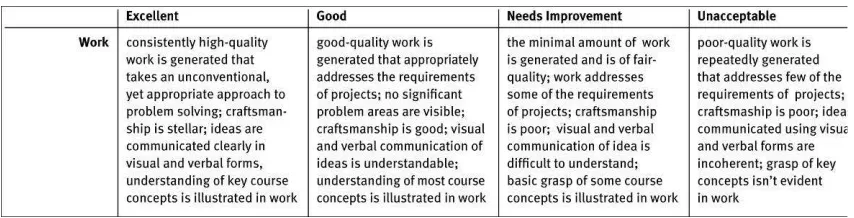
Based on the models that I studied, I constructed a rubric that encompassed the over-arching goals for the course (fig.1). Heidi Goodrich Andrade explains the value of instructional rubrics as tools that facilitate thinking and learning (2000). Therefore, I delivered the rubric to students on the first day of class and used it as a way of explaining to them the goals of the course. I described to students how they could use the rubric as a learning guide, as a tool for self-assessment, and also as an indicator of the grading methods that we would employ throughout the duration of the course.
To construct the rubric, I first analyzed the goals that my colleague and I established, and considered what we could assess to determine students’ learning achievements. It is important to note the difficulty in measuring abstract learning goals, such as the understanding of a topic. However, students can exhibit their understanding through the making of an artefact or the discussion of an idea, for example. I then created lists of artefacts and behaviours that would indicate learning and grouped them by similarity. The categories formed four criteria areas on which we would assess each
student’s performance throughout the semester: their process for designing, the work they produced, their participation in class activities, and their attitude towards the course exhibited through their work and behaviour. The criteria established one axis of the rubric.
To create the other axis I constructed an assessment scale, ranging from excellent to unacceptable. The quadrant formed by the intersection of the two axes included a description of the corresponding criteria and
performance level. The structure of the resulting rubric matched common models used in other disciplines. However, the criteria were specific to the design course that I co-taught.
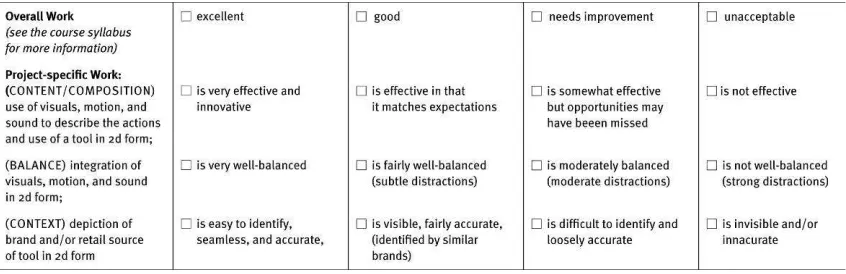
I followed the construction of the course rubric with the development of a rubric that was based on the specific goals of the first project (fig. 2). Although the students did not see the assessment rubric in a matrix form when they started the project, they did receive a project assignment that listed
as a check box in a quadrant. This enabled us to check one detailed component within a category of criteria as “excellent”, for example, and another as “good”. Since we identified areas that could be improved in this and subsequent forms of assessment throughout the semester, I decided to modify each project assessment form slightly, so that we could compare them at the end of the course.
The rubric that I constructed for the second project matched the structure of the course rubric more closely than the one we used to assess the first project (fig. 3). Instead of providing detailed feedback on individual aspects of each criteria category via numerous check boxes, this form described performance levels in paragraph form, forcing us to check one performance level for each criteria category. The bottom quarter of the form included common successes and failures that related to the project. Instead of writing similar comments on each student’s assessment form, we simply checked off all of the statements that applied to the individual’s performance for the project.
The assessment form that I developed for the third project provided students with the criteria that were used to assess their performance, similarly to the previous rubrics (fig. 4). However, instead of seeing a scale of performance attributes that were checked off, students read handwritten comments that described the nature of their performance. A scale accompanied the
notations, with each level defined by a single word. A tick made on the scale denoted the level of their performance relative to the specific criteria
category. This type of form is related to a grade rubric but does not describe the characteristics of optimal performances.
[image:8.595.120.547.487.596.2]This set of figures shows portions of each of the learning and assessment tools that were used in the freshmen design studio throughout the duration of the course. Note that to enable the comparing of assessment tools, the segments shown here relate to the “work” attribute in each project. However, students were also assessed based on their design process, participation, and attitude.
Fig. 2: Shown here is a section of the assessment rubric that was used to evaluate the first project in the course. It includes check boxes that were used to describe each student’s performance levels in a range of areas.
Fig. 3: Shown here is the bottom of the assessment rubric that was used to evaluate the second project in the course. It includes check boxes that describe common successful and unsuccessful steps taken by students.
Fig. 4: Shown here is a section of the assessment sheet that was used to evaluate the third project in the course. It includes an area for writing comments and check boxes to indicate the quality of performance.
Questionnaire study
During the last day of class each student in the course was asked to complete an anonymous questionnaire regarding the paper-based evaluations that they received throughout the semester. Although the session was not timed, most of the students completed the questionnaire in class in less than fifteen minutes. The questionnaire was divided into four parts. The first section
included questions that referred to the course rubric that was given to them as part of their syllabus on the first day of class. Each of the subsequent sections included questions that were specific to one of the three project rubrics.
questions in this and subsequent sections provided students with a set of check boxes as response options and a comment area if it was applicable. For example, students were asked, “If you did not understand something, you asked for clarification from (check all that apply): course professors, teaching assistants, classmates, no one, other:___”
The second, third, and fourth sections of the questionnaire functioned similarly to each other. Once again students were asked how much of each
assessment sheet they read and understood, and who they approached to clarify terminology that they did not understand. Students were asked how much of the feedback they understood and how much of it provided
detailed information about how to improve in the course and in what areas— process, work, participation, and/or attitude. Students’ perceptions of the assessment forms were also a component of the questionnaire. Based on their beliefs, students were asked to rate the thoroughness of their professors’ reviews, the accuracy of their professors’ feedback, and the correlation of their professors’ comments to the project’s objectives. Lastly, students were asked to rank the effectiveness of each assessment form, provide reasons for their response, and suggestions for its improvement. The students also noted the grade that they received on each corresponding project.
Study outcomes
Some of the findings gleaned from the questionnaire answers were consistent with my hypotheses. In response to the first set of questions, which focused on the course rubric, 26 of them stated that they scanned it. 37 of the students noted that they knew most, if not all, of its terminology. 17 students, the highest percentage for the third question, stated that the unfamiliar terminology used in the rubric hindered their understanding of it. 21 of the students noted that they asked their professors, teaching assistants, and classmates for clarification of the content that they did not understand. The subsequent sections of the questionnaire, which related to individual project assessments, yielded results that were consistent with each other (figs. 5, 6). The majority of students
responded that they read the assessment sheets thoroughly, understood most, if not all of the terminology that was used in them, and asked their professors, teaching assistants, and classmates for clarification when needed.
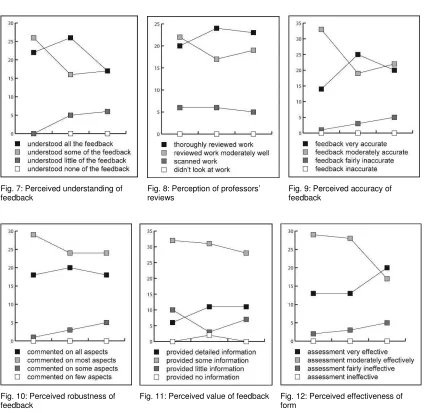
Responses to the questions that dealt with the students’ perceptions of the assessment forms yielded more interesting, and unexpected results (figs. 7, 8, 9). In relation to the first and third assessment forms, the majority of students’ responses fell in the middle of the scale established by the check box options that were provided. Approximately half of the students, the majority in all cases, claimed that they understood how some of the checked boxes related to their work. They believed that their professors reviewed their work
In all cases, the majority of students responded that the feedback they received provided them with some information about how to improve in the class, that it addressed most of the aspects of the corresponding project, and that it was most useful to the development of their process and final work (figs. 10, 11). The outcomes to these two questions fell in the middle of the provided scale. There was no notable connection between the grades that students received and their responses to the questionnaire.
It is important to note that although the second form delivered the most favorable responses (figs. 7-9), students declared that the third form, which contained handwritten comments that provided less information than the others, as the most effective form of assessment by a slight majority of 20 students (fig. 12). 28 and 29 students rated the first and second assessment forms moderately effective.
The additional comments that students provided as part of the questionnaire were also insightful. Students repeatedly commented that they would have liked more handwritten, personal feedback that used explicit language to describe their successes and failures. Many of them also wanted to see more suggestions for ways that they could improve their performance in the class. A few of them commented that they believed the assessment feedback that they received was inconsistent with the direction they received in class and that they would have preferred for the criteria to include weight distributions. Lastly, a few students stated that they would have appreciated more
feedback that specifically addressed the artifact that they constructed.
Although my colleague and I did not formally evaluate the forms that we used to assess each of the course projects, we informally discussed our perceptions of them, covering many of the attributes that the students evaluated in the questionnaire. Based on the literature survey that I
conducted on the topic of rubrics, I anticipated that our use of them would decrease our assessment time. Unfortunately, we did not witness a time reduction. However, this could be attributed to our status as novice users of rubrics. For example, since my colleague and I assessed students together we spent a great deal of time discussing our different interpretations of rubric terminology, which would likely be reduced had we improved the language of the form and were not using rubrics for the first time. We noticed that rubrics enabled and forced us to evaluate more tangible and intangible aspects of each project than we had in the past, which may have also contributed to the lack of assessment time change. I was confident that the very structured rubrics helped us assess all 49 students consistently and fairly, which was not the case in the handwritten evaluation form. We agreed that students initially had some difficulty understanding the use of the rubrics because we received questions from several of them. My colleague and I also recognized that the formal rubric functioned well as an aid for thorough assessment of student performance. However, we were uncertain of its value to students because of its robust and complex form.
This set of figures illustrates students’ perceptions of the three assessment forms used in the freshmen design studio. Each column correlates to a different assessment form. They appear in sequential order moving from a modified scale rubric, to a traditional scale rubric with check boxes that describe common performances, to a form that lists
Fig. 5: Students’ reading of forms Fig. 6: Perceived understanding of terminology
Fig. 7: Perceived understanding of feedback
Fig. 8: Perception of professors’ reviews
Fig. 9: Perceived accuracy of feedback
Fig. 10: Perceived robustness of feedback
Conclusion
Personal comments are important.
The results of this study suggest that students view the scale rubric as a form that aids their learning and improvement in the course more than the other assessment types. However, despite the positive responses to the scale rubric, students declared the handwritten rubric as the most effective tool among the set by a slight margin. This finding suggests that students prefer
handwritten feedback despite the fact that they found the form less accurate, informative, and thorough than the scale rubric. This notion is supported by the comments that students provided that describe the importance of personal feedback, which they did not believe they received in the pre-formatted printed rubrics. A follow-up study in this area would compare students’ perceptions of personal feedback, which they’d receive in handwritten and typed forms.
Rubrics aid the assessment of intangibles.
I found that although my inexperience writing rubrics made it challenging for me to generate the initial course rubric that described the performance attributes that we would assess, the process helped us better define the intangible performance attributes that we would assess and explain our evaluations to students more explicitly. The performance criteria helped us assess 49 students thoroughly, consistently, and fairly and enabled us to point students to particular areas where they could improve. The study results indicate that the majority of students perceived the feedback that they received in all three rubrics as moderately to very accurate. Most of them believed that the assessments commented on most, if not all, of the project criteria and that they used the information to improve in numerous areas of subsequent projects. These findings indicate the value of rubrics to students and educators as tools for assessing emerging areas of design.
Rubrics do not diminish students’ creative thinking.
As described in the study implementation, each assessment rubric included performance attributes that were identical to the project objectives that the students received at the start of every project. The objectives functioned as project guides by providing students with a list of criteria on which they would be assessed. Although we made the performance goals of each project explicit, we did not prescribe final outcomes. The results of this first year design class were on par with prior teaching years, which indicated that the rubrics did not diminish the students’ creativity but instead provided students with clear goals for them to strive to achieve.
Rubrics must include clear terminology.
attributes for intangibles was challenging, especially when creating rubrics for projects that we had never conducted. Improvements in the form language of rubrics and class discussions that emphasize the importance of all the facets of designing can help students gain a better understanding of emerging design ideas and practices.
The introduction of rubrics to students must be carefully planned
and scaffolded.
The study results illustrate a miscorrelation between students’ understanding of each rubric and the feedback they received. The findings show that first year design students had difficulty understanding common design terminology based on their unfamiliarity with the words. It is also clear that first year design students seek an abundance of written feedback on their performance, based on the comments that repeatedly appeared throughout the
questionnaire. These findings indicate that students must be taught how to read and use rubrics and that the form and content of rubrics must match the level of students for rubrics to function as effective assessment tools.
Rubrics require educators and students to change their way of
thinking about the tools.
Although the results of this study point to the benefits of using rubrics in design courses, students and educators must change their thinking of the tools for them to be truly effective. For example, my colleague and I decided to simplify the assessment form that we were using after each project, reducing the amount of time needed to evaluate the students. This decision was based more on our time constraints than on what would benefit the students.
Likewise, although my colleague and I spent an abundance of time working with students on an individual basis, the students wanted us to spend an equal amount of time providing them with detailed, individual, written comments. This information indicates that students and educators must recognize the importance of assessment to learning, appreciate the needs and demands of each other, and come to an agreement on the amount and type of
feedback that is feasible and valuable.
Next steps
The results of this formative field study function as groundwork for future study into the value of rubrics in design education. Since the investigation
References
ALTEC, t. U. o. K. (2007). RubiStar. Retrieved October 21, 2007, from http://rubistar.4teachers.org/index.php.
Cothran, D.J. (2003). Students’ use of and perspective on rubrics. In Educational Research, Risks and Dilemmas: NZARE/AARE Conference 29 November–3 December, Auckland, New Zealand: New Zealand Association for Research in Education.
Fuchs, L.S. & Fuchs, D. (1986). Effects of systematic formative evaluation: a meta-analysis. Exceptional Children, 53, 199-206.
Gardner, H. (1991). Assessment in context: The alternative to standardized testing. In B. R. Gifford & M. C. O’Connor (Eds.), Changing assessments: Alternative views of aptitude, achievement and instruction (pp. 239-252). Boston, Massachusetts: Kluwer Publishers.
Gibbons, T. Bridging the gap between literacy and technology: educational component.
Retrieved February 10, 2008, from
http://www.nald.ca/CLR/Btg/ed/evaluation/writing.htm.
Goodrich, H. (1996). Understanding rubrics. Educational Leadership 54(4), 14-17.
Goodrich, Andrade, H. (2000). Using rubrics to promote thinking and learning. Educational Leadership 57(5), 13-18.
Goulden, N.R. & Griffin, C.J. (1997). Comparison of university faculty and student beliefs about the meaning of grades. Journal of Research and Development in Education, 31, 27-37.
Heller, S. (1998). The education of a graphic designer (2nd ed.). New York, New York: Allworth Press.
Marzano, R.J. (2000). Transforming classroom grading. Alexandria, Virginia: Association for Supervision and Curriculum Development.
Patton, M.Q. (2002). Qualitative evaluation and research methods (3d ed.). Thousand Oaks, California: Sage.
Poggenpohl, S. (2004). Plain Talk about Learning and a Life-in Design.
Retreived March 3, 2008, from http://www.aiga.org/content.cfm/plain-talk-about-learning-and-a-life-in-design.
Stevens, D. D. & Levi, A. J. (2005). Introduction to rubrics: an assessment tool to save grading time, convey effective feedback and promote student learning. Sterling, Virginia: Stylus Publishing, LLC.
Unit, Technology Education Research (1993). Understanding Assessment in Design and Technology. (re-issue ed.) Hodder and Arnold H&S.
Stacie Rohrbach
graduate curriculum. Rohrbach’s research investigates how combining design processes and learning theories improves the teaching of complex and
abstract content—specifically visual communication. She explores the design of educational tools and methods for university students within and outside of design, in classroom and online contexts. Rohrbach also applies her new knowledge to areas outside of visual communication, such as the biological sciences. The nature of her work allows her to explore the relationships between print and digital media and the communicative value of sound, motion, and visuals as educational tools.