Lr39
+
Pm21
: a New Effective Combination of Resistance
Genes for Leaf Rust and Powdery Mildew in Wheat
Aleksandra PIETRUSIŃSKA1, Paweł Częstobor CZEMBOR 2 and Jerzy Henryk CZEMBOR1
1Department of Plant Breeding and Genetics and 2Department of Plant Pathology,
Plant Breeding and Acclimatization Institute, National Research Institute at Radzików, Błonie, Poland
Abstract
Pietrusińska A., Czembor P.Cz., Czembor J.H. (2013): Lr39 + Pm21: a new effective combination of resistance genes for leaf rust and powdery mildew in wheat. Czech J. Genet. Plant Breed., 49: 109–115.
Two effective resistance genes were introduced, one for leaf rust (Lr39) and the other for powdery mildew (Pm21), into the susceptible German wheat cv. Lexus. Molecular selection of plant material was carried out us-ing closely linked markers to the introduced genes (foreground selection). In addition, for the BC1F1 population, background selection was carried out using AFLP markers that were distributed randomly throughout the wheat genome. Moreover, resistance tests were conducted using natural pathogen populations of Puccinia triticina and Blumeria graminis. The use of molecular markers for foreground selection in combination with pathology tests enabled 66 homozygous lines to be obtained that were simultaneously resistant to leaf rust and powdery mildew. Keywords: Blumeria graminis; gene pyramiding; Puccinia triticina
Despite the knowledge of resistance genes, it is still important to look for new and effective sources of resistance to fungal diseases, especially because the resistance of cultivars can be overcome by new virulent pathogen races. One of the best strategies to obtain effective and durable resistance in cultivars is gene pyramiding, namely the selection of multiple resistance genes. Since the expression of individual resistance genes is difficult to monitor in offspring populations, marker-assisted selection (MAS) became a powerful alternative. There are several published examples of resistance breeding in common wheat using gene pyramiding, which include: Pm2 + Pm4a, Pm2 + Pm21, Pm4a + Pm21 in the Chinese cv. Yang 158 (Liu et al. 2000), Lr16 + Lr34 and Lr22a + Lr52 in wheat populations (Hiebert et al. 2010).
The ultimate aim of our work was to increase wheat resistance to powdery mildew and leaf rust
by pyramiding two highly effective resistance genes Lr39 and Pm21. The 6VS/6AL translocation line of Yangmai 5, which carries the Pm21 gene derived from the wild wheat relative Dasypyrum villosum, was used as the donor of resistance to powdery mildew. The line KS90WGRC10, which carries the Lr39 (formerly Lr41) gene derived from the diploid wild wheat Triticum tauschii, was used as the donor of resistance to leaf rust (Singh et al. 2004).
MATERIAL AND METHODS
Plant materials
Wheat Genetic and Genomic Resources Center at Kansas State University, USA. The translocation line 6VS/6AL Yangmai5, which carries the Pm21 gene, was used as the donor of resistance to pow-dery mildew. The Yangmai5 line was developed at the Cytogenetics Institute, Nanjing Agricultural University (CINAU) (Cao et al. 2006). The Ger-man wheat cv. Lexus, which was provided by Dr Andreas Jacobi from W. von Borries-Eckendorf (Leopoldshöhe, Germany), was used as the recur-rent parecur-rent susceptible to both diseases.
Experimental design
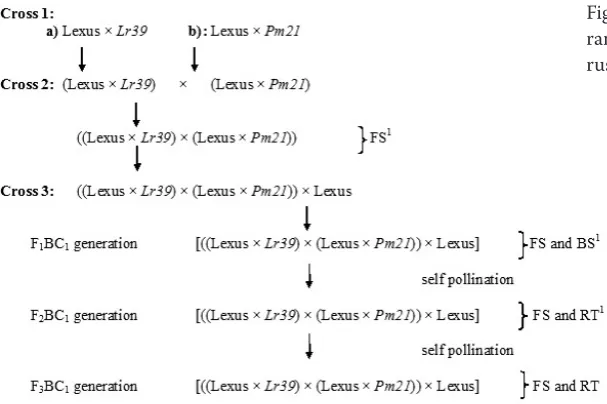
To introduce the two resistance genes, Lr39 and Pm21, into the cv. Lexus, the breeding scheme shown in Figure 1 was used.
Screening for leaf rust and powdery mildew
Screening for resistance to leaf rust and powdery mildew was carried out in a greenhouse on plants at the three-leaf stage. The greenhouse conditions were 16–22°C with a light:dark cycle of 16:8 h. The inoculum sources were natural populations of P. tri-ticina and B. graminis. The chosen inocula for both pathogens were avirulent to line KS90WGRC10 and virulent to Lexus. Plants were inoculated initially with P. triticina and then after 3–4 days the same plants were inoculated with the Bgt28 B. graminis. Reactions to infection were assessed 8–10 days later using a scale in which 0–2 indicates resistant plants and 3–4 indicates susceptible plants, with the latter displaying symptoms of leaf rust (Levine & Cherewick 1952) or powdery mildew (Mains & Dietz 1930).
DNA extraction
For the detection of resistance genes in plant materials, DNA was extracted from fresh leaves of plants using the method described by Higgins et al. (2000). For background selection, total DNA was isolated using a spin column-based method (DNeasy Plant Mini Kit, Qiagen, Valencia, USA).
Foreground selection (FS)
Lr39, a leaf rust resistance gene. In foreground selection to detect the Lr39 gene, five microsatel-lites (Simple Sequence Repeats, SSRs) were used: Gdm35 (170 bp), Barc124 (250 bp), Gwm261 (160 to
200 bp), Gwm296 (135 bp), and Gwm210 (182 bp) (Röder et al. 1998; Pestsova et al. 2000; Singh et al. 2004; Somers et al. 2004; Song et al. 2005). Polymerase chain reactions (PCRs) were performed in low-profile PCR tube strips (BIO-RAD, Her-cules, USA) in a Mastercycler ep thermocycler (Eppendorf, Hamburg, Germany). PCRs were car-ried out under the following conditions when the total reaction volume of 8 µl contained: 1.5 µl of DNA solution, 1× buffer (MBI Fermentas, Vilnius, Latvia), 2.5mM MgCl2, 0.2mM dNTPs, 0.5µM primer, and 1 U of Taq DNA polymerase (MBI Fermentas, Vilnius, Latvia). Amplification products were separated on denaturing polyacrylamide gels (Long Ranger Gel Solution, Rockland, USA) on an ABI Prism 377 automated DNA sequencer for 2 h.
Pm21, a powdery mildew resistance gene. In foreground selection to detect the Pm21 gene in plant material, three molecular markers were used:
SCAR1250 (1250 bp), SCAR1400 (1400 bp) (Liu et
al. 1999; Yildirim et al. 2004), and NAU/xibao (902 bp) (Cao et al. 2006). The 10-µl reaction mix-ture contained the following components: 4 µl of DNA solution, 1 × buffer (MBI Fermentas), 2.5mM MgCl2, 0.2mM dNTPs, 0.5µM primer, and 1 U of Taq DNA polymerase (MBI Fermentas). Amplifi-cation products were separated on 1.6% agarose gels in 1 × TBE buffer for 4 h, and visualised under UV light after the addition of ethidium bromide.
AFLP analysis and estimation of the percentage of recurrent parent genome
using the formula developed by KeyGene (Wage-ningen, the Netherlands).
Genetic map construction.
Genetic maps for the BC1F3 generation were constructed with 5 microsatellites that flanked the Lr39 gene using JoinMap 4.0 (Kyazma B.V., Wage-ningen, the Netherlands) at LOD > 3.0 (Lander et al. 1987) and the Kosambi mapping function (Kosambi 1943).
RESULTS AND DISCUSSION
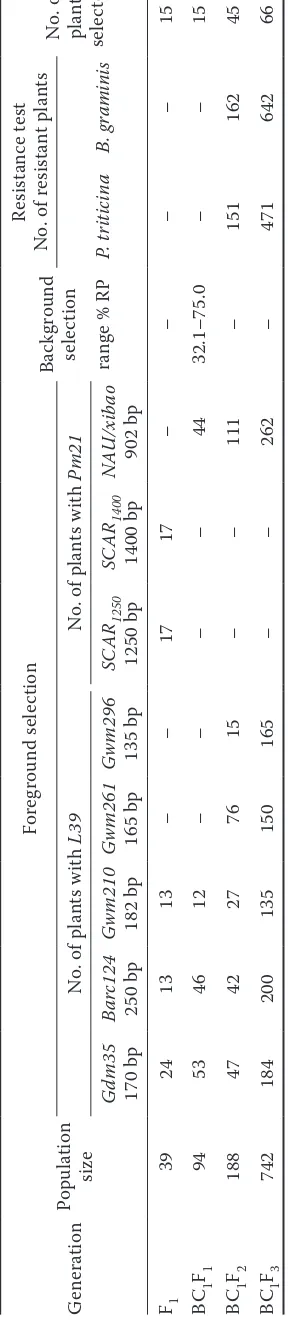
First, two crosses were carried out between Lexus and the line KS90WGRC10, and between Lexus and the translocation line 6VS/6AL Yangmai5. Next, we performed crosses between (Lexus × Lr39) and (Lexus × Pm21) and analysed 39 plants (Table 1). Three molecular markers were used to detect the Lr39 gene in the F1 plants: Gdm35, Barc124, and Gwm210. A 170 bp allele for the Gdm35 marker was amplified in 24 plants, whereas in 13 plants both a 250 bp allele for Barc124 and a 182 bp allele for Gwm210 were amplified (Table 1). Two specific molecular markers were used to detect the Pm21 gene in the F1 plants: SCAR1250 (1250 bp) and SCAR1400 (1400 bp). Seven-teen plants yielded the expected 1250 bp band for
SCAR1250 and 1400 bp band for SCAR1400. When
the results were compared, 15 plants carried both resistance genes (Lr39 + Pm21) (Table 1).
The plants that carried both Lr39 and Pm21 were used in backcrosses with the Lexus cultivar as the recurrent parent to obtain a BC1F1 generation. Nine-ty-four BC1F1 plants were tested for the presence or absence of the resistance genes by foreground selection (Table 1). To detect the Lr39 gene in the BC1F1 plants, the same 3 microsatellites described above were used. With the primers for Gdm35, a 170 bp fragment was amplified in 53 plants, whereas the primers for Barc124 amplified a 250 bp frag-ment in 46 plants, and the primers for Gwm210 amplified a 182 bp fragment in 12 plants (Table 1). This marker NAU/xibao was used to detect the presence of the Pm21 gene in the BC1F1 generation, and the expected 902 bp fragment was amplified in 44 plants (Table 1). Overall, 24 plants showed the presence of both (Lr39 + Pm21).
Next, these 24 plants were subjected for BS analy-sis using 5 combinations of AFLP primers: P38/ Table 1. M
ole cul ar analy sis (f or eg
round and b
ac
kg
round s
ele
ction) and r
esi
st
anc
e of t
he ((L
ex
us ×
Lr39
) × (L
ex
us ×
Pm21
)) × L
ex us p opul ation t o le af r ust and powder y milde w G enera tion Popul ation si ze For eg round s ele ction Bac kg round se le ction
range % R
P Re si st anc e t est
No. of r
esi st an t pl an ts
No. of plan
ts
se
le
ct
ed
No. of pl
an
ts w
ith
L39
No. of pl
an ts w ith Pm21 P. tr itici na B. g ra mini s G
dm35 170 bp
Ba rc124 250 bp Gw m210 182 bp Gw m261 165 bp Gw m296 135 bp SC A R1250 1250 bp SC A R1400 1400 bp N AU/xi bao 902 bp F1 39 24 13 13 – – 17 17 – – – – 15 BC 1 F1 94 53 46 12 – – – – 44 32.1–75.0 – – 15 BC 1 F2 188 47 42 27 76 15 – – 111 – 151 162 45 BC 1 F3 742 184 200 135 150 165 – – 262 – 471 642 66
– not t
est
[image:3.595.335.479.99.761.2]T43, P41/T41, P39/T41, P35/T43, and P36/T46. These primers generated a total of 28 polymorphic AFLP markers. On the basis of the results, the % RP for the BC1F1 was estimated. The % RP was in the range of 32.1–75% (Table 1). Fifteen plants which were in the range from 50 to 75% were used to produce the BC1F2 generation by self-pollination. In total, 188 BC1F2 plants were analysed by foreground selection and phytopathology tests (Table 1). To detect the Lr39 gene in the BC1F2 plants, 5 molecular markers were used: Gdm35, Barc124, Gwm261, Gwm296, and Gwm210. With the primers for marker Gdm35, a 170 bp DNA frag-ment from the line KS90WGRC10 was amplified in 47 plants (Table 1). The primers for Barc124 amplified a 250 bp fragment in 42 plants, whereas the primers for Gwm261 amplified a 165 bp frag-ment in 76 BC1F2 plants. The primers for Gwm296 amplified a 135 bp fragment in 15 plants, and Gwm210 a 182 bp fragment in 27 plants (Lr39 + Pm21) (Table 1). The marker for the Pm21 gene, NAU/xibao, was detected in 111 plants (Table 1). Phytopathology tests using a natural population of P. triticina revealed that 151 plants were resistant to this pathogen, whereas 162 BC1F2 plants were resistant to B. graminis. On the basis of the results from the foreground selection and phytopathol-ogy tests, 45 plants that carried both Lr39 and Pm21 were selected for production of the BC1F3 generation by self-pollination (Table 1).
In total, 742 BC1F3 plants were analysed by phy-topathology tests using natural populations of P. triticina and B. graminis (Table 1). Four hundred and seventy-one BC1F3 plants were found to be resistant to leaf rust. In addition, 642 plants were found to be resistant to powdery mildew (Table 1). A total of 382 plants were analysed by foreground selection to detect the Lr39 and Pm21 genes. The primers for the marker Barc124 amplified a 250 bp fragment in 200 plants, those for Gdm35 ampli-fied a 170 bp fragment in 184 plants, whereas the primers for Gwm261 amplified a 165 bp fragment in 150 plants (Table 1). In addition, the primers for Gwm296 amplified a 135 bp fragment in 165 plants and a 182 bp fragment for Gwm210 was amplified in 135 plants (Table 1). Furthermore, the prim-ers for the marker NAU/xibao amplified a 902 bp fragment in 262 plants (Table 1). On the basis of the molecular and phenotypic characteristics, a total of 66 homozygous plants carried both Lr39 and Pm21 in a single genotype, and were selected for field evaluation (Table 1).
Linkage analysis showed that the Lr39 gene was linked to the 5 microsatellite markers Gdm35, Barc124, Gwm261, Gwm296, and Gwm210. Map-ping of these markers showed that Barc124 was linked most closely to Lr39, at a distance of 9.7 cM. The order of the other markers on the 2DS chro-mosome was Gdm35, Gwm261, Gwm296, and Gwm210 at 14.8 cM, 20.6 cM, 26.0 cM, and 33.2 cM, respectively, from the locus of resistance Lr39 (Figure 2).
The results described herein demonstrate that the success of gene pyramiding depends on the combination of molecular selection on the basis of DNA markers with phenotypic selection, both of which contribute significantly to the efficiency of the selection process. During foreground selection to detect the Lr39 gene in the composite F1 gen-eration (crosses 2) (Figure 1), 3 microsatellites were used: Gdm35, Barc124, and Gwm210. On the basis of the results obtained for the composite F1 generation, we applied additional polymor-phic markers that are linked more closely to locus Lr39, according to the microsatellite consensus map constructed by Somers et al. (2004), namely Gwm261 and Gwm296. Therefore, subsequently, 5 microsatellite markers were used for foreground selection: Gdm35, Barc124, Gwm210, Gwm261, and Gwm296. The use of these specific molecular markers to detect Lr39 in breeding material was based on previous reports. Singh et al. (2004) used only 3 markers (Gdm35, Barc124, Gwm210) to perform successful foreground selection for Lr39. On the basis of the findings of Sun et al. (2009), other combinations of microsatellites could be used potentially for marker-assisted selection (MAS), such as Barc124, Gwm210, Gdm35, and Cfd36. From these earlier reports of the identification of Lr39 resistance genes in breeding material, it can be concluded that there might be no universal marker that is suitable for MAS of Lr39 in breed-ing programs.
or Foster etc., Barc124 is not recommended for MAS (Sun et al. 2009). Gdm35 is also particularly useful for MAS for Lr39 when the KS90WGRC10/ TAM 107 population is used as the donor of Lr39 (Singh et al. 2004).
In the study reported herein, to interpret the results for the BC1F2 generation better (Figure 2), a genetic map was constructed using 5 microsat-ellites. This linkage map was compared with the genetic maps obtained by Somers et al. (2004) (map A), Singh et al. (2004) (map C), and Sun et al. (2009) (map D) (Figure 2). The locations of markers relative to the locus Lr39 differed among the maps. For the map obtained with the BC1F2 generation, the order of the molecular markers on chromosome 2DS was as follows: Barc124 (9.7 cM to Lr39), Gdm35 (14.8 cM), Gwm261 (20.6 cM), Gwm296 (26.0 cM), and Gwm210 (33.2 cM). Ac-cording to the map of Singh et al. (2004), the closest marker to the resistance locus was Gdm35 (1.9 cM to Lr39), followed by Barc124 (5.8 cM) and Gwm210 (7.9 cM). For the map constructed by Sun et al. (2009), the closest marker to Lr39 was Barc124 (1.0 cM to Lr39), followed by Gwm210 (1.5 cM), Gdm35 (2.8 cM), and Cfd36 (4.1 cM). The differences in the locations of the molecular markers among the different maps suggest that the resistance gene Lr39 might sometimes be difficult or problematic to detect in breeding material. In MAS, selection for the presence of the Lr39 gene using only three microsatellites might not be suf-ficient for plant breeding. As a consequence, to increase the efficiency of selection of the Lr39 gene in this study, 5 microsatellite markers were
used: Gdm35, Barc124, Gwm210, Gwm261, and Gwm296. On the basis of our results, it is not possible to recommend one universal marker that is suitable for detection of the Lr39 gene in large-scale breeding programs.
[image:5.595.64.368.83.285.2]In this study, a total of 3 molecular markers were used to detect Pm21 in breeding material, SCAR1250, SCAR1400, and co-dominant PCR marker NAU/xibao, all of which appeared to be suitable for Figure 1. Experimental design for the py-ramiding of two resistance genes for leaf rust and powdery mildew
Figure 2. Partial map of wheat chromosome 2DS (B) including resistance gene Lr39 based on the analysis of the BC1F3 population Lexus × KS90WGRC10; the order of the markers is compared with reference maps from (A) Somers et al. 2004, (C) Singh et al. 2004, and (D) Sun et al. 2009
Barc124 0,0
Cfd56 7,0
Cfd36 11,0
Wmc25 18,0
Gwm261 23,0
Gwm296 23,5
Gwm210 26,0
Wmc112 28,0
Gwm455 32,0
A
Lr39
0,0
Barc124 9,7
Gdm35 14,8
Gwm261 20,6
Gwm296 26,0
Gwm210 33,2
B
Lr39
0,0
Gdm35 1,9
Barc124 5,8
Gwm210 7,9
C
Lr39
0,0
Barc124 1,0
Gwm210 1,5
Gdm35 2,8
Cfd36 4,1
D
Barc124 0,0
Cfd56 7,0
Cfd36 11,0
Wmc25 18,0
Gwm261 23,0
Gwm296 23,5
Gwm210 26,0
Wmc112 28,0
Gwm455 32,0
A
Lr39
0,0
Barc124 9,7
Gdm35 14,8
Gwm261 20,6
Gwm296 26,0
Gwm210 33,2
B
Lr39
0,0
Gdm35 1,9
Barc124 5,8
Gwm210 7,9
C
Lr39
0,0
Barc124 1,0
Gwm210 1,5
Gdm35 2,8
Cfd36 4,1
[image:5.595.309.536.458.657.2]MAS. Similar results were reported by Liu et al. (1999), Yildirim et al. (2004), and Cao et al. (2006). Other markers were previously used to detect Pm21 and identify homozygous and heterozygous translocation in breeding materials, these include specific RAPD markers, such as OPH17-1900 and OPH17-1000 (Qi et al. 1996). In addition, Liu et al. (2000) used the RFLP marker Psr113 to select Pm21. The most frequently encountered obstacles for MAS are the high cost and time requirements of RFLP technologies, and the low repeatability of RAPD markers. As a consequence, these types of marker are no longer used commonly for MAS.
One of the benefits of using molecular markers in breeding programs is the potential to estimate the proportion of alleles from the parental lines in the genomes of the offspring. Such information is particularly important in backcross breeding programs. Compared with conventional backcross-ing, selection based on DNA markers (such as microsatellites and AFLPs) can speed up recovery of the recurrent parent (RP) genome (Ribaut & Hoisington 1998; Servin & Hospital 2002). This strategy is highly profitable after the first backcrosses in BC1F1 generations, when the widest variation for the RP genome content is observed and the individuals with the highest RP genome content can be selected, as was demonstrated in this study. Microsatellite and AFLP markers are used commonly to estimate genetic similarity, and they are effective tools for backcross breeding programs. In the present study, a set of 5 AFLP primer combinations was used to estimate genetic similarity among the backcross lines and it was estimated to be in the range of 32.1–70.8%. Chen et al. (2001) estimated genetic similarity using a set of 10 AFLP primer combinations, and found the recovery percentages for the recipient genome to be approximately 92.25% (BC1F1), 97.67% (BC2F1), and 98.8% (BC3F1). In a similar study, which was based on 35 microsatellites and 12 AFLP primer combinations, the range of % RP in BC1F3 was found to be 94.3–97% (Gupta et al. 2008).
In summary, gene pyramiding is a breeding strat-egy that enables multiple resistance genes to be introduced into a single genotype, which results in cultivars that are resistant to one or more diseases. Using foreground and background selection to introduce resistance genes considerably reduces the time required to breed new cultivars. The use of molecular selection in conjunction with resistance tests confers many benefits for MAS,
especially when the foreground selection is dif-ficult to interpret. In this study, we obtained new homozygous lines that were resistant to leaf rust and powdery mildew. These lines could be used as a source of resistance to these pathogens in wheat breeding programs.
Acknowledgements. Supported by the UE
BIOEX-PLOIT project (FOOD-CT-2005-513959) and Polish Ministry of Science and Higher Education (Grant No. NN310 147035).
References
Cao A.Z., Wang X.E., Chen Y.P., Zou X.W., Chen P.D. (2006): A sequence-specific PCR marker linked with
Pm21 distinguishes chromosomes 6AS, 6BS, 6DS of
Triticum aestivum and 6VS of Haynaldia villosa. Plant Breeding, 125: 201–205.
Chen S., Xu C.G., Lin X.H., Zhang Q. (2001): Improving bacterial blight resistance of 6078, an elite restorer line of hybrid rice, by molecular marker-assisted selection. Plant Breeding, 120: 133–137.
Gupta P.K., Balyan H.S., Kuma R.J., Kulwal P.L., Kumar N., Mir R.R., Kumar A., Mohan A., Prabhu K.V. (2008): QTL analysis and marker assisted selection for improve-ment in grain protein content and pre-harvest sproting tolerance in bread wheat. In: Proc. 11th Int. Wheat
Genet-ics Symp. August 24–29, Brisbane.
Hiebert C.W., Thomas J.B., McCallum B.D., Somers D.J. (2010): Genetic mapping of the wheat leaf rust resistance gene Lr60 (LrW2). Crop Science, 48: 1020–1026. Higgins C.M., Hall R.M., Campbell P.R., Dietzgen R.G.
(2000): PCR rescue and analysis of transgene sequences directly from crude extracts of transgenic embryos and plants. Plant Molecular Biology Reporter, 18: 285a–285g. Kosambi D.D. (1943): The estimation of map distance from recombination values. Annals of Human Genetics,
12: 172–175.
Lander E.S., Green P., Abrahamson J., Barlow A., Daly M.J., Lincoln S.T., Newburg L. (1987): Mapmaker: An interactive computer package for construction primary genetic linkage maps of experimental and natural popula-tions. Genomics, 1: 174–181.
Levine M.N., Cherewick W.J. (1952): Studies on Dwarf Leaf Rust on Barley. USDA Technical Bulletin 1056, USDA, Washington D.C., 1–17.
Liu Z., Sun Q., Ni Z., Yang T. (1999): Development of SCAR markers linked to the Pm21 gene conferring re-sistance to powdery mildew in common wheat. Plant Breeding, 118: 215–219.
Mains E.B., Dietz S.M. (1930): Physiologic forms of barley mildew, Erysiphe graminis hordei Marchal. Phytopatho-logy, 20: 229–239.
Pestsova E., Ganal M.W., Röder M.S. (2000): Isolation and mapping of microsatellite markers specific for the D genome of bread wheat. Genome, 43: 689–697. Qi L., Cao M., Chen P., Li W., Liu D. (1996): Identification,
mapping, and application of polymorphic DNA associ-ated with resistance gene Pm21 of wheat. Genome, 39: 191–197.
Ribaut J.M., Hoisington D. (1998): Marker-assisted se-lection: new tools and strategies. Trends in Plant Science,
3: 236–239.
Röder M.S., Korzun V., Wendehake K., Plaschke J., Tixier M.H., Leroy P., Ganal M.W. (1998): A micro-satellite map of wheat. Genetics, 149: 2007–2023. Serwin B., Hospital F. (2002): Optimal positioning of
markers to control genetic background in Marker Assist-ed Backcrossing. The Journal of HerAssist-edity, 93: 214–217. Singh S., Franks C.D., Huang L., Brown-Guedira G.L.,
Marshall D.S., Gill B.S. (2004): Lr41, Lr39, and a leaf
rust resistance gene from Aegilops cylindrica may be al-lelic and are located on wheat chromosome 2DS. Theo-retical and Applied Genetics, 108: 586–591.
Somers D.J., Isaac P., Edwards K. (2004): A high-density microsatellite consensus map for bread wheat (Triticum aestivum L.). Theoretical and Applied Genetics, 109: 1105–1114.
Song Q.J., Shi J.R., Singh S., Fickus E.W., Costa J.M., Lewis J., Gill B.S., Ward R., Cregan P.B. (2005): Devel-opment and mapping of microsatellite (SSR) markers in wheat. Theoretical and Applied Genetics, 110: 550–560. Sun X., Bai G., Carver B.F. (2009): Molecular markers for
wheat leaf rust resistance gene Lr41. Molecular Breeding,
23: 311–321.
Vos P., Hogers R., Bleeker M., Reijans M., van de Lee T., Hornes M., Friters A., Pot J., Paleman J., Kuiper M., Zabeau M. (1995): AFLP: a new technique for DNA fingerprinting. Nucleic Acids Research, 23: 4407–4414. Yildirim A., Sakin M., Karadag Y., Gokmen S., Kan-demir N., Akkaya M.S., Yildirim F. (2004): Genetic marker mediated transfer of an alien gene, Pm21, into wheat conferring resistance to powdery mildew. Bio-technology & Biotechnological Equipment, 18: 15–19.
Received for publication July 30, 2012 Accepted after corrections May 27, 2013
Corresponding author:
Dr. Aleksandra Pietrusińska, National Research Institute at Radzików, Plant Breeding and Acclimatization Institute, Department of Plant Breeding and Genetics, 05-870 Błonie, Poland