Effects of faba bean (
Vicia faba
) varieties on the development
of
Bruchus rufimanus
Marek SEIDENGLANZ
1and Igor HUŇADY
21Department of Plant Protection, AGRITEC Research, Breeding and Services, Ltd., Šumperk, Czech Republic; 2Department of Grain Legumes and Technical Crops, Agritec Plant Research
Ltd., Šumperk, Czech Republic
Abstract
Seidenglanz M., Huňady I. (2016): Effects of faba bean (Vicia faba) varieties on the development of Bruchus rufi-manus. Czech J. Genet. Plant Breed., 52: 22–29.
The development of Bruchus rufimanus was assessed in randomised field trials from 2005 to 2007 with eight faba bean genotypes (SU 5/13, SU-BT, Mistral, Merkur, Stabil Merlin, Melodie, Divine). Significant differences, reproducible between the years, were found between the faba bean lines. The varieties most attractive to
B. ru-fimanus ovipositing females were SU-BT and Divine. Merkur showed a certain level of non-preference. The
highest mortality rates of eggs and first instar larvae in pod valve tissues were recorded in Merkur (34–45%) and Divine (51–55%). The highest mortality rates of larvae and pupae during their development in seeds (effect of seed coat and cotyledon tissues) were recorded in Merkur (87–90%) and Melodie (87–99%). Parasitation by Triaspis thoracicus contributed to this mortality. The highest levels of B. rufimanus parasitation were found in SU-BT (32–35%), the lowest in Melodie (3–9%). The total reduction in Bruchus rufimanus individuals during their development was relatively high in all varieties, ranging from 72% to 99%.
Keywords: antibiosis; Bruchus rufimanus mortality in seeds; nonpreference; plant resistance to bruchids
The bean seed beetle, Bruchus rufimanus
(Bohe-man), is an economically important pest of Vicia faba
bean crops throughout Europe (Czerniakowski et
al. 1996; Meyer 1998; Ward & Smart 2011) and
has been a serious insect pest in the Czech Republic (CZ). The adults are in reproductive diapause from September to April. They overwinter under the bark of trees, in leaf litter and also in seeds (Middlekauf
1961; Tran et al. 1993) and return to the growing
crop in the spring, once the beans begin to flower (usually at the end of May or in the first half of June in CZ). At the time of colonization, the males have active reproductive organs: their diapause has already terminated. The females remain in diapause and their sexual development begins in the fields
(Tran & Huignard 1992; Tran et al. 1993;
Ka-niuczak 2006). Females lay eggs on the outside of developing pods, predominantly on the lowest fertile
nodes, where flowering starts (Ward & Smart 2011). Hatching larvae bore through the pod valves and develop within the seeds. This fact makes the larvae a difficult target for control with insecticide sprays and thus the adults are usually the main target of control attempts. The sprays have to coincide with the egg-laying period to be effective. Two applications are usually recommended (Ward & Smart 2011). However, egg monitoring on pods is complicated and very time-consuming for farmers, so the spray timing is often incorrect and the control is gener-ally poor (Ward & Smart 2011). Moreover, even if the spray timing is correct, the effects of commonly available insecticides (pyrethroids, neonicotinoids) are often unsatisfactory (Matłosz & Kaniuczak
1997; Bruce et al. 2011; Seidenglanz etal. 2011).
seed stock production and human consumption (the latter is not the case for CZ growers) due to crop re-jection on standards of quality. Because levels of seed infestation have ranged between 1% and 50% during the last decade (2000–2010) in Central and Western Europe, and as this can vary in individual seasons, an effective approach to a control system consisting of more than just one operation is essential for grow-ers to expand their use of beans as a valuable break crop in both organic and conventional arable
farm-ing systems. Bruce et al. (2011) aimed to develop a
semiochemical-based monitoring system as part of an Integrated Pest Management (IPM) strategy. A moni-toring system supported by better knowledge of the pest biology would allow more effective control with insecticides and would provide a reliable risk indicator for determining the need or optimum timing of sprays, reducing multiple applications and risk of resistance. In addition, the identification of genetic resources of plant resistance for breeding programmes would enhance a package of IPM approaches. It is known (Matłosz 1998; Kaniuczak 2004; unpublished data: LEGATO project KBBE.2013.1.2-02) that faba bean varieties used in individual European countries (UK, France, Germany, Spain, Poland, CZ) often react dif-ferently after contact with the pest, with their eggs or larvae. Some varieties are significantly more attractive to egg-laying females or constantly show significantly higher levels of seed infestation than others under
the same field conditions (Matłosz 1998; Kaniuc-zak 2004). Relatively resistant accessions should be present in genetic resource collections (unpublished data: LEGATO project KBBE.2013.1.2-02).
Comparison of B. rufimanus development (from egg
stage to hatching of new adults) in eight faba bean varieties / breeding materials is the aim of the paper.
MATERIAL AND METHODS
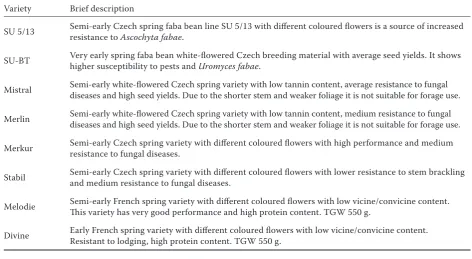
The trials were conducted under field conditions in the Czech Republic (49°59.42497'N, 17°1.20018'E) over three years (2005–2007). The design of the trials was the same in each of the seasons. Trials were designed as four complete randomised blocks. Plots with each of the varieties (1–8) were in four repetitions. Size of plots: 1.2 × 1.2 m (1.44 m2). The individual faba bean plots were surrounded by a white mustard crop (width of mustard strips = 3 m). A description of the faba bean varieties used is given in Table 1.
[image:2.595.60.533.506.765.2]Monitoring of bruchid egg counts on pods started at the time when the first eggs were observed on pods. This always occurred first on SU-BT plants. This variety started flowering earlier than the others in the test group. The monitoring was concentrated exclusively on the two bottom nodes which are more attractive to egg-laying females (Ward & Smart 2011). The assessments were done once or twice a week in the period of egg-laying (2005: 17 June–3 July;
Table 1. Brief descriptions of the varieties used in field trials (2005–2007)
Variety Brief description
SU 5/13 Semi-early Czech spring faba bean line SU 5/13 with different coloured flowers is a source of increased resistance to Ascochyta fabae.
SU-BT Very early spring faba bean white-flowered Czech breeding material with average seed yields. It shows higher susceptibility to pests and Uromyces fabae.
Mistral Semi-early white-flowered Czech spring variety with low tannin content, average resistance to fungal diseases and high seed yields. Due to the shorter stem and weaker foliage it is not suitable for forage use.
Merlin Semi-early white-flowered Czech spring variety with low tannin content, medium resistance to fungal diseases and high seed yields. Due to the shorter stem and weaker foliage it is not suitable for forage use.
Merkur Semi-early Czech spring variety with different coloured flowers with high performance and medium resistance to fungal diseases.
Stabil Semi-early Czech spring variety with different coloured flowers with lower resistance to stem brackling and medium resistance to fungal diseases.
Melodie Semi-early French spring variety with different coloured flowers with low vicine/convicine content. This variety has very good performance and high protein content. TGW 550 g.
2006: 25 June–11 July; 2007: 20 June–7 July; 20 pods from two bottom nodes per plot were assessed). The assessments with the highest mean counts per pod were used for further analysis.
Pods (exclusively from two bottom nodes) were taken by hand at harvest (August) and analysed for damage to seed by bruchids (20 pods per plot = 80 pods per treatment) in September/October. A pod was the basic unit for all assessments conducted in the laboratory. Each pod was assessed solely for the total number of seeds, for the number of larval
entrances into seeds, number of Bruchus exit holes
from seeds and for the number of Triaspis thoracicus
(parasitoid of the insect pest) exit holes from seeds. From these primary data, the proportions of seeds
left by B. rufimanus adults and T. thoracicus adults
were calculated for each pod and, after that, the mean
values for each variety (n = 80 = 4 × 20 pods per
treatment) were determined. Proportions of
B. ru-fimanus individuals that died in seeds and/or were
parasitized by T. thoracicus in the compared varieties
were inferred from the numbers of larval entrances
into seeds and the numbers of B. rufimanus and/or
T. thoracicus exit holes. Again, the proportions were first determined for each pod and, after that, for the individual varieties (expressed as variety means). The pods with seeds free from larval entrances were excluded from the two last assessments.
To test significant differences in mean values de-termined for the studied variables in the compared varieties in the three years (2005, 2006, 2007) and totally (2005–2007) analysis of variance (ANOVA) and an appropriate post-test (Tukey’s test) were per-formed. The statistical analysis was performed by the Statistica software v.10 (StatSoft, Inc. 1984–2013).
RESULTS
The Divine variety was significantly more attractive
to egg-laying B. rufimanus females than the majority of
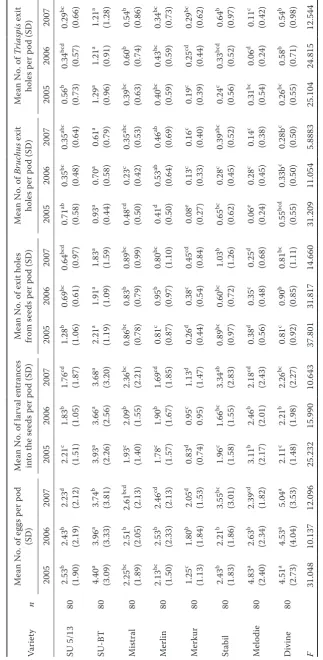
the other varieties compared in the group in all three years. The SU-BT variety also showed significantly (in many instances) higher numbers of bruchid eggs on pods, especially in the first two years. In contrast, the lowest numbers of eggs were recorded on the Merkur variety in all three years. So the variety showed a certain level of nonpreference (Table 2).
The highest numbers of bruchid larvae entering the seeds were recorded with the SU-BT variety in all three years. Interestingly, the mean numbers of larvae entering the Divine seeds, the most attractive
variety to ovipositing females, were markedly lower in all three years (Table 2). The reason was the mark-edly higher mortality of young bruchid individuals
(eggs and 1st instar larvae) on pod valves and within
the pod in this variety compared to SU-BT (Table 3). The lowest numbers of larval entrances to seeds were recorded with the Merkur variety (Table 2). This coincides with the relatively low numbers of eggs on pods and it is also a result of the high mortality of eggs and young larvae on pod valves and in within the pod (Table 3).
Most insect adults (B. rufimanus + its parasitoid
T. thoracicus) successfully finished their development, hatched and left seeds on the SU-BT variety. There were significantly higher mean numbers of exit holes from seeds in all three years in this variety. In contrast, substantially fewer insects left seeds of the Merkur and Melodie varieties during these years (Table 2). The recorded levels of bruchid larvae mortality in seeds correspond with such development (Table 3). Seeds of the Melodie variety proved to be the most unfavourable place for development of bruchid larvae (the variety showed the highest level of antibiosis) in the tested group, even if this variety was relatively attractive to egg-laying females and the mortality of eggs/larvae on pod valves and within the pod was rather lower at the same time (with the exception of the 2005 season; Table 3).
The highest numbers of B. rufimanus adults were
found leaving SU-BT pods (mean number of bruchid exit holes from seeds per pod) every year. In 2005 a
high number of B. rufimanus adults also hatched in
SU 5/13. In 2006 and 2007 relatively high numbers of B. rufimanus adults completed their development in the Merlin variety. The fewest adults left pods of the Merkur and Melodie varieties (Table 2). This coincides with the levels of mortality in their seeds (high level of antibiosis in Merkur and Melodie, lower in SU-BT) and on pod valves and within the pod (high level of antibiosis in Merkur, average for Melodie, low ‒ average in SU-BT). However, this does not correspond with the levels of parasitation (high in SU-BT, average in Merkur, low in Melodie).
Even if the B. rufimanus parasitation (induced by
T. thoracicus) reached the highest levels in SU-BT (32.08–34.96%), the variety remained the most in-tensively damaged by the pest (17.58–27.06% of
seeds left by Bruchus adults). The least damaged
varieties were Merkur (1.98–4.90% of seeds left by
Bruchus adults) and Melodie (1.81–9.90% of seeds
Ta
ble 2. Eff
ec
ts of f
ab a b ean ( Vici a f ab a ) v ar ie tie
s and p
ara sit oid ( Tr ia spi s thor acicu s
) on t
he de
ve
lopmen
t of br
oad b ean we ev il ( Br uchu s r ufim anu s
) under fie
ld c
ondi
-tions (2005–2007) Var
ie
ty
n
M
ean No. of e
gg s p er p od (S D) M
ean No. of l
ar val en tranc es in to t he s ee ds p er p od (S D) M
ean No. of e
xit hole s fr om s ee ds p er p od (S D) M
ean No. of
Br uchu s e xit hole s p er p od (S D) M
ean No. of
Tr ia sp is e xit hole s p er p od (S D) 2005 2006 2007 2005 2006 2007 2005 2006 2007 2005 2006 2007 2005 2006 2007 SU 5/13 80 2.53 b (1.90) 2.43 b (2.19) 2.23 d (2.12) 2.21 c (1.51) 1.83 b (1.05) 1.76 cd (1.87) 1.28 b (1.06) 0.69 bc (0.61) 0.64 bcd (0.97) 0.71 ab (0.58) 0.35 bc (0.48) 0.35 ab c (0.64) 0.56 b (0.73) 0.34 bcd (0.57) 0.29 bc (0.66) SU-BT 80 4.40 a (3.09) 3.96 a (3.33) 3.74 b (3.81) 3.93 a (2.26) 3.66 a (2.56) 3.68 a (3.20) 2.21 a (1.19) 1.91 a (1.09) 1.83 a (1.59) 0.93 a (0.44) 0.70 a (0.58) 0.61 a (0.79) 1.29 a (0.96) 1.21 a (0.91) 1.21 a (1.28) Mi stral 80 2.25 bc (1.89) 2.51 b (2.05) 2.61 bcd (2.13) 1.93 c (1.40) 2.09 b (1.55) 2.36 bc (2.21) 0.86 bc (0.78) 0.83 b (0.79) 0.89 bc (0.99) 0.48 cd (0.50) 0.23 c (0.42) 0.35 ab c (0.53) 0.39 bc (0.63) 0.60 b (0.74) 0.54 b (0.86) M er lin 80 2.13 bc (1.50) 2.53 b (2.33) 2.46 cd (2.13) 1.78 c (1.57) 1.90 b (1.67) 1.69 cd (1.85) 0.81 c (0.87) 0.95 b (0.97) 0.80 bc (1.10) 0.41 d (0.50) 0.53 ab (0.64) 0.46 ab (0.69) 0.40 bc (0.59) 0.43 bc (0.59) 0.34 bc (0.73) M er kur 80 1.25 c (1.13) 1.80 b (1.84) 2.05 d (1.53) 0.83 d (0.74) 0.95 c 0.95) 1.13 d (1.47) 0.26 d (0.44) 0.38 c (0.54) 0.45 cd (0.84) 0.08 e (0.27) 0.13 c (0.33) 0.16 c (0.40) 0.19 c (0.39) 0.25 cd (0.44) 0.29 bc (0.62) St abil 80 2.43 b (1.83) 2.21 b (1.86) 3.55 bc (3.01) 1.96 c (1.58) 1.66 bc (1.55) 3.34 ab (2.83) 0.89 bc (0.97) 0.60 bc (0.72) 1.03 b (1.26) 0.65 bc (0.62) 0.28 c (0.45) 0.39 ab c (0.52) 0.24 c (0.56) 0.33 bcd (0.52) 0.64 b (0.97) M elo die 80 4.83 a (2.40) 2.63 b (2.34) 2.39 cd (1.82) 3.11 b (2.17) 2.46 b (2.01) 2.18 cd (2.43) 0.38 d (0.56) 0.35 c (0.48) 0.25 d (0.68) 0.06 e (0.24) 0.28 c (0.45) 0.14 c (0.38) 0.31 bc (0.54) 0.06 d (0.24) 0.11 c (0.42) Div ine 80 4.51 a (2.73) 4.53 a (4.04) 5.04 a (3.53) 2.11 c (1.48) 2.21 b (1.98) 2.26 bc (2.27) 0.81 c (0.92) 0.90 b (0.85) 0.81 bc (1.11) 0.55 bcd (0.55) 0.33b c (0.50) 0.28b c (0.50) 0.26 bc (0.55) 0.58 b (0.71) 0.54 b (0.98) F 31.048 10.137 12.096 25.232 15.990 10.643 37.801 31.817 14.660 31.209 11.054 5.8883 25.104 24.815 12.544 The n umb ers mar ke d w ith diff er en t le
tters in t
Ta
ble 3. The c
ours e of B. r ufi ma nu s mor tality dur ing it s de ve lopmen
t in t
he c om par ed f ab a b ean v ar ie tie s (2005–2007) Tre atmen t No. Var ie ty A ppr oxima te me an le ve ls of mor
tality of e
gg
s on p
od
s
+ I. inst
ar l ar vae una ble t o en ter suc ce ssf ully t he s ee ds in p od s (%) 1 M ean le ve
l of l
ar
vae mor
tality in s
ee
ds (%)
# (S
D)
M
ean le
ve
l of p
ara
siti
sa
tion (%)
# (S
D) n * 2005 2006 2007 2005 2006 2007 2005 2006 2007 2005 2006 2007 1 SU 5/13 12.65 24.69 21.08 65.59
b (23.75)
78.93
ab (29.99)
75.99
ab (35.36)
22.69
ab (23.10)
17.50
b (28.84)
14.26
bc (26.98)
65 70 52 2 SU-BT 10.68 7.58 1.60 72.55
b (16.50)
73.16
b 30.00)
80.91
ab (24.48)
32.08
a (18.46)
34.96
a (23.75)
34.25
a (29.19)
71 68 64 3 Mi stral 14.22 16.73 9.58 72.30
b (29.94)
87.96
a (21.47)
78.88
ab (33.73)
17.57
bcd (26.89)
28.68
ab (30.53)
22.10
ab (30.33)
68 63 64 4 M er lin 16.43 24.90 31.30 72.27
b (34.93)
72.95
b (27.05)
73.91
b (30.74)
18.50
bcd (23.49)
24.02
ab (30.15)
17.81
bc (29.93)
61 59 52 5 M er kur 33.60 47.22 44.88 89.82
a (29.75)
87.32
ab (26.34)
86.71
ab (25.97)
22.22
bc (39.25)
24.64
ab (32.15)
23.89
ab (34.55)
54 46 42 6 St abil 19.34 24.89 5.92 64.05
b (31.86)
80.94
ab (29.34)
84.11
ab (26.12)
6.67
d (13.48)
16.14
bc (19.81)
19.96
ab
c (27.73)
66 56 70 7 M elo die 35.61 6.46 8.79 98.45
a (5.91)
88.71
a (16.22)
91.32
a (23.86)
9.43
d (15.17)
3.21
c (11.54)
5.50
c (19.34)
69 59 61 8 Div ine 53.22 51.21 55.16 68.90
b (32.47)
84.14
ab (21.59)
82.66
ab (32.57)
10.52
cd (19.47)
27.27
ab (26.59)
20.68
ab
c (31.12)
68
57
61
F
(7,514
) = 13.208
F
(7,470
) = 3.6820
F
(7,458
) = 2.0839
F
(7,514
) = 9.0185
F
(7,470
) = 8.4764
F
(7,458
) = 4.9867
The n umb ers mar ke d w ith diff er en t le
tters in t
he c olumns diff er sig nific an tly ( Tuk ey ’s t est ; P < 0.05);
1the ra
te
s of mor
tality ar
e only a
ppr oxima te, b ec au se t he monit or ing of egg s w
as done on diff
er
en
t p
od
s t
han all t
he ot her a ss essmen ts ;
# as a b
asi s f or c alc ul ation t he n umb
er of l
ar val en tranc es t o s ee ds p er p od w as u se
d (= 100%) and t
he n umb ers of Br uchu s or Tr ia sp is e xit hole s f rom se ed s p er po d wer e ex pr ess ed in %; n –
No. of p
od s analy se d per var ie ty ; *t he po ds w ith se ed s w ithout lar val en tranc es wer e e xc lude d fr om the a ss essmen ts mar ke d w ith
# , s
o t he n v alue s ar
e lower t
DISCUSSION
The reproduction of B. rufimanus is synchronised
with the flowering and fructification cycles of its
host plant (Medjdoub-Bensaad et al. 2007). When
temperatures rise above 15°C, the insects leave their hibernation sites and migrate towards the broad bean
cultures (Hoffmann et al. 1962). In Europe
oviposi-tion is usually triggered and the B. rufimanus activity
in crops starts increasing when temperatures of 20°C or more are reached (Muel personal communication 2006; Ward & Smart 2011). The colonisation of
faba bean cultures by B. rufimanus adults depends
on plant flower availability; the pollen consumption provides the insect with nutrition and induces female reproduction. When important trophic supplies are available on stems, females are attracted by these resources, forage on such stems for a long period and have higher chances of encountering suitable
pods for oviposition there (Medjdoub-Bensaad et
al. 2007). In a field where more than one faba bean
variety is grown together, early flowering varieties
attract B. rufimanus females earlier and the
oviposi-tion starts earlier and lasts longer; at least under CZ field conditions, where the oviposition period lasts about two to three weeks maximally. This prob-ably explains the differences in mean numbers of eggs recorded in the study. The SU-BT and Divine varieties with the highest mean numbers of eggs on pods entered the flowering period earlier (by about one week) than the others in the group every year. The relationship between the time of flowering and
attractiveness of faba bean to B. rufimanus females
was also confirmed in screening trials (300 faba bean accessions compared) conducted under CZ field con-ditions in 2014 (unpublished data: LEGATO project KBBE.2013.1.2-02) and also for some closely related
species (for example in B. pisorum: Burov 1980;
Annis 1983; Clement 1992; Smith & Hepworth 1992). Among the varieties with somewhat delayed start of flowering (compared to SU-BT and Divine) Merkur showed the highest level of nonpreference (the lowest attractiveness to ovipositing females).
In total, the (approximate) rates of bruchid egg/first instar larvae mortalities on pod valves and within the pod for all compared varieties in the study ranged from 1.60% to 55.16% during the three years (Table 3). There were significant differences in the decreases
between the mean numbers of B. rufimanus eggs per
pod and the mean numbers of B. rufimanus larval
entrances into seeds per pod in the varieties Divine,
Ta
ble 4. F
inal le
ve
ls of s
ee d d amage c au se d by B. r ufi ma nu s and t ot al pr op or
tions of s
ee
ds lef
t by t
he p
est and/or it
s p ara sit oid T. thor acicu s (2005–2007) Var ie ty n M
ean No. of s
ee ds p er p od (S D) M ean p or
tion of s
ee ds le ave d by Br uchu s adult s (%) (S D) M ean p or
tion of s
ee ds le ave d by Br uchu s or (and) Tr ia sp is adult
s (%) (S
D) 2005 2006 2007 2005 2006 2007 2005 2006 2007 SU 5/13 80 3.28
bc (1.12)
3.43
cd (0.85)
3.23
ab (0.67)
26.40
a (27.48)
11.17
ab
cd (15.85)
10.83
ab
c (19.77)
41.69
b (36.58)
21.50
bcd (20.37)
19.48 bcd (28.90) SU-BT 80 3.81
a (1.07)
3.91
ab (0.96)
3.51
a (0.66)
27.06
a (17.13)
18.04
a (16.13)
17.58
a (23.13)
59.46
a (34.32)
49.13
a (28.79)
47.92
a (38.74)
Mi
stral
80
3.33
ab
c (1.19)
3.50
bcd
(0.97)
3.35
a (0.75)
15.81
b (19.87)
7.17
cd (14.29)
10.77
ab
c (16.85)
30.08
bc (30.69)
24.81
bc (24.61)
26.13
bc (27.32)
M
er
lin
80
3.63
ab (1.19)
3.79
ab
c (0.91)
3.59
a (0.79)
13.38
b (18.95)
15.06
ab (18.86)
13.23
ab (21.82)
23.98
cd (27.21)
26.88
bc (28.99)
22.10
bc (29.93)
M er kur 80 3.45 ab
c (0.93)
3.81
ab
c (1.08)
3.39
a (0.74)
1.98
c (7.17)
3.73
d (10.38)
4.90
bc (12.42)
8.94
e (17.70)
10.96
d (17.16)
12.85
cd (24.46)
St
abil
80
3.71
ab (1.10)
3.98
a (0.76)
3.54
a (0.84)
19.27
ab (18.93)
7.19
cd (12.31)
11.96
ab
c (16.74)
26.02
cd (29.17)
15.56
cd (18.48)
27.31
b (29.51)
M
elo
die
80
2.95
c (1.02)
3.16
d (0.86)
2.88
b (0.92)
1.81
c (7.20)
9.90
bcd
(16.72)
4.58
c (13.12)
14.35
de (23.56)
12.33
d (17.65)
7.50
d (17.67)
Div
ine
80
3.56
ab (0.81)
3.53
ab
cd (1.32)
3.31
a (0.77)
15.90
b (16.27)
11.56
ab
c (21.17)
8.85
bc (16.69)
23.71
cd (27.84)
29.23
b (30.61)
23.75
bc (31.46)
F 5.4595 6.5141 6.9479 23.169 6.5549 4.5819 24.142 21.003 13.615 The n umb ers mar ke d w ith diff er en t le
tters in t
Merkur, Merlin and Melodie (Table 2). In the other varieties in the group the differences were less clear (SU 5/13, Stabil, Mistral) or almost negligible (SU-BT) (Table 3). The results show there is no clear (and simple) relationship between the tannin content (or vicine/convicine content) in the faba bean variety or
the colour of its flowers and the mortality of
B. ru-fimanus eggs/larvae on pod valves and within the pod. This finding agrees with those of some other studies (Matłosz & Kaniuczak 1997; Matłosz 1998; Kaniuczak 2006) and indicates different lev-els of antibiosis in pod valve tissues of the varieties. The pod valves of the Divine and Merkur varieties seem to be a markedly more difficult obstacle for young bruchid individuals than the pod valves of the other varieties in the group. In the two varie-ties we also recorded more neoplastic structures on pod valves. Whether the growth of the tumour-like structures was stimulated by the previous presence of B. rufimanus eggs laid there we were unable to determine. However, the presence of some form of induced resistance in the two varieties should not be
excluded (Doss et al. 2000). The approximate mean
mortalities of B. rufimanus in the pod valves of the
two varieties ranged from about 40% (Merkur) to 50% (Divine) during the three years (Table 3).
In general the rates of B. rufimanus larvae
mortali-ties in seeds were relatively high in all variemortali-ties and in all years (they ranged from 64.05% to 98.45%) and were markedly higher than those observed for pod valves. Seed tissues (seed coat and cotyledon tissues) showed higher levels of antibiosis compared to pod
valve tissues for B. rufimanus. Mortality in seeds alone
was the most important reduction factor of bruchid individuals in all varieties compared, even if there were significant differences between them (Table 3). In comparison with the recorded rates of mortality of
B. rufimanus larvae presented in this study, the rates
of mortality determined for B. pisorum were almost
negligible in seeds of common CZ field pea varieties tested under comparable field conditions (unpub-lished data: LEGATO project KBBE.2013.1.2-02). The initial levels of infestation (mean number of eggs per pod; mean number of larval entrances into
seeds per pod) are usually markedly higher for
B. ru-fimanus than for B. pisorum under common field conditions in CZ.
The successful development of B. rufimanus in
dif-ferent faba bean varieties can differ substantially. In
general, mortality rates of B. rufimanus individuals
(eggs, larvae, pupas) in the course of their
develop-ment on faba beans, even where common European varieties are compared, are relatively high. Total
(egg-imago) reduction of Bruchus rufimanus individuals
ranged from 72% to 99% in the present study. The highest rates of mortality were recorded among lar-vae in seeds (64–99%). In some varieties pod valves seem to be a dangerous obstacle for young bruchid
individuals. Parasitation by Triaspis thoracicus can
also play an important role in decreasing the numbers
of new emerged B. rufimanus adults (reduction of
new overwintering population).
Acknowledgements. This work was supported by the grant LEGATO (KBBE.2013.1.2-02) and by the Ministry of Agriculture of the Czech Republic (Project No. QJ1510312). Institutional support for long-term conceptual development of research organizations (RO 0111) was also used for pre-paring the manuscript. The authors would like to thank to E. O´Reilly for the revision of the manuscript.
References
Annis B.A. (1983): Mechanisms of Host Plant Resistance to the Pea Weevil in Peas. [PhD. Thesis.] Moscow, Uni-versity of Idaho.
Bruce T.J.A., Martin J.L., Smart L.E., Pickett J.A. (2011): De-velopment of semiochemical attractants for monitoring bean seed beetle, Bruchus rufimanus. Pest Management Science, 67: 1303–1308.
Burov D. (1980): Studies on monophagy in the pea weevil,
Bruchus pisi L. Nauchni Trudove, Entomologiya, Mikro-biologiya, Fitopatologiya, 25: 77–81.
Clement S.L. (1992): On the function of pea flower feed-ing by Bruchus pisorum. Entomologia Experimentalis et Applicata, 63: 115–121.
Czerniakowski Z.W., Błażej J., Olbrycht T. (1996): Increased incidence of major diseases and pests on horse bean (Vicia faba L. var. minor Harz.). Plant Breeding and Seed Science, 40: 79–86.
Doss P.R., Oliver J.E., Proebsting W.M., Potter S.W., StreyReath K., Clement C.L., Williamson R.T., Carney J.R., DeVilbiss E.D. (2000): Bruchins: Insect-derived plant regulators that stimulate neoplasm formation. Proceedings of the National Academy of Sciences of the USA, 97: 6218–6223.
Hoffmann A., Labeyrie V., Balachowsky A.S. (1962): Famille des Bruchidae. In: Entomologie appliqué à l´agriculture. Paris, Masson et Cie: 185–188. (in French)
Kaniuczak Z. (2006): Bruchus rufimanus on beans. Ochrona Roślin, 51: 15–17.
Matłosz I. (1998): Results of studies on susceptibility of some field broad bean cultivars to seed damage by broad bean weevil (Bruchus rufimanus Boh.) in Rzeszów region. Journal of Plant Protection Research, 38: 154–157. Matłosz I., Kaniuczak Z. (1997): Results of studies on the
occurrence of the broad bean weevil (Bruchus rufimanus
Boh.) and on the effects of its control on broad bean at different dates. Journal of Plant Protection Research, 37: 94–98.
Medjdoub-Bensaad F., Khelil M. A., Huignard J. (2007): Bio-ecology of broad bean bruchid Bruchus rufimanus Boh. (Coleoptera: Bruchidae) in a region of Kabylia in Algeria. African Journal of Agricultural Research, 2: 412–417. Meyer E. (1998): Attack by seed beetle (Bruchus sp.) on
broad beans. Gemüse (München), 34: 152–153.
Middlekauf W. (1961): Field studies on the bionomics and control of the broad bean weevil Bruchus rufimanus. Journal of Economic Entomology, 44: 240–243.
Seidenglanz M., Rotrekl J., Poslušná J., Kolařík P. (2011): Ovicidal effects of thiacloprid, acetamiprid,
lambda-cy-halothrin and alpha-cypermethrin on Bruchus pisorum L. (Coleoptera: Chrysomelidae) eggs. Plant Protection Sci-ence, 47: 109–114.
Smith A.M., Hepworth G. (1992): Sampling statistics and a Sampling plan for eggs of pea weevil (Coleoptera: Bruchi-dae). Journal of Economic Entomology, 85: 1791–1796. Tran B., Huignard J. (1992): Interactions between
pho-toperiod and food affect the termination of reproduc-tive diapause in Bruchus rufimanus (Boh.), (Coleoptera, Bruchidae). Journal of Insect Physiology, 38: 637–642. Tran B. Darquenne J., Huignard J. (1993): Changes in
re-sponsiveness to factors inducing diapause termination in Bruchus rufimanus (Boh.) (Coleoptera: Bruchidae). Journal of Insect Physiology, 39: 769–774.
Ward R.L., Smart L. (2011): The effect of temperature on the effectiveness of spray applications to control bean seed beetle (Bruchus rufimanus) in field beans (Vicia faba). Aspects of Applied Biology, 106: 247–254.
Received for publication September 1, 2015 Accepted after corrections March 16, 2016
Corresponding author: