Maize (Zea mays ssp. mays) was introduced into
Europe at the end of the 15th century by the expe-dition of Christopher Columbus. Dissemination from Spain, associated transmission over the old continent from different parts of America, and subsequent maize exploitation during the next five centuries contributed to the establishment of na-tive maize genetic diversity in Europe. Even though the genetic variation of American populations will probably remain higher forever in comparison with European maize, alleles specific to European populations also emerged during adaptation to the local climate and environment (Rebourg et al. 2003). Contrasting climate, soils, agronomi-cal practices, and breeder’s effort created loagronomi-cal populations progressively cultivated in favourable European regions. Local populations were grown
by the end of the forties of the 20th century. After World War Two traditional local maize populations (landraces, obsolete cultivars) were progressively replaced by agronomically improved hybrids. At the same time there were efforts to preserve tra-ditional populations (landraces) and collections of maize genetic resources were established in different countries. The maintenance of genetic resource collections is necessarily associated with relevant evaluation and characterization of genetic diversity. The maize germplasm belongs to the most studied. Extensive evaluations of morphological traits were complemented later by isoenzyme markers as the first type of applied molecular markers. Many laboratories have been investigat-ing the polymorphic isoenzyme patterns in plants for more than twenty years (Brown 1979). They
Inter- and Intra-Population Variation of Local Maize
(
Zea mays
L.
) Populations from Slovakia and Czech Republic
Pavol Múdry
1and Ján KraiC
2,31
Trnava University, Trnava, Slovak republic;
2SCPV-research institute of Plant
Production, Piešťany, Slovak republic;
3University of SS. Cyril and Methodius,
Trnava, Slovak republic
Abstract: Evaluation of genetic variation was performed within 62 local maize populations originating from
Slovakia and Czech Republic. In total 48 alleles at 22 analyzed isoenzyme loci with an average of 2.2 alleles per locus were revealed. The percentage of polymorphic loci ranged from 14% to 59% and the frequencies of de-tected alleles varied from null to four per locus. No polymorphism was dede-tected at the loci dia2, Got3, Mdh4, Mmm, and Pgm1. The highest number of alleles (four) was detected at loci acp1, Cat3, Pgm2. No new alleles were identified, nevertheless the frequency of seven alleles was only about 1%. The expected heterozygosity ranged from null to 0.492 with an average of 0.197. The revealed isoenzyme polymorphism confirmed that all analyzed populations were heterogeneous and as many as 17 of them were completely heterogeneous. None of the analyzed populations was identical in the frequency of alleles at all 22 analyzed loci.
Keywords: maize; local populations; isoenzyme; genetic diversity
have found massive application in maize studies to survey adapted and exotic populations (Kahler et al. 1986; Rebourg et al. 2001), historically impor-tant lines (Smith et al. 1985), races (Goodman & Stuber 1983; Pflüger & Schlatter 1996), and other populations (Lefort-Buson et al. 1991). Recent development in molecular biology methods influenced also the concept of maize populations and maize genetic resource evaluation where DNA-based markers are frequently used, mainly RFLPs (Melchinger et al. 1991; Messmer et al. 1992; Gauthier et al. 2002), AFLPs (Marsan et al. 1998), and SSRs (Heckenberger et al. 2002).
The power of isoenzyme and DNA markers to evaluate genetic diversity within and among popu-lations is certainly different. DNA loci definitely contain greater variation and discrimination ability. The total number of alleles and overall diversity detected by isoenzymes is lower but the magni-tude of population differentiation, relative to the total diversity, should be similar for isoenzymes and RFLPs (Dubreuil & Charcosset 1998). This supports that isoenzyme loci are driven by similar evolutionary forces and are neutral. For these reasons the starch gel electrophoresis of maize isoenzymes is still widely used for several purposes. Moreover, it is the basic, relatively sim-ple, and inexpensive tool for the analysis of genetic variation within and among maize populations including local populations – landraces (Kahler et al. 1986). Moreover, segregating isoenzyme loci in maize appeared to provide effective means for the identification of genomic regions influencing an important phenotypic characteristic. Edwards et al. (1987) explained 8–40% of the phenotypic variation in quantitative traits by cumulative ef-fects of allozyme loci. Linkages between some isoenzyme loci and important quantitative agro-nomical traits were published by Zlokolica and Milošević (2001).
Such a tool was also used in the study of lo-cal maize populations originating from Slovakia and Czech Republic, considering that scientists, breeders, curators, and other enthusiasts have collected local populations in the last fifty or sixty years for further exploitation in breeding and conservation. Collected seed samples have usually been multiplied and evaluated by morphologi-cal traits according to national and international descriptors.
Therefore the aims of this study were: (i) to per-form the quantitative and qualitative isoenzyme
evaluation of diversity of original Slovak and Czech local maize populations as the first study of this type for populations originating from this terri-tory, (ii) to identify new or rare isoenzyme alleles in these populations, (iii) to analyse intra- and inter-population variation within local popula-tions, and (iv) to determine relatedness among local populations.
MATERIAL AND METHODS
A total of 62 local populations of maize (Zea mays L.) from the collection of maize genetic resources were analyzed. They were collected in different regions of Slovakia and Czech Republic and they were provided for analyses by the curator of the maize genetic resource collection (Sempol Holding Inc., Trnava). Our study was based on the analysis of twenty individuals per population originating from bulked seed samples. Bulks were generated by multiplication where the rules for the effective size of heterogenic local populations were taken into account as described by Ryšavá (1997).
Analyses were performed by horizontal starch gel electrophoresis according to Cardy et al. (1980), Stuber et al. (1988), Greneche and Giraud (1989), Bourgoin-Greneche and Lallemand (1993), and Bourgoin-Greneche et al. (1998). Twenty individual seeds were used for isoenzyme extraction and analysis. Seeds were randomly sampled from seed bulks representing maintained accessions.
Variation within each population was profiled at 22 loci of 11 isoenzymes: acid phosphatase (ACP, E.C. 3.1.3.2), alcoholdehydrogenase (ADH, E.C. 1.1.1.1), catalase (CAT, E.C. 1.11.1.6), diaphorase (DIA, E.C. 1.6.99.2), β-glucosidase (GLU, E.C. 3.2.1.21), gluta-mateoxaloacetatetransaminase (GOT, E.C. 2.6.1.1), isocitratedehydrogenase (IDH, E.C. 1.1.1.42), malat-edehydrogenase (MDH, E.C. 1.1.1.37), 6-phos-phogluconatedehydrogenase (PGD, E.C. 1.1.1.44), phosphoglucoisomerase (PGI, E.C. 5.3.1.9), and phosphoglucomutase (PGM, E.C. 2.7.5.1). Alleles at observed loci were classified according to their migration characteristics in starch gel. The null recessive alleles were labelled with n. Mmm is a modified locus the alleles of which affect the mi-gration of certain MDH bands (Goodman et al. 1980; Newton & Schwartz 1980).
evaluated by hierarchic cluster analysis using the
statistical software package SPSS for Windows 8.0.1. (SPSS Inc.).
RESULTS AND DISCUSSION
In total 48 alleles at 22 analyzed isoenzyme loci with an average of 2.2 allele per locus were revealed across 62 local maize populations. This character-istic, i.e. the number of alleles per locus, should be considered as the basic quantitative trait of genetic diversity specific to any population. The studied local maize populations do not seem exceptional at the first sight. The average number of alleles per locus seems less variable than the same param-eter in maize populations originating from other regions, e.g. south-western China (3.7 alleles per locus) (Lu et al. 2002), USA (2.8) (Kahler et al. 1986), Bolivia (5.2) (Goodmann & Stuber 1983), or Mexico (7.1) (Doebley et al. 1985). However, it should be emphasized that the results of our and above-mentioned studies were obtained by the analysis of different numbers of populations and individuals within them, and different and more or less compatible loci, which affects the compari-son of genetic variation. Populations possessing a high range of alleles and a high average number of alleles per locus are generally considered as germplasms valuable for the broadening of genetic variation in modern maize. Germplasms coming from the centre of origin and adjacent areas are traditionally regarded as reservoirs of high inherent genetic variation. The study of Matsuoka et al. (2002) indicated that the high genetic diversity of maize arose as single domestication in highlands of southern Mexico, which supports high isoenzyme variation of these populations (Doebley et al. 1985; Goodmann & Stuber 1983). Other factors also influence the incidence of a higher number of alleles in populations originating from outside of the centre of origin, e.g. growing of populations instead of hybrids, small-scale farming systems, and self-seed generation. On the contrary, reasons for lower genetic variation can be recent founding of the population from a small number of individu-als, reduction of population size, restricted gene flow among populations (Heywood & Fleming 1986) as well as later introduction of maize into a specific region, large area management of growing and mass seed production for a long time, and more active maintenance of homogeneity in the fields. Local population improvement by recurrent
selection also increases the frequency of favour-able alleles and reduces overall variation. Such an effect of recurrent and reciprocally recurrent selection in maize was described at the isoenzyme and RFLP loci (Stuber et al. 1982; Labate et al. 1999; Pinto et al. 2003). Discrepant variation between maize populations of different origin may also be a consequence of small sample size collected (Reedy et al. 1995) and founder effects (Doebley et al. 1983). Based on the quantitative evaluation of isoenzyme diversity of the Slovak and Czech local maize populations they appertain into the range of populations originating from other areas. This is confirmed for instance by the studies of Brazilian and other tropical maize populations where average numbers of alleles per loci were lower than within our populations – 1.6 and 2.0–2.4, respectively (Gimenes & Lopes 2000; Pinto et al. 2003). This parameter is also generally affected (decreased) by a low number of analyzed populations (Dubreuil & Charcosset 1998).
al. 1998), U.S. (Kahler et al. 1986), and south-western Chinese (Lu et al. 2002) maize populations. According to those results neither new allele nor special distinctness was revealed in our study. Nevertheless, differences were observed in the frequency of alleles. The low frequency of allele acp1:3 (1.5%) in our populations is similar to Spanish (Lefort-Buson et al. 1991) and other European populations (Llaurado et al. 1993) and very different from the frequency of this
allele in western African (Sanou et al. 1997), south-western U. S. (Doebley et al. 1988), and Brazilian (Gimenes & Lopes 2000) ones. The almost identical status in comparison with those populations was in the frequency of allele Mdh1:1, less frequented was allele Mdh5:15 and more fre-quented was allele Pgd1:2.
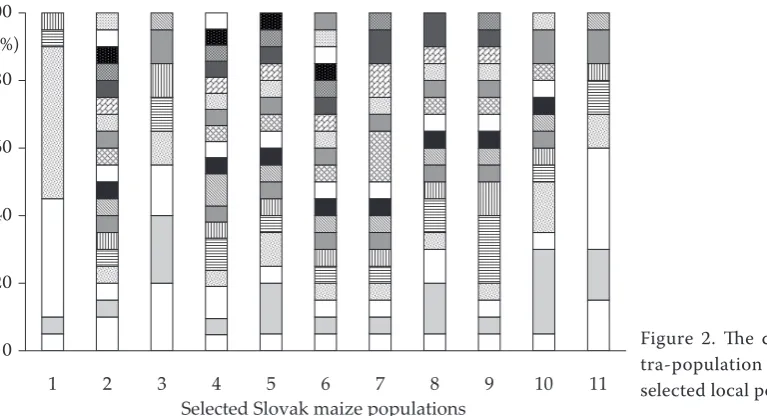
The highest internal isoenzyme homogeneity was detected within the local population Čerhov, which contains only 6 different isoenzyme lines. On the
Figure 2. The divergence in in-tra-population heterogeneity of selected local populations 0%
20% 40% 60% 80% 100%
1 2 3 4 5 6 7 8 9 10 11
Selected Slovak maize populations 100
80
60
40
20
[image:4.595.71.515.87.336.2]0 (%)
Figure 1. Frequency of alleles in 62 local maize populations 0
0.2 0.4 0.6 0.8 1
Ac
p Adh Cat Dia1 Dia2 Glu Got1 Got2 Got3 Idh1 Idh2 Mdh1 Mdh2 Mdh3 Mdh4
M
dh5 Mmm:M Pgd1 Pgd2 Pgi1 Pgm1 Pgm2
Frequency of alleles at the 22 isoenzyme
[image:4.595.77.461.548.756.2]11 contrary, as many as 17 maize populations (27.4%
of all analyzed ones) were completely heterogene-ous, i.e. each of twenty individual grains revealed different isoenzyme patterns (samples in Figure 2). Prevalence of populations with higher heteroge-neity and tendency to increase intra-population variation is an understandable trait of maize. A very significant factor in the process of increas-ing or decreasincreas-ing the intra-population variation is the relation between native tendency of maize to increase its heterogeneity as open-pollinated species and antagonistic effort of breeder. It is a very important feature mainly for local popula-tions grown in developing countries where they are not cultivated yet and selection for homogene-ity has lagged behind. High heterogenehomogene-ity within the analyzed Slovak and Czech local populations could be an effect of grower practices and isolation distances used in the years 1950–1970.
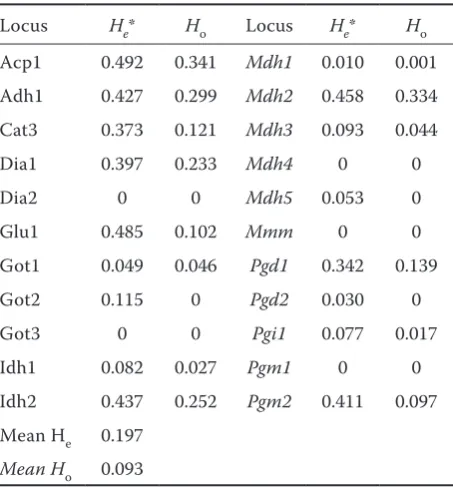
The expected heterozygosity (He) revealing both allele numbers and allele frequencies ranged from null to 0.492 (locus acp1) with an average of 0.197 (Table 1), which is less than average He in south-western Chinese (0.29) (Lu et al. 2002), U.S. (0.46) (Kahler et al. 1986), Bolivian (0.23) (Goodmann & Stuber 1983) or Mexican (0.21) (Doebley et al. 1985) but similar to Brazilian (0.195) (Gimenes & Lopes 2000) populations. Considering that 15% of alleles were rare in the Slovak and Czech local populations a lower level of heterozygosity is explainable by this fact.
The revealed isoenzyme polymorphism in our local populations confirmed that all of them are heterogeneous. The analyses also showed that none of the analyzed populations was identical in the frequency of alleles at all 22 analyzed loci.
The isoenzyme occurrence was different across all local populations and showed the presence of a variable number of involved isoenzyme genotypes and phenotypes (Figure 3).
Graphical presentation of diversity among popu-lations (Figure 4) confirms the more or less com-pact branching of individuals of randomly chosen five local populations. Individuals from different populations were clustered into common groups. A dendrogram shows intra- and inter-population isoenzyme diversity and heterotic groups which
Table 1. Genetic variation at 22 loci in 62 Slovak and Czech local populations
Locus He* Ho Locus He* Ho Acp1 0.492 0.341 Mdh1 0.010 0.001 Adh1 0.427 0.299 Mdh2 0.458 0.334 Cat3 0.373 0.121 Mdh3 0.093 0.044
Dia1 0.397 0.233 Mdh4 0 0
Dia2 0 0 Mdh5 0.053 0
Glu1 0.485 0.102 Mmm 0 0
Got1 0.049 0.046 Pgd1 0.342 0.139
Got2 0.115 0 Pgd2 0.030 0
Got3 0 0 Pgi1 0.077 0.017
Idh1 0.082 0.027 Pgm1 0 0
Idh2 0.437 0.252 Pgm2 0.411 0.097 Mean He 0.197
Mean Ho 0.093
*unbiased estimate according to Nei (1972)
Ho – observed heterozygosity
0 4 8 12 16 20 6
alelles 8 alelles 12
ale lle s 13 ale lle s 14 ale lle s 15 ale lle s 16 ale lle s 17 ale lle s 18 ale lle s 19 ale lle s 20 ale lle s
Number of alleles in 20 analyzed grains
[image:5.595.305.532.113.357.2]N um be r o f p op ul at io ns
[image:5.595.70.375.570.740.2]0 5 10 15 20 25 Line No. +---+---+---+---+---+
Pezinok 8 -+ Kazimír 30 -+ Kazimír 31 -+ Pezinok 16 -+-+ Kazimír 46 -+ +---+ Kazimír 33 -+-+ I Kazimír 34 -+ I I Pezinok 9 -+-+ +-+ Kazimír 36 -+ I I Pezinok 6 -+---+ I I Pezinok 7 -+ I I I Pezinok 2 -+-+ +---+ I Pezinok 3 -+ +-+ I Pezinok 5 -+-+ I I Pezinok 11 -+ I I Pezinok 1 -+-+ I I
Pezinok 4 -+ I I +---+ Pezinok 18 -+ +-+ I I Pezinok 19 -+-+ I I Pezinok 13 -+ I I I Pezinok 17 ---+ I I Kazimír 39 -+ I I Kazimír 40 -+---+ I I M.Lieskové 25 -+ I I I M.Lieskové 26 -+ I I I M.Lieskové 23 -+ +---+ I M.Lieskové 27 -+ I I M.Lieskové 21 -+-+ I I Pezinok 15 -+ +-+ I Pezinok 10 -+ I I
M.Lieskové 24 -+-+ +---+ M.Lieskové 20 -+ I I M.Lieskové 22 -+ I I Pezinok 14 -+ I I
Malá TĚĖa 58 -+-+ I I
Malá TĚĖa 62 -+ +-+ I I
Pezinok 12 -+-+ I I I
Malá TĚĖa 63 -+ I I I
Malá TĚĖa 50 -+ +---+ I I
Malá TĚĖa 52 -+-+ I I I I
Kazimír 48 -+ I I I I I
Malá TĚĖa 56 -+ I I I I I
Kazimír 44 -+ +-+ I I I Kazimír 41 -+ I I I I Kazimír 45 -+-+ I I I Kazimír 32 -+ I +---+ I M.Lieskové 29 ---+ I I
Malá TĚĖa 59 -+ I I
Malá TĚĖa 61 -+-+ I I
Kazimír 42 -+ +---+ I I Kazimír 47 -+ I I I I
Malá TĚĖa 54 -+-+ I I I
Kazimír 43 -+ I I I
Malá TĚĖa 55 -+ +---+ I
Malá TĚĖa 53 -+ I I
Malá TĚĖa 60 -+---+ I I
Malá TĚĖa 49 -+ I I I
Malá TĚĖa 57 -+ +-+ I
Kazimír 38 -+ I I
Malá TĚĖa 51 -+-+ I I
M.Lieskové 28 -+ +-+ I Kazimír 37 -+ I I Kazimír 35 ---+ I Breznica 66 -+ I Breznica 72 -+-+ I Breznica 68 -+ I I Breznica 70 -+ +---+ I
Malá TĚĖa 64 -+-+ I I
Malá TĚĖa 65 -+ I I I
Breznica 67 -+ I +---+ Breznica 80 -+-+ I
Breznica 71 -+ I Breznica 75 -+---+ I Breznica 76 -+ +-+ Breznica 69 -+-+ I Breznica 73 -+ +-+ Breznica 78 -+ I Breznica 79 -+-+ Breznica 74 -+ Breznica 77 -+
[image:6.595.66.408.70.768.2]13 should be consequently used in hybrid breeding.
The pedigree of populations was unknown. Nev-ertheless, the grouping of populations reflects geographic (microgeographic) relations between them. Individuals in the framework of populations Pezinok, M. Lieskové, and Breznica are grouped more tightly and these populations are more ev-idently separated from the others. Individuals from the populations Malá Tŕňa and Kazimír were more or less mixed together in the dendrogram composition, which could correspond to a small distance between places where these populations were collected (Figure 5) due to gene flow between both near located places caused by the transfer of genetic variability by farmers.
The Slovak and Czech local populations of maize represent original ecotypes of this crop which are not grown in agricultural practice at the present time. They can serve as valuable biological materi-als for experimental research and materi-also for breeding. Presented results show high genotypic (phenotypic) variation within analyzed local maize populations. All populations have a different composition at isoenzyme loci, nevertheless no new unknown allele was found. We believe that the proteomic classification of local populations by an isoenzyme analysis could increase interest in their utilization in research, breeding programmes, European maize landraces survey and database.
References
Bourgoin-Greneche M., Lallemand J. (1993): Electro-phoresis and Its Application to the Description of Varieties. A presentation of the Techniques Used by GEVES. GEVES, Guyancour, 1–63.
Bourgoin-Greneche M., Lallemand J., Pouget R. (1998): Technical Reference Manual for the Isoenzymatic Analysis of Maize. GEVES, Guyancourt.
Brown A.H.D. (1979): Enzyme polymorphism in plant po-pulation. Theoretical Population Biology, 15:1–42. Cardy B.J., Stuber C.W., Goodman M.M. (1980):
Techniques for Starch Gel Electrophoresis of Enzy-mes from Maize (Zea mays L.). Institute of Statistics Mimeograph Series No. 1317, North Carolina State University, Raleigh.
Doebley J.E., Goodman M.M., Stuber C.W. (1983): Isozyme variation in maize from the south western United States: taxonomic and anthropological impli-cations. Maydica, 28: 97–120.
Doebley J.E., Goodman M.M., Stuber C.W. (1985): Isozyme variation in the races of maize from Mexico. American Journal of Botany, 72: 629–639.
Doebley J., Wendel J., Smith J.S.C., Stuber C.W., Go-odman M.M. (1988): The origin of cornbelt maize: the isozyme evidence. Economic Botany, 42: 120–131. Dubreuil P., Charcosset A. (1998): Genetic diversity
within and among maize populations: a comparison between isozyme and nuclear RFLP loci. Theoretical and Applied Genetics, 96: 577–587.
Edwards M.D., Stuber C.W., Wendel J.F. (1987): Mole-cular-marker-facilitated investigations of quantitative--trait loci in maize. I. Numbers, genomic distribution and types of gene action. Crop Science, 116: 113–125. Gauthier P., Gouesnard B., Dallard J., Redaelli
R., Rebourg C., Charcosset A., Boyat A. (2002): RFLP diversity and relationships among traditional European maize populations. Theoretical and Applied Genetics, 105: 91–99.
Gimenes M.A., Lopes C.R. (2000): Isoenzymatic variation in the germplasm of Brazilian races of maize (Zea mays L.). Genetics and Molecular Biology, 23: 375–380. Goodman M.M., Stuber C.W. (1983): Races of maize.
VI. Isozyme variation among races of maize in Bolivia. Maydica, 28: 169–187.
Goodman M.M., Stuber C.W., Lee C.-N., Johnson F.M. (1980): Genetic control of malate dehydrogenase isozymes in maize. Genetics, 94: 153–168.
Kazimír
Breznica
Pezinok
M. Lieskové
Malá TĚĖa 280
320 70
65
[image:7.595.109.481.88.208.2]15
Greneche M., Giraud G. (1989): Manuel technique de référence pour l’analyse isoenzymatique du Mais. GEVES, Surgeres, 1–78.
Heckenberger M., Bohn M., Ziegle J.S., Joe L.K., Hauser J.D., Hutton M., Melchinger A.E. (2002): Variation of DNA fingerprints among accessions within maize inbred lines and implications for identification of essentially derived varieties. I. Genetic and technical sources of va-riation in SSR data. Molecular Breeding, 10: 181–191. Heywood J.S., Fleming T.H. (1986): Patterns of
allo-zyme variation in three Costa Rica species of piper. Biotropica, 18: 208–216.
Kahler A.L., Hallauer A.R., Gardner C.O. (1986): Allozyme polymorphisms within and among open- pollinated and adapted exotic populations of maize. Theoretical and Applied Genetics, 72: 592–601. Labate J.A., Lamkey K.R., Lee M., Woodman W.L.
(1999): Temporal changes in allele frequencies in two reciprocally selected maize populations. Theoretical and Applied Genetics, 99: 1166–1178.
Lavergne V. (1988): Variabilité entre populations de mais (Zea mays L.). Approche biométrique et ap-proche enzymatique. Thése de Docteur Ingénieur, Université Paris-Sud. In: Bourgoin-Greneche M., Lallemand J., Pouget R. (1998): Technical Reference Manual for the Isoenzymatic Analysis of Maize. Geves, Guyancourt.
Lefort-Buson M., Lavergne V., Daudin J.J., Char-cosset A., Sampoux J.P., Gallais A. (1991): Genetic variability among populations of maize germplasm. 2. Enzymatic polymorphism and its relationship to quantitative trait diversity. Maydica, 36: 237–246. Llaurado M., Moreno-Gonzales J., Arus P. (1993):
Classification of Northern Spanish populations of maize by methods of numerical taxonomy. 2. Isozyme varia-tion. Maydica, 4: 249–258.
Lu H., Li J.S., Liu J.L., Bernardo R. (2002): Allozyme polymorphisms of maize populations from southwes-tern China. Theoretical and Applied Genetics, 104: 119–126.
Marsan P.A., Castiglioni P., Fusari F., Kuiper M., Motto M. (1998): Genetic diversity and its relationship to hybrid performance in maize as revealed by RFLP and AFLP markers. Theoretical and Applied Genetics,
96: 219–227.
Matsuoka Y., Vigouroux Y., Goodman M.M., Sanchez J.G., Buckler E., Doebley J. (2002): A single domes-tication for maize shown by multilocus microsatellite genotyping. Proceeding of the National Academy of Sciences of the USA, 99: 6080–6084.
Melchinger A.E., Messmer M.M., Lee M., Woodman W.L., Woodman W.L., Lamkey K.R. (1991): Diversity
and relationships among U.S. maize inbreds revealed by restriction fragment length polymorphism. Crop Science, 31: 669–678.
Messmer M.M., Melchinger A.E., Boppenmaier J., Brunklaus-Jung E., Herrman R.G. (1992): Relation-ships among early European maize inbreds. I: genetic diversity among flint and dent lines revealed by RFLPs. Crop Science, 32: 1301–1309.
Nei M. (1972): Genetic distances between populations. American Naturalist, 106: 283–292.
Newton K.J., Schwartz D. (1980): Genetic basis of the major malate dehydrogenase isozymes in maize. Genetics, 95: 425–442.
Pinto L.R., Vieira, M.L.C., de Souza C.L., da Silva R.M. (2003): Isoenzymatic variability in tropical mai-ze populations under reciprocal recurrent selection. Scientia Agricola, 60: 291–297.
Pflüger L.A., Schlatter A.R. (1996): Isozyme varia-tion in some races of maize from Argentina. Genetic Resources and Crop Evolution, 43: 357–362.
Rebourg C., Gouesnard B., Charcosset A. (2001): Large scale molecular analysis of traditional European maize populations. Relationships with morphological variation. Heredity, 86: 574–587.
Rebourg C., Chastanet M., Gouesnard B., Welcker C., Dubreuil P., Charcosset A. (2003): Maize intro-duction into Europe: the history reviewed in the light of molecular data. Theoretical and Applied Genetics,
106: 895–903.
Reedy M.E., Knapp A.D., Lamkey K.R. (1995): Isozyme allelic frequency changes following maize (Zea mays L.) germplasm regeneration. Maydica, 40: 269–273. Revilla P., Soengas P., Malvar R.A., Cartea M.E.,
Ordás A. (1998): Isozyme variation and historical relationships among the maize races of Spain. Maydica,
43: 175–182.
Ryšavá B. (1997): Genetic resources of maize (Zea mays L.) in Slovakia. In: Lipman E., Ellis R.H., Gass T. (eds): Maize Genetic Resources in Europe. Report of workshop, IPGRI, 28-29 May 1996, Rome, 48–51. Sanou J., Gouesnard B., Charrier A. (1997): Isozyme
variability in west-african maize cultivars (Zea mays L.). Maydica, 42: 1–11.
Smith J.S.C., Goodman M.N., Stuber C.W. (1985): Ge-netic variability within U.S. maize germplasm. I. Histo-rically Important Lines. Crop Science, 25: 550–555. Stuber C.W., Goodman M.M., Moll R.H. (1982):
Im-provement of yield and ear number resulting from selection at allozyme loci in a maize population. Crop Science, 22: 737–740.
15 Corresponding author:
RNDr. Ján Kraic, Ph.D., Slovenské centrum poľnohospodárskeho výskumu – Výskumný ústav rastlinnej výroby, Bratislavská cesta 122, 921 68 Piešťany, Slovenská republika
tel.: + 421 337 722 311, fax: + 421 337 726 306, e-mail: [email protected] starch-gel electrophoresis of enzymes from maize (Zea
mays L.). Technical Bulletin 286, North Carolina Agric. Res. Service, North Carolina State University, Raleigh, USA, 1–87.
Zlokolica M., Milošević M. (2001): Isozymes as ge-netic markers in maize breeding. Biologia Plantarum,
44: 207–211.