JOURNAL OF FOREST SCIENCE, 51, 2005 (3): 108–114
Climate change is one of the most significant sus-tainable development challenges the international community is facing. It has implications not only for health and well-being of Earth’s ecosystems, but also for economic entities and social livelihoods. No country is immune from the threat of climate change and all contribute to the problem to some extent.
Several policy initiatives, aimed at mitigating climate change, have emerged from international forums, national governments and private sector. The most important among them are the United Nations Framework Convention on Climate Change (UNFCCC), the Kyoto Protocol to the Convention, and the Marrakech Accord – a rulebook to the Kyoto Protocol. These documents constitute a policy framework for introducing legally binding economic instruments for reducing greenhouse gas emissions and mitigating climate change. They also stress that forests and forestry sector can play a significant role in mitigating climate change and should be involved in the process.
Forests play an important role in the climate system. They are a major reservoir of carbon, con-taining some 80% of all the carbon stored in land vegetation, and about 40% of the carbon fixed in soils. Immense quantities of carbon may be
emit-ted into the atmosphere during transitions from one forest type to another if mortality releases car-bon faster than regeneration and growth absorbs it. Forests also directly affect climate on the local, regional, and continental scales by influencing ground temperature, evapotranspiration, surface roughness, albedo (or reflectivity), cloud formation as well as precipitation (UNITAR, UNEP, WMO, WHO, UN 2002).
The UNFCCC provides principles and framework for cooperative international action on climate change. Under this agreement, over 180 countries (Parties of the Convention) have agreed to reduce their greenhouse gases (GHG) emissions, so as to stabilize their concentrations in the Earth’s at-mosphere at a level that will prevent dangerous human-induced interference in the climate system. Generally, the Parties are obligated to reduce or limit their emissions relative to their 1990 levels (a base year). The Parties may offset their emissions by lim-iting emissions from various anthropogenic sources (for example: energy production, transport, industry, and agriculture) as well as enhancing fixing carbon sequestration from the atmosphere and its storage by terrestrial ecosystems, so called “carbon sinks” (for example forests).
The policy process on climate change
Z. SARVAŠOVÁ
1, A. KALISZEWSKI
21
Forest Research Institute in Zvolen, Zvolen, Slovak Republic
2
Instytut Badawczy Leśnictwa, Warszawa, Poland
ABSTRACT:The United Nations Framework Convention on Climate Change accepted in 1992 at the Earth Summit in Rio de Janeiro provides principles and framework for cooperative international action on mitigating climate change. But it soon became clear that more radical targets were needed to encourage particular countries to reduce greenhouse gas emissions. In response, countries that have ratified the United Nation Framework Convention on Climate Change accepted the Kyoto Protocol in 1997. The rulebook for how the Kyoto Protocol will be implemented – the Marrakech Accord, was agreed in 2001. This paper describes political instruments and facilities of mitigating climate change by forestry proposed in those political documents.
The history of the international activities
By 1979, when the First World Climatic Conference took place in Geneva, which was the first consider-able international event concerning climate change, questions of GHG effects on climate were exclusively a domain of scientist interest. The conference issued a declaration calling on countries’ governments to foresee and prevent potential man-made changes of the climate that might be adverse to humankind well-being. It also endorsed plans to establish the World Climate Programme (WCP) under the joint responsibility of the World Meteorological Organi-zation (WMO), the United Nations Environment Programme (UNEP), and the International Council of Scientific Unions (ICSU) (UNITAR, UNEP, WMO, WHO, UN 2002).
A number of intergovernmental conferences fo-cusing on climate change were held in the late 1980s and early 1990s. Two of them – in Willach (1985) and in Bellagio (1987) – designed a common attitude related to possible global heating and set a political assignment to deal with the problem.
From that time, a previous academic problem changed into a political one. The matter was more and more often in agendas of international meetings. Among others, during the conference in Toronto in 1988 the “Act on Air” proposed for the first time an idea to take a common responsibility for climate changes and accept a common legal act on the issue under the United Nations (UN). The issue was taken into account also during the Second World Climatic Conference (Geneva 1990), where additionally a need of looking for solution in co-operation with both academics and politicians was stressed (SA-DOWSKI 1996).
In 1998 the UNEP and the WMO established the International Panel on Climate Change (IPCC). The Panel was given a mandate to assess the state of exist-ing knowledge about the climate system and climate change, the environmental, economic, and social impacts of the change, and the possible response strategies. Approved after a painstaking peer review process, the first IPCC report on climate change presented scientific evidence for climate change. It had a powerful effect on both policy-makers and the general public and provided the basis for negotia-tions on the UNFCCC.
On the 11th December 1990, the 45th session of the UN General Assembly adopted a resolution estab-lishing the International Negotiating Committee for Framework Convention on Climate Change (INC/ FCCC). The UN Framework Convention on Climate Change, prepared by the Committee, was presented
in June 1992 during the conference Environment and
Development in Rio de Janeiro. Under this
agree-ment, over 180 countries have agreed to reduce their emissions of greenhouse gases so as to stabilize their concentrations in the Earth’s atmosphere at the level that will prevent dangerous human-induced interfer-ence in the climate system. Industrialized countries committed to stabilize their emissions of GHG at the level of 1990 by the year 2000 through voluntary actions (STUART, MOURA COSTA 1998).
The UNFCCC is the first legal political step to-wards mitigating climate change. But already during the First Conference of Parties (COP) in Berlin in 1995 it became clear that the Convention itself was not a sufficient instrument of permanent and effec-tive limitation climate changes, and another, more radical agreement is needed. Therefore, delegates of 117 Parties of the Convention and 53 Observer States, which participated in COP 1, agreed that the commitments under the Convention for developed countries were inadequate and launched the Berlin Mandate talks on additional commitments.
As a result of the undertaken action, countries that have ratified the Convention on Climate Change adopted the Kyoto Protocol to the Convention (at COP3, on 11 December 1997), under which deve-loped countries agreed to reduce their overall emis-sions of the six major greenhouse gases to an average of 5.2% below 1990 levels by 2008–2012.
Because the commitment required many detailed operational and technical arrangements to be done, the Parties adopted a two-year Plan of Action for completing the Kyoto rulebook. The agreement on the political principles of the operational rulebook for the Kyoto Protocol was reached in 2001. This set of documents – Marrakech Accord – addressed the emission trading system, the Clean Develop-ment Mechanism, the rules for counting emission reductions from carbon sinks, and the compliance regime. It also outlined a package of financial and technological support to help developing countries contribute to global action on climate change. With the completion of these negotiations, the way has been paved for ratification of the Kyoto Protocol.
Framework convention on climate change
meth-ane (CH4), nitrous oxide (NO2), hydrofluorocarbons (HFCs), perfluorocarbons (PFCs) and sulphur hex-afluoride (SF)] are being considered by countries. These include taxes on emissions, subsidies for emis-sion reduction projects, tradable emisemis-sion permits and direct regulation of emission sources.
All Parties will develop and submit national communications containing inventories of GHG emissions by source and GHG removals by sinks. They will adopt national programmes for mitigating climate change and develop strategies for adapting to its impacts. They will also promote technology transfer and sustainable management, conserva-tion, and enhancement of greenhouse gas sinks and reservoirs (such as forests and oceans). In addition, the Parties will take climate change into account in their relevant social, economic and environmen-tal policies, cooperate in scientific, technical and educational matters, and promote education, public awareness and the exchange of information related to climate change.
Most members of the Organization for Economic Cooperation and Development (OECD) plus the states of Central and Eastern Europe (Annex I coun-tries) committed themselves to adopt policies and measures aimed at returning their GHG emissions to 1990 levels by the year 2000 (emission targets for the post-2000 period are addressed by the Kyoto Protocol). They must also submit national commu-nications on a regular basis detailing their climate change strategies. Several states may together adopt a joint emission target. The countries in transition to a market economy are granted a certain degree of flexibility in implementing their commitments.
A financial mechanism provides funds on a grant or concession basis. The COP shall decide on its poli-cies, programme priorities, and eligibility criteria.
No matter what policy instruments are utilized, there are likely to be substantial efficiency gains available from the use of carbon offsets. Offsets are a mechanism by which companies, countries or fi-nancing entities undertake emission improvements outside of their direct operation or territory.
International carbon offset projects between countries have traditionally been referred to as joint implementation projects (JI). The meaning of these terms has changed. While the JI mechanism was a part of negotiations before the Rio conference (introduced by Norway in 1991), COP 1 created a compromise pilot phase (until the 1st of January 2000) during which projects were called Activities Implemented Jointly (AIJ).
Until March 2002, more than 150 AIJ projects were communicated to the secretariat, engaging around
one quarter of the Parties to the Convention, either as investors or as hosts. Interest in the AIJ pilot phase has steadily grown, especially since the adoption of the Kyoto Protocol, with an almost 50% increase in the number of projects since 1997. While 70% of host Parties are non-Annex I Parties (developing coun-tries), countries with economies in transition (EITs) still host the majority of AIJ projects, although the balance is gradually shifting towards the developing countries. Most projects concern sources of renew-able energy and energy efficiency sectors, although the largest projects involve forest preservation, reforestation or restoration (UNFCCC-CC INFO 2002).
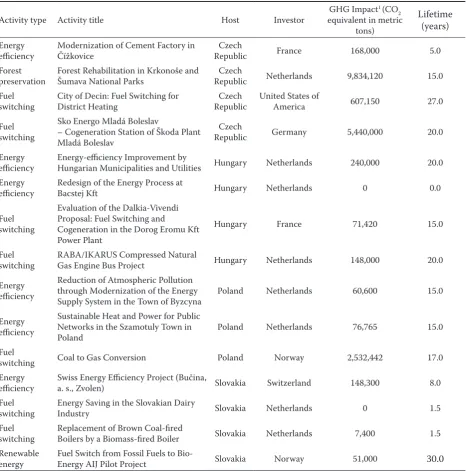
The following table contains projects that have been accepted, approved or endorsed by the desig-nated national authorities for AIJ in Slovak Republic, Poland, Hungary and Czech Republic. Totally in this phase were 85 AIJ projects in EITs. From among them only 3 have been executed in the forest sector: two in the Russian Federation (reforestation in Vologda and RUSAFOR – Saratov Afforestation Project) and one in the Czech Republic (Forest Rehabilitation in Krkonoše and Šumava National Parks).
Kyoto Protocol
During COP 3, which took place in December 1997 in Kyoto, Japan, the Parties concluded the Berlin Mandate process. The adopted Kyoto Protocol of the UNFCCC appears to be a very important step in the GHG emission mitigation arena.
The rules for entry into force of the Kyoto Protocol require 55 Parties to the Convention to ratify (ap-prove, accept, or accede to) the Protocol, including Annex I Parties, accounting for 55% of that group’s carbon dioxide emissions in 1990. On 18th November 2004, when the Russian Federation ratified the Kyoto Protocol, the period of uncertainty closed. The docu-ment was ratified in total by 129 countries, including 33 of the Annex I Parties, which represented 61.6% of GHG emissions in 1990 and the Kyoto Protocol enters into force on 16 February 2005.
The Protocol is liberal in allowing a variety of mechanisms for achieving those reductions, both technically, in the form of formally recognizing forestry and agricultural emission reductions, and structurally, through the trading of emission quotas and various forms of JI emission reduction projects.
subtract-ed from the assignsubtract-ed amount of the Party. Forests have an important role in removing CO2 from atmosphere and therefore may help to achieve the reduction of GHG emissions. In particular, this is mentioned in Article 3.3 and 3.4 of the Kyoto Protocol:
Article 3.3
The net changes in greenhouse gas emissions by sourc-es and removals by sinks rsourc-esulting from direct human-induced land-use change and forestry activities, limited to afforestation, reforestation and deforestation since
1990, measured as verifiable changes in carbon stocks in each commitment period, shall be used to meet the commitments under this Article of each Party included in Annex I. The greenhouse gas emissions by sources and removals by sinks associated with those activities shall be reported in a transparent and verifiable manner and reviewed in accordance with Articles 7 and 8.
Article 3.4
Prior to the first session of the Conference of the Par-ties serving as the meeting of the ParPar-ties to this
Pro-Table 1. Activities Implemented Jointly – examples from some EITs
Activity type Activity title Host Investor GHG Impact 1 (CO
2 equivalent in metric
tons)
Lifetime (years) Energy
efficiency Modernization of Cement Factory in Čížkovice RepublicCzech France 168,000 5.0 Forest
preservation Forest Rehabilitation in Krkonoše and Šumava National Parks RepublicCzech Netherlands 9,834,120 15.0 Fuel
switching City of Decin: Fuel Switching for District Heating RepublicCzech United States of America 607,150 27.0
Fuel switching
Sko Energo Mladá Boleslav
– Cogeneration Station of Škoda Plant Mladá Boleslav
Czech
Republic Germany 5,440,000 20.0
Energy
efficiency Energy-efficiency Improvement byHungarian Municipalities and Utilities Hungary Netherlands 240,000 20.0 Energy
efficiency Redesign of the Energy Process at Bacstej Kft Hungary Netherlands 0 0.0
Fuel switching
Evaluation of the Dalkia-Vivendi Proposal: Fuel Switching and
Cogeneration in the Dorog Eromu Kft Power Plant
Hungary France 71,420 15.0
Fuel
switching RABA/IKARUS Compressed Natural Gas Engine Bus Project Hungary Netherlands 148,000 20.0
Energy efficiency
Reduction of Atmospheric Pollution through Modernization of the Energy
Supply System in the Town of Byzcyna Poland Netherlands 60,600 15.0
Energy efficiency
Sustainable Heat and Power for Public Networks in the Szamotuly Town in
Poland Poland Netherlands 76,765 15.0
Fuel
switching Coal to Gas Conversion Poland Norway 2,532,442 17.0 Energy
efficiency Swiss Energy Efficiency Project (Bučina,a. s., Zvolen) Slovakia Switzerland 148,300 8.0 Fuel
switching Energy Saving in the Slovakian Dairy Industry Slovakia Netherlands 0 1.5 Fuel
switching Replacement of Brown Coal-firedBoilers by a Biomass-fired Boiler Slovakia Netherlands 7,400 1.5 Renewable
energy Fuel Switch from Fossil Fuels to Bio-Energy AIJ Pilot Project Slovakia Norway 51,000 30.0 Source: UNFCCC-CC:INFO/AIJ
[image:4.595.66.533.72.544.2]tocol, each Party included in Annex I shall provide, for consideration by the Subsidiary Body for Scientific and Technological Advice, data to establish its level of carbon stocks in 1990 and to enable an estimate to be made of its changes in carbon stocks in subsequent years. The Conference of the Parties serving as the meeting of the Parties to this Protocol shall, at its first session or as soon as practicable thereafter, decide upon modalities, rules and guidelines as to how, and which, additional human-induced activities related to changes in greenhouse gas emissions by sources and removals by sinks in the agricultural soils and the land-use change and forestry categories shall be added to, or subtracted from, the assigned amounts for Parties included in Annex I, taking into account uncertainties, transparency in reporting, verifiability, the methodological work of the Intergovernmental Panel on Climate Change, the advice provided by the Subsidiary Body for Scientific and Technological Advice in accordance with Article 5 and the decisions of the Conference of the Parties. Such a decision shall apply in the second and subsequent commitment periods. A Party may choose to apply such a decision on these additional human-induced activities for its first commitment period, provided that these activi-ties have taken place since 1990.
Under Article 3.3 verifiable changes in carbon stor-age from afforestation, reforestation and deforesta-tion since 1990 can be counted as credits or debits if they result directly from human activities. Article 3.4 provides an opportunity for countries to propose additional forest management activities (MURRAY et al. 2000).
The Protocol broke new ground with three in-novative mechanisms that were collectively called flexibility mechanisms:
Joint implementation – JI (under Article 6) pro-vides for Annex I Parties to implement projects that reduce emissions or remove carbon from the air, in other Annex I Parties, in return for emission reduc-tion units (ERUs).
The clean development mechanism – CDM de-fined in Article 12 provides for Annex I Parties to implement projects that reduce emissions in non-Annex I Parties, in return for certified emission reductions (CERs), and assist the host Parties in achieving sustainable development and contributing to the ultimate objective of the Convention.
Emission trading – or the QUERO (Quantified Emission Limitation and Reduction Obligations) trading, as set out in Article 17, provides for An-nex I Parties to acquire units from other AnAn-nex I Parties. These units may be in the form of assigned amount units (AAUs), removal units (RMUs), ERUs
and CERs. As set out in Article 17, it provides for Annex I Parties to acquire units from other Annex I Parties. These units may be in the form of assigned amount units (AAUs), removal units (RMUs), ERUs and CERs.
The Marrakech Accords allow businesses, environ-mental NGOs and other “legal entities” to participate in any of the mechanisms – or in all three – albeit at the discretion of their governments.
The removal of GHG from the atmosphere, for example through planting trees or improving for-est management, can be partially counteracted at a relatively low cost. However, it is often difficult to estimate emissions and removals from the land use, land-use change and forestry (LULUCF) sector. Carbon removals and emission reductions achieved as a result of LULUCF interventions can be counted towards meeting Parties’ emission targets (IPCC 2000).
For the forestry sector in developing countries the most important seems to be the clean develop-ment mechanism, which makes it possible to take up mitigation projects in co-operation with developed countries. The CDM and emission trading were designed to boost the cost effectiveness of climate change mitigation by opening ways for Parties to cut emissions, or enhance carbon ‘sinks’, more cheaply abroad than at home. The Marrakech Accords call on Annex I Parties to implement domestic action to reduce emissions in ways that could help to narrow the differences per capita between developed and developing countries. They also impose no quanti-tative limits on the extent to which the mechanisms can be used to meet emission targets.
Emission targets must be achieved as an average over the first commitment period of 2008–2012. However, in order to show early action, Parties must have already made demonstrable progress towards meeting their commitments under the Kyoto Pro-tocol until 2005, and must submit their progress reports on this matter by the 1st of January 2006 (UNFCCC 2003).
Joint implementation allows the Annex I Parties to implement projects that reduce emissions, or in-crease removals using sinks, in other Annex I coun-tries. ERUs generated by such projects can then be used by investing Annex I Parties to help meet their emission targets.
this sector and Annex I Parties are to refrain from using ERUs generated from nuclear facilities to meet their targets.
The Member States of the European Union col-lectively have to reduce their emissions to a level of 8 percent below their 1990 emissions (UNFCCC 2003). To achieve this target projects between An-nex I Parties are also prepared in the second phase of JI (e.g. Czech Republic–Netherlands, Slova-kia–Denmark). But there are not enough activities in LULUCF sector again and they are concentrated in energy and fuels.
CONCLUSIONS
Within this global process governments need to move forward quickly now to design and carry out their national climate change policies.
The reduction of CO2 emissions and increase of stored carbon can be possible by applying princi-ples and methods of sustainable forest management (SFM). One of these elements is to reduce impact logging (RIL) techniques used in tropical forests and based on strict forest operation planning and reduc-ing damage to forest stands and soils.
The rate of CO2 sequestration can be enhanced by the cultivation of fast-growing tree species. Forest plantations and agro-forestry systems can also pro-vide some other beneficial effects, such as economic development of rural areas, reduced pressure on na-tive forests and providing forest product utilization. They can also play an important role especially in the non-forest or degraded areas (KALISZEWSKI 2001).
In temperate and boreal zones the sustainable forest management will lead to increased carbon se-questration and storage in forests as well. It will also probably demand to accept longer stand rotations while the management of fast-growing plantations and agro-forestry leads to a shortening of rotations.
These two approaches do not oppose but complete each other. Their application will depend mostly on local circumstances.
References
KALISZEWSKI A., 2001. Aspects of forest utilization in the Kyoto Protocol. [Thesis.] Warsaw, SGGW – Warsaw Agri-cultural University, Faculty of Forestry: 85.
MURRAY B.C., PRISLEY S.P., BRIDSEY R.A., SAMPSON R.N., 2000. Carbon sinks in the Kyoto Protocol, potential relevance for US forests. Journal of Forestry, 9: 6–11. SADOWSKI M., 1996. Predicted changes of the climate and
their environmental, social and political consequences. Sylwan, CXL: 83–103.
STUART M.D., MOURA COSTA P., 1998. Climate change mitigation by forestry: a review of international initia-tives. Policy that works for forests and people, series No. 8. London, International Institute for Environment and De-velopment: 68.
IPCC, 2000. Special Report. Land Use, Land Use Change, and Forestry. Summary for Policymakers, Geneva.
UNFCCC-CC INFO, 2002. AIJ – list of AIJ projects. UNFCCC, 2003. Caring for Climate A Guide to the Climate
Change Convention and the Kyoto Protocol, Issued by the Climate Change Secretariat (UNFCCC). Bonn.
UNITAR, UNEP, WMO, WHO, UN, 2002. Climate Change Information Sheet, Nr. 17, The international response to climate change, Nr. 27, New approaches to forestry and agriculture.
The United Nation Framework Convention on Climate Change, 1992.
Kyoto Protocol to the United Nation Framework Convention on Climate Change, 1997.
www.ipcc.ch www.unfccc.org
Received for publication October 7, 2004 Accepted after corrections January 11, 2005
Politický proces v klimatickej zmene
Z. SARVAŠOVÁ1, A. KALISZEWSKI2
1Lesnícky výskumný ústav vo Zvolene, Zvolen, Slovenská republika
2Instytut Badawczy Leśnictwa, Warszawa, Poland
ABSTRAKT: Rámcový dohovor spojených národov o klimatickej zmene prijatý v roku 1992 na Samite Zeme v Rio de Janei-
Až do roku 1979, keď sa v Geneve konalo prvé významné medzinárodné podujatie – Prvá sveto-vá klimatická konferencia, boli otázky vplyvu skle-níkových plynov na klímu Zeme výlučne oblasťou záujmu vedcov. Dve po nej nasledujúce konferencie (Willach 1985, Belliago 1987) vypracovali spoločné stanovisko krajín v súvislosti s možným globálnym oteplením a zadali politikom úlohu zaoberať sa tým-to problémom. Od tejtým-to doby sa problém dovtedy vedecký premenil na problém politický.
Medzinárodný záujem o túto problematiku vy-ústil do toho, že Svetová meteorologická organizá-cia a Organizáorganizá-cia spojených národov v roku 1988 zvolali IPCC (Medzivládny panel o zmene klímy). Tento pakt mal za úlohu pripraviť pre Valné zhro-maždenie OSN správu o probléme zmeny klímy, jej vplyvu na životné prostredie a žitie človeka spolu s návrhom stratégií a reakcií na tieto zmeny. V r. 1990 bola táto správa prednesená na 45. stretnutí Valného zhromaždenia OSN a začali sa prípravy na Konvencii o zmene klímy. V r. 1992 na Samite Zeme v Rio de Janeiru došlo k podpisu Rámcového doho-voru o zmene klímy (The United Nation Framework Convention on Climate Change UN-FCCC). Odvte-dy sa začala história dokumentov zmierňujúcich do-pady zmien klímy pomocou politických nástrojov.
Rámcový dohovor Spojených národov o klima-tickej zmene obsahuje princípy a rámce medziná-rodnej spolupráce v oblasti zmierňujúcich opatrení klimatickej zmeny.
Čoskoro sa ukázalo, že je potrebný ostrejší pro-striedok na zaistenie cieľa znížiť v jednotlivých kra-jinách emisie skleníkových plynov. Krajiny, ktoré ratifikovali Rámcový dohovor Spojených národov o klimatickej zmene, prijali v r. 1997 Kyotsky pro-tokol. Príručka, ako sa má Kyotsky protokol imple-mentovať, bola dohodnutá v r. 2001.
Lesy majú dôležitú úlohu v odstraňovaní CO2 z atmosféry a tým môžu pomôcť pri znižovaní
emi-sií skleníkových plynov. Konkrétne je to spomenuté v odsekoch 3 a 4 Článku 3 Kyotskeho protokolu. Pod článkom 3.3 sa overujú zmeny v uskladňovaní uhlíka prostredníctvom zalesňovania a odlesňovania od roku 1990; tieto zmeny môžu byť hodnotené ako plusy aj mínusy, ak sú priamo spôsobené ľudskou činnosťou. Článok 3.4 dáva možnosť krajinám na-vrhnúť ďalšie lesnícke aktivity, majúce vzťah ku zme-nám emisií skleníkových plynov. Protokol obsahuje pravidlá spoločných projektov (JI v prvej fáze nazý-vané AIJ projekty) na zníženie emisií, nástroje CDM (mechanizmu čistého rozvoja), obchod s emisiami (QUERO) ako aj nástroje finančnej a technologickej podpory pomáhajúce rozvojovým krajinám podieľať sa na zmierňovaní dopadov klimatickej zmeny.
V krajinách prechádzajúcich procesom trans-formácie na trhovú ekonomiku je stále nedostatok spoločných projektov v sektore zahrňujúcom les-níctvo a zmeny vo využívaní poľnohospodárskej pôdy (LULUCF). Z celkového počtu 85 AIJ projek-tov v týchto krajinách sa len tri dotýkali lesníctva (2 zalesňovacie projekty v Ruskej federácii a obno-va NP Krkonoše a Šumaobno-va v Českej republike). Táto nepriaznivá situácia naďalej pretrváva. Aj v druhej fáze sa JI projekty medzi krajinami Anexu I sústre-ďujú na oblasti energetiky a palív.
Členské štáty EU sa kolektívne zaviazali znížiť emisie skleníkových plynov. Na dosiahnutie tohto cieľa je vhodné paralelne s plantážami rýchlo ras-túcich drevín a agro-lesníctvom, ktoré majú krátke obnovné doby, podporiť projekty trvalo udržateľ-ného obhospodarovania lesov, čím sa predĺži doba uskladnenia a sekvestrácie uhlíka v lesoch našich zemepisných šírok.
V snahe posunúť dopredu tento globálny politický proces musia vlády krajín rýchle vytvoriť a uskutoč-niť zmeny vo svojej národnej politike zmeny klímy a použiť príslušné opatrenia aj v LULUCF sektore. Príručka, ako sa má Kyotsky protokol implementovať – Marrakeshsky akord – bol dohodnutý v r. 2001. Príspevok popisu-je politické nástropopisu-je a prostriedky na zmiernenie klimatickej zmeny prostredníctvom lesného hospodárstva, navrhované v spomínaných politických dokumentoch.
Kľúčové slová:klimatická zmena; UNFCCC; Kyotsky protokol; lesníctvo; mechanizmy flexibility
Corresponding author:
Ing. ZUZANA SARVAŠOVÁ, Lesnícky výskumný ústav vo Zvolene, T. G. Masaryka 22, 960 92 Zvolen, Slovenská republika