Local Modes-based Free-Shape Data Partitioning
Plamen Angelov,
Fellow
,
IEEE
and Xiaowei Gu
School of Computing and Communications,Lancaster University Lancaster, LA1 4WA, UK {p.angelov,x.gu3}@lancaster.ac.uk
Abstract—In this paper, a new data partitioning algorithm,
named “local modes-based data partitioning”, is proposed. This algorithm is entirely data-driven and free from any user input and prior assumptions. It automatically derives the modes of the empirically observed density of the data samples and results in forming parameter-free data clouds. The identified focal points resemble Voroni tessellations. The proposed algorithm has two versions, namely, offline and evolving. The two versions are both able to work separately and start “from scratch”, they can also perform a hybrid. Numerical experiments demonstrate the validity of the proposed algorithm as a fully autonomous partitioning technique, and achieve better performance compared with alternative algorithms.
Keywords— data partitioning; evolving clustering; parameter-free; data cloud; data- driven.
I. INTRODUCTION
Clustering has long been considered as one of the most effective tools for recognizing the underlying patterns within the data. As a supervised machine learning method, clustering currently is a very hot topic in the field of data analytics.
Established clustering algorithms [1-6] require different kinds of user inputs. For instance, the k-means algorithm [2] requires the number of clusters to be known beforehand, the DBScan algorithm [4] requires the radius and the minimum number of data samples within the radius to be predefined, etc. Although, these algorithms can achieve relatively high accuracy, their performances heavily rely on the user- and problem-specific parameters, which require clear prior
knowledge. However, in most real cases, the prior knowledge is too limited for pre-defining the user input, which, in turn, influences the efficiency and accuracy of the clustering algorithms.
The concept of a data cloud was introduced in [7] as a collection of data samples entirely based on the mutual distribution and ensemble properties. Thus, data clouds are nonparametric and they do not have a specific shape. The data clouds directly represent the distribution of the observed data samples instead of giving some desirable/excepted (often, subjectively) pre-defined smooth functions. A number of focal points (not necessarily to be the centres or means of the data clouds) representing the modes of the data density. They attract the nearest data samples to them and then form data clouds
forming Voroni tessellations [8] in the data space.
In this paper, we propose a new, fully autonomous algorithm named local modes-based data partitioning. This novel algorithm is entirely driven by the observed data samples and their mutual distribution in the data space. It can automatically identify the focal points representing the main modes of the data pattern merely based on the empirically observed data samples and then uses them to form data clouds.
Thus, there is no need for any kind of user- or problem-specific parameters or assumptions.
This algorithm has two versions, i) offline and ii) evolving. The offline version is designed to partition the offline dataset while the evolving version is for streaming data processing. They have the ability of starting “from scratch”, thus, they can both work independently. While a hybrid between the two versions is also possible. In this paper, we will introduce the two versions of the proposed method as two independent algorithms without loss of generality.
The remainder of this paper is organised as follows. Section II describes the theoretical basis of the proposed algorithm. The offline and evolving versions are separately introduced in sections III and IV. Section V summarizes main procedures of the proposed algorithm and section VI presents the numerical experiments and a discussion. The paper is concluded by section VII.
II. THEORETICAL BASIS
In this paper, the theoretical basis of the proposed local modes-based data partitioning algorithm will be introduced.
Frist of all, let us assume the data set/stream in the Hilbert data space d
R as
x k x x1, 2,...,xk
,T ,1, , 2,..., ,
i xi xi xi d
x ,
1, 2,...,
i k indicates the time instance that the ith data sample arrives. To be more general and realistic, we assume that some data samples within the data set/stream repeat more than once, namely, xi xj, i j. The set of unique data samples can be denoted as
1, 2,...,
k l k
u u u u (ui ui,1,ui,2,...,ui d, T,
u k x k, 1 lk k) and the corresponding frequencies ofoccurrence
1, 2,...,
k l k
f f f f (
1
1 k l
i i
f
).In the rest of this section, the main operators of the recently introduced Empirical Data Analytics (EDA) [9]-[12] and their
corresponding recursive expressions disclosing the ensemble properties of the observed data samples will be introduced. At the end, the well-known Chebyshev inequality and its new, simpler form within the EDA framework will be briefly presented. The most widely used Euclidean type of distance is used in this paper for derivation clarity, but we have to stress that, the proposed algorithm can work with various types of distance as well.
A. Cumulative proximity
The cumulative proximity
of a particular data sample ix (i1, 2,...,k) is defined as the sum of square distances between this data sample to all other data samples existing in the data space [9],[10]:
2
2 2
1
k
k i i j i k k k
j
k X
x x x x μ μ (1)
where 2
, ,
21
d
i j i l j l
l
x x
x x . μk is the mean of
k x
and Xk is the average scalar product, and they can be updated recursively as:
k 1 k1 1 k; 1 1
k
k k
μ μ x μ x (2)
Xk k 1Xk1 1 k 2; X1 12
k k
x x (3)
B. Standardized eccentricity
Standardized eccentricity is a very important measure for anomaly/fault detection [11]. The standardized eccentricity
of xi (i1, 2,...,k) is defined in [11] as:
2 1
2
1 1 1
2 2
1
k
i l
k i l
k i k k k
k j j l
j j l
k k
x x x xx x x
(4)
The sum of the cumulative proximity of
kx can be expressed using μk and Xk instead [11],[12]:
2
2
1
2
k
k i k k
i
k X
x μ (5)Combining equations (1) and (5), the recursive expression of the standardized eccentricity,
is expressed as follows:
2 2
1 i k ; 1, 2,...,
k i k k i k X x μ x
μ (6)
C. Unimodal density
Unimodal density [12] is defined as the inverse of
standardized eccentricity
. The unimodal density D of the data sample xi (i1, 2,...,k) is expressed as follows [12]:
1 1 2 2 1 2 1 k k j jk i k i
k i i k
k k D k X
x x xx x μ
μ
(7)
D. Multimodal density
The multimodal density, MM
D of a specific unique data sample ui (i1, 2,...,lk) is a weighted sum of its unimodal density by the corresponding frequency fi , expressed as [12]:
1 2 2 1 2 1 k k k j jMM i i
k i l
k i i k
j j k k f f D k f X
x uu u μ
μ
(8)
E. Chebyshev inequality
The well-known Chebyshev inequality [13] describes the probability of the distance between a certain data sample xi
and the mean value to be larger than n times the standard deviation, namely, “n
”. We introduced earlier a more elegant and general form of Chebyshev inequality in terms ofstandardized eccentricity,
, expressed as [11]:P
k
i 1 n2
1 12n
x (9)
The inequality (9) can be applied to anomaly detection directly regardless of the distribution of data samples [11].
III. OFFLINE LOCAL MODE-BASED PARTITIONING
The proposed offline version of the local modes-based partitioning algorithm employs the multimodal density,
MM
D as the main operator. The main procedure of the offline algorithm is summarized as follows:
Stage 1: Identifying the global maximum
For every unique data sample within the dataset
k x , itslocal density, L
k i
D u (i1, 2,...,lk) can be calculated using the following equation:
2 2 2 i L k d Lk i i L
k i D f k
x u x uu (10)
where d is the average distance between the data samples of
2
2 1 2 2 k k i i k k d X k
xμ (11) The unique data sample with the highest DL is selected as the reference sample in the ranked unique data samples set
*k
u :
*(1)
1,2,..., arg max k L k j j l D
u u (12)
where u*(1) is the unique data sample with the global maximum of the local density DL and assign u*r u*(1). If there are more than one maximum, choose any one of them to be *r
u .
Stage 2: Re-ordering the local density
Then, we find the unique data sample which is nearest to
*r
u . Assuming there are q unique data samples holding the smallest distance to *r
u at the same time, they all will be selected and put into
*k
u together as u*(2), u*(3),…,u*(q1),
and their order will be decided by their local density DLin descending order. Once the unique data samples are put into
*k
u , they will be removed from
k u .This process continues with the rest of the data samples remaining in
k
u , and the last unique data sample, u*(q1), in
*k
u is used as the reference data sample (u*r u*(q1)) to find its closest unique data samples, and then put them into
*k
u and remove from
ku . By repeating this procedure till
u k becomes , we can finally get the ranked unique data samples, denoted as
u* k = u*(1)|i1, 2,...,lk
and their corresponding ranked local density collection:
DkL
u*
L *(1) , L *(2) ,..., L *(lk)
k k k
D u D u D u .
Stage 3: Detecting all local maxima
At this stage, we need to derive all local maxima of the ranked local density
DkL
u*
using the sign function:
* 1 *
* * 1
* 1 *
*( ) sgn sgn 1 sgn 1 max j j L L k k j j L L k k j j L L k k j L
IF D D
D D
AND D D
THEN is a local imum of D
u u u u u u u (13)
where sgn
is the sign function:
1 0
sgn 0 0
1 0 x x x x . We
denote the set of the local maxima of DL as the set
**
** j | 1, 2,..., *
k
k j l
u u ( *
k k
l l ).
Stage 4: Forming data clouds
Each local maxima, ** i
u is then set as a focal point/prototype of a data cloud. All other data samples are then assigned to the nearest focal point (local maximum) forming data clouds according to the following rule:
**
*
1,2,...,
arg min , j k
i
j l
cloud label d
x u (14)
After all the data samples within
kx are assigned to the
data clouds, the actual center (mean) μk j, and the standard deviation k j, ( 1, 2,..., *
k
j l ) of each data cloud can be calculated. Then we consider the set of centers, μk j, ( 1, 2,..., *
k
j l ) of the data clouds as if this is our dataset and calculate their multimodal density, MM
D using equation (8). The respective frequency of each data cloud is determined based on the sum of frequencies of the unique data samples associated with it.
The centers μk j, ( 1, 2,..., *
k
j l , *
k k
l l ) are ranked again in
the same way as described in stages 1 and 2, denoted as
*k μ
and the corresponding standard deviations
* k as well. Then, the set of centers
*k
μ is filtered according to the following rule:
* 1 * * 1 *
* *
, 2
; 1, 2,...,
j j j j
k k k k
k j
k
IF d
j l
THEN is deleted
μ μ μ (15)
From the Chebyshev inequality (equation (5)) we can see
that
5
34 k i
P x , which means more than 3
4 of the data samples are expected to be within 2 from the mean.
After the filtering operation, the collection of the filtered
data cloud centers denoted as
**
** j | 1, 2,..., **
k k
k j l
μ μ
( ** *
k k
l l ) is obtained, and they are passed to stage 4 for another round of filtering until the data cloud centers do not change any more.
Finally, we can get the filtering result, re-named as
o kμ ,
and use the
o kIV. EVOLVING LOCAL MODE-BASED PARTITIONING
The evolving version of the proposed local modes-based data partitioning algorithm works with the eccentricity,
andunimodal density, D of the streaming data. The evolving
algorithm has three stages as follows.
Stage 1: Identification of the evolving local modes
For each new data sample, denoted as xk1, that arrives, the global μk and Xk are updated to μk1 and Xk1 firstly using equations (2) and (3).
After the unimodal densities of xk1 and all the existing local modes, Dk1
xk1
and Dk1
μk i, (i1, 2,...,Ck) are obtained using equation (7), the following condition [14] is checked to see whether xk1 is associated with a new local mode:
1 1 1 ,
1
1 1 1 ,
1 1
max
min
1 k
k C
k k k k i
i
C
k k k k i
i
k k
IF D D
OR D D
THEN C C
x μ
x μ (16)
where we use Ck as the number of existing local modes at the
kth time instance.
If this condition is met, a new local mode is added in the data space (Ck1Ck1). On the contrary, if the condition is not satisfied, xk1 is associated with the nearest existing local mode and Ck1Ck.
Assuming xk1is assigned to the ith (i1, 2,...,Ck1) local modewhich is decided by equation (14), the support of the ith
local mode is updated as Sk1,i Sk i, 1; μk i, and Xk i, are
updated to μk1,iand Xk1,i using equations (2) and (3). For other local modes, their parameters stay the same for the next processing cycle.
Stage 2: Filtering main local modes
Once there are no new data samples available, the data clouds will automatically be formed based on the existing local modes as focal points or poles of attraction around which to form data clouds. However, because data clouds do not have specific shapes, they may overlap with each other, thus, the redundant local modes need to be removed first.
The filtering stage begins from the data cloud with the smallest support and ends with the one with the largest support. For each data cloud, we check the following principle according to the Chebyshev inequality using the standardized eccentricity (equation (9)) [11]:
, , , ,
k i k j o k j k i o
th th
IF OR
THEN Merge the i and j data clouds together
μ μ
(17)
Here, we use o 5 , which corresponds to 2 as described earlier. k i,
μk j, and k j,
μk i, are thestandardized eccentricities calculated per data cloud
expressed as follows (i j) [12]:
, ,
2 2
, , ,
2 2
, , , , , , ,
1
1
k p k q
k p k q k p
k p k p k p k q k q k p k p
S
S S X S
μ
μ μ
μ μ μ
(18)
where p q, i or j and pq.
If the principle in equation (17) is met, the two data clouds
merge:
, , ,
, ,
, , ,
, ,
, ,
, , ,
, ,
1
k k
k i j k i k i
k j k i
k i j k i k j
k i j k i j
k j k i
k i j k i k j
k i j k i j
C C
S S S
S S
S S
S S
X X X
S S
μ μ μ (19)
Stage 3: Forming data clouds
After the main local modes were filtered out, the output is generated. The remaining local modes, re-named as
ok
μ ,
are used as the focal points/prototypes to build data clouds
using equation (14).
V. ALGORITHM SUMMARY
In this section, the overall procedure of the two versions (offline and evolving) of the proposed local modes-based partitioning algorithm are presented in the form of pseudo-code in two separate subsections.
A. Offline local modes-based partitioning algorithm
i. Calculate DkL
ui (i1, 2,...,lk ) using eq. (10);ii. Find the unique data sample *(1)
u with global maximum of DLusing eq. (12);
iii. Send *(1)
u into
*k
u and L
*(1)k
D u into
L
*
k
D u
and delete *(1)
u from
k u ;iv. *r *(1)
u u ;
v.While
k
u
* Find the unique data sample(s) which is/are nearest to *r
u ;
* Send the data sample(s) and the corresponding DL
to
* ku and
DkL
u*
, respectively; * Delete these data sample(s) from
TABLEI.DATASET DESCRIPTION-PART 1
Dataset
Details Number of Data
Samples
Number of Clusters
Number of Attributes
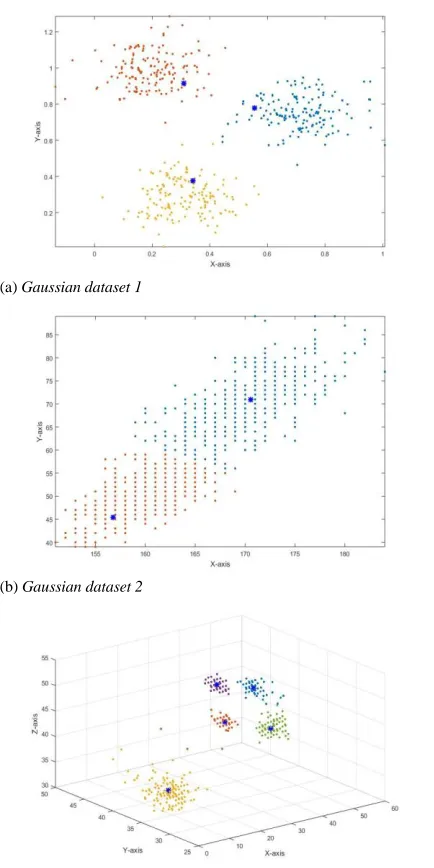
G1a 450 3 2
G2b 800 2 2
WWc 750 5 3
a. Gaussian dataset 1; b. Gaussian dataset 2; c. Wrist-worn accelerometer dataset.
* Set the latest element in
*k u as *r
u ;
vi. End While
vii. Filter
* ku and
DkL
u*
using eq. (13) and obtain
**k
u as focal points of the data clouds;
viii.While
o kμ are not fixed
* Use the focal points to form the data clouds from
x kusing eq. (14);* Obtain the parameters
kμ and
k of the data clouds;
* Calculate DkMM
μj ( j1, 2,...,lk*) using eq. (8); * Find the μ*(1) with maximum DMM using eq. (12); * Send μ*(1) into
*k
μ and DkMM
μ*(1) into
MM *
k
D μ and delete μ*(1) from
k μ ;
* μ*r μ*(1) ; * While
k
μ
- Find the element(s) of
kμ which is/are nearest
to μ*r;
- Send the element(s) and the corresponding MM D into
*k
μ ;
- Delete the element(s) from
k μ ;- Set the latest element in
*k
μ as μ*r; * End While
* Apply eq. (15) to filter
*k
μ and obtain new focal
points
**k
μ ;
*
o **k k
μ μ
ix.End While
x. Build the data clouds with
o kμ using eq. (14).
B. Evolving local modes-based partitioning algorithm
i. While the new data sample xk1 of the data stream is
available (or until interrupted) * If (k0) Then
-μ1x1 - C11; - S1,11; - μ1,1x1; - X1,1 x1 2; * Else
- Update μk and Xk to μk1 and Xk1using eqs.
(2) and (3);
- If (Condition (eq. (16)) is met) Then
1. Ck1Ck1; 2.
1
1, k 1 k C S ; 3.
1
1, k 1
k C k
μ x ;
4.
1
2 1, k 1
k C k
X
x ;
- Else
1. Use eq. (14) to decide the ith local modes
1
k
x is assigned to;
2. Update μk i, and Xk i, to μk1,i and Xk1,i usingeqs. (2) and (3);
3. Sk1,i Sk i, 1; - End If
* End If
ii. End While
iii. Whiledata clouds exhibit overlap
* If (Condition (eq. (17)) is met) Then
- merge the two overlapping data clouds into one using eq. (19);
* End If
iv. End While
v. Obtain
o kμ from the remaining local modes;
vi. Build the data clouds with
o kμ usingeq.(14).
VI. NUMERICAL EXAMPLES
In this section, a number of benchmark problems were considered to evaluate the performance of the proposed algorithm.
For better analysis, we also consider a number of performance measures:
1) Inp: the parameters that have to be predefined (user input);
2) NoC: number of clusters/data clouds in the processing results;
3) AvP: the average purity of the clusters/data clouds, but may disguise poor results [5];
4) MaP: the maximum cluster/data cloud purity [5]; 5) MiP: the minimum cluster/data cloud purity [5]; 6) T: the execution time (in seconds).
A. Evaluation of the offline version
TABLEIII.DATASET DESCRIPTION-PART 2
Dataset
Details Number of Data
Samples
Number of Clusters
Number of Attributes
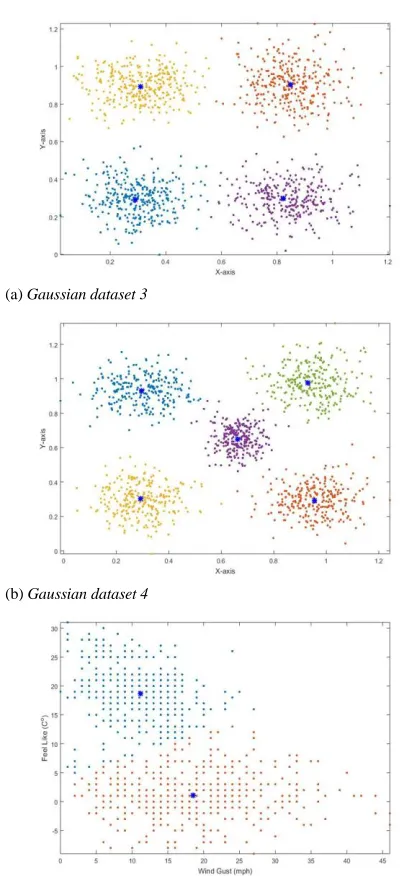
G3a 1200 4 2
G4b 1250 5 2
Cc 938 2 2
[image:6.612.52.269.58.492.2]a. Gaussian dataset 3; b. Gaussian dataset 4; c. Real climate dataset TABEL II . Comparison between offline algorithms
Inp Data set
Measures
NoC AvP MaP MiP T
LMa
G1
3 0.9978 1.0000 0.9934 12.13
MS b 0.3 3 0.9911 1.0000 0.9740 0.02
0.4 3 0.9844 1.0000 0.9554 0.02
KM c 3 3 0.9978 1.0000 0.9934 0.17
LM
G2
2 0.9475 0.9661 0.9303 10.07
MS
5 4 0.9413 1.0000 0.7647 0.03
8 2 0.9325 0.9832 0.8914 0.03
KM 2 2 0.9475 0.9661 0.9303 0.14
LM
WW
5 0.9973 1.0000 0.9868 5.11
MS
10 5 0.9947 1.0000 0.9804 0.02
12 3 0.6000 1.0000 0.5000 0.02
KM 5 5 0.9973 1.0000 0.9868 0.14
a.
Local Modes-based Partitioning Algorithm; b.
Mean Shift Algorithm; c.
K-means Algorithm.
(a) Gaussian dataset 1
(b) Gaussian dataset 2
[image:6.612.307.563.71.305.2](c) Wrist-worn accelerometer dataset
Fig. 1 Offline partitioning results (Blue “*” stands for the focal points, if “” is in different colours, then it stands for different data clouds)
offline version of the proposed local modes-based partitioning algorithm on two synthetic Gaussian problems and a real problem (wrist-worn accelerometer dataset [15]) on a benchmark. The datasets used in the evaluation are tabulated in Table I. The partitioning results are presented in Fig. 1. The detailed experimental results are tabulated in Table II.
For further discussion of the performance, the offline version of the proposed algorithm is compared with two well-known offline clustering algorithms: mean shift [1] (needs the kernel size.
to be predefined) and k-means [2] (needs the number of clusters to be predefined). The experimental results of the two comparative algorithms are tabulated together in the Table II as well.As we can see from Table II, the mean shift algorithm [1] is the fastest one from all the three, however, it is less accurate.
The k-means algorithm [2] is somehow comparable to the proposed local modes-based partitioning algorithm in terms of accuracy, but one has to keep in mind that the high accuracy of the k-means algorithm relies heavily on the properly pre-defined user input. In real cases, the number of clusters within a dataset is often hard to be decided because of the very limited
prior knowledge. Comparatively, the proposed algorithm is not
as fast as the other two algorithms, but it has the high accurate performance, and the most important point is that, it does not require any kind of user input.
B. Evaluation of the evolving version
[image:6.612.315.573.615.696.2]TABEL IV . Comparison between evolving algorithms
Inp Data set
Measures
NoC AvP MaP MiP T
LM
G3
4 0.9958 1.0000 0.9900 2.00
DB a
0.06,
10 c 4 0.9325 1.0000 0.9965 0.10
0.08,
10 3 0.7350 1.0000 0.5017 0.16
ELMb 0.04 10 0.9967 1.0000 0.9870 1.06
0.06 3 0.7425 0.9802 0.5000 0.41
LM
G4
5 0.9920 1.0000 0.9689 2.24
DB
0.06,
10 5 0.9464 1.0000 0.9957 0.11
0.08,
10 3 0.5928 1.0000 0.3360 0.17
ELM
0.03 9 0.9912 1.0000 0.9689 1.18
0.04 6 0.8896 1.0000 0.6507 0.87
LM
C
2 0.9691 0.9747 0.9634 1.58
DB
1.6,
10 7 0.7985 1.0000 0.9966 0.04
2,10 3 0.8902 1.0000 0.9908 0.06
ELM
3 4 0.9670 1.0000 0.9592 0.42
5 3 0.6215 1.0000 0.5639 0.24
a. DBScan Algorithm; b. ELM Algorithm; c.[Radius, minimum number].
(a) Gaussian dataset 3
(b) Gaussian dataset 4
(c) Real climate dataset
Fig. 2 Evolving partitioning results (Blue “*” stands for the focal points; if “” is in different colours, then it stands for different data clouds)
The comparison results as depicted in Table IV demonstrate that, the proposed algorithm is the most accurate one of the three, and the most importantly, it is entirely data-driven and free from any pre-defined parameters or assumptions. In contrast, the DBScan algorithm is the fastest, but it is less accurate and needs two parameters to be decided by the user. ELM algorithm exhibits comparably accurate performance with the proposed algorithm; however, this also depends on the user input. With improperly defined radius, its performance can be significantly degraded.
C. Hybrid example between the offline and evolving versions
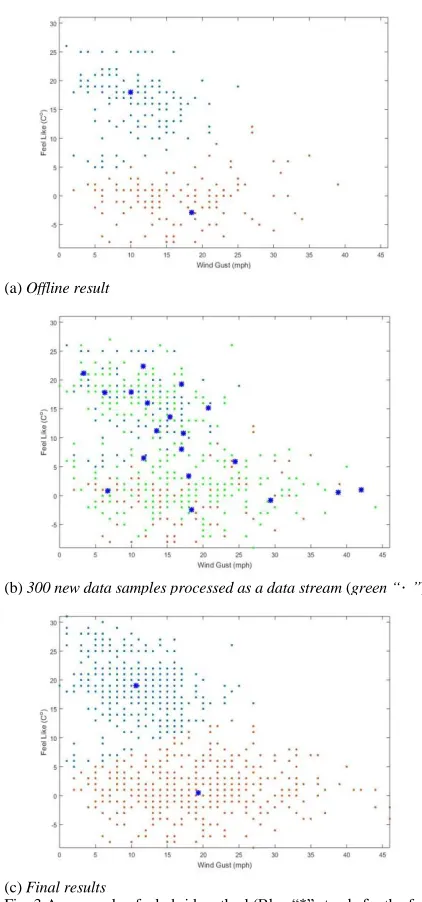
We use the same real climate dataset [16] as tabulated in Table II to study a hybrid between the offline version to start and the evolving version afterwards. The offline version is
applied to the first 300 data samples of the climate dataset [16] and the evolving version then is used to process the remaining 638 data samples as a data stream. The results of using the hybrid are shown in Fig. 3. From the figure we can see that the offline version builds two data clouds based on the 300 data samples. Then, the evolving version takes over the task and continues to process the rest of the data samples. The density changes with more data samples arriving and more clusters being formed based on the new data samples. Once, there are no anymore new data samples, the algorithm performs a filtering operation of the main modes and successfully identifies the two focal points representing the two main modes of the data density. Finally, the two focal points are used to form the two data clouds.
VII.CONCLUSION
In this paper, a novel “local modes-based” partitioning algorithm is introduced as a fully autonomous technique to partition the data space into parameter-free data clouds
[image:7.612.318.563.74.382.2] [image:7.612.314.564.83.374.2](a) Offline result
(b) 300 new data samples processed as a data stream (green “”)
[image:8.612.48.259.62.513.2](c) Final results
Fig. 3 An example of a hybrid method (Blue “*” stands for the focal points; if “”is in different colours, then it stands for different data clouds)
REFERENCES
[1] K. Fukunaga and L. Hostetler, “The estimation of the gradient of a density function, with applications in pattern recognition,” IEEE
Transactions on Information Theory, 1975, vol. 21, no. 1, pp. 32–40.
[2] J. B. MacQueen, “Some methods for classification and analysis of multivariate observations,” in Berkeley Symposium on Mathematical
Statistics and Probability, 1967, vol. 1, no. 233, pp. 281–297.
[3] S. L. Chiu, “Fuzzy model identification based on cluster estimation.,”
Journal of intelligent and Fuzzy systems, 1994, vol. 2, no. 3. pp. 267–
278.
[4] M. Ester, H. P. Kriegel, J. Sander, and X. Xu, “A density-based algorithm for discovering clusters in large spatial databases with noise,”
in International Conference on Knowledge Discovery and Data Mining,
1996, vol. 96, pp. 226–231.
[5] R. Dutta Baruah and P. Angelov, “Evolving local means method for clustering of streaming data,” in IEEE International Conference on
Fuzzy Systems, 2012, pp. 10–15.
[6] R. R. Yager and D. P. Filev, “Approximate clustering Via the mountain method,” IEEE Transactions on Systems, Man, and Cybernetics, vol. 24, no. 8, pp. 1279–1284, 1994.
[7] P. Angelov and R. Yager, “A new type of simplified fuzzy rule-based system,” International Journal of General Systems, vol. 41, no. 2, pp. 163–185, 2011.
[8] A. Okabe, B. Boots, K. Sugihara, and S. N. Chiu, Spatial tessellations: concepts and applications of Voronoi diagrams, 2nd ed. Chichester, England: John Wiley & Sons., 1999.
[9] P. Angelov, “Outside the box: an alternative data analytics framework,”
Journal of Automation, Mobile Robotics and Intelligent Systems, vol. 8,
no. 2, pp. 53–59, 2014.
[10] P. Angelov, “Typicality distribution function – a new density- based data analytics tool,” in IEEE International Joint Conference on Neural
Networks (IJCNN), 2015, pp. 1–8.
[11] P. P. Angelov, “Anomaly detection based on eccentricity analysis,” in
IEEE Symposium Series in Computational Intelligence, IEEE Symposium on Evolving and Autonomous Learning Systems, EALS, SSCI, 2014, pp. 1–8.
[12] P. P. Angelov, X. Gu, J. Principe, and D. Kangin, “Empirical data analysis - a new tool for data analytics,” in IEEE International
Conference on Systems, Man, and Cybernetics, 2016, p. in press.
[13] J. Saw, M. Yang, and T. Mo, “Chebyshev inequality with estimated mean and variance,” The American Statistician, 1984, vol. 38, no. 2, pp. 130–132.
[14] P. Angelov, Autonomous Learning Systems: From Data Streams to Knowledge in Real Time. John Willey, 2012.
[15] https://archive.ics.uci.edu/ml/datasets/Dataset+for+ADL+Recognition+ with+Wrist-worn+Accelerometer