A Small Electronic Computer Applied in a Retail Department Store
A Line Printer Memory Utilizing Magnetic Cores
The Application of Digital Control Systems in the Process Industries
AUGUST
1958
•
PROVING GROUND
for
COMPUTER CORES
Bulletin TC-108A
"TAPE-WOUND BOBBIN CORES FOR COMPUTER APPLICATIONS"
Includes essential data on applications and properties, fabrication and testing of Arnold Bolibin Cores; lists standard sizes, etc.
Bulletin GC·106C
"ARNOLD MAGNETIC MATERIALS"
I
Contains data on the complete Arnold line, including cast and sintered Alnico magnets, Silectron cores, tape-wound cores, bobbin cores, Mo-Permalloy and iron powder cores, and special permanent ~agne~ material~.
ADDRESS DEPT. CA-88
2
Take the hundreds of tiny Arnold tape wound bobbin cores that are the heart of some of today's remarkable computing machines.
Each one must provide reliable, uniform performance. Each must meet rigid standards of magnetic and phys-ical specifications. And, most im-portant of all, their basic material properties must be examined for proper grading of cores to assure per-formance of the final product.
Only precision manufacture can assure you this top-quality perform-ance in magnetic core materials . . . and at Arnold each core is made and painstakingly checked before ship-ment by the latest, most thorough methods and equipment.
Some of this testing equipment and many of our production methods were developed by us-for our own use exclusively-and surpass the stand-ards set by the industry. You know, when you use Arnold cores, that the materials you receive have met all the rigid standard tolerances, plus any individual specifications you may have.
• Let us supply your requirements for Bobbin Cores-or other tape wound cores, powder cores, perma-nent magnets, etc.-from the most complete line of magnetic materials in the industry. And rememher, Arnold
products are made, precision-tested, to your specifications.
WSW 7047
[1uj'ARNOLD
£NGINEt:
RING
·COMPANY
'$""
"~:',
" '
',.M,ain'Offi~e
&'
Plan't:
JY\a~eng'o,,' IInn~i$<
>[,' ", f!1l,'"
Repath f)oclfl,c DiYislo~ ~Ia,~t: 641 ~CI$f ,it~$,t Street, t.~s Angel . . :eClu,.
, ' "" : " '. . D,strict Safes, Off,ces: ' . '
, . . . ",',' Bodon;' 49 Waltham Sf;, lexington Los Angeles: 3450 Wilshire Blvd.
, N~w York. 350 Fifth ~ve. WO$hingfon, D.C •• '1001~15th'Sf., H.W. '
Make Your Own Tiny Genius Computers . ..
Have Fun While You Learn With
BRAINIAC
Small Electric Brain Construction Kit K 15
- includes all 33 Geniacs (1955), all 13 Tyniacs (1956), and 60 all new Brainiacs (1957)
FUN -
SCIENTIFIC -
INSTRUCTIVE -
SAFE -
INEXPENSIVE
The complete kit you need to build over 100 baby genius electric brains
WHAT COMES WITH YOUR BRAINIAC KIT? Manual on what, why and how of small electric brains, incorpo-rating over 7 years of our research and study. All 33 experiments from our former Geniac kit, with exact wiring tem-plates for each one. All 13 experiments from the former Tyniac kit, also with exact wiring templates. 60 entirely new experiments (Brainiacs) with their solutions. An introduction to Boolean Algebra for designing circuits. Over 450 parts~
as follows: 6 Multiple Switch Discs; Mounting Panel; 10 Flashlight Bulbs; 2 Multiple Socket Parts, each holding 5 bulbs;
70 Wipers, for making good electrical contact (novel design, patent applied for); 25 Jumpers, for transfer contacts; 50
feet of Insulated Wire; Flashlight Battery; Battery Clamp and Main On-Off Switch; nuts, bolts, sponge rubber washers, hard washers, screwdriver, spintite blade, etc.
This kit is an up-to-the-minute introduction to the design of arithmetical, logical, reasoning, computing, puzzle-solving~
and game-playing circuits - for boys, students, schools, colleges, designers. It is simple enough for intelligent boys to
as-semble, and yet it is instructive even to engineers, because it shows how many kinds of computing and reasoning circuits can be made from simple components. This kit is the outcome of 7 years of design and development work with Geniacs and small robots by Berkeley Enterprises, Inc. With this kit and manual you can easily make over 100 small electric brain machines that display intelligent behavior and teach understanding first-hand. Each one runs on one flashlight battery; all connections with nuts and bolts; no soldering required. (Returnable for full refund if not satisfactory.) .. Price $17.95
WHAT CAN YOU MAKE WITH A BRAINIAC KIT?
LOGIC MACHINES Syllogism Prover
James McCarty's Logic Machine
AND, OR, NOT, OR ELSE, IF . . . THEN, IF AND ONLY IF, NEITHER . . . NOR Machines
A Simple Kalin-Burkhart Logical Truth Calculator The Magazine Editor's Argument
The Rule About Semicolons and Commas The Farnsworth Car Pool
GAME-PLAYING MACHINES Tit-Tat-Toe
Black Match Nim Sundorra 21
Frank McChesney's Wheeled Bandit
COMPUTERS - to add, subtract, multiply, divide, •••• ~ using decimal or binary numbers.
- to convert from decimal to other scales of notation and vice versa, etc.
Operating with Infinity Adding Indefinite Quantities
Factoring Any Number from 45 to 60
Prime Number Indicator for Numbers 1 to 100 Thirty Days Hath September
Three Day Weekend for Christmas
Calendar Good for Forty Years 1950 to 1989 Money Changing Machine
Four by Four Magic Square Character of Roots of a Quadratic Ten Basic Formulas of Integration
PUZZLE-SOLVING MACHINES The Missionaries and the Cannibals The Daisy Petal Machine
Calvin's Eenie Meenie Minie Moe Machine The Cider Pouring Problem
The Mysterious Multiples of 76923, of 369, etc. Bruce Campbell's Will
The Fox, Hen, Corn, and Hired Man The Uranium Shipment and the Space Pirates General Alarm at the Fortress of Dreadeerie COMPUTERS and AUTOMATION for August, 1958
The Two Suspicious Husbands at Great North Bay The Submarine Rescue Chamber Squalux
The Three Monkeys Who Spurned Evil Signals on the Mango Blossom Special The Automatic Elevator in Hoboken Timothy'S Mink Traps
Josephine's Man Trap Douglas Macdonald's Will Word Puzzle with TRICK
QUIZ MACHINES Intelligence Test Guessing Helen's Age Geography Quiz History Quiz
Mr. Hardstone's Grammar Test Solving Right Triangles
SIGNALING MACHINES
The Jiminy Soap Advertising Sign The Sign that Spells Alice
Tom, Dick, and Harry's Private Signaling Channels Jim's and Ed's Intercom
CRYPTOGRAPHIC MACHINES Secret Coder
Secret Decoder
Lock with 65,000 Combinations Lock with 15,000,000 Combinations The General Combination Lock Leonard's Two-Way Coding Machine
. . . AND MANY MORE
r - - .. --
MAIL THIS REQUEST or a copy of itBerkeley Enterprises, Inc.
815 Washington Street, R135, Newtonville 60, Mass. Please send me BRAINIAC KIT K 15, including manual, instructions, over 400 parts, templates, circuit diagrams, etc. I enclose $17.95 for the kit plus ... .for handling and shipping (30c, east of Mississippi; 80c, west of Mississippi; $1.80, outside U.S.). I understand the kit is returnable in
seven days for full refund if not satisfactory (if in good condition) .
COMPUTERS
and
AUTOMATION
DATA PROCESSING
•
CYBERNETICS
•
ROBOTS
Number 8
Volume 7
EDMUND C. BERKELEY
NEIL D. MACDONALD
Editor Assistant Editor
SERVICE AND SALES DIRECTOR MILTON L. KAYE
535 Fifth Ave.
MUrray Hill 2-4194 New York 17, N.Y.
CONTRIBUTING EDITORS ANDREW D. BOOTH
NED CHAPIN JOHN W. CARR, III
ALSTON S. HOUSEHOLDER
ADVISORY COMMITTEE MORTON M. ASTRAHAN
HOWARD T. ENGSTROM GEORGE E. FORSYTHE
RICHARD W. HAMMING ALSTON S. HOUSEHOLDER
H. JEFFERSON MILLS, JR. HERBERT F. MITCHELL, JR.
SAMUEL B. WILLIAMS
ADVERTISING REPRESENTATIVES
Middle Atlantic States MILTON L. KAYE 535 Fifth Ave. New York 17, N.Y.
MUrray Hill 2-4194
San Francisco 5
605 Market St.
Los Angeles 5
439 S. Western Ave.
Elsewhere
A. S. BABCOCK YUkon 2-3954 W. F. GREEN DUnkirk 7-8135
THE PUBLISHER Berkeley Enterprises, Inc. 815 Washington St., Newtonville 60, Mass.
DEcatur 2-5453 or 2-3928
AUGUST,
1958
September 1951 EstablishedFRONT COVER
Semi-Automatic Data Reduction .1,6
ARTICLES
A Small Electronic Computer Applied In a Retail
De-partment Store 8
C. FRED FLANNELL
A Line Printer Memory Utilizing Magnetic Cores 12 B. GODA, S. MARKOWITZ, AND E. JACOBI
The Application of Digital Control Systems In the
Process Industries 14
M. PHISTER, JR.
READERS' AND EDITOR'S FORUM The Navigation of the Nautilus Interesting Computer Society Meetings
JACKSON W. GRANHOLM
Locks for Front Doors
NEIL MACDONALD
The Ultimate Copy
MEL CARLSON
REFERENCE INFORMATION
Association for Computing Machinery Meeting, Urbana, Ill., June 11 to 13, 1958 - Program, Titles, and
6
6
24 24
Abstracts (Part 2) 16
Books and Other Publications 27
INDEX OF NOTICES Advertising Index Back Copies Bulk Subscriptions Manuscri pt Notice Who's Who Entry Form
.
, 30see July, page 4 see May, ,page 4 see April, page 32
31
COMPUTERS and AUTOMATION is published monthly at 160 Warren St., Roxbury 19, Mass., by Berkeley Enterprises, Inc. Printed in U.S.A.
SUBSCRIPTION RATES: (United States) $5.50 for 1 year, $10.50 for 2 years; (Canada) $6.00 for 1 year, $11.50 for 2 years; (Foreign) $6.50 for 1 year, $12.50 for 2 years.
Address all Editorial and Subscription Mail to Berkeley Enterprises, Inc., 815 Washington St., Newtonville 60, Mass.
ENTERED AS SECOND CLASS MATTER at the Post Office at Boston 19, Mass.
POSTMASTER: Please send all Forms 3579 to Berkeley Enterprises, Inc., 160 Warren St., Roxbury 19, Mass.
Copyright, 1958, by Berkeley Enterprises, Inc.
CHANGE OF ADDRESS: If your address changes, please send us both your new address and your old address (as it appears on the magazine address sticker), and allow three weeks for the change to be made.
~ ' ...
1",
SQUARE PULSE GENERATOR!
ESC's Low Cost, Portable Modupulser®
Now generate any fixed or variable pulse repetition rate without tying up larger pulse generating equipment. ESC's new 1" square fixed Modupulser is factory-set at the specified pulse rate-you just plug it in to operate. The Modupulser is so inexpensive and convenient, you can stock several (with various pulse rates already fixed)
for quick insertion at any time-or a Modupulser with a variable repetition rate. Also supplied for external trig-gering. Manufactured for commercial and military appli-cations, Modupulsers are available from stock or custom-built to your specifications. Write for complete technical data today!
Pulse Width Range: 1.0 I-tsec to 8 I-tsec PRF Range: 400 cps to 15,000 cps Rise Time: 0.2 I-tsec min.
Output: 6 volts positive and 6 volts nega-tive when operated from a 6 volt DC source
Tolerance (on pulse width and PRF): ±20% * change in performance from nominal (@25 0 C): when operated over
a wide operating temperature range: 10%
Supply Voltage: -6 volts
Supply Current: Dependent on pulse width and PRF
Minimum Output Load: 75,000 ohms (lower output load values available with re-duced amplitude)
Volume: I" x I" x I" Available with miniature 7-pin plugs, 1/10" grid pins
for printed circuit boards, or to your specifications.
*This tolerance can be reduced if speciJied
~r---7
/
electronic components division
J
L ___________________
~~~IE
r:i!.J
~ CORPORATION· 534 BERGEN BOULEVARD· PALISADES PARK. NEW JERSEY, , , , R exceptional employment opportunities for engineers experienced in pulse techniques
Pulse transformers. tledium and tow-power trAnsformers. filUlS
Qf antypes • Pulse-forming networks. UIntature ptug-In encapsulated circuit
3S$emb1i~sReaders' and Editor's Forum
FRONT COVER: SEMI-AUTOMATIC DATA REDUCTION
,-THE FRONT COVER shows two machines being operated to convert analog information from oscillo-graph records into digital information punched in cards. After the operator aligns the cross hairs of the "Oscar, Model J" (made by Benson Lehner Corp., Los A'ngeles, Calif.) over the desired point on the curve, he presses a button, and then the machine assembly converts the point to a four-digit number automatically punched. into an IBM punch card. The scene is in the computing \ service at Datics Corp., Fort Worth, Texas. '
THE NAVIGATION OF THE NAUTILUS
THE MARVELOUS history-making trip of the U.S. atomic submarine Nautilus under the North Polar ice cap, from the Pacific Ocean to the Atlantic Oc~~,n, is, among many other things, another remarkable ihstance of what is almost becoming commonplace today: that automatic, reasonable, information-processing of a kind which is altogether impossible for human beings, is
pos-sible for machines and devices.
The Nautilus' navigation devices included: automatic depth controls, automatic course keeping controls, gyro-compasses of submarine and aircraft types, and inertial navigation systems. One of the devices was a Sperry Celestial Altitude Recorder (SCAR), which "permits celestial navigation while submerged," and enables the inertial navigation system to be checked and corrected. "Details on the SCAR system, developed by Sperry's Marine Division, remain classified." How to perform "celestial navigation," presumably navigation with ref-erence to the sun and the stars, while submerged under water and ice, a feat totally impossible to a human being, is, according to the news, possible for the machine. But we are not permitted to know !he fascinating details because the "details are classified."
We can predict however that the knowledge that something is possible will enable other scientists also to solve the problem, duplicating,~ or improving on the solution. The secrets of nature are open to determined scientists adequately supported, and after a few years or decades, arrive in the textbooks for everyone to learn.
INTERESTING COMPUTER SOCIETY MEETINGS I. To the Editor from Jackson W. Granholm
Editor and Publisher, Computing News
Seatde, Wash.
YOU ARE TO BE commended for that portion of your notes in the June issue on p. 6 entitled: "Is the Com-puter Field Staying Together or Separating?", in which you pointed out, among other things, that "92
%
of the papers presented at the ACM meeting in Urbana re-quired specialized knowledge to be understood," and that "probably no one enjoys sitting in a lecture hall and hearing a person present a paper which starts off beyond his comprehension, and then goes much further."::
K?~ ,~~ye :~~~., ~IJe: n:;til 9~: t}1~~4~fl.d! ..I
f anything, y~)Urcomments are too gentle. . .
6
You wrote about computing machines when it was hardly popular and surely not monetarily rewarding to do so. You have always written in simple, understand-able fashion. You know what you are talki~g about.
For some time I have worried about the tendency toward what can be described as "pseudo-intellectual snobbery" in computing meetings. Nor is this limited to meetings of the Association for Computing Machin-ery. There is no reason to turn computer meetings into a poor copy of a mathematical society meeting. Nor is this to speak out against those vital contributions that mathematicians make to the computing field. When well-done they are a joy ,to beho~d.
; Fred Gruenberger expressed it well when he observed that undertakers probably have more fun at their
con-v~ntions ,~han computer people do.
One need only read the writings of Albert Einstein to' know that what is profound and vital need not be pompous and brontosaurian.
Keep up the good work.
II. From the Editor
A perennial problem that faces many computer peo-ple from time to time is: "I should like to give a paper at a computer meeting. How shall I present it? How shall I be interesting? How shall I say something worth-while?"
To solve this problem, a few, simple, fundamental considerations apply, because the persons who may listen to the paper have some simple, basic questions upper-most in their minds. The first one is:
"What is this paper about? What is the subject?" The first duty of any author of a paper, therefore, is to make the subject clear, in simple language that peo-ple can understand. This permits those who are not in-terested in the subject, and those who are already ex-perts in
tfI,e;
~~bje<;t, ~o .go: a:w~y' .an.~:lnQ.t)is.~~~~~ .. ~Clearly, when an author is thinking about a paper, and has settled on a subject, the next thing he should do is estimate the number of persons interested in it.
If his estimate indicates that there will be fewer than a dozen persons interested in his subject, it would be wise for him to change his subject to one in which at least thirty people will be really interested.
After this step, the assumed audience is smaller, con-sisting just of persons interested in the subject, and so easier to talk to.
The next question uppermost in the mind of a listener IS:
"How shall I understand what this author i-s talking
about?" , ....
In order to understand what an author is talking about, a listener needs to know the terms the author is using. These divide into two kinds of terms. The first kind of terms is the kind which people who are interested in the subject surely already know; and when you as author decide which .are these terms, .please think of your. less
• • .. • • ~ j • • • • • • I [Please turn to page 24}
231 R
Symbol of the greatest advance in analog computing techniques--announcing PACE Analog Computer Console 231 R. This console incorporates new and exclusive features that enable it to set new standards in the art of analog computing for speed, precision, and reliability . For full information, write for bulle-tin number CG-116,Electronic Associates, Inc., Long Branch, N.
J.
See Elrctronic Associat,s' equipment demonstrated at the WESCON Show, Aug. 19-22, Pan-Pacific Auditorium, Los Angeles. Our booth numbers are 801 and 802.
COMPUTERS Cl1ld AUTOMATION for August, 1958
A SMALL ELECTRONIC COMPUTER APPLIED
IN A RETAIL DEPARTMENT STORE
C. Fred Flannell
Director, Electronic Computer Dept. Royal McBee Corp., Port Chester, N.Y.
E
LECTRONIC COMPUTERS of the present day which are designed for application in business data processing often need a large random access memory unit or very fast input-output. By a random access mem-ory unit, we mean a memmem-ory unit in which a piece of information stored may be called for and obtained in approximately the same amount of time regardless of its location in the memory. Magnetic drums, short mag-netic tape files, and magmag-netic disks are examples of such memory units. With such a unit data may be stored and called out at random, without paying attention to its se-quential position in the memory. This is not true for long reels of magnetic tape, where attention must be given to the sequential position of information in the memory, for otherwise a great deal of time may be needed to search the long tape for the desired data, and in addi-tion sorting of the calls for desired informaaddi-tion may be necessary.Since many applications require a large random access memory, attention has been directed toward large ca-pacity computers with maximum access time of about one second. (Maximum access time is the longest time required to find any data.) But the price of such ma-chines frequently precludes their use.
However, a large, random access memory in many cases can be avoided. In such cases, a computer like the Royal McBee LGP-30 may be used. Its magnetic drum memory containing 4096 words (a word consists of nine digits and sign) may serve as a very fast random access memory device. The maximum access time of the LGP-30 is 17 thousandths of a second. In applications where a medium memory may be used, an inexpensive com-puter with a high speed drum memory may actually process the data faster than a computer with a very large memory device.
The following case history illustrates how a relatively inexpensive, physically small computer with a relatively large drum memory is used in a retail electronic data processing system. This system resulted from a joint effort of personnel from Burdine's Department Store in Miami, Fla., and Royal McBee.
Choosing Equipment
Burdine's is one of the stores of the American Mer-chandising Corporation. As a group these stores joined forces to study EDP equipment. The program started . with the procurement of an RCA Bizmac Computer . which was located at Higbee Department Store in
Cleve-land. All of the stores in the group contributed per-sonnel to the study. Mr. Mike Zappia of Burdine's joined the other members of AMC in working on vari-ous applications for the giant computer.
8
.:.
:
••
••
•
•••
••
•
•••
••
•• •
•
••• ••
••••
•
••
•••
••
•
•
••••
•••
·
••
.
••
• •
•
•
••
•
•••
• ••••
••
•••••
•
••••• •
•••
•
••••
•
••
·
•.
•
•
•• •
•
-
.
Q~.
cool
LA • ~ x I~Jm!lmf!
...
« 00MIIIMI • MIAMI IIEACH III Sf SlfO."' •• (,.'u II •••• • WEST ~ALM IIEACH •
-i
~
FT. LAUDERDALE
.
..
~:
I
0 ' "I
DATI: ..~S~.'=Ml----~---~--~----~ ~
~~.o=o.~ .. ~s---~.a o
CITY
T ZON~
~o~ __________________________ ~41
, N ... ' U
~~AO=O.=l'~S---~.
:r,CO~"---~Z=0.~l---~5T'~Tl~--~
.
:r.U-.C-HA-Sl-D---~I--'I--~·
, ;' TAKE SEND ~~THO.IZED
X
II
CASH
ICHAR.l
I'"A
IHHe
"
..
CD " I: 5= ~a III: c"
ITEM O[SCIIPTION
r
JAN ISSAMPLE OF SALES CHSCK
Figure 1
I
VALUE
AMOUNT
3.5 5
2.4 b 6.00 s
.1 8 Tx .25 3.00-3.43 T
•
•
•
•
•
•
•
-I
Over two years ago, :Mr. Zappia became interested in the application of a small computer to department store operations. He thought there were many problems involved in using a large computer which could be solved by placing a small computer in the store, thereby avoiding the bottleneck of one large centralized data processing installation. Burdine's management decided to lease an LGP-30 for Burdine's sales audit application in their newest Miami branch (163rd Street store). Man-agement expens this store to do business amounting to
about five million dollars per year involving two to four thousand transactions per day.
The existing cash registers in the store were replaced by new cash registers which produce a punched paper tape and a sales ticket as a by-product of entering a sale. The new cash register has eleven columns of
three for department number, two for class of merchan-dise, one for multiple item sales, and five for price. This equipment eliminates writing sales tickets by hand and punches a paper tape used for subsequent data processing. About fifty of these new registers have been installed in the Burdine's store.
Point of Sale Operation
On the sample sales ticket (see Figure 1) you will notice that for each item sold the sales person enters department number, class of merchandise, number of items involved if a multiple sale (0 represents 1 item - no key is depressed), and price. After all items have been entered, a sub-total may be taken. This total is followed by special charges such as taxes, C.O.D. charges, gift wrapping, etc. Each special charge entry can be identified by the identifying code number. Prices are entered as negative numbers on items such as de-posits on lay-aways and employee discounts.
After all special charges have been recorded, striking the total bar on the register records the total. (Totals are not punched on the tape.) Then the sales person enters clerk number and "type of sale" code (type of sale includes cash, C.O.D., lay-away, 30 day charge, etc.). Striking the End-of-Transaction bar records this information plus store number, register number, and transaction number.
It would be presumptuous of us not to provide a pro-cedure for marking a mistake; therefore a void key is provided on the register; this key punches a "void code" in the paper tape. The tapes are read into the computer backwards so that any void code enters first and the computer skips that transaction. The numbers on each line of the sales ticket are punched in reverse order so that they enter correctly.
At the end of each day the tapes are gathered from all registers and taken to the LGP-30. Punched paper tape for input is taken directly from the point-of-sale device in a form which is acceptable to the computer; no manual punching of additional information is neces-sary. All of the information which is required for the sales audit is already punched in the tape by the point-of-sale device.
Data Processor
The LGP-30 used for processing the data will accept information from the attached typewriter keyboard, its tape reader, or a photoelectric tape reader. The photo-electric reader was selected for this application because its maximum reading speed of 12,000 characters per minute is suitable for the large amount of input data.
The computer uses the stored program principle of operation, which means that instructions for solving the problem are stored in the drum memory and exe-cuted automatically. As sales data enter the computer, the specified totals (sales person, class, department, etc.) are up-dated. The magnetic memory retains information in a manner similar to tape on a home tape recorder: information remains on the drum until new information is recorded replacing old totals. Since data enters at random, all tapes must be read and the totals retained in memory before any reports are printed, except for the error report, which will now be explained.
COMPUTERS and AUTOMATION for August, 1958
Error Checking
The first job of the computer is that of policeman. Error checking is built into the physical components of the system and into the program. As tapes pass thro~gh the reader, a parity check circuit stops the reader 1f a punching error or reading error is det.ected .. We accept the fact that mechanical and electronlC equ1pment w1ll occasionally make a mistake. We also admit that people in the system make even more mistakes. The computer searches for human errors by checking for inconsisten-cies in the data which the clerk has punched. Some of the errors detected are: non-existent department or sales person; parcel post charge on lay-away; C.O.D. fee on other type of sale; cash deposit on cash sale; etc. As errors are detected the transaction number and type of error is recorded. Thus the first important report printed by the computer is an error re~ort. The alt~rnative of manually checking each sales shp for prepanng such a report would be very time-consuming and expensive.
Cash Report
The second report produced by the computer is a cash report for all registers. The sample report illustrates
Chart 1 - Sample of: CASH REPORT
Register Net
Number Sales
1 262.05
2 195.15
49 24.04
50 202.40
TOTAL 7111.85
the actual appearance of the reports. Since the com-puter may receive and print all typewriter characters, the headings are printed automatically by the computer program.
Sales Report by Type of Sale
The third report is a report by type of sale. All ac-tivity including charge sales and retur~s are. entered into the registers. The six types of sales hsted 10 the report are:
1. Cash Sale 2. C.O.D. 3. Lay-away Sale
7. Household Club Charge
8. Permanent Budget Account Charge 9. Thirty-day Charge
Chart 2 - Sample of: SALES BY TYPE
Type Gross Net
Sale Sales Returns Sales
1 7439.53 327.68 7111.85
2 20.44 16.42 4.02
3 282.40 4.96 277.44
7 3281.12 493.74 2787.38
8 230.02 98.64 131.38
9 2674.77 116.09 2558.68
TOTALS 13928.28 1057.53 12870.75
Sales Report by Salesperson
The fourth report is a report on salesperson perform-ance sorted by department and clock numbers. The pro-gram will accommodate 400 sales people.
10
SPACE FLIGHT and NUCLEAR PROPULSION
A drastic reduction in vehicle mass ratios ... substan-tially increased specific impulse values ... a capability for achieving very high speeds ... these are some of the significant advantages that will come from the application of nuclear energy to space flight.
A numbeX.of different Qropulsion systems have been proposed to utilize nuclear reactions. The simplest system consists of a fission reactor through which the propellant is passed, heated, and then expanded through a rocket nozzle. Fission reactors can also be employed as a source of energy to generate electric power, which in turn can be used to accelerate ions or charged particles, or to create and accelerate a plasma. And fusion reactors, when developed, can be used to generate electric power for the same purposes. In addition, in the case of the fusion reactor, there is the attractive possibility that the reaction energy can be used directly without conversion to electric power. The fission-powered thermal propUlsion system will probably constitute one of the next major advances in space technology. As an example of the gain which can be achieved, consider a vehicle with a payload weight of about 25 tons for a manned flight to one of the nearer planets, landing, and returning. Powered
by chemical rocket engines, the takeoff weight for such a vehicle would be 50,000 tons. But powered by a fission-thermal propUlsion system, weight at launch would not exceed 500 tons ... a 100-fold reduction in the mass ratio. Considerably greater gains are pre-dicted for the more advanced systems.
Systems studies and advanced research in the appli-cation of nuclear energy to the requirements of space flight are in progress at Space Technology Laboratories. This work illustrates the emphasis at STL on the exploration and development of new concepts and techniques in ballistic missile and space technology.
Both in support of its over-all systems engineering responsibility for the Air Force Ballistic Missile Pro-gram, and in anticipation of future system require-ments, STL is engaged in a wide variety of analytical and experimental research. Projects are in progress in electronics, aerodynamics, hypersonics, propUlsion and structures.
The scope of activity at Space Technology Labora-tories requires a staff of unusual technical breadth and competence. Inquiries regarding professional opportunities on the STL Technical Staff are invited.
SPACE TECHNOLOGY LABORATORIES
A Division of The Ramo - Wooldridge Corporation 5730 ARBOR VITAE STREET. L.OS ANGEL.ES 45. CAL.IFORNIA
Chart 3 - Sample of: SALES BY SALESPERSON
Dept. Clock
No. No.
001 007
009 013 016
002 006
198 009
TOTALS Gross Sales 211.25 56.71 432.73 353.46 414.70 98.76 13928.28 Returns 22.86 7.62 183.38 181.84 182.40 3.99 1057.53
Sales Report by Department
Net Sales 188.39 49.09 249.35 171.62 232.30 98.76 12870.75
The fifth report provides an analysis by department. Burdine's has 93 retail departments, 2 special retail de-partments, 6 leased dede-partments, 3 cost dede-partments, and 9 workroom departments. Special charges (taxes, C.O.D. fee, etc.) are included on this report.
Dept.
01
92
93
Chart 4 - Sample of: SALES BY CLASS
Net Dept.
Class Sales Totals
134.62 4.33
21 8.75
22 9.10
23 6.40
24 12.00
132.16 16.75
81 17.21
82 21.02
83 16.57
84 29.20
119.77 41.07
11 45.09
Sales Report by Class of Merchandise
The sixth report gives an analysis of sales by class of merchandise within each department. For example, de-partment 63 is Men's Hats and the classifications in this department are 71 Felt, 72 Panama, 73 Straw, 74 Caps, 75 Cloth Hats, 76 Uniform Caps, 77 Braid Hats, 78 Helmets, and 79 Berets. The program provides for 1000 classifications. If the number of classifications were in-creased, the processing could still be completed by sort-ing the tapes and runnsort-ing the tapes from one or two floors at a time. This system does not provide for item control but item control could be accomplished in some departments by assigning a class number to each item. The offset amounts were entered without a department number indicating clerical error or unclassified merchan-dise.
If you desire to punch the totals as the reports are printed, the "Punch" switch on the typewriter may be depressed. These tapes may be used for preparing weekly or monthly reports.
A quick glance at the number of totals carried in
COMPUTERS and AUTOMATION for August, 1958
Chart 5 - Sample of: SALES BY DEPARTMENT
V)
~c:
c
(J)·3
V) ... u
c:: ~ o t';t
a.
~ V) .... V) 0.c:
o <1.1
.a
... <1.1 ~.~ o t';t <1.1 ....-
<1.1-~~ <1.1
Z~ ZQ Z~
Q p:::
01 139.50 4.88 134.62 12.32 196
93 142.21 22.44 119.77 33.61 374
348 12.29 .93 11.36 2.21 15
368 13.70 17.53 3.83 .41 194
Total
Retail 13535.08 1049.95 12485.13 1220.51 13434
102 228.46 .53 227.93 .57 57
106 .26 .26 .73 10
118 17.45 .19 17.26 4.91 15
120 9.97 1.01 8.96 15.36 11
124 16.38 16.38 204
Total
Leased 272.52 1.99 270.53 21.57 297
306 14.29 1.01 13.28 .22 15
309 13.16 .97 12.19 1.06 07
353 Total
Cost 27.45 1.98 25.47 1.28 22
200 13.01 .21 12.80 .13 11
203 9.85 .93 8.92 1.07 24
205 .93 .93 04
206 14.29 1.01 13.28 1.01 186
209 14.34 .26 14.08 .89 11
218 14.36 .13 14.23 .93 12
232 15.50 .34 15.16 1.04 13
330 8.66 8.66 13
332 2.29 .73 1.56 .85 12
Workrooms 93.23 3.61 89.62 5.92 286
Grand Total 13928.28 1057.53 12870.75 1249.28 14039
400 209.43 720 21.76
500 218.70 730 33.88
600 169.56 800 321.66
700 120.91 900 321.32
memory will indicate that more totals are held than the number of available memory locations. But the totals do not require 9 digits of magnitude, and so two units of data may be stored in one memory location and sep-arated by the program for processing. This effectively doubles the size of the memory, from 4096 locations to 8192 locations.
Time Required
The time required to process the tapes and prepare the reports may vary a great deal depending on the num-ber of errors in the tapes and the numnum-ber of transactions. Initially, processing required two to five hours, and even longer on some days; much of this time was spent in error checking. This running time has subsequently been cut considerably by improving the program.
The Old System and the New System
Under the old system, one department processed sales audit information for the other five Burdine's stores, using a manual method of sales audit with modified bank machines. This department employed 24 girls. The
Salesperson and Class Reports were not prepared in the old system.
The reports from the new system are prepared by the computer and one of the sales audit girls. The computer is simple enough to operate so that no special personnel are required.
Cost
The cost of any electronic data processing system is certainly an important factor. The following equipment is used.
LGP-30 Computer Photoelectric Reader
$1100/mo. $ 200/mo.
Applicable taxes are not included in these prices since they vary with location. Maintenance service is included. Included in the cost of computer is a tape typewriter with a tape reader and tape punch for input-output. Instruction manuals and free training are also included. The prices listed include installation (shipping charges
are extra but should not exceed $225 in the U.S.). The system operates on a standard 110 volt power supply; so no special wiring is needed. Little special provision must be made since the computer is no larger than an office desk and requires no special air conditioning.
Recent reports from Burdine's indicate that the sys-tem is not only providing extra information but is eco-nomically justified. Since the computer is now operated only part of the day producing the sales reports, addi-tional applications are being programmed. With these additional jobs the computer can reduce operating costs still further.
This system is an example of how a low C(i)st com-puter may serve as an electronic data processing system with its relatively large drum memory serving as a high speed random access memory device. It indicates some of the types of data processing problems which may be solved on such a system.
A LINE PRINTER MEMORY UTILIZING
MAGNETIC CORES
B. Goda, S. Markowitz, and E. Jacobi
Telemeter Magnetics, Inc. Los Angeles, Calif.
I
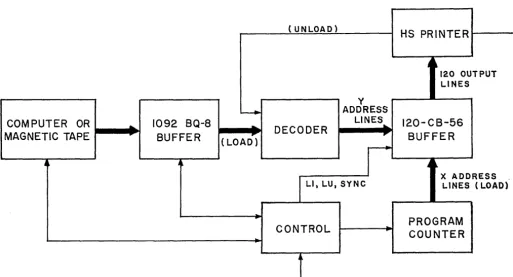
N MANY RESPECTS, ferromagnetic cores are ideal for storage in line printer systems. They permit simplicity of design, economy of components, high speed, and very high reliability. An example is pro-vided by a magnetic core "corner turner buffer" which has been produced for several companies currently man-ufacturing high-speed line printers. A corner turner buffer, as applied to magnetic core storage memories,means a high-speed memory system which will take in data serially from a computer and put out data in parallel to a line printer, for simultaneous printing of a whole line of characters; information comes into the buffer one character at a time and is put out by the buffer as one full line at a time.
This buffer is used in conjunction with a high-speed line printer of the UNIVAC, ANELEX, Shepard, or National Cash Register types. These printers have a configuration of 120 or more print wheels containing 56 or more alphanumeric characters and print symbols. The magnetic memory of the buffer represents an image of the wheels of the print drum. It contains 56 core rows (Y lines) and 120 columns (X lines). The 6720 storage cores located at the intersections of the rows and columns thus correspond exactly to the 6720 characters on the print drum. Selection of a given core during the WRITE cycle results in printing of the corresponding character during the READ CYCLE.
Four inputs are required for the random selection of anyone of the 6720 storage cells in the buffer. The Y addresses are initially stored in a block buffer in the form of binary characters. In a succeeding stage these are decoded so each energizes two Y address lines, which select one of 56 Y lines. The X addresses are supplied
12
from a program counter, which energizes two X address lines for the selection of one of 120 X lines.
The coincidence of two currents - one through the X line and one through the Y line - is required to set a selected core from the original ZERO to the ONE state. Since the storage core used has a square hysteresis loop, single currents pulsing the unselected cores on the' selected X and Y lines will do no more than disturb their ZERO states slightly. During unloading, which is done with currents pulsing the cores in the direction opposite to the load, the cores storing a ONE produce a "turnover" signal owing to the change of flux, and the cores storing a ZERO do not.
Characters are loaded into the buffer sequentially, but are unloaded in parallel by simultaneous read-out of an entire character row. The expression "corner turner" buffer is derived from the corner-turning effect of driv-ing the cores in the Y direction while readdriv-ing at right angles to it on 120 individual sense windings -running parallel to the X lines.
Unload commands are given by the printer in syn-chronization with the revolution of its print drum. The sequence in which the buffer Y lines are scanned corre-sponds to the character sequence on the print wheels; therefore, one complete revolution of the print drum results in a scan of all 56 Y lines and clears the buffer. The buffer may be loaded at a rate of up to 50,000 characters per second, and unloaded at a rate of up to 20 micro-seconds per line. Loading is performed during the 20-millisecond interval while the paper is shifted to the next line. The buffer is for use with printers having a printing rate of up to fifteen lines per second.
Therefore a print hammer cycle should occur in about 65 milliseconds. ::.-:_.
The storage section of the buffer consists of one folded matrix whose two identical sections have the 56
Y lines (rows) in common but contain two different sets of 60 X lines (columns) each. These lines are driven by means of the "end fire" system which requires that two switches, one at either end of the driven line, be activated simultaneously. The advantage of this method is that (M
+
N) drivers can select (MX
N)lines. The two types of switches used are a digit driver and a transistor switch. The digit driver has one side tied to ground, but is capable of a 100
%
duty cycle. The transistor switch is highly versatile in that it can be connected between a variety of power sources and loads, but it has a more limited duty cycle.The driving scheme of the buffer is economical, in that it requires a total of only 39 drivers for driving 176 lines in the load or the unload direction. For driving the 120 X lines, for instance, eight lines fan out from each of 15 digit drivers, each of them connected to one of eight different transistor switches. In this manner, energizing one of 15 digit drivers and one of eight transistor switches results in the selection of one of 120
lines. The 56 Y lines are driven similarly by eight digit drivers and seven transistor switches. The 39th driver is for the Z plan winding which substitutes for the X
lines during unloading by providing the required co-incident half current in the unload direction.
Bi-directional driving with only one set of drivers is achieved by means of a wiring scheme which loops each
Y line through the matrix twice so that current flows in the load direction through one row of cores and in the unload direction through the other.
Discrimination of the two lines is accomplished by means of an address shifter consisting of an array of
~
COMPUTER OR
...
1092 BQ-8.
MAGNETIC TAPE BUFFER r(LOAD)
~ 4~
level gates wired to enable either one in a set of two transistor switches to accept current from a digit driver. The gates are enabled by the flip flops controlling the mode of operation for the equipment. This makes it possible to drive a given core row in either the loading or the unloading direction by selecting two different
Y address lines from identical inputs. The current flow-ing through the other loop of the same Y line in the unwanted direction can, in each case, be disregarded; during loading it is opposed and cancelled by the current through the X line, and during unloading by that through the Z lines.
The timing and control circuits of the unit are quite simple. Two parallel flip-flops provide the various en-abling levels required by each mode of operation. Two one-shot multivibrators are incorporated, each contain-ing a delay and pulse section. One generates timcontain-ing pulses for enabling the transistor switches. The other generates strobe pulses to sample the turnover signals to the print hammers at their peak amplitude.
Since it is necessary to sense the output from up to
120 storage cells simultaneously, the buffer contains 120
individual read amplifiers, one for each column of the matrix. These units are mounted five to a printed cir-cuit card.
The power supply for the unit is operated from 115 volts, 60 cycles per second and provides regulated out-puts of
+
14 and+
5 volts in addition to a number of other unregulated ones. A transistorized negative cur-rent stabilizer is furnished to regulate the Y current during the read-out operation.The equipment is entirely transistorized. All elec-tronic circuits are mounted on printed circuit boards which are easily accessible for probing and testing. Feed-throughs and pin jacks are provided for conveni-ent testing of the unit's X, Y, and Z drives.
( UNLOAD)
HS PRINTER
~ ~
120 OUTPUT LINES
Y
ADDRESS
DECODER
LINES ... 120-CB-56
,.
BUFFER
A
X ADDRESS
LI, LU, SYNC LINES (LOAD)
CONTROL PROGRAM COUNTER
[image:13.602.48.561.445.722.2],
Figure 2 Block diagram - high speed line printer system
THE APPLICATION OF DIGITAL CONTROL
SYSTEMS IN THE PROCESS INDUSTRIES
M. Phister, Jr.
Head, Industrial Control Systems Section The Ramo-Wooldridge Corp.
Los Angeles, Calif.
(based on a paper given at the 8th National Conference on Standards, San Francisco, November, 1957)
The Basic Problems in Controlling a Process Obtaining the best profit possible from his investment in the plant is, of course, the manufacturer's central ob-jective in running a chemical plant or a steel mill or a petroleum refinery.
A very large number of complicated strategic and ac-counting problems enter into determining the best way to make a profit; but the profit problem is somewhat simplified at the plant operating level. Specifically, in a particular operating unit in a plant in a process in-dustry, the various raw materials and products are as-signed values, and certain costs are allocated to the running of the process; then it is the operator's objective to obtain the maximum return, based on these values and costs. At the same time, he wishes to maintain some minimum level of product quality. Putting it another way, the operator is required to make a standard product at highest possible profit.
Plant operators have available many instruments and much laboratory apparatus and equipment to help them control the process in such a way as to solve the prob-lem. In order to see precisely how they exercise control and why their problem is difficult, let us examine a typi-cal control system in a little more detail.
The operators are concerned primarily with three dif-ferent kinds of variables. They must watch the product variables - that is, the variables which determine the character of the product, and in terms of which the product standards are specified. These variables include, for example, the chemical composition or color or weight or other dimensions of a product. Next, there are the
intermediate variables over which the operators can
exer-cise direct control. For example, an operator can directly control the flow of a liquid in a pipe by opening or closing a valve. Notice that operators control the prod-uct variables only indirectly by exercising control over the intermediate variables. There is no knob labeled "color" which an operator can use to adjust the color of his final product, but he may be able to affect the color by making an adjustment in a flow here and a temperature there, for example. Finally, there are the
independent variables over which the operator has no
control. These are the ambient conditions - outside temperature and direction and force of wind, for exam-ple - and, in general, the chemical, physical, and other properties of the materials being fed into the process. For example, in a steel mill, the characteristics of the iron ore are independent variables dictated by nature. These characteristics may vary over a fairly narrow range, but nevertheless their variation is an important factor in the operation of the process.
With these three kinds of variables in mind, it is
pos-14
sible to state the operator's and control system's function a little more definitely. The purpose of a control sys-tem is maintenance of a standard product quality and operation of the unit at its highest profit, by making adjustments in the intermediate variables (over which the operator can exercise some control) to compensate for variations in the independent variables. Note that if there were no independent variables - that is, if
nothing in the process, its environment, or in the mate-rials used in the process ever varied - it would be necessary only to adjust the intermediate variables at some fixed setting which corresponds to best operation of the unit, and thereafter and forever the unit would operate without the need for further attention. Un-fortunately (or perhaps Un-fortunately for those of us in-terested in automatic control systems), the plants hav-ing a great many important independent variables far outnumber those which can be operated so uniformly. The operator, working carefully with his instruments and other apparatus, at the present time does an excel-lent job of handling this very difficult control problem. However, in some processes the relationships between control variables are very complicated, and the way they should be manipulated in order to operate the plant in the best possible way is not at all obvious. The result is that a plant may be run in a somewhat erratic way, so that the quality of the product and the profit derived from operating the unit vary considerably from minute to minute and hour to hour. Because many of these processes involve profits of thousands of dollars every day, the elimination of these variations can be a very profitable objective, even if the variations are slight. It
is here that the digital control system can be of use. Functions of a Digital Control System A digital control system can be thought of as an op-erator who follows a very complicated set of instruc-tions which direct him to make many arithmetic calcu-lations, to "read" many process instruments, and to ad-just many intermediate variables, automatically, continu-ously, and without error prejudice. A digital control system has facilities which make it possible to connect the temperature, flow, level, composition, and other process measuring instruments directly to a digital com-puter, so that the computer can determine which adjust-ments should be made in the process to operate it in the most efficient manner while holding product quality or standards within specified limits. The computer is also connected directly to the equipment which adjusts the intermediate variables, so the computer can take action directly on the process when it has determined that some modification is necessary or desirable. A typewriter in-put-output system is also provided with a digital control
system to enable it to communicate with a human op-erator.
It is important to note that, in addition to "tuning up" or "trimming" the process in order to keep it at its best possible operation, the computer may have a num-ber of other useful functions. It can be used to inter-pret instrument readings and to calibrate instruments periodically. It can be used during process start-up or shutdown to insure that operations are carried out in a proper (predetermined) sequence. It can be con-tinually and tirelessly on the lookout for instrument or process failures or other troubles, and it can collect and interpret process data for later study by engineering and research staffs.
Advantages
It seems very likely that control systems of this kind will become as widely used in the process industries in the next five years as business data processors have been in the past five years. If this is so, it will be true for only one reason: such control systems pay for them-selves by virtue of the improvements they make possible in process operation. The improvement, in general, will come in one or more of these specific areas: from increased production through better control; from im-proved quality; or from reduced operating costs. Gen-erally, the improvement will arise as a result of some optimum balance between gains in these three areas. To make it possible to see a little more precisely where
these gains may come from, let us examine them in greater detail.
Increased production may arise from a number of different improvements attributable to a digital control system. The continual "tuning up" of the process may mean that the yield of the product from a raw material is higher than before. Better control may make possible reduced maintenance so that an operating unit may be "on stream" for a higher percentage of the time. (For example, the digital control system provides the possi-bility of eliminating process upsets which would other-wise require that the operating unit, whatever it might be, be closed down for repairs.) Better control may result in fewer periods of off-specification production, when materials are wasted or must be rerun. A digital control system may make possible a quicker start-up and shutdown time which will result in increased total production.
Better quality control is a natural benefit obtained from a digital control system, and one which, in some instances may be the most important feature of all. Through the better use of current information about the process and the products it makes - information derived from data continually being read from process instruments - a digital control system may make pos-sible a substantial reduction in product variability. Al-ternatively, or perhaps at the same time, it will be pos-sible to improve the average quality if that is desirable for competitive or other reasons. The continual tighten-ing-up of product standards and specifications leads to an ever-increasing demand by industry for methods which will make possible a better control over product quality, and the digital control system is in its element here.
Finally, the employment of a digital control system makes possible a reduction in operating costs. There will be less waste through the better use of raw
mate-COMPUTERS and AUTOMATION for August, 1958
rials, catalysts, etc. Better use will be made of the energy supplied to the process, whether it be electrical energy or chemical energy in the form of burning gas, coal, or fuel oil. The trouble-shooting attributes of the digital control system will reduce maintenance costs. Finally, extensive applications of these control systems may make possible a reduction in manpower. It should be noted, however, that manpower is already used very effectively in the process industries, and that such a reduction is not likely to be as important as the applica-tions of computers to business data processing, for ex-ample. A process control computer will be employed to make decisions so complex that they are not made now at all, and we are therefore not contemplating the use of a computer to replace a man or a number of men currently making the same decision. Instead, the present operator or operators will be better able to make use of their time and of their know ledge of the process. They will be freed of the routine and tedious operations they must now perform, and they will be able to devote their time and energy to making still further improvements.
One aspect of the usefulness of digital control systems, which is particularly appropriate and very important, has not yet been mentioned. A computer control system can be extremely flexible, so that simply by changing a set of instructions stored in the computer memory it is possible to change slightly, or even completely, the con-trol actions taken by the computer. This means that it will be possible to improve or to relax product quality in order to meet competition or to handle emergency situations. It will be possible to take into consideration changes in operating costs or in raw material costs or in product prices and make sure that such changes have the proper influence on operating conditions. It will also be possible to modify process operation in order to take into account new technical information about the process and to use this technical information most effectively.
So far, I have discussed only the application of a digital control system to an existing plant, and the eco-nomic savings which can be effected by such an applica-tion. In addition, there will be important implications in the application of such systems to new processes and to the construction of new plants. Generally speaking, the improved control of processes through such control systems will permit substantial reductions in plant in-vestment. The reduced investment will come about for several reasons. The prospect of tighter control will mean that some of the sizing safety factors which are put into new plants can be reduced, so that, for given plant output, smaller reactors, furnaces, pipes, heat ex-changers, conveyors, etc., may be employed. Further-more, the very large and expensive storage capacity which must sometimes be provided to help smooth out variations in product quality may be vastly reduced.
The most interesting implication of all, however, is the prospect of the use of digital control computers in the control of presently uncontrollable processes. Now-adays products are made in plants which could not pos-sibly have been operated twenty years ago without mod-ern instrumentation. Twenty years from now there will be processes run by digital control systems which can-not be run today using the conventional methods. In this regard, such systems may have a tremendous impact on process technology.
MEETING OF
ASSOCIATION FOR COMPUTING MACHINERY
URBANA, ILL., JUNE
11
to
13, 1958
PROGRAM, TITLES and ABSTRACTS
Part
2(Continued from the July issue)
23. AN ALGORITHM FOR THE DETERMINATION OF THE POLYNOMIAL OF BEST MINIMAX APPROXIMATION TO A FUNCTION DEFINED ON
A FINITE POINT SET PHILIP C. CURTIS,
JR.
University of California and the Ramo- Wooldridge Corp., Los Angeles, California, AND
WERNER L. FRANK
The Ramo- Wooldridge Corporation, Los Angeles, Calif·
Let f (x) be a function defined on a finite point set S of more than n
+
2 points. Let p (x) be the polynomial of degree n of best minimax approximation to f (x) on S. The algorithm describes a process of constructing a finite sequence To, ... , T m of sub-sets of S each having n+
2 points such that the polynomial of best minimax ap-proximation to f (x) on T m is identical to p (x). Thepro-cedure is applicable to more general families of approximat-ing functions and to arbitrary bounded closed point set S.
24. PANEL DISCUSSION ON MATRIX COMPUTATIONS AND PROGRAMMING
METHODS
This may best be described as an hour and forty minutes of free consultation on matrix computations and program-ming methods for the benefit of the audience. There are no prepared talks. The audience is invited to come pre-pared with questions for the panel on machine methods for matrix inversion, solution of large linear systems, ma-trix eigenvalue and eigenvector problems, and linear and nonlinear programming problems. The answers should be better if questions are given to the Chairman in advance. The answers should be still better if questions are mailed by June 1 to the Chairman at the Department of Mathe-matics, Stanford University, Stanford, California.
25. BINARY ARITHMETIC FOR DISCRETELY VARIABLE WORD LENGTH IN A
SERIAL COMPUTER
PAOLO ERCOLI AND ROBERTO VACCA
Istituto Nazionale per le Applicazioni del Calcolo Rome, Italy
An arithmetic unit dealing with words of discretely variable length can be advantageous in a serial computer: permitting the choice of ranges of accuracy and speed according to the stability of solutions.
The FINAC computer was originally equipped with 20 or 40 bits words. The necessity of greater accuracy arose, especially in order to solve large and particularly ill-con-ditioned systems of algebraic linear equations.
Two different possibilities are discussed: that of in-creasing the speed of multiplication and of performing
16
by program double-precision arithmetic with the already existing word length of 40 bits, and that of installin~ an arithmetic unit operating also on 80 bits words. The latter solution was chosen and the new facility has been installed and is in full operation.
The report presents the results of the statistical con-siderations on which the decision was based and describes the logical features of the unit and the arithmetic rules according to which round-off is performed in multipli-cation.
26. ON MULTIPLICATION AND DIVISION WITH THE FEWEST POSSIBLE ADDITIONS AND
SUBTRACTIONS GEORGE W. REITWIESNER
Ballistic Research Laboratories, Aberdeen Proving Ground, Maryland
Multiplication/division is performed in digital calcula-tions by iterated addition and/or subtraction of the mul-tiplicand/divisor from an intermediate product/dividend, where the additions and/or subtractions are interspersed with shifting to accommodate increasing or decreasing as-sociated powers of the number base with the applicable digits of the multiplier/quotient. This paper exhibits a set of examinations whose results yield individual mul-tiplier/ quotient digits such that the number of individual additions and subtractions of the multiplicand/divisor dur-ing the multiplication/division is irreducible. Argument
is conducted for base-complement representation for
arbi-trary number base b; it is extended to accommodate the representations of magnitude with appended sign and of complement with respect to b -1; clearly it specializes to
b= 10 and to b=2.
27. AN ANALYSIS OF CARRY TRANSMISSION IN COMPUTER ADDITION
S. G. CAMPBELL
IBM, Poughkeepsie, New York, AND
G. H. ROSSER, JR.
Duke University, Durham, North Carolina
Since all arithmetic operations reduce ultimately to ad-dition, a basic consideration in designing a high speed computing automaton is fast addition; and a basic diffi-culty in achieving fast addition is the carry problem. This paper determines the effect of various methods of increas-ing binary addition speed by "carry sensincreas-ing," designed to increase the speed of carry propagation. By T: Cj ~ Cj we mean a carry transformation T which transforms a carry of j places into a carry of i places. By determining the various carry transformations and expressing them in closed form, we can accomplish several objectives: