Worcester Polytechnic Institute
Digital WPI
Doctoral Dissertations (All Dissertations, All Years) Electronic Theses and Dissertations
2012-07-31
Secure and Reliable Data Outsourcing in Cloud
Computing
Ning Cao
Worcester Polytechnic Institute
Follow this and additional works at:https://digitalcommons.wpi.edu/etd-dissertations
This dissertation is brought to you for free and open access byDigital WPI. It has been accepted for inclusion in Doctoral Dissertations (All Dissertations, All Years) by an authorized administrator of Digital WPI. For more information, please [email protected].
Repository Citation
Cao, N. (2012).Secure and Reliable Data Outsourcing in Cloud Computing. Retrieved from https://digitalcommons.wpi.edu/etd-dissertations/333
Secure and Reliable Data Outsourcing in Cloud Computing
by Ning Cao
A Dissertation Submitted to the Faculty
of the
WORCESTER POLYTECHNIC INSTITUTE In partial fulfillment of the requirements for the
Degree of Doctor of Philosophy in
Electrical and Computer Engineering
July 2012
Approved:
Professor Wenjing Lou Professor Xinming Huang
ECE Department ECE Department
Dissertation Advisor Dissertation Committee
Professor Berk Sunar Professor Joshua D. Guttman
Abstract
The many advantages of cloud computing are increasingly attracting individuals and organizations to outsource their data from local to remote cloud servers. In addition to cloud infrastructure and platform providers, such as Amazon, Google, and Microsoft, more and more cloud application providers are emerging which are dedicated to offering more accessible and user friendly data storage services to cloud customers. It is a clear trend that cloud data outsourcing is becoming a pervasive service. Along with the widespread enthusiasm on cloud computing, however, con-cerns on data security with cloud data storage are arising in terms of reliability and privacy which raise as the primary obstacles to the adoption of the cloud. To address these challenging issues, this dissertation explores the problem of secure and reliable data outsourcing in cloud computing. We focus on deploying the most fundamental data services, e.g., data management and data utilization, while considering relia-bility and privacy assurance.
The first part of this dissertation discusses secure and reliable cloud data man-agement to guarantee the data correctness and availability, given the difficulty that data are no longer locally possessed by data owners. We design a secure cloud storage service which addresses the reliability issue with near-optimal overall per-formance. By allowing a third party to perform the public integrity verification, data owners are significantly released from the onerous work of periodically checking data integrity. To completely free the data owner from the burden of being online after data outsourcing, we propose an exact repair solution so that no metadata needs to be generated on the fly for the repaired data.
The second part presents our privacy-preserving data utilization solutions sup-porting two categories of semantics – keyword search and graph query. For pro-tecting data privacy, sensitive data has to be encrypted before outsourcing, which obsoletes traditional data utilization based on plaintext keyword search. We de-fine and solve the challenging problem of privacy-preserving multi-keyword ranked search over encrypted data in cloud computing. We establish a set of strict privacy requirements for such a secure cloud data utilization system to become a reality. We first propose a basic idea for keyword search based on secure inner product computation, and then give two improved schemes to achieve various stringent pri-vacy requirements in two different threat models. We also investigate some further enhancements of our ranked search mechanism, including supporting more search semantics, i.e., TF × IDF, and dynamic data operations.
As a general data structure to describe the relation between entities, the graph has been increasingly used to model complicated structures and schemaless data, such as the personal social network, the relational database, XML documents and chemical compounds. In the case that these data contains sensitive information and need to be encrypted before outsourcing to the cloud, it is a very challenging task to effectively utilize such graph-structured data after encryption. We define and solve the problem of privacy-preserving query over encrypted graph-structured data in cloud computing. By utilizing the principle of filtering-and-verification, we pre-build a feature-based index to provide feature-related information about each encrypted data graph, and then choose the efficient inner product as the pruning tool to carry out the filtering procedure.
Acknowledgements
Without the generous support of many people this dissertation would not have been possible. First, I want to thank my advisor, Dr. Wenjing Lou, who guided me into the research area of cloud computing and security, discussed about my ideas, challenged me with sharping questions, gave suggestions about the structure of the paper and did proofread with great patience. I appreciate the insightful suggestions Dr. Lou has given to me and the strong belief she has put in me. Her hard working and passion for research also has set an example that I would like to follow.
I want to thank my thesis committee, Dr. Xinming Huang, Dr. Berk Sunar and Dr. Joshua D. Guttman, for serving on my dissertation committee, and for their good questions and insightful comments on my work. I also want to thank Dr. Kui Ren for discussing with me on the technique details, helping me think through the difficult problems and kind support to my job application.
My sincere gratitude further goes to current and former fellow graduate students in the Cyber Security lab, including Kai Zeng, Shucheng Yu, Zhenyu Yang, Ming Li, Hanfei Zhao, Qiben Yan, Yao Zheng, Ning Zhang, Wenhai Sun, Bing Wang, and Tingting Jiang for their friendship and support. Besides, I would like to extend my thanks to my fellow collaborators, Cong Wang and Qian Wang, for their invaluable discussions and the kind friendship. I also wish to take this opportunity to say thank you to my fellow friends at WPI: Sisi Luo, Qi Ao, Xiaodong Huang, Shiquan He, Xiaolin Hu, Ya Zhang, Yuqin Yao and many others, for their accompany during my study here.
Finally, I want to thank my family. I am in debt to my parents, Fengjin Cao and Enying Liang, who always encouraged me to pursue what I wanted. I want to thank my younger sister, Bo Cao, giving me courage when I face difficulties. I am very
also want to thank my dearest wife, Ruijun Fu. To accompany me studying abroad, Ruijun sacrificed many chances of studying and working. Without her support, encouragement and love, I cannot imagine how I can go through this four-year study. She is the best gift I have ever received in my life. Special thanks also go to my parents in-law, Genfa Fu and Yali Yang. Thanks for their support and love in Ruijun and me. This thesis is dedicated to all my dearest family members.
Contents
1 Introduction 1
1.1 Motivation . . . 1
1.2 Contributions . . . 4
1.3 Roadmap . . . 6
2 Secure and Reliable Cloud Storage 8 2.1 Introduction . . . 8
2.2 Problem Formulation . . . 11
2.2.1 The System Model . . . 11
2.2.2 The Threat Model . . . 12
2.2.3 Design Goals . . . 12
2.2.4 Notations . . . 13
2.2.5 Preliminary on LT Codes . . . 14
2.3 LTCS: Design Rationale . . . 14
2.3.1 Enabling Reliability and Availability . . . 14
2.3.2 Reducing Maintenance Cost . . . 18
2.3.3 Offline Data Owner . . . 19
2.4 LTCS: The Proposed Secure and Reliable Cloud Storage Service . . . 20
2.4.2 Data Outsourcing . . . 20
2.4.3 Data Retrieval . . . 22
2.4.4 Integrity Check . . . 23
2.4.5 Data Repair . . . 25
2.5 Security Analysis . . . 27
2.5.1 Protection of Data Confidentiality and Integrity . . . 27
2.5.2 Verification Correctness in Integrity Check . . . 28
2.6 Performance Analysis . . . 28 2.6.1 Outsourcing . . . 29 2.6.2 Data Retrieval . . . 31 2.6.3 Integrity Check . . . 33 2.6.4 Data Repair . . . 33 2.7 Related work . . . 34
2.7.1 Network Coding-based Distributed Storage . . . 34
2.7.2 Remote Data Integrity Check . . . 35
2.8 Conclusions . . . 37
3 Privacy-Preserving Multi-Keyword Ranked Search 39 3.1 Introduction . . . 39 3.2 Problem Formulation . . . 43 3.2.1 System Model . . . 43 3.2.2 Threat Model . . . 44 3.2.3 Design Goals . . . 45 3.2.4 Notations . . . 45
3.2.5 Preliminary on Coordinate Matching . . . 46
3.3 Framework and Privacy Requirements for MRSE . . . 47
3.3.2 Privacy Requirements for MRSE . . . 48
3.4 Privacy-Preserving and Efficient MRSE . . . 50
3.4.1 Secure Inner Product Computation . . . 50
3.4.2 Privacy-Preserving Scheme in Known Ciphertext Model . . . . 53
3.4.3 Privacy-Preserving Scheme in Known Background Model . . . 58
3.5 Discussion . . . 61
3.5.1 Supporting More Search Semantics . . . 61
3.5.2 Supporting Data Dynamics . . . 64
3.6 Performance Analysis . . . 66
3.6.1 Precision and Privacy . . . 66
3.6.2 Efficiency . . . 68
3.7 Related Work . . . 73
3.7.1 Single Keyword Searchable Encryption . . . 73
3.7.2 Boolean Keyword Searchable Encryption . . . 74
3.7.3 Secure Top-K Retrieval from Database Community . . . 75
3.7.4 Other Related Techniques . . . 76
3.8 Conclusion . . . 77
4 Privacy-Preserving Query over Encrypted Graph-Structured Data 78 4.1 Introduction . . . 78
4.2 Problem Formulation . . . 82
4.2.1 The System Model . . . 82
4.2.2 The Known Background Threat Model . . . 83
4.2.3 Design Goals . . . 83
4.2.4 Notations . . . 84
4.3.2 Secure Euclidean Distance Computation . . . 87
4.4 PPGQ: The Framework and Privacy . . . 88
4.4.1 The Framework . . . 88
4.4.2 Choosing Frequent Features . . . 89
4.4.3 Privacy Requirements . . . 90
4.5 PPGQ: The Proposed Scheme and Analysis . . . 93
4.5.1 Privacy Concerns on Secure Inner Product Computation . . . 94
4.5.2 The Proposed Privacy-Preserving Graph Query Scheme . . . . 95
4.5.3 The Analysis . . . 98
4.6 Experimental Evaluations . . . 101
4.6.1 False Positive and Index Construction . . . 102
4.6.2 Trapdoor Generation and Query . . . 104
4.7 Related Work . . . 107
4.7.1 Graph Containment Query . . . 107
4.7.2 Keyword-based Searchable Encryption . . . 107
4.8 Conclusion . . . 108
5 Conclusion and Future Work 110 5.1 Conclusion . . . 110
List of Figures
2.1 Distributed storage systems based on replication. . . 15
2.2 Distributed storage systems based on optimal erasure codes. . . 16
2.3 Distributed storage systems based on network coding. . . 17
2.4 Data availabity after functional repair as in LTNC. . . 18
2.5 LT codes-based cloud storage service (LTCS). . . 24
2.6 Outsourcing performance with differentε . . . 30
2.7 Encoding and decoding time for different size of file . . . 32
2.8 Communication cost of repair . . . 34
3.1 Architecture of the search over encrypted cloud data . . . 43
3.2 Distribution of final similarity score . . . 57
3.3 Tradeoff between precision and rank privacy . . . 67
3.4 Time cost of building index. . . 69
3.5 Time cost of generating trapdoor. . . 71
3.6 Time cost of query. . . 72
4.1 Architecture of graph query over encrypted cloud data . . . 82
4.2 Distribution of Feature Support . . . 91
4.3 Build subindex for each data graph . . . 96
4.5 Relation between minimum support and other parameters. . . 102
4.6 Index construction cost. . . 103
4.7 Trapdoor size in different dataset . . . 104
4.8 Trapdoor generation time. . . 105
4.9 Query execution time on server. . . 106
List of Tables
2.1 Performance complexity analysis of storage services . . . 26
3.1 K3 appears in every document . . . 59
3.2 K3 does not appear in either document . . . 60
3.3 Size of subindex/trapdoor . . . 73
Chapter 1
Introduction
1.1
Motivation
Cloud computing is the long dreamed vision of computing as a utility, where cloud customers can remotely store their data into the cloud so as to enjoy the high qual-ity networks, servers, applications and services from a shared pool of configurable computing resources [103]. The advantages of cloud computing include on-demand self-service, ubiquitous network access, location independent resource pooling, rapid resource elasticity, usage-based pricing, transference of risk, etc. [11] Its great flexi-bility and economic savings are motivating both individuals and enterprises to out-source their local complex data management system into the cloud.
Along with the widespread enthusiasm on cloud computing, however, concerns on data security with cloud storage are arising due to unreliability of the service and malicious attacks from hackers. Recently more and more events on cloud ser-vice outage or server corruption with major cloud infrastructure providers are re-ported [2–4, 117]. Data breaches of noteworthy cloud services also appear from time to time [84, 99, 100]. Besides, the cloud service providers may also voluntarily
exam-ine customers’ data for various motivations. Therefore, we argue that the cloud is intrinsically neither secure nor reliable from the view point of the cloud customers. Without providing strong security, privacy and reliability guarantee, it would be hard to expect cloud customers to turn over control of their data to cloud servers solely based on economic savings and service flexibility. To address these concerns and thus motivate the wide adoption of data outsourcing in cloud, in this thesis we will explore the problem of secure and reliable data outsourcing. We aim at deploying the most fundamental data services including data management and data utilization, with built-in reliability and privacy assurance as well as high level service performance, usability, and scalability.
Firstly, in addition to major cloud infrastructure providers, such as Amazon, Google, and Microsoft, more and more third-party cloud data service providers are emerging which are dedicated to offering more accessible and user friendly storage services to cloud customers [11]. Examples include Dropbox [1] which already has millions of users. It is a clear trend that cloud storage is becoming a pervasive service. With the increasing adoption of cloud computing for data storage, assur-ing data service reliability, in terms of data correctness and availability, has been outstanding. While existing solutions address the reliability issue by adding data redundancy to multiple servers, the problem becomes challenging in the “pay-as-you-use” cloud paradigm where we always want to efficiently resolve it for both corruption detection and data repair. Prior distributed storage systems based on erasure codes or replication techniques have either high decoding computational cost for data users, or too much burden of data storage and repair cost for data owners. Recently Chen et al. [37] proposed a network coding-based storage system which provides a decent solution for efficient data repair. This scheme, based on previous work [43, 44, 78, 121], reduces the communication cost for data repair to
the information theoretic minimum. This is achieved by recoding encoded packets in the healthy servers during the repair procedure. However, as network coding uti-lizes Gaussian elimination for decoding, the data retrieval in terms of computation cost is more expensive than erasure codes-based systems. Hence, new secure and reliable storage solutions with the efficiency consideration of both data repair and data retrieval are entailed in the cloud computing.
Secondly, to protect data privacy and combat unsolicited accesses in the cloud and beyond, sensitive data, e.g., emails, personal health records, tax documents, financial transactions, etc., may have to be encrypted by data owners before out-sourcing to the commercial public cloud [58]; this, however, obsoletes the traditional data utilization service based on plaintext keyword search. The trivial solution of downloading all the data and decrypting locally is clearly impractical, due to the huge amount of bandwidth cost in cloud systems. Moreover, aside from eliminating the local storage management, storing data into the cloud serves no purpose unless they can be easily searched and utilized. Thus, exploring privacy-preserving and effective search service over encrypted cloud data is of paramount importance. Con-sidering the potentially large number of on-demand data users and huge amount of outsourced data documents in the cloud, this problem is particularly challenging as it is extremely difficult to meet also the requirements of performance, system usabil-ity and scalabilusabil-ity. Related works on searchable encryption focus on single keyword search or Boolean keyword search, and rarely sort the search results. How to design an efficient encrypted data search mechanism that supports multi-keyword ranking semantics without privacy breaches still remains a challenging open problem.
Thirdly, we further explore the data search within another category of search semantics in cloud computing. As a general data structure to describe the relation between entities, the graph has been increasingly used to model complicated
struc-tures and schemaless data, such as the personal social network (the social graph), the relational database, XML documents and chemical compounds studied by research labs [38, 91, 92, 128, 132, 133]. Images in the personal album can also be modeled as the attributed relational graph (ARG) [20]. For the protection of users’ privacy, these sensitive data also have to be encrypted before outsourcing to the cloud. More-over, some data are supposed to be shared among trusted partners. For example, the lab director and members are given the authorization to access the entire lab data. Authorized users are usually planning to retrieve some portion of data they are interested rather than the entire dataset, mostly because of the “pay-for-use” billing rule in the cloud computing paradigm. Considering the large amount of data centralized in the cloud datacenter, the key challenge here is to realize an efficient encrypted query design which supports graph semantics without privacy breaches.
1.2
Contributions
In this dissertation, the fundamental problem of secure and reliable data outsourcing in Cloud Computing is tackled. The detailed and challenging research tasks we solved are outlined below:
Secure and Reliable Cloud Storage In Chapter 2, we address the problem of
secure and reliable cloud storage with efficiency consideration of both data repair and data retrieval. By utilizing a near-optimal erasure codes, specifically LT codes, our designed storage service has faster decoding during data retrieval than existing solutions. To minimize the data repair complexity, we employ the exact repair method to efficiently recover the exact form of any corrupted data. Such a design also reduces the data owner’s cost during data repair since no verification tag needs to be generated (old verification tags can be recovered as same as data recovery). Our
proposed cloud storage service provides a better overall efficiency of data retrieval and repair than existing counterparts. It also completely releases the data owner from the burden of being online by enabling public integrity check and exact repair. Portions of the work studied in this chapter were presented as extended abstract at the 31th IEEE Conference on Computer Communications (INFOCOM’12) [32].
Privacy-Preserving Multi-Keyword Ranked Search over Encrypted Cloud Data In Chapter 3, we address the problem of privacy-preserving multi-keyword ranked search over encrypted data in cloud computing. We establish a set of strict privacy requirements for such a secure cloud data utilization system. Among various multi-keyword semantics, we choose the efficient similarity measure of “coordinate matching”, i.e., as many matches as possible, to capture the relevance of data doc-uments to the search query. We further use “inner product similarity” to quanti-tatively evaluate such similarity measure. We first propose a basic idea for ranked keyword search based on secure inner product computation, and then give two im-proved schemes to achieve various stringent privacy requirements in two different threat models. We also investigate some further enhancements of our ranked search mechanism, including supporting more search semantics, i.e., TF × IDF, and dy-namic data operations. Portions of the work studied in this chapter were presented as extended abstract at the 30th IEEE Conference on Computer Communications (INFOCOM’11) [30].
Privacy-Preserving Query over Encrypted Graph-Structured Cloud Data
In Chapter 4, we address the problem of privacy-preserving query over encrypted graph-structured data in cloud computing. Our work utilizes the principle of “filtering-and-verification”. We pre-build a feature-based index to provide feature-related information about each encrypted data graph, and then choose the efficient in-ner product as the pruning tool to carry out the filtering procedure. To meet the
challenge of supporting graph query without privacy breaches, we improve the se-cure inner product computation to achieve various privacy requirements under the known-background threat model. Portions of the work studied in this chapter was presented as extended abstract at the 31th International Conference on Distributed Computing Systems (ICDCS’11) [31].
1.3
Roadmap
The organization of this dissertation is as follows.
Chapter 2 presents our solution for secure and reliable cloud storage. Section 2.1 describes the problem as well as the main idea of our solution. In Section 2.2, we formulate the problem by introducing the system model, the threat model, our design goals, and the preliminary. Section 2.3 gives our design rationale, followed by section 2.4, which describes the proposed scheme. Section 2.5 and 2.6 discuss security analysis and performance analysis, respectively. We discuss related work on both network coding-based distributed storage and remote data integrity check in Section 2.7, and conclude the chapter in Section 2.8.
Chapter 3 presents our proposed privacy-preserving multi-keyword ranked search over encrypted cloud data. Section 3.1 describes the problem as well as the main idea of our solution. In Section 3.2, we introduce the system model, the threat model, our design goals, and the preliminary. Section 3.3 describes the framework and privacy requirements, followed by section 3.4, which describes the proposed schemes. Section 3.5 discusses supporting more search semantics and dynamic operation. Section 3.6 presents simulation results. We discuss related work on both single and Boolean keyword searchable encryption in Section 3.7, and conclude the chapter in Section 3.8.
Chapter 4 presents our proposed privacy-preserving query over encrypted graph-structured cloud data. Section 4.1 describes the problem as well as the main idea of our solution. In Section 4.2, we introduce the system model, the threat model and our design goals. Section 4.3 gives preliminaries, and section 4.4 describes the framework and privacy requirements, followed by section 4.5, which gives our proposed scheme. Section 4.6 presents evaluation results. We discuss related work on both keyword searchable encryption and graph containment query in Section 4.7, and conclude the chapter in Section 4.8.
Chapter 5 concludes this dissertation and presents several directions for future work.
Chapter 2
Secure and Reliable Cloud Storage
2.1
Introduction
The many advantages of cloud computing are increasingly attracting individuals and organizations to move their data from local to remote cloud servers [58]. In addition to major cloud infrastructure providers [11], such as Amazon, Google, and Microsoft, more and more third-party cloud data service providers are emerging which are dedicated to offering more accessible and user friendly storage services to cloud customers. It is a clear trend that cloud storage is becoming a pervasive ser-vice. Along with the widespread enthusiasm on cloud computing, however, concerns on data security with cloud storage are arising due to unreliability of the service. For example, recently more and more events on cloud service outage or server cor-ruption with major cloud infrastructure providers are reported [3, 4], be it caused by Byzantine failures and/or malicious attacks. Such a reality demands for reliable data storage to tolerate certain outage/corruption. In particular, the cloud storage service should offer cloud customers with capabilities of: 1) timely detection of any server (and hence data) corruption event, 2) correct retrieval of data even if a limited
number of servers are corrupted, and 3) repair of corrupted data from uncorrupted data. Although existing techniques have provided solutions for them individually, the main challenge for cloud storage service is to simultaneously provide these capa-bilities at minimal cost. This is because in cloud computing both data storage and transmission are charged in the “pay-as-you-use” manner. Solutions of high cost will discourage user engagement and be of less practical use. Moreover, it is important to set cloud customers free by minimizing the complexity imposed on them in terms of computation/communication cost and burden of being online.
Existing solutions address the reliability issue by adding data redundancy to multiple servers. These techniques can be categorized into replication-based solu-tions and erasure codes-based ones. Data replication is the most straightforward way of adding redundancy. The advantage of replication is its simplicity in data management. Repair of data on corrupted servers is also straightforward by simply copying the entire data from a healthy server. The main drawback of replication is its high storage cost. Moreover, replication-based solutions cannot satisfy the high-throughput requirement in distributed storage service like cloud computing, where a large number of users may access the service concurrently. This is because different users may want to access different pieces of data on a server, which would cause less cache hits but frequent disk I/O requests. [126] provides a detailed analysis on this drawback.
As compared to its replication-based counterparts, erasure codes-based solutions can achieve the required reliability level with much less data redundancy [116]. Dif-ferent from replication-based solutions, erasure codes-based ones are more suitable for distributed storage systems with concurrent user access. This is because every block of data on a server is useful for decoding the original data, which leads to a high cache hit rate of the system. There have been a large number of related works
on erasure codes-based distributed storage systems [60,61,126]. The main drawback of existing optimal erasure codes-based systems, however, is the high communication cost needed for repairing a corrupted storage server. It is commonly believed that the communication cost is equal to the size of the entire original data [43]. For ex-ample, Reed-Solomon codes [79] usually need to reconstruct all the original packets in order to generate a fragment of encoded packets. Taking into consideration the large amount of data outsourced, the entire data reconstruction is expensive which makes this solution less attractive. Similarly, existing distributed storage systems based on near-optimal erasure codes [126] do not have an efficient solution for the data repair problem or pay no attention to it.
Recently Chen et al. [37] proposed a network coding-based storage system which provides a decent solution for efficient data repair. This scheme, based on previous work [43, 44, 78, 121], reduces the communication cost for data repair to the infor-mation theoretic minimum. This is achieved by recoding encoded packets in the healthy servers during the repair procedure. However, as network coding utilizes Gaussian elimination for decoding, the data retrieval in terms of computation cost is more expensive than erasure codes-based systems. Moreover, [37] adopts so-called functional repair for data repair, i.e., corrupted data is recovered to a correct form, but not the exact original form. While this is good for reducing data repair cost, it requires the data owner to produce new verification tags, e.g., cryptographic mes-sage authentication code, for newly generated data blocks. As the computational cost of generating verification tags is linear to the number of data blocks, this de-sign will inevitably introduce heavy computation/communication cost on the data owner. Moreover, the data owner has to stay online during data repair.
In this chapter, we explore the problem of secure and reliable storage in the “pay-as-you-use” cloud computing paradigm, and design a cloud storage service with the
efficiency consideration of both data repair and data retrieval. By utilizing a near-optimal erasure codes, specifically LT codes, our designed storage service has faster decoding during data retrieval than existing solutions. To minimize the data repair complexity, we employ the exact repair method to efficiently recover the exact form of any corrupted data. Such a design also reduces the data owner’s cost during data repair since no verification tag needs to be generated (old verification tags can be recovered as data recovery). By enabling public integrity check, our designed LT codes based secure cloud storage service (LTCS) completely releases the data owner from the burden of being online. Our contributions are summarized as follows, 1) We are among the first to explore the problem of secure and reliable cloud storage with the efficiency consideration for both data repair and data retrieval.
2) Our proposed cloud storage service provides a better overall efficiency of data retrieval and repair than existing counterparts. It also greatly reduces cost and burden of being online for the data owner by enabling public integrity check and exact repair.
3) The advantages of our proposed service are validated via both numerical analysis and experimental results.
2.2
Problem Formulation
2.2.1
The System Model
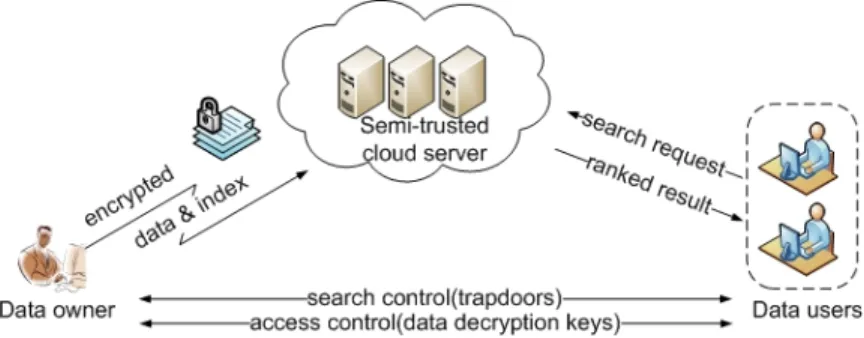
Considering a cloud data storage service which provides both secure data outsourcing service and efficient data retrieval and repair service, including four different entities: the data owner, the data user, the cloud server, and the third party server. The data owner outsources the encoded fragments of the file M to n cloud servers denoted
as storage servers. If the data owner requires to keep the data content confidential, the fileMcan be first encrypted before encoding. Outsourced data are attached by some metadata like verification tags to provide integrity check capability. After the data outsourcing, a data user can select any k storage servers to retrieve encoded segments, and recover the file M, which can be further decrypted in case the file is encrypted. Meanwhile, the third party server periodically checks the integrity of data stored in cloud servers. Failed cloud servers can be repaired with the help of other healthy cloud servers.
2.2.2
The Threat Model
The cloud server is considered as “curious-and-vulnerable”. Specifically, the cloud server is vulnerable to Byzantine failures and external attacks. While Byzantine failures may be made by hardware errors or the cloud maintenance personnel’s misbehaviors, external attacks could be ranging from natural disasters, like fire and earthquake, to adversaries’ malicious hacking. After the adversary gains the control of the cloud server, it may launch the pollution attack or the replay attack which aims to break the linear independence among encoded data, by replacing the data stored in corrupted cloud server with old encoded data. If the cloud server is not corrupted, it correctly follows the designated protocol specification, but it will try to infer and analyze data in its storage and interactions during the protocol execution so as to learn additional information. This represents a threat to the privacy of cloud users’ data stored on the server.
2.2.3
Design Goals
simul-• Availability and Reliability: By accessing anyk-combination of n storage servers, the data user could successfully retrieve encoded data and recover all the original data. The data retrieval service remains functional when up to n−k storage servers are corrupted in one round, and corrupted servers can be repaired from other healthy servers.
• Security: The designed storage service protects the data confidentiality and
periodically checks the integrity of data in cloud servers to prevent data dropout or corruption.
• Offline Data Owner: Data owners can go offline immediately after data
outsourcing, which means they are not required to be involved in tasks such as data integrity check and repair at a later stage.
• Efficiency: Above goals should be achieved with low storage, computation
and communication cost for the data owner, data users and cloud servers.
2.2.4
Notations
• M: the outsourced file, consisting ofm original packets,M= (M1, . . . , Mm).
• Sl : the l-th storage server, 1 ≤l ≤n.
• Cli : the i-th encoded packet stored in thel-th storage server, 1≤i≤α.
• ∆li : the coding vector of the encoded packet Cli.
• φl : the coding tag, used to verify all the coding vectors ∆li inSl.
• ϕli : the retrieval tag, used to verify Cli in the retrieval and repair.
2.2.5
Preliminary on LT Codes
LT codes [69] has a typical property that the encoding procedure can generate un-limited number of encoded packets, each of which is generated by conducting bitwise XOR operation on a subset of original packets. LT codes can recover m original packets from any m+O(√mln2(m/δ)) coded packets with probability 1−δ. The decoding procedure is performed by the efficient Belief Propagation decoder [70] with complexity O(mln(m/δ)). Code degree d is defined as the number of original packets that are combined into one coded packet. In LT codes, the distribution of code degree is defined by Ideal Soliton distribution or Robust Soliton distribution. The Ideal Soliton distribution is ρ(i), i.e.,P{d=i}, where∑mi=1ρ(i) = 1 and
ρ(i) =P{d=i}= 1/m if i= 1 1/i(i−1) if i= 2, . . . , m.
Robust Soliton distribution isµ(i), whereµ(i) = (ρ(i)+τ(i))/β andβ =∑mi=1ρ(i)+ τ(i). Let R=c·ln(m/δ)√m, and defineτ(i) as follows,
τ(i) = R/im if i= 1, . . . , m/R−1 Rln(R/δ)/m if i=m/R 0 if i=m/R+ 1, . . . , m.
2.3
LTCS: Design Rationale
2.3.1
Enabling Reliability and Availability
To ensure the data reliability in distributed storage systems, various data redun-dancy techniques can be employed, such as replication, erasure codes, and network
Figure 2.1: Distributed storage systems based on replication.
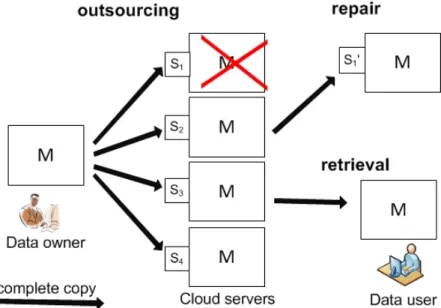
coding. Replication as shown in Fig. 2.1 is the most straightforward way of adding data redundancy where each of n storage servers stores a complete copy of the orig-inal data. Data users can retrieve the origorig-inal data by accessing any one of the storage servers, and the corrupted server can be repaired by simply copying the entire data from a healthy server.
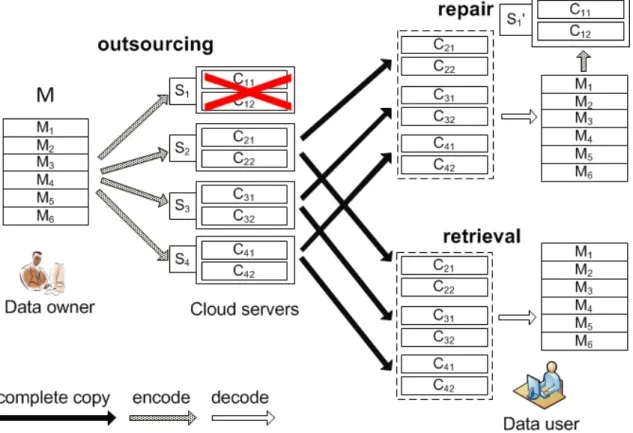
Given the same level of redundancy, the optimal erasure codes based distributed storage system as shown in Fig. 2.2 is more reliable by many orders of magnitude than the replication-based system [116]. Data users can recover the entiremoriginal packets by retrieving the same number of encoded packets from anyk-combination of n servers, and therefore every server only needs to storem/k encoded packets which is regarded as the property of optimal redundancy-reliability tradeoff. However, its quadratic decoding complexity makes it very inefficient for data users to recover data during data retrieval. Moreover, the communication cost to repair a failed storage server is equal to the size of the entire original data in the optimal erasure codes-based distributed storage system [43, 44]. For example, as a typical optimal
Figure 2.2: Distributed storage systems based on optimal erasure codes. erasure codes, Reed-Solomon codes [79] usually need to reconstruct all the original packets in order to generate a fragment of encoded packets. In other words, one has to retrieve m encoded packets in order to generate only m/k encoded packets for the corrupted server.
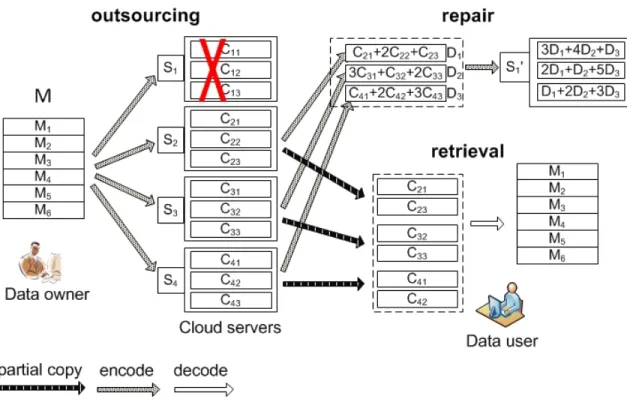
Network coding-based storage codes [43, 44, 78, 121] as shown in Fig. 2.3 reduce the repair communication cost to the information theoretic minimum by combining encoded packets in the healthy servers during the repair procedure, where only m/k recoded packets are needed to generate the corrupted m/k encoded packets. Each server needs to store 2m/(k+ 1) encoded packets, which is more than optimal erasure codes, to guarantee that data users can retrieve m linearly independent encoded packets from any k-combination ofn servers. Besides, the network coding-based storage codes have the similar inefficient decoding problem as optimal erasure
Figure 2.3: Distributed storage systems based on network coding. codes due to the utilization of Gaussian elimination decoder.
To meet the efficient decoding requirement in the cloud data storage scenario where the data owner outsources huge amount of data for sharing with data users, our design is based on the near-optimal erasure codes, specifically LT codes, to store low-complexity encoded packets over n distributed servers. The fast Belief Propagation decoding for LT codes can be used during data retrieval in our LT codes based secure cloud storage service (LTCS). Data users can efficiently recover all the m of original packets from any m(1 + ϵ) encoded packets which can be retrieved from any k-combination ofn servers. To achieve so, every server needs to store at least m(1 +ε)/k encoded packets which is larger than the erasure codes but smaller than the network coding based storage codes.
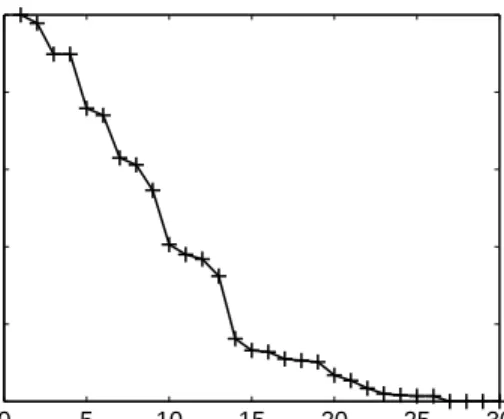
0 5 10 15 20 25 30 0 20 40 60 80 100 # of repairs Data availabilty (%)
Figure 2.4: Data availabity after functional repair as in LTNC.
2.3.2
Reducing Maintenance Cost
To prevent data dropout or corruption, the integrity of data stored in each server needs to be periodically checked. In [37], the data owner raises a challenge for every encoded packet to cloud servers. Taking into consideration the large number of encoded packets with substantial data redundancy in cloud servers, the cost of such private integrity check is somehow burdensome in terms of both computation and communication for data owners. LTCS utilizes the public integrity verification which enables the data owner to delegate the integrity check task to a third party server. Once there is a server failing to pass the integrity check, the third party server immediately reports it to the administrator of the cloud server who will then activate the repair process.
The repair task in our LT codes based storage service is accomplished by gen-erating the exactly same packets as those previously stored in corrupted storage servers. Such repair method does not introduce any additional linear dependence among newly generated packets and those packets stored in healthy storage servers, and therefore maintains the data availability. Furthermore, we run the decoding over the encoded packets before outsourcing to guarantee the reliable data retrieval
and recovery. Unlike the exact repair in our designed service, the functional repair is the other category of data repair, where the repair procedure generates correct encoded packets, but not the exactly same packets as those corrupted. Attempts to apply functional repair in the LT codes based distributed storage should first solve how to recode packets, because the random linear recoding in the functional repair of network coding-based storage codes cannot satisfy the degree distribution in LT codes. It seems that this problem can be solved by utilizing the recently proposed LT network codes (LTNC) which provides efficient decoding at the cost of slightly more communication in the single-source broadcasting scenario [33]. However, af-ter several rounds of repair with same recoding operations regulated in LT network codes, data users experience decoding failure with high probability, as illustrated in Fig. 2.4, where data availability is the probability that data users could recover original data from any k-combination of n storage servers. The major reason is that recoding operations with the degree restriction in LT network codes introduce inneglectable linear dependence among recoded packets and existing packets in LT codes based storage service. Therefore, the functional repair is not suitable for LT codes-based storage service.
2.3.3
Offline Data Owner
In the repair procedure, network coding-based storage systems with functional repair generate new encoded packets to substitute corrupted data in the failed server. The data owner needs to stay online for generating necessary tags for these new pack-ets [37]. In LTCS, all newly generated packpack-ets for the corrupted storage server in the repair procedure are exactly the same as old ones previously stored in the server, which means their corresponding metadata are also same. Like the distributed stor-age of data packets, these metadata can be stored in multiple servers and recovered
in case of repairing corrupted servers. The replication or erasure codes (like Reed-Solomon codes) can be adopted to reliably backup these metadata. Hence, without the burden of generating tags and checking integrity, the data owner can stay offline immediately after outsourcing the data which makes LTCS more practical to be deployed in the cloud paradigm.
2.4
LTCS: The Proposed Secure and Reliable Cloud
Storage Service
In this section, we present the LT codes-based secure and reliable cloud storage service (LTCS), where n storage servers {Sl}1≤l≤n are utilized to provide the data
storage service for data owner and data users. Our data integrity technique is partially adapted from the BLS signature in POR [87].
2.4.1
Setup
Let e :G×G→ GT be a bilinear map, where g is the generator ofG, with a BLS
hash functionH :{0,1}∗ →G. The data owner generates a random numberη ←Zp
and s random numbers u1, . . . , us ← G. The secret key sk is {η}, and the public
key is pk ={u1, . . . , us, v}, where v ←gη.
2.4.2
Data Outsourcing
The data outsourcing is to pre-process data and distribute them to multiple cloud servers. The file M is first equally split into m original packets, M1, . . . , Mm, with
the same size of |M|m bits. Following the Robust Soliton degree distribution in LT codes, m original packets are combined by exclusive-or (XOR) operations to
gen-erate nα encoded packets, where α is the number of packets outsourced to each storage server and set to m/k·(1 +ε). For protecting data confidentiality, sensitive data could be encrypted before the encoding process. Existing data access control mechanisms [129] can be employed to prevent the cloud server from prying into outsourced data.
According to LT codes, all the m original packets can be recovered from any m(1 +ε) of encoded packets with probability 1−δ by on average O(m·ln(m/δ)) packet operations. However, the availability requirement specifies that data recov-ery should be always successful by accessing any k of healthy storage servers. To achieve this goal, the data owner checks the decodability of these encoded pack-ets before outsourcing by executing the decoding algorithm. Specifically, all the nα encoded packets are divided into n groups, each of which consists of α pack-ets, {{Cli}1≤i≤α}1≤l≤n. The Belief Propagation decoding algorithm is then run on
every k-combination of n groups. If the decoding fails in any combination, the data owner re-generates encoded packets and re-checks the decodability until every k-combination can recover all the m original packets. Once the encoding config-uration successfully passes the decodability detection, it can be reused for all the storage services that specifies the same n and k.
For each encoded packet Cli, 1 ≤ l ≤ n, 1 ≤ i ≤ α, three kinds of auxiliary
data are attached, i.e., the coding vector, the retrieval tag, and verification tags. The coding vector ∆li is a m-bit vector, where each bit represents whether the
corresponding original packet is combined into Cli or not. The retrieval tag ϕli,
computed by Eq. 2.1, is to verify the encoded packet Cli in data retrieval, and also
in data repair if necessary.
To generate the verification tag for the purpose of integrity check, each encoded packet Cli is split into t segments, {Cli1, . . . , Clit}. Each segment Clij includes s
symbols in Zp : {Clij1, . . . , Clijs}. For each segment Clij, we generate a verification
tag σlij, 1≤j ≤t, in Eq. 2.2.
σlij ←(H(l||i||j)· s ∏ ℓ=1 uClijℓ ℓ ) η ∈G (2.2)
These data are outsourced to the l-th storage server in the form of
{l,{i, Cli,∆li, ϕli,{σlij}1≤j≤t}1≤i≤α, φl}, whereφlis the coding tag to validate all the
previously coding vectors. The computation of φl is shown in Eq. 2.3.
φl←(H(l||∆l1||. . .||∆lα))η ∈G (2.3)
2.4.3
Data Retrieval
Data users can recover original data by accessing any k of n cloud servers in the data retrieval. The data user first retrieves all the coding vectors and the coding tags stored in the selected k cloud servers, and performs the verification in Eq. 2.4. If the verification operation on any coding tag fails, the data user sends reports to the third party server and accesses one substitutive storage server.
e(φl, g)
?
=e(H(l||∆l1||. . .||∆lα), v) (2.4)
Once all the coding tags fromk storage servers pass the validation, the data user partially executes the Belief Propagation decoding algorithm only with coding vec-tors, and records ids of coding vectors that are useful for the decoding. Meanwhile, the data user retrieves those corresponding useful encoded packets and their
re-trieval tags from corresponding storage servers, and verifies the integrity of encoded packets as shown in Eq. 2.5.
e(ϕli, g)
?
=e(H(l||i||Cli), v) (2.5)
All the original packets in M can be recovered by performing the same XOR operations on encoded packets as those on coding vectors. Finally, the data user can decrypt the Mand get the plaintext data if the file is encrypted before encod-ing. Note that if there exist some verification tags that fail in the integrity check procedure, the data user also reports them to the third party server and retrieves data from one substitutive storage server. When the third party server receives any failure reports from data users about either coding tags or verification tags, it will immediately challenge the corresponding server (details on challenge will be given in the following section).
2.4.4
Integrity Check
To monitor the integrity of data stored in the storage servers, the third party server periodically performs the integrity check over every storage server. The third party server first randomly picksα+tnumbers,a1, . . . , aα, b1, . . . , bt ←Zp, and then sends
them to every storage server. The l-th storage server will compute s integrated symbols {µlℓ}1≤ℓ≤s and one integrated tag ςl in Eq. 2.6. Note that ai corresponds
to the i-th encoded packet in every storage server, and bj corresponds to the j-th
segment in each encoded packet.
µlℓ = α ∑ i=1 t ∑ j=1 aibjClijℓ, ςl = α ∏ i=1 t ∏ j=1 σ aibj lij (2.6)
Figure 2.5: LT codes-based cloud storage service (LTCS).
The third party server verifies these received integrated symbols {µlℓ}1≤ℓ≤s and
the integrated verification tag ςl, as shown in Eq. 2.7.
e(ςl, g) ? =e( α ∏ i=1 t ∏ j=1 H(l||i||j)aibj · s ∏ ℓ=1 uµlℓ ℓ , v) (2.7)
If the verification fails, the third party server reports it to the data center, and the administrator of the storage server will reset the server software and start the data repair procedure.
2.4.5
Data Repair
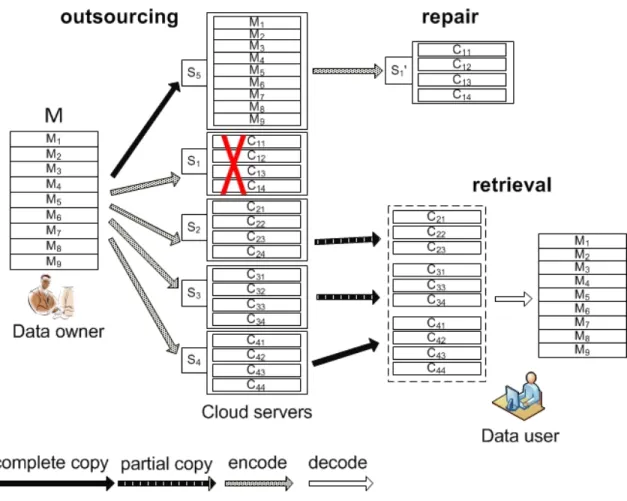
It is commonly believed that all existing coding constructions must access the orig-inal data to generate coded packets, which means the communication cost of data repair for erasure codes is equal to the size of the entire original data [43]. A straightforward data repair method is therefore to recover all the original data pack-ets whenever a storage server is corrupted. But such method will introduce much cost of both computation and communication. In LTCS as illustrated in Fig. 2.5, one repair server Sn+1 is deployed to efficiently repair corrupted storage servers.
Al-though other storage services based on optimal erasure codes or network coding can also integrate the repair server, they still introduce more computational cost during data retrieval (and storage cost for network coding-based service) than LTCS, which will be validated in section 2.6.
To accommodate the repair server, the data owner outsources all the original packets to the repair server Sn+1 during data outsourcing. Each original packet is
also attached by the verification tag which is generated in the same way as shown in Eq. 2.2. Besides, all the auxiliary data of storage servers are stored in the repair server as a backup. Similarly with the distributed data storage, the metadata in-cluding verification tags for original packets need to be reliably stored in n storage servers. Compared with the large size of encoded data, auxiliary data are quite small such that we can employ the simple replication or erasure codes to add redundancy. To deal with the failure on the l-th storage server, the repair server uses all the corresponding coding vectors {∆li}1≤i≤α to generate encoded packets {Cli}1≤i≤α.
Specifically, Cli is generated by the XOR combination of |∆li| original packets, as
illustrated in Eq. 2.8, where jli1, . . . , jli|∆li|← {1, . . . , m}correspond to the nonzero
Table 2.1: Performance complexity analysis of storage services based on different redundancy techniques.
Network Coding Reed-Solomon LTCS
Server storage O((2n/(k+ 1))· |M|) O((1 +n/k)· |M|) O((1 +n(1 +ε)/k)· |M|) Encoding comp. O(2nm2/(k+ 1)) O(nm2/k) O((nm(1 +ε) lnm)/k)
Retrieval comm. O(|M|) O(|M|) O(|M|)
Retrieval comp. O(m2) O(m2) O(mlnm)
Repair comm. O(2T /(k+ 1)· |M|) O(T(1/k+ 1/n)· |M|) O(T((1 +ε)/k+ 1/n)· |M|) with their tags in the form of {l,{i, Cli,∆li, ϕli,{σlij}1≤j≤t}1≤i≤α, φl}.
Cli =Mjli1 ⊕. . .⊕Mjli|∆li| (2.8) The repaired server Sl authenticates received encoded packets {Cli}1≤i≤α and
aux-iliary tags as in the data retrieval and integrity check. If the authentication fails, the repair server itself may be corrupted and need repair.
The third party server also challenges the repair server Sn+1 to check the
in-tegrity of original packets. Since there are m packets stored in Sn+1, instead of α
in storage servers, the third party server should generate m+t random numbers, a1, . . . , am, b1, . . . , bt ← Zp. The integrated symbols {µ(n+1)ℓ}1≤ℓ≤s are then
gen-erated from the m original packets, µ(n+1)ℓ = m ∑ i=1 t ∑ j=1 aibjC(n+1)ijℓ, where C(n+1)i =
Mi. There are similar changes in the generation of the integrated verification tag,
ςn+1 = m ∏ i=1 t ∏ j=1 σ aibj
(n+1)ij . The repair server is less likely to be corrupted than storage
servers, since it does not participate in the data retrieval service for data users. Even when the repair server is found to be corrupted and needs repair, all the original packets and auxiliary data can be recovered by performing data retrieval from any d of healthy storage servers. Therefore, there is no single point of failure.
2.5
Security Analysis
2.5.1
Protection of Data Confidentiality and Integrity
For protecting data confidentiality, existing encryption techniques or data access control schemes [129] can be utilized before the encoding process, which prevent the cloud server from prying into outsourced data. With respect to the data integrity, LTCS utilizes various cryptographic tags to resist the pollution attack during the data repair and retrieval procedures. LTCS is also secure against the replay attack which is presented in the network coding-based distributed storage system [37]. To lunch the replay attack, the adversary first corrupts some storage servers and backups encoded packets stored in these servers. After several rounds of data repair, the adversary corrupts the same storage servers as before, and then substitutes new encoded packets with specific old packets. Since the verification tag only binds the storage server id and the packet id, not the freshness of the packet, the substituted old packets could pass the integrity verification. As a result, such substitution makes encoded packets stored in specifick-combinations ofnstorage servers linearly dependable, and the data recovery would fail when all other n−k storage servers are corrupted. Actually, if the data repair mechanism is designed to generate new packets which are different from the old packets stored in the same storage server, any coding-based distributed storage system is somehow vulnerable to such kind of attack. In other words, the functional repair itself has the possibility to break the decodability. By contrast, LTCS employs the exact repair method where the newly generated packets are the same as those previously stored packets. The replay attack becomes invalid since there is no difference between old and new packets in the same storage server. Furthermore, LTCS examines the data decodability from any k-combination of storage servers before outsourcing, which guarantees that original
data could be recovered even when the adversary corrupts both the repair server and at most n−k storage servers in one round.
2.5.2
Verification Correctness in Integrity Check
The verification correctness in Eq. 2.7 is proved in Eq. 2.9.
e(ςl, g) = e( α ∏ i=1 t ∏ j=1 σ aibj lij , g) = e( α ∏ i=1 t ∏ j=1 (H(l||i||j)aibj· s ∏ ℓ=1 uaibjClijℓ ℓ ), g) η = e( α ∏ i=1 t ∏ j=1 H(l||i||j)aibj· s ∏ ℓ=1 α ∏ i=1 t ∏ j=1 uaibjClijℓ ℓ , v) = e( α ∏ i=1 t ∏ j=1 H(l||i||j)aibj· s ∏ ℓ=1 u α ∑ i=1 t ∑ j=1 aibjClijℓ ℓ , v) = e( α ∏ i=1 t ∏ j=1 H(l||i||j)aibj· s ∏ ℓ=1 uµlℓ ℓ , v). (2.9)
2.6
Performance Analysis
In this section, we demonstrate the performance of storage services based on differ-ent redundancy techniques by both theoretical complexity analysis and experimdiffer-ental evaluation. We set the same desired reliability level as network coding-based dis-tributed storage system RDC-NC [37], where n = 12, k = 3. Other parameters are set from the consideration of specific properties of network coding (NC), Reed-Solomon codes (RS), and LT codes. For LTCS, m = 3072, α = m(1 +ε)/k, ds =
factor. ds and dr represent the number of cloud servers participating in the repair
of corrupted storage server and corrupted repair server, respectively. β represents the number of packets retrieved from each participating server during repair. For Reed-Solomon codes based storage system, m= 6 or 12, α=m/k, d=k, β=α; for network coding based storage system,m = 6or 12, α = 2m/(k+ 1), d=k, β =α/d. The whole experiment system is implemented by C language on a Linux Server with Intel Xeon Processor 2.93GHz. Besides, the performance of network coding and Reed-Solomon codes is optimized by employing table lookup in the multiplica-tion and division over GF(28), and we evaluate their performance with or without repair server (rs), respectively. The performance complexity comparison among stor-age services based on different redundancy techniques with repair server is shown in Tab. 2.1, where T is the number of corrupted storage servers in one round, 0≤T ≤n−k.
2.6.1
Outsourcing
As described in section 2.4.2, the data owner detects the decodability in the en-coding procedure to guarantee data availability. To check all k-combinations of n groups, the data owner has to execute (n
k) times of the Belief Propagation decoding
algorithm. For the efficiency purpose, this decoding process can be partially exe-cuted where only coding vectors follow the decoding steps and data packets are not involved. If there exists a combination that cannot recover all the original pack-ets, the data owner will re-generate nα coding vectors according to LT codes and re-detect them, where α is equal to m(1 +ε)/k. Once all the (n
k) combinations
successfully pass the decodability detection, corresponding coding vectors can be reused for all the storage services that specifies the same n and k. As illustrated in Fig. 2.6(a), the larger εmakes the decodability detection more costly because of the
0.19 0.192 0.194 0.196 0.198 0.2 25 26 27 28 29 LT overhead factor ε
Time of decodability detection (s)
(a) Time of detecting decodability
(b) Data storage cost
Figure 2.6: Outsourcing performance with different ε. n = 12, k = 3, m = 3072. linear relation betweenε andα, namely the number of coding vectors in each group. Considering that the larger ε leads to more storage cost and repair communication cost, the following evaluations are conducted by setting ε to the smallest one as 0.1904, which corresponds to α= 1219.
Once one set ofnαcoding vectors pass the decodability detection, encoding op-erations are performed on real data packets via the XOR combination. Although the number of encoded packets in LTCS, nα, is several hundreds times larger than
in other storage service based on network coding or Reed-Solomon codes, the com-putational cost of encoding in LTCS is much less than the later, as illustrated in Fig. 2.7 (a). The main reason for such big advantage is that the average degree of encoded packets is O(ln(m/δ)) and O(m) in two services, respectively. Further-more, the combination for encoding is the efficient XOR in LTCS while the linear combination in network coding or Reed-Solomon codes involves the multiplication operations with coefficients. The total number of encoded packets in Reed-Solomon codes-based service is less than network coding-based one so the encoding procedure introduces different computational cost in two services.
As for the data storage in LTCS, every storage server storesα encoded packets, each of which has the size of |M|/m. And the repair server stores all them original packets with the same size. The total data storage in cloud servers is the sum of all encoded packets in n storage servers and all original packets in the repair server, which is O(nα· |M|/m+|M|), i.e., O([1 +n(1 +ε)/k]· |M|). Since LT codes is a near-optimal erasure codes in terms of redundancy-reliability tradeoff, the data storage cost in LTCS is larger than Reed-Solomon codes-based storage service which introduces theoretical minimum storage cost as 4|M|in our evaluation setting. By contrast, the total data storage in existing network coding-based storage service is O(|M|[2n/(k+1)]) as illustrated in Fig. 2.6(b). If we integrate the repair server into this service, the storage cost will be O(|M|[1 + 2n/(k+ 1)]) which is much larger than LTCS.
2.6.2
Data Retrieval
The availability in data retrieval is guaranteed by the decodability detection before data outsourcing and the exact repair of corrupted data. Recall that the data user first retrieves kα, i.e. m(1 +ε), of coding vectors from k storage servers, and
1000 200 300 400 500 100 200 300 400 500 600 700 800 File size (MB) Encoding time (s) NC, m=12 RS, m=12 NC, m=6 RS, m=6 LTCS, m=3072 (a) Encoding 1000 200 300 400 500 20 40 60 80 100 120 140 File size (MB) Decoding time (s) NC, m=12 RS, m=12 NC, m=6 RS, m=6 LTCS, m=3072 (b) Decoding
Figure 2.7: Encoding and decoding time for different size of file. n=12, k=3. then only retrieve m of encoded packets that are useful for decoding. Therefore, the communication cost during data retrieval in LTCS is the same O(|M|) as the network coding-based storage system where any m of encoded packets are linearly independent with high probability.
The computational complexity of Belief Propagation decoding in LTCS isO(m· ln(m/δ)) for the data user, where δ is set to 1. By contrast, the other storage services based on network coding or Reed-Solomon codes usually use the costly
decoding algorithms with higher computational complexity, O(m2). Although the total number of original packets,m, may be smaller in the other two storage services than in LTCS, the decoding process for the data user in LTCS performs at least two times faster than in the other two storage services, as illustrated in 2.7(b). This efficient decoding process demonstrates that LTCS is more appropriate than other redundancy-based storage services in the cloud storage paradigm, where data retrieval is a routine task for data users.
2.6.3
Integrity Check
To check the integrity of data stored in a storage server, the third party server needs to perform one integrated challenge in LTCS, which means only two bilinear maps in Eq. 2.7 are executed in order to checkα encoded packets. Network coding-based service has to performαtimes of challenges for each storage server where 2αbilinear maps are executed to check α of encoded packets. Similarly, the communication cost between the third party server and each storage server during one round of Integrity Check in network coding-based service is almost α times more than that in LTCS.
2.6.4
Data Repair
When the repair server is corrupted, LTCS first retrieve β encoded packets from each of dr healthy storage servers to recover all the original packets. In such case,
the communication complexity fromdr healthy storage servers to the repair server is
O(dr·β·|M|/m), i.e.,O((1+ε)·|M|), wheredr =k,β =α. If the repair server is not
corrupted or has been repaired, the data repair of storage servers in LTCS is simply accomplished by the repair server generating β encoded packets for each corrupted storage server, where ds = 1, β = α. Assume the number of corrupted storage
0 2 4 6 8 10 0 2 4 6 8 10
# of corrupted storage servers
Repair communication cost (|M|)
RS w/o rs NC w/ rs NC w/o rs LTCS RS w/ rs
Figure 2.8: Communication cost of repair. n=12, k=3.
servers in one round is T, 0≤T ≤n−k. The repair communication complexity in such scenario is O(T α· |M|/m), i.e.,O(T(1 +ε)/k· |M|), where |M|/m is the size of each encoded packet.
Assume the corruption probability of the repair server is the same as storage servers, i.e., T /n. The total repair communication complexity is then calculated as O(T(1 +ε)/k· |M|+T /n· |M|), i.e., O(T((1 +ε)/k+ 1/n)· |M|). As illustrated in Fig. 2.8, to repair different number of corrupted storage servers T, the communica-tion cost in LTCS is only 15 percent more than Reed-Solomon codes-based service integrated with repair server, but smaller than that in network coding-based service.
2.7
Related work
2.7.1
Network Coding-based Distributed Storage
As a new data transmitting technique, network coding is different with traditional store-and-forward methods. Instead of simply forwarding previously received pack-ets, network coding allows intermediate nodes to recode received packets before
forwarding. It has been proved that random linear network coding over a suffi-ciently large finite field can achieve the multicast capacity [53, 82]. Since the data repair problem in the distributed storage is claimed to be mapped to a multicasting problem on the information flow graph [43], many network coding-based storage codes [42–44, 46, 66, 78, 90, 101, 121–125] have been proposed to take advantage of this property of capacity achievability. By recoding encoded packets in healthy servers during the repair procedure, the repair communication cost is reduced to the information theoretical minimum. The achievable region of functional repair is characterized in [37], but a large part of the achievable region of exact repair remains open [44]. Furthermore, since network coding utilizes Gaussian elimination decoding algorithm, the data retrieval is more expensive than erasure codes-based system [37]. Therefore, these designs are only suitable in “read-rarely” storage sce-narios, and cannot be efficiently deployed in the cloud storage system where data retrieval is a routine operation.
2.7.2
Remote Data Integrity Check
The remote data integrity check problem has been explored in many works [12, 13, 25, 26, 34, 41, 47, 57, 71, 74, 85, 89, 105, 107, 109–113]. However, existing works do not have an efficient solution for the data repair problem or pay no attention to it. Portions of the work studied in this chapter were presented as extended abstract at the 31th IEEE Conference on Computer Communications (INFOCOM’12) [32].
Juels et al. [57] described a formal proof of retrievability (POR) model for en-suring the remote data integrity. Their scheme combines spot-checking and error-correcting code to ensure both possession and retrievability of files on archive service systems. Shacham et al. [87] built on this model and constructed a random linear function based homomorphic authenticator which enables unlimited number of
chal-lenges and requires less communication overhead due to its usage of relatively small size of BLS signature. Bowers et al. [26] proposed an improved framework for POR protocols that generalizes both Juels and Shachams work. Later in their subsequent work, Bowers et al. [25] extended POR model to distributed systems. However, all these schemes are focusing on static data. The effectiveness of their schemes rests primarily on the preprocessing steps that the user conducts before outsourc-ing the data file. Recently, Dodis et al. [45] gave theoretical studies on generalized framework for different variants of existing POR work.
Ateniese et al. [12] defined the provable data possession (PDP) model for ensuring possession of file on untrusted storages. Their scheme utilized public key based homomorphic tags for auditing the data file. In their subsequent work, Ateniese et al. [13] described a PDP scheme that uses only symmetric key based cryptography. This method introduces lower overhead than their previous scheme and allows for block updates, deletions and appends to the stored file. However, their scheme focuses on single server scenario and does not provide data availability guarantee against server failures, leaving both the distributed scenario and data error recovery issue unexplored. Wang et al. [112] proposed to combine BLS based homomorphic authenticator with Merkle Hash Tree to support fully data dynamics, while Erway et al. [47] developed a skip list based scheme to enable provable data possession with fully dynamics support. The incremental cryptography work