Space Flight Operations Contract
Contract NAS9-20000 DRD - 1.4.3.8-b
HAL/S PROGRAMMER’S GUIDE
PASS 32.0/BFS 17.0
HAL/S PROGRAMMER’S GUIDE
Approved by
Original Approval Obtained
Barbara Whitfield, Manager HAL/S Compiler and Application Tools
Original Approval Obtained
The HAL/S Programmer’s Guide has been revised and issued on the following dates1: Issue Revision Date Change Authority Sections Changed 29.0/14.0 03/10/1999 DR109052 4.3 pp.4-7,4-8
DR109063 App. B p. B-4
Cleanup pp. 4-6, 4-8
p 8-8
pp. 11-5, 11-10, 11-12 pp. 16-1, 16-2, 16-3
pp. 19-14, 19-17, 19-21, 19-22, 19-24, 19-26
30.0/15.0 07/21/2000 CR12711 28.1 p. 28-3 CR13212 28.2 p. 28-6 Cleanup Preface
p. 1-6
pp. 2-1, 2-4 thru 2-7 p. 4-9
p. 5-2
p. 6-3 thru 6-7
pp. 2, 3, 5, 6, 8, 9, 7-10, 7-12, 7-14, 7-18, 7-21, 7-22, 7-23
pp. 8-2 thru 8-9
pp. 9-5, 9-6, 9-8,9-10, 9-12 pp. 10-3, 10-7, 10-10, 10-11 pp. 11-3, 11-4, 11-7, 11-10
pp. 12-6, 12-8 thru 12-11, 12-14, 12-16, 12-17, 12-19
pp. 13-2, 13-3, 13-5, 13-6, 13-9, 13-12, 13-13, 13-14,
pp. 15-4, 15-5, 15-7 pp. 16-1, 16-3 pp. 17-3 thru 17-9 pp. 18-2, 18-3
pp. 19-5, 19-8, 19-9, 19-12 thru 19-24, 19-28, 19-30,19-32
pp. 20-1, 20-4, 20-6, 20-9, 20-10, 20-12 thru 20-16
pp. 21-1 thru 21-4, 21-6, 21-11, 21-13, 21-14, 21-15
1. A table containing the Revision History of this document prior to the USA contract can be found in Appendix G.
Issue Revision Date Change Authority Sections Changed Cleanup cont’d pp. 22-2, 22-3, 22-4, 22-6, 22-7
pp. 23-3
pp. 4, 6, 10, 12, 24-13, 24-14, 24-16, 24-18
pp. 25-3, 25-4, 25-5, 25-7,25-8, 25-10, 25-11
pp. 26-2, 26-4, 26-6 thru 26-10, 26-14, 26-16, 26-17, 26-18 pp. 27-2, 27-4, 27-5, 27-7, 27-8 pp. 4, 6, 11, 15, 16, 17, 19, 20, 28-21, 28-23, 28-26 thru 28-29 pp. 29-1, 29-2, 29-3, 29-5, 29-6, 29-9
pp. 31-2, 31-3 pp. B-1, B-2 pp. C-1, C-2
INDEX-1 thru INDEX-4 31.0/16.0 09/07/01 CR13220 24.3
24.8
p. 24-4 p.24-18 CR13336 4.3 pp. 4-7,4-8 Cleanup p.6-3
32.0/17.0 11/05 CR14215B 21.3 pp. 21-7, 21-8 App. A p. A-1
CR14216A Preface
The current status of all pages in this document is as shown below:
Page No. Change No.
All 32.0/17.0
The HAL/S Programming Language was developed by the staff of Intermetrics, Inc. based on many years of experience in producing software in the aerospace field, and is currently maintained by the HAL/S project of United Space Alliance. Although HAL/S was designed to fulfill the flight software requirements of the NASA Space Shuttle pro-gram, its features are sufficiently broadly based to meet production software require-ments in many other aerospace and real time applications. HAL accomplishes three significant objectives:
• problem orientation, through the use of constructs designed with specific applications in mind;
• enhanced readability, through the use of a natural mathematical format;
• increased reliability, through the incorporation of code and data protection features.
The design of HAL/S exhibits a number of influences, the greatest being the syntax of PL/1 and ALGOL, and the two-dimensional format of MAC/360, a language developed at the Charles Stark Draper Laboratory. With respect to the latter, fundamental contribu-tions to the concept and implementation of MAC were made by Dr. J. Halcombe Laning of the Draper Laboratory.
The HAL/S Programmer's Guide presents an informal description of HAL/S aimed prima-rily at those unfamiliar with the language. The original version of the Guide was pre-pared by the staff of Intermetrics, Inc. under direction of Dr. Philip Newbold, that document's principal author.
The primary responsibility is with USA, Department, 01635A7.
Questions concerning the technical content of this document should be directed to Danny Strauss (281-282-2647) MC USH-635L.
Table of Contents
The Programmer’s Guide consists of two parts. Sections 1 - 13 make up the first part, while Sections 15 - 31 constitute the second part.
Sections 1-13 of the Programmer’s Guide are oriented toward those who have no knowledge of the HAL/S language. They describe the simpler versions of many of the salient features across the entire spectrum of the language. This part assumes a gradually accumulating knowledge of HAL/S from section to section. Therefore, it should initially be read through in its entirety from first section to last.
Sections 15-31 describe other more advanced language constructs important in satisfying general purpose programming needs. The topics presented in different sections are largely unrelated to one another. They may therefore be studied as required in any desired order. A detailed knowledge of the material in the first 13 sections is, however, assumed.
Paragraphs of text enclosed in horizontal bars refer to the existence of more complex HAL/S constructs described elsewhere in the Guide or in the Language Specification Document.
List of Figures
INTRODUCTION TO HAL/S
HAL/S is a higher order programming language developed by Intermetrics, Inc. for the flight software of the NASA Space Shuttle program. The language is expressly designed to allow programmers, analysts, and engineers to create software which is reliable, efficient, highly readable, and easily maintained.
HAL/S is intended to satisfy virtually all the flight software requirements of the Space Shuttle. To achieve this, the language incorporates a very wide range of features, including applications oriented data types and computations, real time control, and constructs for implementing systems programming algorithms.
• DATA TYPES AND COMPUTATIONS
HAL/S provides facilities for manipulating a number of different data types. Its integer, scalar, vector, and matrix types, together with the appropriate operators and built-in functions provide an extremely powerful tool for the implementation of guidance and control algorithms. Bit and character string processing constructs are available. The formation and use of multi-dimensional arrays, and of tree-like organizations of heterogeneous data are also featured.
• REAL TIME CONTROL
HAL/S is a real time control language. Real time processes can be scheduled and executed in a variety of different modes. Mechanisms for interfacing with external interrupts and other environmental conditions are provided.
• ERROR RECOVERY
HAL/S contains an elaborate run time error recovery facility which allows the grammer freedom (within the constraints of safety) to define his own error pro-cessing procedures, or to leave control with the operating system.
• SYSTEMS PROGRAMMING FEATURES
HAL/S contains a number of features especially designed to facilitate its applica-tion to systems programming, thus substantially eliminating the necessity of using an assembler language. Most important among these is a facility for creating and manipulating pointers to various kinds of data and code blocks.
Specific features of the HAL/S language have been incorporated to enhance software reliability. By various means, separate blocks of code can be isolated from one another while maintaining ease of access to commonly used data.
• BLOCK ORIENTATION
HAL/S is a block oriented language: nested blocks of code may be established which define local variables that are invisible outside the block.
• CENTRAL DATA POOLS
Separately compiled blocks of code can be executed together, and communicate through one or more centrally managed and highly visible data pools.
• CONTROLLED ACCESS IN REAL TIME
HOW TO USE THE PROGRAMMER'S GUIDE
The HAL/S Programmer's Guide is primarily designed to describe the features of HAL/S and their use to programmers previously unfamiliar with the language. Once the contents of the Guide have been mastered, the HAL/S Language Specification document will serve as an additional reference source for the finer details of each language construct. For executing HAL/S programs, a user will require information contained in the HAL/S User's Manual applicable to his particular machine.
The Programmer's Guide is divided into two parts which should be read in order of their appearance,
• Section 1 through 13 describe many of the major features of the language in sufficient detail to enable a new user to begin writing useful HAL/S programs. It should initially be read through in its entirety, from first section to last, and then later referred back to as required.
• Sections 15 through 31 cover additional language forms omitted from the first segment by reason of their complexity or relative unimportance. The first portions of this guide make frequent reference to the existence of the forms described in this segment to facilitate cross referencing. Since Section 15 through 31 are a collection of largely unrelated topics, it is generally not necessary to read the sections sequentially.
1.0 STRUCTURE OF HAL/S
This section gives an overview on an abstract level of the overall properties of HAL/S compilations, and tries to relate these properties to the need for good programming practice. Later sections of the Guide interpret these properties in terms of actual HAL/S Language constructs.
1.1 STRUCTURING AND HIGHER ORDER LANGUAGES
A common method of problem solving is the so-called “top down” approach. The algorithm for solving the problem is first outlined broadly, and then, step by step,
delineated in successively deeper levels of greater detail. The success of the algorithm in arriving at the solution lies as much in its ability to break down the problem into its simplest component parts, as in its ability to resolve the problem as a whole.
If a problem is to be solved by programming it in a higher order language, then the “top down” approach is of special interest because it lends insight into how the program can be organized. Specifically, the organization takes the form of an outer program block enclosing numerous nested “subroutines”2. On the outermost level, the program is only concerned with the broad outlines of the solution, and relegates the first level of detail to the outer set of subroutines. These in turn relegate the next level of detail to an inner set of subroutines, and so one until each level of the problem has been relegated to the appropriate set of subroutines.
This particular programming technique is partly what is meant by “structured
programming”. This term also implies an ability to form nested groups of executable statements inside a program or subroutine. On each level of nesting, a statement group has the ability to behave as if it were a single executable statement.
The overall effect of structured programming techniques is to introduce an orderliness into the writing of programs that not only makes them easier to read but also far less prone to error. Most modern higher order languages possess constructs out of which structured programs can be created: the constructs of the HAL/S language have been defined deliberately with structured programming in mind.
1.2 THE BLOCK STRUCTURE OF HAL/S
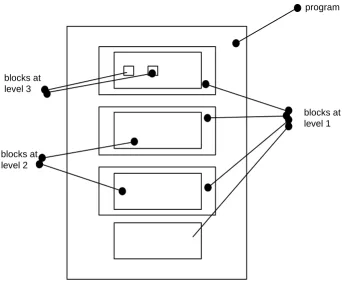
[image:20.612.131.473.150.441.2]The structure of a HAL/S compilation, as indicated below, generally consists of a program block with so-called procedure and function blocks nested within it.
Figure 1-1
Function and procedure blocks constitute the HAL/S interpretation of the “subroutines” of Section 1.1. The more deeply such a block is nested, the greater the depth of detail of the problem solution it is supposed to handle. The blocks at each level contain
executable code implementing the appropriate part of the problem solution.
Both kinds of blocks are similar in that they contain code which is executed by a call or “invocation”, and which returns execution to the caller on completion. However,
procedure and function blocks differ in the way they are invoked. A procedure is invoked by a CALL statement, while a function (like its mathematical counterpart) is invoked by its appearance in an expression, and returns a result3.
Generally, the code in any block may invoke a procedure or function block defined at the same level, or in a surrounding outer level. The rules defining the region where a block may be invoked are discussed later in this Section.
3. A procedure is therefore like a FORTRAN SUBROUTINE, and a function is like a FORTRAN FUNCTION. Note, however, that FORTRAN SUBROUTINES and FUNCTIONS are always exterior to the program calling them, while this is not true for HAL/S.
blocks at level 3
blocks at level 2
blocks at level 1
The forms of procedure and function blocks and the constructs for invoking them are described in Section 11 of the Guide. The form of the outer program block is described in Section 3.
SCOPING OF DATA
In HAL/S, all data must be defined in so-called “data declarations”. An important
consequence of the structural properties of HAL/S is its ability to place data declarations so as to bound the regions in a program which may reference the declared data. This feature is called “scoping”.
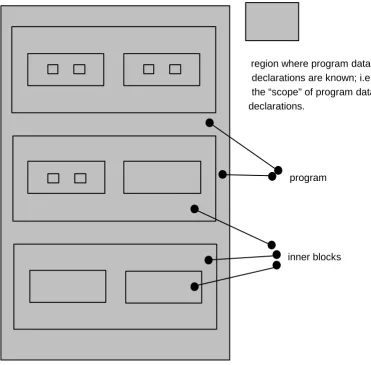
[image:21.612.104.475.262.627.2]Data declared at the program level may generally be used throughout the entire compilation:
Figure 1-2
inner blocks program
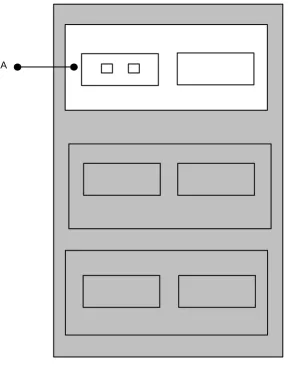
In addition, any procedure or function block nested within a program block may declare local data - data known only in that particular block and in blocks nested within it - as indicated below:
Figure 1-3 SCOPING OF BLOCK NAMES
The program block, and every procedure or function within it are named: block names have scoping rules identical with the data scoping rules already described. The name of any procedure or function block is deemed to have been “declared” in the surrounding block in which the procedure or function is nested. This bounds the region where its name is known, and therefore determines where it may be invoked. Thus, the name of any procedure or function nested at the program level is known anywhere in the
program.
region where data declared local to X are known
region where data declared local to Y are known
However, since in HAL/S recursion is not allowed, such a procedure or function may be invoked from anywhere in the program except inside itself, as indicated:
Figure 1-4
Similarly, inner procedures and functions may be invoked from anywhere in the block enclosing them except within themselves.
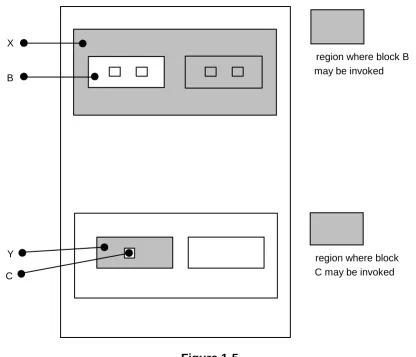
In the following example, inner block B and C can only be invoked from inside regions X and Y respectively:
Figure 1-5
It should be noted that all forms of recursion in HAL/S are illegal. The form of recursion not prevented by the rules given above is that in which procedures P and Q are not contained in each other, but P calls Q and Q calls P.
It is also possible for a program (or any block within it) to invoke entities outside the
compilation unit; i.e., other compilation units. Procedures and functions may be compiled independently for this purpose.
See: Guide/15.
region where block B may be invoked
Y X
B
C
1.3 STATEMENT GROUPING IN HAL/S
In HAL/S, the actual step by step solution of a problem is performed by executable statements contained in the blocks comprising the program. Sequences of executable statements may be grouped together and treated as a single compound statement. Such statement groups are said to be “well-bracketed” - they begin with a special statement (a “DO” statement), and end with another special statement (an “END” statement). Execution of the sequence of statements in the group can be controlled in various ways depending on the form of the opening “DO” statement:
• The sequence may be executed once only;
• the sequence may be executed repetitively until specified conditions are met; • the sequence may be executed repetitively while specified conditions are met; • one statement in the sequence may be selected as the only one to be executed. Sequences of compound statements may also be grouped together in the same way and, in turn, be treated as a more complex compound statement, and so on to an arbitrary degree of nesting.
Use of this grouping property in conjunction with other HAL/S constructs can
substantially eliminate the need for a “GO TO” statement (in the FORTRAN sense, for example), which from the structured programming viewpoint is recognized to be “dangerous” because it destroys the readability of a program, and makes it more error-prone.
STATEMENT GROUPS AND GO TO STATEMENTS
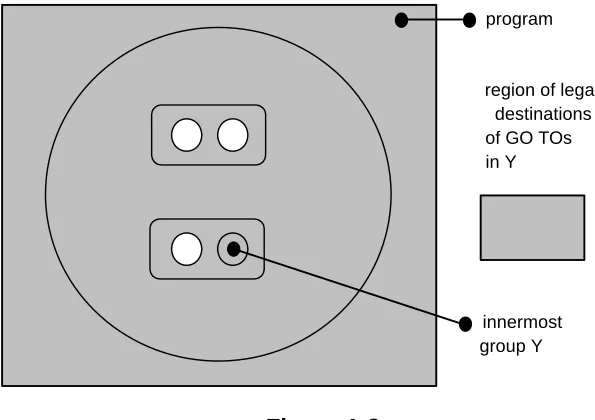
The design of HAL/S minimizes the dangers of “GO TO” statements by limiting the regions which can be branched to by them, in a way analogous to the limits imposed on data by the scoping rules described in Section THE BLOCK STRUCTURE OF HAL/S. Consider a program containing nested groups of executable statements as show below:
Figure 1-6
outermost group X program
The region of legal destinations of “GO TO” statements contained in group X are as indicated below:
Figure 1-7
The region of legal destinations of “GO TO” statements contained in group Y are as indicated below:
Figure 1-8
It is evident from the examples that while groups can be branched out of, or branched within, they may not be branched into.
outermost group X program
region of legal destinations of GO TOs in X
innermost group Y
program
INTERACTION WITH BLOCK STRUCTURE
Since procedure and function blocks may appear anywhere in a program, including inside statement groups, the problem arises of branches by means of “GO TO” statements in and out of such blocks.
In HAL/S, the destinations of “GO TO” statements are labels attached to executable statements. Because the scope rules for statement labels are the same as for declared data, it follows that it is impossible to branch into a procedure or function block.
Additionally, a rule is made that branches may not be made out of a block (even though by scope rules the label of the destination is visible).
2.0 HAL/S SYMBOLOGY
HAL/S source text has its own particular characteristics; a specific character set, special combinations of characters set aside as reserved words, and certain rules dictating the form of statements. This section is an introduction to these characteristics of the HAL/S Language.
2.1 THE CHARACTER SET
The HAL/S language uses the following character set:
This character set is a subset of the standard character sets ASCII and EBCDIC. Although the user really needs only the above character set when writing a HAL/S program, there are additional special characters which can be used in comments and in character string literals (described later in this section).
The output listings produced by a HAL/S compiler may use these extra special characters for annotation.
2.2 RESERVED WORDS, IDENTIFIERS, AND LITERALS
The HAL/S language uses four kinds of primitive elements as basic constructs:
• RESERVED WORDS are a fixed part of the language and consist of combinations of upper case alphabetic characters;
• IDENTIFIERS are user-defined names used for data or labels, and consist of combinations of the alphanumeric characters;
• LITERALS express actual values, and can consist of any of the symbols in the character set;
• SPECIAL CHARACTERS serve as delimiters, separators or operators, and consist of the non-alphanumeric characters of the HAL/S set.
ABCDEFGHIJKLMNOPQRSTUVWXYZ abcdefghijklmnopqrstuvwxyz
⎫
0123456789 ⎬ numeric characters
⎭ ⎫alphabetic ⎬characters ⎭ ⎫ ⎪ ⎪ ⎬alphanummeric ⎪characters ⎪ ⎭
+-*./|¬&=<>#@$,;:‘ “)(_%¢ "special" characters
RESERVED WORDS
Reserved words are words having a standard meaning in the HAL/S language. As their name suggests, the user cannot use reserved words as identifier names. There are two major categories of reserved words:
• KEYWORDS are used to express parts of HAL/S statements, for example: GO TO, DECLARE, CALL, and so on. A complete list can be found in Appendix E.
• BUILT-IN FUNCTION NAMES are used to identify a library of common
mathematical and other routines, for example: SINE, SQRT, TRANSPOSE, and so on. A complete list can be found in Appendix B.
IDENTIFIERS
An identifier name is a user-assigned name identifying an item of data, a statement or block label, or other entity. The following rules must be observed in the creation of any identifier name4.
Examples:
ELEPHANT_AND_CASTLE
A1 ⎫
P ⎬ legal
⎭
1B ⎫
X_X_ ⎬ illegal
⎭
1. The total number of characters in the name must not exceed 32; 2. The first character must be alphabetic;
3. The remaining characters may be either alphabetic or numeric; 4. Any character except the first or last may be an underscore ( _ )
LITERALS
The three basic kinds of literals described here are arithmetic, character string, and Boolean. The utility of arithmetic literals is obvious. In simple programming problems, character string literals find most use in the generation of output. Boolean literals are used to state logical truth or falsehood.
• ARITHMETIC LITERALS express numerical values in decimal notation. The generic form of an arithmetic literal is:
Examples:
0.123E16 45.9 - 4
It is important to note that HAL/S makes no distinction of type between a integral-valued literal and a fractional valued literal. Either integer (with possible rounding of value) or scalar (i.e., floating-point) type is assumed according to the context in which the literal is used.
mantissa
| 64748 ±ddd.ddd
exponent | 6418
E±ddd
1. ddd represents an arbitrary number of decimal digits. 2. The exponent is optional.
3. The + signs are optional.
4. The decimal point is optional. If absent, it is considered to be to the right of the least significant digit of the mantissa. If the decimal point is present, it may appear anywhere in the mantissa.
5. The minimum number of digits in the mantissa, and in the exponent, if present, is one. The maximum number is implementation dependent†.
† See appropriate User’s Manual.
The use of multiple exponents, and of binary, hexadecimal or octal
• CHARACTER STRING LITERALS consist of strings of characters chosen from the entire HAL/S character set. The generic form is:
Examples:
‘ ’
‘ONE two THREE’ ‘DOG’ ‘S’
• BOOLEAN LITERALS express logical truth or falsehood, and are generally used to set up the values of Boolean data items. Their forms are:
‘ccccccc’
1. The quote marks delimit the beginning and end of the literal.
2. cccc represents an arbitrary number of characters in any combination. 3. Quote marks within the literal must be represented by a pair of quote marks
to avoid confusion with the delimiting quotes.
4. The minimum number of characters is zero (a ‘null’ string), the maximum is 255†.
† See appropriate User's Manual.
If a literal consists of a single character, or character sequence repeated many times, a condensed form of literal using a repetition factor may be used.
See: Spec./2.3.3.
TRUE ⎫
ON ⎬ expressing truth, or binary “1”
⎭
FALSE⎫
OFF ⎬ expressing falsehood or binary “0”
⎭
2.3 FORMAT OF SOURCE TEXT
HAL/S is a “stream-oriented” language, that is, statements may begin anywhere on a line (or card), and may overflow without special indication onto succeeding lines or cards. Several statements may be written on one line (or card) as required.
HAL/S is among the very few languages which permit subscripts and exponents to be represented as they are mathematically, using lines below and above the main line respectively as needed. This multi-line format is an optional alternative to the HAL/S single-line format.
Even when multi-line format is not used, the first character position of each line (or card) is reserved for a symbol denoting the kind of line format, subscript, main, or exponent. SINGLE-LINE FORMAT
In single-line format, the first character position of each line is left blank, denoting a main line. An M can alternatively be used but is generally not preferred by users.
• EXPONENTS are denoted by the operator * * Example:
xt+2 is coded as:
X * *(T+2)
• SUBSCRIPTS are denoted by parenthesizing the subscript and preceding it with the symbol $.
Example:
ai+1 is coded as:
A$(I+1)
MULTI-LINE FORMAT
In multi-line format, the first character of a main line is either left blank or M is inserted as before. The first character of an exponent line is E, and that of a subscript line is S.
• EXPONENTS are written on an exponent line (E-line) immediately above the main line.
Example:
xt+2 is coded as:
|
• SUBSCRIPTS are written on a subscript line (S-line) immediately below the main line.
Example:
ai+1 is coded as:
| | M A
| S I + 1 |
When using multi-line format the type indicator (- for vector, * for matrix, etc.) must overlap the identifier on the M line. Except for this, care must be taken to ensure that nothing on the E- and S-lines overlaps anything on the M-line.
2.4 STATEMENT DELIMITING
As Section 2.3 indicated, HAL/S statements may be written in free form without regard for line (or card) boundaries. Because of this there is the need to explicitly indicate the end of each statement with a special symbol. HAL/S uses a semicolon for this purpose. The following statements arbitrarily selected from the language show the placement of the semicolon.
Examples:
|
| DECLARE I INTEGER; | I = I + 1;
| CALL P (I,J); |
2.5 COMMENTS IN HAL/S
The use of comments is a sine qua non of good programming practice. HAL/S possesses two mechanisms for the inclusion of comments in a compilation.
• IMBEDDED COMMENTS may be placed anywhere on main, exponent or subscript lines of HAL/S text.
• COMMENT LINES may appear between main, exponent and subscript lines of HAL/S text.
Exponents of exponents and subscripts of subscripts use extra subscript and
exponent lines. Special rules apply if exponents are subscripted, or if subscripts possess exponents.
IMBEDDED COMMENTS
An imbedded comment takes the form:
Such comments may appear between HAL/S statements or imbedded in a statement. They may not appear in the middle of a literal, reserved word, or identifier. Nor may they overlap any source text or other comments on other lines of a group written in multi-line format. As far as the sense of the source text is concerned, an imbedded comment is treated as if it were a string of blank characters.
Examples:
|
|M X = X + 1; /* ADD ONE TO X */ |
|
|M X = Y;
|S 1 /* BAD * / |
|
illegal-comment overlap rule
COMMENT LINES
Comment lines are input lines specially reserved solely for comments by placing the character C in the first character position of the line. The rest of the line may contain any desired text.
Examples:
|
|M X = X + l; |C ADD ONE TO X |C THEN CARRY ON |
|
When the SRN option is specified, columns 73-80 are interpreted as a statement number. Vertical spacing and page skipping are controlled by the EJECT option.
3.0 A HAL/S COMPILATION - THE PROGRAM BLOCK
The structuring of HAL/S programs was dealt with on the conceptual level in Section 1. Section 3 begins to interpret this information in terms of actual HAL/S language constructs.
For the purposes of Part I, an entire HAL/S unit of compilation is known as the “program block”. The term “block” has a special connotation in this Guide. It is taken to mean a coherent body of data declarations and executable statements enclosed in statements delimiting its opening and closing, and identified with a name.
3.1 OPENING AND CLOSING THE PROGRAM BLOCK
The first statement of a HAL/S program is a statement defining the name of the program and opening the program block. The last statement of a HAL/S program is a statement closing the program block. Between the two are all the statements comprising the body of the program.
PROGRAM OPENING
The statement opening a program block takes the form:
The program block is closed with the statement:
Example:
|
| label: PROGRAM; |
1. label is any legal identifier name, and constitutes the name of the program.
| |
| CLOSE label;
1. The identifier label is optional.
2. If label is supplied, it must be the program name, i.e. the label on the opening statement of the program block.
|
| TEST: PROGRAM;
| ⎫
| ⎬⎯⎯⎯• body of program goes in here
| ⎭
3.2 POSITION OF DATA DECLARATIONS
Normal HAL/S programs require the use of data. The names used to identify this data must be declared before use by the means of data declaration statements. Data declarations (and, additionally, certain other kinds of statements) must be placed after the program opening statement and before the first executable statement.
Example:
3.3 FLOW OF EXECUTION IN THE PROGRAM
The program begins execution at the first executable statement after the data declarations, and thereafter follows a path determined by the kinds of executable statements encountered. Unless statement groups, branches, or conditional statements intervene, execution is sequential. Finally, the path either reaches a statement terminating execution of the program, or reaches the closing statement of the program block, which has the same effect.
As described in Section 1, procedure and function definition blocks may be interspersed between the statements in a program block. The only way of executing such blocks is by explicit invocation: if they are encountered in the path of execution they are passed over as if nonexistent.
|
| TEST: PROGRAM;
| ⎫
| ⎬–––• data declaration statements
| ⎭
|
| ⎫
| ⎬–––• executable statements
| ⎭
Example:
Figure 3-1 CLOSE;
executable statements TEST: PROGRAM;
block invoked and returned from
procedure definition block
data declaration statements
path of
4.0 DATA DECLARATION
Programming largely consists of the manipulation of numerical data. The diversity of the data types in a language determines its utility for any required task. HAL/S contains an exceptionally diverse set of data types.
Identifiers of the kind described in Section 2 are used to name items of data. Identifier names used to represent data items must1 be defined in data declarations appearing in the appropriate program, procedure or function block. The effect of placing data in different blocks is described in Section 1. The position of data declarations within a program block is described in Section 2.
This Section now proceeds to describe the detailed construction of data declarations. 4.1 HAL/S DATA TYPES
In the HAL/S language, arithmetic data of the following types can be declared: • INTEGER for the representation of integer-valued quantities;
• SCALAR for the representation of “floating-point” quantities;
• VECTOR for the representation of algebraic row or column vectors (without distinction), and each element of which is a scalar quantity;
• MATRIX for the representation of algebraic matrices, and each element of which is a scalar quantity.
These arithmetic data types may be specified in either single or double precision. In the case of integer, the precision determines the maximum absolute value the identifier might take on. In all other cases, it determines the number of significant digits in the mantissa of the value.
In addition, HAL/S also possesses the following data types: • CHARACTER for the representation of strings of text;
• BOOLEAN for the representation of binary-valued (logical) quantities. It is possible to declare arrays (or tables) of any of the six above types.
1. The HAL/S language prohibits the use of implicitly declared data items considering it to be an undesirable programming practice.
HAL/S possesses other data types. The Boolean data type is a degenerate form of the HAL/S “bit string” data type.
See: Guide/17.
HAL/S also possesses hierarchical organizations of data items of any type, known as “structures”.
4.2 SIMPLE DECLARATION STATEMENTS
Data declaration statements define identifiers used to name data. The simplest forms of declaration statement for each data type listed above are examined on the following pages.
INTEGER
For the integer data type, single precision usually implies halfword and double precision fullword, depending on the implementation2.
Examples:
|
| DECLARE I1 INTEGER;
| DECLARE BIG_I INTEGER DOUBLE; |
SCALAR
Double precision usually implies increased range of exponent and increased number of digits in the mantissa, but it is implementation dependent2.
| | | |
DECLARE name INTEGER;
DECLARE name INTEGER SINGLE;
DECLARE name INTEGER DOUBLE;
1. In each of the forms name is any legal HAL/S identifier. 2. Presence of the keyword SINGLE specifies single precision. 3. Presence of the keyword DOUBLE specifies double precision. 4. Absence of either keyword implies default of single precision.
2. See appropriate User’s Manual. |
| | | |
DECLARE name SCALAR;
DECLARE name SCALAR SINGLE;
DECLARE name SCALAR DOUBLE;
Examples:
|
| DECLARE S1;
| DECLARE S2 SCALAR;
| DECLARE S3 SCALAR DOUBLE; |
MATRIX
Examples:
|
| DECLARE M1 MATRIX(2,4);
| DECLARE M2 MATRIX(4,5) DOUBLE; | DECLARE M3 MATRIX;
| ↑
a 3 X 3 matrix
VECTOR | | | |
DECLARE name MATRIX(m,n);
DECLARE name MATRIX(m,n)SINGLE;
DECLARE name MATRIX(m,n)DOUBLE;
1. In each of the forms name is any legal identifier.
2. Keywords SINGLE and DOUBLE have the same significance as for scalar and vector types.
3. m and n denote respectively the number of rows and columns in the matrix. They must lie in the range 1 < m, n ≤ 64† .
† This value may vary between implementations. See appropriate User's Manual 4. If the size specification (m, n) is absent, a 3x3 matrix is assumed.
|
| DECLARE name VECTOR(n);
| DECLARE name VECTOR(n) SINGLE;
| DECLARE name VECTOR(n) DOUBLE;
|
1. In each form name is any legal identifier.
2. Keywords SINGLE and DOUBLE have the same significance as for scalar type.
3. n specifies the length of the vector and must lie in the range 1 < n < 64†.
Examples:
|
| DECLARE V1 VECTOR(10);
| DECLARE V2 VECTOR(10) DOUBLE; | DECLARE V3 VECTOR;
| ↑
a 3-vector
CHARACTER
Example:
|
| DECLARE C1 CHARACTER(80); |
BOOLEAN
Example:
|
| DECLARE B1 BOOLEAN; |
|
| DECLARE name CHARACTER(n);
|
1. nameis any legal identifier.
2. n specifies the maximum length of the text string that the data type may carry (i.e., the maximum number of characters). It must lie in the range of 1 ≤ n ≤ 255†.
† This value may vary between implementations. See appropriate User’s Manual.
3. The actual length of the string of text carried may vary during execution between zero (a “null” string) and the maximum n.
|
| DECLARE name BOOLEAN;
|
ARRAYS
The properties of a data item, (its type, precision, and size), as expressed in its
declaration are called the “attributes’’ of the data item. In any of the above declarations, the attributes are specified following the name of the data item.
To declare an array of any data type an ARRAY specification is inserted between the name of the data item and its attributes:
Examples:
|
| DECLARE AS1 ARRAY(500) SCALAR;
| DECLARE AM1 ARRAY(20) MATRIX(4, 4); |
|
| DECLARE name array(n) attributes; |
1. attributes stands for any legal form of attributes for any data type described.
It is possible that none appear, in which case SCALAR, SINGLE is implied.
2. n denotes the number of elements in the array (i.e., entries in the table) and must lie in the range 1 < n < 32768†.
† This value may vary between implementations. See appropriate User’s Manual.
HAL/S also supports multidimensional arrays of any data type.
COMPOUND AND FACTORED DECLARATIONS
If a program contains declarations of many data items it is tedious to repeat the keyword DECLARE in every declaration. Many separate declarations may be condensed into one compound declaration as shown below.
Example:
| DECLARE S; ⎫
| DECLARE I INTEGER DOUBLE; ⎪
| DECLARE M3 MATRIX; ⎪
| DECLARE M6 MATRIX(6,6); ⎬ separate declarations
| DECLARE B BOOLEAN; ⎪
| DECLARE C ARRAY(5) CHARACTER(20); ⎪
| DECLARE V ARRAY(3) VECTOR; ⎭
|
| DECLARE S ⎫
| I INTEGER DOUBLE, ⎪
| M3 MATRIX, ⎬ equivalent compound
| M6 MATRIX(6,6), ⎪ declaration
| C ARRAY(5) CHARACTER(20), ⎪
| V ARRAY(3) VECTOR; ⎭
|
Note the commas separating the declaration of each data item.
If the identifiers in a compound declaration have some attributes in common, a third, even more compact form called a factored declaration is possible. This form is as shown below.
Example:
|
| DECLARE V1 VECTOR(3), ⎫
| V2 VECTOR(3)DOUBLE,⎬ compound declarations
| V3 VECTOR(3)DOUBLE;⎭
|
can be rewritten in the factored form:
|
| DECLARE VECTOR(3),V1, equivalent
| V2 DOUBLE, factored
| V3 DOUBLE; declaration
|
Note the comma separating the factored attributes and the first declared data item.
4.3 INITIALIZATION OF DATA
A HAL/S data item of any type may be initialized by incorporating the appropriate specification into its declaration. The form of such a specification differs depending on whether the data item is “uni-valued” or “multi-valued’’.
• UNI-VALUED data items are those having only one element: unarrayed scalars, Booleans, and characters.
• MULTI-VALUED data items are those having more than one element: unarrayed vectors and matrices, and arrayed data items of any type.
In either case, the specification is placed after the type, precision, and size attributes of a declaration. This positioning will become apparent in the examples to follow.
UNI-VALUED DATA ITEMS
The two variations of the construct for initializing uni-valued data items are:
Examples:
|
| DECLARE A SCALAR INITIAL(3),
| B SCALAR CONSTANT(4.5E-3),
| C CHARACTER(80) INITIAL(‘YES’), | D BOOLEAN INITIAL (TRUE);
|
Note: initial working length of C becomes 3.
INITIAL(value)
CONSTANT(value)
1. The two forms have the same effect in that the data item is initialized to the literal indicated by value.
2. The form using the keyword CONSTANT is required only if the user wishes never to change the initial value during execution† .
† In many respects, a data item initialized in this way is akin to a literal.
3. The type of the literal value must be compatible with the type of the data item as determined from the following table:
data type literal value
CHARACTER
BOOLEAN
INTEGER
SCALAR
character string††
Boolean
arithmetic
†† If the length of the literal value in the CONSTANT clause is greater than the declared length of the variable, the literal will be truncated to match the declared variable length. A warning message (DI18) will be generated.
MULTI-VALUED DATA ITEMS
There are two corresponding variations of the INITIAL/CONSTANT specification for multi-valued data items:
Note that if all the elements of a multi-valued data item are to be initialized to the same value then the form used for uni-valued data items may be used.
Examples:
|
| DECLARE V VECTOR INITIAL(1,2,3.5), | S ARRAY(2) CONSTANT (1,0),
| T ARRAY(2) VECTOR(2) INITIAL(4.7,-5.3,0,0); | DECLARE V VECTOR INITIAL(0),
| S ARRAY(100) INTEGER INITIAL(256);
↑
all elements of these data items are identically initialized.
INITIAL(value1, value2,....)
CONSTANT(value1, value2,....)
1. The meaning of the keyword CONSTANT is the same as for uni-valued data items.
2. The type of each literal value must be compatible with the type of the data item as determined from the following table:
data type literal value
CHARACTER BOOLEAN
INTEGER⎫
SCALAR ⎬
VECTOR ⎪
MATRIX ⎭
character string
Boolean
ORDER OF INITIALIZATION
To complete the specification of initialization, the order initialization of the elements of multi-valued data items needs to be defined.
The following ordering rules, though applied here to the initialization of multi-valued data items, holds true whenever the ordering of elements is called into question.
• VECTOR data items are initialized in order of increasing index.
• MATRIX data items are initialized row by row in order of increasing index. • ARRAY data items are initialized array element by array element in order of
increasing index. Where the array element are themselves multi-valued, each array element in turn is initialized completely according to the previous rules before going on to the next.
Example:3
DECLARE M ARRAY(2) MATRIX(2,2) INITIAL(1,2,3,4,5,6,7,8);
if M1 is the first array element, and M2 is the second, then:
3. In this and many following examples in the Guide, the symbol ≡ means “has the value”, or “having the value”. M1≡ ⎡1 2⎤, M2≡ ⎡5 6⎤
⎣3 4⎦ ⎣7 8⎦
Literal values appearing in initial lists may be expressions computable at compile time rather than literals.
See: Guide/Appendix D.
Additional more compact initialization forms are available if only partial initialization is required, or if subsets of the initial values are identical.
5.0 REPLACE STATEMENTS
Often in writing a HAL/S program, it may be necessary to use the same language construct, identically repeated, many times. To avoid the tedium involved in rewriting it each time it is required, a so-called “replace name” can be defined to represent symbolically the text of the construct. The replace name can then be written in place of the construct each time, and the HAL/S compiler will perform the necessary substitutions.
The use of such replace names is especially useful in cases where the constructs they represent may be required to be modified from compilation to compilation.
The definition of the replace name and the text it substitutes is accomplished by a REPLACE statement.
5.1 THE REPLACE STATEMENT
The REPLACE statement is placed together with the data declarations of the program, or other block in which it is to be used. It takes the form:
Examples:
|
| REPLACE OUTPUT BY “WRITE (6)”; | REPLACE INCREMENT BY “X=X+1;”; |
|
| REPLACE name BY “XXXXXXX”;
|
1. name is the replace name chosen to symbolically represent the text, It may be any legal identifier name.
2. XXXXXXX represents the HAL/S source text which is to be substituted. The text is delimited by double quote marks, and must be written in single line format.
3. XXXXXXX may be any legal source text of arbitrary length. Imbedded double quote marks must be represented as a pair of double quote marks to avoid confusion with the delimiters,
5.2 USING REPLACE STATEMENTS
The following examples show the way in which the symbol substitution defined by the REPLACE statement is used.
Examples:
|
| REPLACE DV BY “VECTOR DOUBLE INITIAL(0)”; | DECLARE VEC1 DV,
| VEC2 DV, | VEC3 DV; |
- by expansion of DV it is evident that VEC1, VEC2, VEC3 are all double precision vectors initialized to zero.
| REPLACE N BY “4”; | DECLARE V1 VECTOR(N), | M1 MATRIX(N,N), | M2 MATRIX(2,N);
- this shows the utility of the REPLACE statement in making it easy to change the sizes of several vectors and matrices simultaneously.
| REPLACE X BY “VECTOR(2)”; | REPLACE Y BY “ARRAY(5) X”;
- this is an example of nested substitutions. The expansion of Y is ARRAY(5) VECTOR(2).
| REPLACE X BY “REPLACE Y BY””Z”””; | X;
| DECLARE Y SCALAR;
- although this is a legal use of REPLACE statements, it does not lend itself to clarity. The sequence of statements culminates in Z being declared as a scalar data item.
A REPLACE statement takes effect only after it appears. It does not modify the entire block, only that section that follows its appearance.
Example:
|
| DECLARE V1 VECTOR(N); | REPLACE N BY “4”;
| DECLARE V2 VECTOR(N); .
. .
Care must be taken in using REPLACE statements because the ways in which they are affected by the block structure of the HAL/S program in which they appear are not always obvious.
Example:
Figure 5-1 REPLACE X BY “Y”;
DECLARE X SCALAR;
Procedure block
the user must remember that the X of the local declaration inside the procedure block is still subject to the REPLACE statement at the program level.
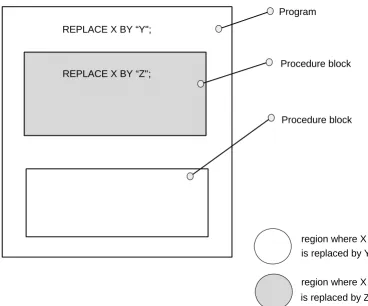
The only case in which a REPLACE statement in an outer block becomes ineffective in an inner block is when the inner block has a REPLACE statement in it with the same name.
Figure 5-2 REPLACE X BY “Y";
REPLACE X BY “Z";
Program
Procedure block
Procedure block
region where X is replaced by Y
region where X is replaced by Z
Replace statements may also possess parameters, turningthem into a sophisticated macro expansion facility.
6.0 DATA REFERENCING AND SUBSCRIPTING
Any appearance of the name of a previously-declared data item in an executable statement constitutes a reference to its value (and possibly causes a change in its value)10. Sometimes it is necessary to be able to reference elements of vectors, matrices, and arrays, and also to reference parts of character strings. HAL/S has a wide range of subscript forms designed for this purpose.
Two kinds of subscripting are relevant to the data types described in Section 4.
• COMPONENT SUBSCRIPTING allows the user to select elements or subsets of elements from vectors and matrices, and to select substrings from character data items.
• ARRAY SUBSCRIPTING allows the user to select elements or subsets of elements from arrays of any data type.
Depending on the nature of a particular data item, either or both kinds of subscripting may be affixed to it.
6.1 SUBSCRIPTS OF UNARRAYED DATA TYPES
Unarrayed data types, i.e., those whose declarations contain no array specification, may at most possess only component subscripting. Unarrayed data items of integer, scalar, and Boolean types may not possess any subscripting. Allowable subscripts for the remaining types, - character, vector, and matrix - are now each described in turn.
CHARACTER
In a character data item, character positions are indexed left to right starting from 1. In the subscript forms given below, STRING represents an unarrayed data item of character type with current working length L.11
• To select the αth character from STRING:
• To select α characters from STRING, starting from the βth:
10.This Section, for convenience, includes appearance causing change in value under the term “reference'', even though this is not the most usual meaning of the term.
11.In the case where reference of a subscripted character data type causes a change in its value (e.g. on the left hand side of an assignment), somewhat different interpretations of the subscript form holds true. An account of these is given in Section 8.3.
STRINGα
1. α is an integer expression in the range 1 ≤α≤ L.
STRINGα AT β
1. α and β are integer expressions 2. β is in the range 1 ≤β≤ L.
• To select a substring starting with the αth character of STRING, and ending with the
βth:
Examples:
VECTOR
Elements of a vector are indexed starting from 1. In the following subscript forms, VEC represents an unarrayed vector data item of length L.
• To select the αth element from VEC:
• To select an α-vector partition starting from the βth element of VEC:
• To select a partition starting from the αth element of VEC and ending with the βth.
STRINGα TO β
1. αand β are integer expressions in the range 1 ≤ (α,β) ≤ L. 2. β>α.
if C ≡ ‘ABCDEF’ then:
C5≡‘E’ For further information refer to the Language Specification, Sec. 5.3.2 where the use of # is explained.
C2 AT 2 ≡ ‘BC’ C4 TO 6 ≡ ‘DEF’
VECα
1. α is an integer expression in the range 1 ≤α≤ L. 2. The resulting data type is scalar.
VEC α AT β
1. α is an integer literal value in the range 2 < α < L. 2. β is an integer expression in the range 1 ≤β≤ L - α + 1.
VECα TO β
Examples:
then:
V1 4.5 (scalar)
MATRIX
Rows and columns of a matrix are indexed starting from 1. Any matrix subscript must consist of a row subscript followed by a column subscript. In the following subscript forms, MAT represents an unarrayed M x N matrix data item.
• To select the element of MAT common to the αth row and βth column:
• To select the αth row of MAT:
• To select the βth column of MAT:
⎡ 4.5 ⎤ if V ≡ ⎢ 9.3 ⎢
⎢ 7.1 ⎢ ⎣ 2.7 ⎦
V3 TO 4 ⎡7.1⎤
⎣2.7⎦ (2-vector)
V2 AT 1 ⎡4.5⎤
⎣9.3⎦ (2-vector)
MATα,β 1. α, β are integer expressions.
2. α is in the range 1 ≤α≤ M, and β is in the range of 1 ≤β≤ N. 3. The resultant data type is SCALAR.
MATα,*
1. α is an integer expression in the range 1 < α < M. 2. The resultant data is N-VECTOR.
3. If the asterisk is replaced by a TO- or AT- subscript under the rules given for vector data types, a vector partition from the αth row may be selected.
MAT*, β
1. β is an integer expression in the range 1 < β < N. 2. The resultant data is M-VECTOR.
3. If the asterisk is replaced by a TO- or AT- subscript under the rules given for vector data types, a vector partition from the βth column may be selected.
≡ ≡
• To select a α x γ matrix partition starting from the βthrow and σth column of MAT:
Examples:
M2,3 ≡ 2.3 (scalar)
6.2 SUBSCRIPTS OF ARRAYED DATA TYPES
Arrayed data types, i.e., those whose declarations contain an array specification, may possess array subscripting. If the data types are vector, matrix, or character, then they may, in addition, possess component subscripting.
ARRAY SUBSCRIPTING ONLY
Arrays are indexed starting from 1. In the array subscript forms given below, TABLE represents an array of length L of any data type.
MATα AT β,γ AT α
1. α, γ are integer literal values in ranges 2< α < M, 2< γ< N, respectively. 2. β, γ are integer expression in ranges 1≤β≤ M - α + 1,
1 < σ < N - γ + 1 respectively.
3. Either or both the AT-subscripts may be replaced by TO-subscripts under rules already given by vector and matrix types.
4. Either of the AT- subscripts may in addition be replaced by an asterisk if all M rows or all N columns are to be included in the partition.
⎡ 1.1 1.2 1.3 ⎤
if M ≡ ⎢ 2.1 2.2 2.3 ⎥ then: ⎣ 3.1 3.2 3.3 ⎦
⎡1.1⎤ ⎢2.1⎥
M∗,1 ≡ ⎣3.1⎦ (3-vector) ⎡2.2⎤
M2, 2 TO 3 ≡ ⎣2.3⎦ (2-vector) ⎡1.1 1.2⎤
M∗,2 AT 1 ≡ ⎢2.1 2.2⎥ (3x2 matrix) ⎣3.1 3.2⎦
⎡1.1 1.2⎤
• To select the αth array element from TABLE:
• To select a sub-array of length α starting from the βth array element of TABLE:
• To select a sub-array starting from the αth array element of TABLE and ending with the βth.
Examples:
if T is a 4-array of Booleans with
T ≡ (TRUE FALSE TRUE TRUE) then: T2:≡ FALSE (unarrayed) T3 TO 4:≡ (TRUE,FALSE) (still arrayed) if T is a 4-array of integers with
T ≡ (1 2 3 4) then:
T2≡ 2 (unarrayed)
T3 TO 4≡ (3,4) (still arrayed) optional colon omitted
if C is a 3-array of characters, with C ≡ (‘YES’ ‘NO’ ‘MAYBE’) then:
C1:≡ ‘YES’ (selects first array element) C2 TO 3:≡ (‘NO’,‘MAYBE’) (still arrayed)
TABLEα:
1. α is an integer expression in the range 1 ≤α≤ L.
2. The colon is optional only if the data type of TABLE is integer or scalar.
TABLEα AT β:
1. α is an integer literal value in the range 1 ≤α≤ L.
2. β is an integer expression in the range 1 ≤β≤ L - α + 1.
3. The colon is optional if the data type of TABLE is integer or scalar.
TABLE α TO β:
1. α, β are integer literal values in the range 1 ≤ (α,β) ≤ L . 2. β > α
3. The colon is optional if the data type of TABLE is integer or scalar.
ARRAY AND COMPONENT SUBSCRIPTING
If TABLE represents an array of vector, matrix, or character data type, then the following rule shows how array and component subscripting are juxtaposed.
The purpose of the colon now becomes clear: it is required to distinguish and separate array and component subscripting.
Examples:
if C is a 3-array of characters, with C ≡ (‘YES’,‘NO’,‘MAYBE’) then: C3:3 ≡ ‘Y’ (selects 3rd character from third array element) if M is a 2-array of 2x2 matrices with
M2:2, 2 = 8 (element in 2nd row, 2nd column of second array element)
COMPONENT SUBSCRIPTING ONLY
When an arrayed data item of vector, matrix or character type is required to be given only component subscripting, array subscripting cannot be totally omitted. Rather, it must be replaced by an asterisk. Let TABLE represent such a data item; the subscripting form is then required to be:
TABLEarray: component
1. array represents array subscripting of any of the forms previously described.
2. component represents any form of component subscripting legal for the data type of TABLE, as described in Section 6.1.
⎡1 2⎤ ⎡5 6⎤
M ≡ ⎣3 4⎦, ⎣7 8⎦ then:
Apparently, the colon should be optional on Boolean data types also. It is not because the Boolean data type is a degenerate case of a bit string data type which may possess component subscripting.
See: Guide/17.3.
TABLE*:component
Examples:
if C is a 3-array of characters, with C ≡ (‘YES’,‘NO’,‘MAYBE’) then:
C*:1≡ (‘Y’,‘N’,‘M’) (makes 3-array from first character of each item) if M is a 2-array of 2x2 matrices with
M*:1,1= (1,5) (2-array of scalars)
M ≡ ⎛ ⎡1 2⎤ ⎡5 6⎤ ⎞ then:
⎝ ⎣3 4⎦, ⎣7 8⎦ ⎠
M*:*,2≡ ⎛ ⎡2⎤ ⎡6⎤ ⎞ (2-array of 2-vectors) ⎝ ⎣4⎦, ⎣8⎦ ⎠
HAL/S allows more general forms of subscript expressions than just those stated above. See Spec./5.3. In particular, a symbolic form of reference to the last array or other element of a data type is allowed.
See Spec./5.3.2.
More complex subscripting forms apply to multi-dimensional arrays, See Guide/18.3; and to the organization of data called “structures”.
See Guide/19.6.
Subscript forms stated to be literals may in fact be expressions computable at compile time.
7.0 EXPRESSIONS
Section 6 dealt with the referencing of declared data items. At this point it is appropriate to describe how the values of these data items can be manipulated. In HAL/S the construct which specifies operations on data items is called an "expression"1. In many cases it is very close in form to the generally accepted notion of a mathematical
expression.
Generally, expressions consist of sequences of operations, possibly parenthesized in places to override the precedence rules of HAL/S. Each operation is comprised of one or two operands and an operator. The very simplest form of expression is one in which there are no operations and just one operand. An operand may be a data item, possibly subscripted, or a built-in function, or an explicit conversion function. This section begins by describing the legal HAL/S operations, and then continues to show how they are combined into expressions.
Previous sections of the Guide have divided data items and literals into three broad classes: arithmetic, character, and Boolean. It is convenient to divide the operations to be described into the same three classes. The type of an expression is the type of the value resulting from its execution, and may, in general, be different from the types of some of its operands.
7.1 ARITHMETIC OPERATIONS
Arithmetic operations are the most numerous of all operations in the HAL/S language. They comprise operations on vector, matrix, integer, and scalar data types. HAL/S recognizes the following operations:
1. The storing of the result of a HAL/S expression into a data item is performed by an ASSIGNMENT statement, of which the expression forms a part.
Symbol Purpose
* * exponentiation, inversion, transposition
(blank) multiplication
* vector cross product
. vector dot product
/ division
+ addition
NEGATION
Negation is a unary operation applicable to any arithmetic data type:
Examples:
if I is an integer and I ≡ 5 then -I ≡ -5
Symbolic form: - R
1. The legal data types for R are given by the following table: R-type
MATRIX VECTOR SCALAR INTEGER
2. Negation of vector and matrix types implies element-by-element negation.
⎡-1.5 ⎤ if V is a 3-vector and V ≡ ⎢ 4.2 ⎪
⎣-5.1 ⎦ ⎡ 1.5 ⎤
ADDITION AND SUBTRACTION
Addition and subtraction can only take place between compatible arithmetic data types:
Examples:
If I is integer with I ≡ 5 S is scalar with S ≡ -4.2 then
I + 1 ≡ 6 (integer result) I + 0.5 ≡ 5.5 (scalar result) S + 1 ≡ -3.2 (scalar result) I - S ≡ 9.2 (scalar result)
then the operation V1 + V2 is illegal because the lengths of V1, V2 do not match; Symbolic form: L + R
1. The legal combinations of data types are indicated by the following table:
L-type R-type
MATRIX VECTOR
SCALAR ⎫
INTEGER⎬
⎭
MATRIX VECTOR
⎧SCALAR
⎨INTEGER
⎩
2. Operations on matrix and vector operands imply element-by-element addition and subtraction.
3. The operands in a matrix addition or subtraction must have the same row and column dimensions.
4. The operands in a vector addition or subtraction must have the same lengths.
5. In a mixed integer-scalar operation, the result is scalar. The integer operand is first converted to single precision scalar.
if V1 is a 3-vector with V1 ≡
V2 is a 4-vector with V2 ≡
1.0 –
2.5 –
3.2
0.5 0 2.2 –
but
Using S, V1 above,
S + V1 is illegal because the types are incompatible;
but S + V13 ≡ -1.0 is legal and has a scalar result because subscripting has changed the R operand to scalar type.
then M1 - M2 is illegal because the row dimensions of the operands do not match; but
DIVISION
In division, the dividend may be any data type, but the divisor must either be integer or scalar.
⎡ -1.5 ⎤
V1 - V21 TO 3 ≡ ⎢ -2.5 ⎢ is legal because of the R operand has ⎣ 5.4 ⎦ produced a 3-vector.
⎡ 1.0 0 ⎤ If M1 is a 3 x 2 matrix with M1 ≡ ⎢-0.5 -1.0 ⎢
⎣ 0 0 ⎦ ⎡ 0.5 -0.5 ⎤ M2 is a 2 x 2 matrix with M2 ≡ ⎣ 1.0 1.0 ⎦
⎡ 0.5 0.5 ⎤
M12 AT 1,* - M2 ≡ ⎣ -1.5 -2.0 ⎦ is legal because the number of rows in the L operand have been reduced to 2 by subscripting.
Symbolic form: L/R
1. The legal combinations of data types are given by the following table:
L-type R-type
MATRIX ⎫
VECTOR ⎬
SCALAR ⎪
INTEGER⎭
⎧
⎨SCALAR
⎩INTEGER
2. If the dividend is of matrix or vector type, element-by-element division by the R operand is implied.
Examples:
1/2 ≡ 0.5 (both integer operands converted to scalar)
if V is a 3-vector with V ≡
then V/2 ≡
S is a scalar with S ≡ 0.5
then S/M is illegal since the R operand may not be of matrix type,
DOT PRODUCT
The HAL/S dot product operation corresponds to the mathematical dot or inner product of two vectors. In mathematical notation:
s = <u , v> or s = uTv
where u, v are column vectors and T denotes the transpose.
Note that HAL/S does not require the user to distinguish between row and column vectors because the position of the operand in the operation is sufficient in itself to allow it to be interpreted as one or the other.
⎡ 1.0 -0.5⎤ if M is a 2 x 2 matrix with M ≡ ⎣ 0.2 0.6 ⎦
⎡2.0 -1.0⎤ but M/S ≡ ⎣ 0.4 1.2 ⎦
Symbolic form: L.R
1. The operands of the dot product must be as shown: L-type R-type
VECTOR VECTOR
2. The lengths of each operand must be the same. 3. The result is of scalar type.
2.0 4.0 6.0
Example:
if V is a 3-vector with V ≡
then V.V = 1.5 CROSS PRODUCT
The HAL/S cross product operation corresponds to the mathematical vector cross product in 3-dimensional Euclidean space:
Figure 7-1
Example:
Symbolic form: L * R
1. The operands must be of type vector:
L-type R-type
VECTOR VECTOR
2. Both operands must be of length 3. 3. The result is a 3-vector.
if V1 is a 3-vector with V1 ≡
if V2 is a 3-vector with V2≡
then V1 * V2 ≡
0.5 1.0 0.5 –
u
v
θ w
if w is perpendicular to u, v as shown, and | w | = | u | | v | sinθ then w = u x v
0.5 0 0 0 0.5 0 0
MULTIPLICATION
The HAL/S language has no explicit symbol for multiplication: the adjacency of two operands signifies this operation. Multiplication can take place with arithmetic operands of any type:
• If operand types are either integer or scalar, multiplication in the regular arithmetic sense is implied;.……….………CASE • if one operand is integer or scalar, and the other vector or matrix, then
element-by-element multiplication is implied;………. CASE • if both operands are vectors then the outer product is implied, the result being a
matrix;.………...CASE • if both operands are matrices, the matrix product is implied;.………...CASE • if one operand is a matrix, and the other a vector, then a vector-matrix product is
implied, the result being a vector..……….…...CASE The symbolic form for multiplication is as shown:
The additional rules applicable to each of the cases described above are now listed in turn.
CASE
Example:
If I is integer with I ≡ 10
then 1.5E-2 I ≡ 0.15 (scalar result)
Symbolic form: L R
1. At least one blank character must separate the L and R operands.
2. The operand types are:
L-type R-type
INTEGER SCALAR
⎧
⎨INTEGER
⎩SCALAR
3. If both operands are integer, the result is integer, otherwise it is scalar.
4. If one operand is integer, then it is first converted to single precision scalar.
1
2
3
4
5
1
CASE
Examples:
if S is scalar with S ≡ 1.5
CASE
2. The operand types are:
L-type R-type
INTEGER SCALAR
⎧
⎨VECTOR
⎩MATRIX
VECTOR MATRIX
⎧
⎨INTEGER
⎩SCALAR
3. Element-by-element multiplication of the vector or matrix is implied. 4. If one operand is of integer type, it is first converted to single
precision scalar.
⎡ 0 0.3 ⎤ M is a 2 x 2 matrix with M ≡ ⎣-0.1 0.4 ⎦
⎡ 0 0.45⎤
then S M ≡ ⎣-0.15 0.6 ⎦
⎡ 0 0.45⎤
and M S ≡ ⎣-0.15 0.6 ⎦
2. The operand types are: L-type R-type
VECTOR VECTOR
3. If the L-operand is of length m, and the R operand is of length n, the result is an m x n matrix.
2
⎫ ⎬ ⎭
⎫ ⎬ ⎭