warwick.ac.uk/lib-publications
Original citation:
Dabrowski, Konrad K., Lozin, Vadim V. and Paulusma, Daniel. (2017) Well-quasi-ordering
versus clique-width : new results on bigenic classes. Order .
Permanent WRAP URL:
http://wrap.warwick.ac.uk/88456
Copyright and reuse:
The Warwick Research Archive Portal (WRAP) makes this work of researchers of the
University of Warwick available open access under the following conditions.
This article is made available under the Creative Commons Attribution 4.0 International
license (CC BY 4.0) and may be reused according to the conditions of the license. For more
details see:
http://creativecommons.org/licenses/by/4.0/
A note on versions:
The version presented in WRAP is the published version, or, version of record, and may be
cited as it appears here.
DOI 10.1007/s11083-017-9430-7
Well-Quasi-Ordering versus Clique-Width: New Results
on Bigenic Classes
Konrad K. Dabrowski1·Vadim V. Lozin2 · Dani¨el Paulusma1
Received: 13 November 2016 / Accepted: 13 May 2017 © The Author(s) 2017. This article is an open access publication
Abstract Daligault, Rao and Thomass´e asked whether a hereditary class of graphs well-quasi-ordered by the induced subgraph relation has bounded clique-width. Lozin, Razgon and Zamaraev recently showed that this is not true for classes defined by infinitely many forbidden induced subgraphs. However, in the case of finitely many forbidden induced sub-graphs the question remains open and we conjecture that in this case the answer is positive. The conjecture is known to hold for classes of graphs defined by a single forbidden induced subgraphH, as such graphs are well-quasi-ordered and are of bounded clique-width if and only ifH is an induced subgraph ofP4. For bigenic classes of graphs, i.e. ones defined by
two forbidden induced subgraphs, there are several open cases in both classifications. In the present paper we obtain a number of new results on well-quasi-orderability of bigenic classes, each of which supports the conjecture.
Keywords Well-quasi-order·Induced subgraph·Hereditary graph class·Bigenic class
Research supported by EPSRC (EP/K025090/1 and EP/L020408/1) and the Leverhulme Trust (RPG-2016-258). An extended abstract of this paper appeared in the proceedings of IWOCA 2016 [12].
Konrad K. Dabrowski
Vadim V. Lozin [email protected]
Dani¨el Paulusma
1 School of Engineering and Computing Sciences, Durham University, Science Laboratories, South
Road, Durham DH1 3LE, UK
1 Introduction
Well-quasi-ordering is a highly desirable property and frequently discovered concept in mathematics and theoretical computer science [18,22]. One of the most remarkable results in this area is Robertson and Seymour’s proof of Wagner’s conjecture, which states that the set of all finite graphs is well-quasi-ordered by the minor relation [27]. One of the first steps towards this result was the proof of the fact that graph classes of bounded treewidth are well-quasi-ordered by the minor relation [26] (a graph parameterπis said to be bounded for some graph classGif there exists a constantcsuch thatπ(G)≤cfor allG∈G).
The notion of clique-width generalizes that of treewidth in the sense that graph classes of bounded treewidth have bounded clique-width, but not necessarily vice versa. The impor-tance of both notions is due to the fact that many algorithmic problems that are NP-hard on general graphs become polynomial-time solvable when restricted to graph classes of bounded treewidth or clique-width. For treewidth this follows from the meta-theorem of Courcelle [6], combined with a result of Bodlaender [2]. For clique-width this follows from combining results from several papers [8, 17, 20, 25] with a result of Oum and Seymour [24].
In the study of graph classes of bounded treewidth, we can restrict ourselves to minor-closed graph classes, because from the definition of treewidth it immediately follows that the treewidth of a graph is never smaller than the treewidth of its minor. This restriction, however, is not justified when we study graph classes of bounded clique-width, as the clique-width of a graph can be much smaller than the clique-width of its minor. In particu-lar, Courcelle [7] showed that ifGis the class of graphs of clique-width 3 andGis the class of graphs obtainable from graphs inGby applying one or more edge contraction operations, thenGhas unbounded clique-width. On the other hand, the clique-width of a graph is never smaller than the clique-width of any of its induced subgraphs (see, for example, [9]). This allows us to restrict ourselves to classes of graphs closed under taking induced subgraphs. Such graph classes are also known ashereditaryclasses.
It is well-known (and not difficult to see) that a class of graphs is hereditary if and only if it can be characterized by a set of minimal forbidden induced subgraphs. Due to the min-imality, the setF of forbidden induced subgraphs is always an antichain, that is, no graph inF is an induced subgraph of another graph inF. For some hereditary classes this set is finite, in which case we say that the class isfinitely defined, whereas for other heredi-tary classes (such as, for instance, bipartite graphs) the set of minimal forbidden induced subgraphs forms an infinite antichain. The presence of these infinite antichains immedi-ately shows that the induced subgraph relation is not a well-quasi-order. In fact there even exist graph classes of bounded clique-width that are not well-quasi-ordered by the induced subgraph relation: take, for example, the class of cycles, which all have clique-width at most 4. What about the inverse implication: does well-quasi-ordering imply bounded clique-width? This was stated as an open problem by Daligault, Rao and Thomass´e [15] and a negative answer to this question was recently given by Lozin, Razgon and Zama-raev [23]. However, the latter authors disproved the conjecture by giving a hereditary class of graphs whose set of minimal forbidden induced subgraphs is infinite. Hence, for finitely defined classes the question remains open and we conjecture that in this case the answer is positive.
We emphasize that our motivation for verifying Conjecture 1 is not only mathematical but also algorithmic. Should Conjecture 1 be true, then for finitely defined classes of graphs the aforementioned algorithmic consequences of having bounded clique-width also hold for the property of being well-quasi-ordered by the induced subgraph relation.
A class of graphs is monogenic orH-freeif it is characterized by a single forbidden induced subgraphH. For monogenic classes, the conjecture is true. In this case, the two notions even coincide: a class of graphs defined by a single forbidden induced subgraphHis well-quasi-ordered if and only if it has bounded clique-width if and only ifHis an induced subgraph ofP4(see, for instance, [14,16,21]).
A class of graphs isbigenicor(H1, H2)-freeif it is characterized by two incomparable
forbidden induced subgraphs H1 andH2. The family of bigenic classes is more diverse
than the family of monogenic classes. The questions of well-quasi-orderability and having bounded clique-width still need to be resolved. Recently, considerable progress has been made towards answering the latter question for bigenic classes; there are currently seven (non-equivalent) open cases [13]. With respect to well-quasi-orderability of bigenic classes, Korpelainen and Lozin [21] left all but 14 cases open. Since then, Atminas and Lozin [1] proved that the class of(K3, P6)-free graphs is well-quasi-ordered by the induced subgraph
relation and that the class of(2P1+P2, P6)-free graphs is not. Very recently, we used the
techniques developed in the present paper to prove that the classes of(P1+P3, P2+P4)
-free graphs and(P1+P3, P1+P5)-free graphs are also well-quasi-ordered by the induced
subgraph relation [13]. The class of(P1+P3, P1+2P2)-free graphs, which is contained
in both of these classes, was also an open case. This reduced the number of remaining open cases to nine. All available results for bigenic classes verify Conjecture 1. Moreover, six of the nine open cases have bounded clique-width (and thus immediately verify Conjecture 1), leaving three remaining open cases of bigenic classes for which we still need to verify Conjecture 1.
1.1 Our Results
Our first goal is to obtain more (bigenic) classes that are well-quasi-ordered by the induced subgraph relation and to support Conjecture 1 with further evidence. Our second and more general goal is to increase our general knowledge on well-quasi-ordered graph classes and the relation to the possible boundedness of their clique-width.
Towards our first goal we prove in Section4that the class of(2P1+P2, P2+P3)-free
graphs (which has bounded clique-width [11]) is well-quasi-ordered by the induced sub-graph relation. In Section5we also determine, by giving infinite antichains, two bigenic classes that are not, namely the class of (2P1+P2, P2 + P4)-free graphs, which has
unbounded clique-width [11], and the class of(P1+P4, P1+2P2)-free graphs, for which
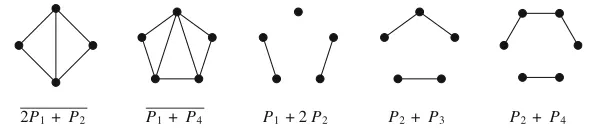
boundedness of the clique-width is unknown (see Fig.1for drawings of the five forbidden induced subgraphs). Consequently, there are six classes of(H1, H2)-free graphs for which
we do not know whether they are well-quasi-ordered by the induced subgraph relation, and there is one open case left for the verification of Conjecture 1 for bigenic classes. We refer to Open Problems 1 and 3, respectively, in Section6where we also give an exact description of the state-of-the-art for results on well-quasi-orderability and boundedness of clique-width for bigenic classes of graphs.
2P1+ P2 P1+P4 P1+ 2P2 P2+ P3 P2+ P4
Fig. 1 The forbidden induced subgraphs considered in this paper
graph fromGvia a number of elementary graph operations that do not modify the clique-width by “too much” into a graph from a class for which we do know whether or not its clique-width is bounded.
It is a natural question to research how the above modification technique can be used for well-quasi-orders. We do this in Section3. The permitted elementary graph operations that preserve (un)boundedness of the clique-width are vertex deletion, subgraph comple-mentation and bipartite complecomple-mentation. As we will explain in Section 3, these three graph operations do not preserve well-quasi-orderability. We circumvent this by investi-gating whether these three operations preserve boundedness of a graph parameter called uniformicity. This parameter was introduced by Korpelainen and Lozin [21], who proved that every graph classG of bounded uniformicity is well-quasi-ordered by the so-called labelled induced subgraph relation, which in turn implies thatGis well-quasi-ordered by the induced subgraph relation. Korpelainen and Lozin [21] proved that boundedness of uni-formicity is preserved by vertex deletion. We prove that this also holds for the other two graph operations.
The above enables us to focus on boundedness of uniformicity. However, we cannot always do this: there exist graph classes of unbounded uniformicity that are well-quasi-ordered by the labelled induced subgraph relation. As such, we sometimes need to rely only on the labelled induced subgraph relation directly. Hence, in Section3we also show that the three permitted graph operations, vertex deletion, subgraph complementation and bipar-tite complementation, preserve well-quasi-orderability by the labelled induced subgraph relation.
As explained in Section6, we believe that this graph modification technique will also be useful for proving well-quasi-orderability of other graph classes. As such, we view the results in Section3as the second main contribution of our paper.
2 Preliminaries
Thedisjoint union(V (G)∪V (H ), E(G)∪E(H ))of two vertex-disjoint graphsGandH
is denoted byG+H and the disjoint union ofr copies of a graphGis denoted byrG. Thecomplementof a graphG, denoted byG, has vertex setV (G) = V (G)and an edge between two distinct vertices if and only if these vertices are not adjacent inG. For a subset
S ⊆ V (G), we letG[S]denote the subgraph ofGinducedbyS, which has vertex setS
and edge set{uv|u, v∈S, uv∈E(G)}. IfS= {s1, . . . , sr}then, to simplify notation, we may also writeG[s1, . . . , sr]instead ofG[{s1, . . . , sr}]. We useG\Sto denote the graph obtained fromGby deleting every vertex inS, i.e.G\S=G[V (G)\S]. We writeH ⊆i G to indicate thatH is isomorphic to an induced subgraph ofG.
[image:5.440.70.367.57.123.2]i ≤j, denotes thesubdivided claw, that is, the tree that has only one vertexxof degree 3 and exactly three leaves, which are of distance h,i andj fromx, respectively. Observe that S1,1,1 = K1,3. We let S denote the class of graphs, each connected component of
which is either a subdivided claw or a path. For a set of graphs{H1, . . . , Hp}, a graphG is(H1, . . . , Hp)-freeif it has no induced subgraph isomorphic to a graph in{H1, . . . , Hp}; ifp=1, we may writeH1-free instead of(H1)-free.
For a graph G = (V , E)and a vertexu ∈ V, the setNG(u) = {v ∈ V | uv ∈ E} denotes the (open)neighbourhoodofuinGandNG[u] =NG(u)∪ {u}denotes theclosed
neighbourhood ofu. We may writeN (u)andN[u]instead of NG(u)andNG[u]if this is unambiguous. A graph isbipartiteif its vertex set can be partitioned into (at most) two independent sets. ThebicliqueKr,sis the bipartite graph with sets in the partition of sizer andsrespectively, such that every vertex in one set is adjacent to every vertex in the other set.
LetXbe a set of vertices of a graphG=(V , E). A vertexy∈V\XiscompletetoXif it is adjacent to every vertex ofXandanti-completetoXif it is non-adjacent to every vertex ofX. Similarly, a set of verticesY ⊆V\Xiscomplete(resp.anti-complete) toXif every vertex inYis complete (resp. anti-complete) toX. A vertexy∈V\XdistinguishesXify
has both a neighbour and a non-neighbour inX. The setXis amoduleofGif no vertex in
V \XdistinguishesX. A moduleXisnon-trivialif 1<|X|<|V|, otherwise it istrivial. A graph isprimeif it has only trivial modules.
Aquasi order≤on a setXis a reflexive, transitive binary relation. Two elementsx, y∈ Xin this quasi-order arecomparableifx ≤yory≤x, otherwise they areincomparable. A set of elements in a quasi-order is achainif every pair of elements is comparable and it is anantichainif every pair of elements is incomparable. The quasi-order≤is a well-quasi-orderif any infinite sequence of elementsx1, x2, x3, . . .inXcontains a pair(xi, xj)with
xi ≤xjandi < j. Equivalently, a quasi-order is a well-quasi-order if and only if it has no infinite strictly decreasing sequencex1x2x3· · · and no infinite antichain.
For an arbitrary set M, letM∗ denote the set of finite sequences of elements of M. Any quasi-order≤ onM defines a quasi-order≤∗ onM∗as follows:(a1, . . . , am) ≤∗
(b1, . . . , bn)if and only if there is a sequence of integersi1, . . . , imwith 1≤i1 <· · ·<
im≤nsuch thataj≤bij forj ∈ {1, . . . , m}. We call≤∗thesubsequence relation.
Lemma 1 (Higman’s Lemma [19]) If(M,≤) is a well-quasi-order then(M∗,≤∗) is a well-quasi-order.
2.1 Labelled Induced Subgraphs and Uniformicity
To define the notion of labelled induced subgraphs, let us consider an arbitrary quasi-order
(W,≤). We say thatGis alabelledgraph if each vertexvofGis equipped with an element
lG(v)∈W(thelabelofv). Given two labelled graphsGandH, we say thatGis alabelled
induced subgraphofH ifGis isomorphic to an induced subgraph ofH and there is an
isomorphism that maps each vertexvofGto a vertexwofHwithlG(v)≤lH(w). Clearly, if(W,≤)is a well-quasi-order, then a class of graphsXcannot contain an infinite sequence of labelled graphs that is strictly-decreasing with respect to the labelled induced subgraph relation. We therefore say that a class of graphs Xis well-quasi-ordered by thelabelled
induced subgraph relation if it contains no infinite antichains of labelled graphs whenever
(W,≤)is awell-quasi-order. Such a class is readily seen to also be well-quasi-ordered by the induced subgraph relation.
Lemma 2([1]) The class ofP6-free bipartite graphs is well-quasi-ordered by the labelled
induced subgraph relation.
Lemma 3 ([1]) Let k, , m be positive integers. Then the class of (Pk, K, Km,m)-free
graphs is well-quasi-ordered by the labelled induced subgraph relation.
Lemma 4([1]) LetXbe a hereditary class of graphs. ThenX is well-quasi-ordered by the labelled induced subgraph relation if and only if the set of prime graphs inX is. In particular,Xis well-quasi-ordered by the labelled induced subgraph relation if and only if the set of connected graphs inXis.
Letkbe a natural number, letK be a symmetric square(0,1)-matrix of orderk, and letFkbe a graph on the vertex set{1,2, . . . , k}. LetH be the disjoint union of infinitely many copies ofFk, and fori =1, . . . , k, letVi be the subset ofV (H )containing vertexi from each copy of Fk. Now we construct fromH an infinite graph H (K)on the same vertex set by applying a subgraph complementation toVi if and only ifK(i, i) = 1 and by applying bipartite complementation to a pairVi, Vjif and only ifK(i, j )=1. In other words, two verticesu∈Viandv∈Vj are adjacent inH (K)if and only ifuv∈E(H )and
K(i, j )=0 oruv /∈E(H )andK(i, j )=1. Finally, letP(K, Fk)be the hereditary class consisting of all the finite induced subgraphs ofH (K).
Letkbe a natural number. A graphGisk-uniformif there is a matrixKand a graphFk such thatG∈P(K, Fk). The minimumksuch thatGisk-uniform is theuniformicityofG. The following result was proved by Korpelainen and Lozin. The class of disjoint unions of cliques is a counterexample for the reverse implication.
Theorem 1([21]) Any class of graphs of bounded uniformicity is well-quasi-ordered by the labelled induced subgraph relation.
3 Permitted Graph Operations
It is not difficult to see that ifGis an induced subgraph ofH, thenGis an induced subgraph ofH. Therefore, a graph classXis well-quasi-ordered by the induced subgraph relation if and only if the set of complements of graphs inXis. In this section, we strengthen this observation in several ways.
First, we define the operation of subgraph complementation as follows.
Definition 1 Subgraph complementationin a graphGis the operation of complementing a subgraph ofGinduced by a subset of its vertices.
Applied to the entire vertex set ofG, this operation coincides with the usual complemen-tation ofG. However, applied to a pair of vertices, it changes the adjacency of these vertices only. Clearly, repeated applications of this operation can transformGinto any other graph on the same vertex set. Therefore, unrestricted applications of subgraph complementation may transform a well-quasi-ordered classXinto a class containing infinite antichains. How-ever, if we bound the number of applications of this operation by a constant, we preserve many nice properties ofX, including well-quasi-orderability with respect to the labelled induced subgraph relation.
Definition 2 Bipartite complementationin a graphGis the operation of complementing the edges between two disjoint subsetsX, Y ⊆V (G).
Note that applying a bipartite complementation betweenXandY has the same effect as applying a sequence of three subgraph complementations: with respect toX,YandX∪Y.
Finally, we define the following operation:
Definition 3 Vertex deletionin a graphGis the operation of removing a single vertexv
from a graph, together with any edges incident tov.
3.1 Operations on Labelled Graphs
Letk≥0 be a constant and letγ be a graph operation. A graph classGis(k, γ )-obtained
from a graph classGif the following two conditions hold:
(i) every graph inGis obtained from a graph inGby performingγ at mostktimes, and (ii) for everyG∈Gthere exists at least one graph inGobtained fromGby performingγ
at mostktimes.
We say thatγpreserveswell-quasi-orderability by the labelled induced subgraph relation if for any finite constantkand any graph classG, any graph classGthat is(k, γ )-obtained fromGis well-quasi-ordered by this relation if and only ifGis.
Lemma 5 The following operations preserve well-quasi-orderability by the labelled induced subgraph relation:
(i) Subgraph complementation,
(ii) Bipartite complementation and
(iii) Vertex deletion.
Proof We start by proving the lemma for subgraph complementations.
LetXbe a class of graphs and letY be a set of graphs obtained fromXby applying a subgraph complementation to each graph inX. More precisely, for each graphG∈Xwe choose a setZGof vertices inG; we letGbe the graph obtained fromG by applying a complementation with respect to the subgraph induced by ZG and we letY be the set of graphsGobtained in this way. Clearly it is sufficient to show thatXis well-quasi-ordered by the labelled induced subgraph relation if and only ifY is.
Suppose thatXis not well-quasi-ordered under the labelled induced subgraph relation. Then there must be a well-quasi-order(L,≤)and an infinite sequenceG1, G2, . . .of graphs
in X with vertices labelled with elements ofL, such that these graphs form an infinite antichain under the labelled induced subgraph relation. Let(L,≤)be the quasi-order with
L = {(k, l) : k ∈ {0,1}, l ∈ L} and(k, l) ≤ (k, l) if and only ifk = kandl ≤ l
(soLis the disjoint union of two copies ofL, where elements of one copy are incomparable with elements of the other copy). Note that(L,≤)is a well-quasi-order since(L,≤)is a well-quasi-order.
For each graphGi in this sequence, with labellingli, we construct the graphGi (recall thatGiis obtained fromGiby applying a complementation on the vertex setZGi). We label the vertices ofV (Gi)with a labellinglias follows:
We claim that whenG1, G2, . . .are labelled in this way they form an infinite antichain with respect to the labelled induced subgraph relation. Indeed, suppose for contradiction thatGi is a labelled induced subgraph ofGj for somei =j. This means that there is a injective mapf : V (Gi) → V (Gj)such thatli(v) ≤ lj(f (v))for allv ∈ V (Gi)and
v, w∈V (Gi)are adjacent inGiif and only iff (v)andf (w)are adjacent inGj. Now since
li(v)≤lj(f (v))for allv∈V (Gi), by the definition of≤we conclude the following:
– li(v)≤lj(f (v))for allv∈V (Gi)and – v∈ZGiif and only iff (v)∈ZGj.
Supposev, w ∈V (Gi)withw /∈ZGi (vmay or may not belong toZGi) and note that this impliesf (w) /∈ ZGj. Thenv andw are adjacent inGi if and only ifvandw are adjacent inGiif and only iff (v)andf (w)are adjacent inGjif and only iff (v)andf (w)
are adjacent inGj.
Next supposev, w∈ZGi, in which casef (v), f (w)∈ZGj. Thenvandware adjacent inGi if and only ifv andw are non-adjacent inGi if and only iff (v) andf (w)are non-adjacent inGjif and only iff (v)andf (w)are adjacent inGj.
It follows thatf is an injective mapf :V (Gi) →V (Gj)such thatli(v) ≤lj(f (v)) for allv ∈V (Gi)andv, w∈V (Gi)are adjacent inGiif and only iff (v)andf (w)are adjacent inGj. In other wordsGiis a labelled induced subgraph ofGj. This contradiction means that ifG1, G2, . . .is an infinite antichain thenG1, G2, . . .must also be an infinite
antichain.
Therefore, if the classXis not well-quasi-ordered by the labelled induced subgraph rela-tion then neither isY. Repeating the argument with the roles ofG1, G2, . . .andG1, G2, . . .
reversed shows that if Y is not well-quasi-ordered under the labelled induced subgraph relation then neither isX. This completes the proof for subgraph complementations.
Since a bipartite complementation is equivalent to doing three subgraph complementa-tions one after another, the result for bipartite complementacomplementa-tions follows.
Finally, we prove the result for vertex deletions.
LetXbe a class of graphs and let Y be a set of graphs obtained fromXby deleting exactly one vertexzGfrom each graphGinX. We denote the obtained graph byG−zG. Clearly it is sufficient to show thatXis well-quasi-ordered by the labelled induced subgraph relation if and only ifYis.
Suppose thatYis well-quasi-ordered by the labelled induced subgraph relation. We will show thatX is also well-quasi-ordered by this relation. For each graphG ∈ X, letG
be the graph obtained fromGby applying a bipartite complementation between{zG}and
N (zG), sozGis an isolated vertex inG. LetZbe the set of graphs obtained in this way. By Lemma 5.(ii),Zis well-quasi-ordered by the labelled induced subgraph relation if and only ifXis. SupposeG1, G2are graphs inZwith vertices labelled from some
well-quasi-order(L,≤). Then fori∈ {1,2}the vertexzGihas a label fromLand the graphGi−zGi belongs toY. Furthermore ifG1−zG1 is a labelled induced subgraph ofG2−zG2 and
lG1(zG1) ≤lG2(zG2)thenG1 is a labelled induced subgraph ofG2. Now by Lemma 1 it
follows thatZis well-quasi-ordered by the labelled induced subgraph relation. ThereforeX
is also well-quasi-ordered by this relation.
and label all other verticesv ∈ V (Gi)with the same label as that used inGi. We make this new label∗incomparable to all the other labels inLand note that the obtained quasi order(L∪ {∗},≤)is also a well-quasi-order. It follows thatG1, G2, . . .is an antichain inX
when labelled in this way. Therefore, ifY is not well-quasi-ordered by the labelled induced subgraph relation then neither isX. This completes the proof.
Note that the above lemmas only apply to well-quasi-ordering with respect to thelabelled
induced subgraph relation. Indeed, if we take a cycle and delete a vertex, complement the subgraph induced by an edge or apply a bipartite complementation to two adjacent vertices, we obtain a path. However, while the set of cycles is an infinite antichain with respect to the induced subgraph relation, the set of paths is not.
3.2 Operations onk-Uniform Graphs
We now show that our graph operations do not change uniformicity by “too much” either. The result for vertex deletion was proved by Korpelainen and Lozin.
Lemma 6 LetGbe a graph of uniformicityk. Let G,G andGbe graphs obtained fromGby applying one vertex deletion, subgraph complementation or bipartite complemen-tation, respectively. Let,andbe the uniformicities ofG,GandG, respectively. Then the following three statements hold:
(i) < k <2+1 [21];
(ii) k2 ≤≤2k;
(iii) k3 ≤≤3k.
Proof The first inequality of Part (i) is trivial. The second inequality of Part (i) was proved in [21]. We prove Parts (ii) and (iii) below.
LetGbe a graph of uniformicityk, letXbe a set of vertices inGand letGbe the graph obtained fromGby applying a complementation with respect to the subgraph induced byX. Letbe the uniformicity ofG. By symmetry, to prove Part (ii), it is sufficient to prove that≤2k.
SinceGis ak-uniform graph, it must belong toP (Fk, K)for someFkand someK, so it is an induced subgraph ofH (K).
Consider the graph obtained from Fk by replacing each vertex v of Fk by two non-adjacent vertices vandv. Apply a complementation with respect to{1,2, . . . , k} and letFkbe the obtained graph. In other words, ifv∈V (Fk)then
NF
k(v) = NFk(v)∪ {w
|w∈N
Fk(v)}and NF
k(v
) = N
Fk(v)∪ {w|w∈V (Fk)\NFk[v]}.
LetKbe a 2k×2kmatrix indexed by{1,2, . . . , k,1,2, . . . , k}withKi,j =Ki,j =
Ki,j =1−Ki,j =Ki,j.
This means thatH (K)is formed fromH (K)by adding a copy of each vertex that has the same neighbourhood and then applying a complementation with respect to the set of newly-created vertices.
newly-created vertices. ThereforeGis an induced subgraph ofH (K). ThereforeGis a 2k-uniform graph.
Part (iii) follows from similar arguments to those for Part (ii). (Also note that if we weaken the bounds in Part (iii) to k8 ≤ ≤8kthen the result follows immediately from combining Part (ii) with the fact that a bipartite complementation is equivalent to a sequence of three subgraph complementations).
4 A New Well-Quasi-Ordered Class
In this section we show that(2P1+P2, P2+P3)-free graphs are well-quasi-ordered by
the labelled induced subgraph relation. We divide the proof into several sections, depend-ing on whether or not the graphs under consideration contain certain induced subgraphs or not. We follow the general scheme that Dabrowski, Huang and Paulusma [11] used to prove that this class has bounded clique-width, but we will also need a number of new arguments.
4.1 Graphs containing aK5
We first consider graphs containing aK5and prove the following lemma.
Lemma 7 The class of(2P1+P2, P2+P3)-free graphs that contain aK5 is
well-quasi-ordered by the labelled induced subgraph relation.
Proof LetGbe a(2P1+P2, P2+P3)-free graph. LetXbe a maximal (by set inclusion)
clique inGcontaining at least five vertices.
Claim 1. Every vertex not inXhas at most one neighbour inX.
This follows from the fact thatXis maximal andGis 2P1+P2-free.
Suppose there is aP3 inG\X, say on verticesx1, x2, x3 in that order. Since|X| ≥
5, we can find y1, y2 ∈ X none of which are adjacent to any of x1, x2, x3. Then
G[y1, y2, x1, x2, x3]is aP2+P3. This contradiction shows thatG\XisP3-free and must
therefore be a union of disjoint cliquesX1, . . . , Xk. We say that a cliqueXi islargeif it contains at least two vertices and that it issmallif it contains exactly one vertex.
Claim 2. Ifx ∈Xis adjacent toy∈Xi andXj (withi =j) is large, thenxcan have at
most one non-neighbour inXj.
For contradiction, assume thatxis non-adjacent toz1, z2 ∈Xj. Since|X| ≥ 5 and each vertex that is not inXhas at most one neighbour inX, there must be a vertexx∈Xthat is non-adjacent toy, z1andz2. ThenG[z1, z2, x, x, y]is aP2+P3, a contradiction.
We consider several cases:
Case 1:G\Xcontains at most one clique.
Then the complement of G is a bipartite graph. Moreover, since the complement of 2P1+P2 is an induced subgraph ofP6, we conclude that the complements of graphs in
our class form a subclass ofP6-free bipartite graphs, which are well-quasi-ordered by the
Case 2:G\Xdoes not contain large cliques.
In this case, the structure of graphs can be described as follows: take a collection of stars and create a clique on their central vertices and then add a number (possibly zero) of isolated vertices. In other words, applying subgraph complementation once (to the cliqueX), we obtain a graph which is a disjoint union of stars and isolated vertices. Clearly, a graph every connected component of which is a star or an isolated vertex isP6-free bipartite and hence
by Lemmas 2 and 5.(i) we conclude that graphs in our class are well-quasi-ordered by the labelled induced subgraph relation.
Case 3:G\Xcontains exactly one large clique.
Without loss of generality, assume thatX1is large and the remaining cliquesX2, . . . , Xkare small. Suppose there aredistinct verticesx1, . . . , x∈X, each of which has a neighbour inX2∪ · · · ∪Xk. By Claim 2, each of these vertices has at most one non-neighbour inX1.
But then≤2, since otherwise a vertex ofX1has more than one neighbour inX.
Therefore, by deleting at most two vertices fromGwe transform it to a graph from Case 1 plus a number of isolated vertices. Lemma 4 allows us to ignore isolated vertices, while Lemma 5.(iii) allows the deletion of finitely many vertices. Therefore, in Case 3 we deal with a set of graphs which is well-quasi-ordered by the labelled induced subgraph relation.
Case 4:G\Xcontains at least two cliques that are large.
Suppose there is a vertexx ∈Xthat has a neighbour outside ofX. By Claim 2,xhas at most one non-neighbour in each large clique. Therefore, at most two vertices of Xhave neighbours outside ofX, since otherwise each large clique would have a vertex with more than one neighbour inX. But then by deleting at most two vertices we transformGinto aP3-free graph (i.e. a graph every connected component of which is a clique). It is
well-known (and also follows from Lemma 4) that the set ofP3-free graphs is well-quasi-ordered
by the labelled induced subgraph relation. Therefore, by Lemma 5.(iii), the same is true for graphs in Case 4.
4.2 Graphs containing aC5
By Lemma 7, we may restrict ourselves to looking atK5-free graphs in our class. We now
consider the case where these graphs have an inducedC5.
Lemma 8 The class of(2P1+P2, P2+P3, K5)-free graphs that contain an inducedC5
has bounded uniformicity.
Proof To prove this, we modify the proof from [11], which shows that this class of graphs has bounded clique-width. LetGbe a(2P1+P2, P2+P3, K5)-free graph containing aC5,
say on verticesv1, v2, v3, v4, v5in order. Our goal is to show that the graphGhas bounded
uniformicity and hence, by Lemma 6.(i), in the proof we can neglect any set of vertices that is bounded in size by a constant.
Let Y be the set of vertices adjacent to v1 andv2 (and possibly to other vertices on
the cycle). If y1, y2 ∈ Y are non-adjacent, thenG[v1, v2, y1, y2]would be a 2P1+P2.
Therefore,Yis a clique. This clique has at most two vertices, since otherwise three vertices ofY together withv1andv2would create aK5. Therefore, the set of all vertices with two
Now letWbe the set of vertices whose unique neighbour on the cycle isv1. Ify1, y2∈W
are non-adjacent, thenG[v3, v4, y1, v1, y2]would be aP2+P3. Ify1, y2 ∈W are adjacent,
thenG[y1, y2, v2, v3, v4]would be aP2+P3. Therefore,W contains at most one vertex,
and hence the set of all vertices with exactly one neighbour on the cycle can be removed from the graph.
LetXbe the set of vertices with no neighbours on the cycle.Xmust be an independent set, since if two vertices inx1, x2∈Xare adjacent, thenG[x1, x2, v1, v2, v3]would induce
aP2+P3inG.
Fori ∈ {1,2,3,4,5}, letVi be the set of vertices not on the cycle that are adjacent tovi−1andvi+1, but non-adjacent to all other vertices of the cycle (subscripts on vertices and vertex sets are interpreted modulo 5 throughout this proof). For eachi, the setVi must be independent, since ifx, y∈Vi are adjacent thenG[x, y, vi−1, vi+1]is a 2P1+P2.
We say that two setsVi andVj areconsecutive(respectivelyopposite) ifvi andvj are distinct adjacent (respectively non-adjacent) vertices of the cycle. We say that a setXorVi islarge if it contains at least three vertices, otherwise it issmall. We say that a bipartite graph with bipartition classesAandBis amatching(co-matching) if every vertex inAhas at most one neighbour (non-neighbour) inB, and vice versa.
Dabrowski, Huang and Paulusma proved the following claims about the edges between these sets (see AppendixAfor a proof).
Claim 1. ([11])G[Vi∪X]is a matching.
Claim 2. ([11]) IfVi andVjare opposite, thenG[Vi∪Vj]is a matching.
Claim 3. ([11]) IfVi andVjare consecutive, thenG[Vi∪Vj]is a co-matching.
Claim 4. ([11]) IfVi is large, thenXis anti-complete toVi−2∪Vi+2.
Claim 5. ([11]) IfVi is large, thenVi−1is anti-complete toVi+1.
Claim 6. ([11]) IfVi−1, Vi, Vi+1are large, thenViis complete toVi−1∪Vi+1.
We also prove the following claim:
Claim 7. Suppose two consecutive setsVi andVi+1 are large and a vertexy ∈ Vi is not
adjacent to a vertexz∈Vi+1. Then every vertexx ∈X∪Vi+3is either complete or
anti-complete to{y, z}.
To prove this, suppose for contradiction that this is not the case. Without loss of generality, we may assume that thatxis adjacent toybut not toz. SinceVi is large it contains at least two other vertices, sayaandb. Thenzis adjacent to bothaandb(sinceG[Vi∪Vi+1]is a
co-matching), whilexis adjacent neither toanor tob(sinceG[Vi∪X]andG[Vi∪Vi+3] are matchings). But thenG[x, y, a, z, b]is aP2+P3, a contradiction.
We are now ready to prove the lemma. We may delete fromG the verticesv1, . . . , v5
and all vertices in every small setXorVi. LetGbe the resulting graph. In order to show thatGhas bounded uniformicity, we split the analysis into the following cases.
Case 1: All setsV1, . . . , V5are large.
From the above claims we conclude that any two consecutive sets are complete to each other and any two opposite sets are anti-complete to each other. Also,Xis anti-complete to each of them. ThereforeGis 6-uniform.
Case 2: Four setsViare large, sayV1, . . . , V4.
ThenV1 andV4 form a matching, while any other pair of these sets are either complete
Case 3: Three consecutive setsViare large, sayV1, V2, V3.
ThenV2is complete toV1andV3, whileV1andV3are anti-complete to each other. Also,
Xis anti-complete toV1andV3forms a matching withV2. ThereforeGis 4-uniform.
Case 4: Three non-consecutive setsViare large, sayV1, V3, V4.
ThenXis anti-complete to each of them. From the above claims we know thatV1forms a
matching with bothV3andV4, whileV3andV4form a co-matching. Also, from Claim7we
conclude that whenever two verticesy∈V3andz∈V4are non-adjacent, then either none
of them has a neighbour inV1or they both are adjacent to the same vertex ofV1. Therefore,
if we complement the edges betweenV3 andV4, thenGtransforms into a graph in which
every connected component is one of the following graphs:K3,P3,P2,P1. Each of these
graphs is an induced subgraph ofP1+P3(also known as thepaw), so the obtained graph
is 4-uniform. By Lemma 6.(iii), it follows thatG[V1∪V3∪V4]is 12-uniform and soGis
13-uniform.
Case 5: Two consecutive setsViare large, sayV3, V4.
This case is similar to the previous one, where the role ofV1 is played byX. ThusG is
12-uniform.
Case 6: Two non-consecutive setsViare large.
ThenXis anti-complete to each of them and hence the graph is obviously 3-uniform.
Case 7: At most one setViis large. ThenGis obviously 2-uniform.
Since the above cases cover all possibilities, this completes the proof.
4.3 Graphs Containing aC4
By Lemmas 7 and 8, we may restrict ourselves to looking at(K5, C5)-free graphs in our
class. We prove the following structural result.
Lemma 9 LetGbe a(2P1+P2, P2+P3, K5, C5)-free graph containing an inducedC4.
Then by deleting at most 17 vertices and applying at most two bipartite complementations, we can modifyGinto the disjoint union of a(P2+P3)-free bipartite graph and a 3-uniform
graph.
Proof In order to prove the lemma, we again modify the proof from [11], which shows that this class of graphs has bounded clique-width. LetGbe a(2P1+P2, P2+P3, K5, C5)-free
graph containing aC4induced by the verticesv1, v2, v3, v4in order. We interpret subscripts
on vertices modulo 4 in this proof.
Let Y be the set of vertices adjacent to v1 andv2 (and possibly to other vertices on
the cycle). If y1, y2 ∈ Y are non-adjacent, thenG[v1, v2, y1, y2]would be a 2P1+P2.
Therefore,Yis a clique. This clique has at most two vertices, since otherwise three vertices ofYtogether withv1andv2would create aK5. Therefore, after deleting at most 2×4=8
vertices, we may assume that no vertex of the graph contains two consecutive neighbours on the cycle.
Let V1 denote the set of vertices adjacent to v2 andv4, and let V2 denote the set of
empty of contains at least two vertices. Finally, letXbe the set of vertices with no neighbour on the cycle.
Dabrowski, Huang and Paulusma proved the following claims about the edges between these sets (see AppendixBfor a proof).
Claim 1. ([11])Viis independent fori∈ {1,2}.
Claim 2. ([11])Wiis independent fori ∈ {1,2,3,4}.
Claim 3. ([11])Xis independent.
Claim 4. ([11])Wiis anti-complete toXfori∈ {1,2,3,4}.
Claim 5. ([11]) Fori ∈ {1,2}eitherWi orWi+2is empty. Therefore, we may assume by
symmetry thatW3= ∅andW4= ∅.
Note that in our arguments so far we have deleted at most 12 vertices. We now argue as follows:
Any vertices ofXthat do not have neighbours inV1∪V2must be isolated vertices of the
graph. Since adding isolated vertices to aP2+P3-free bipartite graph maintains the property
of it beingP2+P3-free and bipartite, we may therefore assume that every vertex inXhas
a neighbour inV1∪V2. LetX0denote the subset ofXwhose vertices have neighbours both
inV1andV2, letX1 denote the subset ofXwhose vertices have no neighbours inV1and
letX2denote the subset ofXwhose vertices have no neighbours in V2.
LetV0denote the set of vertices inV1∪V2adjacent to at least one vertex ofX0and let
V10=V1∩V0andV20=V2∩V0. IfV10orV20contains at most one vertex then we may
delete this vertex. This would causeX0 to become empty. Therefore, by deleting at most
one vertex, we may assume that either bothV10andV20each contain at least two vertices
or elseV10,V20andX0are all empty. We will show thatG[X0∪V0]is 3-uniform and can
be separated from the rest of the graph using at most two bipartite complementations. To do this, we first prove the following additional claims.
Claim 6. Every vertex ofX0 has exactly one neighbour inV10and exactly one neighbour
inV20and these neighbours are adjacent.
First, we observe that if a vertexx ∈ X0 is adjacent to y ∈ V1 and toz ∈ V2, then y
is adjacent toz, since otherwiseG[x, y, v2, v1, z]is an inducedC5. This implies that ifx
has the third neighboury ∈V1∪V2, thenG[x, z, y, y]is a 2P1+P2. This contradiction
proves the claim.
Claim 7. Every vertex ofV0is adjacent to exactly one vertex ofX0.
Letvbe a vertex inV0. Without loss of generality, assume thatvbelongs toV10. Suppose
that vhas at least two neighbours in X0, sayx andx, and at least one non-neighbour,
sayx. Letvbe the neighbour ofxinV10. ThenG[v, x, x, v, x]is aP2+P3. This
contradiction shows that ifvhas at least two neighbours inX0, then it must be adjacent to
all the vertices ofX0. Since every vertex ofX0has exactly one neighbour inV10it follows
thatvis the only vertex ofV10, a contradiction. We conclude thatv(and hence every other
vertex ofV0) has exactly one neighbour inX0.
Claim 8.V10is complete toV2andV20is complete toV1.
Supposev ∈V10is non-adjacent toy ∈V2and letxbe the unique neighbour ofvinX0.
Sinceyis non-adjacent tov, it cannot be the unique neighbour ofxinV2. Thereforeymust
be non-adjacent tox. It follows thatG[x, v, v1, y, v3]is aP2+P3, a contradiction. The
Claim 9. Every vertex inW1∪W2∪X1∪X2is either complete or anti-complete toVi0for
i =1,2.
Suppose a vertexw∈W1∪W2∪X1∪X2has both a neighbourvand a non-neighbourv
inV10. Letxandxbe the neighbours ofvandv, respectively, inX0. Recall thatxandx
must be non-adjacent tow. ThenG[v, x, w, v, x]is aP2+P3, a contradiction.
By Claims 8 and 9, every vertex outside V10∪V20∪X0 is either complete or
anti-complete toV10and either complete or anti-complete toV20. Applying at most two bipartite
complementations, we may therefore disconnectG[V10∪V20∪X0]from the rest of the graph
i.e. remove all edges between vertices inV10∪V20∪X0and vertices outsideV10∪V20∪X0.
By Claims 6, 7 and 8 it follows thatG[V10∪V20∪X0]is a 3-uniform graph.
We may now assume thatX0is empty. LetH be the graph obtained fromGby deleting
the vertices of the original cycle. Note thatV (H ) = X1∪V1∪W1∪X2∪V2∪W2. It
remains to show thatHis a(P2+P3)-free bipartite graph.
We claim thatH is bipartite with independent setsX1∪V1∪W1 andX2∪V2∪W2.
To show this, it suffices to prove thatH has no triangles, because all other odd cycles are forbidden inG(and hence inH). We know thatX1∪V1is an independent set andX2∪V2
is an independent set. Also, W1 andW2 are independent and the vertices of Xhave no
neighbours inW1∪W2. It follows that inH vertices inX1an can only have neighbours
inV2 and vertices ofX2 can only have neighbours inV1, so no triangle inH contains a
vertex ofX. By symmetry, if H[x, y, z]is a triangle then we may therefore assume that
x ∈ W1,y ∈ V2andz ∈V1∪W2. NowG[x, y, z, v1]is a 2P1+P2, a contradiction. It
follows thatH is bipartite. Moreover, it is(P2+P3)-free. This completes the proof.
SinceP2+P3is an induced subgraph ofP6, it follows that every(P2+P3)-free graph is
P6-free. Combining Lemma 9 with Theorem 1 and Lemmas 2, 5.(ii) and 5.(iii) we therefore
obtain the following corollary.
Corollary 1 The class of (2P1+P2, P2 + P3, K5, C5)-free graphs containing an
inducedC4is well-quasi-ordered by the labelled induced subgraph relation.
4.4 (2P1+P2, P2+P3)-free graphs
Theorem 2 The class of (2P1+P2, P2+P3)-free graphs is well-quasi-ordered by the
labelled induced subgraph relation.
Proof Graphs in the class under consideration containing an induced subgraph isomor-phic toK5,C5 orC4are well-quasi-ordered by the labelled induced subgraph relation by
Lemmas 7 and 8 and Corollary 1, respectively. The remaining graphs form a subclass of
(P6, K5, K2,2)-free graphs, sinceC4=K2,2andP2+P3is an induced subgraph ofP6. By
Lemma 3, this class of graphs is well-quasi-ordered by the labelled induced subgraph rela-tion. Therefore, the class of(2P1+P2, P2+P3)-free graphs is well-quasi-ordered by the
labelled induced subgraph relation.
5 Two New Non-Well-Quasi-Ordered Classes
In this section we show that the classes of (2P1+P2, P2 + P4)-free graphs and
(P1+P4, P1+2P2)-free graphs are not well-quasi-ordered by the induced subgraph
12 1 2
3
4
5
6
7
8
9
10
11
Fig. 2 The GraphG4nfrom Theorem 3 whenn=3
and Lozin to show that the class of(2P1+P2, P6)-free graphs is not well-quasi-ordered
with respect to the induced subgraph relation. Because of this, we can show show a stronger result for the first case.
Theorem 3 The class of(2P1+P2, P2+P4, P6)-free graphs is not well-quasi-ordered by
the induced subgraph relation.
Proof Letn≥2 be an integer and consider a cycleC4n, sayx1−x2− · · · −x4n−x1. We
partition the vertices of this cycle into three sets as follows:
X = {xi|i ≡0 or 2 mod 4},
Y = {xi|i ≡1 mod 4},
Z = {xi|i ≡3 mod 4}.
LetG4nbe the graph obtained fromC4nby connecting every vertex ofYto every vertex ofZ (see also Fig.2). Atminas and Lozin showed that the resulting graphs are(2P1+P2, P6)
-free and form an infinite antichain with respect to the induced subgraph relation [1]. It remains to prove thatG4nis(P2+P4)-free. We argue as in the proof of [11,
Theo-rem 1 (iv)]. For contradiction, suppose thatG4ncontains an induced subgraphIisomorphic toP2+P4. LetI1andI2be the connected components ofIisomorphic toP2andP4,
respec-tively. SinceG4n[Y ∪Z]is complete bipartite,I2 must contain at least one vertex ofX.
Since the two neighbours of any vertex ofXare adjacent, any vertex ofXinI2 must be
an end-vertex ofI2. Then, asY andZare independent sets,I2contains a vertex of bothY
andZ. AsI1can contain at most one vertex ofX(becauseXis an independent set),I1
con-tains a vertexu∈Y∪Z. However,G4n[Y∪Z]is complete bipartite andI2contains a vertex
of bothY andZ. Hence,uhas a neighbour inI2, which is not possible. This completes the
[image:17.440.107.332.58.291.2]12 1 2
3
4
5
6
7
8
9
10
11
Fig. 3 The GraphG4nfrom Theorem 4 whenn=3
The graphsG4nin the above proof are obtained from cycles in the same way that walls were transformed in [11] to show unboundedness of clique-width for(2P1+P2, P2+P4)
-free graphs (The setsA, BandCin [11] correspond to the setsY, XandZ, respectively, in the proof above). In fact the construction in [11] is alsoP6-free by the same arguments as
in [1], so we obtain the following:
Remark 1 The class of(2P1+P2, P2+P4, P6)-free graphs has unbounded clique-width.
For our second class, we need a new construction.
Theorem 4 The class of(P1+P4, P1+2P2)-free graphs is not well-quasi-ordered by the
induced subgraph relation.
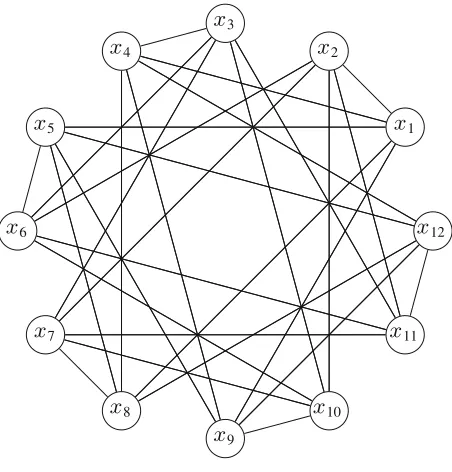
Proof Letn ≥3 be an integer. Consider a cycleC4n, sayx1−x2− · · · −x4n−x1. We
partition the vertices ofC4nas follows:
X = {xi |i≡0 or 1 mod 4},
Y = {xi |i≡2 or 3 mod 4}.
Next we apply a complementation to each of XandY, so that in the resulting graphX
andY each induce a clique on 2nvertices with a perfect matching removed. LetG4nbe the resulting graph (see also Fig.3).
Suppose, for contradiction that G4n contains an inducedP1 +2P2. Without loss of
generality, the setXmust contain three of the verticesv1, v2, v3 of theP1 +2P2. Since
every component of P1 +2P2 contains at most two vertices, without loss of
[image:18.440.108.334.58.294.2]ofG4n[X]has exactly one non-neighbour inX. This contradiction shows thatG4nis indeed
(P1+2P2)-free.
Every vertex inXhas exactly one neighbour inYand vice versa. This means that anyK3
inG4nmust lie entirely inG4n[X]orG4n[Y]. SinceG4n[X]orG4n[Y]are both comple-ments of perfect matchings and every vertex ofP1+P4lies in one of three inducedK3’s,
which are pairwise non-disjoint, it follows thatG4nisP1+P4-free.
It remains to show that the graphsG4nform an infinite antichain with respect to the induced subgraph relation. Sincen≥3, every vertex inX(resp.Y) has at least two neigh-bours inX(resp.Y) that are pairwise adjacent. Therefore, givenx1, we can determine which
vertices lie inXand which lie inY. Every vertex inX(resp.Y) has a unique neighbour inY (resp.X) and a unique non-neighbour inX(resp.Y). Therefore, by specifying which vertex inG4nisx1, we uniquely determinex2, . . . , x4n. SupposeG4nan induced subgraph ofG4mfor somem≥3. Thenn≤mdue to the number of vertices. By symmetry, we may assume that the induced copy ofG4ninG4mhas vertexx1ofG4nin the position of ver-texx1inG4m. Then the induced copy ofG4nmust have verticesx2, . . . , x4nin the same position asx2, . . . , x4ninG4m, respectively. Nowx1andx4nare non-adjacent inG4n. If
n < mthenx1andx4nare adjacent inG4m, a contradiction. We conclude that ifG4nis an induced subgraph ofG4mthenn=m. In other words{G4n|n≥3}is an infinite antichain with respect to the induced subgraph relation.
6 State of the Art and Future Work
In this section we summarise what is currently known about well-quasi-orderability and boundedness of clique-width, taking into account the results proved in this paper. We also give a number of directions for future work.
Given four graphsH1, H2, H3, H4, the class of(H1, H2)-free graphs and the class of
(H3, H4)-free graphs are equivalent if the unordered pair H3, H4 can be obtained from
the unordered pairH1, H2by some combination of the operations (i) complementing both
graphs in the pair and (ii) if one of the graphs in the pair isK3, replacing it withP1+P3
or vice versa. If two classes are equivalent, then one of them is well-quasi-ordered with respect to the induced subgraph relation if and only if the other one is [21]. Similarly, if two classes are equivalent, then one of them has bounded clique-width if and only if the other one does [14]. We use this terminology in the remainder of this section.
6.1 Well-Quasi-Ordering
Atminas and Lozin [1] proved that the class of(K3, P6)-free graphs is well-quasi-ordered
by the induced subgraph relation, while the class of (2P1+P2, P6)-free graphs is not.
In a recent paper [13] we proved that the classes of(P1+P3, P2 +P4)-free graphs and
(P1+P3, P1+P5)-free graphs are well-quasi-ordered by the labelled induced subgraph
relation. Updating the classification in [21] with these four results and the three results proved in this paper (Theorems 2–4) leads to the following classification:
Theorem 5 LetGbe a class of graphs defined by two forbidden induced subgraphs. Then:
1. Gis well-quasi-ordered by the labelled induced subgraph relation if it is equivalent to a class of(H1, H2)-free graphs such that one of the following holds:
(ii) H1=sP1andH2 =Ktfor somes, t;
(iii) H1⊆i P1+P3andH2⊆iP2+P4, P1+P5orP6.
(iv) H1⊆i 2P1+P2andH2 ⊆iP2+P3orP5.
2. G is not well-quasi-ordered by the induced subgraph relation if it is equivalent to a class of(H1, H2)-free graphs such that one of the following holds:
(i) neitherH1norH2is a linear forest (disjoint union of paths);
(ii) H1⊇i K3andH2⊇i 3P1+P2,3P2or2P3;
(iii) H1⊇i 2P2andH2⊇i 4P1or2P2;
(iv) H1⊇i 2P1+P2andH2 ⊇i4P1, P2+P4orP6;
(v) H1⊇i P1+P4andH2⊇iP1+2P2.
Note that in Theorem 5 every class that is well-quasi-ordered with respect to the induced subgraph relation is also well-quasi-ordered with respect to thelabelledinduced subgraph relation (see [1,21] and Theorem 2). This agrees with a conjecture of Atminas and Lozin [1] stating that these concepts coincide for hereditary classesXprecisely whenXis defined by a finite collection of forbidden induced subgraphs. Theorem 5 leaves us with six open cases.
Open Problem 1 Is the class of(H1, H2)-free graphs well-quasi-ordered by the induced
subgraph relation when:
(i) H1=2P1+P2andH2∈ {P1+2P2, P1+P4};
(ii) H1=P1+P4andH2∈ {P1+P4,2P2, P2+P3, P5}.
In relation to Open Problem 1, we mention that the infinite antichain for
(P1+P4, P1+2P2)-free graphs was initially found by a computer search. This computer
search also showed that similar antichains do not exist for any of the remaining six open cases. As such, constructing antichains for these cases is likely to be a challenging prob-lem and this suggests that many of these classes may in fact be well-quasi-ordered. Some of these remaining classes have been shown to have bounded clique-width [3–5,10]. We believe that some of the structural characterizations for proving these results may be useful for showing well-quasi-orderability.
6.2 Clique-Width
In the aforementioned paper [13] we also proved that the class of(P1+P3, P2 +P4)
-free graphs has bounded clique-width. The following theorem, obtained after updating the theorem from [10] with the above result, describes exactly for which pairs(H1, H2) the
(un)boundedness of the clique-width of(H1, H2)-free graphs has been determined.
Theorem 6 LetGbe a class of graphs defined by two forbidden induced subgraphs. Then:
1. Ghas bounded clique-width if it is equivalent to a class of(H1, H2)-free graphs such
that one of the following holds:
(i) H1orH2⊆i P4;
(ii) H1=sP1andH2 =Ktfor somes, t;
(iii) H1 ⊆i P1+P3andH2⊆i K1,3+3P1, K1,3+P2, P1+P2+P3, P1+P5,
P1+S1,1,2, P2+P4, P6, S1,1,3orS1,2,2;
(v) H1⊆iP1+P4andH2⊆i P1+P4orP5;
(vi) H1⊆i4P1andH2⊆i2P1+P3;
(vii) H1, H2⊆i K1,3.
2. Ghas unbounded clique-width if it is equivalent to a class of(H1, H2)-free graphs such
that one of the following holds:
(i) H1 ∈SandH2 ∈S;
(ii) H1∈/SandH2 ∈S;
(iii) H1⊇iK1,3or2P2andH2 ⊇i4P1or2P2;
(iv) H1⊇i2P1+P2andH2⊇i K1,3, 5P1, P2+P4orP6;
(v) H1⊇i3P1andH2⊇i2P1+2P2, 2P1+P4, 4P1+P2, 3P2or2P3;
(vi) H1⊇i4P1andH2⊇iP1+P4or3P1+P2.
This leaves us with the following seven non-equivalent open cases.
Open Problem 2 Does the class of (H1, H2)-free graphs have bounded or unbounded
clique-width when:
(i) H1=3P1andH2∈ {P1+S1,1,3, S1,2,3};
(ii) H1=2P1+P2andH2 ∈ {P1+P2+P3, P1+P5};
(iii) H1=P1+P4andH2∈ {P1+2P2, P2+P3}or
(iv) H1=H2=2P1+P3.
A potential direction for future research related to determining boundedness of clique-width is investigating linear clique-clique-width for classes defined by two forbidden induced subgraphs. Indeed, it is not hard to show thatk-uniform graphs have bounded linear clique-width. Again, we can use complementations and vertex deletions when dealing with this parameter.
6.3 Well-Quasi-Ordering versus Clique-Width
Recall that all bigenic classes known to be well-quasi-ordered by the induced subgraph relation are also known to have bounded clique-width. Hence, to verify Conjecture 1 for bigenic classes, we only need to check the six open cases mentioned in Open Problem 1. Note that Conjecture 1 is verified directly if a graph class has bounded clique-width. Brandst¨adt, Le and Mosca [4] proved that the class of(P1+P4, P1+P4)-free graphs (and
thus the class of(2P1+P2, P1+P4)-free graphs) has bounded clique-width. Using results
from [3], the same authors proved in [5] that the class of(P1+P4, P5)-free graphs (and
thus the class of(P1+P4,2P2)-free graphs) has bounded clique-width. Dabrowski, Dross
and Paulusma [10] showed that the class of(2P1+P2, P1+2P2)-free graphs has bounded
clique-width. Hence, there is only one bigenic class of graphs left for which Conjecture 1 needs to be verified.
Open Problem 3 Is Conjecture 1 true for the class of(H1, H2)-free graphs whenH1 =
P1+P4andH2 =P2+P3?
As can be seen from Open Problems 1 and 2, we known neither whether the class of
(P1+P4, P2+P3)-free graphs is well-quasi-ordered by the induced subgraph relation nor