transition-metal dichalcogenides
E. MostaaniDepartment of Physics, Lancaster University, Lancaster LA1 4YB, United Kingdom and Cambridge Graphene Centre, Engineering Department, University of Cambridge,
9 J. J. Thomson Avenue, Cambridge CB3 0FA, United Kingdom
M. Szyniszewski
National Graphene Institute, University of Manchester, Booth Street East, Manchester M13 9PL, United Kingdom and
Department of Physics, Lancaster University, Lancaster LA1 4YB, United Kingdom
C. H. Price
Department of Physics, Lancaster University, Lancaster LA1 4YB, United Kingdom
R. Maezono
Japan Advanced Institute of Science and Technology,
School of Information Science, Asahidai 1-1, Nomi, Ishikawa 923-1292, Japan
M. Danovich
National Graphene Institute, University of Manchester, Booth Street East, Manchester M13 9PL, United Kingdom
R. J. Hunt
Department of Physics, Lancaster University, Lancaster LA1 4YB, United Kingdom
N. D. Drummond
Department of Physics, Lancaster University, Lancaster LA1 4YB, United Kingdom
V. I. Fal’ko
National Graphene Institute, University of Manchester, Booth Street East, Manchester M13 9PL, United Kingdom
(Dated: August 4, 2017)
Excitonic effects play a particularly important role in the optoelectronic behavior of two-dimensional semiconductors. To facilitate the interpretation of experimental photoabsorption and photoluminescence spectra we provide (i) statistically exact diffusion quantum Monte Carlo binding-energy data for a Mott-Wannier model of (donor/acceptor-bound) excitons, trions, and biexcitons in two-dimensional semiconductors in which charges interact via the Keldysh potential, (ii) con-tact pair-distribution functions to allow a perturbative description of concon-tact interactions between charge carriers, and (iii) an analysis and classification of the different types of bright trion and biex-citon that can be seen in single-layer molybdenum and tungsten dichalcogenides. We investigate the stability of biexcitons in which two charge carriers are indistinguishable, finding that they are only bound when the indistinguishable particles are several times heavier than the distinguishable ones. Donor/acceptor-bound biexcitons have similar binding energies to the experimentally mea-sured biexciton binding energies. We predict the relative positions of all stable free and bound excitonic complexes of distinguishable charge carriers in the photoluminescence spectra of WSe2 and MoSe2.
PACS numbers: 78.20.Bh, 31.15.-p, 73.20.Hb, 78.55.-m
I. INTRODUCTION
The last decade has witnessed a remarkable surge of interest in the properties of truly two-dimensional (2D), atomically thin semiconductors. These include mono-layer transition-metal dichalcogenides (TMDCs) such as MoS2, MoSe2, WS2, and WSe2, which acquire a direct-gap character in hexagonal monolayer form.1–4 The
(bound pairs of excitons).13–16 The nonhydrogenic na-ture of the excitonic energy spectrum is due to lat-eral polarization effects in 2D crystals, which modify the form of the Coulomb interaction between charge carriers. Mott-Wannier models of 2D trions and biex-citons have been studied using quantum Monte Carlo (QMC) methods,17–25, variational methods26–28, and hy-perspherical harmonics approaches,29 and interpolation formulas linking the 2D-screened and 1/rCoulomb inter-action regimes have been proposed. Here we extend these studies to provide numerically exact binding-energy data for all nonlocal screening strengths, including an analy-sis of limiting behavior, and we classify the types of trion and biexciton that can be observed in different TMDCs. We also investigate donor- and acceptor-bound charge-carrier complexes in TMDCs, such as donor-bound biex-citons and quintons, which have not to our knowledge been studied before.
The rest of the article is structured as follows. In Sec. II we describe the band structures of molybdenum and tungsten dichalcogenides and analyze the nature of the trions and biexcitons in these materials; further-more, we perform a group theoretical analysis of exci-ton properties. In Sec. III we explain the Keldysh form of the screened Coulomb interaction between charges in 2D semiconductors, describe the ways in which charge-carrier complexes are expected to dissociate and recom-bine, and explain the importance of the contact pair distribution function (PDF). In Sec. IV we describe our computational methodology for solving the Mott-Wannier model of charge-carrier complexes. We present our numerical results for the binding energies and PDFs of the different complexes in Sec. V. Finally, we draw our conclusions in Sec. VI.
II. BRIGHT AND DARK BIEXCITONS AND
TRIONS IN MOLYBDENUM AND TUNGSTEN DICHALCOGENIDES
A. Classification of trions and biexcitons
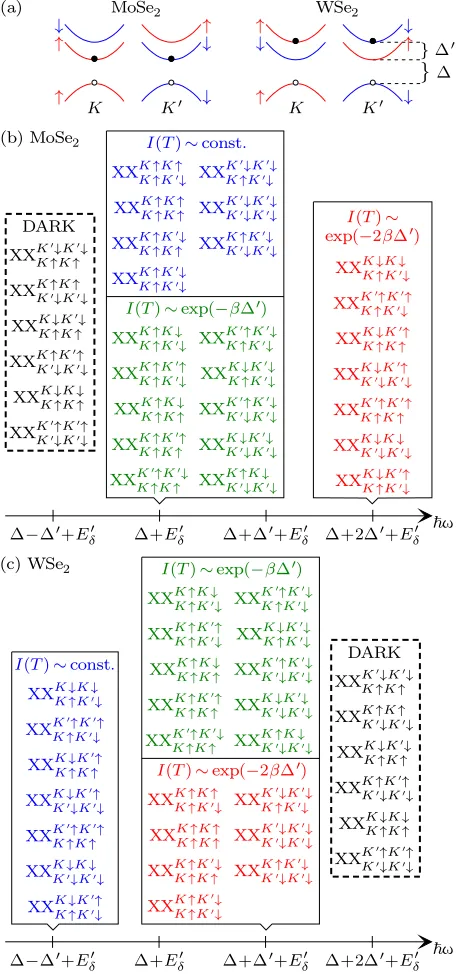
In monolayer molybdenum and tungsten dichalco-genides the conduction-band minimum and valence-band maximum occur at theK andK0 points of the hexago-nal Brillouin zone. Spin-orbit coupling induces a signif-icant splitting of both the valence band and the con-duction band at K and K0. In molybdenum dise-lenides, the valence-band maximum has the same spin as the conduction-band minimum within each valley, while in tungsten dichalcogenides such states have op-posite spins.3 Figure 1(a) presents examples of the ways in which biexcitons can be formed in molybdenum and tungsten dichalcogenides. The spin-splitting of the va-lence band (0.15–0.5 eV) is sufficiently large that no holes in the lower spin-split valence band are expected at room temperature; however, the spin-splitting of the conduc-tion band (∆0 = 3–50 meV) is small enough that elec-trons can be found in the upper spin-split conduction band at room temperature.3
An exciton, biexciton or trion is said to be either dark orsemidark when the recombination of an electron and hole is forbidden by spin and momentum conservation; otherwise the complex is said to be bright. Semidark complexes are those in which recombination can in fact take place due to intervalley scattering with an accompa-nying energy shift. The precise photon energies depend on whether the electrons occupy the higher- or lower-energy spin-split bands in the initial and final states. Furthermore, the intensity of a spectral line depends on the thermal occupancy of the initial state. Figures 1(b) and 1(c) present a classification of biexcitons in molyb-denum and tungsten dichalcogenides with respect to the recombination energy and the intensity of the emitted photons. This intensity has the following temperature dependence:
I(T)∼
const. for no electrons in the upper spin-split conduction band
e−∆0/(kBT) for one electron in the upper spin-split conduction band
e−2∆0/(kBT) for two electrons in the upper spin-split conduction band
, (1)
where ∆0 is the spin-orbit-induced splitting of the con-duction band,kB is Boltzmann’s constant, andT is the temperature. A similar classification can be made for trions: see Fig. 2. In a photoluminescence experiment, we expect to see energies attributed to different kinds of biexcitons and trions and emission lines of varying inten-sity, as explained in Sec. III C.
The opposite spin-splittings of the conduction and va-lence bands in tungsten dichalcogenides results in the
(c) WSe2
(b) MoSe2
∆+2∆′+Eδ′
∆−∆′+Eδ′
∆+∆′+E δ′
XXKK↑↓KK↑′↑
∆+∆′+Eδ′
XXK′↓K′↓
K↓K′↓ ∆+Eδ′
∆−∆′+E δ′
XXK↑K′↓
K′↓K′↓
~w
∆+2∆′+E δ′ ∆+Eδ′
XXKK↑↑KK↑↑
XXK′↓K′↓
K′↓K′↓
XXK′↓K′↓
K↑K′↓
XXKK↑↑KK↑′↓ XXK↑K′↓
K↑K↑ I(T)∼const.
XXKK↑↑KK↑↑
XXK↑K′↓
K↑K↓
XXK↑K′↓
K↑K′↑
XXK↑K′↓
K′↑K′↓
XXK↑K′↓
K↓K′↓
XXKK↑↑KK↑↓
XXKK↑K↑K↑′↑
XXKK↑′↑KK↑′↓
XXK′↓K′↓
K′↑K′↓
XXKK↓K′↓K′↓ ′↓
XXK′↓K′↓
K↑K↓ XX
K↑K′↓ K↓K′↑ XXK′↓K′↓ K↓K↓
XXKK↑′↑KK↑′↑ XXK′↓K′↓ K↓K′↑ XXKK↑↓KK↑′↑ XXK↑K′↓ K′↑K′↑ XXK↑K′↓ K↓K↓
XXKK↑′↓KK↑′↓ XXK′↓K′↓ K↑K↑
XXKK↑↓KK↑′↓ XXK′↓K′↓ K↑K′↑
XXKK↑↓KK↑↓ XXK′↓K′↓
K′↑K′↑ DARK
XXK′↓K′↓
K↓K↓ XXKK↑′↑KK↑′↑ XXK′↓K′↓
K↓K′↑
XXK↑K′↓
K↓K′↑
XXKK↑↑KK↑′↓ XXKK↑′↑KK↑′↓
XXK↑KK↓K′↓ ′↓
XXK′↓K′↓ K↑K′↑ XXK↑KK↑K′↓
′↑
XXKK↑↓KK↑↓ XXKK↑↓KK↑′↓ XXKK↑K↓′↓K′↓
XXK′↓K′↓ K′↓K′↓
XXK↑K′↓ K↑K′↓
XXK↑K′↓
K′↑K′↑
XXKK↑↑KK↑′↑
XXK↑K′↓
K↓K↓
XXK↑K′↓ K↑K↑
XXK↑K′↓
K′↑K′↓
XXKK↑↑KK↑↓
XXK′↓K′↓ K↑K↑ DARK
I(T)∼exp(−2β∆′) I(T)∼exp(−β∆′)
XXK′↓K′↓
K′↑K′↓
XXK′↓K′↓ K′↑K′↑ I(T)∼ exp(−2β∆′)
I(T)∼exp(−β∆′) XXK↑K′↓
K↑K′↓
XXK′↓K′↓ K↑K′↓ I(T)∼const.
XXK↑K′↓
K↑K↓
XXK↑K′↓ K′↓K′↓
XXKK↑′↓KK↑′↓
[image:3.612.324.555.49.421.2]~w ↑ (a) ↑ ↓ K′ K ↓ ↑ ↑ ↓ ↑ K′ WSe2 ↓ ↓ K ↑ }∆ }∆′ MoSe2 ↓
FIG. 1. (Color online) (a) Spin-split valence and conduc-tion bands for MoSe2 (left) and WSe2 and WS2 (right). We only show the splitting of the conduction band; the spin-splitting of the valence band is much larger, so that no holes in the lower spin-split valence band are expected at room temperature.3 (b) and (c) Classification of biexciton recom-bination processes in molybdenum and tungsten dichalco-genides, respectively. ∆ is the band gap, while ∆0 is the spin-splitting of the conduction band. Eδ0 ≡EXX−EX is the difference between the total energiesEXXandEXof a biexci-ton and an excibiexci-ton. ~ωindicates the photon energies at which peaks in photoluminescence spectra are expected to appear.
XXk1σ1k2σ2k3σ3k4σ4denotes a biexciton consisting of conduction-band
electrons in valleys k1 and k2 with spins σ1 and σ2 and valence-band holes in valleysk3 andk4 with spinsσ3 andσ4. For example, the biexcitons shown in (a) are both denoted by XXKK↓K↓K00↑↑.
(c) WSe2 (b) MoSe2
∆+2∆′+Eδ ∆−∆′+Eδ
TK′↓ K↑K′↓
I(T)∼exp(−β∆′) DARK
∆+∆′+Eδ
∆+2∆′+Eδ ∆+Eδ
TKK↑↓K↓
I(T)∼exp(−2β∆′)
TKK↑↑K′↓
~w
TK′↓ K↑K′↑ TK′↓
K↑K′↓ I(T)∼const.
TKK↑↑K↑ TK′↓
K′↓K′↓
TKK↓K′↓ ′↓ TK′↓
K′↑K′↓
TKK↑K↑ ′↑ TK↑K↑K↓
I(T)∼exp(−β∆′)
TK′↓ K↓K↓
TK′↓ K↓K′↑ TKK↑′↑K′↑ TKK↑↓K′↑
TK′↓ K↑K′↑
TK′↓ K′↑K′↑
TK′↓ K↑K↑ TKK↑↓K′↓ TKK↑↓K↓ TKK↑′↓K′↓
DARK
~w
TKK↑↑K′↓ TK′↓
K′↓K′↓ TK′↓
K′↑K′↓
∆+∆′+Eδ
TK′↓ K′↑K′↑
TK′↓ K↑K↑ TKK↑K↑ ′↑ TKK↓K′↓
′↓
TKK↑↓K′↑ I(T)∼const.
TKK↑↑K↑
I(T)∼ exp(−2β∆′)
TKK↑′↑K′↓ TK′↓
K↑K↓
TKK↑↓K′↓ TK↑K↑K↓
TK′↓
K↑K↓
}∆′
}∆
K′
↓
↑ (a) MoSe2
↑ ↓ ↑ ↑ ↓ ↓ ↓ K ↑ ↓
↑ K′ K
WSe2
∆−∆′+Eδ TK′↓
K↓K↓ TK′↓
K↓K′↑ TKK↑′↑K′↑
∆+Eδ TKK↑′↑K′↓
TKK↑′↓K′↓
FIG. 2. (Color online) As Fig. 1, but for negative trions in molybdenum and tungsten dichalcogenides. Eδ ≡ EX− is the total energyEX− of a negative trion. Tkk13σσ13k2σ2 denotes a trion consisting of conduction-band electrons in valleysk1 andk2with spinsσ1andσ2and a valence-band hole in valley k3 with spinσ3.
expected photoluminescence spectrum contains two ad-ditional lines resulting from the recombination of these “semidark” trions and biexcitons, at an energy shifted downwards by 2∆0 relative to the bright complexes, and having a temperature-independent intensity.
B. Group theoretical analysis of excitons
Exciton wave functions can be classified according to the irreducible representation (irrep) of the point-group symmetry of the TMDC crystal,D3h. As the states in the two valleys are degenerate, one can treat the two valleys simultaneously by using the extended groupD00
[image:3.612.63.291.53.540.2]The total exciton wave functionX is given in general by the product of three components: the spatial envelope function Φ, the Bloch or lattice wave functions of the electron and holeUk, and the spin partχ:
X = Φ(re,rh)⊗Uk(re,rh)⊗χ(se, sh). (2) The representations of the wave functions by irreps con-sist of the direct product of the individual irreps corre-sponding to the three components: ΓX = ΓΦ⊗ΓU⊗Γχ. The tightly bound ground-state excitons are character-ized by a maximally symmetrcharacter-ized envelope function cor-responding to the identity irrep ΓΦ=A+1. Therefore the representations of the exciton states are determined by the irreps of the lattice and spin parts.
The conduction- and valence-band Bloch states trans-form according to the 2D irrepsE10 andE02, respectively. Using the product table, Table X, the lattice part of the exciton wave function transforms as
E10+⊗E20+=E+⊕E03+, (3) where the 2D irrep E+ corresponds to intravalley exci-tons in the K and K0 valleys, and E0+
3 corresponds to intervalley excitons, which are dark due to momentum conservation. In the following, we will consider the E+
intravalley excitons only.
The exciton spin part consists of two spin-1/2particles corresponding to the spinor 2D irrep D1/2. The direct product of the two spinors can be decomposed into the crystal point group irreps as
D1/2⊗D1/2=A + 1 ⊕A
+
2 ⊕E−. (4) Hence the total exciton representation is given by
E+lattice⊗(A+1⊕A+2⊕E−)spin = 2E+⊕A−1⊕A−2⊕E−. (5) The E+ irrep corresponds to the vector representation, and therefore the two E+ irreps correspond to excitons coupled to in-plane polarized light. The z coordinate transforms as theA−2 irrep, and therefore theA−2 exciton is coupled to out-of-plane polarized light, which involves a spin-flip process in recombination.30In the case of tung-sten dichalcogenides, theA−2 exciton is the ground-state exciton, and results in photon emission at an energy that is lower than the excited bright exciton by the spin-orbit splitting of the conduction band ∆0. The A−1 and E−
excitons are not coupled to light. A summary of the classification of exciton states is given in Table I using a notation similar to that used in Figs. 1 and 2. Finally, we note that the spin-flip transition resulting in the emission of out-of-plane polarized light corresponding to the A−2
exciton is also relevant for ground-state trions and biex-citons in tungsten dichalcogenides, resulting in trion or biexciton emission at a photon energy shifted downwards relative to the excited bright states by ∆0.
TABLE I. Classification of exciton states into irreps ofD3h00 and the polarization (kand z for in-plane and out-of-plane, respectively) of the electric field to which the excitons are coupled.
Irrep Excitons Field
E+ XK↑
K↑, X
K0↓
K0↓ E
k E+ XKK↑↓, XKK00↓↑
A−2 X (dark): {XKK↑↓−XKK00↑↓} Ez E− XK↓K↑, XKK00↑↓
–
A−1 {X
K↑
K↓+ X
K0↓
K0↑}
III. CHARGE-CARRIER COMPLEXES IN 2D
SEMICONDUCTORS
A. Screened Coulomb interaction between charge carriers
We model the charge carriers in a 2D semiconduc-tor using a Mott-Wannier model, in which small num-bers of quasielectrons and quasiholes are treated within the band effective mass approximation and interact via an appropriately screened Coulomb interaction. The band effective masses for different 2D semiconductors are assumed to be 2D-isotropic, and are discussed in Sec. V B 2. However, unlike quasi-2D electron(-hole) systems in GaAs/InAs heterostructures, the form of the Coulomb interaction is profoundly affected by the 2D nature of single-layer TMDCs, as we will now discuss.
Consider a charge densityρ(x, y)δ(z) in thez= 0 plane of the 2D material, embedded in an isotropic medium of permittivity. The resulting electric displacement field is D=−∇φ+P⊥(x, y)δ(z) =−∇φ−κ[∇φ(x, y,0)]δ(z),
whereφis the electrostatic potential,P⊥(x, y) is the
in-plane polarization, andκis the in-plane susceptibility of the material. By using Gauss’s law,∇ ·D= ρδ(z), we obtain
∇2φ=−ρδ(z)−κ[∇2φ(x, y,0)]δ(z). (6) After taking the Fourier transform, denoting the wavevector in the (x, y) plane by q and the wavenum-ber in thezdirection by k, we find
φ(q, k) =ρ(q)−κq
2φ(q, z= 0)
(q2+k2) . (7)
However
φ(q, z= 0) = 1 2π
Z
φ(q, k)dk
= 1
2q[ρ(q)−κq
2φ(q, z= 0)]. (8) Rearranging, we find the in-plane electric potential to be
φ(q, z= 0) = ρ(q)
Therefore the electrostatic potential energy between chargesqiand qj in a 2D semiconductor is
v(q) = qiqj 2q(1 +r∗q)
, (10)
where r∗ ≡κ/(2). After taking the Fourier transform,
the potential energy can be written as
v(r) = qiqj 4πr∗
V
r
r∗
, (11)
whereris the separation of the particles and
V(r/r∗) =
π
2
H0 r
r∗
−Y0 r
r∗
, (12)
where Hn(x) is a Struve function andYn(x) is a Bessel function of the second kind. This result was first derived by Keldysh,31 and we refer to the interaction of Eq. (12) as theKeldysh interaction. At long range (r r∗) this
potential becomes a Coulomb interaction:
V(r/r∗)≈r∗/r, (13)
while at short range (r r∗) it is approximately
loga-rithmic:
V(r/r∗)≈[log (2r∗/r)−γ] = log
2r
∗
exp(γ)r
, (14)
where γ is Euler’s constant. We refer to the interaction potential of Eq. (14) as thelogarithmic interaction. The Keldysh interaction is plotted in Fig. 3, along with the Coulomb (r∗= 0) and logarithmic (r∗→ ∞)
approxima-tions.
0.0001 0.01 1 100 10000
r / r * 0.0001
0.001 0.01 0.1 1 10
V
(
r / r
*
)
Keldysh int. Coulomb int. Logarithmic int. Approx. Keldysh int. [PRB 84, 085406 (2011)]
0.001 1 1000 r / r
* -6
-5 -4 -3 -2 -1 0 1
Percentage error
FIG. 3. (Color online) Dimensionless interaction potential between charge carriers in a 2D semiconductor, as defined in Eq. (11). The inset shows the percentage error in different approximations [Eqs. (13), (14), and (15)] to the Keldysh in-teraction of Eq. (12).
The following approximation to Eq. (12) was intro-duced in Ref. 32:
V(r/r∗)≈ −log
r/r∗
1 +r/r∗
−[γ−log(2)]e−r/r∗. (15)
This form of potential was used in the diffusion quantum Monte Carlo (DMC) study of Ref. 21. It is also plotted in Fig. 3, where it can be seen that the error in Eq. (15) is as large as several percent in the region r ≈ r∗. We
compare DMC results obtained using Eqs. (12) and (15) in Sec. IV F.
Finally, the Mott-Wannier-Keldysh Schr¨odinger equa-tion for a set of charged quasiparticles in a 2D semicon-ductor is
− X
i ~2 2mi
∇2 i +
X
i>j qiqj 4πr∗
V
r
ij r∗
ψ=Eψ, (16)
wheremi and qi are the band effective mass and charge of particlei,rij is the separation of particlesiandj, and Eis the energy eigenvalue.
Now consider the situation in which the 2D semicon-ductor has a dielectric medium of permittivitya above it and a dielectric medium of permittivitybbelow it, as would be the case for a 2D semiconductor deposited on a substrate. In general this is a more complicated problem than the situation described above. However, if we take
≡(a+b)/2 in the expressions above, the correction to the electrostatic energy of Eq. (11) is second order ina−b. Hence the Keldysh interaction remains valid when the permittivity is chosen to be the average of the permittivities of the media on either side of the 2D semiconductor, provided these permittivities are similar.
B. Units and scaling
1. Excitonic units
The energies of complexes interacting via the Keldysh or Coulomb interactions are given in terms of the exciton Rydberg, R∗y = µe4/[2(4π)2
~2], and lengths are given in terms of the exciton Bohr radius, a∗0 = 4π~2/(µe2), where µ = memh/(me +mh) is the reduced mass of electron-hole pairs, with me and mh being the electron and hole masses, respectively.
Let ˜ri=ri/a∗0. Then Eq. (16) can be written as
− X
i µ mi
˜
∇2 i +
X
i>j
2qiqja∗0
e2r
∗
V
r˜
ija∗0
r∗
ψ=Eψ, (17)
where E = E/R∗y. Note that µ/mi only depends on the electron-hole mass ratio σ ≡ me/mh. Hence for a fixed value ofr∗/a∗0, the dimensionless energy eigenval-uesEonly depend on the mass ratio, not on the absolute masses. Furthermore, for an exciton we may write the Schr¨odinger equation in terms of the difference coordi-naterehas
−∇˜2 eh−
2a∗0
r∗
V
˜
reha∗0
r∗
so that for a given value ofr∗/a∗0, the dimensionless exci-ton energy eigenvalues EX are also independent of the mass ratio. For the case of the Coulomb interaction (r∗ = 0), the dimensionless ground-state energy of an
isolated exciton is EX =−4, irrespective of the mass of the electron or the hole. The binding energies in exci-tonic Rydbergs of donor-bound trions, biexcitons, and donor-bound biexcitons only depend on r∗/a∗0 and the electron-hole mass ratio σ. Unfortunately, the energies of the different complexes go to zero in these units in the limit that r∗ → ∞, and so a separate set of units
is required for the case of the logarithmic interaction, as discussed in Sec. III B 2.
2. Logarithmic interaction
For the limitr∗ → ∞, where the interaction is of
loga-rithmic form, we use the dimensionless units introduced in Ref. 19. The Schr¨odinger equation for a charge
car-rier complex with the logarithmic approximation to the interaction [Eq. (14)] is
− X
i ~2 2mi
∇2 i +
X
i>j qiqj 4πr∗
log 2r
∗
exp(γ)r
ψ=Eψ. (19) Let
r0= s
4πr∗~2
2e2µ (20)
and
E0=
e2
4πr∗
. (21)
Defining dimensionless coordinates ˜ri =ri/r0 and a di-mensionless energyE=E/E0, the Schr¨odinger equation can be written as
−X
i µ mi
˜
∇2 i −
X
i>j qiqj
e2 [log(˜rij) + log (r0/r∗) +γ−log(2)]
ψ=Eψ. (22)
The only dependence of the dimensionless energyE of the complex onr∗ is through the pairwise additive constant
C=−X i>j
qiqj
e2 log (r0/r∗). (23)
Note that
X
i>j qiqj
e2 =
−1 for an exciton or donor atom
−1 for a trion or donor-bound exciton
−2 for a biexciton or donor-bound trion
−2 for a donor-bound biexciton
(n+−n−)2−n+−n−
2 for a complex ofn+ charges +eandn− charges−e
. (24)
Hence the additive constantC cancels out of the binding energies of the different charge-carrier complexes defined in Sec. III C.
For an isolated exciton, we may write the Schr¨odinger equation in terms of the difference coordinate reh and reduced mass, giving
h
−∇˜2eh+ log(˜reh) + log (r0/r∗) +γ−log(2)
i
ψ=EXψ. (25) The only dependence of the dimensionless energy eigen-valueEX on the mass ratio and r∗ comes from the
con-stant term log(r0/r∗) in the Hamiltonian. Hence we may
write the ground-state dimensionless energy as
EX=EX0−log (r∗/r0), (26)
whereEX0= 0.41057747491(7) was evaluated by a
finite-element method (see Sec. V A).
C. Binding energies and spectra of charge-carrier complexes
We define the binding energies EXb−, EXXb , E b D+X,
EbD0X, and E b
respectively, as follows:
EX−b =EX−EX− (27)
EXXb = 2EX−EXX (28)
EDb+X=ED0−ED+X (29)
EDb0X=ED0+EX−ED0X (30)
EDb+XX=ED0X−ED+XX, (31) whereEX,EX−,EXX,ED0,ED+X,ED0X, andED+XXare the ground-state total energies of an exciton, trion, biex-citon, donor atom, donor-bound exbiex-citon, donor-bound trion, and donor-bound biexciton, respectively. These are the binding energies with respect to dissociation into the most energetically competitive species. With the ex-ceptions of the donor-bound exciton (D+X) and donor-bound biexciton (D+XX), each of the complexes dissoci-ates into an exciton (X) plus one other complex. Binding energies of charge-conjugated complexes (such as positive trions, acceptor-bound trions, and acceptor-bound biex-citons) are defined in an analogous fashion. Note that, under the definitions of Eqs. (27)–(31), a binding energy ispositive for a bound complex.
The energy difference between the exciton peak in a photoluminescence experiment and the peak correspond-ing to a particular complex is equal to the energy re-quired to separate a single exciton from that complex. Thus the energy difference between the exciton peak and the trion peak is EX−EX− = EXb−; the energy differ-ence between the exciton peak and the biexciton peak is 2EX −EXX = EXXb ; and the energy difference be-tween the exciton peak and the donor-bound trion peak is
EX+ED0−ED0X=EDb0X. On the other hand, the energy difference between the exciton peak and the donor-bound exciton peak is EX−ED+X =EDb+X+EX−ED0, and the energy difference between the exciton peak and the donor-bound biexciton peak is EX+ED+X−ED+XX =
EDb+XX+E b D0X−E
b
D+X. Some of these peaks are shown in Fig. 4. In addition there are expected to be offsets to the peak positions due to the spin-splitting of the conduction bands of TMDCs, as described in Sec. III.
In Sec. V F we report DMC binding energies for quin-tons and other large charge-carrier complexes in tungsten and molybdenum dichalcogenides. In each of these cases the binding energy is defined to be the energy required to remove an exciton from the complex; this is the binding energy with respect to dissociation into the most ener-getically competitive products.
D. Contact and exchange interactions between charge carriers
The Mott-Wannier model of a charge-carrier complex is valid provided the complex extends over many unit cells of the underlying crystal. However, when charge carriers are present at the same point in space there is an energy contribution due to local exchange and cor-relation effects.25 Although the excitons in TMDCs are
Mott-Wannier-like, their wave functions only extend over a small number of primitive unit cells, so that local ex-change and correlation effects are expected to be sig-nificant. We may represent this effect within a Mott-Wannier model by introducing additional pairwise con-tact interaction potentials. For example, for a biexciton the Hamiltonian should include an additional term of the form
Aeeδ(ree) +Ahhδ(rhh) +Aeh
2 X
i=1 2 X
j=1
δ(reihj), (32)
whereAee,Ahh, andAeh are constants andr
ee,rhh, and reihj are the electron-electron separation, the hole-hole separation, and the separation of electroni and holej, respectively. Evaluating Aee, Ahh, and Aeh by ab initio calculations is challenging, and so we leave them as free parameters to be determined in experiments or subse-quentab initio calculations. If we evaluate the expecta-tion value of this contact interacexpecta-tion then we find that the first-order perturbative correction to the total energy can be written asAehgeh
XX(0) +AeegXXee (0) +AhhgXXhh(0), where the electron, hole-hole pair, and electron-hole PDFs are
geeXX(r) =hδ(r−ree)i (33)
ghhXX(r) =hδ(r−rhh)i (34)
gehXX(r) = * 2
X
i=1 2 X
j=1
δ r−reihj
+
, (35)
respectively. We report contact PDF data within the Mott-Wannier model.
In addition to the role of the contact PDF in evaluat-ing perturbative corrections due to contact interactions, the PDF and contact PDF contain a wealth of physical information. The exciton recombination rate of a charge-carrier complex is proportional to the electron-hole con-tact PDF. Furthermore, the PDF gives a very direct in-dication of the spatial size and shape of a charge-carrier complex.
2Δ′
2Δ′
(a)MoSe2
ℏω-Δ-EX
[meV]
-120 -100 -80 -60 -40 -20 0 20
X X-/X+ XX
D0X A0X D+XX
A-XX X-/X+
(SD) XX (SD)
D+X A-X
XX
-Δ′
2Δ′
2Δ′
(b)WSe2
ℏω-Δ-Δ'-EX
[meV]
-100 -80 -60 -40 -20 0
X
X-/X+ XX
D0X
A0X
D+XX
A-XX
X-/X+
(SD) XX (SD)
D+X
A-X
XX
-X (dark)
FIG. 4. (Color online) Expected photoemission spectra for (a) MoSe2and (b) WSe2, showing lines for the different complexes studied in this work. ∆ and ∆0are the quasiparticle band gap and the spin-splitting of the conduction band, respectively. The numerical values of ∆0are taken from density-functional-theory calculations with the Heyd-Scuseria-Ernzerhof (HSE06) hybrid functional.3EXis the total energy of an exciton. The lines show the frequency relative to the bright exciton peak arising due to the recombination of a single electron-hole pair in each complex: see Sec. III C. E.g., the D0X line shows the frequency relative to the exciton peak of the process D0X→D0+γ. The trion and biexciton peaks labelled “SD” arise from semidark complexes, and are offset by 2∆0, as explained in Sec. II A; the exciton peak labelled “dark” arises from the process described in Sec. II B; the other peaks arise from bright complexes. Donor- and acceptor-bound exciton peaks are shown with very low intensity due to the marginal stability of these complexes.
IV. COMPUTATIONAL METHODOLOGY
A. Quantum Monte Carlo modelling of excitonic complexes
Our total-energy and PDF calculations were carried out using the variational quantum Monte Carlo (VMC) and DMC approaches.34,35 The ground-state wave func-tion for a set of interacting, distinguishable particles is nodeless; hence the fixed-node DMC algorithm is exact for all the systems studied in this work with the excep-tion of biexcitons with indistinguishable holes. We used a numerical representation of the potential of Eq. (12) that is accurate to at least eight significant figures. Trial wave functions were optimized using VMC with variance minimization36,37and energy minimization.38The DMC calculations were performed using time steps in the ratio 1 : 4 with the corresponding target configuration popu-lations being in the ratio 4 : 1. Afterwards, the energies were extrapolated linearly to zero time step and hence, simultaneously, to infinite population. To perform all our calculations, thecasinocode was used.39
QMC methods have previously been used to study 2D trions with nonlocal screening19,21 and the Coulomb interaction22and 2D biexcitons with the Coulomb inter-action (including indirect biexcitons in coupled-quantum-well heterostructures)17,18,40,41and in TMDCs with non-local screening.21,23 In a recent work some of the present authors have investigated the binding energies of trions and biexcitons using DMC for a range of susceptibility parametersr∗and effective masses, and have represented
the DMC data using simple interpolation formulas.25 It was shown that for the applicable range ofr∗ values, 2D
[image:8.612.75.549.56.328.2]B. Wave functions for complexes of distinguishable charge carriers
Our trial wave functions for complexes of distinguish-able charge carriers were of the Jastrow form Ψ = exp[J(R)], whereRis the vector of all the particle coor-dinates. The Jastrow exponentJ(R) included a pairwise sum of terms of the form42
uex2D(r) = [c1+ Γ
0log(r) +c
2r]r2 1 +c3r2
(36)
for the Keldysh and logarithmic interactions, wherer is interparticle distance,c1,c2≤0, andc3≥0 are optimiz-able parameters, and
Γ0=− qiqjmimj
2a∗0µe2r
∗(mi+mj)
(37)
for distinguishable pairs of particles of charge qi and qj and massmi andmj. Different constantsci are used for each type of particle pair. This form satisfies the ana-log of the Kato cusp conditions,43,44 i.e., it ensures that the local energy Ψ−1HˆΨ is nondivergent at coalescence points, where ˆH is the Hamiltonian operator.
Where the interaction between the charge carriers was of Coulomb form, we used pairwise terms of the form
uex2D(r) =Γr+c1r 2
1 +c2r
(38)
in the Jastrow exponent, where c1 ≤0 and c2 ≥ 0 are optimizable parameters, and
Γ = 2qiqjmimj
a∗0µe2(m i+mj)
(39)
for distinguishable pairs of particles of massmi andmj and charge qi and qj. This form satisfies the Kato cusp conditions.43,44
Donor ions and other infinitely heavy particles were fixed point charges in our calculations. In this caseuex2D provided a one-body Jastrow term between the free par-ticles and the fixed parpar-ticles that satisfies the Kato cusp conditions. In addition, cuspless one-body, two-body and three-body polynomial terms truncated at finite range were used in our Jastrow factor.45,46
C. Wave functions for biexcitons with indistinguishable holes
For biexcitons with indistinguishable holes we used the trial wave function
Ψ = exp[J(R)]x0hh(R), (40) where J is of the form described in Sec. IV B. For in-distinguishable particles of mass m and charge q inter-acting via the logarithmic or Keldysh interactions, Eq.
(37) must be replaced by Γ0 =−q2m/(8a∗
0µe 2r
∗), while
for indistinguishable pairs of particles interacting via the Coulomb interaction, Eq. (39) must be replaced by Γ =q2m/(2a∗
0µe2). x0hh is thex-component of r0hh =rhh+ηhh(rhh)rhh
+ηeh(re1h1)re1h1+ηeh(re1h2)re1h2
−ηeh(re2h1)re2h1−ηeh(re2h2)re2h2, (41) whereηhh and ηeh are smoothly truncated polynomials, with optimizable expansion coefficients, andrhhandreihj are the hole-hole and electron-hole relative positions, re-spectively. Equation (41) is effectively a backflow47,48 transformation: Ψ = exp(J)xhh introduces the correct nodal topology for the state that we want to consider and Eq. (41) maps the particle coordinates{r}to quasiparti-cle coordinates{r0}without changing the nodal topology. In Eq. (41),
ηhh(r) = Nhh
η X
n=2
anrn(r−L)CΘ(L−r) (42)
and
ηeh(r) = Neh
η X
m=0
bmrm(r−L)CΘ(L−r) (43)
are smoothly truncated polynomials with optimizable pa-rameters{an} and {bn}. L is a cutoff length, Nηhh and Neh
η determine the amount of variational freedom,C= 3 to ensure smooth behavior at the cutoffs, and Θ denotes the Heaviside function. We requireb1=Cb0/Lto ensure that η does not affect the Kato cusp conditions, which are enforced by the Jastrow factor. We optimized the free parameters in our antisymmetric wave function us-ing energy minimization.38
For different values of Nηhh andNηeh in Eqs. (42) and (43), we compare the VMC ground-state energy, vari-ance, and DMC energy of biexcitons with indistinguish-able electrons interacting via the logarithmic interaction in Table II. Analogous results for biexcitons interacting via the Keldysh interaction at finiter∗ are shown in
Ta-ble III. Our results show that increasing Nηhh and Nηeh
slightly decreases the variances; nevertheless, the VMC and DMC energies are independent of the number of free parameters when Nhh
η , Nηeh ≥ 2 to within our statisti-cal error bars. We have used Nhh
η = Nηeh = 3 in our production calculations.
Biexcitons with distinguishable electrons and indistin-guishable holes can trivially be mapped onto biexcitons with indistinguishable electrons and distinguishable holes by charge conjugation.
D. Time-step and population-control errors
TABLE II. Effect of changing the number of free parame-ters in η [i.e., the values of Nηhh and Nηeh in Eqs. (42) and (43)] on the VMC ground-state energy (EVMC), VMC energy variance, and DMC energy (EDMC) for biexcitons with indis-tinguishable holes interacting via the logarithmic interaction. The mass ratio isσ= 0.1 and the reduced mass isµ= 0.5m0, wherem0 is the bare electron mass. In each caser∗=r0.
Nhh
[image:10.612.325.555.50.205.2]η =Nηeh EVMC(E0) Variance (E02) EDMC(E0) 2 0.7604(3) 0.00920 0.7585(2) 3 0.7602(3) 0.00908 0.7584(2) 4 0.7605(3) 0.00914 0.7579(2) 6 0.7606(3) 0.00927 0.7580(2)
TABLE III. Effect of changing the number of free parameters inη [i.e., the values ofNηhh and Nηeh in Eqs. (42) and (43)] on the VMC ground-state energy (EVMC), VMC energy vari-ance, and DMC energy (EDMC) of biexcitons with indistin-guishable holes interacting via the Keldysh interaction, with an electron-hole mass ratio ofσ= 0.1. r∗= 0 corresponds to the Coulomb interaction.
r∗/a∗0 Nηhh=Nηeh EVMC(R∗y) Variance (R∗y2) EDMC (R∗y)
0 2 −8.608(1) 0.1709 −8.6100(4)
0 3 −8.608(1) 0.1658 −8.6112(4)
0 4 −8.606(1) 0.1718 −8.6108(4)
0 6 −8.608(1) 0.1719 −8.6108(4)
8 2 −0.6304(1) 0.0008 −0.6308(1)
8 3 −0.63020(8) 0.0007 −0.6306(2)
8 4 −0.6301(1) 0.0007 −0.6308(1)
8 6 −0.63024(8) 0.0007 −0.6309(1)
time step was much less than r0 for the logarithmic in-teraction, much less thana∗0for the Coulomb interaction, and much less than min{r0, a∗0} for the Keldysh interac-tion at finiter∗. In Fig. 5 we plot the DMC total energy
of a biexciton with distinguishable particles against time step. The figure confirms that the linear extrapolation scheme described in Sec. IV A largely eliminates the ef-fects of time-step bias, provided the time steps used are sufficiently small. For the logarithmic interaction with
σ = 1 and r∗ = r0, the time step should evidently be
rather less than 0.04~/E0.
Figures 6 and 7 show similar time-step tests performed for a negative trion and a donor-bound biexciton with the Keldysh interaction. Forr∗≥0.25a∗0, one should use time steps of less than 0.01~/R∗yto be in the linear time-step bias regime, while forr∗<0.25a∗0, time steps of less than 0.0025~/R∗y are required.
0 0.02 0.04 0.06 0.08 0.1
Time step (h_/E0)
0.7460 0.7462 0.7464 0.7466 0.7468 0.7470
DMC biexciton GS energy (
E 0
)
FIG. 5. (Color online) DMC ground-state (GS) energy of a biexciton with distinguishable particles at mass ratioσ= 1 against time step, with the logarithmic interaction between charges. The configuration population was varied in inverse proportion to the time step. The reduced mass isµ= 0.5m0 andr∗=r0.
0.00 0.01 0.02 0.03 0.04
-1.6738 -1.6737 -1.6736 -1.6735 -1.6734 -1.6733
Time step(ℏ/Ry*)
DMC
trion
GS
energy
(
Ry
* )
[image:10.612.73.282.145.212.2]σ=1.0,r*=0.5ɑ0*
FIG. 6. (Color online) DMC ground-state (GS) energy of a negative trion at mass ratioσ = 1 andr∗= 0.5a∗0 against time step, with the Keldysh interaction between charges. The configuration population was varied in inverse proportion to the time step.
E. PDF calculations
The PDFs defined in Sec. III D were evaluated by bin-ning the interparticle distances sampled in VMC and DMC calculations. The errors in the VMC and DMC PDFs are linear in the error in the trial wave function; however, the error in the extrapolated estimate (twice the DMC estimate minus the VMC estimate) is quadratic in the error in the trial wave function.49Our reported PDFs were obtained by extrapolated estimation.
Contact PDF data have been calculated by extrapo-lating electron-hole and electron-electron PDFs to zero separation for eachr∗ value and mass ratio considered.
[image:10.612.324.556.311.451.2] [image:10.612.55.298.347.466.2]0.000 0.005 0.010 0.015 -7.72 -7.71 -7.70 -7.69 -7.68 -7.67
Time step(ℏ/Ry*)
DMC donor -bound biexciton GS energy ( Ry * )
σ=0.3,r*=0.077ɑ0*
FIG. 7. (Color online) DMC ground-state (GS) energy of a donor-bound biexciton atσ = 0.3 andr∗= 0.077a∗0 against time step, with the Keldysh interaction between charges. The configuration population was varied in inverse proportion to the time step.
PDF data at short range,50where
˜
g(r) =a00+ 2Γ0r2log(r) +a02r2+a03r3+· · ·+a06r6 (44)
for the Keldysh and logarithmic interactions and
˜
g(r) =a0+ 2Γr+a2r2+· · ·+a6r6 (45)
for the Coulomb interaction (r∗ = 0), where Γ0 and Γ
are defined in Eqs. (37) and (39) anda00,a02, . . . ,a06 and
a0,a2, . . . ,a6are fitting parameters. These forms satisfy (the analog of) the Kimball cusp conditions.51The model functions were fitted to our PDF data at small r, with the data being weighted by 2πr.
F. Sensitivity of binding energy to the form of screened interaction
We have investigated whether the approximation to the Keldysh interaction given in Eq. (15), which has been used in previous QMC studies of excitonic complexes,21 leads to significant errors. For an exciton withr∗=a∗0/2, the DMC total energies areEX=−1.5358899(2)R∗y and
−1.4668074(3)R∗ywith the Keldysh interaction [Eq. (12)] and the approximate Keldysh interaction [Eq. (15)], re-spectively. This is a difference of about 4.5%, which is small but non-negligible. The DMC binding energies of trions with r∗ = a∗0/2 and mass ratio σ = 1 us-ing the exact and approximate Keldysh interactions are 0.1377(4)R∗y and 0.1335(3)R∗y, respectively, so the error in the binding energy due to the approximate Keldysh interaction is about 3%. Since these errors are easily avoidable, we have used the exact Keldysh interaction in our production calculations.
V. NUMERICAL RESULTS
A. Excitons
The exciton ground-state energy is presented in Fig. 8. Our DMC data are in agreement with the results of finite-element calculations as implemented in the Mathematica software.52 In excitonic units, the energy of an exciton is independent of the effective masses: see Sec. III B. In the Coulomb limit, one recovers the well-known excitonic energy of −4R∗y. We can determine the behavior of the energy near the Coulomb limit by evaluating the first-order perturbative correction
h∆vi R∗
y
= 32r∗(a
∗
0+ 4r∗)
(a∗0)2+ 16r2
∗
−128a
∗
0r∗2
csch−1(4r∗/a∗0) + sinh
−1(4r
∗/a∗0)
[(a∗0)2+ 16r2
∗]
3/2
≈32r∗/a∗0+O((r∗/a∗0)
2), (46)
where ∆v=vKeldysh−vCoulombis the difference between the Keldysh potential of Eq. (12) and the Coulomb po-tential of Eq. (13), and the expectation value is taken with respect to the exact ground-state wave function for the Coulomb interaction Ψ = exp(−2r/a∗0). The correc-tion is shown in Fig. 8 as a green line.
◆ ◆ ◆ ◆◆◆◆◆◆◆◆◆◆◆◆◆◆◆◆ ◆◆◆◆◆◆◆◆◆◆ ◆ ◆◆◆◆◆◆ ◆◆◆◆◆◆◆◆◆◆ ◆ ◆ ◆◆◆◆◆◆◆◆◆◆ ◆◆◆◆◆◆◆◆◆◆ ◆◆◆◆◆◆◆◆◆◆◆◆ ◆ ◆◆◆◆◆◆◆◆◆◆◆◆◆◆◆◆◆◆◆◆◆◆◆◆◆◆◆◆◆◆◆◆◆◆◆◆◆◆◆◆◆◆◆◆◆◆◆◆◆◆◆◆◆◆◆◆◆◆◆◆
Finite element
◆ DMC
0.0 0.2 0.4 0.6 0.8 1.0
-4 -3 -2 -1 0
r*/ (r*+ɑ0*)
DMC exciton GS energy ( Ry * )
FIG. 8. (Color online) Exciton ground-state (GS) energy eval-uated using DMC and a finite-element method. The plot also shows the approximations to the ground-state energy ob-tained by first-order perturbation theory about the Coulomb limit (green) and by using the logarithmic approximation to the Keldysh potential (red).
We have numerically evaluated the dimensionless con-stant EX0 in Eq. (26) to be EX0 = 0.41057739(7) us-ing DMC andEX0 = 0.41057747491(7) using the finite-element method. These results confirm the expected ac-curacy of the DMC method. The logarithmic-limit be-havior from Eq. (26) is also shown in Fig. 8 (red line) and matches the DMC data near r∗ → ∞. The
[image:11.612.63.293.52.192.2] [image:11.612.325.553.372.523.2]larger∗was calculated numerically. Using the optimized
ground-state wave function for the logarithmic interac-tion, we used VMC to evaluate the first-order perturba-tive approximation ∆EX/E0 ≈ hvKeldysh−vlogarithmici. The results are presented in Fig. 9 and show that the leading-order error in the exciton energy due to the log-arithmic interaction goes aspa∗0/r∗.
0.001 0.010 0.100
0.01 0.02 0.05 0.10 0.20
1/ (r*/ɑ0*) ℰX0
-1 log 2
2
r* * ɑ0
[image:12.612.324.554.294.592.2]
-EX E0
FIG. 9. (Color online) Difference of dimensionless exciton energies with the Keldysh interaction and the logarithmic ap-proximation to the Keldysh interaction, calculated using first-order perturbation theory within VMC. The solid line is a fit ofapa∗
0/r∗to the VMC data, witha= 0.871(2).
We fitted the function
EX R∗
y =
(1−y) "
−4 + 33y+a1y3/2 +P5
k=2aky
k+ log(1−y)
#
1 + (1−y)y3(b
1+b2y)
,
(47) witha5=−29 + 2EX0−a1−a2−a3−a4−log 2 to our DMC exciton energy data, wherey=r∗/(a∗0+r∗) and the
remaining {ai} and {bi} are six free fitting parameters. The fractional error in the fit of Eq. (47) to our DMC data is everywhere less than 0.5%.
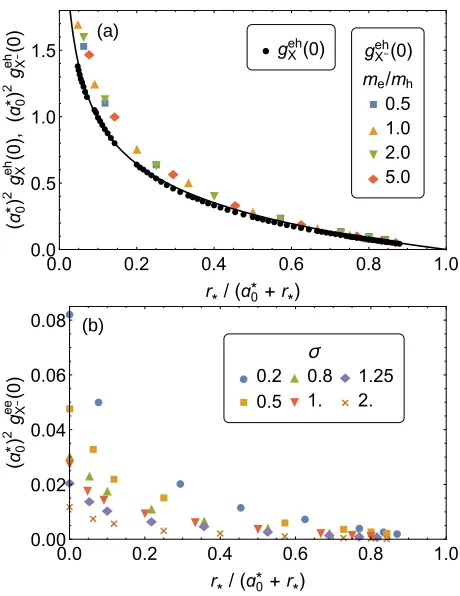
Contact PDFs were extracted as described in Sec. IV E. An example of a fit to Monte Carlo-sampled PDF data is shown in Fig. 10, and our contact PDF results are shown in Fig. 11(a). In all our plots of contact PDFs the statistical error bars from the Monte Carlo calculation are smaller than the symbols. Unlike the DMC mixed estimate of the energy, the extrapolated estimate of the PDF depends on the stochastically optimized trial wave function and hence in some cases slight noise in theg(0) data is visible.
In the Supplemental Material we provide a program for evaluating our fit to the total energy of an exciton [Eq. (47)], as well as fits to the binding energies of biexci-tons, trions, donor-bound excibiexci-tons, donor-bound trions, and donor-bound biexcitons.53 In addition, the program reports fits to contact PDFs for the different clusters.
0.0 0.5 1.0 1.5 2.0 2.5 3.0 3.5
0.00 0.01 0.02 0.03 0.04 0.05 0.06
r/ɑ0*
( ɑ0 * ) 2 g X eh ( r )
DMC pair density results Extrapolation to contact PDF
σ=0.3,r*/ɑ0*=6.15
FIG. 10. (Color online) PDF of an exciton withσ= 0.3 and r∗ = 6.15a∗0. The contact PDF is extracted by fitting the numerical results to Eq. (44).
■ ■ ■ ■ ■ ■ ■ ▲ ▲ ▲ ▲ ▲ ▲ ▲ ▲ ▼ ▼ ▼ ▼ ▼ ▼ ▼ ▼ ◆ ◆ ◆ ◆ ◆ ◆ ◆◆
gXeh-(0)
me/mh
■ 0.5
▲ 1.0
▼ 2.0 ◆5.0
0.0 0.2 0.4 0.6 0.8 1.0
0.0 0.5 1.0 1.5
r*/ (ɑ0*+r*)
( ɑ0 * ) 2 g X eh ( 0 ) , ( ɑ0 * ) 2 g X -eh ( 0 )
gXeh(0) (a) ■ ■ ■ ■ ■ ■ ■ ■ ▲ ▲ ▲ ▲ ▲ ▲ ▲ ▲ ▲ ▼ ▼ ▼ ▼ ▼ ▼ ▼ ▼ ▼ ◆ ◆ ◆ ◆ ◆ ◆ ◆ ◆ ◆ × × × × × × × × × σ 0.2 ■ 0.5 ▲ 0.8 ▼ 1. ◆ 1.25 × 2.
0.0 0.2 0.4 0.6 0.8 1.0
0.00 0.02 0.04 0.06 0.08
r*/ (ɑ0*+r*)
( ɑ0 * ) 2 g X -ee ( 0 ) (b)
B. Biexcitons
1. Binding energies
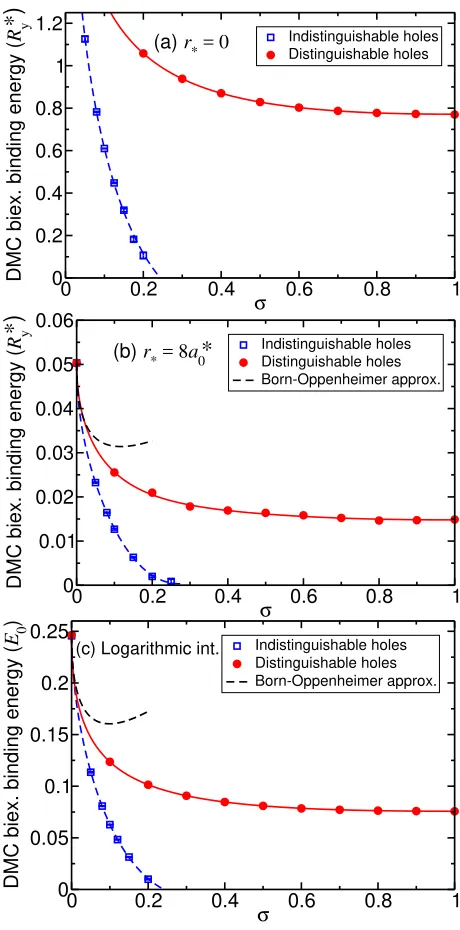
We compare the stability of biexcitons with distin-guishable and indistindistin-guishable holes in the limit of the Coulomb interaction (r∗ = 0) in Fig. 12(a) and at
r∗= 8a∗0 in Fig. 12(b). We find that biexcitons with in-distinguishable holes are unbound forσ&0.3, while biex-citons consisting of distinguishable particles are bound at all mass ratios. The binding energies at σ = 0 are ob-tained using the Born-Oppenheimer potentials as a func-tion of heavy-hole separafunc-tion r plotted in Fig. 13. We fitted U(r) = α+β√r+γr+δr2, where α, β, γ, and
δ are fitting parameters, to our DMC data to find the minimum and the curvature about the minimum of the Born-Oppenheimer potential. For the logarithmic inter-action we fitted U(r) = ζ+ηexp(−r/d) +κlog(r) to our data, where ζ, η, d, and κ are fitting parameters. The Born-Oppenheimer approximation in Fig. 12(b) for heavy holes is in agreement with our DMC calculations at smallσ. Analogous results obtained with the logarith-mic interaction are shown in Fig. 12(c). Forσ&0.2, only biexcitons with distinguishable holes are stable. Hence it is only at extreme mass ratios, where exchange effects be-tween the heavy particles are negligible, that biexcitons with indistinguishable particles are stable.
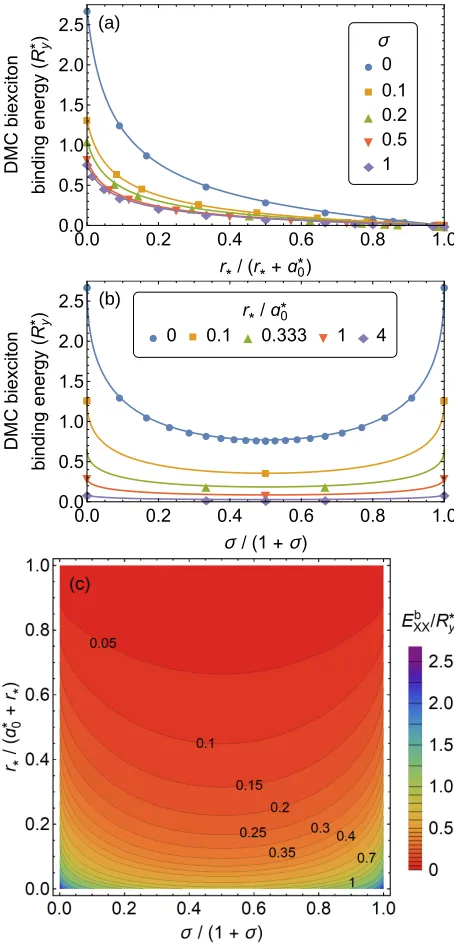
Figure 14 shows DMC binding energies for biexcitons with distinguishable particles interacting via the Keldysh interaction as a function ofx=σ/(1 +σ) and rescaled in-plane susceptibility y=r∗/(a∗0+r∗). Our results are
in agreement with path-integral Monte Carlo (PIMC) data at finite r∗, as shown in Fig. 15.20 However, the
PIMC data obtained by Velizhanin and Saxena have much larger statistical errors and they quoted a previ-ous DMC result54 at r∗ = 0 due to the infeasibility of
PIMC in this case. The function
Eb XX
R∗
y
= (1−y) P
i,jaij
xi/2+ (1−x)i/2
yj
1 +P
i,jbij
xi/2+ (1−x)i/2
yj (48)
containing 17 fitting parameters{aij}and{bij}, was fit-ted to our DMC binding-energy data, giving a fractional error of less than 1.5% everywhere. This choice of fit-ting function exhibits the correct behavior asσ→0, as derived in App. B 1, and is also invariant under charge conjugation (me ↔ mh). Equation (48) accurately re-produces the DMC biexciton binding energies over the whole space of possible susceptibility and mass-ratio pa-rameters, unlike the simple fitting functions reported in Ref. 25. The latter are by construction only valid in the currently experimentally relevant region and, because of the relative simplicity of the fitting function, give sig-nificantly larger fractional errors (up to 5%) than Eq. (48). The fitted binding energy can be evaluated using the program supplied in the Supplemental Material.53 Binding-energy results in the limit of larger∗, where the
interaction is of logarithmic form, are given in Sec. V G.
0 0.2 0.4 0.6 0.8 1
σ 0
0.2 0.4 0.6 0.8 1 1.2
DMC biex. binding energy (
Ry
*
)
Indistinguishable holes Distinguishable holes
(a) r* = 0
0 0.2 0.4 0.6 0.8 1
σ
0 0.01 0.02 0.03 0.04 0.05 0.06
DMC biex. binding energy (
R y
*
)
Indistinguishable holes Distinguishable holes Born-Oppenheimer approx.
(b) r
* = 8a0
*
0 0.2 0.4 0.6 0.8 1
σ 0
0.05 0.1 0.15
0.2 0.25
DMC biex. binding energy (
E 0
)
Indistinguishable holes Distinguishable holes Born-Oppenheimer approx. (c) Logarithmic int.
FIG. 12. (Color online) DMC binding energies of biexcitons with distinguishable electrons and distinguishable holes and biexcitons with distinguishable electrons and indistinguish-able holes against mass ratioσwith (a) the Coulomb inter-action (r∗ = 0), (b) the Keldysh interaction with r∗ = 8a∗0, and (c) the logarithmic interaction [Eq. (14)] between charge carriers.
[image:13.612.324.554.48.513.2]biex-1 2 3 4 5
r / a
0
*
-0.3-0.2 -0.1
0 0.1
DMC Born-Oppenheimer pot. (
R y
*
)
r * = a0* r
* = 2a0* r
* = 4a0* r
* = 6a0* r
* = 8a0*
(a) Keldysh int.
1.4 1.6 1.8 2.0
r / r 0
-0.25 -0.24 -0.23 -0.22 -0.21
DMC Born-Oppenheimer pot. (
E 0
)
(b) Logarithmic int.
FIG. 13. (Color online) DMC Born-Oppenheimer potential energy of a heavy-hole biexciton with distinguishable elec-trons against the hole separation for (a) the Keldysh inter-action with r∗ = a∗0, 2a∗0, 4a∗0, 6a∗0, and 8a∗0; and (b) the logarithmic interaction between charge carriers. The zero of the Born-Oppenheimer potential energy in the plot is twice the isolated exciton energy.
citon binding energies are up to three times smaller than those reported in experimental works.15,16,55,56 There is also a striking, qualitative disagreement with the exper-imental works regarding the trion and biexciton bind-ing energies: the Mott-Wannier model with the Keldysh interaction predicts that the trion has a larger binding energy than the biexciton,21,25 while the experimental studies report that the biexciton peak occurs at lower en-ergies than the trion peak in photoluminescence spectra (i.e., that the biexciton has a larger binding energy). The theoretical results are reported for a free-standing mono-layer; any screening by the substrate and environment would further exacerbate the disagreement with experi-ment.
The ground-state wave function of a system of distin-guishable particles is nodeless, and so DMC provides ex-act solutions to Mott-Wannier models of excitonic com-plexes. Hence the disagreement with experiment regard-ing the bindregard-ing energies of biexcitons in 2D
semiconduc-
■
■ ■
■ ■
■ ■ ■ ■ ■■ ▲
▲ ▲
▲ ▲
▲ ▲ ▲ ▲ ▲▲
▼
▼ ▼
▼ ▼
▼ ▼ ▼ ▼ ▼▼
◆ ◆
◆ ◆
◆ ◆
◆ ◆ ◆ ◆ ◆◆
σ
0
■ 0.1
▲ 0.2
▼ 0.5
◆ 1
0.0 0.2 0.4 0.6 0.8 1.0
0.0 0.5 1.0 1.5 2.0 2.5
r*/ (r*+ɑ0*)
DMC
biexciton
binding
energy
(
Ry
* )
(a)
■ ■
■ ■
■ ■
▲ ▲
▼
▼ ▼
▼
◆ ◆ ◆◆ ◆ ◆
r*/ɑ0*
0 ■ 0.1 ▲ 0.333 ▼ 1 ◆ 4
0.0 0.2 0.4 0.6 0.8 1.0
0.0 0.5 1.0 1.5 2.0 2.5
σ/ (1+σ)
DMC
biexciton
binding
energy
(
Ry * )
(b)
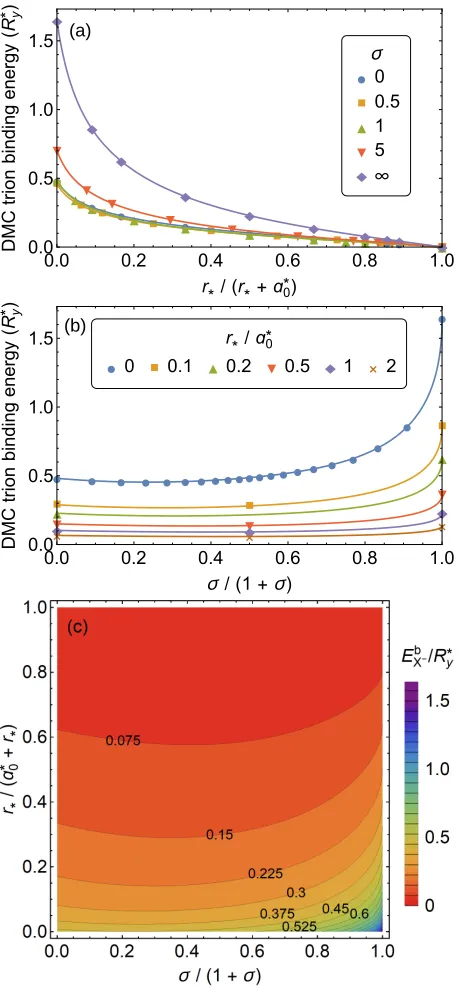
FIG. 14. (Color online) (a) DMC binding energies of biex-citons with distinguishable particles against rescaled suscep-tibility r∗/(a∗0 +r∗). (b) DMC binding energies of biexci-tons with distinguishable particles against rescaled mass ratio σ/(1+σ). (c) DMC binding energies of biexcitons with distin-guishable particles against rescaled susceptibility and rescaled mass ratio. The DMC results for distinguishable particles were reported in Ref. 25.
tors could only arise for one or more of the following four reasons: (i) the 2D Mott-Wannier model with the Keldysh interaction between charge carriers is incorrect or incomplete; (ii) the parameters (band effective masses andr∗ values) used in the model are incorrect; (iii) the
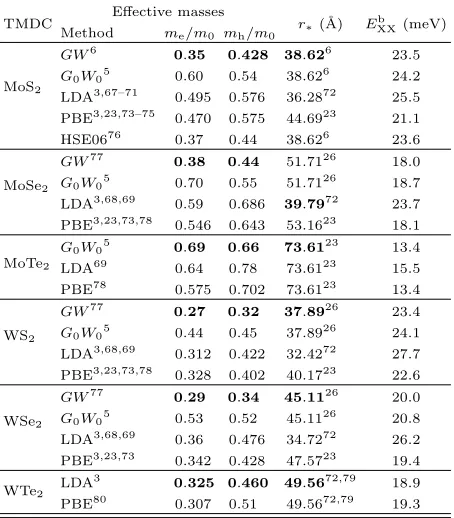
[image:14.612.325.552.50.525.2] [image:14.612.65.293.56.389.2]TABLE IV. Total energies of excitons (X) and binding energies of biexcitons (XX) and trions (X−and X+) with distinguishable particles for different monolayer TMDCs suspended in vacuum (=0). We compare our results with values reported in the literature obtained by DMC, PIMC, hyperspherical harmonics (HH), stochastic variational (SV), and variational (V) methods. For each complex we use the values ofme,mh, andr∗shown in bold in Table V to evaluate the fits of Eqs. (48) and (49). Note that the ditellurides adopt a 2H stacking arrangement in bulk and few-layer samples, which may complicate comparison with experiment.
Ex. tot. en.EX(meV) Biexciton binding energyEXXb (meV) TMDC
Eq. (47) V26 Eq. (48) DMC21 PIMC23 Exp. SV27,28 HH29 MoS2 −546.5 −540 23.5 22.7(3) 22.7(5) 70,1340–6055 22.5 22.1 MoSe2 −543.3 −470 22.9 17.7(3) 19.3(5) '2057 18.4 17.9
MoTe2 −385.7 13.4 14.4(4)
WS2 −511.9 −500 23.4 23.3(3) 23.9(5) 65,1665–70,58 4514 23.6 23.1
WSe2 −461.1 −450 20.0 20.2(3) 20.7(5) 5215 20.2 19.8
WTe2 −454.3 18.9
Negative trion binding energyEb
X− (meV) Positive trion bind. en.E b
X+ (meV) TMDC
Eq. (49) DMC21 PIMC23 SV27,28 HH29 V26 Exp. Eq. (49) PIMC23 Exp. MoS2 35.0 33.8(3) 32.0(3) 33.7 32.8 26 40,12,5918.0(15),114360 34.9 31.6(3)
MoSe2 34.5 28.4(3) 27.7(3) 28.2 27.6 21 3010,61 34.4 27.8(3) 3010
MoTe2 22.5 21.0(2) 2562 22.6 20.9(3)
WS2 33.5 34.0(3) 33.1(3) 33.8 33.1 26 34,6336,810–15,1430,164564 33.6 33.5(4)
WSe2 29.6 29.5(3) 28.5(3) 29.5 28.3 22 3065,66 29.6 28.5(4) 30,652466
WTe2 28.7 28.6
0 0.2 0.4 0.6 0.8 1
r
* / (a0* + r*)
0 0.2 0.4 0.6 0.8
DMC biex. binding energy (
R y
*
)
DMC [Phys. Rev. B 95, 081301 (2017)]
PIMC [Phys. Rev. B 92, 195305 (2015)]
FIG. 15. (Color online) Binding energies of biexcitons with distinguishable particles of equal mass (σ = 1) against rescaled susceptibilityr∗/(a∗0+r∗), as calculated using DMC25 and PIMC.20
biexciton is not in its ground state;27 or (iv) the exper-imental spectra have been misinterpreted or the peaks have been misclassified.
As explained in Sec. III D, there should be an addi-tional contact interaction between charge carriers; how-ever, the Mott-Wannier model with the Keldysh inter-action apparently provides a good description21,25of the
energies of excitons and trions, and there is no obvious reason to believe that contact interactions should be more important in a biexciton than in a trion or exciton. More-over, it is unlikely that the contact interactions could be responsible for the threefold difference between the the-oretical and experimental biexciton binding energies.
The second possibility is that the Mott-Wannier model is in principle correct, but the band effective masses and in-plane susceptibilities used in the model are incorrect. These are taken fromab initio calculations, which might not provide a sufficiently accurate description of the elec-tronic band structure. However, as shown in Sec. V B 2, the different mass ratios and in-plane susceptibilities re-ported in the literature do not significantly affect the binding energy; in fact the mass ratios and in-plane sus-ceptibilities would need to be in error by more than an order of magnitude to explain the difference with exper-iment. Finally, if inappropriate model parameters are responsible for the disagreement with experiment regard-ing the biexciton bindregard-ing energy, it is not clear why the Mott-Wannier model with the same parameters appar-ently provides a good description of excitons and trions. We believe that the exciton that remains after exciton recombination in a biexciton is unlikely to be in an ex-cited state, because the parent biexciton is in its nodeless ground state, which strongly overlaps with the product of the ground states of the two daughter excitons.