Some
smaIl COIpputers
aren't deliVered.
They're .
abandoned.
We believe that when you buy a small computer, you
should get more than just a box of hardware. You should
get the same service and support capabilities offered
with the big systems.
That's the kind of support that goes along with all
our small computers. We have documented training
programs, including courses in preventive maintenance.
And if you should need help, our parts and service are
never more than a couple of hours away.
There's a good reason why we can offer this type of
back-up. We're the world's largest manufacturer of test
instruments. So naturally we understand the needs of
engineers and scientists. In fact, we've built our
reputation on understanding these needs and filling them.
And we're not about to blow it.
You probably won't need much help. Our small
computers have an enviable reputation for reliability and
performance in over
2500
successful installations.
And now we've taken another big step forward. Our
new HP
2100
combines all three of our earlier minis
in one. And its submicrosecond memory makes it almost
twice as fast as any of them. It's also much smaller
and you can expand from
4K
to
32K
in the same
convenient mainframe. Using the latest in MSI/LSI
technology, it also offers control Read Only Memory
(ROM) plus a lot of other features usually found only
in bigger systems. And it won't put a big crimp in
your budget. .
So if you want a good small computer, with good
"big computer" support, call your local HP computer
specialist. Or write: Hewlett-Packard, Palo Alto, Calif.
94304;
Europe:
1217
Meyrin-Geneva, Switzerland.
22115
HEWLETT
WPPACKARD
DIGITAL COMPUTERS
~c~{tap~{¢'Elrtrldge
C\nddeck
designed
(notadapted)
forJ~igi.~a·I·.·.·
•••
ll~e
Now Origirial Equipment Manufacturers getcomputer quality performance in the only self-winding magnetic tape cartridge and transport specifically de-signed (not adapted) for digital use. The mini-cartridge .. and transport have already logged more than 1,500,000 hours of operationincustomers'offices. The unique cartridge Simplifies the tape trans;. port mechanism so thafonly onembtor is required where other decks need three to per-form the same functions. Operation is also simpli-fiedand reliability is assured with: • only one motor ·.drop-in loading. tape always in alignment.
com-plete elimination of tape jams.
Cartridge loading is like putting bread ina toaster. With the tape under constant tension and the pinch roller inside the cartridge case, . tape is always where
.;;.tlnen&y&
~4?_ts
with the snap-back
spring-loaded reels
-keeps tape taut
in or out of the deck
-without
the two extra motors
required in other decks
it must be, between the capstan and the pinch roller ... and there is no pressure pad to cause torque losses and generate or collect loose oxides and dirt.
Unlike other miniature tape containers, the flanged reels of our mini-cartridge are constantly guiding tape so that stretched tape or snarls which
bind the transport never occur.·
Cartridge capacity is 190ft.,O.15"widecom-puter-grade tape with BOT
IEOT
sense markers; removable plug for file protect; tape speed is 7 ips; rewind is 21 ips; re-cording· is· at 400 bpi with more than 900K bits on a single cartridge. - For computer quality performance in· a miniature tape transport, contact a Digitronics representative listed in EEM or EBG.Digitronics Corporation, Albertson, New York 11507 .
DATAMATIIaN®
SEPTEMBER 15,1971
volume 17
number 18
departments
Look Ahead
7
Letters to the Editor
11
Perspective
40
News Scene42
Hardware53
Software
61
Literature
65
W.ashington Report
67
People
68
Index to Advertisers
69
The Forum
71
September 15, 1971
[3ENERAL
20 Computers in Architecture
WILLIAM R. MILLER. Once scorned as an avant garde toy of freaky university types, the computer is at last beginning to be recognized as ,a legitimate tool in the world of architectural planning and design.
37 INTERMAG· 1971
A conference report.iiECHNICAL
30 Retention of Data ... for the Long Term
BELDEN MENKUS. It's time now to plan for storing data for ten years or m9re. If mag tape won't do the job, is microfilm the answer?[30MMENTARV
40 Perspective
President Nixon's new science advisor, Edward E .. David, Jr., looked to by many to provide the infor-mation science community with more influence over federal policy, doesn't believe that automating the service industries will swallow up jobs, contrary to a popular view that these industries need less automa-tion rather than more. David sees his new job as that of a loyal member of the White House team. As he put it in an interview, "I belong to the President."
71 The Forum: APL -
a Potential Liability?
RAYMOND J. D. REEVES. Instead of a panacea, this "sporadic user of APL" finds it to be a "singularly unsophisticated" programming language.About the Cover
Barbara Benson's design projects the architect's com-puterized vision onto multiple levels and the emerging shapes reflect the increased options available to designer and planner when the computer is put to optimum use.
4
To
accurately
conat graphic
data
into
digital
computer
format •••
ill~~c4}®®
Graphic Quantizer
Completely solid-state at t OMhz and capable of handling up to three axes, the RSS-400 Graphic Quantizer accepts pulse signals from optical shaft encoders and converts them instantly into digital X, 'f and Z values for display and recording,
Available as a basic system or with a wide variety of ancillary electronics and position determining units, the RSS-400 provides resolution and repeatability of ±O.OOI" and a built-in program board for simple format-ting. Individual axis display is 5-6 digits plus sign, and manual inputs can be front-panel Inserted.
The RSS-400 will normally Interface with standard card punch units, Flexlwrlters, calculators, typewriters and magnetic tape recorders, Custom Interfaces are available for on-line computers,
For complete information, write or call:
~ Petroleum Center, Suite C-118
~
~ H. DELL FOSTER CO.~ 900 NE Loop 410, San Antonio, Texas 78209 (800) 531-5355
CIRCLE 31 ON READER CARD
HOW MANY
MILLIONAIRES
ARE THERE IN THE UNITED STATES?
JOHN SAUER, Pres. , , , and how many NEW milliunaires join the ranks every year? How did they acquire their wealth? The number and the reasons may astonish you! This amazing story ,is revealed in a valuable new booklet,
"NEW ROADS TO OPPORTUNITY AND WEALTH."
Even more exciting are the factual details about a specific business opportunity that is nothing short of a gold mine, Why? Because, as an associate of the organization providing the opportunity, you help others to succeed,
For yoU\' free copy of "New Roads to Opportunity and Wealth," phone, wire, or wl'ite immediately to:
r «.., \.<&~~ ?fW1MP~ ~( .... ww~".",.",,", )"0/ ~ »:;:t_<{ ~w <'~W~:$'_~ "" FW_M»W, """«~.« W'W7'~h '%~;<, ! . ~; , .... \ .
THIS
"
I
l
r
",Off";;:; \ .
VALUABLE."I'd
,'1j , t " i)
t .
~;j'
.
6&PAGE~".'
) .. ;-4%,:rC~~ 4 \ , BOOK SENT .;, i /':;'W~¥f!I!f,;)%"" .,"",
Yes, Rush me
"Ne:"~~dst~r!~~\tn:8t'O~~'~rtunitv"
Today!NAME PHONE _ _ _ _ _
ADDRESS ______________________________ ___ CITY _ _ _ _ _ _ _ _ STATE _ _ _ _ ZIP _ _ _ _ John Sauer, President
D,A,T,K, Inc. - P.O, Box 22125, Denver, Colorado 80222 (303) 757-5500
CIRCLE 22 ON READER CARD
DATAMATION®
SEPTEMBER 15
11971
volume 17
number 18
This issue
110,340
copies
EDITDR
ROBERT B. FOREST
EDITDRIAL STAFF
Managing Editor Senior Associate Editors Associate Editors
Copy Editor Assistant Editors
Special Features Editor Eastern Editor New England Editor Washington Editor Midwestern Editor Southwestern Editor European Editc:' Australian Editor Contributing Editors
Editorial Adviser Technical Consultant
EDWARD K. YASAKI WilliAM J. ROLPH, TOM McCUSKER RICHARD A. McLAUGHLIN, EDITH D. MYERS, JOHN T. WATERHOUSE JANET EYLER MICHAEL WILLIAM CASHMAN ALMA O'STEEN ANGELINE PANTAGES F. BARRY NELSON W. DAVID GARDNER PHIL HIRSCH LAWRENCE RAGAN ROBERT F. ALEXANDER PEARCE WRIGHT FREDERICK A. BLAND HOWARD BROMBERG, ROBERT V. HEAD, PHILIP H. DORN, LOUIS B. MARIENTHAL, MILTON M. STONE, F. G. WITHINGTON, PAUL ARMER ROBERT L. PATRICK LOWELL AMDAHL
EDITORIAL OFFICES
HEADQUARTERS: 94 S. los Robles Ave., pasadena, Calif. 9H01l Phone: (213) 681·8486; EASTERN: 35 Mason St., Greenwlch,Conn. 06830, (203) 661-5400; 19 Marlborough St., Boston, Mass. 02116. (617) 267·9414j 9805 Singleton Dr., Bethesda, Md. 20034, (301) 530-7271; MIDWESTERN: 407 S. Dearborn St., Chicago, III. 60605 (312) 922-8245; SOUTHWESTERN: 2711 Cedar Springs, Dallas, Texas
75201, (2i4) 744-0161. FOREIGN: 65, HIli Road, Chelmsford, Essex, Englandj 322, Park RegiS, I;'ark St., Sydney, NSW 2000, Australia.
GRAPHIC DESIGN
AND PRODUCTIONArt & Production Director Production Manager Production Assistant
CIRCULATION
35 Mason Street Greenwich, Conn, 06830
Circulation Manager Marketing Research Director
PUBLISHER
GARDNER F. LANDON ASSOCIATE PUBLISHERJAMES M. MORRIS
Circulation audited by ~
Business Publications Audit
Iii6IIiI
CLEVE MARIE BOUTELL MARILEE PITMAN GLORIA J. FASANA
MAE VAN RENNES DOUGLAS DeCARLO
At:
--A.jiiIIt, Member, American
--.~ Business Press, Inc.
tp
DATAMATION is published twice monthly on or about the first and fifteenth day of every month by Technical Publishing Company, 1301 South Grove Ave" Barrington, Illinois 60010; Arthur L. Rice Jr., Presi-dent; Gardner F, landon, Executive Vice President. Executive, Circu· lation and Advertising offices, 35 Mason Street, Greenwich, Conn, 06830 (203) 661·5400, Editorial offices, 94 So, los Robles Avenue, Pasadena, California 91101. Published at Chicago, III,DATAMATION is circulated without charge by name and title to certain qualified individuals who are employed by companies involved with automatic information handling ,equipment. Available to others by subscriptio,n, at the rate of $25 annual!y ,In the U,S. and, Cana~a. Reduced rate for qualified students, Foreign subSCriptions are on a paid baSIS only at a rate of $38 annually. No subscription agency is authorized by us to solicit or take orders for subscriptions, Controlled circulation paid at Columbus, 0, and Form 3579 to be sent to Technical Pub-lishing Company, P,O, Box 2000, Greenwich, Conn, 06830, Copyright 1971. Tech-nical Publishing Company, Microfilm copies of DATAMATION may be obtained from University Microfilms, A Xerox Company, 300 North Zeeb Road, Ann Arbor, Michigan.48106,
Printed by B~slow ASSOCiates, Inc,
The new 6000 Series fea-tures the same rotating assembly that has been field-proven for more than 3,000 years* without" a sin-gle bearing assembly fail-ure in our 7300 and 7310 Series.
Built in features? It's LOADED! Naturally, the Series 6000, even though it ... __ .. _ ... , .. _ ... " .. __ .. , .. __ .... __ ... _. is low in cost, features non-contact, fail-safe flying heads, operating in an inert gas environment and has full field-expandable capability. It is interface compatible with the other Series of DOC
head-per-track disc memory systems, requires no pre-ventive maintenance, is internally shock mounted, has high MTBF and low MTTR .. '. just as do all systems produced by DOC, a pioneer designer of head-per-track disc memories.
Can we say more? YES! The new low-cost 6000 Series is a COMPLETE SYSTEM, including all Read/Write electronics with standard TTL interface! It is modular
in design ... you can have from 1 to 8 megabits ca-pacity, from 16 to 128 tracks in 16-track increments, and average access time is 8.7 milliseconds.
Controller capability? JUST ASK! We offer a complete line of mini-computer controllers at competitive prices.
DOC offers customer service engineers in London, Geneva, Frankfurt, and Tokyo as well as New York, St. Louis and San Diego, all geared to provide 24-hour response.
Prices start at less than $5,000 in Quantity One! For complete information on head-per-track memory
sys-tems from 1 to 75 megabits and special quantity
dis-counts, write or call:
DIGITAL
DEVr::LO~:>~VH:~,rf CO[~r)Ol71f.\TION5575 KEARNY VILLA RD., SAN DIEGO, CA 92123 (714) 278-9920/TELEX-US: 69-54-30
, Our BI 2600 is as close to the perfect mag tape unit
as you can get today.
In it, we've cleverly turned a rigid 9 pound front
panel casting into a tape deck that never gets out
of alignment.
We've ingeniously eliminated tape cupping.with a
technique that provides uniform tape tension no matter
what the buffer arm position.
We've meticulously ensured uniform packing
density and tape speed by tying all timing and
spacing to the capstan encoder.
We've sensibly eliminated all electronic and
mechanical adjustments. Normal equipment
maintenance is just
a
simple bit of clean-up, with
virtually no downtime.
Then we wrapped up all this
thinking in our BI 2600 Mag Tape
Unit: Precise bidirectional tape
travel at 4 to 37.5 ips, with a
maxi-mum data transfer rate of 60 kHz.
Uniform packing densities up to
1600 bpi. A tape path completely
to IBM specifications. 81
/2" reels
(also available as our Model
BI 2610 with 101
/2" reels).
Industry compatible interfaces.
High reliability with plug-in
DTL/TTL electronics that have
no one-shots and no
differenti-ators. No program restrictions, no
delays under any circumstances.
INDUSTRIES INC.
6
And we've priced it all at under
$3000 in OEM quantities.
Bright?
, Bright Industries Inc.
One Maritime Plaza, San Francisco · 94111
Telephone: (415) 391-9794
Bright Industries is an affiliate of Tracor Inc.
NEW ACTIVITY SUGGESTS
370/125 ANNOUNCEMENT
WALL STREET SAID COOL
TO COGAR MONEY QUEST
IBM EMPLOYEES GROUP
FORMING IN ALABAMA,
TRIBE CLAIMS KEYPUNCH
PRICE EDGE OVER TAIWAN
"-The revelation that IBM has a 370/125 is not
particularl~new
and exciting. However, we hear
there is new
'act_~vityin the 125' s group--perhaps in
preparation for the''-Ullyeiling of the machine before
the end of the year.
Onepr9blem~forIBM with the
125: the machine would likely"-Tnipact the new Mod 22.
Cogar Corp.'s $9 million. money quest wasn't meeting
with resounding enthusiasm on Wall Street at,press
time, and there
w~resome who believed founder George
Cogar would have to end up biting the bullet; Cogar
could be acquired. More than a few companies are
interested, it's been learned.
Ironically, Cogar's concept that monolithic
semiconductor memories would be the big computer memory
of the 1970s was a sound idea--fortress IBM has been
stuffing them into some of its 370 models.
But IBM
hardly could be expected to turn to Cogar as a
supplier, since Cogar picked up ideas and key men
from IBM to start its monolithic business. And
none of the dwarfs is going the semiconductor route
as yet, leaving Cogar with lagging sales and in
desperate need of new money to
fin~nceR&D efforts.
George King, senior systems engineer with IBM's Mobile,
Ala., office, is forming a "Professional IBM Employees"
group which, if it gets off the ground, will be the
closest the big computer company has ever come to
having a union of salaried employees.
King, of course.
says the association, which encompasses offices
~nAlabama and Louisiana, is·not a union and was formed
to help members exchange professional information.
IBM's employee appraisal techniques and its open door
policy (anyone can see president Frank Cary if he
asks) are sufficient safeguards, says King.
But he
adds that the association would act "if there were an
urgent need to go beyond these safeguards." He also
says the association has been "a long time coming,"
but refuses to explain what he means by that.
So far., the association is an informal one with no
dues-paying members.
But it has an attorney, T.O.
Howell, and is considering incorp6rating, King says.
At first it would appeal to systems engineers, but
eventually could take in "IBM employees at all levels."
At this writing, IBM corporate offices in Armonk had
not heard of the association, a spokesman said.
"Some of our best keypunch operators are men," says
Roger McKenzie, general manager of a keypunching
service on the Pima Maricopa Indian Reservation.
The
business, owned 51% by the tribe, has .all Indian
operators--21 in number--and after six months of
educating and training, it's off and running.
Plans
ONE SMALL STEP FOR
MA BELL, INDEPENDENTS
THEY BOUGHT LOW
ILLIAC IV: PUTTING
IT ALL TOGETHER
RUMORS AND
RAW RANDOM DATA
their prices lower than for keypunching in Taiwan.
McKenzie says their newest effort will be to keypunch
from microfilm, eliminating the necessity for a client
to ship valuable original documents •.
AT&T and independent equipment makers are understood
to be ready to announce agreement on certification
and inspection procedures that would allow direct
attachment of automatic answering or recording devices
to the voice network.
Such a pact, almost certainly,
would spur similar agreements covering other
independently made peripherals. Ultimately, says one
source, private line connecting arrangements will be
made mandatory, at no direct cost to users. AT&T
would make up for this by adding the costs to its
private line rate base.
The one-time chairman of Tenet, Inc., Thomas H. Bay,
may have had problems when he headed the Sunnyvale
time-sharing machine company, now in bankruptcy court;
but another investment worked out for him.
He has made
more than
$1
million on his investment in Data General
Corp., Southboro, Mass.
Information from the recent
DG prospectus also shows that another industry figure
who has fallen on bad times of late, George R. Cogar,
of Cogar Corp. (see above), made more than
$1.5
million when he sold out his original investment in
Data General many months ago.
Tho~gh
slipping its original schedule by several years,
the Illiac IV supercomputer hardware and software are
approaching completion.
According to Burroughs, all
64 processing elements plus 8 spares have been
checked out, and the machine is being
integrated--no mean task with cables in effect hooking each PE
to every other PEt
Software, including GLYPNIR, the
assembly language ASK, and the Fortran-like COCKROACH
("because it has survived from paleolithic times
relatively unchanged"), are running, and version 1.0
of the OS will be ready when the machine is, according
to a Univ. of Illinois Illiac IV spokesman.
What remains is site preparation at the Ames Researcl
Center near San Francisco. Although the Illiac is due
for installation there early next year, we hear there's
no contract yet for the preparation job.
Nobody could accurately assess the effect on dp of ' the
President's new economic policy; but some guessed that
hardware firms would benefit if Congress OKs the tax
credit.
Software firms may have to be more explicit
about the formulas they use to price new packages •..
There's a booby trap in the Navy's Cobol compiler
validation routines.
If run on an 1108, they destroy
4K bytes of MOS/LSI read/write memory. Each of the hundreds of Sycor 340 terminals we're now shipping can be optionally equipped with fast random access memory. Now powerful pro-grams can be more closely tailored to your specific applications and changed as your system requirements grow. And to get you started immediately, we've developed a Program Library, ready to be loaded from cassette and executed at the push of a but-ton: Range Checking. Table Look-Up. Multiplication / Division • Value Comparison. Code Conversion. LRC or CRC checking for communications • Card Reader and Card Punch drivers • Check Digit generation / verification. Conversational Mode ... And more to come.
Our 8K byte ROM has been packed with "goodies" all along. Omission DetectionH
", Capacity Control™, 2400 BAUD BSC
Com-munications and Data Compression. Drivers for 30 cps and 50
LPM printers. All that combined with a control program that doesn't waste time. Input / output· operations are double buf-fered and fully overlapped. And most of our peripherals run on DMA Channels to increase system throughput and allow more application processing time. So far, we've spent over 27 man-years of machine language programming in optimizing your ap-plications in field-proven, general purpose firmware. We didn't think you'd want to absorb the expense, and risk your schedules in doing that!
Even greater capability for 340 users. Once you've tried our Program Library, you may also want to write
51
special programs of your own. Soon we'll beannouncing this further capability. Keep watch-
I:
ing, and ... keep talking to Sycor.100 Phoenix Drive, Ann Arbor, Michigan 48104
SYCOR INC
®®@©@~§
YOU CAN TRUST
MODELS 30+,40+,50+,65+
From Fabri-Tek:
Leader in memory technology
for over a decade.
~A[g~~~ ®T~~frt
INC.
MEMORY PRODUCTS DIVISION
Leader In Memory Technology For Over A Decade.
10 CIRCLE 7 ON READER CARD
Who has Fabri-Tek produced core memo-ries for over the past 15 years?
Hundreds of companies, including:
CDC Canadian Westinghouse
XDS RCA Ltd. (Canada)
RCA Ferranti (Canada)
Honeywell GE (Canada)
DEC Northern Electric (Canada)
GE DeHavilland (Canada)
Burroughs Elliot (England) Varian Nixdorf (Germany)
NCR Olivetti (Italy)
Collins Marconi (Scotland)
H-P ICL (England)
Bell Telephone Honeywell-Bull (France) IT & T AEG-Telefunken (Germany) Univac English Electric (England) Litton Phillips (Holland)
CFTH (France) CII (France) And yes-even IBM!
Now you can capitalize on this expertise, as this growing list of 360 customers and users are doing:
Boothe Computer Corp. • Dearborn Com-puter Leasing • Levin-Townsend ComCom-puter Corp. • National Computer Rentals • Inter-tek, Inc. • Electronic Data Systems Cor-poration • Professional Automation Group
• Gant Shirtmakers • Chicago, Milwaukee, St. Paul and Pacific R.A. • Eagle Discount Supermarkets • Medtronic, Inc. • Spring Mills Inc. • Accounting Corp. of America • Rome Research, Inc. • Weldon, Inc. • Certified Grocers Co-op • MAl Equipment Corporation • Lowes Companies, Inc. • Union National Bank • Kentucky Farm Bureau Mutual Insurance Co. • Maryland Hospital Service, Inc. • Graco, Inc. • Onan • U.T.L. Computers Inc. • Educational Test-ing Services • E.B.S. Data ProcessTest-ing Inc.
• Day's, Inc. • Rockland State Hospital • Trans Union Systems Corp. • Univ. of A.1.
24 hour field maintenance available in over 90 cities - over 900 C.E.'s:
We back our products, and you can be sure we're going to be here to service your 360 memories - and provide spare parts - for as long as you need. And furnish your next generation memories as well.
Reliability and dependability:
Our 360 Core Extension Memory systems have been on-line and fully operational since the summer of 1970, with an excep-tional up-time record.
Find out for yourself! We would be pleased to supply customer reference lists.
Our complete, high-performance line:
MOD 30+ expands main memory of
360/30's to 128 K bytes.
MOD 40+ expands main memory of
360/40's to 512 K bytes.
MOD 50+ expands main memory of
360/50's to 1024 K bytes.
Fabri-Tek also offers the LCM+ large peri-pheral core unit to expand memory capa-bilities of 360/50 and 360/65 processors.
Let us show you how a real leader can
perform: Fabri-Tek, Inc., 5901 South County
Road 18, Minneapolis, Minnesota 55436. Phone 612-935-8811. TWX 910-576-2913.
~
LETTERS
Not so helpful
Sir:
I am referring to Mr. G. C. Kinney's letter "Sight/performance" in the July 15 issue (p. 11). My comment to his offer to provide his expertise on the performance of people in reading ocr: Someone who thinks that Far-rington 12L2/12F2 is like OCR-B should refrain from communicating this information to the computer community. D. HEKIMI European Computer Manufacturers Association Geneva, Switzerland
Misguided?
Sir:Re "The Hidden Speed of ISAM (June 15, p. 48): Mr. Coyle's figures for improving the ISAM rate from 8,000 to 33,000 transactions an hour does not give a performance through-put improvement of 400%, as he says, but of 312%; and if he calculates his own performance improvement in terms of throughput improvement, he should also use the same measure , when quoting the competition's
im-provements.
Instead he uses 20-70% figures which apply to time saved, not to throughput improvement. In fact, his 400% "improvement in performance" for ISAM vs. 70% "performance im-provement" for the unnamed compe-tition (presumably Comress's AMI-GOs) comes out at a claimed differ-ence of only 3~~ minutes of running time saved per hour (45~~ minutes saved as against 42 minutes) .
With this sort of apples-and-oranges calculation going on, per-haps we needn't wonder about why he did not take into account the cost to Chase Manhattan of investigating IBM'S "free" software. As I read his article, Chase would have been dol-lars ahead by buying AMIGOS rather than letting Mr. Coyle spend his time and their computer time on that "long, hard road" doing the work that an outside software supplier would have done for them (free).
I can't see any justification for a user being asked to invest these dol-lars on an IBM "free" product before
he looks around-and I don't see why
September
15, 1971
a GUIDE project chairman should ask them to. It just gives substance to Herb Grosch's claim that the IBM user groups have sold out to IBM. ALAN TAYLOR, CDP
Framingham, Massachusetts
100.0000000000%
Sir:
In response to the letter from Mr. Theodore Shapin in the July 15 issue (p. 11), let it be known that Remote Computing Corp.'s time-sharing sys-tem does give the correct answer to all six problems. I shall expect a con-tract from Mr. Shapin as soon as he is told.
LARRY H. NEBEL
Remote Computing Corporation Los Angeles, California
Two other services claiming to get "A's" on Mr. Shapin's test are Allen-Babcock Computing, Los Angeles (RUSH, a PL/l subset), and The Computer Co., Richmond, Va. (ACTION/APL). Also, Program-matics, Los Angeles, reports that their PI FORT (FORTRAN for sys-tem/3) gave the correct results in all cases.
Point missed
Sir:
You perform a real service to the industry with letters like Ted Shap-in's-and so does he, of course.
The system I use, which I hasten to point out is excellent in most re-gards, got all but one of the examples wrong! I can readily sympathize with the systems programmers who will tell you that it is a damn difficult problem to solve satisfactorily, but it's damn annoying for the user, too, and worth more attention than it gets. DANIEL D. MCCRACKEN
Ossining, New York
Standard communications
Sir:
It is in order to express appreciation for referring to a new magnetic tape cartridge announcement by Digitron-ics in the footnotes of "The Forum" article of your Aug. 1 issue (p. 63). However, I also think it is in order to state that I have had no communi-cations from the Philips orga,nizations
indicating any abandonment of the EGMA standards or any other stan-dardization efforts in regard to the Philips-type cassette.
vVe at Digitronics are enthusiastic about our recent cartridge announce-ment and do feel there is a good potential for the segment of the mar-ket for which the specifications of our
cartridge and/or deck applies-but again, this should not be interpreted as an abandonment by the PhiliPS. associations of the standardizatic:m of the Philips cassette.
CLIFTON W. SINK
Division President and General Manager Digitronics Corporation Albertson, N ew York
Gag lag
Sir:
I live in far-off Australia, hence the enormous time lag. I am not a com-puter professional, just a humble de-sign engineer, but I can laugh as loud and as long as any of you guys. And I did. Oh, that April 1 issue was beau-tiful. It now resides alongside my collection of Goon tapes, and that is high commendation indeed. Many, many thanks, and roll on April 1, 1972.
D. L. BLACK
Doncaster, Victoria
P. S. Ethan Shedley for President. P. P. S. Hoo Boy, that Shedley!
Bells and tassels
Sir:
Congratulations to Dennie Van Tas-sel for outlining computer security problem areas and remedial measures so effectively ("A Contingency Plan for Catastrophe," July 1, pp. 30-33). But a word of caution I Mter three
years devoted to computer security consulting, I have concluded that there is a widespread tendency to base computer security programs on the latest gadgets. This not only wastes money, it also leads to a dan-gerously false sense of security which can only be compared with reliance on a magic amulet to ward off evil spirits.
I am convinced that to be sound and cost-effective a computer secu-rity program must be based on a systematic and comprehensive analy-sis ~f one's own specific security re-quirements. The reference by Wess-ler, Myers, and Gardner in the same
Letters ...
issue (p. 37) to a security program rejected because "it cost too much" points up the need to understand that losses are as much an expense of doing business as payroll and as such should be included in the budget of the organization. Only then can the cost of a security program be evalu-a ted reevalu-alisticevalu-ally.
ROBERT V. JACOBSON
New York, New York
Enough is enough
Sir:
Is there an optimum middle ground of adp knowledge for top manage-ment? Can too much or too little knowledge be self-defeating for men who make the ultimate decisions for new equipment or new systems?
An Army Reserve officer is now assembling background material to support an Army War College study on what a senior executive should know about adp and is seeking sug-gestions, conclusions, and illustrative case histories from DATAMATION readers.
Material on this concept, as well as recommendations for appropriate levels of knowledge, is requested. CULLEN GULKO
2430 Federal Avenue Los Angeles, California 90064
Neighry a word
Sir:
It was surpnsmg that the article on sports and edp in your June 1 issue made no mention at all of the use of computers in the racing industry. Ac-tually, horse racing was probably the first sport to use computers-the first totalisator was installed by the Amer-ican Totalisator Co. at Arlington Park in June 1933. The heart of the system was an' electromechanical computer.
The first digital computers were introduced in the 1960s. Since then great strides have been made in ap-plying computers to racing. Interna-tional Computing Co. designed and developed the software for the new totes that have been deployed by American Tote throughout the coun-try.
The new systems utilize duplexed Varian 620/i computers. These sys-tems record bets, compute odds, keep 'account of ticket sales, compute prices, drive displays, and produce many accounting reports essential to
12
the parimutuel operation. Computers are also used off-line for accounting, auditing, and payroll. In addition, computers will make possible the de-velopment of off-track betting sys-tems, an area with tremendous growth potential.
I would venture that computers have had and will have more impact in racing than in any other sport. BURT H. LIEBOWITZ
Bethesda, Maryland
Futile fight
Sir:
NCR continues to claim that its three-color bar-code merchandise tags and credit cards cannot be altered. In your July 1 issue (p. 16), they assert that the tag which had been altered by coloring over the optical bar-code was indeed read successfully . . . the NCR reading wand actually read the
original price code; that is, .the wand
could see through the new markings and read the old colors underneath ... The fact remains that several peo-ple witnessed the test in New York when the NCR register accepted two altered tags and printed the mark-down prices rather than the original prices. Transaction Systems has the tags and the receipt to prove this . . . Any further exchange of corre-spondence seems futile; we await the . time when NCR finally consents to a
test before the public. WILLIAM H. BURKHART
Transaction Systems, Incorporated Palo Alto, California
Problem-oriented problem
Sir:
In your July 1 News Scene (p. 58), you reported the approval by CODASYL PLC of the CODASYL Data
Base Task Group report. It was also indicated that Burroughs was one of the four dissenters of the report. I would like to explain the reasons for the Burroughs objection.
There seem to be· two schools of thought in the implementation of a data management system. One is a procedure-oriented approach; the other is a problem-oriented ap-proach. The former requires that the applications programmer have knowledge and control over record placement, accessing techniques, search strategy, etc., in order to im-plement an application in the most efficient manner. The problem-ori-ented approach involves an imple-' mentation in which an applications programmer need not concern him-self with how data· is physically maintained within the system. He need only specify what data is needed, with little or no concern for the mechanism by which the data is made available.
It is felt that a procedure-oriented system has an advantage in increased run time efficiency but has the disad-vantage of increased implementation time due to increased complexity; also, changes to the data base struc-ture will cause applications to be more susceptible to major rewrites. A problem-oriented system, conversely, while perhaps running less efficient-ly, is felt to have the advantages of quicker application implementation time, and changes to the data base structure can be more readily made ...
The CODASYL DBTG proposal repre-sents a very sound procedure-ori-ented data base manage~ent system. However, user response indicates a large interest in the problem-oriented approach. It is also felt that near future advances in the state of the art would allow the implementation of a problem-oriented system at an effi-ciency level very nearly equal to that of a procedure-oriented system. As a result, there will be an ever-increas-ing demand for the problem-oriented system.
It is felt that the current DBTG proposal has certain aspects (such as explicit references in DML to AREA and DATABASE-KEY, and also the con-cept of currency indicators) which preclude the implementation of prob-lem-oriented systems-and therein lies the objection.
LERoy R. GUCK
Burroughs Corporation
City of Industry, California •
Thrifty ... not cheap
There's real thrift in using Ampex peripherals
with your 360 or 370 computer. Ampex provides
identical or better performance for less money
with mainframe memory, disk drives,
tape drives, and performance-enhancing
extended memories.
And that's not all!
Ampex thrift-minded lease agreements are·
available for whatever term fits your
need-and there is no penalty for upgrading during
the lease.
Call today and join the thrift generation saving
money the Ampex way. Ampex, Computer
Products Division, 13031 West Jefferson Blvd.,
Marina del Rey, CA 90291. Tel.: (213) 821-8933.
AMPEX
Thrift expert, Jack Benny
14
NeU)
AddoDCore
for
System 360
The
lowest price
available
T
he new Model 3768 Storage Unit lets IBM 360 System users expand their system's memory at the lowest price available.By utilizing the host processor and its time-proven system diagnostics for preventive maintenance as well as remedial maintenance, costly built-in test equipment has been eliminated. The Model 3768 offers direct plug-to-plug compatibility with no complex
interfacing or programming changes, available in standard IBM storage capacities including the Model 30 2.0 micro-second processor. All CHCS memory systems are
manufactured, installed and maintained by personnel thoroughly trained on IBM equipment including System 360 operation, testing, installation, and operational maintenance.
Use of CHCS memory systems will not affect your existing IBM mainframe mai ntenance contract.
The Model 3768 Storage Unit is available immediately for sale or lease.
I
g~
I
Computer Hardware Consultants
&
Services, Inc.
1409 Easton Road, Warrington, Pa. 18976 215-343-1430
Remex knocks down your costs
with two quick punches.
Remex keeps breaking through
its shell with money-saving new
ideas. This time, it's a new brood
of tape perforators designed to
make your engineers happy and
your accountants ecstatic.
On your left, our RPR1075.
The tape punch that gives you
75 characters/second for the
price of 50 or 60. It's ideal for
use with minicomputer systems,
typesetting, data collection or
any other operations requiring
high performance.
The 1075 gives you
ultra-reliable punching of 5,6, 7, and
8 track tapes. Both paper and
Mylar®. And it handles reels up
to
8lj2"in diameter with
propor-tional spooling.
With a tape punch like this
you'll never end up with egg on
your interface. TTL compatible
electronics are highly modular
and mounted on highest quality
circuit cards. Plus, it's 'rack
mounted with integral power
supply. Back space for easy
pro-gram or operator correction is
standard.
On your right, the RPS0030.
For such applications as
com-puter peripherals, automatic test
stations, business machines,
numerically controlled machine
tools and communications
equip-ment, it's perfect.
It gives you 30 characters/
second performance with
bi-directional tape movement. It
can handle up to 1000 feet of a
wide range of industrial tape,
and provides a lighted indication
when tape is running low. You'll
light upatthevery, very low price.
Both the 1075 and the 0030
are available with supply and
spooler take-up as well as
fan~fold configurations.
So, stop brooding about
costs. Write Remex. 1733 Alton
St., Santa Ana, Calif. 92705. In
Europe and U.K., contact S.p.A.,
Microtecnica, Torino, Italy.
Remember-Software
com-patible interfaces are now
avail-able for most popular
minicom-puters. Contact us for price and
availability for your mini
peri-pheral needs.
l!fEMEX
IS COMING OUT
F ITS SHELL.
75 characters/second
for the price of
50
or
60
, for the price of
30 characters/second
10-20
September 15, 1971
A UNIT OF
"'-XL~
~~~
EX-CELL-O, CORPORATION
\ .. ,,')/
\\')~:1
\'--4
The Gould 4800 helps Battelle-Northwest
analyze thermal
di~charges.
.
The Gould 4800 high-speed printer is playing
a big part in the thermal pollution research
being conducted at Battelle-Northwest.
Battelle Memorial Institute, established
over 40 years ago, is a not-for-profit research
corporation with four major laps and offices
around the world. Battelle handles many
projects on a contract basis, with heavy
emphasis on applied research.
Projects currently underway at
Battelle-Northwest in Richland, Washington, include
studies that determine patterns of
waste-water discharges from industrial and
muni-16
cipa! operations and to evaluate their effects
on surrounding waters. The research
tech-nique, developed Oy Battelle, consists of
collecting aerial infrared and tracer dye
imagery of surface water discharges.
Data recorded from the infrared imager is
processed by Battelle's computer system, a
unique hybrid facility. A Beckman EASE 2133
analog computer is coupled to a DEC PDP 7
digital computer.
Th~
Gould 4800 then prints out isothermal
plots, density plqts, and contour plots. The
contour plots provide two different views.
jim ~ •
II
LEVELS 1 2 3
LEVEL TEMP. (OEG. F) 1 56. 99 - 58.00 2 58.00 - 60.00
NUI1BER OF ARE.A ELEMENTS 8592
2433
OOMPUTER PRODUOTS
Used with a stereoscope, these two views
provide simulated three-dimensional
tem-perature contours.
Researchers depend heavily on the Gould
4800's graphics capabilities for output of the
simulation and modeling projects. And even
with their small computer, they get high
speed alphanumerics and graphics.
The Gou Id 4800 operates with the hybrid
system in many other projects at Battelle,
ranging from physics to social sciences. In
addition, by means of a time sharing system,
the 4800 operates simultaneously with an
SEL 840 computer for basic math and
science calculatiens.
Battelle's initial investment in the Gould
4800 was less than the cost of impact printer
and plotter equipment, and they developed
their own interfaces and software for it.
Since the 4800 has few moving parts, as well
as solid-state electronics, there is also a
minimum of maintenance and servicing.
The Gould 4800 high-speed printer. Put it
to work for you. Write Computer Products,
Brush Division, Gould Inc., 3631 Perkins Ave.,
Cleveland, Ohio 44114.
18
If
your world is
punched full of holes,
and limited to
31j4"
x
7
3/8" ••.
Someday you will
change the shape of things
§OMIEDAY ll§ TI-IIE1R?JEo N((J)Wo
Scan-Data Corporation. makes it possible with OCR systems that give real meaning
to the word flexibility.
That eliminate the need for re-creation of source documents.
Part of the reason is SWAMI. Software-Aided Multifont Input. The world's first, and only
self-teaching OCR system. It's designed for use with any Scan-Data system, old or new.
It
enables you to read virtually any consistent font, even degraded characters-directly
,
from source documents. Combined with our superior handprint capabilities, SWAMI
makes document re-creation a thing of the past.
- That's only part of the reason. The rest has to do with our new
250and
350Page and
Docu~entReaders. Which take direct input from pages or documents from
3"x
5"through
11"x
14".On almost any weight or grade of paper.
.
It
all adds up to practically unlimited flexibility in data processing. And that means time
and money savings for you.
Ask us to tell you about the wonderful world of OCR.
Yours now. Courtesy Scan-Data Corporation.
CORPORATION
800 EAST MAIN STREET 0 NORRISTOWN, PENNSYLVANIA 19401
215/277-0500 D TELEX: 846485
Two ways to save money
on practically any
time-sharing service.
Model 33 ASR
accoustically
coupled terminal.
$65 per month.
With about 150 in the U.S. there is no
shortage of time-sharing services. What there
is a shortage of, is low-cost terminals and
service for them.
So about a year ago we decided to offer
terminals that would be compatible with
virtually every time-sharing service. And we
offered terminals at the lowest prices ever.
Add to that nationwide support and it's not
surprising that we have leased literally
thousands of terminals.
We offer models for every purpose. The
Model 33 ASR with acoustic coupler works
with any standard telephone. And we can
Model 33ASR
for data access
arrangement
$75 per month.
provide Model 33 or Mode! 35 for use with
Data-Phone* or data access arrangements.
Regardless of which data terminal
con-figuration you select, you can depend on
Western Union Data Services Company for
nationwide servicing, applications
engineer-ing, training and support.
Interested in the most economical and
efficient data terminal for your needs?
Contact me at Western Union Data
Services Company, 16 McKee Drive,
Mahwah, New Jersey 07430. Phone:
201-529-4600. Outside NJ. call toll-free
800-631-7050. Telex: 12-5077 .
...
• Registered trademark of AT&T.
IIII
!!!!!
data
ser\llCe5 CDmpan!::l
20
from academe
to commercial use
in ten years
~
The advent of computer applications inGi
J
'architecture began in the early 1960s. Much of the work at this time, however, ___ ._ was in the form of academic research. The Boston Computer Conference in 1964 marked the first formal gathering of computer enthusiasts in architec-ture. Most of the attendees at this conference were from the greater Boston-Cambridge university com-plex. Many of these individuals were looked upon by their senior professionals as you,ng, misguided aca-demics with little or no understanding of what it "really" took to become an architect. These early en-thusiasts were often referred to as computer freaks and thought to have ideas too fancy for the commercially oriented architectural practice. These new enthusiasts, however, turned out to be neither freak nor fancy but rather the avant garde of a major new movement inthe field of architecture.
Prior to discussing the extent of computer applica-tions in architecture it would be well to review some background information. When offering computer services to the architectural industry the provider must think of a' broad-based industry composed of many different types of professionals. These include planners, project architects, architectural designers, interior designers, graphic artists, draftsmen, con-struction specifiers, cost estimators, civil engineers, structural engineers, mechanical engineers, electrical engineers, construction inspectors, computer scien-tists, managers, marketing and public relations per-sonnel, and clerical staff. It is the architect, however, who is the primary leader of this industry.
There are over 30,000 registered architects in the U.S. and over 15,000 architectural firms. As well could be expected, many of these architects practice as individuals or in small groups. Most smaller archi-tectural firms (1 to 15 employees) generally do not include the peripheral disciplines listed above. These related services are provided by consultants. But whether an architectural'practice is large or small it likes to think of itself as being able to offer compre-hensive services to its clients.
Typically, o~ly the larger archite~turaJ firms offer the luxury of in-house computer services to their, clients. Most of the films with in-house computer capability utilize remote-entry data processing tech-niques. A few firms, however, have their own com-puter. A few of the medium size and smaller architec-tural firms offer computer services through the use of outside service bureaus.
Hardware manufacturers and general software companies have been slow to develop programs for the architectural industry. There are two reasons for this apparent lack of interest: 1. the market size of the architectural industry is limited relative to other inr dustries such as aerospace, etc., and 2. computer specialists' typically have a lack of understanding regarding computer potential within the architectural industry.
Most application programs have come from univer-sity sources, in-house programmers, and consultants. The programs originating within the circtes of aca-demia (which, by the way, are closely guarded) reach the profession through the hands of the
vidual researcher as he matriculates from the univer-sity. The Laboratory for Computer Graphics and Spatial Analysis at Harvard is the only formally or...; ganized university group developing and distributing computer programs to the architectural community. Most of their application programs are in the area of urban planning. Many of the larger architectural firms using computers are writing proprietary pro-grams using their own programming staff or private consultants. Their hope, which is often realized, is to gain an edge over their competition.
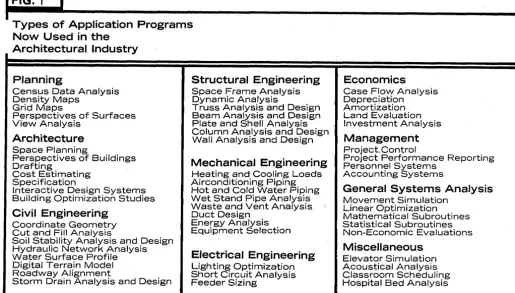
There are many different types of programs used by the architect and his related professionals. The list shown in Fig. 1 (p. 22) contains a sampling of some of these different types of application programs. This list should in no way be considered to be complete, nor does it suggest that anyone office using com-puters will be active in all the listed areas. It does, however, serve to introduce the reader to the extent of application programs currently utilized within the architectural community as a whole. Many of the application areas, such as the engineering, economics and management activities, are probably already fa-miliar to the reader. Others, however, may be un-familiar.
One application area currently receiving much at-tention from the architectural community is that of computer-aided space planning. Space planning is an architectural phrase used to describe the process of locating the functional areas within a building facil-ity. These areas may be either rooms, as in the case of laying out building floor plans, or work stations, as in
September
15, 1971
by William R. Miller
the problem of "office landscaping" (a term used by interior designers describing the act of arranging fur-niture and partitions in large office open spaces) .
MATRAN, a computer program developed by people associated with Design Methods, uses a space-ad-jacency matrix for identifying clusters which can then be mapped into line-dot diagrams. This program has proved quite successful in the architectural offices of Albert C. Martin and Assoc. and Daniel, Mann, John-son and Mendenhall. MATRAN has been used on over
100 space-planning projects including the generation of architectural floor plans, interior space planning and site planning. James Olsten, assistant professor at California State Polytechnic College in San Luis Obispo, has extended the program to include geomet-ric constraints, thus enabling the computer to gener-. ate rectilinear floor plans. A number of other architec-tural firms. are using programs similar to that
dev.el-Computer specialists typically
have a lack of understanding
regarding computer potential
within the architectural
industry.
oped by Olsten. Fig. 2 (p. 23) shows the grapbic output achieved from a space-planning program de-veloped by Welton Becket and Assoc.
The architect is also using the computer to create perspective drawings of his building forms and urban environments. Albert C. Martin and Assoc., architects
computers in architecture ...
in Los Angeles, use a program called THREED-I for
drawing perspectives and orthographic projections. This program has been used to generate visual-design studies as well as for preparing background line draw-ings for final presentation renderdraw-ings. The program has also been used by their structural ,engineers for visually checking member connectivity in large struc-tural space frames.
The San Francisco office of Skidmore, Owings and Merrill uses a program for generating perspective graphics of their projects. In conjunction with this 'program the firm has developed a graphic data base of downtown San Francisco which it can utilize for showing its clients projects as they visually relate to the rest of the city (see the computer drawing of the San Francisco skyline at the beginning of this arti-cle) .
Additional computer applications in architecture include building optimization studies, the preparation of construction specifications and cost estimating. The Skidmore, Owings and Merrill firm in Chicago uses a program called Building Optimization Program' (BOP) for analyzing and selecting architectural sub-' systems for high-rise buildings. Both the American Institute of Architects and the Construction Specifi-cations Institute are currently developing automated construction specification programs. CRS Design
As-sociates (formerly Caudill, Rowlett and Scott), archi-tects in Texas, use the computer for preparing cost estimates as well as in a number of other application areas.
These brief application descriptions point to the fact that architects are currently using computers and can be expected to use them to an even greater extent in the future.
[image:24.617.27.542.453.746.2]Planners are generally more receptive to computer
FIG. 1
I
I
Types of Application Programs
Now Used in the
Architectural Industry
applications than architects. Their problems are more complex and the scope of services that must be inte-grated in the course of generating planning solutions is much broader. Many of the early computer applica-tions in architecture have actually originated in the area of urban planning. Maps show statistical data in a graphical form using the high-speed printer. SYMAP,
a program available from the Harvard lab, was one of the first mapping programs of this type. The recent 1970 population census coupled with the capability of a program such as SYMAP allows the planner to
display and analyze population growth data relative to his specific project in a very effective manner.
Maps similar to those shown in Figs. 3, 4, and 5 (pp. 24-25) are used by planners for overlaying site data for the purpose of identifying the best location for various land uses.
Fig. 3 is an attractiveness map showing the best location of a golf course when considering the existing growth of trees on the site; The dense blue symbols in the center represent the best location, the next most dense symbols in the lower right comer of the map show the next best location, and the least dense symbols in the upper portion of the map show the least desirable location of the golf course.
Fig. 4 is an attractiveness map showing the best location of 'the golf course when considering wind conditions. Again, the dense blue symbols represent the best location, the next most dense symbols repre-sent the n,ext best location, etc.
These two attractiveness maps can be overlaid internally in the computer to produce one composite attractiveness map as shown in Fig. 5. This map identifies the relative attractiveness of locating the golf course when considering both trees and wind simultaneously. This type of grid mapping allows the
Planning
Census Data Analysis Density Maps
Structural Engineering
Space Frame Analysis Dynamic Analysis
Economics
Case Flow Analysis Depreciation
Amortization Grid Maps
Perspectives of Surfaces View Analysis
Architecture
Space Planning
Perspectives of Buildings Drafting
Cost Estimating Specification
Interactive Design Systems Building Optimization Studies
Civil Engineering
Coordinate Geometry Cut and Fill Analysis
Soil Stability Analysis and Design Hydraulic Network Analysis Water Surface Profile Digital Terrain Model Roadway Alignment
Storm Drain Analysis and Design
22
Truss Analysis and Design Beam Analysis and Design Plate and Shell Analysis Column Analysis and Design Wall Analysis and Design
Mechanical Engineering
Heating and Cooling Loads Airconditioning Piping Hot and Cold Water Piping Wet Stand Pipe Analysis Waste and Vent Analysis ' Duct Design
Energy Analysis Equipment Selection
Electrical Engineering
Lighting Optimization Short Circuit Analysis Feeder Sizing
Land Evaluation Investment Analysis
Management
Project. Control
Project Performance Reporting Personnel Systems
Accounting Systems
General Systems Analysis
Movement Simulation Linear Optimization Mathematical Subroutines Statistical Subroutines Non-Economic Evaluations
Miscellaneous
Elevator Simulation Acoustical Analysis Classroom Scheduling Hospital Bed Analysis,. . ;" !~ I : ~
planner to separately analyze large amounts of data and integrate them into one over-all land use evalua-tion model.
Another program used by the planner is VISTA,
written by the U.S. Department of Forestry. Mter
identifying the terrain of the planning area and the
FIG.2
location of an observer, the program will plot out, within a given search radius, those regions of the planning site that are visible from that point and those that are not. This type of program is quite useful in the design of recreational facilities such as golf courses and ski runs, where visual control is an
+---+
115 I
Graphic output of a computer used in a Welton Becket space-planning program shows optimum locations for
I 1
.---+
7-~---7
;2;---;
l.~~;---~
+--+---+---+--+--+ 1 I
I 6 1241 1 t
1 +--+--*~~+--+ t
I 111l~:~:!131 t
various qepartments based on specified adjacency needs. Although it appears
to be a floor ... -+--+.-... +:-:-:~--+
+---...
112 I 20
1:::;:;:;:;:;:i
! 18plan, architects must still work windows, doors, hallways, etc.
+--+ +~~~~~+ t t t t
into final plan. .... -+ +--+ +- .. + + ...
ELEMEi\lT NAME EXECUTIVE OFFICES
DISHNC!:. BETIrJEE\I
116 119
+--+ I 1
1 1 t 1
+--+
+--+.---+
1141
+--+ +.--+ +---+--+
1 t
+---.
1 II t I
NUI"1BER
fi2]
; i, "~~""~\;".:,;,,;,.L1.,'.
Dt.PARTMENTS ( FEET)
12:3 1 1 +--+ 1211 I 1 1 I 1 1 I
+---+ +---+--+ ... -+ 1
t 7 1 t 1
1
+-...
+ .. - .t 1
1 1 +,,-+
1
1
1
1
+--+
.---+
I +- ...
I 1
1 I
1 1
+---+
AREA ADJACENCY PREFERENCES
362~ 2
:s
16 24ADJ
63 107 116 145 15
89
t 1
t +--+
t
+- .. +
8 9 0
AI)J AOJ
63 63 0
---.---.---.---.---.---ADMINtSTHATION 54:5~
DIS1'A1,CE BETltiEE\J DEPARTME~~TS (
1 ADJ 63 :5 AOJ 72 8 AOJ 1j6 24 200 6 141 5 AOJ 72
o
o
~~~~~~~-~~~~~~~~~~---~~~~---~6~~---::~---::3---~---;----~~----~~----~~----~;
DISTAi"CE BETWEE\I DEPARTMENTS (FEET-> 44 72 107 12.8 266 215 404 325
-,-
--
-
--
-,
-
-
--
-
-
-
\:-
-
-
--
-
-\'--
--
-
-
-,-
-
-
-
-
--,-
-
--
--
-,-
-
-
-
---,-
-
-
-
--
-,
-
-
-
--
-
-,
-
-.--
--
-,
-
--
-
-
-
'\
-
--
-
-
-\
--
--
--,-
---,
,
\'
,
,
' "
\, \ ,
\ \ \ \ \ \ \"
\ \ \
"
\ " \ \ \ \ \ \"
----~---~---~---~---~---4---~-
___
---_-~--_____________ -__________ -- ______ -___ _
CL 1 ENT SEHV I CE GROJP ~:~:::: 4505 24 8 11 10 12 19 4· -0
::::::::: AOJ ADJ
DISTANCE BETWEE\I DEPARTMENTS (FEET) 44 181 63 228 82208 J22 0
---_._---.---.---.-.---SALES
m
1000 11 8 2 15 1:3 9 15ADJ AOJ
DISTANCE BETWEE\I D~PARTMENTS (FEET) 0 203 240 152 40 178 152 0
~:---~---::::::::=::::::::::::::::::::::~::::::::::::::::
REQUIRED 26 26 25 25 25 25 25 8
._----.---.---.---.-.---SAT1SFiE~ 25 6 7 2 5 4