warwick.ac.uk/lib-publications Manuscript version: Author’s Accepted Manuscript
The version presented in WRAP is the author’s accepted manuscript and may differ from the published version or Version of Record.
Persistent WRAP URL:
http://wrap.warwick.ac.uk/117447
How to cite:
Please refer to published version for the most recent bibliographic citation information. If a published version is known of, the repository item page linked to above, will contain details on accessing it.
Copyright and reuse:
The Warwick Research Archive Portal (WRAP) makes this work by researchers of the University of Warwick available open access under the following conditions.
Copyright © and all moral rights to the version of the paper presented here belong to the individual author(s) and/or other copyright owners. To the extent reasonable and
practicable the material made available in WRAP has been checked for eligibility before being made available.
Copies of full items can be used for personal research or study, educational, or not-for-profit purposes without prior permission or charge. Provided that the authors, title and full
bibliographic details are credited, a hyperlink and/or URL is given for the original metadata page and the content is not changed in any way.
Publisher’s statement:
Please refer to the repository item page, publisher’s statement section, for further information.
1
Varieties of labour administration in Europe and the consequences of the
Great Recession.
Maria Gavris, University of Warwick
Jason Heyes, University of Sheffield
Accepted for publication in Economic & Industrial Democracy. Forthcoming.
Abstract
This paper focuses on national public administration activities that relate to employment, social protection and industrial relations. The International Labour Organisation (ILO) refers to these activities collectively as ‘labour administration’ and regards the bodies that conduct them within individual countries as together forming national systems of labour administration. This paper explores the concept of ‘national system of labour administration’ and considers the potential contribution of comparative institutional analysis in understanding how national systems are organised and change over time. The paper also compares the organisation of national labour administration systems in European Union (EU) countries and analyses how these systems have developed since the start of the economic crisis that erupted in 2008.
1. Introduction
2
Many of the issues that are of central importance to labour administration have received a substantial amount of research attention from academic researchers and the ILO. Much has been learned about, for example, the activities of ministries of labour (Rychly 2013a, 2013b), measures directed at unemployed workers (e.g. van Berkel 2009, King 2013), institutions of social dialogue (e.g. Papadakis and Ghellab, 2014), arbitration, conciliation and mediation services (e.g. Ebisui et al. 2016) and the role of enforcement agencies in encouraging employer compliance with labour laws (e.g. Páramo and Vega, 2017). Research has tended to focus on specific labour administration functions or policy areas. Recently, however, there has been interest in extending the scope of research to include comparative analyses of national labour administration systems (see Author B and another) and it is this that is the central concern of the present paper. The aims of the paper are twofold. The first is to explore the concept of ‘national system of labour administration’ and consider the potential contribution of comparative institutional analysis in understanding how national systems are organised and change over time. The second aim is to compare the organisation of national labour administration systems in European Union (EU) countries and analyse how these systems have developed since the start of the economic crisis that erupted in 2008. The paper begins with a discussion of labour administration as a component of public administration. ‘Comparative capitalisms’ and comparative public administration scholarship imply that there will be important differences in the ways in which national labour administration systems are organised, particularly in relation to the degree of centralisation of labour administration, the regulation of the labour market and the extent to which social partners are involved in labour governance. The paper therefore considers whether the characteristics of EU national labour administration systems differ between countries associated with different ‘varieties of capitalism’. It then moves on to examine changes in the organisation of different labour administration systems over time, paying particular attention to the period since 2008. The paper concludes by mapping out elements of a research agenda for comparative research in labour administration.
2. Labour administration, public administration and varieties of capitalism
3
the tasks of following the development of the social situation, of supervising the implementation of legislation and of ensuring the operation of existing machinery’ (Valticos 1979: 214).
The ILO’s Convention No. 1501 also refers to the term ‘system of labour administration, which is defined as encompassing:
‘all public administration bodies responsible for and/or engaged in labour administration - whether they are ministerial departments or public agencies, including parastatal and regional or local agencies or any other form of decentralised administration - and any institutional framework for the co-ordination of the activities of such bodies and for consultation with and participation by employers and workers and their organisations’.
National labour administration systems therefore involve labour ministries (or their functional equivalents), the bodies that are responsible for delivering services, particularly those that relate to the re-employment of unemployed workers, the enforcement of labour standards and dispute resolution, and methods of involving employer organisation and trade unions in the development of policies and their implementation. In practice, however, countries differ in terms of the bodies that are involved in labour administration, how services are organised, the resources that are devoted to labour administration and the extent and nature of employer and trade union consultation and involvement (Author B and another).
Although a number of comparative analyses of particular labour administration service functions, particularly public employment services (PES), have been undertaken (e.g. Borghi and van Berkel (2007), Finn (2016), Páramo and Vega (2017), differences between national labour administration systems in toto have rarely been studied in depth. The need for comparative studies has been emphasised by the ILO and researchers with an interest in labour administration (e.g. ILO 2011; Author B and another, 2013) and a small number of studies have been undertaken on behalf of the ILO (Author B). These studies tend to describe national systems at a particular point in time and pay less attention to how systems change over time and whether their development is path dependent. Issues related to system changes and path dependency are afforded considerable attention in the comparative political economy and public administration literatures. With regard to the former, the ‘varieties of capitalism’ (VoC) analytical framework, initially popularised by Hall and Soskice (2001), emphasises that the competitive advantages associated with different combinations of socio-economic institutions create incentives for governments and employers to preserve and enhance their specific characteristics. Hall and Soskice initially distinguished between ‘liberal market economies’ (such as the UK and Ireland) in which coordination of economic activity is supposedly achieved
4
through formal contracting and market-mediated exchanges, and ‘coordinated market economies’ (such as Germany, Austria and the Nordic economies) in which coordination takes place through complementary institutions and networks that facilitate access to information, skills and other resources. Their analysis also emphasised the importance of cooperative industrial relations and social dialogue as underpinning characteristics of CMEs. Although Hall and Soskice did not directly discuss labour administration, their analysis nevertheless hints at ways in which national labour administration systems in CMEs and LMEs might differ. We might, for example, expect employers and trade unions to play a greater role in the governance of labour administration in CMEs than in LMEs. A ‘weakening of organized labor and a substantial amount of deregulation’ (Hall and Soskice, 2001:57) accompanied by a ‘fundamental renegotiation of labor’s position (…) in the political economy as a whole’ (Thelen, 2001:103) is predicted for LMEs, but in CMEs, where deregulation is a threat to comparative advantage, the maintenance of labour-supportive regulatory regimes, ‘resiliency in labor institutions’, and a strengthening of social partners are expected (Thelen, 2001:71). LMEs might also be expected to make greater use of private and voluntary sector providers in the delivery of labour market services, given the greater emphasis they place on the use of market mechanisms. Furthermore, Culpepper (2001:302) predicts a greater degree of decentralisation in LMEs when compared with CMEs and the development of associations aimed at encouraging private actors ‘to begin cooperating with each other’.
Various attempts have been made to extend and refine the VoC typology. Amable (2003), for example, substituted ‘continental’ (e.g. Germany) and ‘social democratic’ (e.g. Denmark) models of capitalism for Hall and Soskice’s CME category and also outlined Asiatic (e.g. Japan) and Mediterranean (Spain Portugal, Greece and Italy) models. King (2007) sought to insert the economies of Central and Eastern Europe into the VoC framework by defining them as ‘liberal-dependent’ economies that resembled the LME type while being more reliant on foreign capital.
5
As has been the case for the comparative political economy literature, public administration researchers have been concerned with the question of whether national institutions and policies are converging or diverging. Particular attention has been given to the extent to which practices associated with the New Public Management (NPM) have been adopted and whether they have been adopted in similar ways in different countries. Some studies (Bevir and Rhodes 2003; Pollitt 2007) have found that NPM reforms have been strongly affected by national contextual factors (Pierre and Rothstein 2011), such as inherited institutions, prevailing traditions of governance and domestic politics and, as a consequence, reform processes and outcomes have varied among countries associated with a specific public administration regime type (Halligan 2011; Kickert 2011). However, while public administration regimes remain diverse, focusing on administrative systems as a whole may result in similarities relating to specific elements of public administration being overlooked, given national complexity. As Brans (2007: 271) has argued, comparative research is most likely to prosper if attempts are focused on relatively narrowly defined subjects rather than public administration systems as a whole (Brans, 2007: 271). A focus on labour administration, as opposed to public administration in toto, may therefore serve to provide clarity.
An important concern for this paper is the impact of the economic crisis that erupted in 2008 for labour administration. Researchers in the field of comparative political economy have noted that liberalisation of labour markets since the start of the crisis has not been confined to LMEs and, moreover, that the crisis accelerated processes of liberalisation that were already underway (Thelen 2014). Liberalisation in relation to labour market policy has included a weakening of employment protections and a dilution of entitlements in relation to social protection (Author B). While such developments suggest a common direction of change across varieties of capitalism towards an ‘unravelling of CMEs and the further liberalization of LMEs’ (Baccaro and Howell, 2017:10), it does not imply ‘that the CME category has been emptied so that the advanced capitalist world is populated solely by varieties of LME’ (Baccaro and Howell, 2017:15). For instance, on German capitalism, Hall (2015: 48) recently wrote that, labour market liberalisation notwithstanding, ‘the basic features of the German political economy continue to distinguish it from many others’, notably ‘its Anglo-American counterparts’. According to Thelen (2014:202), ‘CMEs increasingly find themselves pulled in one of two directions’. The first is a Nordic CME model of ’embedded flexibilization’ in the Scandinavian countries, which combines marketisation with a collectivisation of risk, and the second is a Continental CME model of ‘dualizing liberalization’ in countries such as Germany, which remains coordinated but has become less egalitarian (ibid.).
6
complementarities and derived comparative advantage (Iversen, 2007). CMEs are expected to make greater efforts to minimise labour market disruptions resulting from the crisis in order to ensure continued access to a highly skilled and motivated workforce, whereas LMEs are expected to continue to favour more fluid labour markets. Consequently, the implied VoC prediction is that crises are path-reinforcing, therefore leading to increased divergence between the different varieties of capitalism. The public administration literature (see, e.g. Kuhlmann and Wollmann, 2014; Randma-Liiv and Kickert, 2017), however, considers an alternative possibility, namely that economic crises could be path-breaking rather than path-reinforcing and should therefore be treated as critical junctures or turning points. This notion is borrowed from historical institutionalist theory, according to which national institutional trajectories are characterised by ‘punctuated equilibrium’ – institutions that are relatively stable due to historical legacies, but which nonetheless may undergo change as a result of an exogenous shock (crisis). These two alternative theoretical underpinnings mean that public administration literature on the effects of economic crises on administrative reform is centred around a dichotomy between institutional continuity and change (Peters et al, 2011), which however draws on a common background that views crises as exclusively exogenous, neglecting capitalist dynamics and endogeneity.
This overview of the comparative capitalisms and public administration literatures raises the question of whether differences between national labour administration systems correspond to the different ‘varieties of capitalism’. We explore this in a European context, assessing the veracity of the following assumptions about labour administration that are implicit in the VoC literature:
1. Labour administration is expected to be more centralised and coordinated in CMEs than LMEs.
2. Marketisation of labour administration is expected to be more in evidence in LMEs than CMEs.
3. A higher degree of involvement of social partners in labour administration is expected in CMEs than in LMEs.
4. Economic crises are expected to be path-reinforcing in both LMEs and CMEs, thereby leading to increased administrative divergence between the two varieties of capitalism.
7
3. The current state of national labour administration systems in Europe
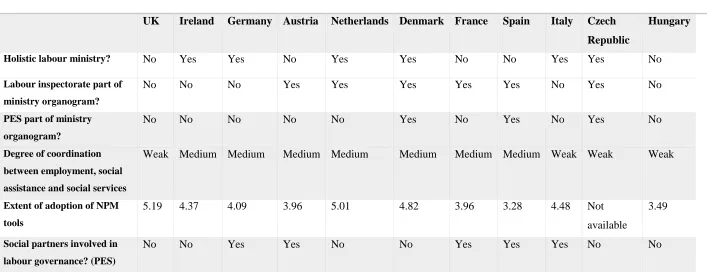
In this section we examine the organisation of national labour administration systems in selected European countries, in comparative perspective, against the VoC predictions outlined above. Our sample contains eleven countries: the UK and Ireland, classified as LMEs in the VoC literature, plus Germany, Austria, the Netherlands, Denmark and France as CMEs. For purpose of comparison we also include the Czech Republic and Hungary as liberal-dependent economies which are expected to follow a broadly similar trajectory to LMEs (King 2007) and, Spain and Italy as examples of the Mediterranean model. Table 1 below summarises key labour administration indicators for our sample.
To evaluate the first hypothesis (that labour administration will be more centralised and coordinated in CMEs than LMEs), we begin by analysing labour ministries as the central institutions in national labour administration systems. One way to assess the degree of centralisation is to ask whether the ministry is holistic – i.e. responsible for all matters related to work and employment as well as social policy (Rychly, 2013a). This is the case for six countries in our sample: Ireland (Department of Employment Affairs and Social Protection), Germany (Federal Ministry of Labour and Social Affairs), the Netherlands (Ministry of Social Affairs and Employment), Denmark (Ministry of Employment), Italy (Ministry of Labour and Social Policy), and the Czech Republic (Ministry of Labour and Social Affairs). In the UK, France and Spain, responsibilities are shared across ministries: between the Departments for Work and Pensions and the Department for Business, Energy and Industrial Strategy (UK); between the Ministry of Labour, the Ministry of Solidarity and Health, and the Minister of State for Gender Equality (France); and between the Ministry of Labour, Migration and Social Security and the Ministry of Health, Consumption and Social Welfare (Spain). In Hungary, there is no de facto labour ministry; since 2010, responsibilities for labour and social welfare issues have been shared between the Ministries of the National Economy (renamed Ministry of Finance in 2018), Interior and Human Capacities. In Austria, labour issues are the domain of a multi-portfolio ministry, the Federal Ministry of Labour, Social Affairs, Health and Consumer Protection (created in January 2018). Thus, there is diversity in the way responsibilities for labour matters are distributed across government, with no evidence of a consistent difference between CMEs and LMEs.
TABLE 1 ABOUT HERE
8
Social) and the Czech Republic (the State Labour Inspection Office). Although Ireland’s Workplace
Relations Commission (WRC) and the Italian National Labour Inspectorate are quasi-autonomous (not on their respective labour ministries’ organogram but periodically supervised by the ministry), they nonetheless represent examples of centralisation, given that they had been created to merge functions previously carried out by a range of state agencies. Germany presents a mixed picture: labour inspection is not part of the ministry organogram, but in 2009 many formerly independent labour inspectorates were integrated into the general state administrative apparatus. At present, there is great variety between Länder, with autonomous labour inspectorates in some states, and labour inspectorates that are part of the administrative structure of the Land in other cases. Hence, it is Germany’s federalism that limits centralisation. In the UK, the Health and Safety Executive (HSE) is sponsored by the Department for Work and Pensions but remains quasi-autonomous (not on the organogram). In Hungary there is no labour ministry organogram to speak of: safety at work and overall labour inspection activities are currently the domain of the Ministry of Finance, while the Ministry of Human Capacities presides over the Chief Medical Officer (ÁNTSZ), which carries responsibility for occupational health and work hygiene issues (Eurofound, 2015).
PES are autonomous or quasi-autonomous bodies (not on the organogram) for most countries in our sample: Ireland (the independent Intreo service), Germany (Bundesagentur für Arbeit [BA]), Austria (Arbeitsmarktservice [AMS]), the Netherlands (Werkbedrijf, a division of UWV, the Employee Insurance Agency, an autonomous body), France (Pôle emploi), and Italy (Agenzia Nazionale Politiche Attive Lavoro). PES appear on the organogram in the case of Denmark (the Agency for
Labour Market and Recruitment), Spain (Servicio Público de Empleo Estatal) and the Czech Republic (Employment Services Administration). The UK’s PES has been part of the Department for Work and Pensions since Jobcentre Plus ceased to exist as a separate entity in 2011. In Hungary, the PES is currently governed by the Ministries of Finance and the Interior. There is evidence that county labour centres receive conflicting instructions from the two ministries (Eurofound, 2015).
Consequently, not only does this overview of labour inspectorates and PES invalidate the VoC assumption that decentralisation is more extensive in LMEs, but it also shows that (de)centralisation in one aspect of labour administration (labour inspection) does not necessarily mean (de)centralisation in other aspects (PES). On the other hand, we will see in Section 5 below that centralisation has been an important trend in labour administration since 2008.
9
rate the degree of coordination in their country as either very good, medium, or weak. The degree of coordination was rated as ‘weak’ in the case of the UK, Italy, the Czech Republic and Hungary, and medium in all other cases. Administrative fragmentation, limited scope for formal coordination, and the lack of common databases were all cited as barriers to coordination (ibid.).
The second hypothesis is that marketisation will be more extensive in LMEs than CMEs. We assess this by using the ‘extent of adoption of new public management tools’ as a proxy. NPM is a trend in public administration towards ‘enterprising the state’ (Author and another, 2013), which prioritises efficiency, quantifiable results, targets, as well as limits on spending. Values for this indicator are taken from Jeannot and Bezes (2016), who calculated these based on a survey with thousands of top civil servants across Europe. Participants were asked to rate the extent to which NPM tools are used in their organisation on a scale from 1 to 7, where 1 means ‘not at all’, and 7, ‘to a large extent’. Country figures represent means of responses from that particular country. Amongst the countries in our sample, the UK appears to have adopted NPM tools to the greatest extent (5.19 out of 7), but it is closely followed by the Netherlands (5.01) and Denmark (4.82). The lowest degree of NPM adoption seems to have occurred in Spain (3.28) and Hungary (3.49), with Italy, Ireland, Germany, Austria and France somewhere in the middle. This suggests that marketisation is not confined to LMEs. Jeannot and Bezes (2016) data on NPM refer to all policy fields, not just labour issues. However, with regard to the adoption of NPM tools in European public employment services specifically, Weishaupt (2010) has shown that this trend started in the UK, then spread to Denmark and Sweden, and was later internalised by most other European PES as a result of a diffusion of ideas via EU institutions and the OECD. In practice, this resulted in ‘a common focus on performance, quality and case management as well as contestability in service delivery’ (ibid: 480) across European PES.
10 4. Changes in labour administration over time
The discussion thus far has suggested that the distinctions employed in the VoC framework are of little explanatory value where analysing national differences in the organisation of labour administration systems. In this section we consider common tendencies is the development of national labour administration systems over time.
There is broad consensus among public administration researchers that the economic crisis of the 1970s was a turning point which gave rise to common ‘mega trends’ of decentralisation, privatisation and marketisation in public administration reform across Europe and North America, which marked a rupture with the immediate post-war period (see e.g. Kuhlmann and Wollmann, 2014; Randma-Liiv and Kickert, 2017). State-market relations were redefined towards ‘enterprising’ the state (Considine 2001), with reform discourse focused on the notion of ‘efficiency’. These processes involved a shift away from traditional organisational principles of hierarchy and functional specialism towards new forms of governance that involved both a change in the way employees of public administration bodies were managed and the development of new relationships involving public and private sector agencies and those who consume their services, including an enhanced emphasis on performance management, entrepreneurial actions by public organizations, principal-agent separation, the development of quasi-markets and an emphasis on ‘citizen responsibility’ (Kuhlmann and Wollmann, 2014:270).
11
unemployment assistance and social assistance payments was transferred to job centres in 2005 as part of the Hartz labour market reforms. The merging of employment and benefit services is thus evident in both LMEs and CMEs. These developments coincided with the imposition of stricter conditions on eligibility for unemployment benefit and stricter obligations for ‘job-seekers’. For instance, the Hartz reforms in Germany entailed also a reduction of long-term benefits, in terms of both amount and duration, as well as the replacement of means-tested flat-rate benefits with earnings-related unemployment assistance (Weishaupt, 2011). In France, the creation of Pôle emploi in 2009 coincided with a reduction in the duration of short term-benefits and an increase in the contributions requirement for long-term benefits (Coquet, 2015). Pôle emploi, Intreo, and JobCentre Plus are all examples of agencification of the state. While ‘agency fever’ is assumed to have originated in the UK (Kuhlmann and Wollmann, 2014) this trend has extended across Europe, and, as the French example suggests, is not confined to LMEs.
A further notable development in a number of countries were attempts to subordinate labour policy to economic policy, associated with reforms aimed at labour market liberalisation. Again, there were consequences for the organisation of labour administration. Some countries merged their economics and labour ministries into a single ministry. Examples include Hungary (1998-2002), Poland (2003-5) and the UK. In 1995, the UK’s de-facto Labour Ministry, the Department of Employment, was merged with the Department of Education and responsibility for industrial relations was transferred to the Department for Trade and Industry (now the Department for Business, Energy and Industrial Strategy, a ministry whose primary responsibility was promoting the competitiveness of British industry. Germany, the ‘ideal type’ of CME in the VoC framework, took a similar path in the early 2000s when a Ministry of Economics and Labour (Bundesministerium für Wirtschaft und Arbeit: BMWA) was created through a merger of the Federal Ministry for Labour and Social Affairs and the Ministry of the Economy. The creation of the BMWA, which lasted until 2005, eased the introduction of the liberalising reforms associated with Agenda 2010 and the Hartz Commission, in that it brought about a diminution in the voice of organised labour in policy debates at cabinet level and led to the orthodox economic analyses associated with the former Ministry of Economics becoming dominant within the BMWA (Author B 2004).
12
case of the German BMWA, mentioned above, represented the culmination of a process of ‘business mobilization for neoliberal reform’ (Fleckenstein and Lee, 2017:166) in the face of globalisation pressures, which had started soon after German reunification. Against this backdrop of power resources shifting towards business, a scandal involving inflated job placement statistics in the German PES in 2002 provided the then-Chancellor Schröder with an excuse for excluding trade unions and social democratic ‘traditionalists’ from policy-making, on account of them being ‘defenders of the status quo’ (Fleckenstein and Lee, 2017). Thus, the perceived failure of a labour administration body (the German PES) led to the sidelining of organized labour within German society, with repercussions for another labour administration body, the Ministry of Labour, which became subordinated to the Ministry of Economics in this process. The evolution of the Spanish Ministry of Equality is similarly best understood in a broader context of changing power relations. Created in 2008 as a standalone ministry, it was merged two years later with other ministries to form the Ministry of Health, Social Policy and Equality (later Ministry of Health, Social Services and Equality). This change coincided with the apogee of Troika power and pro-austerity discourse in Spain, which turned equality ‘into a luxury that could no longer be afforded’ (Campillo Poza, 2018:21). The ministry was restored in 2018 as a result of a new change in the balance of social forces, this time in the form of a new socialist government.
13
involved in the governance of PES in 1987, when the Conservative government dismantled the Manpower Services Commission (ibid.).
The developments discussed in sections 3 and 4 suggest convergence in labour governance in the sense of a gradual side-lining of labour issues in all countries, as evidenced by the limited prevalence of holistic labour ministries, the diminished role of social partners, and the high rate of adoption of NPM tools, instead of growing divergence between CMEs and LMEs as predicted by VoC scholars. The recent economic crisis appears to have further reinforced this trajectory. The effects of the crisis on labour administration are now discussed in more detail.
5. Developments in labour administration since the crisis
The crisis exposed some of the weaknesses of decentralised approaches to public administration, in particular the growing inability of governments ‘to monitor effectively and to regulate effectively’ (Peters et al, 2011). Consequently, the crisis is considered to have marked a turning point towards (re)centralisation. On the other hand, despite this new centralisation trend, other aspects of the pre-crisis model of public administration are shown to have in fact been reinforced post-2008, for instance in the form of a new wave of privatisations following the crisis, especially in Southern Europe, as part of Troika-imposed bailout conditions (Kuhlmann and Wollmann, 2014). As Randma-Liiv and Kickert (2017) argue, this suggests that the crisis had a complex effect upon administrative reform that goes beyond the path-reinforcing/path-breaking dichotomy: it triggered new reforms in some countries or policy areas, boosted reforms already underway in others, and cancelled previous reforms in yet others.2 Centralisation along with fiscal retrenchment are listed as two main forms of response to the crisis common to all European countries (ibid.). However, there is variation in terms of the extent of such reforms, which is closely linked with the extent of the crisis itself, more vulnerable countries being associated with more extensive reforms (Raudla et al, 2015; Randma-Liiv and Savi, 2016). For example, while budget cuts happened everywhere, they were most extensive in countries that required financial assistance, especially given that international creditors provided financial aid to these countries on condition that they implement structural reforms. Another development linked to vulnerability is that in the countries hardest hit by the crisis the legitimacy of social dialogue was called into question most extensively, with public opinion increasingly viewing the social partners as at least partially responsible for the crisis (Guardiancich and Molina, 2017). In what follows, we examine centralisation and fiscal retrenchment as responses to the crisis in relation to labour
14
administration per se and assess also the impact of the crisis upon social dialogue as pertains to labour governance.
Centralisation
The recent trend towards centralisation can be explained by two related factors. The first is that centralisation helps to improve coordination and allows public administrators to better influence outcomes compared to a situation where the public sector is fragmented into myriad units (Raudla et al., 2015). The second is that centralisation can serve as a strategy for achieving spending cuts (Levine, 1979; Raudla et al., 2015), and thus fits in with the wider austerity drive since the crisis. Consequently, centralisation since the start of the crisis has tended to take two main forms: mergers of agencies or ministries, including reabsorption of agencies into their parent ministries, and a strengthening of central financial control over ministries and agencies, i.e. an increase in the power of Finance Ministries (Randma-Liiv and Kickert, 2017).
The survey evidence presented by Randma-Liiv and Kickert (2017) suggests that mergers of ministries and agencies have been the most widespread type of reform in European public administration since the crisis, occurring in LMEs (UK, Ireland, also East European liberal-dependent economies such as Hungary and Romania), as well as CMEs in their different variants (the Netherlands, Austria, France, Italy). Examples of this in the field of labour administration include the creation of the WRC in Ireland, National Labour Inspectorate (INL) in Italy, Pôle emploi in France, the DWP’s reabsorption of JobCentre Plus in the UK, the merger between the Labour Inspectorate and the Social Inspectorate in Romania, and the aforementioned (see Section 3 above) merger between the Ministry of Labour and the Ministry of Health in Austria. The Irish, Italian, and Romanian cases are examples of centralisation of labour inspection services, bringing formerly fragmented services together under one central administrative body. The French and British cases represent examples of PES centralisation. While these mergers had ostensibly been designed to simplify and streamline labour administration processes while reducing costs, in many instances the resources allocated to the merged bodies have been insufficient, resulting in these institutions being understaffed and overburdened (de Comarmond, 2010).
15
in these negotiations and hence also the amount of resources allocated to the PES. Another obvious implication is that other ministries – including Labour Ministries – become less powerful.
Fiscal retrenchment and its impact on labour governance
As mentioned above, fiscal retrenchment was introduced across most of Europe as a response to the crisis, although the harshness of these measures tended to depend on how affected each country had been by the crisis, and on whether it had requested financial assistance from international institutions, which demanded structural reforms in exchange (Randma-Liiv and Savi 2016). Cuts have been most extensive in the areas of welfare, pensions, and healthcare (Randma-Liiv and Savi, 2016). A further consequence has been a reduction in the staffing and capacity of labour administration bodies. In a recent survey, 7000 public administrators across Europe were asked to rate the performance of public administration in their respective policy field over the previous five years. Employment policy received the lowest rating and was also the only policy field rated significantly below the mean (Huxley et al, 2016). The diminution of resources coincided with intensified challenges to labour administration as a result of the crisis, which significantly increased the workload of labour administrators (Rychly, 2009a; EPSU, 2012). In particular, increases in unemployment led to substantial increases in PES caseloads (the ratio of unemployed persons per employment advisor). Between August 2009- August 2010, the caseload of Pôle emploi in France increased from 92 to 103 (de Comarmond, 2010). In Finland, the caseload doubled from 80 to 160 between the onset of the crisis and 2016 (OECD, 2016). Increases in PES caseloads have persisted in more recent years as well: for instance, between 2014-16, caseloads increased by 23.9% in Finland, 19.5% in the Netherlands, 10.5 % in Cyprus, 10% in Greece, 4.3% in Austria. Even where caseloads declined in recent years, high caseload numbers persist as a result of the crisis: for example, while Spain experienced a reduction in caseloads similar to that of Germany between 2014-16 (8.3 % and 8.6%, respectively), the outcome is a caseload of 596 in Spain versus 48 in Germany, with Spain remaining the country with the highest caseload in Europe (European Commission, 2016b). High caseloads make it more difficult for advisors to provide individualised support, calling into question the effectiveness of PES in minimising social hardship. Fiscal retrenchment also resulted in reduced training budgets for PES.
16
Ireland’s National Employment Rights Authority (the predecessor of the current WRC) had employed 84 inspectors; the WRC only employs 53 (Author B and another). Between 2013-2014, the number of labour inspectors employed by the Inspectorate SZW in the Netherlands fell from 1119 to 1024; this is expected to decline even further given that the inspectorate will see further cuts in its budget between 2016-2020 (ibid.). In Germany the number of labour inspectors declined partly because of the non-replacement of retiring staff (EPSU, 2012). In Italy, the number of inspectors was reduced from 3761 in 2007 to 3479 in 2009 (ibid.) while training days for civil servants were reduced by 29.3% over 2008-2011 (DiMascio and Natalini, 2014). The number of inspectors employed by the Romanian labour inspectorate was reduced by half between 2009-2016 (Author B and another), partly as a result of the merger between the Labour Inspectorate and the Social Inspectorate in 2009, and partly as a result of further restructurings in the Ministry of Labour (EPSU, 2012). The Latvian inspectorate experienced a 20% staff reduction (Author B and another), which caused several regional offices to shut down as well (EPSU, 2012). Even in France, where the number of labour inspectors initially increased at the beginning of the crisis (from 488 inspectors and 1053 sub-inspectors in 2007 to 767 and 1423, respectively, in 2009 [EPSU, 2012]), this fell again after 2009, when all labour inspection services were merged and sub-inspector positions were eliminated altogether.
The fact that the crisis has made the work of labour inspectors more complex and demanding, but the number of inspectors went down in most countries, poses risks for the safety of workers, for it implies fewer inspection visits, a greater risk of accidents at work, laxer enforcement of safety laws, as well as fewer resources to tackle discrimination and undeclared work (EPSU, 2012). There are also concerns that insufficient staffing will make it difficult for individual countries to honour pledges made to the European Commission in the field of work and employment: for example, Romanian labour inspectors stated publicly in 2010 that it is becoming increasingly difficult to comply with the number of controls the Inspectorate had pledged to undertake under a memorandum signed with the European Commission to tackle undeclared work (EPSU, 2012). The problem of understaffing of labour inspectorates is further compounded by the downgrading of labour issues in general following the crisis, manifest for instance in the placing of responsibilities for labour issues under other ministries: according to Eurofound (2015), the quality of labour inspection services has been steadily declining in Hungary in recent years, not least because such services had been placed under the supervision of ministries whose portfolios do not naturally encompass labour issues (Ministry of Finance).
The exclusion of social partners from labour governance
17
the principle that cooperation would help reduce social tensions and conflict (Rychly, 2009b; Guardiancich and Molina, 2017). Negotiations between the government and social partners in 2008-9 led to the adoption of the ‘Towards 2016’ agreement in Ireland which contained provisions vis-à-vis the rights of temporary workers (the first category of workers to be affected by the crisis), to the introduction of shortened work hours to avoid crisis-related dismissals in the Netherlands, and the formulation of the tripartite ‘Declaration of principles for the promotion of the economy, employment, competitiveness and social progress’, containing anti-crisis measures, in Spain (Rychly, 2009b).
However, this was only a short-lived phase; the crisis soon began to be portrayed as one of fiscal profligacy and lack of competitiveness in peripheral Europe, and hence used as justification for fiscal consolidation measures. The implementation of austerity reduced the time-frames for consultation as well as room for manoeuvre in national policymaking, severely curtailing or even annulling the participation of social partners in governance altogether. In countries where social dialogue was maintained during the crisis, this had a positive effect, facilitating growth, peaceful industrial relations, and increases in productivity and wages (ibid.); but this was the exception rather than the rule, with most countries in Europe experiencing exclusion of social partners from labour governance instead (Guardiancich and Molina, 2017).
The greatest degree of discontinuity in social dialogue following the start of the crisis occurred in Ireland (an LME) and the Mediterranean countries (Spain, Portugal, Italy, Greece). The exclusion of social partners from governance is particularly striking in the case of Ireland and Spain, both of which had enjoyed strong social partnership prior to the crisis (Guardiancich and Molina, 2017). In Ireland, social dialogue continues only in the National Economic and Social Council (NESC), which has not been involved in any of the crisis or post-crisis reform negotiations (Guardiancich and Molina, 2017). Similarly, formal social partnership broke down in Spain in 2011, despite the fact that Spain had been one of the first countries to involve the social partners in designing policies to tackle the crisis back in 2008-9 (Rychly, 2009b). In the absence of formal social partnership, the only forum left for social dialogue in Spain are bipartite consultations between trade unions and employers (Guardiancich and Molina, 2017). In spite of relatively higher growth rates in both Ireland and Spain since 2014, there have been no attempts to restore institutionalised tripartite social partnership, and ‘no expectations’ of this in either the short-run or the long-run (ibid.). The fact that in Ireland ‘the trade unions, for the first time in over 20 years, have no direct access to government’ (Hardiman, 2010, p 26) makes it increasingly similar to Britain, the other European country classified as an LME, which has no institutionalised role for the social partners.
18
witnessed a decline in the influence of social partners over labour governance (Weishaupt, 2011). As noted in section 4 above, in Denmark this is a direct consequence of restructuring during the crisis, when regional PES offices governed by the social partners were dissolved, while in Germany it is a process that dates back to the Hartz reforms. The Dutch case also mirrors the German one, in the sense that social partnership had been weakened there due to labour market flexibilisation and a decline in unionisation that preceded the crisis, but which intensified tensions during the crisis, especially in consultations over pensions reform (Guardiancich and Molina, 2017). Due to these changes , the social partners in Denmark, Germany and the Netherlands alike acted more like advisors than proactive co-decision makers during the crisis (Weishaupt, 2011; Guardiancich and Molina, 2017). Weishaupt (2011) illustrated this distinction with reference to the Danish case. Prior to 2007, social partners in Denmark had been directly involved in the implementation of active labour market policies at the regional level, with substantial funds at their disposal, but lost their influence once the Regional Employment Council was created, and now mainly engage in ‘re-active criticism when Jobcentres fail to perform’ rather than ‘pro-active planning’ (ibid.:18). Moreover, even as advisors, social partners exerted limited influence Despite the fact that social dialogue is institutionalised at the national level in Denmark in the National Employment Council, the demands of Danish unions for fiscal stimulus and improving qualifications were largely ignored, with the government instead choosing to tighten the benefits regime as part of its flexicurity strategy (Weishaupt, 2011). On the other hand, in Germany social partners were consulted in an ad-hoc manner during the economic crisis summits held at the Federal Chancellery and a formal institutionalisation of social dialogue at the national level was deemed unnecessary (Guardiancich and Molina, 2017). Austria is the only strong exception in this respect, as a CME that ‘has retained a modus operandi of strong social partnership and mutual trust’ (ibid.: vii). The UK and Austria are thus the only two countries in our sample characterised by continuity in social dialogue, albeit as polar opposites, with Austria continuing to exhibit a strong institutionalised role for social partners and the UK none.
5. Conclusion
19
In terms of the impact of the recent economic crisis on labour administration across Europe as a common challenge, the path-reinforcing/path-breaking theoretical divide is likewise of little explanatory value. The crisis appears to have reinforced trends towards marketisation in the form of budget cuts, placing further strain on already overburdened labour inspectorates and PES offices, whose resources have been slashed while challenges have increased. It has, on the other hand, reversed other trajectories, as evidenced most notably by the recent turn away from decentralisation to centralisation, with mergers between ministries and agencies as the most prevalent type of reform in labour administration since the crisis. The gradual side-lining of labour issues appears to be an element of convergence across Europe, but the timing of particular stages in this process varies: for example, the merger between employment and benefit services, accompanied by stricter eligibility criteria, occurred before the crisis in some countries (e.g. Germany, the UK), and during the crisis in others (e.g. Ireland, France). The same is true of the dissolution of holistic labour ministries or of the exclusion of social partners from labour governance – such trends have been precipitated by the crisis in some countries, but date back to earlier restructurings of the state-market relationship in others. These (radical, in some countries) reforms of national systems of labour administration over the past two decades have reflected wider changes in public administration systems, which have involved the adoption of new management practices and organisational forms and a reconsideration of the interface between the public and private sectors and the role of the latter in delivering services.
20
sense of policy conditionality that arises from the way in which past conflicts had been resolved in a particular space.
References
Amable B (2003) The Diversity of Modern Capitalism. Oxford: Oxford University Press.
Baccaro L and Howell C (2017) Trajectories of Neoliberal Transformation: European Industrial Relations Since the 1970s. Cambridge: Cambridge University Press.
Bevir, M and Rhodes RAW (2003) Interpreting British Governance. London: Routledge.
Bieling H-J (2014) Comparative analysis of capitalism from a regulationist perspective extended by neo-Gramscian IPE. Capital & Class, 38 (1): 31-43.
Borghi V and Van Berkel R (2007) Individualised service provision in an era of activation and new governance. International Journal of Sociology and Social Policy, 27 (9/10): 413-424.
Bouget D, Frazer H, Marlier E, Peña-Casas R and Vanherckeet B (2015) Integrated Support for the Long-Term Unemployed in Europe: A Study of National Policies. Online, accessed 8 May 2018,
available from: www.cedefop.europa.eu/files/espn_-_synthesis_report_ltu_final_0.pdf
Brans M (2007) Comparative public administration: from general theory to general frameworks. In: Peters GB and Pierre J (eds) The Handbook of Public Administration. London, Sage: 269-284.
Bruff I and Ebenau M (2014) Critical political economy and the critique of comparative capitalisms scholarship on capitalist diversity. Capital & Class, 38(1): 3-15
Campillo Poza I (2018) Economic Boom, Recession and Recovery in Spain: the Permanent Care Crisis and its Effects on Gender Equality. The Search for Feminist Alternatives. Online, accessed 2
April 2019, available from:
https://www.rosalux.eu/fileadmin/user_upload/Publications/2018/AusterityandFeminismaftertheCrisis
_Spain.pdf
21
De Comarmond L (2010) ‘Les conseillers de Pôle emploi suivent 103 chômeurs en moyenne’. Les Echos, 24 September 2010, online, accessed 10 September 2018, available from:
http://m.lesechos.fr/redirect_article.php?id=020811349260&fw=1
Coquet B (2015) Labour Market Measures in France 2008-13 : The Crisis and Beyond. Online, accessed 10 September 2018, available from: https://www.ilo.org/wcmsp5/groups/public/---dgreports/---inst/documents/publication/wcms_449923.pdf
DiMascio F and Natalini A (2014) Austerity and public administration: Italy between modernization and spending cuts. American Behavioral Scientist, 58(12): 1634-1656.
Ebisui M, Cooney S. and Fenwick C (2016) Resolving Individual Labour Disputes: A Comparative Overview. Geneva: ILO. http://www.ilo.org/wcmsp5/groups/public/---dgreports/---dcomm/---publ/documents/publication/wcms_488469.pdf
EPSU (2012) A Mapping Report on Labour Inspection Services in 15 European Countries. Online, accessed 19 June 2018, available from
https://www.epsu.org/sites/default/files/article/files/EPSU_Final_report_on_Labo
ur_Inspection_Services.pdf
European Commission (2016a) The Role of Social Partners in the Design and Implementation of Policies and Reforms. Online, accessed 25 July 2017, available from
http://ec.europa.eu/social/main.jsp?langId=en&catId=89&newsId=2661&furtherNews=yes
European Commission (2016b) Assessment Report on PES Capacity. Online, accessed 10 September 2018, available from: http://ec.europa.eu/social/BlobServlet?docId=16967&langId=en
Eurofound (2015) Hungary: Closure of National Employment Office. Online, accessed 25 July 2018, available from: https://www.eurofound.europa.eu/publications/article/2015/hungary-closure-of-national-employment-office
Ferrera M and Hemerijck A (2003) Recalibrating Europe’s welfare regimes. In: Zeitlin J and Trubek, DM (eds.) Governing Work and Welfare in a new Economy: European and American Experiments. Oxford: OUP.
Finn D (2016) The Organisation and Regulation of the Public Employment Service and of Private Employment and Temporary Work Agencies: The Experience of Selected European Countries – the
Netherlands, Denmark, Germany and the United Kingdom. Leicester: Learning and Work Institute.
22
Guardiancich I and Molina O (2017) Comparative overview: National trajectories and good practices in social dialogue. In: Guardiancich, I and Molina O (eds.) Talking Through the Crisis: Social Dialogue and Industrial Relations Trends in Selected EU Countries. Geneva: ILO, pp. 1-58.
Hall P and Soskice D (2001) An introduction to Varieties of Capitalism. In: Hall, P and Soskice D (eds.) Varieties of Capitalism: The Institutional Foundations of Comparative Advantage. Oxford: Oxford University Press, pp. 1-67.
Hall P (2015) The Fate of the German Model. In Unger, B. (ed.), The German Model – Seen by its Neighbours, Brussels: Social Europe, pp. 43-62.
Halligan H (2011) NPM in Anglo-Saxon countries. In: Christiensen, T and Laegreid, P (eds) The Ashgate Companion to New Public Management. Farnham: Ashgate.
Hoogenboom M (2011) The Netherlands: two tiers for all. In: Clasen, J and Clegg, D (eds) Regulating the Risk of Unemployment. National Adaptations to Post-Industrial Labour Markets in Europe.
Oxford: Oxford University Press, pp.75-99.
Huxley K, Andrews, R, Hammerschmid, G and Van de Walle, S (2016) Public administration reforms and outcomes across countries and policy area. In: Hammerschmid G, Van de Walle S, Andrews R and Bezes P (eds.) Public Administration Reforms in Europe: The View from the Top. Cheltenham: Edward Elgar.
Iversen, T (2007) Economic shocks and varieties of government responses. In: Hancké B, Rhodes, M and Thatcher, M (eds.), Beyond Varieties of Capitalism. Oxford: OUP, pp. 278-304.
Jeannot G and Bezes, P (2016) Mapping the use of public management tools in European public administration. In: Hammerschmid G, van der Walle S, Andrews R and Bezes P (eds.) Public Administration Reforms in Europe: The View From the Top, Cheltenham: Edward Elgar, pp. 219-30
Kickert WJM (2011) Public management reforms in continental Europe: national distinctiveness. In: Christiensen, T and Laegreid, P (eds) The Ashgate Companion to New Public Management. Farnham: Ashgate.
King LP (2007) Central European capitalism in comparative perspective. In: Hancke B, Rhodes M, and Thatcher M (eds.) Beyond Varieties of Capitalism: Conflict, Contradictions and Complementarities in the European Economy. New York: Oxford University Press, pp. 307-327.
23
Kuhlmann S and Wollmann H (2014) Introduction to Comparative Public Administration: Administrative Systems and Reforms in Europe, Cheltenham: Edward Elgar
Lehmann Š and Kyzlinková R (2015) The Labour Administration’s Performance in the Czech Republic. Unpublished Report Prepared for the ILO.
OECD (2016) Back to Work: Finland - Improving the Re-employment Prospects of Displaced Workers. Paris: OECD Publishing
Page EC (1995) Comparative public administration in Britain. Public Administration, 73(1): 123-141.
Papadakis K and Ghellab Y (eds.) (2014) The Governance of Policy Reforms in Southern Europe and Ireland: Social Dialogue Actors and Institutions in Times of Crisis. Geneva: ILO.
Páramo P and Vega M-L (2017) New Forms of Work and Labour Inspection: The New Compliance Challenges. IUSLabor 2/2017.
Peters G, Pierre J and Randma-Liiv T (2011) Global financial crisis, public administration and governance: do new problems require new solutions? Public Organization Review, 11(1): 13-27.
Pierre J and Rothstein B (2011) Reinventing Weber: the role of institutions in creating social trust. In: Christiensen T and Laegreid P (eds) The Ashgate Companion to New Public Management. Farnham: Ashgate.
Pollitt C (2007) One size does not fit all. Public, June, 22.
Randma-Liiv T and Savi R (2016) Managing the public sector under fiscal stress. Hammerschmid, G, van der Walle S, Andrews R and Bezes P (eds.) Public Administration Reforms in Europe: The View from the Top, Cheltenham: Edward Elgar pp. 231-243
Randma-Liiv T and Kickert W (2017) The impact of the fiscal crisis on public administration reforms: comparison of 14 European countries. Journal of Comparative Policy Analysis, 19(2): 155-172.
Raudla R., Douglas JW, Randma‐Liiv T and Savi (2015) The impact of fiscal crisis on decision-making processes in European governments: dynamics of a centralization cascade. Public Administration Review, 75(6): 842-52.
Rychly L (2009a) Labour Administrations and National Labour Policies: Current Challenges, Practices and Policies. Geneva: ILO. Online, accessed 19 June 2018, available from:
24
Rychly L (2009b) Social Dialogue in Times of Crisis: Finding Better Solutions. Geneva: ILO. Online, accessed 10 September 2018, available from: https://www.ilo.org/ifpdial/information-resources/publications/WCMS_157973/lang--en/index.htm
Rychly L (2013a) Ministries of Labour: Comparative Overview – Database, Organograms, ILO Action. Geneva: ILO.
Rychly L (2013b) The changing fortunes of labour administration. In Heyes J and Rychly L (eds.) Labour Administration in Uncertain Times: Policy, Practice and Institutions. Cheltenham: Edward
Elgar/ILO. pp: 46-65.
Tepe M, Gottschall K and Kittle B (2010) A structural fit of states and markets? Public administration regimes and market economy models in the OECD. Socio-Economic Review, 8(4): 653-684.
Thelen K (2001) Varieties of labor politics in the developed democracies. In: Hall P and Soskice D (eds.), Varieties of Capitalism: The Institutional Foundations of Comparative Advantage, Oxford: Oxford University Press, pp. 71-103.
Thelen K (2014) Varieties of Liberalization and the New Politics of Social Solidarity. Cambridge: Cambridge University Press
Valticos N (1979) International Labour Law. Dordrecht: Kluwer.
Van Berkel R. (2009) The provision of income protection and activation schemes for the unemployed in 'active' welfare states: an international comparison. Journal of Social Policy, 39(1): 17-34.
Weishaupt JT (2010) A silent revolution? New management ideas and the reinvention of European public employment services. Socio-Economic Review, vol. 8(3): 461–486
Weishaupt JT (2011) Social Partners and the Governance of Public Employment Services: Trends and Experiences from Western Europe. Geneva: ILO. Online, accessed 8 May 2018, available from:
25
Table 1: Labour administration indicators – selected European countries
UK Ireland Germany Austria Netherlands Denmark France Spain Italy Czech
Republic
Hungary
Holistic labour ministry? No Yes Yes No Yes Yes No No Yes Yes No
Labour inspectorate part of
ministry organogram?
No No No Yes Yes Yes Yes Yes No Yes No
PES part of ministry
organogram?
No No No No No Yes No Yes No Yes No
Degree of coordination
between employment, social
assistance and social services
Weak Medium Medium Medium Medium Medium Medium Medium Weak Weak Weak
Extent of adoption of NPM
tools
5.19 4.37 4.09 3.96 5.01 4.82 3.96 3.28 4.48 Not
available
3.49
Social partners involved in
labour governance? (PES)