warwick.ac.uk/lib-publications Manuscript version: Author’s Accepted Manuscript
The version presented in WRAP is the author’s accepted manuscript and may differ from the published version or Version of Record.
Persistent WRAP URL:
http://wrap.warwick.ac.uk/107862
How to cite:
Please refer to published version for the most recent bibliographic citation information. If a published version is known of, the repository item page linked to above, will contain details on accessing it.
Copyright and reuse:
The Warwick Research Archive Portal (WRAP) makes this work by researchers of the University of Warwick available open access under the following conditions.
Copyright © and all moral rights to the version of the paper presented here belong to the individual author(s) and/or other copyright owners. To the extent reasonable and
practicable the material made available in WRAP has been checked for eligibility before being made available.
Copies of full items can be used for personal research or study, educational, or not-for-profit purposes without prior permission or charge. Provided that the authors, title and full
bibliographic details are credited, a hyperlink and/or URL is given for the original metadata page and the content is not changed in any way.
Publisher’s statement:
Please refer to the repository item page, publisher’s statement section, for further information.
1
THE CHANGING NATURE OF EXPERTISE: INSIGHTS
FROM THE CASE OF TAVI
Davide Nicolini
University of Warwick, Coventry, United Kingdom
Bjørn Erik Mørk
Department of Strategy and Entrepreneurship, BI Norwegian Business School, Oslo, Norway/University of Warwick, Coventry, United Kingdom
Jasmina Masovic
Department of Informatics, University of Oslo, Norway
Ole Hanseth
Department of Informatics, University of Oslo, Norway
Corresponding author: Davide Nicolini, [email protected]
Citation:
2
THE CHANGING NATURE OF EXPERTISE: INSIGHTS FROM THE
CASE OF TAVI
In this paper, we interrogate the current views on medical expertise, and expertise more
in general, by building upon the study of an innovative medical procedure called
transcatheter aortic valve implantation (TAVI). We find that phenomena like TAVI
require that we modify our traditional views of expertise to acknowledge its social,
material and distributed nature. We also find that in the case of TAVI expertise feeds
upon the broad circuits of knowledge created by the combination of professional
relationships, social ties and, increasingly, economic interests. Becoming and
remaining an expert implies not only being socialised in a local regime of activity but
increasingly also participating in, learning to navigate, and exploiting alternative and
potentially competing circuits of knowledge, which may be controlled by private
companies. The case of TAVI helps us to appreciate expertise as translocal and
connected phenomenon and foreground some of the implications of the emergence of
proprietary circuits of knowledge.
Keywords: expertise; distributed knowledge; relational expertise; situated learning
3 1 Introduction
In this paper we ask whether some of the emerging economically driven ways of
working and operating in many spheres of society require that we rethink and expand the
concept of expertise. We do so by focusing on medical expertise and elaborating our view
through the examination of the case of transcatheter aortic valve implantation (TAVI), an
innovative practice in the field of cardiology. We find that medical expertise is socially
constituted, relational, historically situated, and materially entangled. In addition, we also
find that medical expertise is increasingly translocal, economically invested and proprietary.
This in turn modifies the conditions required to become and remain experts. Although our
conclusions are grounded in our case study, and ultimately it is up to future research to
explore whether what we found in the case of TAVI applies elsewhere, we suspect that what
is happening for medical expertise may hold true also for of other domains of human activity.
In this paper we fully endorse the recent social, material and interactional turn in the
understanding of expertise. Early studies of (medical) expertise were based on an individual
perspective and focused on how mental processing distinguished the diagnostic performance
of experts from that of novices (Chase and Simon, 1973; Elstein and Schwarz, 2002;
Mylopoulos and Regehr, 2007). The introduction of “fluency” accounts of expertise rooted in
the phenomenological tradition (Dreyfus, 2004; Winch, 2010; Kotzee, 2014) enriched this
view by suggesting that expertise was the result of a personal, stage-based journey of learning
that made practitioners less and less dependent on explicit deliberation (Dreyfus, 2004).
However, both models were individually-based; they focused on routine and stable expertise;
and mostly considered crafts and occupations which were long-established and highly
institutionalised (artisans, chess players, virtuoso musicians, etc.) (Kotzee, 2012). As such,
they were ill equipped to examine activities that take place at the intersection of social groups
4
argued that to understand medical expertise in modern healthcare -- and expertise more
general, we needed to reconceptualise it in ways that take into account its personal and its
social, relational and material nature (Stevens et al., 2007; Garrett et al., 2009; Sanders and
Harrison, 2008; Edwards, 2010, Kotzee, 2012; Fenwick and Nerland, 2014; Fenwick and
Dahlgren, 2015). Our main contention is that such a turn is important but insufficient.
Social, relational and material views fail to capture that (medical) expertise is also
increasingly translocal, and economically invested, that is driven by economic interests and
sustained by proprietary forms of networking and circulation of knowledge. The idea of
translocality suggests that expertise exists in many locales at the same time. While each of
these locales has its own trajectory of learning and history of collective refinement, the expert
activity (both individual and collective) feeds upon the connections established and
maintained with other places where the activity is carried out. The idea that expertise is
increasingly economically invested suggests that connections and the circuits of knowledge
that support the collective mastery derive not only from social ties and professional forms of
association, but increasingly also from the establishment of proprietary, and often,
competing networks and circuits of knowledge established to generate profit (Ramlogan et
al., 2007). Becoming and remaining an expert in such conditions implies not only being
socialised in a local regime of activity (i.e., learning and refining one’s skills) but also
participating in, learning to navigate, and exploiting alternative and potentially competing
translocal circuits of knowledge controlled by private companies. Once expertise becomes
proprietary, we observe the emergence of new possibilities but also profound changes in the
nature and dynamics of expert knowing.
In order to build our argument in this paper we work through the case of TAVI, a new
minimally-invasive technique to change heart valves without open heart surgery. We argue
5
is. TAVI is, in fact, a radical innovation that depends on recombining knowledge from
different medical specialities. The field of TAVI is moreover changing rapidly due to
continuous technology improvements, to greater experience with carrying out TAVI in
different ways and at different locales. Importantly, some of these changes are fuelled in part
by the competition between valve vendors who took upon themselves to organise and control
how practitioners learn better ways of doing TAVI (Olsen and Håkansson, 2017).
In the next section we position ourselves within the current debate by referring to three
turns in the study of medical expertise. We then show that the case of TAVI requires the
expansion and integration of existing approaches and what this means for the understanding
or expertise.
2 Three turns in the study of expertise
According to Hoffman (1996) many authors still view expertise as an individual
phenomenon that can be described in terms of cognitive development, reasoning process,
modification of knowledge structure or a combination of the above (see , e.g., Pillay and
McCrindle, 2005). In this paper we adopt a different view. We refer to expertise as a form of
socio-material mastery which is ostensibly exercised when accomplishing specific discursive,
bodily or worldly tasks. Expertise as mastery is, therefore, refined over time and legitimated
by a group of peers; it can be carried by individuals and inscribed in disciplined bodies, but
expertise is not something that individuals possess. This view, which we broadly share with
a number of other scholars (Lave, 1988; Engeström and Middleton, 1996; Garrett et al., 2009;
Edwards, 2010; Fenwick and Nerland, 2014), is the result of three broad turns in the
contemporary understanding of expertise. These can be characterised as the turn from
attributes to situated performance; the realization that expertise is inherently mediated and
6 2.1 From attributes to situated performance
A first major expansion in the understanding of expertise took place in the second part
of the last century. During this period, authors began to question the idea that human
competence is constituted by a specific set of mental contents and static cognitive resources
that a person “has” and that are “used” to accomplish work (Mylopoulos and Regehr,2007).
Underpinning this shift was the increasing acceptance of the idea that expertise, in general,
and medical expertise, in particular, were conceived as practical accomplishments rooted in
personal knowledge and acquired through personal experience. This view, that Winch (2010)
calls the “fluency” model of expertise, reframed the concept of skill acquisition in terms of
personal development, whereby deliberation is substituted stage by stage by practical
understanding based on pattern recognition and aesthetic sensitivity. Expertise, conceived as
fluency in the execution of tasks within a specified domain, is achieved through experience
and reflection. Practitioners move from one level of skills to the next: novices, advanced
beginners, competence, proficiency and expertise (Dreyfus, 2004). Contemporary versions of
the fluency model add that expertise is a not final state, an enduring attainment that all
practitioners could achieve ‘for good’. Expertise is always evolving and relative to specific
contextual conditions; becoming and being an expert is not only a personal journey of
learning, it is an unending journey that requires the willingness and ability to purposefully
question existing skills and expand the existing knowledge base (Mylopoulos and Regehr,
2007; Yanow, 2015).
2.2 From individual to collective and relational
One of the main criticisms of the so called fluency model is that it is still individually
centred (Kotzee, 2014). Being a skilful practitioner in fact necessarily entails being in good
7
negotiated by everyone that has a stake in the practice (Lave and Wenger, 1991). This in turn
requires the decentring of the common notions of mastery: “… mastery resides not in the
master but in the organization of the community of practice of which the master is part”
(Lave and Wenger, 1991: 94). From this perspective, expertise always includes a social
dimension (Kotzee, 2012). Expertise thus refers to a specific regime of competence within
which the expert has been socialised, to which she contributes and for which she is
accountable. The regime, of course, changes over time so that what counts as expertise is
continuously contested and actively disputed (Collins, 2001; Stevens et al., 2007; Sanders
and Harrison, 2008; Mørk et al., 2008; 2010).
The idea that expertise is the property of a particular social milieu which allows the
socialisation of novices and the development of skills through legitimate peripheral
participation (Lave and Wenger, 1991) requires a revision of the fluency model (Winch,
2010). As Collins (2013) noted, once expertise is considered as the attribute of a social group,
the progression towards higher levels of skills ceases to be seen as a linear stepwise trajectory
and becomes a trajectory within a space of possibilities.
Moreover, once we decentre the idea of expertise, we realise that in most real world
situations expertise entails the “collaborative and discursive construction of tasks, solutions,
visions, breakdowns and innovations” within and across systems rather than the individual
mastery of specific areas of relatively stable activity (Engeström and Middleton, 1996: 4).
Relational agency becomes critical. According to this relational view expertise as a capacity
arises when professionals bring their specialist expertise to bear in their joint actions
(Edwards, 2005; 2010). In this sense expertise should be always conceived as inherently
distributed (Hutchins, 1995), networked (Hakkarainen et al., 2004) and interconnected
(Gherardi and Nicolini, 2002). Expertise, thus, depends both on the journey of learning of
8
increasingly skilful through processes of collective and inter professional learning (Edwards,
2005; 2010) or through the expansion of the competence of the local system of activity
(Engeström and Middleton, 1996; Greig et al., 2012).
2.3 From human-centred to sociomaterial
Social and relational views of expertise often (although not always) limit their focus to
interactions among humans but tend to ignore the historic material conditions within which
expertise is accomplished. In short, expertise is considered as an accomplishment of humans
working together. However, this is only part of the story; the relationship between humans
and their environment is mediated not only through other humans but also through cultural
means such as signs and artefacts (i.e. material devices skilfully built by humans). Through
mediation, history, culture, institutions, and power are all concretely manifested in human
action (Fenwick and Dahlgren, 2015). The skills and capabilities of actors are mediated and
fundamentally transformed by the capabilities of the tools and instruments that they use in
their work. Artefacts are, thus, not only integral in the accomplishment of expert activity, but
they are constitutive of expertise itself, as they have the capacity to mediate into the scene of
action the history of achievements and learning that presided to their creation and refinement
The expansion of the notion of expertise in order to encompass this moves us towards a
mediated or entangled view, positing that material and social forces are mutually implicated
in the masterful accomplishment of activities. The idea that expertise is necessarily
“sociomaterial” also reinforces its situated and social nature. The artefacts used in any expert
performance also establish a relationship between different social groups and different forms
of expertise, which makes the idea of a fully individual expertise practically untenable
9
In sum, the three turns above invite us to conceive expertise as personal and social, historically situated, relational, distributed, and materially entangled. In the rest of the paper
we utilise this emerging approach to work our way through the case of TAVI. As we shall
see, the TAVI case show that this characterization of expertise may still be incomplete. This
leads us to develop what we call a translocal and economically invested view of expertise.
3 Methods
The point of departure for this research project was a grant by the Norway Research
Council to study the process of innovating, adopting, organising and developing a radical
new technology across different hospitals in Scandinavia. We started our study at
Intervention Centre (IVC) at Oslo University Hospital (Norway). Our initial study gave us
rich insights into the complex processes of development and adoption that seemed to explain
the way TAVI came to be organized and performed at this site (Mørk and Hoholm, 2016). It
also appeared that the activities at the centre often were closely connected to activities taking
place elsewhere, both in time and space. We therefore started to “zoom out” (Nicolini, 2009;
2012) to trace the connections to the trans-situated practices and make sense of the wider
picture. We visited nine other Scandinavian hospitals, interviewed over 35 key actors (the
interviews lasted on average 60 minutes), analysed documents and observed procedures and
some meetings. We also interviewed representatives from the two main TAVI valve
equipment companies and attended several national and international TAVI practitioner
conferences and events. These latter conferences and events were important as they enabled
us to observe and talk to representatives from different hospitals in Scandinavia and different
medical equipment companies, and to develop a better understanding of similarities and
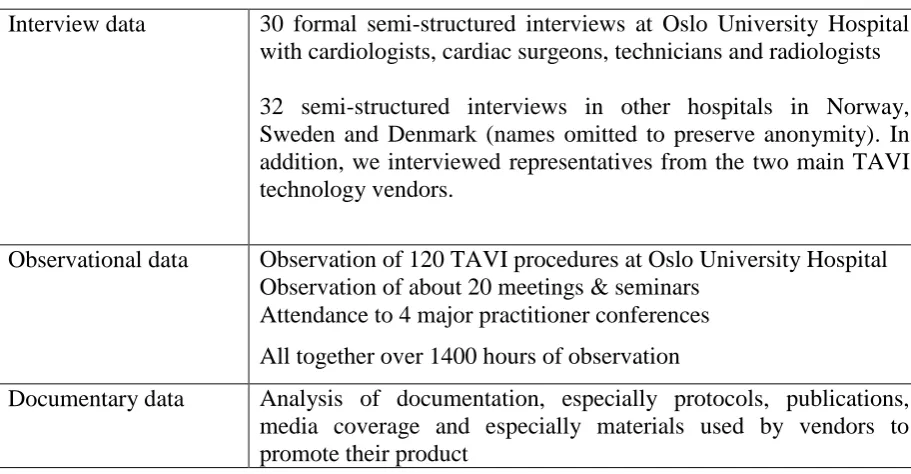
10
Table 1 Summary of data
Interview data 30 formal semi-structured interviews at Oslo University Hospital with cardiologists, cardiac surgeons, technicians and radiologists
32 semi-structured interviews in other hospitals in Norway, Sweden and Denmark (names omitted to preserve anonymity). In addition, we interviewed representatives from the two main TAVI technology vendors.
Observational data Observation of 120 TAVI procedures at Oslo University Hospital Observation of about 20 meetings & seminars
Attendance to 4 major practitioner conferences
All together over 1400 hours of observation
Documentary data Analysis of documentation, especially protocols, publications, media coverage and especially materials used by vendors to promote their product
The analysis proceeded utilising the established conventions and practicalities of robust
interpretive social science (Yanow and Schwartz-Shea, 2006). The research team mutually
constructed a primary thematic structure. The themes reflected the ongoing concerns of
practitioners such as contract negotiations, team relations, technology developments, local,
national and international networks of communication etc. Once expertise and its particular
translocal nature started to emerge as a topic of interest, we went back to our data and mined
the field notes, interviews and document for relevant clues and meaningful events. Moving
continuously between data and literature we started to elaborate the idea that previous
theorization of expertise captures only in part what we have observed. We went through
multiple cycles of analysis and reflection and we returned to the field and asked some of the
practitioners for further information and feedback on our observations. The analysis continued
well into the writing stage. Indeed, the feedback from the anonymous reviewers triggered a
11
4 Findings: The expertise of doing TAVI
We start with a vignette from our fieldwork that takes the reader in the middle of TAVI
action. We use the vignette to discuss the nature of expertise in the case of TAVI.
4.1 Doing TAVI
The hybrid operating room, a surgical room equipped with advanced imaging devices, is crowded today with over 15 people moving in and out of the room. As the operating cardiologist told us in the changing rooms, today for the first time they will be using a new “third generation” delivery system. The two operating cardiologists stand close to the
patient. Next to them is a large screen where they can see what happens inside the body of the patient. A proctor, the “master” cardiologist is standing at one side. He flew in from
Hungary where he has already been using the same system for a few months. His arms are crossed, his head slightly bent. The posture says “I am supervising“. A bit farther away
another doctor, who is also a learner, even though slightly less advanced, observes the procedure in silence. Two other leading cardiologists will arrive halfway through the
intervention to observe the critical part of the procedure – the positioning of the new valve. Everyone in the team -- nurses, radiologists, and anaesthetist moves around in a well-rehearsed choreography, telling of the many procedures they already conducted together.
The guiding wires for catheters and catheter sheaths are inserted into the body of the patient at his groin. The wire reaches the heart (we can see this on our monitor). When the new valve
is moved into and through the body of the patient, the proctor, who until now has been looking from the side, moves closer to the patient’s bed. All glances are towards the X-ray video screen. The robot with the X-ray camera continues to move above the patient making
12
the room stretch their necks to see what happens. The proctor points to the screen and speaks again. For the first time now he also points to the hands of the interventional cardiologist. He
does not touch the catheter but he shows the practitioner how to move it (“Twist it this way, not the other… push it this way”). The operating cardiologist is extremely attentive, his
glance fixed towards the screen while manoeuvring the catheter that controls the valve near to the patient’s heart. He is now visibly concentrated, trying hard, and struggling just a bit. We hear the proctor saying “that is not bad…move it a little bit”. The cardiologist moves the
valve a tad; the valve needs to be positioned perfectly so that no blood refluxes in the heart. This requires physical force as the valve has to be pushed and pulled up and down the artery
using the catheter it is attached to. He glances at his colleague and then the proctor. Then he says, “It seems okay…what do you think?” The proctor seems satisfied: “Yes, not bad”. He
turns around to the other operating cardiologist who has been sharing the procedure: “What
do you think?” “Uh…yes…I’m happy with this.”
After the heart is stopped by fibrillation to deploy the valve into its correct placement,
the tension in the room eases. “Are you satisfied?” The cardiologist in charge asks the anaesthesiologist. “Yes, it is fine”. Within seconds the scene dismantles. The cardiologists who came to witness the operation leave the room while chatting. The proctor and the
application specialist praise the virtues of the new system and the innovations it carries with it: “the behaviour is more predictable…the shape of the valve changed so that it fits better to
the inside of the artery… it can be repositioned easily…it takes less time”. They seem
genuinely enthusiastic about the new system and want to share their experience: “…it is much better at tracking its way inside the patient’s arteries… but you have to relearn how to let it go by itself…it will find its way but you have to stop twisting right and left as you were
13
4.2 TAVI: expertise as accomplishment
The vignette illustrates well that the expertise of TAVI is a learned accomplishment.
Firstly, the vignette presents a scene of individual and collective learning. A very visible and
well-structured social “community of learners” (Lave, 1998) is created by the practice of
doing TAVI. At the centre of the scene are the interventionist cardiologists who manoeuvre
the valve and delivery system and the proctor, that is “the master”. The proctor does not
teach, rather he makes room for the apprentices to learn. The nurses, technicians and
anaesthesiologists are acquiring experience by attending to their tasks. The other onlookers
learn by occupying a peripheral participant role. They came here to learn by watching
attentively, waiting for their opportunity to be at the centre of the action. Every aspect of this
scene speaks of expertise as achieved by learning in and through practice.
Tacit, bodily and aesthetic knowledges are clearly involved here. Inserting a valve is
not only about processing information but also about pushing, pulling and twisting.
Positioning the valve in the “right place” is judged by asking “are you happy with it?”, rather
than referring to rules and abstract criteria. Instead of deliberation we observe a rather fluid
performance guided by the intuitive grasp of the situation – what according to the fluency
model discussed above distinguishes between experts and novices.
It is worth emphasising that the two operating cardiologists, who are considered by
everyone else in the hospital as experts, are also here to learn. In fact, the entire scene is
deliberately constructed as a way for the experts to refine and update their competence by
tapping in the latest technological development. In doing so the two eminent cardiologists
accept to occupy purposefully the role of learners (we would hesitate to call them novices).
The proctor explicitly verbalises this: “you have to relearn how to let it go by itself”.
14
expertise, continuous adaptation and deliberate search for opportunities to expand the
boundaries of their competence.
4.3 TAVI: Expertise as collective and relational
The vignette also illustrates that TAVI is a collective accomplishment and the result of
a joint history of learning that differentiates this center from all others. Indeed, throughout the
procedure the patient was sedated but awake – a pain management strategy that has only
recently been adopted at this specific site.
Performing TAVI requires the collaboration between the cardiologists and cardiac
surgeons. Dozens of TAVI procedures carried out together helped the team to learn how to
operate “in tune” (informant). The result is the highly choreographed performance captured
in the narration.
The extent to which TAVI is indeed a collective achievement became especially clear
in occasion of a small breakdown which we observed during one of the procedures. The
problem emerged because the valve that had been ordered did not fit the size of the patient’s
aorta. At this point Anne, one of the members of the team, got up and rushed to the storage
room. She quickly returned with a large box which she opened in a hurry. She pulled out a
new delivery system, dislodged the valve from the catheter and brought it to the crimping
table for the nurse to prepare for use. When she was reassured that everything had returned to
normal, she cleared out the boxes in front of the operation room and returned to her seat. The
thing is that Anne was in fact an expert radiographer. Her ‘official’ expertise was to operate
CTs and x-ray scanners and give access to the ‘inside’ of the patient. However, Anne here is
displaying a different type of expertise. By participating in dozens of procedures and working
15
towards providing support to the ongoing activities. In so doing she developed an additional
type of expertise “based on confident engagement with the knowledge that underpins one’s
practice… as well as a capacity to recognise and respond to what others might offer”
(Edwards, 2010, p.13). Anne had developed what Edwards (2010) calls “relational expertise”.
Relational expertise describes the capacity of some, but not all professional experts, to align
one’s thoughts and actions with others in the course of an activity. By taking into account the
motives of other professionals, it allows different experts who work together (as in the case of
TAVI) to build common knowledge which in turn allows to make progress on the problem
space at hand.
4.4 TAVI: Expertise as materially entangled
TAVI is not only a collective and social achievement. It is also a highly materially
entangled affair. Human and machine must constitute a well-aligned configuration in order
for TAVI to happen. The expertise of TAVI manifests itself through (and is made possible
by) a functional collective of human and non-human actors, each performing a critical part of
the work. Take away the fluoroscopy x-ray machine (figure 1) which allows a cardiologist to
16
Figure 1: TAVI as material entangled: the fluoroscopy x-ray machine allows surgeon to see inside the body (picture taken during field work used with permission)
Materials do more than simply contributing to the expert action by providing real-time
knowledge of the state of the patient. The valve itself and the delivery device, which allows
to reach the heart through a small keyhole incision on the thigh, carry on the scene the results
of a long history of development, research and accumulated wisdom. In a real sense the
expertise of TAVI strongly depends on social and material connections that extend beyond
the specific scene of action.
5 The landscape of TAVI expertise: expertise as translocal and
economically invested
Summarising from above, the case of TAVI provides support to the view of expertise as
accomplished, social and material in character. No person can do TAVI alone and doctors
17
is also historically situated and evolving. Such expertise did not exist ten years ago and when
TAVI was introduced the procedure started to change what it means to be a “good” heart
surgeon or a leading-edge cardiologist. The expertise of doing TAVI is also materially
mediated and entangled. Our practitioners were very clear that you cannot simply walk into
another hospital and start doing TAVI. Equally, if you enter into an operating theatre that has
the wrong (or simply a different) spatial arrangement your expertise temporarily dissolves.
You can be an expert in one hospital but not in the next one. In theory, expertise is in the
mind. In practice expertise is deeply entangled with the social and material setting where it
happens and depends on a complex hinterland of other skills, other people and other
processes and expertise.
The case of TAVI, however, suggests that this situated, social and material, yet still
local, view of expertise tells only part of the story. While the expertise of TAVI was locally
accomplished and manifested itself in and through a specific collective composed by human
and non-human actants working in alignment, its existence overflowed the local scene of
action. The nature, state and advancement of the expertise of doing TAVI could not be
understood without making reference to other sites, other centers and the relationships
between them. In short, the expertise of TAVI was the emerging property of a larger and
translocal network and their relationships.
5.1 TAVI: expertise is more than local
Our study indicated that both the expertise of doing TAVI (i.e., the skills for doing
TAVI in the best possible way) and the adaptive effort to improve these skills were shared by
a large community of practitioners linked by a number of personal and professional
relationships. The expertise travelled through connections established by individuals and
18
A clear way of establishing connections is when individuals visited other hospitals to learn
about TAVI. In the Scandinavian setting we observed several such examples. For instance,
one of the cardiologists from Oslo spent several months in Copenhagen learning TAVI. Later
he came back and explained to some of the team members the important similarities and
differences between the hospitals’ use of TAVI. One of these differences was that they used a
percutaneous closing device that made it possible to perform TAVI even less invasively.
Moreover, this technology is similar to other techniques well-known to the cardiologists, and
by using it the cardiologists can perform the whole transfemoral procedure without the
presence of cardiac surgeons.
TAVI technology vendors and especially proctors, experienced practitioners with at
least 50 successful operations under their belts who act as intermediaries of expertise on
behalf of the technology producers and they establish and maintain networks of connections
between sites. TAVI proctors are themselves TAVI practitioners at their local hospitals and
some of the team members at our main site have travelled around the world to proctor in
other sites. As evident in the vignette above, proctors play a particularly important role in
circulating working knowledge and developing the joint expertise of the group. Proctors visit
TAVI centers on a regular basis. They discuss the procedures and exchange information
about other practitioners and hospitals, illustrate new ways of operating and disclose tricks to
perform the procedures more successfully. By doing so, they are instrumental in establishing
connections between sites and facilitating the circulation of expertise . Finally, connections
are established and exploited in academic conferences and seminars where hospital
practitioners and technology providers meet to discuss, comment, teach, learn, explain,
introduce new porducts and, in the process, take home snippets of wisdom, hints, and ideas
that they can use in their daily work. The process of learning through borrowing the secrets of
19
community of practitioners and learners. The community of practice created around the
acquisition and development of the expertise of TAVI overflows the local scene of action. In
a very concrete sense, the expertise of TAVI is also decentered. Both individuals and
technologies are travelling across sites, and no single hospital or vendor could argue that “this
is the way we should do TAVI from now on”.
5.2 Competing regimes of expertise on how to do TAVI: expertise as economically
invested and proprietary
In the case of TAVI the flurry of professional and academic visits and exchanges
described above coexisted with a different regime of circulation generated by the economic
forces which operate in the landscape. The two largest producers of valves had in fact
instituted two proprietary networks, which generated competing and alternative circuits of
knowledge. These in turn were the result of the intentional and interested effort of the two
companies who were set to make very sizable profits from the advancement of this type of
intervention and from the control of the expertise associated with it (each valve costs nearly
$20000 each).
Consider how the expertise of doing TAVI was acquired. Valve producers did not
simply sell valves and insertion kits. According to our informants, after choosing which
provider you would like to work with, your whole team had to travel to their European
headquarters to undergo a training program and learn the ropes of TAVI. Here you would
acquire the necessary basic skills to perform TAVI in a safe and efficient way. You will also
learn more about aspects such as the coordination of the TAVI activities, how to organize the
TAVI team, the division of labor between the different team members in the operating room,
the setup of the room and so forth according to the company views. Your first local TAVI
20
company representative will be your contact person who will occasionally attend to see that
everything goes according to plan. The same or different proctors from the company will
continue to visit the site intermittently, often when a new model of the valve is introduced. In
occasion of these visits, before, during and after the procedures, as well as during other
initiatives organized by the technology manufacturer, you would exchange information about
other practitioners, practices, tricks of the trade and the current situation in the TAVI market.
In short, hospitals were de facto enrolled in ‘closed’ networks that vendors created with and
for their clients. These closed networks are the result of the combined work of human
intermediaries (proctors) and material mediators (articles, videos, reports). They establish
durable relationships between TAVI performing centres and in the process they create and
extend particular regimes of expertise which promote and sell trans catheter heart valves of
one type rather than another.
5.3 When expertise becomes economically invested and proprietary: some implications
The existence of competing proprietary circuits of knowledge affected all the aspects of
expertise discussed above. The firms attended to, structured and facilitated individual
learning and expertise refinement. To avoid costly errors (and adverse consequences for
patients) doctors could only learn the practice of TAVI at the vendor training centres or under
the supervision of one of their proctors. The learning by doing model was still used, but under
controlled circumstances and using criteria developed by the company, not the community
(for example who would be entitled to be a TAVI novice; how many TAVI procedures you
need to become an expert) etc. The proctors (the “TAVI masters”) in turn were not chosen by
the community of practice on the basis of professional reputation alone. As one of the
21
and they decided who is suitable…” This is because proctors, who are paid to teach, are not
only translators of expertise, they are also builders of networks and enrolling machines. As
one of our informants explained “…becoming a proctor enables you to also build a large
scientific network” and to include others in it. In summary, the vendors organised their own
proprietary communities of practice that overlapped with the existing academic and
professional networks.
Relational expertise was also affected. The two vendors developed different
technologies and artefacts that require different types of teams, different combinations of
practitioners and different number of people in the room (this was one of the “competitive
advantages that one of the main vendors claimed to have on the other, although over time the
differences tend to fade away). Importantly, at least in the early stages of doing TAVI, the
composition of the teams and the way of working together was prescribed by the vendors,
who required team training as a conditions for hospitals to become TAVI centres.
Finally, the two vendors, who invested significantly in their own Research &
Development, organised they proprietary ways to feedback the experience of users to the
designers of new products. They did so by instituting proprietary networks of practitioners.
As one of our informants explain:
“Once a year we organise a Nordic TAVI meeting. It is based on experience. We
ask the physicians to bring in cases. Cases with problems. Often they say that they like
these kinds of meetings. At the big conferences they only present the success stories. In
these local meetings they also show what went wrong. It is about 50-60
cardiologist-surgeons. We only invite TAVI [name of the vendor] teams.” [Interview with vendor
representative].
These nexuses of relationships, which also helped the manufacturers to refine their
22
regimes of expertise interested in promoting TAVI and themselves. These economically
driven circuits of knowledge co-existed side-by-side, and at times substituted or conflicted
with the traditional scientific mode of circulation of expertise. To some extent, expertise was
privatized. Vendor did not limit to sponsor conferences and visits. They took control of the
whole process.
The existence of such economic epistemic regimes of knowledge circulation and
networks introduces a further element of complexity in the understanding of expertise. It also
affects the traditional conditions of acquisition, transmission and expansion of the expertise.
Both the individual and the group level the acquisition and development of expertise depends
upon the positioning in the political economy of knowledge that rotates around TAVI. As we
were told in one of our interviews “To start up a new [TAVI] centre is about 1 million. This
includes education and proctoring. Not all centres can afford to do this” [interview with
doctor]. The traditional process of learning by doing may also be affected, as access to
learning is now controlled by vendors and limited to hospitals that can fit the required
economic profile. Individual motivation and desire to learn may not be enough: chose the
wrong bandwagon and you may be starved of connections, support and your
knowledgeability may become limited. Moreover, given that large and rich Centres of
excellence are more likely to attract the interest of vendors than smaller, peripheral
establishment, the process risks to be self-fulfilling and to perpetuate a form of intellectual
capitalism (those who have intellectual capital get more of it; the others are increasingly
marginalised). The new arrangement also prevents potentially generative knowledge
exchanges that can lead to innovation. The connections between centre is now partially
affected by vendors who established preferential relationships based on belonging to the same
company network. Finally the feedback from users goes back to the firm rather than been
23
In summary, chose not to participate in the system that generates large profits (a 2016
report estimates that the TAVI market will be worth $5.9 billion by 2022) and the expertise
of TAVI will be at least partially precluded to you.
The effects of this partial privatization of expertise of course are not all negative. The
competition between the two vendors and the control over the process allowed to speed up
the generation of expertise around TAVI when compared with other similar forms of
expertise. Mechanisms like proctoring also reduced the number of failures in the learning by
doing process. This translated in less problems for patients and better clinical outcome faster.
Moreover the circuits of knowledge created by the two firms co-exist, rather replace the
traditional academic practices. In short what we describe as the partial privatization of the
expertise of TAVI created new opportunities for acquiring and refining expertise as well as
new boundaries and potential lines of fracture. In both cases, however, the nature and
dynamics of expert knowing were significantly affected and altered.
6 Discussion and conclusion: the rhizomatic and invested landscape of
TAVI expertise
In this paper we argued that the case of TAVI prompts us to further expand the idea that
medical expertise is personal and social, relational and material. Our suggestion is that this
view needs to include the notion that experts are not so much owners of expertise but rather
the carriers or conduits of broader circuits of knowledge. Understanding expertise in general,
and the expertise of TAVI, in particular, requires to take into account the processes through
which knowledge circulates and the different ways in which experts learn to participate in
24
closed, proprietary and potentially competing circuits of knowledge. The establishment of
such “for profit” epistemic communities adds a further dimension of complexity in
understanding of the dynamics of expertise. In modern medicine as elsewhere the nature of
expertise, its circulation and the making of money cannot be studied in isolation.
The case of TAVI invites us first to problematize the traditional way in which we
ascribe expertise to distributed entities. As we discussed above, expertise is usually attributed
to individuals, groups/communities or networks. In the case of individual groups and
communities the focus is on the site and the local processes of learning. In the case of
network, the focus is on the relationships, while the nodes and their individual history tend to
disappear. In the case of TAVI, however, neither approach is satisfactory. Based on our
study, in response to the question “where is the expertise of TAVI” we can only points at a
rhizomatic set of social and material relationships that as a whole can be ascribed with
expertise. Individual, groups and local sites become carriers and developers of this expertise
that however they do not “own”. The expertise of TAVI is thus both local and translocal; it
“resides” in the relationship between the two. With this we mean that the fluid and evolving
expertise of how to perform TAVI is firstly distributed locally among the elements which
compose the situated activity system (Engeström and Middleton, 1996; Greig et al., 2012).
Expertise is, therefore, eminently territorialised in specific sites. In each site, knowing how to
do TAVI well is the result of a history of joint learning, technological choices, or
relationships with the larger material context. translocalThis makes each site unique and it is
for this reason that you can be an expert in one centre and when operating with one team but
you can no longer be an expert when such conditions change.
At the same time, expertise is also distributed among a host of interconnected centres. It
circulates among them thanks to the active work of material and human intermediaries,
25
emerges as a property of the connections within and between these nodes. Expertise is both
local and translocal and there is no opposition between the two - although tension is always
there. We contrast this view for example with the idea of “networks of practice” understood
as informal, emergent and often virtual social networks between individuals with
practice-related goals which come together to invent and share knowledge (see, e.g., Pugh and
Prusak, 2013 ). In this view the relevance of the local socialization and situated learning
processes, as well as the joint history of learning are lost. A rhizomatic view holds fast to the
idea that expertise is learned and experienced locally and to the idea that novices can be
socialised only if they participate actively in a local culture of practice (an aspect that clearly
emerges from our study). It adds, however, that the locality itself depends on what happens in
other localities. Indeed, certain sites are better at doing TAVI than others and in our study we
heard stories of competition for who is the best. And yet at any moment in time expertise is
an effect produced by and emerging from the entire rhizome, rather than from only one of its
parts. The adaptive work to advance the expertise of TAVI is performed by the entire
rhizomatic heterogeneous entity composed by practitioners, sites and their connections.
One of our main reasons to use the image of the rhizome rather than the more polished
idea of network (Hakkarainenet al., 2004; Pugh and Prusak, 2013) or landscape
(Wenger-Trayner et al., 2014) is that we want to emphasise that the expertise of performing TAVI is
not homogenously distributed like dust on a surface. Understanding expertise necessarily
requires also the consideration of how material interests intersect, sustain and hamper the
circulation of knowledge and the generation of expertise. The case of TAVI and the presence
of (at least) two proprietary networks of practitioners also suggests that modes of circulation
based on personal connections and belonging to the same discipline co-exist with those
deriving from being part of the same commercial alliance. Accordingly, the circulation of
26
egalitarian. To become and remain an expert, one has to learn how to navigate in a diverse,
unequal and shifting landscape where economic alliances determine access to knowledge
sources and where expertise, prestige and money are inextricably entangled. Networks of
expertise and circuits of knowledge are not flat -- not in the world of medicine anyway. To
the extent that the expertise of TAVI become entangled with profit making considering these
economic aspects as external to the study of expertise is rather disingenuous. Economic
processes are in fact likely to significantly affect the dynamics of expertise, and how we
understand it. On the one hand, as we mentioned above, the introduction of private circuits of
innovation introduces new types of epistemic boundaries and potentially interferes with, or
renders more difficult, traditional forms of individual learning and mutual exchange. At the
same time, the emergence of proprietary circuits of knowledge in competition with each other
may speed up the expansion and increase of expertise by rationalising development processes
that historically have left to emergent processes.
The case of TAVI of course is particular in that we are observing an expertise still in
development. Whether the observed intense rhizomatic regime of circulation and competition
will continue or will subside when the approach becomes mainstream is an empirical rather
than a theoretical question. What is clear, however, is that the case of TAVI may not be an
exception. The introduction of game changing technologies has, in fact, become the norm not
only in certain segments of the healthcare sectors in rich countries but also in many other
sectors. The solitary master who thrives in isolation is simply not what we found by studying
leading edge healthcare practices. Maybe this form of expertise still applies to occupations
such as chess master and musicians (two typical cases studies by scholars of expertise: see
Hoffman, 1996) but as TAVI suggests this is less and less the case.
Equally, we are not arguing that all expertise is rhizomatic. Several of the observations
27
study, therefore, raise the question on whether expertise can be studied by extending the same
categories to large and differentiated sets of phenomena and paves the way for a more
nuanced approach that differentiates expertise on the basis of the nature of the practice at
hand. In this sense, our radical take on the nature of expertise point at several opportunities
for future research: how is the multiplicity of the field reflected and lived at individual level
(an aspect that the “unitary” fluency model tends to ignore)? What are the effects of the
partial privatization of expertise? What are the skills that allow one to become and remain
knowledgeable of the existing and mutable landscape? Is the expertise to connect sites and to
deal with vendors similar or different from the already identified forms? Can this expertise in
connectivity and commercial negotiation be subsumed under the category of contributory
expertise as for Collins and Evans (2008)? Or is there a new form of expertise involved?
7 References
Chase, W. G., & Simon, H. A. (1973). “Perception in chess”. Cognitive psychology, 4(1):
55-81.
Collins, H. . (2001). ”What is tacit knowledge?”. In Schatzki, T. R., Knorr Cetina, K.
&
Von Savigny, E. (Eds.), The Practice Turn in Contemporary Theory. London: Routledge: 107–119.Collins, H. (2013). “Three dimensions of expertise”. Phenomenology and the Cognitive Sciences, 12(2): 253–273.
Collins, H., & Evans, R. (2008). Rethinking expertise. Chicago: University of Chicago Press. Dreyfus, S. E. (2004). “The five-stage model of adult skill acquisition”. Bulletin of science,
technology & society, 24(3): 177-181.
Edwards, A. (2005). “Relational agency: Learning to be a resourceful practitioner”.
International journal of educational research, 43(3), 168-182.
Edwards, A. (2010). Being an expert professional practitioner: The relational turn in expertise. Dordrecht: Springer.
Elstein, A. S., & Schwarz, A. (2002). “Clinical problem solving and diagnostic decision making: selective review of the cognitive literature”. British Medical Journal , 324(7339): 729-732.
Engeström, Y., & Middleton, D. (1996). Cognition and communication at work. Cambridge, UK: Cambridge University Press.
Fenwick, T., & Dahlgren, M. A. (2015). “Towards socio‐material approaches in simulation-based education: lessons from complexity theory”. Medical education, 49(4): 359-367. Fenwick, T. & Nerland, M. (Eds.) (2014). Reconceptualising professional
28
Garrett, S. K., Caldwell, B. S., Harris, E. C., & Gonzalez, M. C. (2009). “Six dimensions of expertise: a more comprehensive definition of cognitive expertise for team
coordination”. Theoretical Issues in Ergonomics Science, 10(2): 93-105.
Gherardi, S. & Nicolini, D. (2002). “Learning in a constellation of interconnected practices: canon or dissonance?”. Journal of Management Studies, 39(4): 419-436.
Greig, G., Entwistle, V. A., Beech, N. (2012). “Addressing complex healthcare problems in diverse settings: Insights from activity theory”. Social Science & Medicine, 74(3): 305-312.
Hakkarainen, K., Palonen, T., Paavola, S., & Lehtinen, E. (2004). Communities of networked expertise: Professional and educational perspectives. Amsterdam: Elsevier.
Hoffman, R. R. (1996). “How Can Expertise be Defined? Implications of Research From Cognitive Psychology”. In R. Williams, W. Faulkner & J. Fleck (Eds.) Exploring Expertise. Edinburgh: University of Edinburgh Press, 81–100.
Hutchins, E. (1995). Cognition in the Wild. Cambridge: MIT press.
Kotzee, B. (2012). “Private practice: Exploring the missing social dimension in ‘reflective practice”. Studies in continuing education, 34(1): 5-16.
Kotzee, B. (2014). “Differentiating forms of professional expertise”. In M. Young and J. Muller (Eds.) Knowledge, expertise and the professions. Abingdon: Routledge: 61-77. Lave, J. (1988). Cognition in practice. Cambridge: Cambridge University Press.
Lave, J., & Wenger, E. (1991). Situated learning: Legitimate peripheral participation. Cambridge: Cambridge University Press.
Mørk, B.E. & Hoholm, T. (2016). “From knowledge breakthroughs to changing medical practices”, page 270-286, in Škerlavaj, M., Černe, M., Dysvik, A. and Carlsen, A. (eds) (2016). Capitalizing on Creativity at Work: Fostering the Implementation of Creative Ideas in Organizations, Edward Elgar Publishing.
Mørk, B.E, Hoholm, T., Aanestad, M., Edwin, B. & Ellingsen, G. (2010). “Challenging expertise: on power relations within and across communities of practice in medical innovation”. Management Learning, 41(5): 575-592.
Mørk, B.E., Aanestad, M., Grisot, M., & Hanseth, O. (2008). “Conflicting epistemic cultures and obstacles for learning across communities of practice”. Process and Knowledge Management, 15(1): 12-23.
Mylopoulos, M., & Regehr, G. (2007). “Cognitive metaphors of expertise and knowledge: prospects and limitations for medical education”. Medical education, 41(12): 1159-1165.
Nicolini, D. (2009). “Zooming in and out: Studying practices by switching theoretical lenses and trailing connections”. Organization Studies, 30(12): 1391–1418.
Nicolini, D. (2012). Practice Theory, Work, and Organization: An Introduction. Oxford: Oxford University Press
Olsen, P. I. & Håkansson, H. (2017). The roles of deals and business networks in innovation processes. The IMP Journal, 11 (1): 25-50
Pillay, H., & McCrindle, A. R. (2005). “Distributed and relative nature of professional expertise”. Studies in Continuing Education, 27(1): 67-88.
Pugh, K., & Prusak, L. (2013). “Designing effective knowledge networks”. MIT Sloan Management Review, 55(1), 79.
Ramlogan, R., Mina, A., Tampubolon, G., & Metcalfe, J. S. (2007). “Networks of
29
Sanders, T., & Harrison, S. (2008). “Professional legitimacy claims in the multidisciplinary workplace: the case of heart failure care”. Sociology of Health & Illness, 30(2): 289-308.
Stevens, F. C., Diederiks, J. P., Grit, F., & Van der Horst, F. (2007). “Exclusive, idiosyncratic and collective expertise in the interprofessional arena: the case of optometry and eye care in the Netherlands”. Sociology of health & illness, 29(4): 481-496.
Wenger-Trayner, E., Fenton-O'Creevy, M., Hutchinson, S., Kubiak, C. & Wenger-Trayner, B. (2014) Learning in landscapes of practice: Boundaries, identity, and
knowledgeability in practice-based learning. London: Routledge. Winch, C. (2010). Dimensions of expertise. London: Continuum.
Yanow, D. (2015). “After Mastery. Insights from Practice Theorizing”. In R. Garud, B. Simpson, A. Langley and H. Tsoukas (Eds.) The Emergence of Novelty in
Organizations. Oxford: Oxford University Press: 272-317.