warwick.ac.uk/lib-publications
Original citation:Collins, A., Foniok, J., Korpelainen, Nicholas, Lozin, Vadim V. and Zamaraev, Victor. (2017) Infinitely many minimal classes of graphs of unbounded clique-width. Discrete Applied Mathematics.
Permanent WRAP URL:
http://wrap.warwick.ac.uk/86094
Copyright and reuse:
The Warwick Research Archive Portal (WRAP) makes this work by researchers of the University of Warwick available open access under the following conditions. Copyright © and all moral rights to the version of the paper presented here belong to the individual author(s) and/or other copyright owners. To the extent reasonable and practicable the material made available in WRAP has been checked for eligibility before being made available.
Copies of full items can be used for personal research or study, educational, or not-for-profit purposes without prior permission or charge. Provided that the authors, title and full bibliographic details are credited, a hyperlink and/or URL is given for the original metadata page and the content is not changed in any way.
Publisher’s statement:
© 2017, Elsevier. Licensed under the Creative Commons Attribution-NonCommercial-NoDerivatives 4.0 International http://creativecommons.org/licenses/by-nc-nd/4.0/
A note on versions:
The version presented here may differ from the published version or, version of record, if you wish to cite this item you are advised to consult the publisher’s version. Please see the ‘permanent WRAP URL’ above for details on accessing the published version and note that access may require a subscription.
Infinitely many minimal classes of graphs
of unbounded clique-width
∗A. Collins†, J. Foniok‡, N. Korpelainen§, V. Lozin¶, V. Zamaraevk
Abstract
The celebrated theorem of Robertson and Seymour states that in the family of minor-closed graph classes, there is a unique minimal class of graphs of unbounded tree-width, namely, the class of planar graphs. In the case of tree-width, the restriction to minor-closed classes is justified by the fact that the tree-width of a graph is never smaller than the tree-width of any of its minors. This, however, is not the case with respect to clique-width, as the clique-width of a graph can be (much) smaller than the clique-width of its minor. On the other hand, the clique-width of a graph is never smaller than the clique-width of any of its induced subgraphs, which allows us to be restricted to hereditary classes (that is, classes closed under taking induced subgraphs), when we study clique-width. Up to date, only finitely many minimal hereditary classes of graphs of unbounded clique-width have been discovered in the literature. In the present paper, we prove that the family of such classes is infinite. Moreover, we show that the same is true with respect to linear clique-width.
Keywords: clique-width, linear clique-width, hereditary class
1
Introduction
Clique-width is a graph parameter which is important in theoretical computer science, because many algorithmic problems that are generally NP-hard become polynomial-time solvable when restricted to graphs of bounded clique-width [4]. Clique-width is a relatively new notion and it generalises another important graph parameter, tree-width, studied in the literature for decades. Clique-width is stronger than tree-width in the sense that graphs of bounded tree-width have bounded clique-width, but not necessarily vice versa. For instance, both parameters are bounded for trees, while for complete graphs only clique-width is bounded.
When we study classes of graphs of bounded tree-width, we may assume without loss of generality that together with every graphG our class contains all minors of G, as the tree-width of a minor can never be larger than the tree-width of the graph itself. In other words, when we try to identify classes of graphs of bounded tree-width, we may restrict
∗
The authors acknowledge support of EPSRC, grant EP/L020408/1
†
Mathematics Institute, University of Warwick, UK.
‡
School of Computing, Mathematics and Digital Technology, Manchester Metropolitan University, UK.
§
Department of Electronics, Computing and Mathematics, University of Derby, UK.
¶
Mathematics Institute, University of Warwick, UK.
k
ourselves to minor-closed graph classes. However, when we deal with clique-width this restriction is not justified, as the clique-width of a minor of G can be much larger than the clique-width of G. On the other hand, the clique-width of G is never smaller than the clique-width of any of its induced subgraphs [5]. This allows us to be restricted to hereditary classes, that is, those that are closed under taking induced subgraphs.
One of the most remarkable outcomes of the graph minor project of Robertson and Seymour is the proof of Wagner’s conjecture stating that the minor relation is a well-quasi-order [13]. This implies, in particular, that in the world of minor-closed graph classes there exist minimal classes of unbounded tree-width and the number of such classes is finite. In fact, there is just one such class (the planar graphs), which was shown even before the proof of Wagner’s conjecture [12].
In the world of hereditary classes the situation is more complicated, because the in-duced subgraph relation is not a well-quasi-order. It contains infinite antichains, and hence, there may exist infinite strictly decreasing sequences of graph classes with no min-imal one. In other words, even the existence of minmin-imal hereditary classes of unbounded clique-width is not an obvious fact. This fact was recently confirmed in [8]. However, whether the number of such classes is finite or infinite remained an open question. In the present paper, we settle this question by showing that the family of minimal hereditary classes of unbounded clique-width is infinite. Moreover, we prove that the same is true with respect tolinear clique-width.
The organisation of the paper is as follows. In the next section, we introduce basic notation and terminology. In Section 3, we describe a family of graph classes of unbounded clique-width and prove that infinitely many of them are minimal with respect to this property. In Section 4, we identify more classes of unbounded clique-width. Finally, Section 5 concludes the paper with a number of open problems.
2
Preliminaries
All graphs in this paper are undirected, without loops and multiple edges. For a graph
G, we denote by V(G) and E(G) the vertex set and the edge set of G, respectively. The
neighbourhood of a vertex v∈V(G) is the set of vertices adjacent tov and thedegree ofv
is the size of its neighbourhood. As usual, byPn andCn we denote a chordless path and
a chordless cycle withnvertices, respectively.
In a graph, an independent set is a subset of vertices no two of which are adjacent. A graph is bipartite if its vertices can be partitioned into two independent sets. Given a bipartite graph G together with a bipartition of its vertices into two independent sets
V1 and V2, the bipartite complement of G is the bipartite graph obtained from G by
complementing the edgesbetweenV1 and V2.
Let G be a graph and U ⊆ V(G) a subset of its vertices. Two vertices of U will be calledU-similar if they have the same neighbourhood outside U. Clearly,U-similarity is an equivalence relation. The number of equivalence classes ofU-similarity will be denoted
µ(U). Also, byG[U] we will denote the subgraph ofGinduced byU, that is, the subgraph of G with vertex set U and two vertices being adjacent in G[U] if and only if they are adjacent inG. We say that a graph H is an induced subgraph of GifH is isomorphic to
A class X of graphs is hereditaryif it is closed under taking induced subgraphs, that is, G ∈ X implies H ∈ X for every induced subgraph H of G. It is well-known that a class of graphs is hereditary if and only if it can be characterised in terms of forbidden induced subgraphs. More formally, given a set of graphs M, we say that a graph G is
M-free ifGdoes not contain induced subgraphs isomorphic to graphs inM. Then a class
X is hereditary if and only if graphs in X areM-free for a setM.
The notion of clique-width of a graph was introduced in [3]. The clique-width of a graph G is denoted cwd(G) and is defined as the minimum number of labels needed to constructG by means of the following four graph operations:
• creation of a new vertex v with labeli (denotedi(v)),
• disjoint union of two labelled graphs Gand H (denotedG⊕H),
• connecting vertices with specified labels iand j (denotedηi,j) and
• renaming label ito labelj (denotedρi→j).
Every graph can be defined by an algebraic expression using the four operations above. This expression is called a k-expression if it uses k different labels. For instance, the cycle C5 on vertices a, b, c, d, e (listed along the cycle) can be defined by the following
4-expression:
η4,1(η4,3(4(e)⊕ρ4→3(ρ3→2(η4,3(4(d)⊕η3,2(3(c)⊕η2,1(2(b)⊕1(a)))))))).
Alternatively, any algebraic expression definingGcan be represented as a rooted tree, whose leaves correspond to the operations of vertex creation, the internal nodes correspond to the ⊕-operations, and the root is associated with G. The operations η and ρ are assigned to the respective edges of the tree. Figure 1 shows the tree representing the above expression defining aC5.
+ + + +
C5
4(e) 4(d) 3(c) 2(b)
1(a) ρ4→3ρ3→2η4,3
[image:4.612.152.475.478.541.2]η4,1η4,3 η3,2 η2,1
Figure 1: The tree representing the expression defining aC5
Let us observe that the tree in Figure 1 has a special form known as a caterpillar tree(that is, a tree that becomes a path after the removal of vertices of degree 1). The minimum number of labels needed to construct a graph G by means of caterpillar trees is called thelinear clique-widthof Gand is denoted lcwd(G). Clearly, lcwd(G)≥cwd(G) and there are classes of graphs for which the difference between clique-width and linear clique-width can be arbitrarily large (see e.g. [2]).
clique-width are related to each other by proving that if the clique-width of a graphGis
k, then
rwd(G)≤k≤2rwd(G)+1−1.
Therefore a class of graphs has unbounded clique-width if and only if it also has unbounded rank-width.
For a graph G and a vertex v, the local complementation at v is the operation that replaces the subgraph induced by the neighbourhood ofv with its complement. A graph
His a vertex-minor ofGifH can be obtained fromGby a sequence of local complemen-tations and vertex deletions. In [11] it was proved that ifH is a vertex-minor ofG, then the rank-width ofH is at most the rank-width ofG.
Finally, we introduce some language-theoretic terminology and notation. Given a word
α, we denote by α(k) the k-th letter of α and byαk the concatenation of k copies of α. A factor of α is a contiguous subword of α, that is, a subword α(i)α(i+ 1). . . α(i+k) for somei and k. An infinite word α is periodic if there is a positive integer k such that
α(i) =α(i+k) for alli.
3
Minimal classes of graphs of unbounded clique-width
In this section, we describe an infinite family of graph classes of unbounded clique-width (Subsections 3.1 and 3.2). The fact that each of them is a minimal hereditary class of unbounded clique-width will be proved in Subsection 3.3.
Each class in our family is defined through a universal element, that is, an infinite graph that contains all graphs from the class as induced subgraphs. All constructions start from the graphP given by
V(P) ={vi,j :i, j∈N},
E(P) =
{vi,j, vi,j+1}:i, j∈N .
The j-th column of P is the set Vj = {vi,j : i ∈ N}, and the i-th row of P is the set
Ri ={vi,j :j ∈N}. Observe that each row of P induces an infinite chordless path, and the graphP is the disjoint union of these paths. Moreover, any two consecutive columns
Vj and Vj+1 induce a 1-regular graph, that is, a collection of disjoint edges (one edge from
each path).
Let α =α1α2. . . be an infinite binary word, that is, an infinite word such that αj ∈
{0,1} for each natural j. The graph Pα is obtained from P by complementing the edges
between two consecutive columns Vj and Vj+1 if and only if αj = 1. In other words,
we apply bipartite complementation to the bipartite graph induced by Vj and Vj+1. In
particular, ifα does not contain 1s, thenPα=P.
Finally, byGα we denote the class of all finite induced subgraphs ofPα. By definition,
Gα is a hereditary class. In what follows we show thatGα is a minimal hereditary class of unbounded clique-width for infinitely many values ofα.
3.1 The basic class
Fn,n the subgraph of P1 ∞
induced by nconsecutive columns and any nrows.
In order to show thatG1∞ is a class of unbounded clique-width, we will prove the following
lemma.
Lemma 1. The clique-width of Fn,n is at least bn/2c.
Proof. Let cwd(Fn,n) = t. Denote by τ a t-expression defining Fn,n and by tree(τ) the
rooted tree representing τ. The subtree of tree(τ) rooted at a node x will be denoted
tree(x, τ). This subtree corresponds to a subgraph of Fn,n, which will be denoted F(x).
The label of a vertexv of the graphFn,n at the nodex is defined as the label that v has
immediately prior to applying the operationx.
Let a be a lowest ⊕-node in tree(τ) such that F(a) contains a full column of Fn,n.
Denote the children ofaintree(τ) byb and c. Let us colour all vertices inF(b) blue and all vertices inF(c) red, and the remaining vertices ofFn,n yellow. Note that by the choice
ofathe graphFn,n contains a non-yellow column (that is, a column each vertex of which
is non-yellow), but none of its columns are entirely red or blue. Let Vr be a non-yellow
column ofFn,n. Without loss of generality we assume thatr ≤ dn/2eand that the column
r contains at least n/2 red vertices, since otherwise we could consider the columns in reverse order and swap the colours red and blue.
Observe that edges ofFn,nbetween different coloured vertices are not present in F(a).
Therefore, if a non-red vertex distinguishes two red vertices u and v, then u and v must have different labels at the nodea. We will use this fact to show thatF(a) contains a set
U of at least bn/2c vertices with pairwise different labels at the nodea. Such a set can be constructed by the following procedure.
1. Setj=r, U =∅and I ={i:vi,r is red}.
2. SetK={i∈I :vi,j+1 is non-red}.
3. IfK6=∅, add the vertices{vk,j :k∈K} toU. Remove members ofK from I.
4. IfI =∅, terminate the procedure.
5. Increasejby 1. If j=n, choose an arbitrary i∈I, put U ={vi,m:r≤m≤n−1}
and terminate the procedure.
6. Go back to Step 2.
It is not difficult to see that this procedure must terminate. To complete the proof, it suffices to show that whenever the procedure terminates, the size of U is at least bn/2c
and the vertices inU have pairwise different labels at the node a
First, suppose that the procedure terminates in Step 5. Then U is a subset of red vertices from at leastbn/2cconsecutive columns of rowi. Consider two verticesvi,l, vi,m∈
U with l < m. According to the above procedure, vi,m+1, is red. Since Fn,n does not
contain an entirely red column, there must exist a non-red vertexw in the columnm+ 1. According to the structure ofFn,n, vertexw is adjacent to vi,m and non-adjacent to vi,l.
We conclude thatvi,l and vi,m have different labels. Since vi,l and vi,m have been chosen
Now suppose that the procedure terminates in Step 4. By analysing Steps 2 and 3, it is easy to deduce that U is a subset of red vertices of size at least bn/2c. Suppose that
vi,l and vk,m are two vertices inU with l ≤m. The procedure certainly guarantees that
i6=k and that both vi,l+1 and vk,m+1 are non-red. Ifm ∈ {l, l+ 2}, then it is clear that
vi,l+1 distinguishes verticesvi,landvk,m, and therefore these vertices have different labels.
Ifm /∈ {l, l+ 2}, we may consider vertex vk,m−1 which must be red. Since Fn,n does not
contain an entirely red column, the vertexvk,m must have a non-red neighbour w in the
columnm−1. Butw is not a neighbour of vi,l, trivially. We conclude that vi,l and vk,m
have different labels, and therefore, the vertices ofU have pairwise different labels. This shows that the clique-width of the graphFn,n is at least bn/2c.
3.2 Other classes
In this section, we discover more hereditary classes of graphs of unbounded clique-width by showing that for alln∈Nsuch classes have graphs containingFn,n as a vertex-minor.
Lemma 2. Let α be an infinite binary word containing infinitely many 1s. Then the clique-width of graphs in the classGα is unbounded.
Proof. First fix an even numbern. Letβbe a factor ofαcontaining preciselynoccurrences of 1, starting and ending with 1. We denote the length ofβ by`and consider the subgraph
Gn of Pα induced by `+ 1 consecutive columns corresponding to β and by anyn rows.
We will now show thatGn contains the graphFn,n defined in Lemma 1 as a vertex-minor.
Ifβ contains 00 as a factor, then there are three columns Vi, Vi+1, Vi+2 such that each
ofVi∪Vi+1 andVi+1∪Vi+2 induces a 1-regular graph. We apply a local complementation
to each vertex ofGn in columnVi+1 and then delete the vertices ofVi+1 from Gn. Under
this operation, our graph transforms into a new graph where column Vi+1 is absent,
while columnsVi and Vi+2 induce a 1-regular graph. In terms of words, this operation is
equivalent to removing one 0 from the factor 00. Applying this transformation repeatedly, we can reduceGn to an instance corresponding to a word β with no two consecutive 0s.
Now assume β contains 01 as a factor, and let Vj, Vj+1 and Vj+2 be three consecutive
columns such thatVj∪Vj+1 induces a 1-regular graph, while the edges betweenVj+1 and
Vj+2 form the bipartite complement of a 1-regular graph. We apply a local
complemen-tation to each vertex ofVj+1 in turn and then delete the vertices of Vj+1 from Gn. It is
not difficult to see that in the transformed graph the edges betweenVj and Vj+2 form the
bipartite complement of a matching. Looking at the vertices inVj+2 we see that for any
two verticesx andy in this column, when a local complementation is applied at z∈Vj+1
the adjacency betweenx andy is complemented if and only if bothx and y are adjacent toz. Since|Vj+2|=n is even, we conclude that after napplications of local
complemen-tation Vj+2 remains an independent set. In terms of words, this operation is equivalent
to removing 0 from the factor 01. Applying this transformation repeatedly, we can reduce
Gn to an instance corresponding to a word β which is free of 0s.
The above discussion shows thatGn can be transformed by a sequence of local
com-plementations and vertex deletions into Fn,n. Therefore, Gn contains the graph Fn,n as
3.3 Minimality of classes Gα with a periodic α
In the previous section, we proved that any class Gα with infinitely many 1s in α has
unbounded clique-width. In the present section, we will show that if α is periodic, then
Gα is a minimal hereditary class of graphs of unbounded clique-width, provided that α
contains at least one 1. In other words, we will show that in any proper hereditary subclass ofGα the clique-width is bounded. Moreover, we will show that proper hereditary subclasses ofGα have boundedlinear clique-width. To this end, we first prove a technical lemma, which strengthens a similar result given in [8] from width to linear clique-width. Let us repeat that byµ(U) we denote the number of similarity classes with respect to an equivalence relation defined in Section 2.
Lemma 3. Let m≥2 and `be positive integers. Suppose that the vertex set of G can be partitioned into sets U1, U2, . . . where for each i,
(1) lcwd(G[Ui])≤m,
(2) µ(Ui)≤` and µ(U1∪ · · · ∪Ui)≤`.
Thenlcwd(G)≤`(m+ 1).
Proof. If G[U1] can be constructed with at most m labels and µ(U1) ≤ `, then G[U1]
can be constructed with at mostm` different labels in such a way that in the process of construction any two vertices in different equivalence classes ofU1 have different labels,
and by the end of the process any two vertices in the same equivalence class ofU1 have the
same label. In other words, we buildG[U1] with at most m`labels and finish the process
with at most`labels corresponding to the equivalence classes of U1.
Now assume we have constructed the graph Gi =G[U1∪ · · · ∪Ui] using m` different
labels making sure that the construction finishes with a setAof at most`different labels corresponding to the equivalence classes of U1∪ · · · ∪Ui. By assumption, it is possible
to constructG[Ui+1] using a set B of at most m` different labels such that we finish the
process with at most`labels corresponding to the equivalence classes ofUi+1. We choose
labels so that A and B are disjoint. As we construct G[Ui+1] join each vertex to its
neighbours inGi to build the graph Gi+1 =G[U1∪ · · · ∪Ui∪Ui+1]. Notice that any two
vertices in the same equivalence class ofU1∪· · ·∪UiorUi+1belong to the same equivalence
class ofU1∪ · · · ∪Ui∪Ui+1. Therefore, the construction of Gi+1 can be completed with
a set of at most ` different labels corresponding to the equivalence classes of the graph. The conclusion now follows by induction.
Now let α be an infinite binary periodic word of period p with at least one 1. In the following three lemmas, let Hk,t be any subgraph of Pα induced by the first k rows and
anyt consecutive columns.
It is not difficult to see the following fact.
Lemma 4. A graph with n vertices in Gα is an induced subgraph of Hk,t for any k ≥n
and any t≥n(p+ 1).
Now, with the help of Lemma 3 we derive the following conclusion.
Proof. Denote byUi thei-th row ofHk,t. Since each row induces a path forest (that is, a
disjoint union of paths), it is clear that lcwd(G[Ui])≤3 for every i. Trivially,µ(Ui)≤t,
since|Ui|=t. Also, denotingWi :=U1∪. . .∪Ui, it is not difficult to see thatµ(Wi)≤tfor
everyi, since the vertices of the same column are Wi-similar. Now the conclusion follows
from Lemma 3.
Next we use Lemmas 3, 4 and 5 to prove the following result.
Lemma 6. For any fixed k ≥1, the linear clique-width of any Hk,k-free graph G in the
class Gα is at most (4k−2)(8k+ 1).
Proof. Let G be an Hk,k-free graph in Gα. By Lemma 4, the graph G is an induced
subgraph of Hn,n for some n. For convenience, assume that n is a multiple of k, say
n=tk. We fix an arbitrary embedding of G into Hn,n and call the vertices ofHn,n that
induceG black. The remaining vertices of Hn,n will be called white.
For 1≤i≤t, let us denote byWi the subgraph ofHn,n induced by the kconsecutive
columns (i−1)k+ 1,(i−1)k+ 2, . . . , ik. We partition the vertices of G into subsets
U1, U2, . . . , Ut according to the following procedure:
1. For 1≤j≤t, set Uj =∅. Add every black vertex of W1 toU1. Seti= 2.
2. Forj= 1, . . . , n,
• if rowj ofWi is entirely black, then add the first vertex of this row toUi−1 and
the remaining vertices of the row toUi.
• otherwise, add the (black) vertices of row j preceding the first white vertex to
Ui−1 and add the remaining black vertices of the row to Ui.
3. Increaseiby 1. Ifi=t+ 1, terminate the procedure.
4. Go back to Step 2.
Let us show that the partition U1, U2, . . . , Ut given by the procedure satisfies the
as-sumptions of Lemma 3 withm and` depending only onk.
The procedure clearly assures that each G[Ui] is an induced subgraph of G[V(Wi)∪
V(Wi+1)]. By Lemma 5, we have lcwd(G[V(Wi)∪V(Wi+1)]) = lcwd(Fn,2k) ≤8k. Since
the linear clique-width of an induced subgraph cannot exceed the linear clique-width of the parent graph, we conclude that lcwd(G[Uj])≤8k, which shows condition (1) of Lemma 3.
To show condition (2) of Lemma 3, let us call a vertex vj,m of Ui boundary if either
vj,m−1 belongs to Ui−1 orvj,m+1 belongs toUi+1 (or both). It is not difficult to see that
a vertex ofUi is boundary if it belongs either to the second column of an entirely black
row of Wi or to the first column of an entirely black row ofWi+1. Since the graph G is
Hk,k-free, the number of rows of Wi which are entirely black is at most k−1. Therefore,
the boundary vertices ofUi introduce at most 2(k−1) equivalence classes in Ui.
Now consider two non-boundary vertices ofUi from the same column. It is not difficult
to see that these vertices have the same neighbourhood outside ofUi. Therefore, the
non-boundary vertices of the same column of Ui are Ui-similar and hence the non-boundary
vertices give rise to at most 2kequivalence classes in Ui. Thus, µ(Ui)≤4k−2 for alli.
Similar argument show thatµ(U1∪. . .∪Ui)≤3k−1≤4k−2 for alli. Therefore, by
Theorem 1. Let α be an infinite binary periodic word containing at least one 1. Then the classGα is a minimal hereditary class of graphs of unbounded clique-width and linear clique-width.
Proof. By Lemma 2, the clique-with of graphs in Gα is unbounded. Therefore, linear clique-width is unbounded too. To prove the minimality, consider a proper hereditary subclass X of Gα and let G ∈ Gα\X. By Lemma 4, G is an induced subgraph of Hk,k
for some finitek. Therefore, each graph in X is Hk,k-free. Observe that the value of kis
the same for all graphs in X. It depends only on G and the period of α. Therefore, by Lemma 6, the linear clique-width (and hence clique-width) of graphs inX is bounded by a constant.
4
More classes of graphs of unbounded clique-width
In this section, we extend the alphabet from{0,1} to{0,1,2}in order to construct more classes of graphs of unbounded clique-width. Letα be an infinite word over the alphabet
{0,1,2}. We remind the reader that the letter 1 stands for the operation of bipartite complementation between two consecutive columnsVj and Vj+1 of the graph P, that is,
ifαj = 1, then two vertices vi,j ∈Vj and vk,j+1 ∈Vj+1 are adjacent in Pα if and only if
they are not adjacent inP.
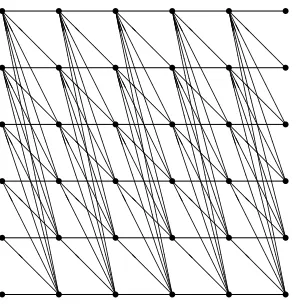
The new letter 2 will represent the operation of “forward” complementation, that is, ifαj = 2, then two vertices vi,j ∈Vj and vk,j+1 ∈ Vj+1 with i < k are adjacent inPα if
and only if they are not adjacent inP. In other words, this operation adds edges between
vi,j and vk,j+1 with i < k. The bipartite graph induced by two consecutive columns
corresponding to the letter 2 is known in the literature as achain graph.
Of special interest for the topic of this paper is the word 2∞= 222. . .. The class G2∞
is also known as the class of bipartite permutation graphs and this is one of the first two minimal classes of graphs of unbounded clique-width discovered in the literature [8]. We will denote by
Xn,n the subgraph ofP2 ∞
induced bynconsecutive columns and and anynrows. Figure 2 represents an example of the graph Xn,n with n= 6.
The unboundedness of clique-width in the class G2∞ follows from the following result
proved in [1].
Lemma 7. The clique-width of Xn,n is at least n/6.
In what follows, we will prove that that every class Gα with infinitely many 2s in α
has unbounded clique-width by showing that graphs in this class containXn,nas a vertex
minor for arbitrarily large values ofn. We start with the case when the letter 1 appears finitely many times inα.
Lemma 8. Let α be an infinite word over the alphabet {0,1,2}, containing the letter 2
infinitely many times and the letter1finitely many times. Then the classGαhas unbounded
r r r r r r
r r r r r r
r r r r r r
r r r r r r
r r r r r r
r r r r r r
[image:11.612.241.389.75.228.2]@ @ @ A A A A A A B B B B B B B B B C C C C C C C C C C C C D D D D D D D D D D D D D DD @ @ @ A A A A A A B B B B B B B B B C C C C C C C C C C C C D D D D D D D D D D D D D DD @ @ @ A A A A A A B B B B B B B B B C C C C C C C C C C C C D D D D D D D D D D D D D DD @ @ @ A A A A A A B B B B B B B B B C C C C C C C C C C C C D D D D D D D D D D D D D DD @ @ @ A A A A A A B B B B B B B B B C C C C C C C C C C C C D D D D D D D D D D D D D DD @ @ @ A A A A A A B B B B B B B B B C C C C C C C C C C C C @ @ @ A A A A A A B B B B B B B B B C C C C C C C C C C C C @ @ @ A A A A A A B B B B B B B B B C C C C C C C C C C C C @ @ @ A A A A A A B B B B B B B B B C C C C C C C C C C C C @ @ @ A A A A A A B B B B B B B B B C C C C C C C C C C C C @ @ @ A A A A A A B B B B B B B B B @ @ @ A A A A A A B B B B B B B B B @ @ @ A A A A A A B B B B B B B B B @ @ @ A A A A A A B B B B B B B B B @ @ @ A A A A A A B B B B B B B B B @ @ @ A A A A A A @ @ @ A A A A A A @ @ @ A A A A A A @ @ @ A A A A A A @ @ @ A A A A A A @ @ @ @ @ @ @ @ @ @ @ @ @ @ @
Figure 2: The graph X6,6
Proof. First fix a constantn. Letβ be a factor ofαcontaining preciselyninstances of the letter 2, starting and ending with the letter 2 and containing no instances of the letter 1 (since letter 2 appears infinitely many times and letter 1 finitely many times inα, we can always find such a factor). We denote the length ofβ by` and consider the subgraphGn
of Pα induced by `+ 1 consecutive columns corresponding to β and by any n2n−1 rows. We will now show thatGncontains the graph Xn,n as a vertex-minor.
Using arguments identical to those in Theorem 2, we can show that any instance of 00 can be replaced by 0 with the help of local complementations and vertex deletions.
Now each instance of 0 is surrounded by 2s in β. Consider any factor 02 of β and let Vj, Vj+1, Vj+2 be three columns such that Vj ∪Vj+1 induces a 1-regular graph and
Vj+1∪Vj+1 induces a chain graph. If we apply a local complementation to each vertex
ofVj+1 in turn, it is easy to see that the edges between Vj and Vj+2 form a chain graph.
Looking at the vertices in the columnVj+2 we see that for any two verticesx andy, when
a local complementation is applied atz∈Vj+1the edge betweenxandyis complemented
if and only if bothx and y are adjacent toz. Therefore,x and y are adjacent if and only if min{|N(x)∩Vj+1|,|N(y)∩Vj+1|} is odd. Hence the vertices of Vj+2 in the even rows
induce an independent set. So, applying a local complementation to each vertex ofVj+1
in turn and then deleting columnVj+1together with the odd rows allows us to reduce the
factor 02 to 2. This transformation also reduces the number of rows two times. Since the factor 02 can appear at most n−1 times, in at most n−1 transformations we reduced
Gn to a graph containing Xn,n. Therefore, Gncontains Xn,n as a vertex minor.
Sincencan be arbitrarily large, we conclude with the help of Lemma 7 that graphs in
Gα can have arbitrarily large clique-width.
To extend the last lemma to a more general result, we again refer to [11], which introduces another useful transformation, calledpivoting. For a graphGand an edge xy, the graph obtained by pivotingxy is defined to be the graph obtained by applying local complementation atx, then at yand then at xagain. Oum shows in [11] that in the case of bipartite graphs pivotingxyis identical to complementing the edges betweenN(x)\ {y}
Lemma 9. Let α be an infinite word over the alphabet {0,1,2}, containing the letter 2
infinitely many times. Then the class Gα has unbounded clique-width.
Proof. First, fix a constantn. Let β be a factor ofα containing precisely ninstances of the letter 2, starting and ending with the letter 2. LetGnbe the subgraph ofPα induced
by the columns corresponding toβ and by any n2n+n2 rows. To prove the lemma, it is enough to show thatGn contains eitherFn,n orXn,n as a vertex minor.
Consider any two consecutive appearances of 2 inβand denote the word between them byγ. In other words,γ is a (possibly empty) word in the alphabet{0,1}. Ifγ contains at leastn instances of 1, then by Lemma 2 Gn containsFn,n as a vertex minor. Therefore,
we assume that the number of 1s in γ is at most n−1. If γ contains no instance of 1, then we apply the idea of Lemma 8 to reduce it to the empty word. Ifγ contains at least one instance of 1, we apply the idea of Lemma 2 to eliminate all 0s from it.
Suppose that after this transformation γ contains at least two 1s, that is, β contains 211 as a factor. LetVj, Vj+1, Vj+2andVj+3 be the four columns such thatVj+1∪Vj+2 and
Vj+2∪Vj+3 induce bipartite complements of 1-regular graph andVj∪Vj+1induces a chain
graph. Letx be the vertex in the first row of columnVj+1 and y be the vertex in the last
row of columnVj+2. It is not difficult to see that if we pivot the edge xy and delete the
first and the last row, then the graphs induced byVj+1∪Vj+2 and byVj+2∪Vj+3 become
a 1-regular. In other words, we transform the factor 211 into 200. Then we apply the idea of Lemma 2 to further transform it into 2.
Repeated applications of the above transformation allows us to assume thatγ contains exactly one 1, that is,β contains 212 as a factor. Let Vj, Vj+1, Vj+2 and Vj+3 be the four
columns such thatVj∪Vj+1 andVj+2∪Vj+3 induce chain graphs andVj+1∪Vj+2induces
the bipartite complement of a 1-regular graph. Let x be the vertex in the first row of column Vj+1 and y be the vertex in the last row of column Vj+2. It is not difficult to
see that if we pivot the edge xy and delete the first and the last row, then the graph induced byVj+1∪Vj+2 becomes 1-regular, while the graphs induced by Vj∪Vj+1 and by
Vj+2∪Vj+3 remain chain graphs. In other words, we transform the factor 212 into 202.
Then we apply the idea of Lemma 8 to further transform it into 22.
The above procedure applied at most n−1 times allows us to transform β into the word of n consecutive 2s. In terms of graphs, Gn transforms into a sequence of n chain
graphs. Moreover, it is not difficult to see that if initiallyGncontainsn2n+n2 rows, then
the resulting graph has at leastnrows, that is, it contains Xn,n as a vertex minor.
5
Conclusion and open problems
In the preceding sections, we have described a new family of hereditary classes of graphs of unbounded clique-width. For many of them, we proved the minimality. Our results allow us to make the following conclusion.
Theorem 2. There exist infinitely many minimal hereditary classes of graphs of un-bounded clique-width and linear clique-width.
Ifn < m, thenGα(n) andGα(m) do not coincide, sinceGα(n) contains an inducedC2(n+2), whileGα(m) does not (which is not difficult to see). Therefore,Gα(1),Gα(2), . . .is an infinite sequence of minimal hereditary classes of graphs of unbounded clique-width and linear clique-width.
A full description of minimal classes of the form Gα remains an open question. To propose a conjecture addressing this question, we first define the notion of almost periodic word. An infinite wordαisalmost periodicif for each factorβ ofαthere exists a constant
`(β) such that every factor of α of length at least `(β) containsβ as a factor.
Conjecture 1. Let α be an infinite word over the alphabet {0,1,2}. Then the class Gα
is a minimal hereditary class of unbounded clique-width if and only ifα is almost periodic and contains at least one1 or 2.
Note that almost periodicity implies that either 1 or 2 appears in α infinitely many times. It is not hard to verify that this condition is necessary for the class Gα to have
unbounded clique-width. In other words, if α contains finitely many 1s and 2s the class
Gα has bounded clique-width.
We conclude the paper by discussing an intriguing relationship between clique-width in a hereditary class X and the existence of infinite antichains in X with respect to the induced subgraph relation. In particular, the following question was asked in [6]: is it true that if the clique-width in X is unbounded, then it necessarily contains an infinite antichain? Recently, this question was answered negatively in [9]. However, in the case of so-calledcolouredinduced subgraphs, the question remains open.
Coloured induced subgraphs. We define this notion for two colours, which is the simplest case where the above question is open. Assume we deal with graphs whose vertices are coloured by two colours, say white and black. We say that a graphH is a coloured induced subgraphofGif there is an embedding ofH intoGthat respects the colours. With this strengthening of the induced subgraph relation, some graphs that are comparable without colours may become incomparable if equipped with colours. Consider, for instance, two chordless paths Pk and Pn. Without colours,
one of them is an induced subgraph of the other. Now imagine that we colour the endpoints of both paths black and the remaining vertices white. Then clearly they become incomparable with respect to the coloured induced subgraph relation (if k 6= n). Therefore, the set of all paths coloured in this way create an infinite coloured antichain. Let us denote it by A0.
In [6], it was conjectured that hereditary classes of graphs of unbounded clique-width necessarily contain infinite coloured antichains. We believe this is true. Moreover, we propose the following strengthening of the conjecture from [6].
Conjecture 2. Every minimal hereditary class of graphs of unbounded clique-width con-tains a canonical infinite coloured antichain.
The notion of a canonical antichain was introduced by Guoli Ding in [7] and can be defined for hereditary classes as follows. An infinite antichain A in a hereditary class X
has no infinite antichains. In other words, speaking informally, an antichain is canonical if it is unique in the class.
To support Conjecture 2, let us observe that it is valid for all minimal classes Gα
described in Theorem 1. Indeed, all of them contain arbitrarily large chordless paths and hence all of them contain the infinite coloured antichainA0 defined above. Moreover, this
antichain is canonical, because by forbidding all paths of length greater thank for some fixed k, we are left with subgraphs of Pα occupying at most k consecutive columns, in
which case the clique-width of such graphs is at most 4k by Lemma 5.
There exist many other infinite coloured antichains, but all available examples are obtained from the antichainA0 by various transformations. We believe that any infinite
coloured antichain can be transformed from A0 in a certain way and that any minimal
hereditary class of unbounded clique-width can be transformed from Pα (for some α) in
a similar way. Describing the set of these transformations is a challenging research task.
References
[1] A. Brandst¨adt and V.V. Lozin, On the linear structure and clique-width of bipartite permutation graphs,Ars Combinatoria, 67 (2003) 273–281.
[2] R. Brignall, N. Korpelainen, V. Vatter, Linear Clique-Width for Hereditary Classes of Cographs,J. Graph Theory, accepted (DOI: 10.1002/jgt.22037).
[3] B. Courcelle, J. Engelfriet and G. Rozenberg, Handle-rewriting hypergraph grammars,
Journal of Computer and System Sciences 46 (1993) 218–270.
[4] B. Courcelle, J.A. Makowsky and U. Rotics, Linear time solvable optimization prob-lems on graphs of bounded clique-width,Theory Comput. Syst. 33 (2000) 125–150. [5] B. Courcelle and S. Olariu, Upper bounds to the clique-width of a graph, Discrete
Applied Math.101 (2000) 77–114.
[6] J. Daligault, M. Rao and S. Thomass´e, Well-Quasi-Order of Relabel Functions,Order
27 (2010) 301–315.
[7] G. Ding, On canonical antichains,Discrete Mathematics 309 (2009) 1123-–1134. [8] V.V. Lozin, Minimal classes of graphs of unbounded clique-width,Annals of
Combi-natorics, 15 (2011) 707–722.
[9] V. Lozin, I. Razgon, V. Zamaraev, Well-quasi-ordering does not imply bounded clique-width, Lecture Notes in Computer Science, 9224 (2016) 351–359.
[10] S. Oum, P. Seymour, Approximating clique-width and branch-width,Journal of Com-binatorial Theory, Series B, 96 (4) (2006) 514-528
[11] S. Oum, Rank-width and vertex-minors,Journal of Combinatorial Theory, Series B, 95 (1) (2005) 79-100