warwick.ac.uk/lib-publications
Manuscript version: Author’s Accepted Manuscript
The version presented in WRAP is the author’s accepted manuscript and may differ from the
published version or Version of Record.
Persistent WRAP URL:
http://wrap.warwick.ac.uk/111420
How to cite:
Please refer to published version for the most recent bibliographic citation information.
If a published version is known of, the repository item page linked to above, will contain
details on accessing it.
Copyright and reuse:
The Warwick Research Archive Portal (WRAP) makes this work by researchers of the
University of Warwick available open access under the following conditions.
© 2018 Elsevier. Licensed under the Creative Commons
Attribution-NonCommercial-NoDerivatives 4.0 International
http://creativecommons.org/licenses/by-nc-nd/4.0/.
Publisher’s statement:
Please refer to the repository item page, publisher’s statement section, for further
information.
Hidden Topic-Emotion Transition Model for
Multi-Level Social Emotion Detection
Donglei Tanga, Zhikai Zhangb, Yulan Hec, Chao Linb, Deyu Zhoub,∗
aSchool of Mathematics and Statistics, Nanjing Audit University, Nanjing, China bSchool of Computer Science and Engineering, Key Laboratory of Computer Network and
Information Integration, Southeast University, Nanjing, China cDepartment of Computer Science, University of Warwick, UK
Abstract
With the fast development of online social platforms, social emotion detection, focusing on predicting readers’ emotions evoked by news articles, has been in-tensively investigated. Considering emotions as latent variables, various prob-abilistic graphical models have been proposed for emotion detection. However, the bag-of-words assumption prohibits those models from capturing the inter-relations between sentences in a document. Moreover, existing models can only detect emotions at either the document-level or the sentence-level. In this paper, we propose an effective Bayesian model, called hidden Topic-Emotion Transition model, by assuming that words in the same sentence share the same emotion and topic and modelling the emotions and topics in successive sentences as a Markov chain. By doing so, not only the document-level emotion but also the sentence-level emotion can be detected simultaneously. Experimental results on the two public corpora show that the proposed model outperforms state-of-the-art approaches on both document-level and sentence-level emotion detection. Keywords: Social Emotion Detection, Sentiment Analysis, Topic Model, Hidden Topic-Emotion Transition Model
1. Introduction
With the fast development of social web, more and more users tend to share their opinions about social events, post discussions of political movements and express their preferences over products and services on online platforms [1, 2]. Some news portals, for example, the Sina news, allows readers to vote for their emotions after reading a news article. Essentially, each news article could be
∗Corresponding author.
Email addresses: [email protected](Donglei Tang),[email protected](Zhikai Zhang),[email protected](Yulan He),[email protected](Chao Lin),
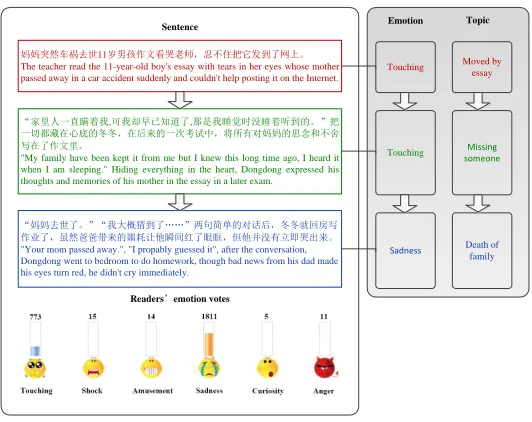
associated with multiple emotions of its readers over a predefined set of emo-tion categories. An example of a news article with the readers’ emoemo-tion votes is shown in Figure 1. Here, the readers’ emotion votes form the document-level e-motion labels which are observed. We assume that such document-level ee-motion labels can be inferred from the unobserved sentence-level topics and emotions. In Figure 1, we manually annotate the sentence-level topics and emotions and display them against a shaded background to denote that they are unobserved.
Emotion
Sentence Topic
妈妈突然车祸去世11岁男孩作文看哭老师,忍不住把它发到了网上。
The teacher read the 11-year-old boy's essay with tears in her eyes whose mother passed away in a car accident suddenly and couldn't help posting it on the Internet.
Touching
“家里人一直瞒着我,可我却早已知道了,那是我睡觉时没睡着听到的。”把 一切都藏在心底的冬冬,在后来的一次考试中,将所有对妈妈的思念和不舍 写在了作文里。
"My family have been kept it from me but I knew this long time ago, I heard it when I am sleeping." Hiding everything in the heart, Dongdong expressed his thoughts and memories of his mother in the essay in a later exam.
“妈妈去世了。”“我大概猜到了……”两句简单的对话后,冬冬就回房写 作业了,虽然爸爸带来的噩耗让他瞬间红了眼眶,但他并没有立即哭出来。
"Your mom passed away.", "I propably guessed it", after the conversation, Dongdong went to bedroom to do homework, though bad news from his dad made his eyes turn red, he didn't cry immediately.
Readers’emotion votes
Touching
Sadness
Moved by essay
Missing someone
[image:3.612.173.439.221.432.2]Death of family
Figure 1: Excerpt of a news article from Sina and its corresponding reader votes over prede-fined emotion classes. Sentence-level topics and emotions in the left shaded pane are manually annotated and unobserved.
and coherent groups of sentences describing the detailed information of the even-t. As can be seen in Figure 1 that (1) one sentence typically only describes a single event/topic; (2) the event or topic directly triggers reader’s emotions; (3) successive sentences tend to share the same emotion or topic.
Based on the above observations, we propose a novel probabilistic graphi-cal model, graphi-called hidden Topic-Emotion Transition (TET) model to model the emotion and topic transitions simultaneously. In specific, TET considers each sentence as a basic unit and all the words in the same sentence are assumed to share the same topic label and the same emotion label. The topic transi-tion and emotransi-tion transitransi-tion in successive sentences are modelled via a hidden Markov model and learned from data, in a way avoiding the document-level bag-of-words assumption. By doing that, TET can detect both the document-level and the sentence-document-level emotions though it only requires data with the document-level emotion labels for training. We conduct experiments on the two public corpora, a news dataset and a blog dataset. Experimental results show that TET outperforms several state-of-the-art approaches for both document-level and sentence-document-level emotion detection and also detects underlying topics which evoke the corresponding emotions.
2. Related Work
Our work is related to two lines of research: social emotion detection and topic models for emotion/sentiment analysis [11].
2.1. Social Emotion Detection
Approaches for social emotion detection can be mainly divided into two categories: discriminative-model based and topic-model based.
For the first category, social emotion detection is often casted as a classifi-cation problem. If only choosing the strongest emotion as the label for a given text, emotion detection is essentially a single-label classification problem. Lin et al. [12] studied the classification of news articles into different categories based on readers’ emotions with various combinations of feature sets. Strapparava and Mihalcea [13] proposed several knowledge-based and corpus-based methods for emotion classification. Quan et al. [6] proposed a logistic regression model with emotion dependency for emotion detection. Latent variables were introduced to model the latent structure of input text. Li et al. [14] combined biterm top-ic model and conventional neural network to detect single social emotion from short texts. Li et al. [15] incorporated domain-specific and universal knowledge into a unified sentiment classification framework to build a domain-adaptive sen-timent classification model. Label propagation was employed to unify universal and domain-specific sentiment lexicons.
with intensities using non-negative matrix factorization with several novel con-straints such as topic correlation and emotion bindings. To predict multiple emotions with different intensities in a single sentence, Zhou et al. [18] proposed a novel approach based on emotion distribution learning. In the same vein, a relevant label ranking framework for emotion detection is proposed for predict multiple relevant emotions as well as the ranking of emotional intensity [19, 20]. A KNN-like approach called social opinion mining model (SOMM) was proposed in [7] where word embeddings were used to calculate word mover’s distance of all the documents via solving an optimizing problem. The average emotion distribution of the k nearest neighbors of a test document was then used for emotion prediction.
As for aspect-level sentiment classification, it can be seen as a fine-grained task in emotion detection. Wang et al.[21] employed an attention-based long short-term memory network for aspect-level sentiment classification. It can con-centrate on different parts of a sentence when different aspects are considered as input. As word embedding has been proven to be a useful model for senti-ment analysis and emotion detection, Li et al. [22] incorporated prior sentisenti-ment information into the embedding process to investigate the influence each word has on the sentiment label of both target word and context words. It can learn better representations for sentiment analysis.
However, discriminative-model based approaches are unable to detect and incorporate latent topic information to understand how the emotions are evoked. To address this problem, topic-model based approaches have been largely ap-plied for social emotion detection [8, 9]. For example, the Emotion-Topic Model (ETM) [23] or the Sentiment Latent Topic Model (SLTM) [8] are similar to the Joint Sentiment-Topic (JST) model [24] in which an additional emotion or sentiment layer is inserted between the topic layer and the observed words in LDA so as to detect emotion- or polarity-bearing topics. Contextual Sentiment Topic Model (CSTM) [9] assumes each word is either drawn from a background theme, a contextual theme or a topic. Emotion classification is based on context-independent topics.
Our proposed approach belongs to the second category. However, while most existing topic model approaches are based on the bag-of-words assumption, our TET model takes the sentence sequential information into consideration and models the topic/emotion transitions explicitly which is crucial for social emotion detection.
2.2. Topic Models for Emotion/Sentiment Analysis
Emotion detection, classifying text into one or more emotion categories such as ‘Happy’, ‘Sad’ and ‘Surprise’, is closely related to sentiment analysis which typically classifying text into one of the three polarity categories, ‘Positive’, ‘Negative’ or ‘Neutral’. As such, we review topic modeling approaches to emo-tion or sentiment detecemo-tion here.
the background model or topical themes where the latter are further catego-rized into three sub categories, i.e., neutral, positive and negative sentiment models. The Joint Sentiment-Topic (JST) [24] inserted an additional sentimen-t layer insentimen-to LDA for polarisentimen-ty-bearing sentimen-topic desentimen-tecsentimen-tion. Aspecsentimen-t and sensentimen-timensentimen-t unification model (ASUM) [27] extended JST by enforcing words in a single sentence to share the same topic and sentiment label. Emotion-Topic Model (ETM) [23] first generated a set of latent topics from emotions, followed by generating affective terms from each topic. Contextual Sentiment Topic Model (CSTM) [9] distinguished context-independent topics from both a background theme, which characterizes non-discriminative information, and a contextual theme, which characterizes context-dependent information across different col-lections. Two models have been proposed in [8]. One is Multi-Label Supervised Topic Model (MSTM), which generated a set of topics from words firstly, fol-lowed by sampling emotions from each topic. The other is Sentiment Latent Topic Model (SLTM), which generated topics from social emotions directly.
However, these models make the bag-of-words assumption and ignore word ordering. To address this problem, some approaches have explicitly consid-ered the order of words and the structure of sentences for topic generation. For example, [28] assumed that words are either generated from the syntactic classes which are drawn from the previous syntactic class or from topics that are drawn randomly. To model topic transition, Hidden Topic Markov Model (HTMM) [29] modelled the topics of words in a document as a Markov chain and assumed that topic transitions can only occur between sentences. In a sim-ilar vein, structural topic model [30] assumed that words in a sentence share the same topic. Hidden Topic Sentiment Model (HTSM) [31] extended HTMM and models the combination of aspect and sentiment label of sentences as a Markov chain. It assumed that words within a sentence share the same aspect label and sentiment label and constrained the transitions with the assumption that only one sentiment polarity can be associated with a specific aspect in a document.
Our proposed TET model is partly inspired by HTSM, but differs from HTSM in several aspects: (1) HTSM only considers binary sentiment polar-ities and models the sentiment transitions simply by a switch variable, while TET models multi-class emotion transitions and takes emotion correlations in-to consideration; (2) Different from the assumption of HTSM that one in-topic in a document can only be associated with one polarity, in TET, one topic can be associated with different emotions in a document since the same topic might evoke different emotions of different readers. (3) HTSM utilizes the predefined aspects and is trained on documents annotated with aspect labels, while no such information is available in our data.
3. Methodology
hidden Markov model, essentially avoiding the bag-of-words assumption at the document-level.
3.1. Hidden Topic-Emotion Transition Model
Assuming that we have a set of documents denoted asD={d1, d2, ..., d|D|},
where each documentdconsists ofmdsentences denoted asS={s1, s2, ..., smd},
and each word in the sentences is an item from a vocabulary withV distinct terms denoted as{1,2, ..., V}. LetE be the number of distinct emotion labels, and an emotion label is denoted ase∈ {1,2, ..., E}. Also,T is the total number of topics and a topic label is denoted ast∈ {1,2, ..., T}. For a given document
d, its document-specific topic-emotion proportion θd is assumed to be drawn from a shared Dirichlet distribution, i.e.,θd∼Dir(α). Each sentencesi indhas
Nsi words and is associated with an emotion labelei and a topic labelti, which
is sequentially drawn from a document-specific Markov chain. As the topic and emotion labels of sentences are unobservable, we introduce a latent variableψ
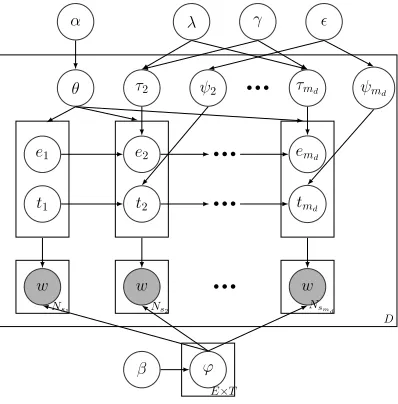
to control the topic transition and τ to control the emotion transition. The plate diagram of TET is given in Figure 2. In what follows, we will describe how topic and emotion transitions are modelled before presenting the overall generative process for TET.
α
θ
e1 e2 • • • emd
t1 t2 • • • tmd
w w • • • w
• • •
Ns1 Ns2 Nsmd
ϕ
E×T
β
D
τ2 ψ2 τmd ψmd
[image:7.612.205.404.365.567.2]λ γ
Figure 2: Graphical model for the proposed hidden Topic-Emotion Transition (TET) model.
3.1.1. Topic Transition
two successive sentences are less likely to share similar topics if their contents are very different. Therefore, it is reasonable to assume that the more similar two sentences are in terms of their content, the less likely there will be a topic transition between them. Several linguistic features in the adjacent sentences are employed to guide the topic transition. The probability of the switch variable
ψi is defined as follows:
p(ψi|si, si−1, si+1, ) =
1 1 + exp(−Tft(si, si
−1, si+1))
, (1)
whereis the feature weights andft(si, si−1, si+1) is the topic transition feature function which takes the current sentencesi, the previous sentencesi−1and the next sentence si+1 as input and outputs a feature vector. It includes: (1) content-based cosine similarity between si and si−1; (2) sentence length ratio of si to si−1; (3) the relative position of si in d; (4) the content-based cosine similarity difference between (si, si−1) and (si, si+1). The first three features are inspired by [31], while the last one assumes that there is no topic transition from the previous sentence to the current sentence if the current sentence is more similar to the previous sentence than the next one.
3.1.2. Emotion Transition
Assuming that an emotion lexicon consisting of words with their correspond-ing emotion distributions is available, i.e., each word is associated with multiple emotion labels with different intensities. We useES(w, e) to denote the emotion score of a wordwassociated with emotione. We will show later in this section how to generate the emotion lexicon from the training data.
As some emotions co-occur more often that the others, we believe that such information would be useful for the derivation of emotion transitions. The Pear-son coefficient between two emotionsej andek, denoted as λej,ek is calculated
from the training set in the following way: First, each emotionejis represented as a vectorEVjwithDdimensions whereD is the number of documents in the training set and each element of the vector, EVj[i], is the number of votes for emotion ej in the ith document. Then, the Pearson coefficients between two emotionsej andek is calculated as:
λej,ek =
cov(EVj, EVk)
σEVjσEVk
. (2)
where cov(·) denotes the covariance and σ denotes standard derivation. The value of Pearson coefficient ranges from −1 to 1, with a value of 1 indicating positive correlation and−1 indicating negative correlation. A value of 0 shows that the two emotions are independent from each other. We convert the Pearson coefficient values to the range of [0,1] using λej ,ek2 +1 so that they can be used as the probabilities measuring how strongly two emotionsej andek are related to each other.
After defining ES(w, e) and λej,ek, we can construct τi, the E×E emotion
transition from ej to ek for si. The transition probability from ej to ek in sentence si is determined by their Pearson coefficient weighted by the sum of the normalized emotion scores ofej in si−1 and ek in si, which is defined as follows:
p(τi,ej,ek|si, si−1, λ, γ)∝
λej,ek+ 1
2 ×(
Nsi−1
X
p=1
ES(wp, ej)
Nsi−1
+
Nsi
X
q=1
ES(wq, ek)
Nsi
) +γ
(3) A smoothing parameterγ= 0.001 is incorporated to avoid zero probabilities.
3.1.3. Generative Process
Based on the ψi and τi,ej,ek defined above, the topic-emotion transition
probability is designed in the following ways: (1) Ifψi = 0 and j =k, there is no change in either topic or emotion label for si; (2) If ψi = 1 and j = k, the emotion label forsi remains the same, but a new topic will be drawn under the same emotion label from θd. Therefore, ti 6= ti−1 and ei = ei−1; (3) If
ψi = 1 and j 6= k, a new topic label and a new emotion label will be drawn fromθd. As we expect that if the topic label stays the same, the emotion label would also stay the same, there is no definition forψi= 0 andj6=k. Therefore, the transition probabilityp(ei, ti|τi,ei−1,ei, ψi, ei−1, ti−1, θ, si−1, si, , λ, γ) can be
formally specified as,
p(ψi= 0)p(τi,ei−1,ei), ifei=ei−1,ti=ti−1,i≥2
p(ψi= 1)p(τi,ei−1,ei)θei,ti, ifei=ei−1,ti6=ti−1,i≥2 p(ψi= 1)p(τi,ei−1,ei)θei,ti, ifei6=ei−1,ti6=ti−1,i≥2
θei,ti, ifi= 1
0, otherwise (4)
The overall generative process for TET is presented below:
• For each possible topic and emotion label combination (e, t), drawϕe,t∼Dir(β).
• For each documentd∈D,
– Draw topic-emotion proportionθd∼Dir(α).
– For each sentencesi∈d,
∗ Ifi= 1, setψi= 1.
∗ Else
· Calculate topic transition probability p(ψi|si, si−1, si+1, ).
· Calculate emotion transition matrixp(τi,ej,ek|si, si−1, λ, γ) ,
1≤j, k≤E.
∗ Perform block sampling (ei, ti) by (ei, ti)∼
3.2. Parameter Estimation
In TET, the parameters can be estimated efficiently using the Expectation Maximization (EM) algorithm. As TET can be seen as a special type of HMM, the customized forward-backward algorithm and Viterbi algorithm in E-step of each iteration to accumulate the sufficient statistics and then update parameters in M-step are employed.
The latent variables in TET are the emotion label assignments e, the topic label assignmentst, the emotion transition indicatorτ and the topic transition indicator ψ. The combinations of (ei, ti, ψi, τi) at sentence si is considered as hidden states in our Markov chain of documentd.
The parameters of TET needed to be updated iteratively are θ, ϕ and . The hyper-parameters αand β are set empirically and λ is pre-calculated in-corporating the emotion correlations. Let CDd,e,t denote the total number of words in dassociated with emotion label e and topic labelt which are drawn
from θd, CWw,e,t denote the number of times that word w is associated with
the emotion labeletogether with the topic labelt.
In E-step, the forward-backward algorithm along with Viterbi algorithm is executed and the following sufficient statistics are accumulated.
E[CDd,e,t] =
md
X
i=1
p(ei=e, ti=t, ψi = 1|d)Nsi (5)
E[CWw,e,t] =
|D|
X
d=1
md
X
i=1
Nsi
X
j=1
δ(wj =w)p(ei=e, ti=t|d) (6)
E[ψi] =p(ψi= 1|d), s.t. i≥2 (7)
In M-step, the parametersθ,ϕandare updated as follows,
θd,e,t∝E[CDd,e,t] +α (8)
ϕe,t,w∝E[CWw,e,t] +β (9)
= arg max
|D|
X
d
md
X
i=1
E[ψi]logp(ψi= 1|d, )
+ (1−E[ψi])log (1−p(ψi= 1|d, )),
(10)
where is updated by optimizing a cross-entropy loss function via a gradient-based optimizer.
3.3. Emotion Lexicon Generation from the Training Data
One is based on an existing emotion lexicon, cev, provided in the Chinese emotional vocabulary ontology library1. It contains seven top-level emotion cat-egories including “happy”,“good”,“angry”, “sad”, “fear”, “disgust” and “ sur-prise”. As the emotion categories incevare not exactly the same as the emotion labels annotated in our data, they are aligned manually. Moreover, to accom-modate uncertainties in emotion alignment, each term in cevis assigned with the score of 0.9 for its corresponding emotion category incevand the remaining 0.1 is equally spread among all the other emotions categories. Emotion lexicon constructed in this way is referred to aslex cev.
The other way is to construct the emotion lexicon from the training data, which is inspired by the lexicon generation method [32]. The emotion lexicon is represented as the term-by-emotion matrix. It can be derived by matrix multi-plication between the term-by-document matrix and the document-by-emotion matrix, which can be easily constructed from the training data. For example, each document’s emotion labels in the training data corresponds to one row of the document-by-emotion matrix. As there are many ways of representing document such as raw frequencies, normalized frequencies, and term frequency-inverse document frequency (TF-IDF), three different emotion lexicons denoted
bylex f,lex nfandlex tfidfare constructed respectively.
4. Experiments
4.1. Setup
To evaluate the performance of the proposed approach for social emotion detection, we conduct experiments on the News Dataset 2016 (ND16) [7], which was collected from the social channel of Sina between January and December of 2016, consisting of 5,258 news documents with 6 reader emotions (i.e.,Touching, Anger, Amusement, Sadness, Shock and Curiosity). The statistics are shown in Table 1. Following the same setup as in [7], the first 3,109 documents in chronological order are used for training and the rest 2,149 are for testing. Pre-processing is conducted on ND16 by first splitting each document into sentences through sentence boundary detection, then removing stop words, numbers, per-son names, punctuations and words appeared in less than 3 documents.
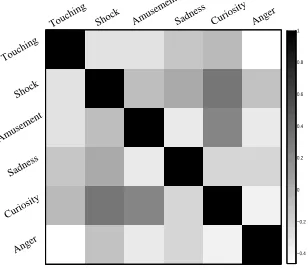
As mentioned before,λej,ekis calculated based on Pearson correlation
coeffi-cient of emotions in the training set describing the degree of correlation between two emotion, which is shown in Figure 3. Dark color indicates that two emotions are positively correlated, e.g., Shock and Curiosity, while light color indicates that two emotions are negatively correlated, e.g.,AngerandTouching. It is clear that the results are in line with our intuition, which justifies the incorporation of such information into our model.
Our TET model can output both document-level and sentence-level emo-tion labels. ND16 only contains news articles annotated with document-level
Table 1: Statistics of the News Dataset 2016 (ND16).
Emotion label # of documents # of votes
Train Test Train Test
Touching 464 365 313,998 175,022
Anger 1077 831 835,644 583,826
Amusement 977 533 613,334 313,455
Sadness 393 293 331,450 230,035
Shock 123 93 292,523 160,670
Curiosity 75 33 133,995 66,682
−0.4 −0.2 0 0.2 0.4 0.6 0.8 1 Touching Shock AmusementSadness Curiosity Anger
Touching
Shock
Amusement
Sadness
Curiosity
Anger
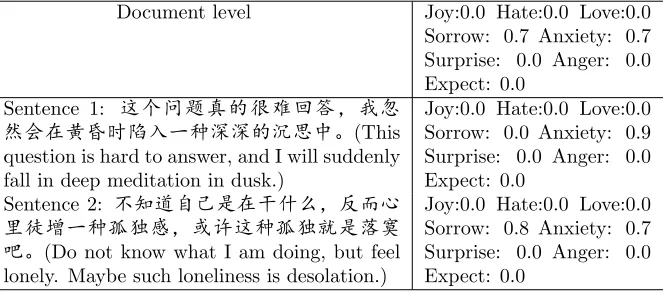
[image:12.612.229.383.452.587.2]emotions from readers’ perspective. It is thus infeasible to use it to evaluate the accuracy of the sentence-level emotion detection of TET. Therefore, we use another corpus, RenCECps [33], which contains both the document-level and sentence-level emotion annotations. An example of an excerpt of a blog with its emotion annotations is presented in Table 2. It is worth mentioning that for both ND16 and RenCECps, only the document-level emotion annotations are used for training TET. The sentence-level emotion annotations of RenCECps are only used for performance evaluation of sentence-level emotion detection on the test set.
Table 2: An example of a part of one blog with its emotion annotation.
Document level Joy:0.0 Hate:0.0 Love:0.0
Sorrow: 0.7 Anxiety: 0.7 Surprise: 0.0 Anger: 0.0 Expect: 0.0
Sentence 1: ù‡¯Ký éJ£‰§· ,¬3‘³ž€\˜« œg¥"(This question is hard to answer, and I will suddenly fall in deep meditation in dusk.)
Joy:0.0 Hate:0.0 Love:0.0 Sorrow: 0.0 Anxiety: 0.9 Surprise: 0.0 Anger: 0.0 Expect: 0.0
Sentence 2: Ø• gC´3ZŸo§‡ %
päO˜« Õa§½Nù« ÕÒ´á( j"(Do not know what I am doing, but feel lonely. Maybe such loneliness is desolation.)
Joy:0.0 Hate:0.0 Love:0.0 Sorrow: 0.8 Anxiety: 0.7 Surprise: 0.0 Anger: 0.0 Expect: 0.0
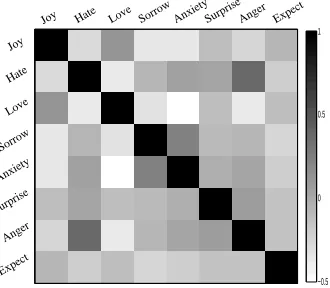
The RenCECps corpus contains 1,487 blog documents with 35,381 sentences. Each sentence is annotated with 8 basic emotions (i.e.,Joy, Hate, Love, Sorrow, Anxiety, Surprise, Anger andExpectation), together with their emotion inten-sities as shown in Table 2. The statistics of RenCECps are presented in Table 3. The first 1,187 documents consisting of 27,528 sentences by chronological order are used for training and the rest 300 documents consisting of 7853 sentences are for testing. The emotion correlations in RenCECps are shown in Figure 4, which indicatesHateandAnger is highly positively related, and thatLove and Anxiety is highly negatively related.
4.2. Baselines and Evaluation Metrics
−0.5 0 0.5 1 Joy Hate Love Sorrow AnxietySurpriseAnger Expect Joy
Hate
Love
Sorrow
Anxiety
Surprise
Anger
[image:14.612.224.389.126.270.2]Expect
Figure 4: Gray-scale image of emotion correlations in RenCECps.
Table 3: Statistics of RenCECps.
Emotion label number of documents number of sentences
Train Test Train Test
Joy 275 26 5766 899
Hate 110 0 2237 118
Love 345 108 6506 2636
Sorrow 145 91 4188 1754
Anxiety 121 44 4731 1918
Surprise 4 0 468 60
Anger 34 1 989 133
Expectation 153 30 2643 335
constraints such as emotion bindings and topic correlations for emotion detec-tion from social media. The input features are generated using the tradidetec-tional TF-IDF features or long short term memory (LSTM) network. Neural network based approaches include CNN [3, 4], CNN-SVM [5] and LSTM with atten-tion [35]. The CNN uses CNN directly while CNN-SVM uses CNN to construct features first and then trains Support Vector Machine (SVM) based on the CNN-extracted features for emotion classification. LSTM with attention employs two kinds of attention mechanisms on top of word embeddings.
[image:14.612.164.445.315.442.2]set of topics from words firstly, followed by sampling emotions from each topic. SLTM generates topics from social emotions directly. ATM is a multi-labeled topic model which is homologous to JST in generative process.
Two evaluation metrics are employed: accuracy at the top one prediction
Acc@1 and averaged Pearson correlation coefficient over all documentsAP. For a documentdin the test setD, given the top one predicted emotioned
p, the top
one ground truth emotionedg,Accd@1 is defined as:
Accd@1 =
(
1, if edpp =edg
0, otherwise (11)
Acc@1 can then be calculated by averagingAccd@1 over all documents. For a documentdin the test setD, given the predicted emotion distribution
rd
p and the ground truth emotion distributionrdg,AP is defined as
AP = 1
|D| |D|
X
d=1
cov(rd p, rgd) σrd
pσrgd
, (12)
where cov is the covariance andσis the standard deviation.
4.3. Results
The overall performance of the proposed approach and the baselines on ND16 is shown in Table 4. For TET, the number of topics is set to 10 and the emotion lexicon lex nf is used. For the baseline results reported here, the results of ConstraintOp and LSTM with attention were obtained by running the author published source code on our data.p JST and ASUM results were generated based our adaptation of the published source code since both models were not for social emotion detection originally. For TET, JST and ASUM, the hyperpa-rameter values,α= 0.01, β = 0.001, γ = 0.001, were set empirically. JST and ASUM also used the same emotion lexicon as in TET for the incorporation of word prior emotion information. The results of other baselines are cited from [7] since we used the same dataset and the same experimental setup here.
It can be observed that TET outperforms all the other approaches on both
Table 4: Overall performance of the proposed approach and the baselines on ND16.
Category Approach Acc@1(%) AP
Discriminativ
e Word-level model ET 48.04 0.43
SWAT 38.97 0.40
Neural network based
CNN-SVM 52.63
-CNN 51.23
-LSTM with attention 21.29
-Optimization based
ConstraintOp using TF-IDF features 28.21 0.21 ConstraintOp using LSTM features 24.81 0.31
SOMM 58.59 0.64
T
opic-mo
d
el
based
JST 58.33 0.63
ETM 54.19 0.49
ASUM 43.16 0.39
CSTM 40.74 0.43
MSTM 32.17 0.34
ATM 29.20 0.28
SLTM 28.95 0.26
Ours TET 61.83 0.66
dose not model the topic/emotion transitions directly. Instead, our proposed TET encodes topic/emotion transitions into the generative process of the topic model and thus achieves the best results overall.
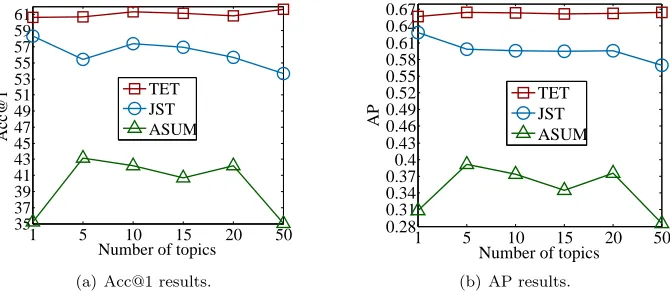
To further investigate the performance of TET in comparison with JST and ASUM, experiments are conducted on ND16 using the same lexiconlex nfwith difference topic number settings. Figure 5 shows the performance of TET, JST and ASUM under topic numbers in [1,5,10,15,20,50]. It can be observed that TET achieves better performance compared to JST and ASUM regardless of the topic number setting. It can also be observed that the performance of TET under different topic numbers is relatively stable while the results of JST and ASUM fluctuate greatly.
1 5 10 15 20 50 35 37 39 41 43 45 47 49 51 53 55 57 59 61
Number of topics
Acc@1
TET JST ASUM
(a) Acc@1 results.
1 5 10 15 20 50 0.28 0.31 0.34 0.370.4 0.43 0.46 0.49 0.52 0.55 0.58 0.61 0.64 0.67
Number of topics
AP
TET JST ASUM
(b) AP results.
[image:16.612.141.476.485.633.2]4.3.1. Impact of Emotion Lexicon and Topic Number
We also investigate the performance of TET with different emotion lexicons and different topic numbers. Figure 6 shows the performance of TET on ND16 using different lexicons, such as,lex nf,lex f, lex tfidfand lex cevunder the topic number in [1,5,10,15,20,50].
1 5 10 15 20 50 42
44 46 48 50 52 54 56 58 60 62
Number of topics
Acc@1
lex_nf lex_f lex_tfidf lex_cev
(a) Acc@1 results.
1 5 10 15 20 50 0.4
0.42 0.44 0.46 0.480.5 0.52 0.54 0.56 0.58 0.6 0.62 0.64 0.66 0.68
Number of topics
AP lex_nf
lex_f lex_tfidf lex_cev
[image:17.612.142.470.204.341.2](b) AP results.
Figure 6: Performance of TET on ND16 using different emotion lexicons under different number of topics.
It can be observed that using the generated emotion lexicons from the train-ing data, such as lex nf, lex f and lex tfidf, TET achieves significantly better results compared tolex cev. The worst results usinglex cevmight be attributed to the indirect mapping of emotion categories and the differences of the data corpora used. As there is no no one-to-one correspondence between the emotion categories in the emotion lexicon,cev, and the readers’ emotions in ND16, manual alignment of emotion categories might introduce some noises. Moreover, the data from whichcevwas derived and the social emotion dataset we used here are different. Therefore, it is more effective to automatically gen-erate an emotion lexicon from our data directly. It can also be observed that the number of topics has less impact on the performance of TET although overall the best Acc@1 and AP results are obtained when the number of topics is set to 50.
4.3.2. Extracted topics
show the triggering events associated with certain social emotions.
Table 5: An example of topics extracted by TET under different emotions on ND16 dataset.
Touching Anger Amusement
Topic 1 Topic 2 Topic 1 Topic 2 Topic 1 Topic 2 š (hospital) P“(teacher) v¦<(suspect) /c(metro) ç¦(lottery) †Â(live broadcasting) š)(doctor) Æ)(student) ‹‚(commit crimes) À•(truck) [•(parents) ² (platform)
Ãâ(surgery) Í<(rescue) y|(scene) ~¬(villager) ì¡(photo) ä(network) ì((organ) •Ï(help) Y‡(case) ¦•(passenger) ù•(red packet) ÌÂ(anchor) ì¡(photo) ÆS(learn) úSÛ(public security bureau) { (court) *l(friend) úi(company) %9(heart) y|(scene) ´(call the police) y|(scene) &E(message) å¯(girl) ‡ö(patient) (run) Ѥ(police station) iÅ(driver) ¥øö(winner) ®j(fan) íz(donate) „Â]•(samaritan) rr(rape) k (die) ø7(bonus) Ѥ(police station) £ (therapy) O%(love) 8¼(arrest) w<(defendant) Õ1(bank) åÌÂ(camgirl)
)·(life) Š~(village) ´(traffic police) •„(carriage) óŠ< (staff) Õ(website)
Sadness Shock Curiosity
Topic 1 Topic 2 Topic 1 Topic 2 Topic 1 Topic 2
™N(dead body) y|(scene) ~¬(villager) Ãâ(surgery) S (Spring Festival Gala) ~(fish) a¢(jump from a building) >F(elevator) › (boa) š)(doctor) ̱<(host) Œ~(big fish) r”(get lost) ¯u(incident) ÄÔ(animal) ž9(breast implant) ò(smiling face) •¬(fisherman)
O(love) «(community) ;[(specialist) š (hospital) ²((star) ™7(Phoebe zhennan) U•(like) k (die) ›(boa) 9Ü(breast) ̱(preside over) Ó¼(catch) F"(hope) Í (rescue) Ã<«(depopulated zone) 5 (injection) *¯(audience) ~¬(villager)
(doggie) »/(fire) o(protect) Þ(ophicephalous) À(CCTV) š)(doctor)
”l(missing) ËA(hotel) (snake) JÈ(jelly) ü(monkey) ¿Ú(crow)
P[(hometown) Ѥ(police station) M(turtle) ;¥(basketball) áN(stereoscopic) o(protect) y|(scene) (run) äÚ(on foot) \<Œ(Canada) S!(Spring Festival) 7l~(tuna)
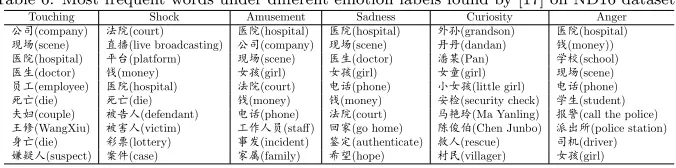
For comparison purpose, we also show the most frequent words under each emotion found by [17] in Table 6. Compared to the topics extracted by TET, they are less meaningful. For example, under the “Anger” emotion, there are words such as hospital, school and driver. It is not obvious to find the relation-ship between the topic and the emotion, therefore can not really explain why the “Anger” emotion is evoked. On the contrary, words in the topics extracted by TET make it more easier to understand which events evoke the corresponding emotion.
Table 6: Most frequent words under different emotion labels found by [17] on ND16 dataset.
Touching Shock Amusement Sadness Curiosity Anger
úi(company) { (court) š (hospital) š (hospital) š(grandson) š (hospital) y|(scene) †Â(live broadcasting) úi(company) y|(scene) ûû(dandan) a(money))
š (hospital) ² (platform) y|(scene) š)(doctor) ,(Pan) Æ (school)
š)(doctor) a(money) å¯(girl) å¯(girl) åÖ(girl) y|(scene)
ó(employee) š (hospital) { (court) >{(phone) å¯(little girl) >{(phone)
k (die) k (die) a(money) a(money) Su(security check) Æ)(student) ÅO(couple) w<(defendant) >{(phone) { (court) êý (Ma Yanling) ´(call the police)
?(WangXiu) ³<(victim) óŠ< (staff) £[(go home) •dË(Chen Junbo) Ѥ(police station) (die) ç¦(lottery) ¯u(incident) •½(authenticate) Í<(rescue) iÅ(driver) v¦<(suspect) Y‡(case) [á(family) F"(hope) ~¬(villager) å¯(girl)
To further evaluate the effectiveness of emotion and topic transitions cap-tured by TET, an example of a news article with the predicted topic-emotion transition results and its ground truth readers’ emotion votes are shown in Fig-ure 7. It can be observed that not only the document-level emotions but also the sentence-level emotions can be detected simultaneously by the proposed TET with high accuracy.
4.4. Sentence-Level Emotion Classification
[image:18.612.137.475.425.509.2]15 154 45 50 9 533
Touching Shock Amusement Sadness Curiosity Anger 0.0206
0.1031 0.0928 0.1546
0.0206 0.6082
Touching Shock Amusement Sadness Curiosity Anger
probability
Shock
Sad
Angry
Sentence
难道他是凶手?很快,鉴定报告确定了这个答案。
Is he a perpetrator?Soon, the identification report identifies this answer.
伤者身中10余刀,刀伤造成其心脏破裂、右颈外静脉破 裂,最终,其经抢救无效死亡 。
There were more than ten knives in the injured body. The knife wound caused the heart to rupture and the right external jugular vein to rupture. Eventually, it died after being rescued.
仅一个多小时的时间,两个年轻人的人生就被彻底改 变。
Just over one hour, the lives of two young man had been completely changed.
Emotion Topic
Accidental offence
The wounded died
Life destruction
[image:19.612.177.439.128.344.2]Ground truth Predicted results
Figure 7: An example of a news article from Sina, its corresponding readers votes over prede-fined emotion classes, predicted document level and sentence level emotions.
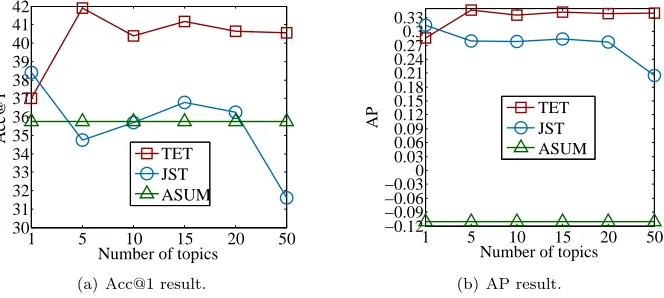
JST and ASUM under different number of topics are shown in Figure 8. The emotion lexicon used is lex nf. Moreover, we also conducted an experiment using LSTM with attention [35]. It adopts LSTM networks augmented with attention mechanisms for short-text emotion detection. The results of LSTM with attention were achieved by running the author published source code on our data set.
Table 7: Performance comparison on RenCECps.
Model Acc@1 AP
JST 38.404 0.3138
ASUM 35.741 -0.1112
TET 41.908 0.3463
LSTM with attention 43.072
[image:19.612.210.404.485.555.2]per-formances of all the approaches on RenCECps are worse than those on ND16, except LSTM with attention. It is perhaps not surprising since sentenclevel e-motion classification is performed on sentences with limited content information. On the contrary, document-level emotion classification operates on the whole document and thus likely gives higher performance compared to classification on the finer-grained sentence level.
1 5 10 15 20 50 30
31 32 33 34 35 36 37 38 39 40 41 42
Number of topics
Acc@1
TET JST ASUM
(a) Acc@1 result.
1 5 10 15 20 50 −0.12
−0.09 −0.06 −0.030 0.03 0.06 0.09 0.12 0.15 0.18 0.21 0.24 0.270.3 0.33
Number of topics
AP TETJST
ASUM
[image:20.612.142.474.213.362.2](b) AP result.
Figure 8: Performance comparison between TET, JST and ASUM with different number of topics on RenCECps.
5. Conclusions
In this paper, we have proposed the Topic-Emotion Transition (TET) model which models the transition of emotions and topics of successive sentences as a Markov chain. In TET, we used linguistic features of sentences to guide topic transition. Emotion correlations calculated from emotion lexicons automatically constructed from data is employed to guide emotion transitions. A customized forward-backward algorithm along with a Viterbi algorithm are used for infer-ence and parameter estimation. Experiments show that our model outperforms the state-of-the-art methods in both document-level and sentence-level emotion classification.
Acknowledgments
References
[1] X. Li, H. Xie, L. Chen, J. Wang, X. Deng, News impact on stock price return via sentiment analysis, Knowledge-Based Systems 69 (2014) 14 – 23.
[2] D. Zhou, T. Gao, Y. He, Jointly event extraction and visualization on twitter via probabilistic modelling, in: Proceedings of the 54th Annual Meeting of the Association for Computational Linguistics, ACL, 2016, pp. 269–278.
[3] Y. Kim, Convolutional neural networks for sentence classification, in: Pro-ceedings of the 2014 Conference on Empirical Methods in Natural Language Processing, pp. 1746–1751.
[4] S. Poria, E. Cambria, A. Gelbukh, Deep convolutional neural network tex-tual features and multiple kernel learning for utterance-level multimodal sentiment analysis, in: Proceedings of the 2015 Conference on Empirical Methods in Natural Language Processing, 2015, pp. 2539–2544.
[5] S. Poria, E. Cambria, D. Hazarika, P. Vij, A deeper look into sarcas-tic tweets using deep convolutional neural networks, in: Proceedings of the 26th International Conference on Computational Linguistics, 2016, pp. 1601–1612.
[6] X. Quan, Q. Wang, Y. Zhang, L. Si, L. Wenyin, Latent discriminative mod-els for social emotion detection with emotional dependency, ACM Trans-actions on Information Systems 34 (2) (2015) 1–19.
[7] X. Li, Q. Peng, Z. Sun, L. Chai, Y. Wang, Predicting social emotions from readers’ perspective, IEEE Transactions on Affective Computing.
[8] Y. Rao, Q. Li, X. Mao, L. Wenyin, Sentiment topic models for social emo-tion mining, Informaemo-tion Sciences 266 (2014) 90–100.
[9] Y. Rao, Contextual sentiment topic model for adaptive social emotion clas-sification, IEEE Intelligent Systems 31 (1) (2016) 41–47.
[10] D. M. Blei, A. Y. Ng, M. I. Jordan, Latent dirichlet allocation, Journal of Machine Learning Research 3 (Jan) (2003) 993–1022.
[11] E. Cambria, Affective computing and sentiment analysis, IEEE Intelligent Systems 31 (2) (2016) 102–107.
[13] C. Strapparava, R. Mihalcea, Learning to identify emotions in text, in: Proceedings of the 2008 ACM symposium on Applied computing, 2008, pp. 1556–1560.
[14] X. Li, J. Pang, B. Mo, Y. Rao, Hybrid neural networks for social emo-tion detecemo-tion over short text, in: Proceedings of the Internaemo-tional Joint Conference on Neural Networks, 2016, pp. 537–544.
[15] Y. Li, H. Guo, Q. Zhang, J. Gu Mingyunand Yang, Imbalanced tex-t sentex-timentex-t classificatex-tion using universal and domain-specific knowledge, Knowledge-Based Systems 160 (2018) 1–15.
[16] P. K. Bhowmick, Reader perspective emotion analysis in text through en-semble based multi-label classification framework, Computer and Informa-tion Science 2 (4) (2009) 64–74.
[17] Y. Wang, A. Pal, Detecting emotions in social media: A constrained op-timization approach, in: Proceedings of the Twenty-Fourth International Joint Conference on Artificial Intelligence, 2015, pp. 996–1002.
[18] D. Zhou, X. Zhang, Y. Zhou, Q. Zhao, X. Geng, Emotion distribution learning from texts, in: Proceedings of the 2016 Conference on Empirical Methods in Natural Language Processing, EMNLP, 2016, pp. 638–647. [19] D. Zhou, Y. Yang, Y. He, Relevant emotion ranking from text constrained
with emotion relationships, in: Proceedings of the 2018 Conference of the North American Chapter of the Association for Computational Linguistics: Human Language Technologies NAACL-HLT, 2018, pp. 561–571.
[20] Y. Yang, D. Zhou, Y. He, An interpretable neural network with topical information for relevant emotion ranking, in: Proceedings of the 2018 Con-ference on Empirical Methods in Natural Language Processing, 2018, pp. 3423–3432.
[21] Y. Wang, M. Huang, X. Zhu, L. Zhao, Attention-based lstm for aspect-level sentiment classification, in: Proceedings of the 2017 Conference on Empirical Methods in Natural Language Processing, 2017, pp. 606–615. [22] Y. Li, Q. Pan, T. Yang, S. Wang, J. Tang, E. Cambria, Learning word
representations for sentiment analysis, Cognitive Computation (6) (2017) 1–9.
[23] S. Bao, S. Xu, L. Zhang, R. Yan, Z. Su, D. Han, Y. Yu, Joint emotion-topic modeling for social affective text mining, in: Proceedings of the Ninth IEEE International Conference on Data Mining, 2009, pp. 699–704. [24] C. Lin, Y. He, Joint sentiment/topic model for sentiment analysis, in:
[25] L. Zhu, Y. He, D. Zhou, Hierarchical viewpoint discovery from tweets using bayesian modelling, Expert Systems with Applications 116 (2019) 430–438. [26] Q. Mei, X. Ling, M. Wondra, H. Su, C. Zhai, Topic sentiment mixture: modeling facets and opinions in weblogs, in: Proceedings of the 16th inter-national conference on World Wide Web, 2007, pp. 171–180.
[27] Y. Jo, A. H. Oh, Aspect and sentiment unification model for online review analysis, in: Proceedings of the fourth ACM international conference on Web search and data mining, 2011, pp. 815–824.
[28] T. L. Griffiths, M. Steyvers, D. M. Blei, J. B. Tenenbaum, Integrating topics and syntax, in: Advances in Neural Information Processing Systems 17, 2005, pp. 537–544.
[29] A. Gruber, Y. Weiss, M. Rosen-Zvi, Hidden topic markov models, in: Pro-ceedings of the Eleventh International Conference on Artificial Intelligence and Statistics, 2007, pp. 163–170.
[30] H. Wang, D. Zhang, C. Zhai, Structural topic model for latent topical structure analysis, in: Proceedings of the 49th Annual Meeting of the As-sociation for Computational Linguistics: Human Language Technologies-Volume 1, 2011, pp. 1526–1535.
[31] M. M. Rahman, H. Wang, Hidden topic sentiment model, in: Proceedings of the 25th International Conference on World Wide Web, 2016, pp. 155– 165.
[32] J. Staiano, M. Guerini, Depechemood: a lexicon for emotion analysis from crowd-annotated news, in: Proceedings of the 52nd Annual Meeting of the Association for Computational Linguistics, 2014, pp. 427–433.
[33] C. Quan, F. Ren, A blog emotion corpus for emotional expression analysis in chinese, Computer Speech & Language 24 (4) (2010) 726–749.
[34] P. Katz, M. Singleton, R. Wicentowski, Swat-mp: the semeval-2007 systems for task 5 and task 14, in: Proceedings of the International Workshop on Semantic Evaluations, 2007, pp. 308–313.
[35] C. Baziotis, N. Pelekis, C. Doulkeridis, Datastories at semeval-2017 task 4: Deep lstm with attention for message-level and topic-based sentiment analysis, in: Proceedings of the International Workshop on Semantic Eval-uation, 2017, pp. 747–754.