U.S. CORE INFLATION: A WAVELET
ANALYSIS
K
EVIND
OWDCass Business School
J
OHNC
OTTERUniversity College Dublin
L
IXIAL
OHSheffield Hallam University
This paper proposes the use of wavelet methods to estimate U.S. core inflation. It explains wavelet methods and suggests that they are ideally suited to this task. Comparisons are made with traditional Consumer Price Index–based and regression-based measures for their performance in following trend inflation and predicting future inflation. Results suggest that wavelet-based measures perform better, and sometimes much better, than the traditional approaches. These results suggest that wavelet methods are a promising avenue for future research on core inflation.
Keywords:Core Inflation, Wavelets, Trend Inflation, Inflation Prediction
1. INTRODUCTION
Monetary economists have long understood that some measures of inflation are more important, or more revealing, than others, and the distinction between head-line inflation and underlying, or core, inflation has been recognized for many years. However, interest in core inflation took off only in the 1990s.1As inflation
targeting became more widespread, central bankers became more concerned to find the “right” inflation rate to target, or to use as a monetary policy indicator; and as inflation fell, disentangling inflation signals from inflation noise became more crit-ical to successful monetary policy decision-making: to paraphrase Blinder (1997, p. 158), when inflation is high, the central bank knows it has to lower inflation, regardless of how it is measured; but when inflation is low, different measures of inflation can suggest different monetary policy decisions, and correctly extracting the inflation signals becomes critical.
The literature on core inflation suggests two alternative definitions of the term. Some authors define core inflation as an inflation measure that represents
The authors thank Tim Cogley, Ramo Genc¸ay, Julie K. Smith, Theo Panagiotidis, and two anonymous referees for helpful comments on an earlier draft. They also thank Julie Smith for permission to use her data. Cotter acknowledges the support of Science Foundation Ireland under Grant Number 08/SRC/FM1389. Address correspondence to: Kevin Dowd, Pensions Institute, Cass Business School, 106 Bunhill Row, London EC1Y 8TZ, United Kingdom; e-mail: [email protected].
c
underlying or trend inflation [e.g., Bryan et al. (1997); Cecchetti (1997)], whereas others define core inflation as a leading indicator of future inflation [e.g., Blinder (1997); Smith (2004)]. In practice, we would often like a core inflation measure that is compatible with both definitions—that is, is a good representation of underlying trend inflation and is a good indicator of future inflation. Thus we analyze two performance criteria (and separate associated test methodologies) to determine whether the candidate core inflation measures are able to match the alternative definitions of core inflation (i.e., in terms of tracking a trend and predicting future inflation).2
We can also think of core inflation as follows. We start with a given original or “parent” inflation series, whose “core” we are seeking. We can then regard core inflation as some series that is closely related to the parent series, but that also satisfies certain desirable properties such as capturing the trend and predicting the parent series.
Much of the literature on core inflation in the United States has taken the parent inflation rate to be the Consumer Price Index (CPI) and examined measures of core inflation derived directly from the components that make up the aggregate CPI.3 The most widely used such measure is “CPI less food and energy”—
inflation measured on the basis of a reconstructed CPI that gives food and energy components a zero weight. There are also related measures—inflations based on “CPI less energy,” “CPI less food,” the median CPI, and various “trimmed mean” CPIs. The use of “CPI less x” measures of core inflation is sometimes justified on the ground that the excluded terms (supposedly) have more noise than the included terms, and the median and trimmed mean measures can be justified on robust statistics and other grounds [see, e.g., Bryan et al. (1997)]. Core inflation measures are also sometimes obtained using regression-based methods, which can be regarded as producing optimal measures of core inflation given assumptions about the trend itself and the noise around it. These methods include moving averages, exponential (and other) smoothing methods, and time series (Box–Jenkins) methods.
shocks, and similar times-series behavior, such as we see in many inflation rate series. Wavelet methods are therefore ideal for signal extraction problems such as the measurement of core inflation.4
This paper is laid out as follows. Section 2 briefly reviews some of the existing literature on core inflation in the United States. Section 3 introduces wavelet methods. Section 4 explains their suitability for estimating core inflation and shows how they can be applied to this purpose. Section 5 explains the data, and Section 6 presents our results. Section 7 concludes.
2. EXISTING MEASURES OF CORE INFLATION
2.1. CPI-Based Measures of Core Inflation
Many common measures of U.S. core inflation are derived from the CPI as the parent inflation series. Perhaps the most widely used such measure is CPI inflation less food and energy—the CPI inflation rate constructed with zero weights attached to the food and energy components—which has long been used as a measure of core inflation in the United States. This measure is often motivated informally by the assertion—valid or otherwise—that food and energy are subject to a lot of high-frequency variation (e.g., due to weather and seasonality) that injects noise into CPI inflation signals. It is argued that cutting out these components eliminates this noise and so gives a better indicator of underlying (i.e., core) inflation. We can also cut out these components individually to give two different core inflation measures—CPI less energy and CPI less food—that can be motivated on similar grounds, and we can cut out other components as well. These measures have the advantages that they are easily understood, timely, and not subject to revision. However, the choice of excluded components is arbitrary, such measures fail to address relative price shocks within included components, and the excluded components may not be more volatile than included ones.5
banks may not wish to use the median as a measure of core inflation on the ground that the median is not well understood by the public [Roger (1998); ´Alvarez and Llanos (1999)].
Closely related are the trimmed mean measures.6 These are the means of the
ordered weighted component-inflation rates, with the upper and lower tails ex-cluded. For example, the 9% trimmed mean is the mean constructed from the ordered weighted component-inflation rates, with the bottom 9% and top 9% of changes excluded. The use of these measures can also be justified by robust statistics theory and/or economic menu-cost arguments, and they too do not re-quire arbitrary decisions on what components should be included or excluded.7
However, trimmed measures arguably suffer from problems similar to those of the median.
2.2. Regression-Based Measures of Core Inflation
Regression methods provide a rather different approach to core inflation measure-ment. If we define core inflation in terms of a trend, then the estimation of core inflation requires estimation of a trend and—provided we feel comfortable with the statistical assumptions involved—regression methods provide a straightfor-ward way to estimate this trend: we specify our underlying assumptions about the trend itself (e.g., whether it is linear, quadratic, etc.); we specify the nature of the departures from it, which can be regarded as the equation’s errors (e.g., these might be normal, autocorrelated, etc.); and we apply the appropriate re-gression method. These methods include simple moving averages of current and past inflation, time series methods such as Box–Jenkins ARMA and ARIMA methods,8and statistical smoothing methods, such as the exponentially smoothed
core inflation estimator recently proposed by Cogley (2002).9Regression-based
methods avoid the arbitrariness of including or excluding particular components, are easy to use, and can be applied in real time if we estimate regressions on a rolling basis. They also have the attraction that a suitable choice of regression method can provide us with an optimal trend—and hence an “optimal” core inflation measure—giventhe assumptions we make. However, their disadvantage is that we have no easy way to verify what these assumptions should actually be. In practice, we can rule out the more obviously na¨ıve assumptions (e.g., that core inflation is constant?) on a priori grounds or on the basis of suitable tests, but distinguishing between more plausible alternatives is difficult. In using such methods, we therefore end up having to make certain assumptions on faith, and the value of our results may be dependent on the validity of these untested assumptions.
3. WAVELET METHODS
analysis consists of taking a chosen waveform, the so-called mother wavelet, and breaking up a signal or series into shifted (in time) and scaled (i.e., compressed and extended) versions of the mother wavelet. Unlike classical wave analysis (i.e., Fourier analysis),10wavelet analysis does not require strong statistical assumptions
and can be applied to difficult signal processing problems such as the detection of underlying patterns or trends in nonstationary series, the removal of noise, and the identification of breakdown points and discontinuities. Wavelet analysis is a relatively recent development—most of the seminal work was done in the 1980s—but has proven to be immensely useful in many diverse areas, such as medicine, biology, oceanography, earth studies, and fingerprint analysis. Wavelets have also been used in a variety of economic and finance applications, such as the modeling of nonstationary processes [Ramsey and Zhang (1997)] and long-memory processes [Jensen (1999)], time-series decomposition [Ramsey and Lampart (1998)], forecasting [Stevenson (2001)], and scaling analysis [Genc¸ay et al. (2002)].11
Wavelet analysis is particularly promising for the estimation of core inflation for several reasons. First and most obviously, wavelet analysis is tailor-made for the denoising of (or signal extraction from) nonstationary time series, and these characteristics are ideal for core inflation analysis: the process of obtaining a core inflation rate is essentially a form of signal extraction, and inflation series are typically nonstationary. Hence, wavelet analysis has the advantages that it avoids strong statistical assumptions (unlike, say, regression-based estimates of core inflation) and has no problem handling the nonstationary behavior of inflation arising from shifts in monetary policy, oil price shocks, and the like.
0 0.5 1 -2
-1 0 1 2
Haar wavelet
Va
lu
e
Domain
-5 0 5
-0.5 0 0.5 1
Mexican hat wavelet
Va
lu
e
Domain
0 2 4 6
-1 0 1 2
Db4 wavelet
Va
lu
e
Domain
0 1 2 3
-2 -1 0 1 2
Sym2 wavelet
Va
lu
e
Domain
FIGURE1.Illustrative wavelets.
To apply wavelets, we first select a particular wavelet type, and there are many types to choose from; these have different properties and are useful for different applications.13 The simplest (and also first known) wavelet is the Haar wavelet, which is a straightforward step function. A second is the Mexican hat wavelet with its distinctive shape. Other popular wavelets are the family of Daubechies wavelets. These are distinguished from each other by their order number—Daubechies 1, Daubechies 2, and so on—and include the Haar wavelet as a special case when the order is 1. Similar to these are the symlets—symlet 1, symlet 2, etc.—which are nearly symmetrical relatives of the Daubechies family.
Some of these wavelet shapes are illustrated in Figure 1. This figure shows the discontinuous Haar or step-function wavelet, the unmistakable Mexican hat wavelet, a Daubechies 4 wavelet showing the asymmetry of this wavelet family, and a near-symmetrical Symlet 2 wavelet.
Feb 67 Feb 71 Feb 75 Feb 79 Feb 83 Feb 87 Feb 91 Feb 95 Feb 990 2
4 6 8 10 12 14
Month/year
A
n
n
u
al
iz
ed
i
n
fl
ati
o
n
,
%
Actual CPI
CPI less food and energy CPI less energy
CPI less food Median CPI 9% trimmed mean 18% trimmed mean
FIGURE 2. CPI-based measures of core inflation. Based on 409 monthly observations spanning February 1968 to January 2002.
highlights the small-scale, high-frequency components (or noise) of the original series. If we wish, we can then take the approximation series and filter it again: this gives us a level 2 approximation. We can repeat the process as often as we wish: filtering the level 2 approximation gives us a level 3 approximation, and so on. Each time we apply the filter (or increase the approximation level) we remove more of whatever high-frequency, small-scale components still exist in our approximation series, and so obtain a cleaner large-scale, low-frequency underlying pattern or trend. We can therefore think of the application of wavelets as involving both a choice of wavelet form and a choice of approximation level: decomposing the series once is a level-1 analysis, decomposing twice is a level-2 analysis, and so on.
Feb 67 Feb 71 Feb 75 Feb 79 Feb 83 Feb 87 Feb 91 Feb 95 Feb 990 2
4 6 8 10 12 14
Month/year
A
n
n
u
al
iz
ed
i
n
fl
ati
o
n
,
%
Actual CPI 37 month MA 19 month MA Cogley ES
FIGURE3.Regression-based measures of core inflation. Based on 409 monthly observations spanning February 1968 to January 2002.
4. USING WAVELETS TO ESTIMATE CORE INFLATION14
As we have already mentioned, wavelet analysis involves the application of suc-cessive approximations to remove more and more high-frequency detail, or noise, and so help reveal an underlying signal (or shape). However, if we apply too many approximations, we also remove parts of the signal itself. A balance therefore has to be struck so that we do not lose the signal along with the noise. This means that we need some guidelines to help draw a reasonable balance, and in this paper we make use of two particular sets of guidelines:
• Normality of details: There is a heuristic argument that we should stop approximating before the details have become normal. More precisely, if the details at leveliare normal, then theith-level approximation merely removed random noise, and this would indicate that theith-level approximation was unnecessary: that is, no more thani– 1 levels are needed.
Feb 67 Feb 71 Feb 75 Feb 79 Feb 83 Feb 87 Feb 91 Feb 95 Feb 99 -10
-5 0 5 10 15 20
Month/year
Annualized inflation, %
Actual CPI db10, level 4 sym5, level 5
FIGURE4.Smooth wavelet-based measures of core inflation.Based on 421 monthly obser-vations spanning February 1967 to January 2002.
These considerations suggest the following approach to the selection of plausi-ble wavelet-based measures of core inflation:
• We start with a reasonable universe of plausible wavelet types,15where the initial choice of plausible wavelets might be guided by the context we are working in: so, for example, if we are seeking a smooth core inflation series, we might restrict ourselves to wavelets that generate a smooth core inflation series, etc. For each type of wavelet, we consider a reasonable number of approximation levels.16
• For each wavelet type and approximation level considered, we estimate the Jarque–Bera (JB) probability values for the details estimated at that level of approximation, and we note those levels (if any) with reasonable probability values (e.g., higher than 1%). If we cannot find any levels with reasonable JB probability values, then we eliminate that wavelet from consideration.
Feb 67 Feb 71 Feb 75 Feb 79 Feb 83 Feb 87 Feb 91 Feb 95 Feb 99 -10
-5 0 5 10 15 20 25
Month/year
A
n
n
u
a
lize
d
in
fl
a
tio
n
, %
Actual CPI db2, level 3 db3, level 5
FIGURE5.Pointed wavelet-based measures of core inflation.Based on 421 monthly obser-vations spanning February 1967 to January 2002.
• We now eliminate all combinations of wavelet and approximation level that do not satisfy bothour JB probability value and our entropy-permissible criteria.
• We can cut down further by doing a casual inspection of our candidate core inflation series and eliminating those that look very similar to each other.18
The remaining series—in our case, just six—are our plausible core inflation series.19
5. DATA
Our parent inflation series is the year-on-year rate of change of seasonally ad-justed CPI (all items inclusive), observed at a monthly frequency, where the rate of change is computed based on the log difference between relevant price-index observations.20The choice of the CPI can be justified by its importance for
Feb 67 Feb 71 Feb 75 Feb 79 Feb 83 Feb 87 Feb 91 Feb 95 Feb 99 -10
-5 0 5 10 15 20
Month/year
A
n
n
u
a
liz
e
d
in
fl
a
ti
o
n
, %
Actual CPI haar, level 2 sym1, level 4
FIGURE6. Plateaued wavelet-based measures of core inflation. Based on 421 monthly observations spanning February 1967 to January 2002.
We use a long data period from February 1967 to January 2002 to make max-imum use of available data. The length of our data set is constrained on the one hand by the fact that some of our series only start in February 1967, and on the other hand by the fact that our trimmed mean series end in January 2002. This data set encompasses 421 monthly observations over an interesting period that encompasses significant shifts in monetary policy and the behavior of inflation.
6. EMPIRICAL RESULTS
We look at a variety of CPI-based, regression-based, and wavelet-based measures of core inflation.
• The CPI-based measures are (1) CPI inflation less food and energy, (2) CPI inflation less energy, (3) CPI inflation less food,22 (4) median CPI
inflation,23(5) 9% trimmed mean CPI inflation, and (6) 18% trimmed mean
CPI inflation.24
measure, with its single parameter set at 0.125/3 per month, in line with his recommended value of 0.125 per quarter;26and (10) an ARMA(1, 1) fitted to the parent CPI inflation rate.
• Using the selection approach outlined earlier, we ended up choosing the following six wavelets for further analysis: (11) a Daubechies 10 wavelet obtained at a level 4 approximation; (12) a symlet 5 wavelet at a level 5 approximation; (13) a Daubechies 2 wavelet at a level 3 approximation; (14) a Daubechies 3 wavelet at a level 5 approximation; (15) a Haar wavelet at a level 2 approximation; and (12) a symlet 1 wavelet at a level 2 approxima-tion. The first two, second two, and last two sets of wavelets provide good illustrations of smooth, pointed. and plateaued patterns, respectively, and were chosen for their illustrative properties without regard to their potential test performance.
6.1. Plots of Core Inflation
Before we carry out more formal comparisons, it is good practice to plot the various core inflation series and look for any outstanding features. Plots of our series are given in Figures 2–6. Figure 2 gives plots of the CPI-ex core inflation measures, Figure 3 gives plots of the regression-based measures and Figures 4–6 give plots of our chosen wavelets. In each case, we also plot the parent CPI inflation rate for comparison. We separate out the wavelet plots so that Figure 4 gives plots of the two smooth wavelet measures, Figure 5 gives plots of the pointed wavelet measures, and Figure 6 gives plots of the plateaued wavelet measures. A comparison of these figures indicates some striking differences between different core inflation series.
6.2. Evaluation Criteria
The performance of core inflation measures can be evaluated using a number of criteria. As outlined earlier, we have two performance criteria for our candidate measures, which are based on alternative definitions of core inflation: ability to track a trend and ability to predict future inflation.
Beginning with trend-based evaluation, we might expect a good core inflation series to have the same mean as its parent inflation series [see, e.g., Clark (2001, Table 2)]. Moreover, a good core inflation measure should also have a lower variance than its parent series, and this suggests that the core series should pass a test of the hypothesis that its variance is less than that of its parent series. A trend-based notion of core inflation should also lead us to expect that a core inflation series would exhibit fewer turning points than its parent series. In addition, we might expect a good measure of core inflation to be cointegrated with its parent inflation series [e.g., as in Freeman (1998) or Marques et al. (2000)], and we might also expect the difference between these two series to be stationary.
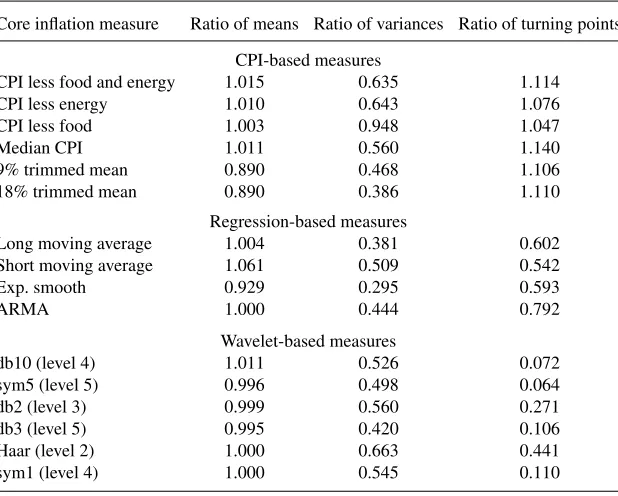
Core inflation measure Ratio of means Ratio of variances Ratio of turning points
CPI-based measures
CPI less food and energy 1.015 0.635 1.114
CPI less energy 1.010 0.643 1.076
CPI less food 1.003 0.948 1.047
Median CPI 1.011 0.560 1.140
9% trimmed mean 0.890 0.468 1.106
18% trimmed mean 0.890 0.386 1.110
Regression-based measures
Long moving average 1.004 0.381 0.602 Short moving average 1.061 0.509 0.542
Exp. smooth 0.929 0.295 0.593
ARMA 1.000 0.444 0.792
Wavelet-based measures
db10 (level 4) 1.011 0.526 0.072
sym5 (level 5) 0.996 0.498 0.064
db2 (level 3) 0.999 0.560 0.271
db3 (level 5) 0.995 0.420 0.106
Haar (level 2) 1.000 0.663 0.441
sym1 (level 4) 1.000 0.545 0.110
Notes: Ratio of means is mean core inflation divided by mean CPI inflation; ratio of variances is variance of core inflation divided by variance of CPI inflation; ratio of turning points is number of core inflation turning points divided by number of CPI inflation turning points. Based on 421 observations from 67:2 to 02:1.
difference between current core inflation and later actual inflation as an evaluation criterion: the lower the variance, the better the fit. We might also expect core inflation now and actual inflation later to be cointegrated, and the prediction error to be stationary.
We can also examine whether a candidate core inflation series passes a recent inflation-prediction test suggested by Cogley (2002). Ifπc
t is a measure of (inflation predicting) core inflation, then for any reasonable horizonH, the regression
πt+H −πt=α+β
πt−πtc
+ut+H (1)
should satisfy the predictionsα=0 andβ= −1. These restrictions reflect the ex-pectations that a good core inflation series should predict future changes in inflation by the right magnitude. So, for example, if the slope coefficient is less (greater) than one in an absolute sense, it suggests that the measure of core inflation is over-predicting (underover-predicting) the magnitude of subsequent changes in inflation. We would also expect the regression to exhibit a good overall fit (e.g., a highR2).
6.3. Results27
[image:13.432.62.371.81.329.2]TABLE 2. Test results for cointegration between core inflation and CPI inflation series
Prob-value of hypothesis of no cointegration
Core inflation No deterministic trend With deterministic trend
CPI-based measures
CPI less food and energy 0.000 0.000
CPI less energy 0.000 0.000
CPI less food 0.000 0.000
Median CPI 0.000 0.000
9% trimmed mean 0.000 0.000
18% trimmed mean 0.000 0.000
Regression-based measures
Long moving average 0.000 0.000
Short moving average 0.0001 0.000
Exp. smooth 0.0005 0.005
ARMA NA NA
Wavelet-based measures
db10 (level 4) 0.0001 0.0001
sym5 (level 5) 0.0001 0.000
db2 (level 3) 0.0001 0.0001
db3 (level 5) 0.000 0.000
Haar (level 2) 0.0001 0.0001
sym1 (level 4) 0.0001 0.000
Notes: Results are based on 415 observations over 67:7 to 02:1. Results are for the Johansen cointegration test and were obtained using Eviews 5. NA indicates that results were not available because of a near-singular matrix.
as the relevant core inflation parameters divided by their parent inflation counterparts.
• Means:Most series have mean ratios indicating that their means are close (or even identical) to those of the parent CPI series. The accuracy of the wavelet measures, in particular, is striking. The only series that perform poorly by this criterion are the trimmed mean, short MA, and exponentially smoothed measures. These are respectively 8.9%, 6.1%, and 7.1% away from their target of 1, whereas the other ratios are generally within 1% of the target ratio.
core inflation and CPI inflation series
Aug. Dickey–Fuller statistic
Core inflation No intercept With intercept
CPI-based measures
CPI less food and energy −11.616∗∗ −11.611∗∗ CPI less energy −18.789∗∗ −18.775∗∗ CPI less food −13.075∗∗ −13.059∗∗ Median CPI −17.047∗∗ −17.033∗∗ 9% trimmed mean −10.653∗∗ −16.194∗∗ 18% trimmed mean −10.423∗∗ −11.009∗∗
Regression-based measures
Long moving average −6.379∗∗ −6.372∗∗ Short moving average −9.532∗∗ −9.608∗∗ Exp. smooth −7.126∗∗ −7.211∗∗ ARMA −18.890∗∗ −18.867∗∗
Wavelet-based measures
db10 (level 4) −18.113∗∗ −18.091∗∗ sym5 (level 5) −16.611∗∗ −16.593∗∗ db2 (level 3) −12.788∗∗ −12.773∗∗ db3 (level 5) −14.287∗∗ −14.272∗∗ Haar (level 2) −14.489∗∗ −14.471∗∗ sym1 (level 4) −18.086∗∗ −18.065∗∗
Notes: Test statistic is distributed ast. Results are based on 419 observations over 67:3 to 02:1.
∗∗=significant at 1% level.
• Numbers of turning points:The CPI-based measures clearly perform badly by this criterion, as their turning point ratios all exceed 1. The regression-based measures perform better, with turning point ratios varying from 0.542 to 0.792, and the wavelet-based measures perform much better still, with ratios varying from 0.064 to 0.441.
These results indicate that CPI based measures tend to perform poorly across one or more criteria—the trimmed mean, short MA, and exponentially smoothed measures do badly by the mean criterion, CPI-less-food does badly by the variance criterion, and the CPI-ex measures all do badly by the turning point criterion. The performance of the regression-based measures is mixed, and that of the wavelet-based measures is fairly good.28
TABLE4.Variances of core inflation prediction errors
Core inflation Variance Ranking
CPI-based measures
CPI less food and energy 17.596 15
CPI less energy 16.011 14
CPI less food 19.422 16
Median CPI 15.303 12
9% trimmed mean 13.949 9
18% trimmed mean 13.103 6
Regression-based measures
Long moving average 14.622 11 Short moving average 15.811 13
Exp. smooth 13.298 7
ARMA 13.646 8
Wavelet-based measures
db10 (level 4) 12.675 4
sym5 (level 5) 12.156 2
db2 (level 3) 12.773 5
db3 (level 5) 11.034 1
Haar (level 2) 14.289 10
sym1 (level 4) 12.666 3
Notes: Results are based on 402 observations over 68:8 to 02:1, with an assumed forecast horizon ofH=18 months. The prediction error is the difference between core inflation and actual CPI inflation at a horizon 18 months ahead. Ranking is by variance: the lower the variance, the higher the ranking.
Results for tests of the stationarity of the difference between core and parent inflation series are presented in Table 3. For every series, the null hypothesis of a unit root is easily rejected: all series pass with flying colors. Thus, these first two tests give us no reason to prefer any one measure of core inflation to any others.
We now turn to the inflation-prediction tests, and Table 4 gives the variances of core inflation prediction errors applied to an 18-month forecast horizon.29 If
we rank them by their lowest-first variance rankings, the CPI-based measures have rankings varying from 6 to 16 (with most of them at or near the bottom), the regression-based measures have rankings of 7 to 13, and the wavelets have rankings from 1 to 10 for the Haar wavelet (and include the top five rankings). Note, too, that the performance of the wavelet measures improves even further if we exclude the rogue Haar wavelet: as Figure 1 shows, this is a fairly primitive wavelet anyway. Thus, a fairly clear pecking order emerges: the wavelets generally perform best by this criterion, and the CPI measures generally perform worst.
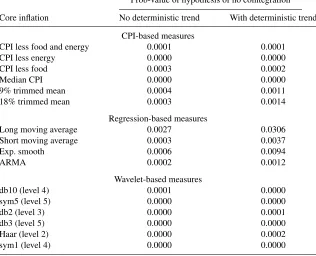
inflation series
Prob-value of hypothesis of no cointegration
Core inflation No deterministic trend With deterministic trend
CPI-based measures
CPI less food and energy 0.0001 0.0001
CPI less energy 0.0000 0.0000
CPI less food 0.0003 0.0002
Median CPI 0.0000 0.0000
9% trimmed mean 0.0004 0.0011
18% trimmed mean 0.0003 0.0014
Regression-based measures
Long moving average 0.0027 0.0306
Short moving average 0.0003 0.0037
Exp. smooth 0.0006 0.0094
ARMA 0.0002 0.0012
Wavelet-based measures
db10 (level 4) 0.0001 0.0000
sym5 (level 5) 0.0000 0.0000
db2 (level 3) 0.0000 0.0001
db3 (level 5) 0.0000 0.0000
Haar (level 2) 0.0000 0.0002
sym1 (level 4) 0.0000 0.0000
Notes: Results are based on 397 observations over 67:7 to 00:4 with an assumed horizon of 18 months. Results are for the Johansen cointegration test and were obtained using Eviews 5.
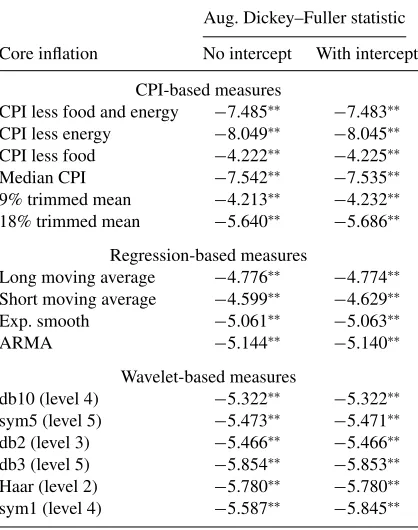
Results for tests of the stationarity of the core inflation prediction error are presented in Table 6 and indicate very clearly that the prediction errors are stationary.
Table 7 gives the prediction results based on estimates of (1). The table also reports the individual coefficients of the regression and their standard errors, and these can be used to carry outt-tests of the two predictions α=0 andβ= −1 separately considered, and to carry out anF-test of them jointly. We find that the CPI-based measures fail these tests, the regression-based measures give a mixed performance, and the wavelet-based measures (usually) perform well. The table also reports the different measures’R2 rankings. The CPI-based measures have
[image:17.432.57.373.102.358.2]TABLE6. Stationarity test results for core inflation prediction error
Aug. Dickey–Fuller statistic
Core inflation No intercept With intercept
CPI-based measures
CPI less food and energy −7.485∗∗ −7.483∗∗ CPI less energy −8.049∗∗ −8.045∗∗ CPI less food −4.222∗∗ −4.225∗∗ Median CPI −7.542∗∗ −7.535∗∗ 9% trimmed mean −4.213∗∗ −4.232∗∗ 18% trimmed mean −5.640∗∗ −5.686∗∗
Regression-based measures
Long moving average −4.776∗∗ −4.774∗∗ Short moving average −4.599∗∗ −4.629∗∗ Exp. smooth −5.061∗∗ −5.063∗∗ ARMA −5.144∗∗ −5.140∗∗
Wavelet-based measures
db10 (level 4) −5.322∗∗ −5.322∗∗ sym5 (level 5) −5.473∗∗ −5.471∗∗ db2 (level 3) −5.466∗∗ −5.466∗∗ db3 (level 5) −5.854∗∗ −5.853∗∗ Haar (level 2) −5.780∗∗ −5.780∗∗ sym1 (level 4) −5.587∗∗ −5.845∗∗
Notes: Results are based on 418 observations over 67:4 to 02:1 with an assumed forecast horizon ofH=18 months. The prediction error is the difference between core inflation and future actual CPI inflation.
If we take all these results together, we can also say something about the relative performance of individual series in each of these groups:
• CPI-based measures: There is not a great deal to choose from between CPI-less-x and median-CPI measures. Among the CPI-based measures, the trimmed mean measures perform worst in the ratio-of-means results in Table 1, but in contrast outperform the other CPI measures in the inflation-prediction results of Tables 4–7.
• Regression-based measures: There is also little to choose from between most of these measures, except to point out that the exponentially smoothed measure performs worst by the ratio-of-means results in Table 1 but best in the inflation-prediction results in Tables 4–7.
[image:18.432.112.321.95.360.2]Core inflation measure Intercept Slope F-test prob R2 R2ranking
CPI-based measures
CPI less food and energy −0.121 −0.519 0.000 0.352 14 (0.371) (0.064)
CPI less energy −0.106 −0.464 0.000 0.305 15 (0.338) (0.081)
CPI less food −0.099 −0.353 0.000 0.275 16 (0.375) (0.088)
median CPI −0.074 −0.685 0.000 0.393 13 (0.058) (0.069)
9% trimmed mean −0.393 −0.875 0.090 0.456 12 (0.362) (0.070)
18% trimmed mean 0.416 −0.887 0.084 0.483 11 (0.349) (0.065)
Regression-based measures
Long moving average −0.085 −0.872 0.057 0.537 6 (0.410) (0.053)
Short moving average −0.317 −0.890 0.102 0.527 8 (0.454) (0.055)
Exp. smooth 0.250 −0.898 0.130 0.545 4
(0.382) (0.054)
ARMA −0.075 −0.791 0.001 0.538 5
(0.389) (0.043) Wavelet-based measures
db10 (level 4) −0.101 −0.910 0.004 0.547 3 (0.371) (0.055)
sym5 (level 5) −0.082 −0.910 0.177 0.552 2 (0.354) (0.054)
db2 (level 3) −0.101 −0.900 0.184 0.512 9 (0.372) (0.055)
db3 (level 5) −0.088 −0.911 0.239 0.563 1 (0.317) (0.053)
Haar (level 2) −0.101 −0.808 0.246 0.486 10 (0.388) (0.058)
sym1 (level 4) −0.090 −0.897 0.250 0.534 7 (0.363) (0.056)
Notes: First numbers in second and third columns are estimated parameters; numbers in parentheses are their estimated standard errors. Results based on equation (1) with AR(1) errors, estimated using 401 observations over 67:3 to 00:7 for a horizon of 18 months. TheF-test is testing the restriction thatαH=0 andβH= −1.
measures of core inflation if we want a smooth core inflation series. It is also interesting to note that these two measures have especially low turning-point ratios—suggesting the not-unreasonable conclusion that a good measure of (trend) core inflation should have relatively few turning points.
7. CONCLUSIONS
This paper has suggested using wavelet methods to estimate core inflation. Wavelets are ideally suited to denoising nonstationary time series, and the problem of estimating core inflation is essentially one of denoising a badly behaved time series. An additional attraction of using wavelets for this purpose is that different wavelets lead to core inflation series of different shapes, so we can choose a wavelet that produces the shape we think most appropriate to the precise problem at hand, that is, one that addresses the question of why we want to measure core inflation in the first place. The paper explains how wavelets might be applied to this purpose, and sets out a wavelet selection procedure that will generate a core inflation series from some initial parent inflation series. The paper goes on to compare wavelet-based measures of core inflation against a number of existing measures, and results indicate that the wavelet-based measures generally do better, and often much better, than earlier core inflation measures.31The performance of
the wavelet measures is particularly impressive, and not least because the wavelets were chosen merely for illustrative purposes and no effort was made to find an optimal wavelet measure. There is therefore every reason to believe that an optimal wavelet would perform even better.32
NOTES
1. The term “core inflation” goes back at least to Eckstein (1981, p. 7), who defined it as the “trend increase in the cost of the factors of production.” However, modern usage of the term is somewhat different from Eckstein’s original definition, and tends to focus more on trend inflation or inflation prediction. All discussions of core inflation, in turn, take place against the background of a longstanding debate on inflation measurement that goes back to Irving Fisher and earlier. For more on these issues and the origin of the notion of core inflation, see, for example, Wynne (1997) and Roger (1998).
2. Ideally, we might also want a measure of core inflation to satisfy a number of additional criteria [see Wynne (1999) for a detailed list]: to be robust to ancillary assumptions, credible, verifiable, and transparent, have some economic-theoretical basis [e.g., in monetary theory, as in Quah and Vahey (1995)], remove seasonality [as in Cecchetti (1997)], be implementable in real time (and produce estimates of core inflation that do not change as new inflation observations become available), and produce results that are easy to communicate [see Roger (1998)]. However, no measure of core inflation satisfies all these criteria, and one is inevitably forced to compromise and accept core inflation measures that only satisfy some of them. We return to some of these issues further below.
idea is to use a pyramidal filter bank with an algorithm that allows new incoming data to be processed individually and merged with existing processed data in a way that does not require a complete recomputation of the new entire data set. Alternatively, an ad hoc approach that is computationally less efficient would be to use standard wavelet methods that would be updated on a rolling window basis to give real-time estimates of core inflation. These approaches offer promise of further developments in the estimation of real-time core inflation measures.
5. Most empirical studies seem to suggest that CPI less food and energy is a poor measure of core inflation [see, e.g., Cecchetti (1997)], but there appears to be little consensus on the performance of other “CPI-less-x” measures of core inflation.
6. There are also other related measures. For example, there are the volatility-weighted (or Edge-worthian) measures, proposed, e.g., by Wynne (1997, 2001) and Vega and Wynne (2001). These are based on the idea that we should weight price changes by volatility, giving more volatile components a lower weight and getting a more accurate aggregate price signal. Because volatility erodes the relative price signal, we volatility-adjust the weights to get a more reliable aggregate signal. These have the advantage over median and trimmed mean estimators of not throwing information away, but constructing weights can be difficult and the weights themselves can be unreliable.
7. Most studies seem to agree that these median and trimmed means measures generally perform better than CPI less food and energy. There does not appear to be any consensus on the relative performance of median and trimmed mean measures, although one study [Smith (2004)] clearly finds that the median performs better than the trimmed-mean measures.
8. There is relatively little clear evidence in the literature on the performance of these measures, because these measures are usually used in this area to provide proxies for trend inflation against which
othermeasures of core inflation can be assessed. In this paper, by contrast, we are concerned with these estimators as measures of core inflation in their own right.
9. This estimator has a number of attractive features as a measure of core inflation (e.g., it depends on a single parameter that is easily calibrated, and has a nice theoretical basis in Sargent’s self-confirming expectations theory), and Cogley’s results suggest that it performs well.
10. Fourier analysis is limited because it presupposes a stationary signal. The traditional solution to the problem of analyzing nonstationary series within the Fourier paradigm is to use short-time or windowed Fourier analysis [Gabor (1946)]: we break up our series into a series of fixed-size windows and apply Fourier analysis to each window separately. However, this is a very imperfect solution (e.g., because of the arbitrariness of the size of the window), and it is much better to use wavelets instead. Wavelets are more flexible and much more powerful—not least because they enable us to obtain greater accuracy in both scale and time domains.
11. Wavelet methods also have another, albeit mixed, blessing. From a filtering point of view, wavelet analysis can be regarded as a highly efficient form of two-sided filtering with time-varying coefficients, and has the standard advantages of two-sided over one-sided filtering. [For more on these, see, e.g., Genc¸ay et al. (2002).] So, for instance, in estimating unobservable variables such as core inflation over a specific time period, wavelet methods can incorporate data from both before and after that time period, and so produce estimates that are superior (from a filtering perspective) to those that can be obtained using only one-sided filters (in which estimates of the current period’s core inflation make use of data available in this period and do not make use of later data that become available). This is an advantage in contexts where we might be interested in measuring historical core inflation rates. Nontheless, it is a (potential) disadvantage when operating in situations where we wish to estimate core inflation using only past data for each period concerned, that is, in many real-time contexts. However, as we have seen in note 4, this is not an insurmountable barrier by any means.
weighed against their attractions. In any case, a core inflation measure need not always be explained to the public: for example, a central bank might use wavelet methods to provide inflation indicators for its own internal analysis. One might also argue that the public has little real understanding of index-number issues in the first place.
13. There exists a considerable technical literature on the different wavelets and their properties. Perhaps the main criteria useful in evaluating which wavelets suit which applications are the support, which affects speed of convergence as the frequency gets large; the degree of symmetry, given that symmetry is an advantage in image processing; the number of vanishing moments, which affects compression analysis; and regularity, which is useful for getting nice features such as smoothness in reconstructed signals. For more on the different wavelets and their properties, see Daubechies (1992) and Misiti et al.(2000).
14. Because our purpose is to introduce wavelet methods into the estimation of core inflation, there is little point in using some of the more sophisticated tools in the wavelet armory such as wavelet thresholding methods. In any case, experimentation with thresholding methods indicates that these make only insignificant changes in the core inflation series. Such refinements were therefore not used in the results reported here.
15. The wavelets considered in this study were those that could be calculated by MATLAB’s Wavelet Toolbox, which covers the most popular wavelets.
16. We considered up to 10 such levels, which should be more than adequate in most contexts. 17. We looked at Shannon and log energy entropies [see, e.g., Misiti et al. (2000)], and in every case, we found that the entropies were lowest for relatively low levels of approximation. This indicates the need to take a relatively small number of approximation levels: certainly no more than five in any case considered, and in many cases ideally lower.
18. In the present case, a little over half the series were judged to be very close to other series, and were therefore eliminated as adding relatively little value.
19. Plots and calculations were carried out using Eviews and MATLAB, including MATLAB’s Wavelet Toolbox. The MATLAB programs specially written for this paper are available on request.
20. Alternatively, we might have worked with annualized monthly rates of change. Such series are considerably more volatile (and therefore arguably a more interesting subject for a denoising analysis), but we prefer to report results based on the more conventional year-on-year change to facilitate comparison with most other studies, which also work with year-on-year changes.
21. Naturally, we recognize that the CPI has its problems. Most particularly, it has undergone major changes from time to time and these may impact our results. However, such problems arise with all studies that use the CPI, and there is little we can realistically do about them here. Instead, we simply take the CPI as a given parent inflation series for reasons explained in the text, and then focus on alternative measures of core inflation that can be derived from it.
22. The series used are CPILFESL: Consumer price index for all urban consumers: all items less food & energy, seasonally adjusted, CPILEGSL: consumer price index for all urban consumers: all items less energy, seasonally adjusted, and CPIULFSL: Consumer price index for all urban consumers: all items less food, seasonally adjusted, which are all available on the FREDII website. Note that all inflation rates were constructed as differences in the logs of relevant price indices.
23. The series used here is taken from the Cleveland Fed website at http://www.clevelandfed .org/Research/Data/mcpi.txt.
24. The latter two series are constructed using the CPI components and relative weights given by Smith (2004), available in the JMCB data archive at http://webmail.econ.ohio-state .edu/john/IndexDataArchive.php.
25. Based on the series CPIAUCSL: Consumer price index for all urban consumers: all items, seasonally adjusted, available on the FREDII website.
26. Because the MA and Cogley measures involve measures of core inflation that involves long lag functions of the parent series, these particular measures were estimated using a parent inflation data set going back to February 1962.
series easily passed these tests anyway.
28. As an aside, note that we have compared each core inflation series to theactualparent series. However, it is quite common in core inflation studies to compare core inflation series to someassumed
trend series. For example, some authors look at whether the core inflation improves upon simple autoregressions of the actual inflation rate, whereas others take a moving-average trend as a proxy for core inflation and then assess the candidate core against the proxy (e.g., via lowest variance or RMSE criteria). However, such methods are questionable because they are based on the assumption that we already know how to model the trend correctly, and this begs the very point at issue, that is, that the whole purpose of the investigation is to identify the best trend, given that we are working here with a trend-based interpretation of core inflation. We can also put this point a different way: if we think that we already know what the best trend is, then the investigation is redundant, because we already have the answer; and, on the other hand, if we do not know what the best trend is, then we cannot use some arbitrary rule as a proxy for it. Any significant difference between the candidate core inflation series and the proxy is then uninterpretable without further information, because we could not dismiss the possibility that it is the proxy rather than the core inflation measure that is wrong.
29. We also replicated the prediction results for a twelve-month and twenty-four-month forecast horizon. The results for a twelve-month forecast horizon tend to produce very similar rankings; for a twenty-four-month horizon the superiority of the wavelets-based measures over the regression-based ones is still discernable but less marked. These results for prediction errors over alternative forecast horizons are available on request.
30. The results reported in this table and the next are extremely robust if we change the horizon periods to twelve or twenty-four. Those reported in Table 7 are broadly robust (i.e., do not affect the main conclusions) in the face of such changes.
31. The choice between different wavelets comes down, in part, to which of these types of trend is most plausible for the application at hand. However, from the point of view of identifying core inflation as trend inflation, the smooth trends are presumably more plausible in this context than the other ones. Interestingly, the two individual wavelets that dominate the performance evaluation are both examples of wavelets that produce smooth core inflation series.
32. Two obvious extensions to our work are therefore as follows: (1) more sophisticated wavelet methods might yield even better measures of core inflation; (2) wavelet methods of core inflation might be implemented in a real-time context using only information currently available.
REFERENCES
´
Alvarez, L. J. and M. Llanos (1999) Underlying inflation measures in Spain. InProceedings of the Bank for International Settlements Workshop on Measures of Underlying Inflation and their Role in the Conduct of Monetary Policy.Available at http://www.bis.org/publ/bisp05 p6.pdf.
Apel, M. and P. Jansson (1999) A parametric approach for estimating core inflation and interpret-ing the inflation process. InProceedings of the Bank for International Settlements Workshop on Measures of Underlying Inflation and their Role in the Conduct of Monetary Policy.Available at http://www.bis.org/publ/bisp05 p2.pdf.
Blinder, A. S. (1997) Commentary.Federal Reserve Bank of St. Louis Review 79(May–June), 157–160.
Bryan, M. F. and S. G. Cecchetti (1993) The consumer price index as a measure of inflation.Federal Reserve Bank of Cleveland Economic Review29, 15–24.
Bryan, M. F. and S. G. Cecchetti (1994) Measuring core inflation. In N. Gregory Mankiw (ed.),
Monetary Policy, pp. 195–215. Chicago: Chicago University Press.
Bryan, M. F., S. G. Cecchetti, and R. L. Wiggins, III (1997) Efficient Inflation Estimation. NBER working paper 6183.
Clark, T. E. (2001) Comparing measures of core inflation.Federal Reserve Bank of Kansas City Economic Review89(Second Quarter), 5–31.
Cockerell, L. (1999) Measures of inflation and inflation targeting in Australia. InProceedings of the Bank for International Settlements Workshop on Measures of Underlying Inflation and their Role in the Conduct of Monetary Policy.Available at http://www.bis.org/publ/bisp05 p5.pdf.
Cogley, T. (2002) A simple adaptive measure of core inflation.Journal of Money, Credit, and Banking
34, 94–113.
Daubechies, I. (1992)Ten Lectures on Wavelets, CBMS-NSF Regional Conference Series in Applied Mathematics, Volume 61. Philadelphia: Society for Industrial and Applied Mathematics. Eckstein, O. (1981)Core Inflation. Englewood-Cliffs, NJ: Prentice–Hall.
Freeman, D. G. (1998) Do core inflation measures help forecast inflation?Economics Letters58, 143–147.
Gabor, D. (1946) Theory of communication. Journal of the Institute of Electrical Engineers93, 429–457.
Genc¸ay, R., F. Selc¸uk, and B. Whitcher (2002)An Introduction to Wavelets and Other Filtering Methods in Economics and Finance. San Diego, CA: Academic Press.
Jensen, M. (1999) Using wavelets to obtain a consistent ordinary least squares estimator of the long-memory parameter.Journal of Forecasting18, 17–32.
Mallat, S. (1989) A theory of multiresolution signal decomposition: the wavelet representation.IEEE Transactions on Pattern Analysis and Machine Intelligence11, 674–693.
Marques, C. R., P. D. Neves, and L. M. Sarmento (2000) Evaluating Core Inflation Indicators. Banco de Portugal working paper 3–00.
Misiti, M., Y. Misiti, G. Oppenheim, and J.-M. Poggi (2000)Wavelet Toolbox for Use with MATLAB.
Natick, MA: The MathWorks, Inc.
Quah, D. and S. P. Vahey (1995) Measuring core inflation.Economic Journal105, 1130–1144. Ramsey, J. B. and Lampart, C. (1998) The decomposition of economic relationships by time scale
using wavelets: Money and income.Macroeconomic Dynamics2, 49–71.
Ramsey, J. B. and Z. Zhang (1997) The analysis of foreign exchange data using waveform dictionaries. Journal of Empirical Finance4, 341–372.
Roger, S. (1998) Core inflation: Concepts, Uses and Measurement. Mimeo. Reserve Bank of New Zealand.
Roughan, M., D. Veitch, and P. Abry (2000) Real-time estimation of the parameters of long-range dependence.IEEE/ACM Transactions on Networking8, 467–478.
Schleicher, C. (2002) An Introduction to Wavelets for Economists. Bank of Canada working paper 2002–3.
Smith, J. K. (2004) Weighted median inflation: Is this core inflation?Journal of Money, Credit, and Banking36, 253–263.
Stevenson, M. (2001) Filtering and Forecasting Spot Electricity Prices in the Increasingly Deregulated Australian Electricity Market. Quantitative Finance Research Papers 63, University of Technology, Sydney.
Vega, J.-L. and M. A. Wynne (2001) An Evaluation of Some Measures of Core Inflation for the Euro Area. European Central Bank working paper 53.
Wynne, M. A. (1997) Commentary.Federal Reserve Bank of St. Louis Review79(May–June), 161–167. Wynne, M. A. (1999) Core Inflation: A Review of Some Conceptual Issues. European Central Bank
working paper 5.5.