• No results found

Course and Exam Description

N/A
N/A
Protected

Academic year: 2020

Share "Course and Exam Description"

Copied!
177
0
0

Loading.... (view fulltext now)

Full text

(1)

Course and Exam Description

Revised edition

(2)

Course and Exam Description Revised Edition

Effective Fall 2014

(3)

to college success and opportunity. Founded in 1900, the College Board was created to expand access to higher education. Today, the membership association is made up of over 6,000 of the world’s leading educational institutions and is dedicated to promoting excellence and equity in education. Each year, the College Board helps more than seven million students prepare for a successful transition to college through programs and services in college readiness and college success — including the SAT® and the Advanced Placement Program®. The organization also serves the education community through research and advocacy on behalf of students, educators and schools.

For further information, visit www.collegeboard.org.

AP ® Equity and Access Policy

The College Board strongly encourages educators to make equitable access a guiding principle for their AP programs by giving all willing and academically prepared students the opportunity to participate in AP. We encourage the elimination of barriers that restrict access to AP for students from ethnic, racial and socioeconomic groups that have been traditionally underserved. Schools should make every effort to ensure their AP classes reflect the diversity of their student population. The College Board also believes that all students should have access to academically challenging course work before they enroll in AP classes, which can prepare them for AP success. It is only through a commitment to equitable preparation and access that true equity and excellence can be achieved.

This edition includes updated exam information and minor revisions to Appendix A.

See About This Edition on page v for details.

Third reprint. ©2014 The College Board. College Board, Advanced Placement Program, AP, AP Central and the acorn logo are

registered trademarks of the College Board. All other products and services may be trademarks of their respective owners. Visit the

College Board on the Web: www.collegeboard.org.

(4)

About This Edition ... v

About AP

®

... 1

About the AP Chemistry Course and Exam ... 2

How AP Courses and Exams Are Developed ... 2

How AP Exams Are Scored ... 3

Using and Interpreting AP Scores ... 4

Additional Resources ... 4

AP Chemistry Curriculum Framework ... 5

Introduction ... 5

The Emphasis on Science Practices ... 5

Overview of the Concept Outline ... 6

The Concept Outline ...8

Big Idea 1: The chemical elements are fundamental building materials of matter, and all matter can be understood in terms of arrangements of atoms. These atoms retain their identity in chemical reactions. ... 8

Big Idea 2: Chemical and physical properties of materials can be explained by the structure and the arrangement of atoms, ions, or molecules and the forces between them. ... 19

Big Idea 3: Changes in matter involve the rearrangement and/or reorganization of atoms and/or the transfer of electrons. ...38

Big Idea 4: Rates of chemical reactions are determined by details of the molecular collisions. ...46

Big Idea 5: The laws of thermodynamics describe the essential role of energy and explain and predict the direction of changes in matter. ...53

Big Idea 6: Any bond or intermolecular attraction that can be formed can be broken. These two processes are in a dynamic competition, sensitive to initial conditions and external perturbations. ...68

Science Practices for AP Chemistry. ...82

References ...87

Appendix: AP Chemistry Concepts at a Glance ...88

The Laboratory Investigations ...107

Inquiry Instruction in the AP Science Classroom ...107

Time and Resources ...108

Recommended Experiments ...109

(5)

Resource Requirements ... 112

Exam Information ... 113

How the Curriculum Framework Is Assessed ... 116

Sample Multiple-Choice Questions ... 117

Answers to Multiple-Choice Questions ... 135

Sample Free-Response Questions ...136

Scoring Guidelines ... 142

Appendix A: Preparing Students for Success in AP Chemistry ...150

Appendix B: AP Chemistry Equations and Constants ... 161

Appendix C: How to Set Up a Lab Program ...163

(6)

About This Edition

This edition of the AP Chemistry Course and Exam Description includes the following changes, which take effect in fall 2014:

• The Exam Information section has been edited to reflect the addition of

15 minutes to the free-response section of the exam. Starting with the May 2015 exam administration, the exam will be 3 hours and 15 minutes long and include both a 90-minute multiple-choice section and a 105-minute free-response section.

• The descriptions of desired performance in Appendix A have been minimally revised for clarity and ease of use.

This edition also reflects changes to the curriculum framework that were made in previous editions, as described in Table 1 and Table 2 below.

Table 1. Spring 2014 Revisions

Fall 2013 Curriculum Framework Spring 2014 revisions Essential Knowledge

2.D.2.b 1. Substitutional alloys form between atoms of comparable radius, where one atom substitutes for the other in the lattice. (Brass is an example in which some copper atoms are substituted with a different element, usually zinc.) The density typically lies between those of the component metals and the alloy remains malleable and ductile.

2. Alloys typically retain a sea of mobile electrons and so remain conducting 3. In some cases, alloy formation alters

the chemistry of the surface. An example is formation of a chemically inert oxide layer in stainless steel.

1. Substitutional alloys form between atoms of comparable radius, where one atom substitutes for the other in the lattice. (Brass is an example in which some copper atoms are substituted with a different element, usually zinc.) The density typically lies between those of the component metals, as with interstitial alloys, substitutional alloys are less malleable and ductile than pure metals.

2. Alloys typically retain a sea of mobile electrons and so remain conducting 3. Often the surface of a metal or alloy is

changed through a chemical reaction.

An example is formation of a chemically inert oxide layer in stainless steel, through reaction with oxygen in the air.

Essential Knowledge 2.D.3 Covalent network solids generally have extremely high melting points and are hard and are thermal insulators. Some conduct electricity.

Covalent network solids have properties

that reflect their underlying 2-D or 3-D

networks of covalent bonds. Covalent

network solids generally have extremely

high melting points and are hard.

(7)

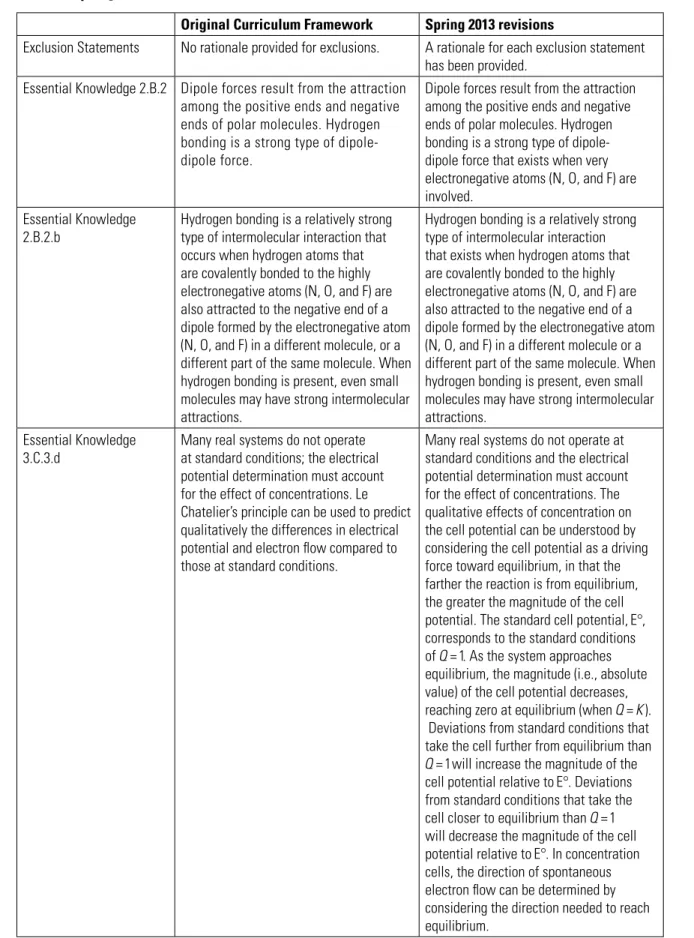
Table 2. Spring 2013 Revisions

Original Curriculum Framework Spring 2013 revisions

Exclusion Statements No rationale provided for exclusions. A rationale for each exclusion statement has been provided.

Essential Knowledge 2.B.2 Dipole forces result from the attraction among the positive ends and negative ends of polar molecules. Hydrogen bonding is a strong type of dipole- dipole force.

Dipole forces result from the attraction among the positive ends and negative ends of polar molecules. Hydrogen bonding is a strong type of dipole- dipole force that exists when very electronegative atoms (N, O, and F) are involved.

Essential Knowledge

2.B.2.b Hydrogen bonding is a relatively strong type of intermolecular interaction that occurs when hydrogen atoms that are covalently bonded to the highly electronegative atoms (N, O, and F) are also attracted to the negative end of a dipole formed by the electronegative atom (N, O, and F) in a different molecule, or a different part of the same molecule. When hydrogen bonding is present, even small molecules may have strong intermolecular attractions.

Hydrogen bonding is a relatively strong type of intermolecular interaction that exists when hydrogen atoms that are covalently bonded to the highly electronegative atoms (N, O, and F) are also attracted to the negative end of a dipole formed by the electronegative atom (N, O, and F) in a different molecule or a different part of the same molecule. When hydrogen bonding is present, even small molecules may have strong intermolecular attractions.

Essential Knowledge

3.C.3.d Many real systems do not operate at standard conditions; the electrical potential determination must account for the effect of concentrations. Le Chatelier’s principle can be used to predict qualitatively the differences in electrical potential and electron flow compared to those at standard conditions.

Many real systems do not operate at standard conditions and the electrical potential determination must account for the effect of concentrations. The qualitative effects of concentration on the cell potential can be understood by considering the cell potential as a driving force toward equilibrium, in that the farther the reaction is from equilibrium, the greater the magnitude of the cell potential. The standard cell potential, , corresponds to the standard conditions of . As the system approaches equilibrium, the magnitude (i.e., absolute value) of the cell potential decreases, reaching zero at equilibrium (when ).

Deviations from standard conditions that take the cell further from equilibrium than

will increase the magnitude of the

cell potential relative to . Deviations

from standard conditions that take the

cell closer to equilibrium than

will decrease the magnitude of the cell

potential relative to . In concentration

cells, the direction of spontaneous

electron flow can be determined by

considering the direction needed to reach

equilibrium.

(8)

Essential Knowledge

3.C.3.e The magnitude of the standard cell potential is proportional to (standard Gibbs free energy) for the redox reaction from which it is constructed.

(standard Gibbs free energy) is proportional to the negative of the cell potential for the redox reaction from which it is constructed.

Essential Knowledge 5.B.4 Calorimetry is an experimental technique that is used to measure the change in energy of a chemical system.

Calorimetry is an experimental technique that is used to determine the heat exchanged/transferred in a chemical system.

Learning Objective 1.15 SP 6.4 added

Learning Objective 1.19 SP 6.4 added

Learning Objective 1.20 SP 6.4 added

Learning Objective 2.10 SP 6.4 added

Learning Objective 2.13 SP 6.4 added

Learning Objective 2.22 SP 6.4 added

Learning Objective 3.5 SP 6.4 added

Learning Objective 4.2 SP 6.4 added

Learning Objective 5.7 SP 6.4 added

Learning Objective 6.12 SP 6.4 added

Learning Objective 6.13 SP 6.4 added

Learning Objective 6.23 SP 6.4 added

(9)
(10)

About AP ®

AP® enables students to pursue college-level studies while still in high school. Through more than 30 courses, each culminating in a rigorous exam, AP provides willing and academically prepared students with the opportunity to earn college credit and/or advanced placement. Taking AP courses also demonstrates to college admission officers that students have sought out the most rigorous course work available to them.

Each AP course is modeled upon a comparable college course, and college and university faculty play a vital role in ensuring that AP courses align with college-level standards.

Talented and dedicated AP teachers help AP students in classrooms around the world develop and apply the content knowledge and skills they will need later in college.

Each AP course concludes with a college-level assessment developed and scored by college and university faculty, as well as experienced AP teachers. AP Exams are an essential part of the AP experience, enabling students to demonstrate their mastery of college-level course work. Most four-year colleges and universities in the United States and universities in 60 countries recognize AP in the admission process and grant students credit, placement or both on the basis of successful AP Exam scores. Visit

www.collegeboard.org/apcreditpolicy to view AP credit and placement policies at more than 1,000 colleges and universities.

Performing well on an AP Exam means more than just the successful completion of a course; it is a gateway to success in college. Research consistently shows that students who score a 3 or higher on AP Exams typically experience greater academic success in college and have higher graduation rates than their non-AP peers.

1

Additional AP studies are available at www.collegeboard.org/research.

1. See the following research studies for more details:

Linda Hargrove, Donn Godin, and Barbara Dodd, College Outcomes Comparisons by AP and Non-AP High School Experiences (New York: The College Board, 2008).

Chrys Dougherty, Lynn Mellor, and Shuling Jian, The Relationship Between Advanced Placement and College Graduation

(Austin, Texas: National Center for Educational Accountability, 2006).

(11)

About the AP Chemistry Course and Exam

This AP Chemistry Course and Exam Description details the essential information

required to understand the objectives and expectations of an AP course. The AP Program unequivocally supports the principle that each school develops and implements its own curriculum that will enable students to develop the content knowledge and skills described here.

The AP Chemistry course is designed to be taken only after the successful completion of a first course in high school chemistry. Surveys of students who take the AP Chemistry Exam indicate that the probability of achieving a score of 3 or higher is significantly greater for students who successfully complete a first course in high-school chemistry prior to undertaking the AP course. Thus it is strongly recommended that credit in a first- year high school chemistry course be a prerequisite for enrollment in an AP Chemistry class. In addition, the recommended mathematics prerequisite for an AP Chemistry class is the successful completion of a second-year algebra course. The advanced work in chemistry should not displace any other part of the student’s science curriculum. It is highly desirable that a student have a course in secondary school physics and a four-year college-preparatory program in mathematics.

Schools wishing to offer AP courses must participate in the AP Course Audit, a process through which AP teachers’ syllabi are reviewed by college faculty. The AP Course Audit was created at the request of College Board members who sought a means for the College Board to provide teachers and administrators with clear guidelines on curricular and resource requirements for AP courses and to help colleges and universities validate courses marked “AP” on students’ transcripts. This process ensures that AP teachers’

syllabi meet or exceed the curricular and resource expectations that college and secondary school faculty have established for college-level courses. For more information on the AP Course Audit, visit www.collegeboard.com/apcourseaudit.

How AP Courses and Exams Are Developed

AP courses and exams are designed by committees of college faculty and expert AP teachers who ensure that each AP subject reflects and assesses college-level expectations.

To find a list of each subject’s current AP Development Committee members, please visit press.collegeboard.org/ap/committees. AP Development Committees define the scope and expectations of the course, articulating through a curriculum framework what students should know and be able to do upon completion of the AP course. Their work is informed by data collected from a range of colleges and universities to ensure that AP course work reflects current scholarship and advances in the discipline.

The AP Development Committees are also responsible for drawing clear and well-

articulated connections between the AP course and AP Exam — work that includes

(12)

designing and approving exam specifications and exam questions. The AP Exam development process is a multiyear endeavor; all AP Exams undergo extensive review, revision, piloting, and analysis to ensure that questions are high quality and fair and that there is an appropriate spread of difficulty across the questions.

Throughout AP course and exam development, the College Board gathers feedback from various stakeholders in both secondary schools and higher education institutions. This feedback is carefully considered to ensure that AP courses and exams are able to provide students with a college-level learning experience and the opportunity to demonstrate their qualifications for advanced placement upon college entrance.

How AP Exams Are Scored

The exam scoring process, like the course and exam development process, relies on the expertise of both AP teachers and college faculty. While multiple-choice questions are scored by machine, the free-response questions are scored by thousands of college faculty and expert AP teachers at the annual AP Reading. AP Exam Readers are thoroughly trained, and their work is monitored throughout the Reading for fairness and consistency.

In each subject, a highly respected college faculty member fills the role of Chief Reader, who, with the help of AP readers in leadership positions, maintains the accuracy of the scoring standards. Scores on the free-response questions are weighted and combined with the results of the computer-scored multiple-choice questions, and this raw score is converted into a composite AP score of 5, 4, 3, 2, or 1.

The score-setting process is both precise and labor intensive, involving numerous psychometric analyses of the results of a specific AP Exam in a specific year and of the particular group of students who took that exam. Additionally, to ensure alignment with college-level standards, part of the score-setting process involves comparing the performance of AP students with the performance of students enrolled in comparable courses in colleges throughout the United States. In general, the AP composite score points are set so that the lowest raw score needed to earn an AP score of 5 is equivalent to the average score among college students earning grades of A in the college course.

Similarly, AP Exam scores of 4 are equivalent to college grades of , , and B. AP Exam

scores of 3 are equivalent to college grades of , , and C.

(13)

Using and Interpreting AP Scores

The extensive work done by college faculty and AP teachers in the development of the course and the exam and throughout the scoring process ensures that AP Exam scores accurately represent students’ achievement in the equivalent college course. While colleges and universities are responsible for setting their own credit and placement policies, AP scores signify how qualified students are to receive college credit and placement:

AP Score Recommendation

5 Extremely well qualified

4 Well qualified

3 Qualified

2 Possibly qualified

1 No recommendation

Additional Resources

Visit apcentral.collegeboard.org for more information about the AP Program.

(14)

AP Chemistry Curriculum Framework

Introduction

Given the speed with which scientific discoveries and research continuously expand scientific knowledge, many educators are faced with the challenge of balancing breadth of content coverage with depth of understanding. The AP® Chemistry course addresses this challenge by focusing on a model of instruction which promotes enduring, conceptual understandings and the content that supports them. This approach enables students to spend less time on factual recall and more time on inquiry-based learning of essential concepts, and helps them develop the reasoning skills necessary to engage in the science practices used throughout their study of AP Chemistry.

To foster this deeper level of learning, the breadth of content coverage in AP Chemistry is defined in a way that distinguishes content essential to support the enduring

understandings from the many examples or applications that can overburden the course.

Illustrative examples are provided that offer teachers a variety of optional instructional contexts to help their students achieve deeper understanding. Additionally, content that is outside the scope of the course and exam is also identified.

Students who take an AP Chemistry course, designed with this curriculum framework as its foundation, will also develop advanced inquiry and reasoning skills, such as designing a plan for collecting data, analyzing data, applying mathematical routines, and connecting concepts in and across domains. The result will be readiness for the study of advanced topics in subsequent college courses — a goal of every AP course.

The AP Chemistry course is designed to be the equivalent of the general chemistry course usually taken during the first college year. For some students, this course enables them to undertake, in their first year, second-year work in the chemistry sequence at their institution or to register in courses in other fields where general chemistry is a prerequisite. For other students, the AP Chemistry course fulfills the laboratory science requirement and frees time for other courses.

The Emphasis on Science Practices

A practice is a way to coordinate knowledge and skills in order to accomplish a goal or

task. The science practices enable students to establish lines of evidence and use them to

develop and refine testable explanations and predictions of natural phenomena. Because

content, inquiry, and reasoning are equally important in AP Chemistry, each learning

objective described in the concept outline combines content with inquiry and reasoning

skills described in the science practices.

(15)

The science practices that follow the concept outline of this framework capture important aspects of the work that scientists engage in, at the level of competence expected of AP Chemistry students. AP Chemistry teachers will see within the learning objectives how these practices are effectively integrated with the course content, and will be able to design instruction with these practices in mind.

Overview of the Concept Outline

The key concepts and related content that define the revised AP Chemistry course and exam are organized around a few underlying principles called the big ideas, which encompass the core scientific principles, theories, and processes governing chemical systems. For each of the big ideas, enduring understandings, which incorporate the core concepts that students should retain from the learning experience, are also identified.

Each enduring understanding is followed by statements of the essential knowledge necessary to support it. Unless otherwise specified, all of the details in the outline are required elements of the course and may be needed to successfully meet the learning objectives tested by the AP Chemistry Exam questions. To help teachers distinguish content that is essential to support the enduring understandings from the many possible examples and applications that can overburden a course — and to see where important connections exist among the different content areas — particular content components are emphasized as follows:

• Exclusion statements define content or specific details about the content, which do not need to be included in the course because teaching this level of detail does not foster students’ conceptual understanding, or the level of detail represents knowledge students should have acquired prior to participating in this course.

The content in the exclusion statements will not be assessed on the AP Chemistry Exam. Exclusion statements are denoted as shown in this example:

Memorization of exceptions to the Aufbau principle is beyond the scope of this course and the AP Exam.

Note: While excluded content will not be assessed on the AP Chemistry Exam, such content may be provided in the body of exam questions as background information for the concept and science practice(s) being assessed. The text indicates if content is excluded because it is prior

knowledge or if it is excluded because it is not essential to an understanding of the big ideas.

• Learning objectives provide clear and detailed articulation of what students

should know and be able to do. Questions for the AP Chemistry Exam will be

written based upon both the content and the science practice designated in the

learning objectives. Each learning objective is designed to help teachers integrate

science practices with specific content, and to provide them with clear information

about how students will be expected to demonstrate their knowledge and abilities.

(16)

Alignment of the learning objectives to the science practices is denoted in

brackets. For example, in the first learning objective under 1.A.1: “The student can justify the observation that the ratio of the masses of the constituent elements in any pure sample of that compound is always identical on the basis of the atomic molecular theory. [See SP 6.1],” the bracketed reference points to this science practice: “6.1 The student can justify claims with evidence.”

Note: To develop conceptual understanding, it is essential that the student can

draw connections between concepts and engage in reasoning that combines

essential knowledge components from across the curriculum framework. For

this reason, learning objectives may occur at the level of big ideas, enduring

understandings, or essential knowledge. The learning objectives are listed

immediately following the description of the associated big idea, enduring

understanding, or essential knowledge. In addition, some learning objectives

connect to different portions of the curriculum, which is indicated with the

addition of [connects to] at the end of the learning objective.

(17)

The Concept Outline

Big Idea 1: The chemical elements are fundamental building materials of matter, and all matter can be understood in terms of arrangements of atoms. These atoms retain their identity in chemical reactions.

The atomic theory of matter is the most fundamental premise of chemistry. A limited number of chemical elements exist, and the fundamental unit of the chemical identities they carry is the atom. Although atoms represent the foundational level of chemistry, observations of chemical properties are always made on collections of atoms, and macroscopic systems involve such large numbers that they are typically counted in the unit known as the mole rather than as individual atoms. For elements, many chemical and physical properties exhibit predictable periodicity as a function of atomic number. In all chemical and physical changes, atoms are conserved.

Enduring understanding 1.A: All matter is made of atoms. There are a limited number of types of atoms; these are the elements.

The concept of atoms as the building blocks of all matter is a fundamental premise of the discipline of chemistry. This concept provides the foundation for conceptualizing, interpreting, and explaining the macroscopic properties and transformations observed inside and outside the laboratory in terms of the structure and properties of the

constituent materials. The concept of the mole enables chemists to relate measured masses in the laboratory to the number of particles present in a sample. These two concepts also provide the basis for the experimental determination of the purity of a sample through chemical analysis. The most important aspect of chemistry is not the memorization of the laws and definitions, but rather the ability to explain how the laws and relationships arise because of the atomic nature of matter.

Essential knowledge 1.A.1: Molecules are composed of specific combinations of atoms; different molecules are composed of

combinations of different elements and of combinations of the same elements in differing amounts and proportions.

a. The average mass of any large number of atoms of a given element is always the same for a given element.

b. A pure sample contains particles (or units) of one specific atom or molecule; a mixture contains particles (or units) of more than one specific atom or molecule.

c. Because the molecules of a particular compound are always composed of the

identical combination of atoms in a specific ratio, the ratio of the masses of the

constituent elements in any pure sample of that compound is always the same.

(18)

d. Pairs of elements that form more than one type of molecule are nonetheless limited by their atomic nature to combine in whole number ratios. This discrete nature can be confirmed by calculating the difference in mass percent ratios between such types of molecules.

Learning Objective for EK 1.A.1:

LO 1.1 The student can justify the observation that the ratio of the masses of the constituent elements in any pure sample of that compound is always identical on the basis of the atomic molecular theory. [See SP 6.1]

Essential knowledge 1.A.2: Chemical analysis provides a method for determining the relative number of atoms in a substance, which can be used to identify the substance or determine its purity.

a. Because compounds are composed of atoms with known masses, there is a

correspondence between the mass percent of the elements in a compound and the relative number of atoms of each element.

b. An empirical formula is the lowest whole number ratio of atoms in a compound.

Two molecules of the same elements with identical mass percent of their constituent atoms will have identical empirical formulas.

c. Because pure compounds have a specific mass percent of each element,

experimental measurements of mass percents can be used to verify the purity of compounds.

Learning Objectives for EK 1.A.2:

LO 1.2 The student is able to select and apply mathematical routines to mass data to identify or infer the composition of pure substances and/or mixtures.

[See SP 2.2]

LO 1.3 The student is able to select and apply mathematical relationships to mass

data in order to justify a claim regarding the identity and/or estimated purity of a

substance. [See SP 2.2, 6.1]

(19)

Essential knowledge 1.A.3: The mole is the fundamental unit for counting numbers of particles on the macroscopic level and allows quantitative connections to be drawn between laboratory experiments, which occur at the macroscopic level, and chemical processes, which occur at the atomic level.

a. Atoms and molecules interact with one another on the atomic level. Balanced chemical equations give the number of particles that react and the number of particles produced. Because of this, expressing the amount of a substance in terms of the number of particles, or moles of particles, is essential to understanding chemical processes.

b. Expressing the mass of an individual atom or molecule in atomic mass unit (amu) is useful because the average mass in amu of one particle (atom or molecule) of a substance will always be numerically equal to the molar mass of that substance in grams.

c. Avogadro’s number provides the connection between the number of moles in a pure sample of a substance and the number of constituent particles (or units) of that substance.

d. Thus, for any sample of a pure substance, there is a specific numerical relationship between the molar mass of the substance, the mass of the sample, and the number of particles (or units) present.

Learning Objective for EK 1.A.3:

LO 1.4 The student is able to connect the number of particles, moles, mass, and volume of substances to one another, both qualitatively and quantitatively.

[See SP 7.1]

Enduring understanding 1.B: The atoms of each element have unique structures arising from interactions between electrons and nuclei.

The shell model arises from experimental data. The shell model forms a basis for

understanding the relative energies of electrons in an atom. The model is based on

Coulomb’s law and qualitatively predicts ionization energies, which can be measured in

the lab. Understanding how the shell model is consistent with the experimental data is a

key learning goal for this content, beyond simple memorization of the patterns of electron

configurations.

(20)

Essential knowledge 1.B.1: The atom is composed of negatively charged electrons, which can leave the atom, and a positively charged nucleus that is made of protons and neutrons. The attraction of the electrons to the nucleus is the basis of the structure of the atom. Coulomb’s law is qualitatively useful for understanding the structure of the atom.

a. Based on Coulomb’s law, the force between two charged particles is proportional to the magnitude of each of the two charges , and inversely proportional to the square of the distance, r, between them. (Potential energy is proportional to ) If the two charges are of opposite sign, the force between them is attractive;

if they are of the same sign, the force is repulsive.

b. The first ionization energy is the minimum energy needed to remove the least tightly held electron from an atom or ion. In general, the ionization energy of any electron in an atom or ion is the minimum energy needed to remove that electron from the atom or ion.

c. The relative magnitude of the ionization energy can be estimated through qualitative application of Coulomb’s law. The farther an electron is from the nucleus, the lower its ionization energy. When comparing two species with the same arrangement of electrons, the higher the nuclear charge, the higher the ionization energy of an electron in a given subshell.

d. Photoelectron spectroscopy (PES) provides a useful means to engage students in the use of quantum mechanics to interpret spectroscopic data and extract information on atomic structure from such data. In particular, low-resolution PES of atoms provides direct evidence for the shell model. Light consists of photons, each of which has energy , where is Planck’s constant and is the frequency of the light. In the photoelectric effect, incident light ejects electrons from a material. This requires the photon to have sufficient energy to eject the electron. Photoelectron spectroscopy determines the energy needed to eject electrons from the material. Measurement of these energies provides a method to deduce the shell structure of an atom. The intensity of the photoelectron signal at a given energy is a measure of the number of electrons in that energy level.

e. The electronic structure of atoms with multiple electrons can be inferred from

evidence provided by PES. For instance, both electrons in are identical, and

they are both roughly the same distance from the nucleus as in H, while there

are two shells of electrons in , and the outermost electron is further from the

nucleus than in H.

(21)

Learning Objectives for EK 1.B.1:

LO 1.5 The student is able to explain the distribution of electrons in an atom or ion based upon data. [See SP 1.5, 6.2]

LO 1.6 The student is able to analyze data relating to electron energies for patterns and relationships. [See SP 5.1]

Essential knowledge 1.B.2: The electronic structure of the atom can be described using an electron configuration that reflects the concept of electrons in quantized energy levels or shells; the energetics of the electrons in the atom can be understood by consideration of Coulomb’s law.

a. Electron configurations provide a method for describing the distribution of electrons in an atom or ion.

b. Each electron in an atom has a different ionization energy, which can be qualitatively explained through Coulomb’s law.

c. In multielectron atoms and ions, the electrons can be thought of as being in

“shells” and “subshells,” as indicated by the relatively close ionization energies associated with some groups of electrons. Inner electrons are called core electrons, and outer electrons are called valence electrons.

d. Core electrons are generally closer to the nucleus than valence electrons, and they are considered to “shield” the valence electrons from the full electrostatic attraction of the nucleus. This phenomenon can be used in conjunction with Coulomb’s law to explain/rationalize/predict relative ionization energies.

Differences in electron-electron repulsion are responsible for the differences in energy between electrons in different orbitals in the same shell.

Learning Objectives for EK 1.B.2:

LO 1.7 The student is able to describe the electronic structure of the atom, using PES data, ionization energy data, and/or Coulomb’s law to construct explanations of how the energies of electrons within shells in atoms vary.

[See SP 5.1, 6.2]

LO 1.8 The student is able to explain the distribution of electrons using

Coulomb’s law to analyze measured energies. [See SP 6.2]

(22)

Enduring understanding 1.C: Elements display periodicity in their properties when the elements are organized according to increasing atomic number. This periodicity can be explained by the regular variations that occur in the electronic structures of atoms. Periodicity is a useful principle for understanding properties and predicting trends in properties. Its modern-day uses range from examining the composition of materials to generating ideas for designing new materials.

Although a simple shell model is not the currently accepted best model of atomic structure, it is an extremely useful model that can be used qualitatively to explain and/

or predict many atomic properties and trends in atomic properties. In particular, the arrangement of electrons into shells and subshells is reflected in the structure of the periodic table and in the periodicity of many atomic properties. Many of these trends in atomic properties are important for understanding the properties of molecules, and in being able to explain how the structure of the constituent molecules or atoms relates to the macroscopic properties of materials. Students should be aware that the shells reflect the quantization inherent in quantum mechanics and that the labels given to the atomic orbitals are examples of the quantum numbers used to label the resulting quantized states.

Being aware of the quantum mechanical model as the currently accepted best model for the atom is important for scientific literacy.

Essential knowledge 1.C.1: Many properties of atoms exhibit periodic trends that are reflective of the periodicity of electronic structure.

a. The structure of the periodic table is a consequence of the pattern of electron configurations and the presence of shells (and subshells) of electrons in atoms.

b. Ignoring the few exceptions, the electron configuration for an atom can be deduced from the element’s position in the periodic table.

Memorization of exceptions to the Aufbau principle is beyond the scope of this course and the AP Exam.

Rationale: The mere rote recall of the exceptions does not match the goals of the curriculum revision. If given an exception on the AP Exam, students will be responsible for providing possible reasons for the exceptions based on theory.

c. For many atomic properties, trends within the periodic table (and relative values for different atoms and ions) can be qualitatively understood and explained using Coulomb’s law, the shell model, and the concept of shielding/effective nuclear charge. These properties include:

1. First ionization energy

2. Atomic and ionic radii

(23)

3. Electronegativity 4. Typical ionic charges

d. Periodicity is a useful tool when designing new molecules or materials, since replacing an element of one group with another of the same group may lead to a new substance with similar properties. For instance, since can be a ceramic,

may be as well.

Learning Objectives for EK 1.C.1:

LO 1.9 The student is able to predict and/or justify trends in atomic properties based on location on the periodic table and/or the shell model. [See SP 6.4]

LO 1.10 Students can justify with evidence the arrangement of the periodic table and can apply periodic properties to chemical reactivity. [See SP 6.1]

LO 1.11 The student can analyze data, based on periodicity and the properties of binary compounds, to identify patterns and generate hypotheses related to the molecular design of compounds for which data are not supplied. [See SP 3.1, 5.1]

Essential knowledge 1.C.2: The currently accepted best model of the atom is based on the quantum mechanical model.

a. Coulomb’s law is the basis for describing the energy of interaction between protons and electrons.

b. Electrons are not considered to follow specific orbits. Chemists refer to the region of space in which an electron is found as an orbital.

c. Electrons in atoms have an intrinsic property known as spin that can result in atoms having a magnetic moment. There can be at most two electrons in any orbital, and these electrons must have opposite spin.

d. The quantum mechanical (QM) model addresses known problems with the classical shell model and is also consistent with atomic electronic structures that correspond with the periodic table.

e. The QM model can be approximately solved using computers and serves as the basis for software that calculates the structure and reactivity of molecules.

Assignment of quantum numbers to electrons is beyond the scope of this course and the AP Exam.

Rationale: Assignment of quantum numbers to electrons does not increase students’

conceptual understanding of quantum theory.

(24)

Learning Objective for EK 1.C.2:

LO 1.12 The student is able to explain why a given set of data suggests, or does not suggest, the need to refine the atomic model from a classical shell model with the quantum mechanical model. [See SP 6.3]

Enduring understanding 1.D: Atoms are so small that they are difficult to study directly; atomic models are constructed to explain experimental data on collections of atoms.

Because the experimental measurement of ionization energy provides a window into the overall electronic structure of the atom, this content provides rich opportunities to explore how scientific models can be constructed and refined in response to available data. The modern use of mass spectrometry provides another example of how experimental data can be used to test or reject a scientific model.

Essential knowledge 1.D.1: As is the case with all scientific models, any model of the atom is subject to refinement and change in response to new experimental results. In that sense, an atomic model is not regarded as an exact description of the atom, but rather a theoretical construct that fits a set of experimental data.

a. Scientists use experimental results to test scientific models. When experimental results are not consistent with the predictions of a scientific model, the model must be revised or replaced with a new model that is able to predict/explain the new experimental results. A robust scientific model is one that can be used to explain/

predict numerous results over a wide range of experimental circumstances.

b. The construction of a shell model of the atom through ionization energy information provides an opportunity to show how a model can be refined and changed as additional information is considered.

Learning Objective for EK 1.D.1:

LO 1.13 Given information about a particular model of the atom, the student is

able to determine if the model is consistent with specified evidence. [See SP 5.3]

(25)

Essential knowledge 1.D.2: An early model of the atom stated that all atoms of an element are identical. Mass spectrometry data demonstrate evidence that contradicts this early model.

a. Data from mass spectrometry demonstrate evidence that an early model of the atom (Dalton’s model) is incorrect; these data then require a modification of that model.

b. Data from mass spectrometry also demonstrate direct evidence of different isotopes from the same element.

c. The average atomic mass can be estimated from mass spectra.

Learning Objective for EK 1.D.2:

LO 1.14 The student is able to use data from mass spectrometry to identify the elements and the masses of individual atoms of a specific element.

[See SP 1.4, 1.5]

Essential knowledge 1.D.3: The interaction of electromagnetic waves or light with matter is a powerful means to probe the structure of atoms and molecules, and to measure their concentration.

a. The energy of a photon is related to the frequency of the electromagnetic wave through Planck’s equation . When a photon is absorbed (or emitted) by a molecule, the energy of the molecule is increased (or decreased) by an amount equal to the energy of the photon.

b. Different types of molecular motion lead to absorption or emission of photons in different spectral regions. Infrared radiation is associated with transitions in molecular vibrations and so can be used to detect the presence of different types of bonds. Ultraviolet/visible radiation is associated with transitions in electronic energy levels and so can be used to probe electronic structure.

c. The amount of light absorbed by a solution can be used to determine the

concentration of the absorbing molecules in that solution, via the Beer-Lambert

law.

(26)

Learning Objectives for EK 1.D.3:

LO 1.15 The student can justify the selection of a particular type of spectroscopy to measure properties associated with vibrational or electronic motions of molecules. [See SP 4.1, 6.4]

LO 1.16 The student can design and/or interpret the results of an experiment regarding the absorption of light to determine the concentration of an absorbing species in a solution. [See SP 4.2, 5.1]

Enduring understanding 1.E: Atoms are conserved in physical and chemical processes.

The conservation of mass in chemical and physical transformations is a fundamental concept, and is a reflection of the atomic model of matter. This concept plays a key role in much of chemistry, in both quantitative determinations of quantities of materials involved in chemical systems and transformations, and in the conceptualization and representation of those systems and transformations.

Essential knowledge 1.E.1: Physical and chemical processes can be depicted symbolically; when this is done, the illustration must conserve all atoms of all types.

a. Various types of representations can be used to show that matter is conserved during chemical and physical processes.

1. Symbolic representations 2. Particulate drawings

b. Because atoms must be conserved during a chemical process, it is possible to calculate product masses given known reactant masses, or to calculate reactant masses given product masses.

c. The concept of conservation of atoms plays an important role in the interpretation and analysis of many chemical processes on the macroscopic scale. Conservation of atoms should be related to how nonradioactive atoms are neither lost nor gained as they cycle among land, water, atmosphere, and living organisms.

Learning Objective for EK 1.E.1:

LO 1.17 The student is able to express the law of conservation of mass

quantitatively and qualitatively using symbolic representations and particulate

drawings. [See SP 1.5]

(27)

Essential knowledge 1.E.2: Conservation of atoms makes it possible to compute the masses of substances involved in physical and

chemical processes. Chemical processes result in the formation of new substances, and the amount of these depends on the number and the types and masses of elements in the reactants, as well as the efficiency of the transformation.

a. The number of atoms, molecules, or formula units in a given mass of substance can be calculated.

b. The subscripts in a chemical formula represent the number of atoms of each type in a molecule.

c. The coefficients in a balanced chemical equation represent the relative numbers of particles that are consumed and created when the process occurs.

d. The concept of conservation of atoms plays an important role in the interpretation and analysis of many chemical processes on the macroscopic scale.

e. In gravimetric analysis, a substance is added to a solution that reacts specifically with a dissolved analyte (the chemical species that is the target of the analysis) to form a solid. The mass of solid formed can be used to infer the concentration of the analyte in the initial sample.

f. Titrations may be used to determine the concentration of an analyte in a solution.

The titrant has a known concentration of a species that reacts specifically with the analyte. The equivalence of the titration occurs when the analyte is totally consumed by the reacting species in the titrant. The equivalence point is often indicated by a change in a property (such as color) that occurs when the equivalence point is reached. This observable event is called the end point of the titration.

Learning Objectives for EK 1.E.2:

LO 1.18 The student is able to apply conservation of atoms to the rearrangement of atoms in various processes. [See SP 1.4]

LO 1.19 The student can design, and/or interpret data from, an experiment that uses gravimetric analysis to determine the concentration of an analyte in a solution. [See SP 4.2, 5.1, 6.4]

LO 1.20 The student can design, and/or interpret data from, an experiment that uses titration to determine the concentration of an analyte in a solution.

[See SP 4.2, 5.1, 6.4]

(28)

Big Idea 2: Chemical and physical properties of materials can be explained by the structure and the arrangement of atoms, ions, or molecules and the forces between them.

Transformations of matter can be observed in multiple ways that are generally categorized as either chemical or physical change. These categories can generally be distinguished through consideration of the electrostatic (Coulombic) forces that are associated with a given change at the particulate level. The strength of such forces falls along a continuum, with the strongest forces generally being chemical bonds. Chemical changes involve the making and breaking of chemical bonds. For physical changes, the forces being overcome are weaker intermolecular interactions, which are also Coulombic in nature. The shapes of the particles involved, and the space between them, are key factors in determining the nature of these physical changes. Using only these general concepts of varying strengths of chemical bonds and weaker intermolecular interactions, many properties of a wide range of chemical systems can be understood.

Learning Objectives for Big Idea 2:

LO 2.1 Students can predict properties of substances based on their chemical formulas, and provide explanations of their properties based on particle views.

[See SP 6.4, 7.1]

LO 2.2 The student is able to explain the relative strengths of acids and bases based on molecular structure, interparticle forces, and solution equilibrium.

[See SP 7.2, connects to Big Idea 5, Big Idea 6]

Note: These learning objectives apply to essential knowledge components of 2A–2D.

Enduring understanding 2.A: Matter can be described by its physical properties. The physical properties of a substance generally depend on the spacing between the particles (atoms, molecules, ions) that make up the substance and the forces of attraction among them.

There is a relationship between the macroscopic properties of solids, liquids, and gases, and

the structure of the constituent particles of those materials on the molecular and atomic

scale. The properties of solids, liquids, and gases also reflect the relative orderliness of the

arrangement of particles in those states, their relative freedom of motion, and the nature and

strength of the interactions between them. For gases, volumetric relationships can be used to

describe ideal behavior, and a conceptual understanding of that behavior can be constructed

based on the atomic model and a relatively simple kinetic molecular theory (KMT).

(29)

Solutions are an important class of mixtures; of particular importance is a conceptual understanding on the molecular level of the structure and composition of a liquid

solution. In addition, the energetics of solution formation can be understood qualitatively through consideration of the interactions and structure of the components before and after the creation of the solution.

Essential knowledge 2.A.1: The different properties of solids and

liquids can be explained by differences in their structures, both at the particulate level and in their supramolecular structures.

a. Solids can be crystalline, where the particles are arranged in a regular 3-D structure, or they can be amorphous, where the particles do not have a regular, orderly arrangement. In both cases, the motion of the individual particles is limited, and the particles do not undergo any overall translation with respect to each other. Interparticle interactions and the ability to pack the particles together provide the main criteria for the structures of solids.

b. The constituent particles in liquids are very close to each other, and they are continually moving and colliding. The particles are able to undergo translation with respect to each other and their arrangement, and movement is influenced by the nature and strength of the intermolecular forces that are present.

c. The solid and liquid phases for a particular substance generally have relatively small differences in molar volume because in both cases the constituent particles are very close to each other at all times.

d. The differences in other properties, such as viscosity, surface tension, and volumes of mixing (for liquids), and hardness and macroscopic crystal structure (for solids), can be explained by differences in the strength of attraction between the particles and/or their overall organization.

e. Heating and cooling curves for pure substances provide insight into the energetics of liquid/solid phase changes.

Learning Objective for EK 2.A.1:

LO 2.3 The student is able to use aspects of particulate models (i.e., particle spacing, motion, and forces of attraction) to reason about observed differences between solid and liquid phases and among solid and liquid materials.

[See SP 6.4, 7.1]

(30)

Essential knowledge 2.A.2: The gaseous state can be effectively modeled with a mathematical equation relating various macroscopic properties. A gas has neither a definite volume nor a definite shape;

because the effects of attractive forces are minimal, we usually assume that the particles move independently.

a. Ideal gases exhibit specific mathematical relationships among the number of particles present, the temperature, the pressure, and the volume.

b. In a mixture of ideal gases, the pressure exerted by each component (the partial pressure) is independent of the other components. Therefore, the total pressure is the sum of the partial pressures.

c. Graphical representations of the relationships between P, V, and T are useful to describe gas behavior.

d. Kinetic molecular theory combined with a qualitative use of the Maxwell- Boltzmann distribution provides a robust model for qualitative explanations of these mathematical relationships.

e. Some real gases exhibit ideal or near-ideal behavior under typical laboratory conditions. Laboratory data can be used to generate or investigate the relationships in 2.A.2.a and to estimate absolute zero on the Celsius scale.

f. All real gases are observed to deviate from ideal behavior, particularly under conditions that are close to those resulting in condensation. Except at extremely high pressures that are not typically seen in the laboratory, deviations from ideal behavior are the result of intermolecular attractions among gas molecules.

These forces are strongly distance-dependent, so they are most significant during collisions.

g. Observed deviations from ideal gas behavior can be explained through an understanding of the structure of atoms and molecules and their intermolecular interactions.

Phase diagrams are beyond the scope of this course and the AP Exam.

Rationale: Phase diagrams are standard in all high school chemistry textbooks and

therefore are considered prior knowledge.

(31)

Learning Objectives for EK 2.A.2:

LO 2.4 The student is able to use KMT and concepts of intermolecular forces to make predictions about the macroscopic properties of gases, including both ideal and nonideal behaviors. [See SP 1.4, 6.4]

LO 2.5 The student is able to refine multiple representations of a sample of matter in the gas phase to accurately represent the effect of changes in macroscopic properties on the sample. [See SP 1.3, 6.4, 7.2]

LO 2.6 The student can apply mathematical relationships or estimation to determine macroscopic variables for ideal gases. [See SP 2.2, 2.3]

Essential knowledge 2.A.3: Solutions are homogenous mixtures in which the physical properties are dependent on the concentration of the solute and the strengths of all interactions among the particles of the solutes and solvent.

a. In a solution (homogeneous mixture), the macroscopic properties do not vary throughout the sample. This is in contrast to a heterogeneous mixture in which the macroscopic properties depend upon the location in the mixture. The distinction between heterogeneous and homogeneous depends on the length scale of interest. As an example, colloids may be heterogeneous on the scale of micrometers, but homogeneous on the scale of centimeters.

b. Solutions come in the form of solids, liquids, and gases.

c. For liquid solutions, the solute may be a gas, a liquid, or a solid.

d. Based on the reflections of their structure on the microscopic scale, liquid solutions exhibit several general properties:

1. The components cannot be separated by using filter paper.

2. There are no components large enough to scatter visible light.

3. The components can be separated using processes that are a result of the intermolecular interactions between and among the components.

e. Chromatography (paper and column) separates chemical species by taking advantage of the differential strength of intermolecular interactions between and among the components.

f. Distillation is used to separate chemical species by taking advantage of the

differential strength of intermolecular interactions between and among the

components and the effects these interactions have on the vapor pressures of the

components in the mixture.

(32)

g. The formation of a solution may be an exothermic or endothermic process, depending on the relative strengths of intermolecular/interparticle interactions before and after the dissolution process.

h. Generally, when ionic compounds are dissolved in water, the component ions are separated and dispersed. The presence of ions in a solution can be detected by use of conductivity measurements.

i. Solution composition can be expressed in a variety of ways; molarity is the most common method used in the laboratory. Molarity is defined as the number of moles of solute per liter of solution.

j. Understanding how to prepare solutions of specified molarity through direct mixing of the components, through use of volumetric glassware, and by

dilution of a solution of known molarity with additional solvent is important for performing laboratory work in chemistry.

Colligative properties are beyond the scope of this course and the AP Exam and are therefore considered prior knowledge and not directly assessed on the exam.

Calculations of molality, percent by mass, and percent by volume are beyond the scope of this course and the AP Exam.

Rationale: Molality pertains to colligative properties, which are considered prior knowledge and therefore molality will not be assessed on the exam.

Learning Objectives for EK 2.A.3:

LO 2.7 The student is able to explain how solutes can be separated by chromatography based on intermolecular interactions. [See SP 6.2]

LO 2.8 The student can draw and/or interpret representations of solutions that show the interactions between the solute and solvent. [See SP 1.1, 1.2, 6.4]

LO 2.9 The student is able to create or interpret representations that link the concept of molarity with particle views of solutions. [See SP 1.1, 1.4]

LO 2.10 The student can design and/or interpret the results of a separation

experiment (filtration, paper chromatography, column chromatography, or

distillation) in terms of the relative strength of interactions among and between

the components. [See SP 4.2, 5.1, 6.4]

(33)

Enduring understanding 2.B: Forces of attraction between particles (including the noble gases and also different parts of some large molecules) are important in determining many macroscopic properties of a substance, including how the observable physical state changes with temperature.

Chemists categorize intermolecular interactions based on the structural features giving rise to the interaction. Although there are some trends in the relative strengths of these interactions, the specific structure and size of the particles involved can play a very important role in determining the overall strength of a particular intermolecular (or intramolecular) interaction. The properties of condensed phases and of many crucial biological structures are determined by the nature and strength of these

interactions. Deviation from ideal gas behavior is generally a reflection of the presence of intermolecular interactions between gas particles. Thus, in all phases, the structure of particles on the molecular level is directly related to the properties of both the particles themselves and the behavior of macroscopic collections of those molecules.

Essential knowledge 2.B.1: London dispersion forces are attractive forces present between all atoms and molecules. London dispersion forces are often the strongest net intermolecular force between large molecules.

a. A temporary, instantaneous dipole may be created by an uneven distribution of electrons around the nucleus (nuclei) of an atom (molecule).

b. London dispersion forces arise due to the Coulombic interaction of the temporary dipole with the electron distribution in neighboring atoms and molecules.

c. Dispersion forces increase with contact area between molecules and with increasing polarizability of the molecules. The polarizability of a molecule increases with the number of electrons in the molecule, and is enhanced by the presence of pi bonding.

Learning Objective for EK 2.B.1:

LO 2.11 The student is able to explain the trends in properties and/or predict

properties of samples consisting of particles with no permanent dipole on the

basis of London dispersion forces. [See SP 6.2, 6.4]

(34)

Essential knowledge 2.B.2: Dipole forces result from the attraction among the positive ends and negative ends of polar molecules. Hydrogen

bonding is a strong type of dipole-dipole force that exists when very electronegative atoms (N, O, and F) are involved.

a. Molecules with dipole moments experience Coulombic interactions that result in a net attractive interaction when they are near each other.

1. Intermolecular dipole-dipole forces are weaker than ionic forces or covalent bonds.

2. Interactions between polar molecules are typically greater than between nonpolar molecules of comparable size because these interactions act in addition to London dispersion forces.

3. Dipole-dipole attractions can be represented by diagrams of attraction

between the positive and negative ends of polar molecules trying to maximize attractions and minimize repulsions in the liquid or solid state.

4. Dipole-induced dipole interactions are present between a polar and nonpolar molecule. The strength of these forces increases with the magnitude of the dipole of the polar molecule and with the polarizability of the nonpolar molecule.

b. Hydrogen bonding is a relatively strong type of intermolecular interaction that exists when hydrogen atoms that are covalently bonded to the highly electronegative atoms (N, O, and F) are also attracted to the negative end of a dipole formed by the electronegative atom (N, O, and F) in a different molecule, or a different part of the same molecule. When hydrogen bonding is present, even small molecules may have strong intermolecular attractions.

Other cases of much weaker hydrogen bonding are beyond the scope of the AP Chemistry course and exam.

Rationale: The hydrogen bonding that occurs when hydrogen is bonded to highly electronegative atoms (N, O, and F) will be emphasized as will the electrostatic versus covalent nature of the bond. We will not include other cases of much weaker hydrogen bonding in the AP Chemistry course.

c. Hydrogen bonding between molecules, or between different parts of a single molecule, may be represented by diagrams of molecules with hydrogen bonding and indications of location of hydrogen bonding.

d. Ionic interactions with dipoles are important in the solubility of ionic compounds

in polar solvents.

(35)

Learning Objectives for EK 2.B.2:

LO 2.12 The student can qualitatively analyze data regarding real gases to identify deviations from ideal behavior and relate these to molecular interactions.

[See SP 5.1, 6.5, connects to 2.A.2]

LO 2.13 The student is able to describe the relationships between the structural features of polar molecules and the forces of attraction between the particles.

[See SP 1.4, 6.4]

LO 2.14 The student is able to apply Coulomb’s law qualitatively (including using representations) to describe the interactions of ions, and the attractions between ions and solvents to explain the factors that contribute to the solubility of ionic compounds. [See SP 1.4, 6.4]

Essential knowledge 2.B.3: Intermolecular forces play a key role in

determining the properties of substances, including biological structures and interactions.

a. Many properties of liquids and solids are determined by the strengths and types of intermolecular forces present.

1. Boiling point 2. Surface tension 3. Capillary action 4. Vapor pressure

b. Substances with similar intermolecular interactions tend to be miscible or soluble in one another.

c. The presence of intermolecular forces among gaseous particles, including noble gases, leads to deviations from ideal behavior, and it can lead to condensation at sufficiently low temperatures and/or sufficiently high pressures.

d. Graphs of the pressure-volume relationship for real gases can demonstrate the

deviation from ideal behavior; these deviations can be interpreted in terms of the

presence and strengths of intermolecular forces.

Figure

Table 2. Spring 2013 Revisions

References

Related documents

An analysis of the economic contribution of the software industry examined the effect of software activity on the Lebanese economy by measuring it in terms of output and value

This essay asserts that to effectively degrade and ultimately destroy the Islamic State of Iraq and Syria (ISIS), and to topple the Bashar al-Assad’s regime, the international

innovation in payment systems, in particular the infrastructure used to operate payment systems, in the interests of service-users 3.. to ensure that payment systems

The LISFLOOD hydrological and water use model was run using climate projections for a high emissions (RCP8.5) and moderate-mitigation (RCP4.5) scenario to simulate minimum river

Although a longitudinal study would have been desirable to assess continuous changes of bone and biochemical parameters which occur during after stroke, this cross-sectional study

Pada penelitian sebelumnya mengenai pengaruh size terhadap corporate social responsibility disclosure yang dilakukan oleh Robiah dan Erawati (2017) menyimpulkan bahwa

The projected gains over the years 2000 to 2040 in life and active life expectancies, and expected years of dependency at age 65for males and females, for alternatives I, II, and

Product Feature Component Tags Description Oracle Field Service Wireless Other Change_Task_ Assignment_St atus Task Assignme nt, Task Status, Wireless. This component changes task