INTRODUCTION
Maintenance of constant plasma [Ca2+] and [Na+] is crucial to vertebrates; both ions are involved in a multitude of physiological processes (e.g. muscular contraction, action potential generation and cellular signalling). In the aquatic environment, levels of these ions can vary from vastly in excess of physiological needs (e.g. seawater) to nearly zero (soft freshwater). As yet, however, the mechanisms by which fish perceive these environmental levels are poorly understood. Accumulating evidence suggests that teleosts have olfactory sensitivity to changes in environmental [Ca2+] and [Na+] (Bodznick, 1978; Hubbard et al., 2000; Hubbard
et al., 2002; Nearing et al., 2002). Olfactory sensitivity to changes in environmental [Ca2+] has been described in both freshwater
and marine fish; goldfish (Carassius auratus) and freshwater-reared sockeye salmon (Oncorhynchus nerka) have olfactory sensitivity to increases in environmental [Ca2+] (Bodznick, 1978; Hubbard et al., 2002) whereas the seabream (Sparus aurata) is sensitive to reductions in [Ca2+] (Hubbard et al., 2000). Bodznick proposed that the olfactory sensitivity of freshwater-reared sockeye salmon to changes in environmental [Ca2+] contributed to their ability to identify natal rivers (Bodznick, 1978). However, goldfish and seabream do not undergo diadromous migrations, which suggests that there may be other reasons for fish to be able to monitor environmental [Ca2+] (Hubbard et al., 2000; Hubbard et al., 2002). Thus, seabream, although predominantly marine, can survive in brackish water but not in freshwater, and it has been suggested that olfactory sensitivity to changes in environmental [Ca2+] is used to warn the fish that it is reaching the limit of its salinity tolerance (Hubbard et al., 2000; Nearing
et al., 2002). It may also affect the physiological mechanisms regulating internal calcium homeostasis.
Goldfish and sockeye salmon also have olfactory sensitivity to increases in environmental [Na+] (Bodznick, 1978; Hubbard and Canário, 2007; Hubbard et al., 2002). The physiological significance of this phenomenon is not yet known; however, the relatively high detection threshold for Na+ suggests that this sensitivity is not
involved in routine monitoring but may serve as a warning that the fish is approaching the limits of its osmoregulatory capacity and/or activate osmoregulatory mechanisms (Hubbard et al., 2002). Nevertheless, in the goldfish at least, Ca2+and Na+are detected by
distinct olfactory mechanisms (Hubbard and Canário, 2007). As well as acting as putative odorants in their own right, both Ca2+and Na+are intimately involved in olfactory transduction of ‘conventional’ odorants (Menini, 1999; Nakamura, 2000; Schild and Restrepo, 1998). How the large changes in external availability of these ions that occur as a result of salinity changes may affect olfactory sensitivity has been little studied. In euryhaline fish, such as salmonids, olfactory sensitivity to amino acids seems to be largely independent of external salinity (Shoji et al., 1994; Shoji et al., 1996). However, in the seabream, short-term exposure to Ca2+-free seawater
caused a temporary reduction in the olfactory response to L-serine (Hubbard et al., 2000). Thus, olfactory transduction in fish may be independent of external Ca2+and Na+or they may be able to adapt to changing levels. If and how olfactory sensitivity to these ions changes with external salinity has not yet been investigated.
The Senegalese sole (Solea senegalensisKaup 1858), hereafter ‘sole’, is a marine flatfish of the Mediterranean Sea and north-east Atlantic Ocean. It often penetrates estuarine waters to feed (Cabral, The Journal of Experimental Biology 212, 2532-2540
Published by The Company of Biologists 2009 doi:10.1242/jeb.030775
Adaptation to reduced salinity affects the olfactory sensitivity of Senegalese sole
(Solea senegalensis Kaup 1858) to Ca
2+and Na
+but not amino acids
Zélia Velez
1,2, Peter C. Hubbard
1,*, Eduardo N. Barata
1,2and Adelino V. M. Canário
11Centro de Ciências do Mar, Universidade do Algarve, Faro, Portugal and 2Departamento de Biologia, Universidade de Évora,
Évora, Portugal
*Author for correspondence (e-mail: [email protected])
Accepted 20 May 2009
SUMMARY
The Senegalese sole is a marine flatfish, which often penetrates into estuarine waters to feed. It cannot, however, survive in full freshwater. The current study investigated the effect of adaptation to low salinity (10‰) on olfactory responses to changes in environmental [Ca2+] and [Na+] and amino acids by the electro-encephalogram (EEG) recorded from the olfactory bulb. The sole
showed olfactory responses to increases in environmental [Na+] and decreases in environmental [Ca2+]; sensitivity to Na+was greater at 10‰ whereas sensitivity to Ca2+was greater at 35‰. Decreased environmental [Na+] increased sensitivity to changes in
[Ca2+] whereas increased environmental [Ca2+] decreased bulbar responses to changes in [Na+]. Sensitivity to amino acids was unaffected by external salinity. However, the absence of external Na+strongly decreased bulbar responses to amino acids in fish
adapted to 35‰ seawater but not in those at 10‰. The absence of external Ca2+had no such effect at either salinity. This suggests that odorant-receptor binding and/or olfactory transduction is reliant on external Na+(but not Ca2+) at higher salinities but the
olfactory system is able to adapt to lower environmental [Na+]. Taken together, these results suggest that reductions of external salinity modulate olfactory sensitivity to environmental Ca2+and Na+but not amino acids. However, at low salinities, olfactory
2000), although it cannot survive in full freshwater. As it is nocturnal and its main prey live buried in the substrate (Bayarri et al., 2004; Cabral, 2000), it is likely that olfaction plays an important role in food-search. Previous work has shown that the amino acids
L-phenylalanine and glycine are released by one of the sole’s main prey and that the sole has olfactory sensitivity to both (Velez et al., 2005; Velez et al., 2007b). The current study, therefore, investigated how adaptation to reduced salinity may affect olfactory responses to Ca2+, Na+, L-phenylalanine and glycine and the reliance on external Ca2+and Na+in olfactory transduction.
MATERIALS AND METHODS Experimental animals
Sole were obtained from local aquaculture facilities (IPIMAR, Olhão, Portugal). Fish were grown according to procedure described by Dinis et al. (Dinis et al., 1999) and fed daily on commercial pellets (AQUASOJA 2–3.5 mm, Sorgal SA, Portugal). Experiments were carried out on fish kept in full seawater (35‰) and fish adapted to low-salinity seawater (10‰). Adaptation to low salinity was carried out gradually over one week; sole were then kept at 10‰ for one week prior to use. At the time of experiments animals were between 100 and 300 g.
Recording the electro-encephalogram (EEG) from the olfactory bulb
Prior to recording, fish were anaesthetised by immersion in water containing 200 mg l–1 MS-222 (3-aminobenzoic acid ethyl ester; Sigma-Aldrich, Madrid, Spain) followed by intramuscular injection of gallamine triethiodide (Sigma-Aldrich; 0.6 mg 100 g–1body mass) and placed on a padded surface with a slight forward tilt (to prevent water from entering the wound). The gills were irrigated with a constant flow (~1 ml g–1body mass min–1) of aerated water (of the
appropriate salinity) containing MS-222 (100 mg l–1). The body of the fish was covered by damp paper towel and the eyes covered with small pieces of black polythene. The olfactory rosette was exposed by cutting the skin and connective tissue covering the epithelium. The nostril was constantly irrigated with charcoal-filtered seawater (without anaesthetic) under gravity (flow-rate: 6–8 ml min–1) viaa glass tube. Test solutions were delivered to the tube irrigating the nasal cavity viaa computer-operated three-way solenoid valve for a period of 5 s. The upper (right) olfactory bulb was exposed by removal of the skin, connective tissue and the overlying bone. The electro-encephalogram (EEG) was recorded with a purpose-built ‘suction’ electrode (Brierley et al., 2001; Hubbard and Canário, 2007) connected to a Neurolog NL104 AC pre-amplifier (Digitimer Ltd, Welwyn Garden City, UK). The electrode was placed lightly on the surface of the olfactory bulb
that gave strong responses to both amino acids and ions; this was usually the anterior–lateral portion of the bulb, close to the olfactory nerve. However, the internal anatomy of the sole meant that access to the whole bulb was restricted; attempts to record good bulbar responses to bile acids, for example, were unsuccessful, even though this fish gives large responses to bile salts when assessed by electro-olfactogram (EOG) recording from the olfactory epithelium (Velez et al., 2007a; Velez et al., 2009). Thus, the poor bulbar responses to bile acids were most probably due to the area of the bulb responding best to bile acids being inaccessible to the recording electrode. The signal was filtered (low-pass 300 Hz, high-pass 3 Hz; Neurolog NL125, Digitimer Ltd) and integrated (time constant 1 s, Neurolog NL703, Digitimer Ltd). Both the direct and integrated signals were digitised (Digidata 1300A, Molecular Devices Corporation, Sunny Vale, CA, USA) and displayed on a computer running Axoscope 9.2 software (Molecular Devices Corporation). All surgical and experimental procedures followed the European Convention for the Protection of Vertebrate Animals Used for Experimental and Other Scientific Purposes (European Treaty Series No. 123) and the Guidelines for the Use of Fishes in Research by the American Fisheries Society (http://www.fisheries.org/afs/ docs/ policy_guidelines2004.pdf).
Stimulus solutions
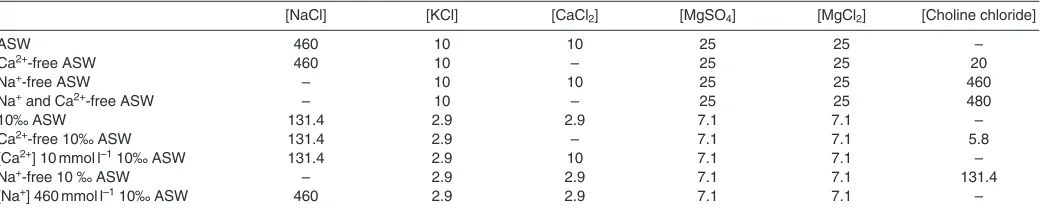
Artificial seawaters (ASW) at 35‰ and 10‰, with and without calcium, with and without sodium, and with and without choline were prepared with the composition shown in Table 1. Ranges of [Ca2+] (10–0 mmol l–1) or [Na+] (0–460 mmol l–1) at 35‰ or 10‰
were made up by appropriate mixing of these solutions. Choline chloride was used to maintain osmolality and [Cl–] in Ca2+- and
Na+-free solutions. Thus, the only difference in ionic composition between ASW and Na+- and/or Ca2+-free ASW is that Ca2+and Na+
were replaced by choline. Control experiments using Ca2+- and Na+ -free ASW without choline and ASW plus 20 mmol l–1 choline
chloride as a stimulus were also carried out.
When testing the olfactory sensitivity in the absence of external Ca2+, the background water perfusing the olfactory epithelium was Ca2+-free ASW (10‰ or 35‰ as appropriate). When assessing the
olfactory sensitivity in the absence of external Na+, the background water superfusing the olfactory epithelium was Na+-free ASW (10‰
or 35‰ as appropriate). When assessing the effect of different [Na+] on the olfactory response to changes in [Ca2+], the background [Na+]
was held constant at a given concentration (ranging from 0 to 460 mmol l–1); the response was recorded to a reduction in [Ca2+]
from 10 to 0 mmol l–1. Conversely, when assessing the effect of different [Ca2+] on the response to Na+, the background [Ca2+] was
[image:2.612.47.568.616.721.2]held at a given level (ranging from 0 to 10 mmol l–1) and the response
Table 1. Composition of artificial seawaters (ASW) used in the current study
[NaCl] [KCl] [CaCl2] [MgSO4] [MgCl2] [Choline chloride]
ASW 460 10 10 25 25 –
Ca2+-free ASW 460 10 – 25 25 20
Na+-free ASW – 10 10 25 25 460
Na+and Ca2+-free ASW – 10 – 25 25 480
10‰ ASW 131.4 2.9 2.9 7.1 7.1 –
Ca2+-free 10‰ ASW 131.4 2.9 – 7.1 7.1 5.8
[Ca2+] 10 mmol l–110‰ ASW 131.4 2.9 10 7.1 7.1 –
Na+-free 10 ‰ ASW – 2.9 2.9 7.1 7.1 131.4
[Na+] 460 mmol l–110‰ ASW 460 2.9 2.9 7.1 7.1 –
to an increase in [Na+] from 0 to 460 mmol l–1was recorded. These experiments were only carried out in fish adapted to 35‰ seawater. The ranges of concentrations of the three amino acids were prepared with the same water perfusing the olfactory epithelium (35‰ or 10‰ ASW as appropriate). To assess the absence of either Ca2+or Na+on the olfactory responses to amino acids, they were
made up in Ca2+-free ASW or Na+-free ASW (35‰ or 10‰ as appropriate); the same water was used as background.
Data normalisation and statistical analysis
The amplitude of each integrated EEG response was blank subtracted (using the appropriate blank solution). For the [Ca2+], [Na+] and
amino acid concentration/response curves, integrated response amplitudes were normalised to that of 10–3mol l–1
L-cysteine. The
bulbar response to 10–3mol l–1L-cysteine (in 35‰ ASW or 10‰ ASW as appropriate) was checked at regular intervals throughout the recording period. Bulbar EEG responses to changes in external [Ca2+] were fitted to a three-parameter Hill equation as previously
described (Hubbard et al., 2000) to obtain the apparent IC50
(concentration giving a 50% maximal response), Hill co-efficient and Imax(maximum response) values. Apparent IC50and Imaxvalues
(log transformed) were compared using Student’s t-test. For the effect of variations of external Na+or Ca2+on olfactory sensitivity to these ions and amino acids, the integrated response amplitude in the absence of either ion was normalised to control responses recorded in the presence of both ions (at 35‰ or 10‰ as appropriate). Differences in responsiveness to amino acids and sodium between 35‰ and 10‰ were assessed by linear regression
Ca2+-free ASW (35‰)
100 mV
50 µV
2 s
200 ms
35‰ 10‰
Ca2+-free ASW (10‰)
10 mV
10 µV
2 s
200 ms
Salinity
Nor
m
a
li
s
ed integ
r
a
ted re
s
pon
s
e
IC
50
(mmol l
–1
)
[Ca2+] (mmol l–1)
10‰ 35‰
Salinity
Ima
x
10‰ 35‰
2.5
2.0
1.5 1.2
1.0
0.8
0.6
0.4
1.6
1.4
1.2
1.0
0.8
0.6
0.4
0.2
0 0.2
0
1.0
0.5
0.1 1 10
0
**
D
C
E
A
B
Fig. 1. Typical electro-encephalogram (EEG)of log-transformed data (Hubbard et al., 2003; Velez et al., 2005) and comparing both the slopes and elevations of the regressions (Zar, 1996). For the effect of the absence of external Ca2+and Na+ on bulbar responses to amino acids, the data were analysed by repeated-measures analysis of variance (ANOVA) followed by Dunnett’s test (SigmaStat 2000, SPSS Science, Chicago, IL, USA). In all cases, P<0.05 was taken to represent statistical significance.
RESULTS
Olfactory responses to changes in environmental [Ca2+]
Sole responded to a reduction of [Ca2+] in ASW with an increase of EEG wave amplitude in the olfactory bulb (Fig. 1A,B); this increase was significantly higher in fish at 35‰ seawater than those adapted to 10‰ (Fig. 1C–E). At 10‰, the apparent IC50 was
1.52±0.49 mmol l–1Ca2+(mean ± s.e.m., N=8) with a Hill co-efficient of –1.8±0.5 and an Imax of 0.61±0.09. At 35‰, the olfactory
sensitivity to reductions in environmental [Ca2+] was slightly higher, as reflected by a lower IC50of 0.66±0.17 mmol l–1(mean ± s.e.m.,
N=8), a Hill coefficient of –1.3±0.2 and a higher Imaxof 1.34±0.17.
However, only the Imaxwas statistically different between 35‰ and
10‰ adapted fish (Fig. 1E). During stimulation with reductions in external [Ca2+], EEG wave frequency in the olfactory bulb was
similar to basal bulbar activity and there were no significant differences between 35‰ and 10‰ adapted fish (data not shown).
Substitution of CaCl2 with choline chloride did not affect the
responses; neither changes in osmolality nor [Cl–] are responsible
for the observed responses (data not shown).
Olfactory sensitivity to changes in environmental [Na+] As with Ca2+, during stimulation with Na+, EEG wave frequency
in the olfactory bulb was similar to basal bulbar activity, neither were there differences between 10‰ and 35‰ seawater. However, sole responded to increases of external [Na+] with a marked increase in wave amplitude in the olfactory bulb (Fig. 2A,B). This increase in amplitude was significantly higher in fish adapted to 10‰ seawater than in those kept at 35‰ (Fig. 2C). In contrast to the responses to changes in [Ca2+], bulbar responses were only seen to increases in external [Na+]; reduction of external [Na+] failed to
evoke any response at the two salinities tested (Fig. 2D). As the bulbar responses to increases of external [Na+] showed no sign of
reaching a maximum, even at 460 mmol l–1, concentration/response curves could not be fitted to a conventional three-parameter Hill equation. The concentration/response curves to changes in [Na+] at 35‰ and 10‰ ASW were, nevertheless, statistically different in both the slopes and elevations of the regressions (Fig. 2C). Substitution of NaCl with choline chloride did not evoke any response; neither changes in osmolality nor [Cl–] were responsible for the observed responses (data not shown).
460 mmol l–1 Na+ 460 mmol l–1 Na+
10 mV
10 mV
2 s
200 ms
35‰ 10‰
100 mV
50 µV
5 mV
5 µV
2 s
2 s 200 ms
Na+-free ASW
Nor
m
a
li
s
ed integ
r
a
ted re
s
pon
s
e
[Na+] (mmol l–1)
3.0
2.5
2.0
1.5
1.0
0.5
0
10 50 100 500
D
C
A
B
***Elevation
***Slope
Effect of absence of external Ca2+and Na+on olfactory
sensitivity
At 10‰, the absence of external Ca2+did not alter bulbar responses
to increases in external [Na+] (Fig. 3). However, at 35‰, bulbar responses to increases in external [Na+] increased more than
threefold in the absence of external Ca2+compared with control. Conversely, the absence of external Na+completely attenuated the
bulbar response to decreases in external [Ca2+] at both salinities (Fig. 3). The bulbar responses to reductions (10 mmol l–1to 0) of
external [Ca2+] at different background (i.e. continuous) [Na+] levels were severely blunted when the external [Na+] was below
46 mmol l–1. Above this [Na+], the amplitude of bulbar responses to decreases in external [Ca2+] increased exponentially with
background [Na+] (Fig. 4A). Conversely, the dependence of bulbar responses to increases in external [Na+] (from 0 to 460 mmol l–1)
showed the opposite trend. At low background [Ca2+] levels (0.1–0.2 mmol l–1), responses to Na+were similar to those in the
absence of external Ca2+(Fig. 4B). However, at a background [Ca2+] of 0.5 mmol l–1or more, the bulbar responses to increases in external
[Na+] became progressively smaller. Nevertheless, bulbar responses to Na+were never completely attenuated; even at a background
[Ca2+] of 9 mmol l–1, appreciable responses to increases in external [Na+] were recorded.
Olfactory sensitivity to amino acids
Stimulation of the olfactory epithelium with L-cysteine evoked an increase of EEG wave amplitude in the olfactory bulb in a concentration-dependent manner (Fig. 5A). However, there was no apparent effect of salinity on the concentration/response curve to
L-cysteine (Fig. 5C). Bulbar EEG wave frequency in response to stimulation with L-cysteine was similar to basal activity with no
differences between 35‰ and 10‰ adapted fish, and the EEG wave-forms evoked by L-cysteine were similar to those evoked by
changes in [Ca2+] and [Na+]. Similarly, there were no statistically significant effects of salinity on the olfactory sensitivity to amino acids glycine and L-phenylalanine (Figs 6 and 7). Bulbar responses to amino acids in both salinities did not reach a maximum, even at 1.0 mmol l–1.
The effects of the absence of external Ca2+or Na+on olfactory
sensitivity to amino acids were similar for all three amino acids tested (Fig. 8). The bulbar responses to amino acids at both salinities were not altered by the absence of external Ca2+whereas the absence of Na+markedly decreased the amplitude of bulbar responses to all
three amino acids (to about 20% of control) at 35‰ but not at 10‰.
DISCUSSION
Olfactory sensitivity to Ca2+and Na+
The current study shows that the olfactory system of the sole responds to decreases in environmental [Ca2+] and increases in
environmental [Na+]. Both ions evoked large-amplitude, low-frequency (~10 Hz) wave activity in the olfactory bulb, similar to that previously described in goldfish (Hubbard and Canário, 2007) and similar to that evoked by ‘conventional’ odorants, such as amino acids, in the sole. The response to decreases in [Ca2+] was also similar to, albeit slightly more sensitive than, that of the seabream in terms of the apparent IC50 (seabream; 1.7 mmol l–1, sole;
0.7 mmol l–1) and amplitude (Hubbard et al., 2000); this may be due
to the different recording methods used (i.e. multi-unit recording from the olfactory nerve and bulbar EEG, respectively). However, continual exposure of the olfactory epithelium of the seabream to Ca2+-free ASW caused a decrease in the apparent IC
50to 0.5 mmol l–1
(i.e. increased sensitivity); in the sole, adaptation to 10‰ seawater reduced the sensitivity (apparent IC50; 1.5 mmol l–1) and amplitude 500
400
Odorant
%
Control re
s
pon
s
e
300
200
100
0
Na+ Ca2+
35‰ 10‰
**
** **
Fig. 3. Effect of the absence of external Ca2+on the olfactory bulbar response to Na+(0 to 460 mmol l–1; left bars) and the absence of external Na+on the olfactory bulbar response to Ca2+(10 mmol l–1to 0; right bars) recorded from sole adapted to 35‰ (closed bars) or 10‰ (open bars) seawater. Data are shown as means ± s.e.m. (N=6). **P<0.01 compared with control (with Na+-free artificial seawater (ASW) and Na+-free 10‰ ASW as background, in the case responses to Na+, and ASW or 10 mmol l–1[Ca2+] 10‰ ASW as background, in the case of responses to Ca2+). Note that the absence of external Na+attenuated the bulbar response to changes in [Ca2+], independent of salinity whereas the bulbar responses to changes in [Na+] are increases in the absence of Ca2+in fish adapted to 35‰ but not 10‰ seawater.
1.2
1.0
0.8
0.6
4.6 9.2 23
Background [Na+] (mmol l–1) Background [Ca2+] (mmol l–1)
Nor
m
a
li
s
ed integ
r
a
ted re
s
pon
s
e
46 92 230 414 0.4
0.2
0
A
1.61.4
1.2
1.0
0.8
0.6
0.4
0.1 0.2 0.5 1.0 2.0 5.0 9.0
B
Fig. 4. (A) Semi-logarithmic plot showing the effect of increasing background [Na+] on the olfactory bulbar response to changes in external [Ca2+] (10 mmol l–1 to 0) in the sole (N=4). (B) Semi-logarithmic plot of pooled data showing the effect of increasing background [Ca2+] on the olfactory bulbar response to changes in external [Na+] (0 to 460 mmol l–1). Data are shown as means ± s.e.m. (N=4). Bothof the response. This discrepancy may be explained by the effect of Na+ on the olfactory response to Ca2+, because the olfactory
response to changes in environmental [Ca2+] is decreased by low external [Na+]. The olfactory response to reductions of external
[Ca2+] was recorded against a background [Na+] of 460 mmol l–1in the seabream (Hubbard et al., 2000) whereas the olfactory response of sole adapted to 10‰ seawater was recorded against a background [Na+] of 131 mmol l–1. Further work will clarify whether this change
in sensitivity reflects an active adaptation on the part of the olfactory system to lower environmental [Ca2+] (i.e. the sensitivity to a given
stimulus is ‘tuned’ to its prevailing intensity) or if it can be explained simply as a direct result of the lower [Na+] of 10‰ seawater (see
below).
The olfactory system of sole responded to increases in environmental [Na+] in a similar way to freshwater-reared salmon and goldfish (Bodznick, 1978; Hubbard et al., 2002). As far as the authors are aware, this is the first time that an olfactory response to changes in environmental [Na+] has been documented in a marine
fish. In contrast to the response to changes in external [Ca2+], the olfactory system did not respond to decreases in external [Na+] but
only to increases. The functional significance of this observation remains unclear. Nevertheless, the sensitivity to changes in [Na+]
was increased by adaptation to low salinity (10‰). This contrasts directly with the effect of increasing [Ca2+] on the olfactory
sensitivity to Na+in the goldfish (Hubbard and Canário, 2007), where increasing the background [Ca+] reduced the sensitivity to
Na+. Clearly, the ion levels of seawater and freshwater are very different, this discrepancy between the olfactory responses of marine and freshwater fish probably depends on the exact mechanisms involved (see below).
Detection mechanisms for Ca2+and Na+
It has been suggested that the olfactory sensitivity of fish to Ca2+ is mediated by a Ca2+-sensing receptor (Ca2+-SR) (Hubbard et al.,
2002), similar to that cloned from bovine parathyroid gland (Brown et al., 1993); this receptor is present in the olfactory epithelia of several fish (Hubbard et al., 2002; Nearing et al., 2002). Nevertheless, calcium is not the only ligand of the Ca2+-SR; it also
binds other divalent and trivalent cations, including Mg2+(present in seawater at ~50 mmol l–1), although its affinity for Mg2+is much
lower than that for Ca2+(Chang and Shoback, 2004). Consistent with this, the olfactory sensitivity of goldfish to changes in external [Mg2+] is correspondingly less (Hubbard et al., 2002) and the sensitivity to reductions in [Ca2+] in the seabream remains acute
despite the continued presence of 50 mmol l–1Mg2+(Hubbard et al., 2000). Olfactory sensitivity to Mg2+and the effect of Mg2+on the
sensitivities to Ca2+and Na+were not investigated in the present study.
10–3 mol l–1L-cysteine 10–3 mol l–1L-cysteine
Log[L-cysteine] 200 mV
100 µV
200 mV
100 µV 2 s
200 ms
2 s
200 ms
35‰ 10‰
Nor
m
a
li
s
ed integ
r
a
ted re
s
pon
s
e
1.2
1.0
0.8
0.6
0.4
–8 –7 –6 –5 –4 –3
0.2
0
C
A
B
Fig. 5. Typical EEG recordings(middle trace) from the olfactory bulb in response to 10–3mol l–1
The affinity for Ca2+of the mammalian Ca2+-SR is reduced by
elevated extracellular [Na+] (Quinn et al., 1998) possibly due to ‘shielding’ of the Ca2+-binding site by Na+ ions (Loretz, 2008).
Similarly, the olfactory sensitivity of the goldfish to changes in [Ca2+] is reduced by increasing environmental [Na+] (Hubbard and
Canário, 2007). However, in the sole, increased environmental [Na+] increased the olfactory sensitivity to changes in [Ca2+]. This may
be due to a reliance on external Na+ions of the transduction pathway for the sensitivity to external Ca2+. To resolve this, investigation of
the transduction pathway(s) involved is necessary. Alternatively, the olfactory Ca2+-SR of both marine and freshwater teleosts may
be different from the mammalian Ca2+-SR. Extracellular pH also affects the affinity of the Ca2+-SR to Ca2+(Quinn et al., 2004); how
changes in environmental pH affect olfactory sensitivity to Ca2+
awaits investigation.
In mammals, activation of the Ca2+-SR elicits a variety of
G-protein-mediated intracellular signals, including activation of phospholipase C (PLC), cytosolic phospholipase A2 (cPLA2),
phosphatidyl inositol 4-kinase (PI4K), mitogen-activated (MAP)
kinases (extracellular-signal-regulated kinase, ERK, and Jun amino-terminal kinase, JNK) and the inhibition of adenylate cyclase (AC) (Breitwieser, 2008; Hofer and Brown, 2003). Assuming that responses to Ca2+are mediated by a Ca2+-SR, a possible explanation for the olfactory sensitivity of sole to decreases of [Ca2+] is that, in
seawater, there is a high level of receptor occupancy and, consequently, AC activity is inhibited. As the external [Ca2+] log[Glycine]
35‰ 10‰
Nor
m
a
li
s
ed integ
r
a
ted re
s
pon
s
e
1.4
1.2
1.0
0.8
0.6
0.4
0.2
0
–8 –7 –6 –5 –4 –3
Fig. 6. Semi-logarithmic plot of pooled data (N=6) showing the olfactory responses of sole to 10–3mol l–1glycine in 10‰ artificial seawater (ASW) (open circles) and ASW (35‰; closed circles) in fish adapted to 10‰ and 35‰ seawater, respectively. Data are shown as means ± s.e.m. (N=6). No statistically significant differences were found between the slope (P>0.50) or elevation (0.10<P<0.20) of the regression curves fitted to the data at the two different salinities.
log[L-phenylalanine]
35‰ 10‰
Nor
m
a
li
s
ed integ
r
a
ted re
s
pon
s
e
1.0
0.8
0.6
0.4
0.2
0
–8 –7 –6 –5 –4 –3
Fig. 7. Semi-logarithmic plot of pooled data (N=6) showing the olfactory responses of sole to 10–3mol l–1
L-phenylalanine in 10‰ artificial seawater (ASW) (open circles) and ASW (35‰; closed circles) in fish adapted to 10‰ and 35‰ seawater, respectively. Data are shown as means ± s.e.m. (N=6). No statistically significant differences were found between slope (P>0.50) or elevation (P>0.50) of the regression curves fitted to the data at the two different salinities.
Salinity
%
Control re
s
pon
s
e
35‰ 10‰ 1.0
0.8
0.6
0.4
0.2
0 1.2
**
**
C
35‰ 10‰ 1.0
0.8
0.6
0.4
0.2
0 1.2
A
**
35‰ 10‰ 1.0
0.8
0.6
0.4
0.2
0 1.2
B
Ca2+ free
Na+ free
Fig. 8. Effect of the absence of external Ca2+(closed bars) or Na+(open bars) on the olfactory bulbar responses to 10–3mol l–1(A)
decreases, Ca2+ is released from the receptor and AC becomes activated, leading to olfactory neurone depolarisation. In contrast to the goldfish (Hubbard and Canário, 2007), olfactory responses to changes in [Ca2+] in the sole are increased by increasing external
[Na+]; in the absence of external Na+, olfactory sensitivity to Ca2+ is completely abolished. Thus, in the sole, olfactory sensitivity to Ca2+depends on the presence of external Na+.
Na+has a negative effect on the activation of mammalian Ca2+
-SR by Ca2+, possibly by competition with Ca2+ions for the Ca2+ -binding site (Quinn et al., 1998). Thus, decreasing [Na+] leads to a
higher activation of the Ca2+-SR by a given increase in [Ca2+] and a subsequent increase in sensitivity. This may explain why increasing [Na+] attenuates olfactory sensitivity to changes in [Ca2+] in the goldfish (Hubbard and Canário, 2007). Given that the olfactory system of the sole responds to decreases in external [Ca2+] and, presumably, to disassociation of Ca2+ions from the Ca2+-SR, the
higher [Na+] of 35‰ seawater may reduce the affinity of the receptor for Ca2+ ions and make this dissociation more likely, thereby
increasing olfactory sensitivity to changes in [Ca2+]. Activation of non-selective cation channels by Ca2+-SR has been described in
hippocampal pyramidal cells (Ye et al., 1996a; Ye et al., 1996b). This could explain the abolishment of olfactory response to Ca2+
in the absence of Na+and the higher olfactory sensitivity to Ca2+ recorded in sole adapted to 35‰ compared with those adapted to 10‰ seawater; external Na+ ions may be necessary for the transduction of the response to Ca2+.
The sole has olfactory sensitivity to increases in external [Na+] but to decreases in external [Ca2+]; however, the olfactory responses
to changes in [Na+] seem to be mediated by a different mechanism
from those to changes in [Ca2+]. Furthermore, the
concentration/response curve to changes in external [Ca2+] is sigmoidal, suggesting a receptor-mediated mechanism whereas the concentration/response curve to [Na+] does not reach a maximum (within the range of concentrations tested), suggesting that responses to Na+could be channel-mediated (Hubbard and Canário, 2007). In addition, if both Ca2+and Na+responses were due to activation
of the same cells, the absence of Ca2+ would depolarise these neurones; thus, inhibiting responses to Na+whereas decreases of
background [Ca2+] have the opposite effect on olfactory sensitivity to Na+. Furthermore, high external [Na+] would inhibit sensitivity
to Ca2+. In sole, however, the absence of external Ca2+increases olfactory bulbar responses to Na+whereas responses to Ca2+are
attenuated by low external [Na+]. We suggest that olfactory responses to Na+are mediated by a channel that allows the influx
of Na+ions and, possibly, other cations. Ca2+ions may also enter this channel but, instead of entering the cell, remain in the pore and block it. The existence of Na+-activated non-selective cation channels has been shown in the olfactory receptor neurones of lobsters (Zhainazarov and Ache, 1998; Zhainazarov et al., 1998); these Na+-activated channels are (as are other Na+-activated channels
from different systems) blocked by Ca2+ (Armstrong and Cota, 1999).
Olfactory sensitivity to amino acids
Fish, in general, have high olfactory sensitivity to amino acids (Hara, 1994; Michel, 2006) and the sole is no exception (Velez et al., 2005; Velez et al., 2007b). The slightly higher sensitivity of sole to amino acids reported in the current study may simply be a reflection of the different method used; previous studies used the EOG, which is likely to underestimate the true sensitivity due to the shunting effect of seawater (Velez et al., 2005). Recording from the olfactory bulb (EEG) eliminates this problem and allows a direct comparison
of sensitivity at different salinities. Sole are able to maintain olfactory sensitivity to amino acids independently of external salinity; no differences were seen between the bulbar responses to
L-cysteine, L-phenylalanine and glycine at 35‰ and 10‰ with
thresholds of detection around 10–7–10–8mol l–1in all cases. This is consistent with previous studies with euryhaline salmonids (Shoji et al., 1994; Shoji et al., 1996) and would be expected for a fish, such as sole, that often penetrates estuaries in order to feed (Cabral, 2000). Nevertheless, the olfactory transduction mechanism(s) must somehow adapt to the lower availability of Na+in estuarine water;
at 35‰, the olfactory response to amino acids is dependent on external Na+but is independent of Na+at 10‰. Whether this is
achieved by regulating the ionic component of the mucus layer overlying the olfactory epithelium as in mammals (Schild and Restrepo, 1998) or by shifting the transduction pathway to use extracellular (rather than external) Na+ is not yet known. In the
seabream, exposure of the olfactory epithelium to Ca2+-free ASW caused a temporary diminution of the response to L-serine,
suggesting some reliance of the transduction mechanism on external Ca2+ which, again, could be overcome (Hubbard et al., 2000).
Olfactory responses of the sole to amino acids are apparently independent of external Ca2+. This may reflect different ion channels
(Na+-selective or Ca2+-selective) being involved in the transduction mechanisms of the different species. The olfactory transduction pathways in sole are currently under investigation.
Possible environmental implications
For a fish that enters waters of reduced salinity to feed, such as the sole, it would be important to maintain olfactory sensitivity to amino acids. The current study suggests that sole are able to do so but that this requires some modulation of the olfactory system in that reliance on external Na+is reduced as it adapts to reduced salinity. How this
is achieved will be the subject of further studies. Sensitivity to reductions in environmental [Ca2+], however, may serve as a proxy
for reductions in salinity (Hubbard et al., 2000; Nearing et al., 2002), either to warn the fish that it may be reaching the limit of its osmoregulatory tolerance and/or regulate the osmoregulatory mechanisms themselves. As reduced salinity reduces the sensitivity to reductions in environmental [Ca2+], the sole may then seek out water of higher salinity by using its sensitivity to increases in environmental [Na+]. These hypotheses wait further testing.
Conclusion
The olfactory system of sole responds to decreases in environmental [Ca2+] but increases in [Na+]. Sensitivity to Ca2+is higher at 35‰ but that to Na+is higher in 10‰ seawater. Although the sensitivities
to the two ions are mediated by apparently different mechanisms, changes in the background levels of one affect the sensitivity to the other; sensitivity to changes in environmental [Ca2+] are dependent on external Na+whereas olfactory responses to Na+are
reduced by increasing [Ca2+]. Olfactory sensitivity to amino acids is unaffected by reduced salinity. However, at 35‰, the absence of external Na+(but not Ca2+) markedly reduces the response to amino acids. At 10‰ the response to amino acids depends on neither external Ca2+ nor Na+. This suggests that the olfactory system must adapt to lower salinities by reducing the dependence on environmental Na+.
LIST OF ABBREVIATIONS
AC adenylate cyclase
Ca2+-SR calcium-sensing receptor
cPLA2 cytosolic phospholipase A2
EEG electro-encephalogram EOG electro-olfactogram
ERK extracellular-signal-regulated kinase IC50 concentration giving a 50% maximal response Imax maximum response
JNK Jun amino-terminal kinase MAP kinase mitogen-activated protein kinase PI4K phosphatidyl inositol 4-kinase
PLC phospholipase C
This work was supported by grants from the Portuguese National Science Foundation and European Union Social Funds for Regional Development (grant numbers: POCI/BIA-BMC/55467/2004 and SFRH/BD/16242/2004) funded by European Union FSE/FEDER and Ministério da Ciência e do Ensino Superior.
REFERENCES
Armstrong, C. M. and Cota, G.(1999). Calcium block of Na+channels and its effect
on closing rate. Proc. Natl. Acad. Sci. USA 96, 4154-4157.
Bayarri, M. J., Muñoz-Cueto, J. A., López-Olmeda, J. F., Vera, L. M., Rol de Lama,
M. A., Madrid, J. A. and Sánchez-Vázquez, F. J.(2004). Daily locomotor activity
and melatonin rhythms in Senegal sole (Solea senegalensis). Physiol. Behav. 81, 577-583.
Bodznick, D.(1978). Calcium ion: an odorant for natural water discriminations and the
migratory behavior of sockeye salmon. J. Comp. Physiol. A127, 157-166.
Breitwieser, G. E.(2008). Extracellular calcium as an integrator of tissue function. Int.
J. Biochem. Cell Biol. 40, 1467-1480.
Brierley, M. J., Ashworth, A. J., Banks, J. R., Balment, R. J. and McCrohan, C. R. (2001). Bursting properties of caudal neurosecretory cells in the flounder Platichthys flesus, in vitro. J. Exp. Biol. 204, 2733-2739.
Brown, E. M., Gamba, G., Riccardi, D., Lombardi, M., Butters, R., Kifor, O., Sun,
A., Hediger, M. A., Lytton, J. and Hebert, S. C.(1993). Cloning and
characterization of an extracellular Ca2+-sensing receptor from bovine parathyroid.
Nature366, 575-580.
Cabral, H. N.(2000). Comparative feeding ecology of sympatric Solea solea and S.
senegalensis, within nursery areas of the Tagus estuary, Portugal. J. Fish Biol. 57, 1550-1562.
Chang, W. and Shoback, D.(2004). Extracellular Ca2+-sensing receceptors-an
overview. Cell Calcium35, 183-196.
Dinis, M. T., Ribeiro, L., Soares, F. and Sarasquete, C.(1999). A review on the
cultivation potential of Solea senegalensis in Spain and in Portugal. Aquaculture176, 27-38.
Hara, T. J.(1994). The diversity of chemical stimulation in fish olfaction and gustation.
Rev. Fish Biol. Fish. 4, 1-35.
Hofer, A. M. and Brown, E. M.(2003). Extracellular calcium sensing and signalling.
Nat. Rev. Mol. Cell Biol. 4, 530-538.
Hubbard, P. C. and Canário, A. V. M.(2007). Evidence that olfactory sensitivities to
calcium and sodium are mediated by different mechanisms in the goldfish Carassius auratus. Neurosci. Lett. 414, 90-93.
Hubbard, P. C., Barata, E. N. and Canário, A. V. M.(2000). Olfactory sensitivity to
changes in environmental [Ca2+] in the marine teleost Sparus aurata. J. Exp. Biol.
203, 3821-3829.
Hubbard, P. C., Ingleton, P. M., Bendell, L. A., Barata, E. N. and Canário, A. V. M. (2002). Olfactory sensitivity to changes in environmental [Ca2+] in the freshwater
teleost Carassius auratus: an olfactory role for the Ca2+-sensing receptor? J. Exp.
Biol. 205, 2755-2764.
Hubbard, P. C., Barata, E. N. and Canário, A. V. M.(2003). Olfactory sensitivity to
catecholamines and their metabolites in the goldfish. Chem. Senses28, 207-218.
Loretz, C. A.(2008). Extracellular calcium-sensing receptors in fishes. Comp.
Biochem. Physiol. 149A, 225-245.
Menini, A.(1999). Calcium signalling and regulation in olfactory neurons. Curr. Opin.
Neurobiol. 9, 419-426.
Michel, W. C.(2006). Chemoreception. In The Physiology of Fishes (ed. D. H. Evans
and J. B. Claiborne), pp. 471-497. Boca Raton, FL: CRC Press.
Nakamura, T.(2000). Cellular and molecular constituents of olfactory sensation in
vertebrates. Comp. Biochem. Physiol. 126A, 17-32.
Nearing, J., Betka, M., Quinn, S., Hentschel, H., Elger, M., Baum, M., Bai, M.,
Chattopadyhay, N., Brown, E. M., Hebert, S. C. et al.(2002). Polyvalent cation
receptor proteins (CaRs) are salinity sensors in fish. Proc. Natl. Acad. Sci. USA 99, 9231-9236.
Quinn, S. J., Kifor, O., Trivedi, S., Diaz, R., Vassilev, P. and Brown, E.(1998).
Sodium and ionic strength sensing by the calcium receptor. J. Biol. Chem. 273, 19579-19586.
Quinn, S. J., Bai, M. and Brown, E. M.(2004). pH sensing by the calcium-sensing
receptor. J. Biol. Chem. 279, 37241-37249.
Schild, D. and Restrepo, D.(1998). Transduction mechanisms in vertebrate olfactory
receptor cells. Physiol. Rev. 78, 429-466.
Shoji, T., Fujita, K. I., Ban, M., Hiroi, O., Ueda, H. and Kurihara, K.(1994). Olfactory
responses of chum salmon to amino acids are independent of large differences in salt concentrations between fresh and sea water. Chem. Senses19, 609-615.
Shoji, T., Fujita, K. I., Furihata, E. and Kurihara, K.(1996). Olfactory responses of a
euryhaline fish, the rainbow trout: adaptation of olfactory receptors to sea water and salt-dependence of their responses to amino-acids. J. Exp. Biol. 199, 303-310.
Velez, Z., Hubbard, P. C., Barata, E. N. and Canário, A. V. M.(2005). Evidence for
functional asymmetry in the olfactory system of the Senegalese sole (Solea sensgalensis). Physiol. Biochem. Zool. 78, 756-765.
Velez, Z., Hubbard, P. C., Barata, E. N. and Canário, A. V. M.(2007a). Differential
detection of conspecific-derived odorants by the two olfactory epithelia of the Senegalese sole (Solea senegalensis). Gen. Comp. Endocrinol. 153, 418-425. Velez, Z., Hubbard, P. C., Hardege, J. D., Barata, E. N. and Canário, A. V. M. (2007b). The contribution of amino acids to the odour of a prey species in the Senegalese sole (Solea senegalensis). Aquaculture265, 336-342.
Velez, Z., Hubbard, P. C., Welham, K., Hardege, J. D., Barata, E. N. and Canário,
A. V. M.(2009). Identification, release and olfactory detection of bile acids in the
intestinal fluid of the Senegalese sole (Solea senegalensis) J. Comp. Physiol. A195, 691-698.
Ye, C., Kanazirska, M., Quinn, S., Brown, E. E. and Vassilev, P. M.(1996a).
Modulation by polycationic Ca2+-sensing receptor agonists of nonselective cation
channels in rat hippocampal neurons. Biochem. Biophys. Res. Commun. 224, 271-280.
Ye, C., Rogers, K., Bai, M., Quinn, S. J., Brown, E. M. and Vassilev, P. M.(1996b).
Agonists of the Ca2+-sensing receptor (CaR) activate nonselective cation channels in
HEK293 cells stably transfected with the human CaR. Biochem. Biophys. Res. Commun. 226, 572-579.
Zar, J. H.(1996). Biostatistical Analysis. Upper Saddle River, NJ: Pearson Higher
Education.
Zhainazarov, A. B. and Ache, B. W.(1998). Na+-gated nonselective cation channel
from lobster olfactory projection neurons. J. Neurophysiol. 80, 3387-3391.
Zhainazarov, A. B., Doolin, R. E. and Ache, B. W.(1998). Sodium-gated cation