International Journal of Emerging Technology and Advanced Engineering
Website: www.ijetae.com (ISSN 2250-2459, Volume 2, Issue 11, November 2012)392
Accurate Object Detection using Static Camera and Security
Alert to Mobile
D. Beulah David
1, Member, IEEE WIE
,
Dr. M. A. DoraiRangaswamy
2,
Member, IEEE WIE 1Research Scholar, Sathyabama University, Chennai
1Assistant Professor, Department of CSE, Jeppiaar Engineering College, Chennai 2Professor & Dean-CSE, Department of CSE, AVIT University, Chennai
Abstract - This paper gives an overview of the method for accurately detecting objects in video frames particularly in indoor environment such as safety locker rooms in jewelries. This stream is taken by static camera like web camera which handles scenes with illumination variation and shadows. The motion of the objects is determined for future works. Background subtraction is implemented for getting the difference between various image frames. Finally the moving objects such as persons are identified and security alert is made to the investigation bureau. The person’s images are identified and the information relevant to their entry and the burglary are sent to the police personals. The efficiency of the proposed methodology is demonstrated with the needed experimental results.
Keywords — Investigation Bureau, Web Camera, Background Subtraction, Object Tracking, Status Reporting
I. INTRODUCTION
Computer vision application fields like surveillance, monitoring, robot technology, gesture recognition and object recognition are enhanced by moving object detection and tracking. This approach is also used in the fields of traffic monitoring and visual surveillance. While detecting the objects in the scene, some may concentrate in the objects of the scene or some may pay interest only in monitoring the people present in the scene.
The motion detection algorithms are broadly classified into two main categories. They are feature based and optical flow based. In video surveillance, the first step is to detect the moving objects. Next step is to segment the video streams into moving components and background components, where moving objects provide attraction for object recognition. Then classification and activity analysis processes are done for making this process more efficient.
The main objective of tracking is to describe trajectories of moving objects during time analysis. But it is very difficult to track such objects because it is necessary to provide correspondence of objects in different frames. Some of such work is mentioned in the following sections.
The paper organization is given as follows. Section 2 describes the relevant work done in object detection of video frames.
Section 3 gives the view of proposed methodology. Section 4 deals with the experimental results and conclusion with future enhancements is described in Section 5.
II. RELEVANT WORK
The feature based tracking of objects have various methods and techniques for performing detection of objects. For accurate detection, suitable methods have to be followed which may affect the factors such as illumination changes over time and shadows of objects.
The contribution of researchers have been made in the areas of both indoor as well as outdoor environment scenes for tracking and detection of objects is high and they provide some solution for the aforementioned unsolved problems.
In [1], the robust and the efficient detection method based mainly on statistical and knowledge based is proposed by R.Cucchiara et.al. This method can handle situations where there is a change in luminance condition.
In [4], for detecting the contours of moving objects the researchers used color segmentation and non-parametric approach. In [5], Tang Sze Ling et. al., proposed a method of using color information for differentiating various objects and for handling occlusion.
In [6], S.J.Mckenna et.al proposed a method which detects people using mutual occlusions. They form groups using mutual occlusion and separating the groups from one another using the color information. In [7], I.Harintagin et.al., proposed an histogram based approach that locate the human body parts like head. Then using the head information, the number of people detected in the scene can be found out.
International Journal of Emerging Technology and Advanced Engineering
Website: www.ijetae.com (ISSN 2250-2459, Volume 2, Issue 11, November 2012)Along with color and motion, shape of an object also plays an important role in detecting the objects, where the shape is determined using parameterized rectangle or ellipse in [10].
In [12], the changes between two images taken in two different times are calculated using Hopfield Neural Network. In [13], the motion and features of person is tracked in videos using tag assignment.
III. PROPOSED METHODOLOGY
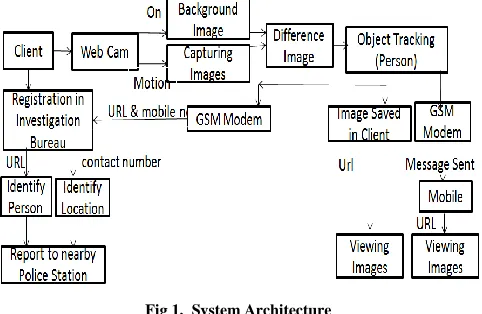
[image:2.612.49.290.333.490.2]Our algorithm aims in consistent identification of each object appears in the scene. The proposed methodology is implemented mainly in areas such as banks where safety lockers having money, ornaments and valuable treasures that need greater security. The structural design of our method is depicted in Fig.1.
Fig 1. System Architecture
Suppose the clients such as banks, jewelry shops and malls that need to provide security against burglary, the information such as client‘s name along with their contact information and landmark have to be registered with the investigation bureau. The database information of such clients are maintained secretly with such bureaus.
The proposed methodology is formulated as follows: those clients, who want to provide security for their concern, register themselves to the investigation bureau with the necessary information.
When the persons in the bank or shopping malls leave the place during night, the security system is switched ON. Initially the webcam took the background image.
Whenever any motion is detected, it captures the image and the difference between the background image and the current image is found. It is compared with the threshold value. If it is greater than the standard threshold value, it detects the object and it is the human being. If it detects the person, it immediately does
(i) Sent the message to the mobile using GSM Modem (ii) Saving the images in the client system itself.
(iii) Sending the mobile no. of the client and the specific URL where the image of the person stored are sent to the Information Bureau..
In the control room, using the mobile number information regarding the concern are viewed and the informed to the nearby police station. The steps involved in this motion detection are
3.1 Registration in investigation bureau
The clients those who want to provide security to their concerns have to register themselves with the information like Owner name, Shop or Corporate Name, Mobile number, Alternate Mobile number, Contact Address, Nearby Police Station, Land mark. Investigation Bureau will have all this information and if any burglary occurs they will provide the necessary security actions.
3.2 Background Subtraction
In video frames, the presence of noise reduces the efficiency of detection process. Preprocessing is the first and major step involved to reduce the noise over images. Mean filter is applied in such frames but as a result blurs the image frames. The presence of blur suppresses the presence of shadows in images.
The second step in object detection is the detection of motion. The most efficient method for this step is background subtraction. It is obtained by finding the difference between current image frame and the background image. This is easy to implement and also very simple. This step removes the foreground objects from the existing background image.
if Fore xy Back xy Totherwise i
i i
y
x
D
10,, ( , ) 1( , ) )
,
(
Where
D
i(
x
,
y
)
is the difference image between the current foreground image Fore(x,y)i and the background
image ( , )
1 x y Back
i as in [12]. This is compared with the
threshold T which suppresses shadows from image frames. Depending on the value of T, the suppressing of shadows varies.
International Journal of Emerging Technology and Advanced Engineering
Website: www.ijetae.com (ISSN 2250-2459, Volume 2, Issue 11, November 2012)394 Each and every moment is being recorded using web camera and when there is a sudden change in pixel intensity variation, it is considered as motion. The binary image is produced as a result of background subtraction which consists of background and moving pixels. Post processing can be done to improve the efficacy of binary image.
3.3 Object Tracking
Each and every frame is tracked to trace objects. The proposed methodology feature is to separate objects from the frame and identify the person who is present in that image frame. The motion blocks in the current frame are grouped as clusters. The matching information of motion blocks is compared between the current frame and the previous frame. By this comparison, people present in that frame are traced.
3.4 Status Reporting
The unauthorized people who entered near safety lockers are detected using web camera. Once identified, send message to the mobile of the client using GSM modem. At the same time save all the detected person images in client system. As burglary occurred in the respective concern, send the contact number of the client and the URL of the detected person‘s images are sent to the security personal of the investigation bureau.
3.5 Information Tracking And Security
The investigation security personals identify the information of the client using the contact details. Then the location of the client is identified by the information present in the database using contact number. The URL of the persons being tracked is sent to the investigation bureau. After identifying the exact location of the client concern, the information regarding the burglary is sent to the nearby police station.
IV. EXPERIMENTAL RESULTS
The experiment of detecting the object is conducted and tested in the indoor environment. Initially the client registers themselves in investigation bureau with the required information which is depicted in Figure 2.
[image:3.612.344.544.132.340.2]The web camera took the initial background image by starting the static camera and it is shown in Figure 3 and 4.
Fig. 2 Registration of User Information in PCR
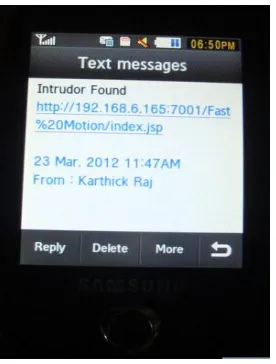
[image:3.612.329.557.433.700.2]Once the person is detected, the message is sent to client‘s mobile and the URL of those detected person‘s images are also sent, which is shown in Figure 5. This information is also sent to the investigation bureau. In figure 6, the images of those detected persons are also saved in the client‘s system.
Fig 3. Starting the Webcam
International Journal of Emerging Technology and Advanced Engineering
Website: www.ijetae.com (ISSN 2250-2459, Volume 2, Issue 11, November 2012)Fig 5. Message sent to client’s mobile
By the information received, the investigation bureau security personal login is opened and the relevant client information is retrieved and it is depicted in Figure 9.
We have implemented the above experiment in Java and the web camera is installed in the client‘s security system. The information of detected persons is sent to mobile using GSM Modem.
[image:4.612.349.536.362.482.2]Our proposed method is robust, scalable and provides efficiency over the existing methods. The processing time for object detection is also low when compared with previous methods.
Fig 6. Saving images of detected persons in Client System
Fig 7. Investigation Bureau login
V. CONCLUSION
[image:4.612.65.273.467.539.2]The milestone of the proposed method provides the robust methodology in background subtraction for real monitoring system. Our method also discusses the problems faced while separating the objects from the background image. For providing security to safety lockers in jewelries this is an efficient method.
Fig 8. Identification of client’s location
[image:4.612.67.251.518.710.2]The experimental results show that our method is providing the efficiency and overall good performance. This is scalable, low cost method and has faster processing time compared to existing methods.
[image:4.612.356.531.544.708.2]International Journal of Emerging Technology and Advanced Engineering
Website: www.ijetae.com (ISSN 2250-2459, Volume 2, Issue 11, November 2012)396 The enhancements can be made in the proposed methodology is to make them to enlarge this safety measures in banks where safety lockers contain documents and ornaments. This can also be extended in the areas of trade centers, malls, offices and even in residence.
In some cases, the theft happened in the banks involves people with masks. For this, thermal scanners can be included in the camera which scans the body of the burglar and then reproduce the structure of the person by which the theft can be avoided or literally it can be reduced.
REFERENCES
[1 ] R. Cucchiara, C. Grana, G. Neri, M. Piccardi and A. Prati, ―The Sakbot system for moving object detection and tracking,‖ Video-based Surveillance Systems-Computer vision and Distributed Processing, pp. 145-157, 2001.
[2 ] C. Stauffer and W. E. L. Grimson, ―Adaptive background mixture models for real-time tracking,‖ in Proc. IEEE Conf. Computer Vision and Pattern Recognition, 1999.
[3 ] C. Wren, A. Azarbayejani, T. Darrell, A. Pentl, ―Pfinder: Real-time tracking of the human body,‖ In IEEE Trans. Pattern Analysis and Machine Intelligent, vol 19, no. 7, pp. 780-785.
[4 ] L. Qiu and L. Li, ―Contour extraction of moving objects,‖ in Proc. IEEE Int‘l Conf. Pattern Recognition, vol. 2, 1998, pp. 1427–1432. [5 ] Tang Sze Ling, Liang Kim Meng, Lim Mei Kuan, Zulaikha Kadim
and Ahmed A. Baha‗a Al-Deen, ―Colour-based Object Tracking in Surveillance Application‖ in Proceedings of the International MultiConference of Engineers and Computer Scientists 2009 Vol I IMECS 2009, March 18 - 20, 2009, Hong Kong.
[6 ] S. J. McKenna, S. Jabri, Z. Duric, A. Rosenfeld and H. Wechsler, ―Tracking group of people,‖ Comput. Vis. Image Understanding, vol. 80, no. 1, pp. 42-56, 2000.
[7 ] I. Haritaoglu, D. Harwood, and L. S. Davis, ―W4: Real-time surveillance of people and their activities,‖ In IEEE Trans. Pattern Analysis and Machine Intelligent, vol. 22, no. 8, 2000, pp. 809-830. [8 ] A. Lipton, H. Fujiyoshi and R. Patil, ―Moving target classification
and tracking from real-time video,‖ In DARPA Image Understanding Workshop, pp. 129-136, November 1998.
[9 ] P. Pérez, J. Vermaak, and A. Blake, "Data fusion for tracking with particles," Proceedings of the IEEE, vol. 92, no. 3, pp. 495-513, (2004).
[10 ]C. Shen, A. van den Hengel, and A. Dick, "Probabilistic multiple cue integration for particle filter based tracking," in Proc. of the VIIth Digital Image Computing: Techniques and Applications. C. Sun, H. Talbot, S. Ourselin, T. Adriansen, Eds., 10-12, (2003).
[11 ]Wang, H., et al., "Adaptive object tracking based on an effective appearance filter". IEEE Transactions on Pattern Analysis and Machine Intelligence,(2007).
[12 ]Beulah David.D, B.V.Krishna, ―Comparison of Analog and Discrete Hopfield Neural Network for Image Change Detection‖, CIIT International Journal of Digital Image Processing , 2010.