doi:10.4236/ampc.2011.12006 Published Online September 2011 (http://www.SciRP.org/journal/ampc)
Temperature and Orientation Dependence of
Ultrasonic Parameters in Americium Monopnictides
Devraj Singh1*, Raj Kumar2, Dharmendra Kumar Pandey3 1
Department of Applied Sciences, Amity School of Engineering and Technology, New Delhi, India 2
Department of Physics, NIMS University, Jaipur, India 3
Department of Physics, P.P.N. P.G. College, Kanpur, India *
E-mail: dsingh1@aset.amity.edu
Received June 28, 2011; revised July 30, 2011; accepted August 10, 2011
Abstract
The temperature dependence of the ultrasonic parameters like ultrasonic velocities and Grüneisen parameters in americium monopnictides AmY (Y: N, P, As, Sb and Bi) have been studied for longitudinal and shear waves along <100>, <110> and <111> crystallographic directions in the temperature range 100 K - 500 K. The second- and third- order elastic constants have also been evaluated for these monopnictides using Cou-lomb and Born-Mayer potential. The values of elastic constants are the highest for AmN. Hence the me-chanical properties of AmN are better than other monopnictides AmP, AmAs, AmSb and AmBi. Ultrasonic velocity is found large for AmP. So the ultrasonic wave propagation will be much better than others in AmP. Obtained results are compared with available results of same type of materials.
Keywords:Americium Monopnictides, Coulomb and Born-Mayer Potential, Elastic Constants, Ultrasonic Velocity, Grüneisen Parameters
1. Introduction
Generally, a crystalline material has anisotropic proper-ties. Properties such as thermal expansion and conduc-tion, temperature dependence specific heat, temperature and pressure variation of elastic constants, damping of high frequency acoustic waves and damping of moving dislocations by phonon viscosity are determined by the intrinsic nonlinearity of solids. This emphasizes the im-portance of non-linear characteristics of solids. Recent developments in the experimental capabilities and theo-retical understanding have provided further impetus to the study of the non-linearity in solids [1].
Wave velocity is a key parameter in ultrasonic charac-terization and can provide information about crystallo-graphic texture. The ultrasonic velocity (V) is related to the elastic constant by the relation
The Grüneisen parameter is of considerable impor-tance to Earth’s scientists, because it sets limitations on the thermoelastic properties of lower mantle [3]. The study of Grüneisen parameters for a solid enable us to describe and discuss various physical properties of a system such as high temperature specific heats of lattice, thermal expansion, thermal conductivity and temperature variation of the elastic constants. The Grüneisen para- meters play a significant role in study of thermoelastic properties. It has fundamental importance to the equation of state and related to thermodynamic properties of the solids [4]. The calculation of anharmonic effects in solids such as thermal expansion or the interaction of acoustic and thermal phonons involves Grüneisen parameters, which describe the volume and strain dependence of the lattice vibrational frequencies. In the Debye model, these vibrations are replaced by standing wave modes of a dispersionless elastic continuum. The Grüneisen pa-rameters are then no longer frequency dependent and can be expressed in terms of second- and third- order elastic constants [5].
V= C , where C is the relevant elastic constant and is the density of that particular material. Particularly, the elastic constant pro-vides valuable information on stability and stiffness of the materials. The elastic constant of solids also provides a link between the mechanical and dynamical behaviours of crystals and gives important information concerning the nature of forces operating in solids [2].
ameri-cium monopnictides were investigated theoretically by Ghosh et al.[6]. The crystal structure of AmAs, AmSb and AmBi were determined by Roddy [7]. The 237Np emission spectra in 241Am: AmO2, AmAs and AmBi
sources have been reported by Friedt et al. [8]. The preparation and XRD of AmBi have been made by Gib-son and Haire [9]. Petit et al. calculated the electronic structure of Am monopnictides with the help of ab-initio self-interaction-correlated local spin density approxima-tion [10].
Ultrasonic study is non-destructive in nature and is helpful for the determination of inherent properties of materials. The elastic constants of materials are directly related to their microstructure and are used to obtain the Debye average velocity, Grüneisen parameter (GP) and other physical properties; and therefore, these are of great interest in applications where the mechanical strength and durability are important. To the best of our knowledge, no experimental or theoretical reports on ultrasonic velocity and Grüneisen parameters on these materials have been seen in the literature. The grounds mentioned above motivate us to choose these compounds for characterization through ultrasonic non-destructive evaluation technique. For which, we performed theoreti-cal investigation of elastic constants, ultrasonic velocities and Grüneisen parameters in Am monopnictides along <100>, <110> and <111> directions at temperature range 100 K - 500 K. The results provide reference data for experimentalists and open a new basis for further study.
2. Theory
The theory is categorized into three phases. In the first phase, temperature dependence of second- and third- order elastic constants (SOEC and TOEC) has been dis-cussed while temperature dependence ultrasonic velocity along different directions has been described in second phase. Temperature dependent Grüneisen parameters along <100>, <110> and <111> orientations have been clarified in the final phase.
2.1. Temperature Dependence of Higher Order Elastic Constants
Elastic properties of a solid are important because they relate to various fundamental solid-state properties such as interatomic potentials, equation of state and phonon spectra. Elastic properties are also linked thermody-namically to the specific heat, thermal expansion, Debye temperature, melting point and Grüneisen parameter. So, it is important to calculate elastic constants of solids. From the calculated elastic constants one can derive the anisotropy in the elastic properties.
The elastic energy density (U) is function of the strain
components.
xx yy zz yz zx xy
1 2 3 4 5 6
UF e , e , e , e , e , e F e , e , e , e , e , e (1)
where eij (i or j = x, y, z) is component of strain tensor.
The second (CIJ) and third (CIJK) order elastic constants
of material are defined by following expressions:
2
IJ
I J
U
C ; I or J 1, e e
, 6 (2)
3
IJK
I J K
U
C ; I or J or K 1, ,6 e e e
(3)
The elastic energy density is well related to interaction potential
r between atoms. The potential used for evaluation of SOEC and TOEC is taken as sum of Cou-lomb and Born-Mayer potentials.
r
C B (4) where
C is electrostatic/Coulomb potential and
Bis the repulsive/Born-Mayer potential, given as
e r 2
C and
B A exp
r b
. Here “e” is electronic charge, “r” is the nearest neighbour distance, “b” is the hardness parameter and “A” is the strength parameter.According to lattice dynamics developed by Leibfried and Ludwig [11] & Mori and Hiki [12], lattice energy changes with temperature. Hence, the addition of vibra-tional energy contribution to static elastic constants, one gets second and third order elastic constants (CIJ and CIJK)
at required temperature.
0 Vib 0 Vib
IJ IJ IJ IJK IJK IJK
C C C and C C C (5)
where superscript 0 has been used to denote SOEC and TOEC at 0 K (static elastic constants) and superscript Vib has been used to denote vibrational part of SOEC and TOEC at a particular temperature. The expressions of CIJ and CIJK are given in our previous paper [2].
2.2. Orientation Dependence of Ultrasonic Velocities
When sound wave propagates through a crystalline me-dium, there is three mode of propagation: one longitudi-nal acoustical (LA) and two transverse acoustical (TA). Thus, there exist three types of velocities as one longitu-dinal (VL) and two shear (VS1 and VS2). These velocities
depend on the direction of propagation of wave [13]. The expressions for direction dependent ultrasonic velocities in cubic crystals are as follows:
Along <100> crystallographic direction;
11 44
L S1 S2
C
V ; V V
d d
C
(6)
11 12 44 11 12 44
L S1 S2
C 2C 4C C C C
V ; V V
3d 3d
(7) Along <110> crystallographic direction;
11 12 44 44 11 12
L S1 S2
C C 2C C C C
V ; V ; V
2d d d
(8) The ultrasonic velocities can be worked out using cal-culated values of second order elastic constants. The Debye average velocity (VD) is useful for information of
Debye temperature and thermal relaxation time of the materials. The following expressions have been used for evaluation of Debye average velocity [13].
1/3
D 3 3
L S1
1/3
3 3 3
L S1 S2
along 100
1 1 2
V ;
and 111 direction
3 V V
1 1 1 1
; along 110 direction
3 V V V
(9)
2.3. Orientation Dependence of Ultrasonic Grüneisen Parameters
A number of anharmonic properties of solids are fre-quently expressed in terms of Grüneisen parameters that are expressed in quasiharmonic approximation as diverse weighted averages of Grüneisen tensor of the first order:
j 1
i i q
. For example, the thermal ex-pansivity is relative to the specific heat weighted
j
q q
C
q,i ,i
,iCq,i , which is thermalGrüneisen parameter . The shear (ultrasonic) Grüneisen parameter can be suitably expressed by thermal conduc-tivity weighted averages of the product j j
[14]. Brugger derived expressions for the components of Grüneisen tensor in terms of second- and third- order elastic constants of an anisotropic elastic continuum [15]. These relations permit the above weighted average to be reliably calculated from elastic and thermal data. The comparison of ultrasonic attenuation and non-linear pa-rameters evaluated with help of them, justifies the ex-pression of Grüneisen parameters [16]. Formulae of Grüneisen parameters along different crystallographic directions are given in literature [17].
3. Results and discussion
The second- and third- order elastic constants (SOEC and TOEC) have been evaluated using two basic parameters i.e., lattice parameter and hardness parameter. The lattice
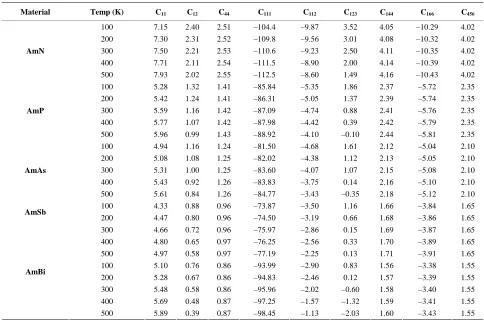
pa-rameters [6-10] for AmN, AmP, AmAs, AmSb and AmBi are 4.825 Å, 5.432 Å, 5.592 Å, 6.003 Å and 6.076 Å re-spectively and the values of hardness parameter are 0.293 Å, 0.301 Å, 0.302 Å, 0.303 Å and 0.271 Åfor AmN, AmP, AmAs, AmSb and AmBi respectively. The computed re-sults of temperature dependent SOEC and TOEC are listed in Table 1. We found no experimental/theoretical result of SOEC and TOEC of these materials directly in existing literature. So, we have compared our results with NaCl-type rare-earth monochalcogenides [18].
It is clear from the Table 1 that, out of nine elastic constants, four (i.e., C11, C44, C112 and C144) are
decreas-ing and other four (i.e., C12, C111,C166 and C123) are
in-creasing with the temperature while C456 is found to be
unaffected. The increase or decrease in stiffness con-stants is due increase or decrease in atomic interaction with temperature. If inter-atomic distance increases or decreases with temperature then interaction potential decreases/increases, which causes decrease or increase in stiffness constants. This type of behaviour has been found already in other NaCl-type materials like gadolin-ium and cergadolin-ium monopnictides [18,19]. The comparison justifies our calculations of second and third order elastic constants. There are no elastic data as a function of tem-perature for these compounds in literature. Most simple theories are able to get a reasonable estimate of elastic constants at room temperature only by using experimen-tal parameters. Table 1 depicts that AmN has highest valued SOEC and TOEC in contrast to other monopnic-tides. Hence mechanical influence of AmN is better than AmP, AmAs, AmSb and AmBi.
The stability of a cubic crystal is expressed in terms of elastic constants as:
11 12 11 12
T 44 S
C 2C C C
B 0, C 0 and C 0
3 2
.
CIJ are the conventional elastic constants, BT is the bulk
moduli. The quantities C44 and CS are the shear and
tetragonal moduli of a cubic crystal. Estimated values of bulk, shear and tetragonal moduli for AmN, AmP, AmAs, AmSb and AmBi at room temperature are presented in
Tables 1-2 that satisfies the above stability criterion for these materials.
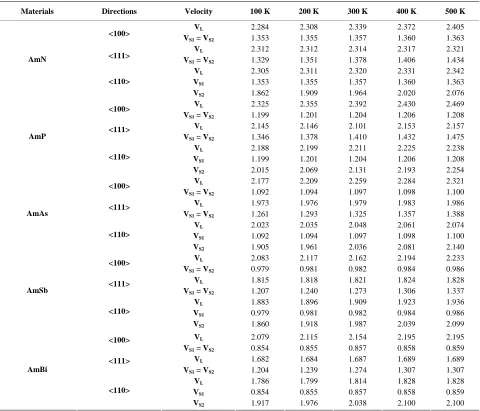
The ultrasonic velocity is a key factor to characterize the properties of material. It is directly related to SOEC and density of that particular material as shown in Eqs. (7-9). The evaluated velocities for longitudinal and shear waves are presented in Table 3 and the Debye average velocities are shown in Figures 1-3.
Table 1. Second- and third- order elastic constants of AmY at the temperature range 100 K to 500 K in the unit of 1011 Dyne/cm2.
Material Temp (K) C11 C12 C44 C111 C112 C123 C144 C166 C456
100 7.15 2.40 2.51 –104.4 –9.87 3.52 4.05 –10.29 4.02
200 7.30 2.31 2.52 –109.8 –9.56 3.01 4.08 –10.32 4.02
300 7.50 2.21 2.53 –110.6 –9.23 2.50 4.11 –10.35 4.02
400 7.71 2.11 2.54 –111.5 –8.90 2.00 4.14 –10.39 4.02
AmN
500 7.93 2.02 2.55 –112.5 –8.60 1.49 4.16 –10.43 4.02
100 5.28 1.32 1.41 –85.84 –5.35 1.86 2.37 –5.72 2.35
200 5.42 1.24 1.41 –86.31 –5.05 1.37 2.39 –5.74 2.35
300 5.59 1.16 1.42 –87.09 –4.74 0.88 2.41 –5.76 2.35
400 5.77 1.07 1.42 –87.98 –4.42 0.39 2.42 –5.79 2.35
AmP
500 5.96 0.99 1.43 –88.92 –4.10 –0.10 2.44 –5.81 2.35
100 4.94 1.16 1.24 –81.50 –4.68 1.61 2.12 –5.04 2.10
200 5.08 1.08 1.25 –82.02 –4.38 1.12 2.13 –5.05 2.10
300 5.31 1.00 1.25 –83.60 –4.07 1.07 2.15 –5.08 2.10
400 5.43 0.92 1.26 –83.83 –3.75 0.14 2.16 –5.10 2.10
AmAs
500 5.61 0.84 1.26 –84.77 –3.43 –0.35 2.18 –5.12 2.10
100 4.33 0.88 0.96 –73.87 –3.50 1.16 1.66 –3.84 1.65
AmSb
200 4.47 0.80 0.96 –74.50 –3.19 0.66 1.68 –3.86 1.65
300 4.66 0.72 0.96 –75.97 –2.86 0.15 1.69 –3.87 1.65
400 4.80 0.65 0.97 –76.25 –2.56 0.33 1.70 –3.89 1.65
500 4.97 0.58 0.97 –77.19 –2.25 0.13 1.71 –3.91 1.65
100 5.10 0.76 0.86 –93.99 –2.90 0.83 1.56 –3.38 1.55
200 5.28 0.67 0.86 –94.83 –2.46 0.12 1.57 –3.39 1.55
300 5.48 0.58 0.86 –95.96 –2.02 –0.60 1.58 –3.40 1.55
400 5.69 0.48 0.87 –97.25 –1.57 –1.32 1.59 –3.41 1.55
AmBi
[image:4.595.58.286.454.690.2]500 5.89 0.39 0.87 –98.45 –1.13 –2.03 1.60 –3.43 1.55
Table 2. Bulk moduli (BT) and tetragonal moduli (CS) of
AmY at room temperature in the unit of 1011 Dyne/cm2.
Material BT CS
AmN AmP AmAs AmSb AmBi
3.97 2.63 2.44 2.04 2.21
2.64 2.22 2.16 1.97 2.45
is small along <100> direction (Figures 1-3). Due to lack of experimental data of these materials for ultra- sonic velocities of AmY, we compare our with other B1 structured materials like semiconductors [20], rare-earth monochalcogenides [21,22] and metallic alloys [23]. The order and nature of ultrasonic velocities and Debye av-erage velocity is found to be same. It is clear from Table 3 that the computed values of ultrasonic velocities are highest in case of AmP. So we can say that the propaga-tion of sound waves through AmP will be better than that of other chosen materials. Hence our approach to com-pute SOEC and TOEC is logical.
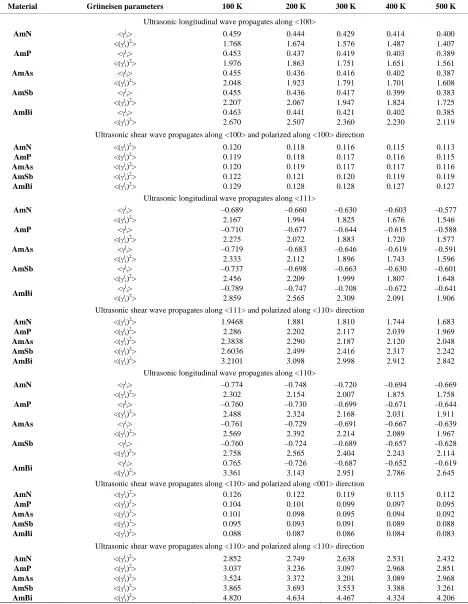
SOEC and TOEC are used to obtain Grüneisen pa- rameters and average squares of the Grüneisen parame- ters along <100> direction for longitudinal wave over 39 modes and for shear wave 18 modes; along <110> direc- tion for longitudinal wave over 39 modes, for shear wave polarized along <001> direction over 14 modes and for shear wave polarized along <110> direction over 20 mo- des and along <111> direction for longitudinal wave over 39 modes and for shear wave polarized along <110 > direc- tion over 14 modes. The temperature dependent averaged ultrasonic Grüneisen parameters and averaged squares of the Grüneisen parameters are presented in Table 4. The value of average Grüneisen parameters is the highest for
Figure 2. Debye temperature versus temperature along <111> direction.
[image:5.595.59.539.307.718.2]Figure 3. Debye average velocity versus temperature along <110> direction.
Table 3. Ultrasonic velocities (in 105 cm/s) of AmY along different crystallographic directions in the temperature range 100 K
- 500 K.
Materials Directions Velocity 100 K 200 K 300 K 400 K 500 K
<100>
<111> AmN
<110>
VL
VS1 = VS2
VL
VS1 = VS2
VL VS1 VS2 2.284 1.353 2.312 1.329 2.305 1.353 1.862 2.308 1.355 2.312 1.351 2.311 1.355 1.909 2.339 1.357 2.314 1.378 2.320 1.357 1.964 2.372 1.360 2.317 1.406 2.331 1.360 2.020 2.405 1.363 2.321 1.434 2.342 1.363 2.076 <100> <111> AmP <110> VL
VS1 = VS2
VL
VS1 = VS2
VL VS1 VS2 2.325 1.199 2.145 1.346 2.188 1.199 2.015 2.355 1.201 2.146 1.378 2.199 1.201 2.069 2.392 1.204 2.101 1.410 2.211 1.204 2.131 2.430 1.206 2.153 1.432 2.225 1.206 2.193 2.469 1.208 2.157 1.475 2.238 1.208 2.254 <100> <111> AmAs <110> VL
VS1 = VS2
VL
VS1 = VS2
VL VS1 VS2 2.177 1.092 1.973 1.261 2.023 1.092 1.905 2.209 1.094 1.976 1.293 2.035 1.094 1.961 2.259 1.097 1.979 1.325 2.048 1.097 2.036 2.284 1.098 1.983 1.357 2.061 1.098 2.081 2.321 1.100 1.986 1.388 2.074 1.100 2.140 <100> <111> AmSb <110> VL
VS1 = VS2
VL
VS1 = VS2
VL VS1 VS2 2.083 0.979 1.815 1.207 1.883 0.979 1.860 2.117 0.981 1.818 1.240 1.896 0.981 1.918 2.162 0.982 1.821 1.273 1.909 0.982 1.987 2.194 0.984 1.824 1.306 1.923 0.984 2.039 2.233 0.986 1.828 1.337 1.936 0.986 2.099 <100> <111> AmBi <110> VL
VS1 = VS2
VL
VS1 = VS2
Table 4. Ultrasonic Grüneisen parameters of AmY along different crystallographic directions in the temperature range 100 K - 500 K.
Material Grüneisen parameters 100 K 200 K 300 K 400 K 500 K
Ultrasonic longitudinal wave propagates along <100>
AmN
AmP
AmAs
AmSb
AmBi
<j i>
<(j i)2>
<j i>
<(j i)2>
<j i>
<(j i)2>
<ji>
<(j i)2>
<j i>
<(j i)2>
0.459 1.768 0.453 1.976 0.455 2.048 0.455 2.207 0.463 2.670 0.444 1.674 0.437 1.863 0.436 1.923 0.436 2.067 0.441 2.507 0.429 1.576 0.419 1.751 0.416 1.791 0.417 1.947 0.421 2.360 0.414 1.487 0.403 1.651 0.402 1.701 0.399 1.824 0.402 2.230 0.400 1.407 0.389 1.561 0.387 1.608 0.383 1.725 0.385 2.119 Ultrasonic shear wave propagates along <100> and polarized along <100> direction
AmN AmP AmAs AmSb AmBi
<(j i)2>
<(j i)2>
<(ji)2>
<(j i)2>
<(j i)2>
0.120 0.119 0.120 0.122 0.129 0.118 0.118 0.119 0.121 0.128 0.116 0.117 0.117 0.120 0.128 0.115 0.116 0.117 0.119 0.127 0.113 0.115 0.116 0.119 0.127 Ultrasonic longitudinal wave propagates along <111>
AmN
AmP
AmAs
AmSb
AmBi
<ji>
<(j i)2>
<j i>
<(ji)2>
<j i>
<(j i)2>
<j i>
<(j i)2>
<j i>
<(j i)2>
–0.689 2.167 –0.710 2.275 –0.719 2.333 –0.737 2.456 –0.789 2.859 –0.660 1.994 –0.677 2.072 –0.683 2.112 –0.698 2.209 –0.747 2.565 –0.630 1.825 –0.644 1.883 –0.646 1.896 –0.663 1.999 –0.708 2.309 –0.603 1.676 –0.615 1.720 –0.619 1.743 –0.630 1.807 –0.672 2.091 –0.577 1.546 –0.588 1.577 –0.591 1.596 –0.601 1.648 –0.641 1.906 Ultrasonic shear wave propagates along <111> and polarized along <110> direction
AmN AmP AmAs AmSb AmBi
<(j i)2>
<(j i)2>
<(j i)2>
<(j i)2>
<(j i)2>
1.9468 2.286 2.3838 2.6036 3.2101 1.881 2.202 2.290 2.499 3.098 1.810 2.117 2.187 2.416 2.998 1.744 2.039 2.120 2.317 2.912 1.683 1.969 2.048 2.242 2.842 Ultrasonic longitudinal wave propagates along <110>
AmN
AmP
AmAs
AmSb
AmBi
<ji>
<(j i)2>
<j i>
<(j i)2>
<j i>
<(j i)2>
<j i>
<(j i)2>
<j i>
<(j i)2>
–0.774 2.302 –0.760 2.488 –0.761 2.569 –0.760 2.758 0.765 3.361 –0.748 2.154 –0.730 2.324 –0.729 2.392 –0.724 2.565 –0.726 3.143 –0.720 2.007 –0.699 2.168 –0.691 2.214 –0.689 2.404 –0.687 2.951 –0.694 1.875 –0.671 2.031 –0.667 2.089 –0.657 2.243 –0.652 2.786 –0.669 1.758 –0.644 1.911 –0.639 1.967 –0.628 2.114 –0.619 2.645 Ultrasonic shear wave propagates along <110> and polarized along <001> direction
AmN AmP AmAs AmSb AmBi
<(j i)2>
<(j i)2>
<(ji)2>
<(j i)2>
<(j i)2>
0.126 0.104 0.101 0.095 0.088 0.122 0.101 0.098 0.093 0.087 0.119 0.099 0.095 0.091 0.086 0.115 0.097 0.094 0.089 0.084 0.112 0.095 0.092 0.088 0.083 Ultrasonic shear wave propagates along <110> and polarized along <110> direction
AmN AmP AmAs AmSb AmBi
<(ji)2>
<(j i)2>
<(j i)2>
<(j i)2>
<(j i)2>
5. Acknowledgements
AmN along <100> direction and the lowest for AmBialong <111> direction for longitudinal waves, while av-eraged square Grüneisen parameters is the highest for AmBi along <110> direction in which shear wave polar-ized along <110> direction, and the lowest for AmBi in which shear wave polarized along <001> direction as shown in Table 4. Hence we can say that AmN is the best for longitudinal wave propagation along <100> di-rection and AmBi would be the best for shear wave propagation. It is found that obtained values of Grüneisen parameters and average squares of the Grüneisen parameters are decreasing with the tempera-ture. This is due to adjustment of SOEC and TOEC for different modes. This type of nature is also found in other B1 structured materials like rare-earth monochal-cogenides [21,22,24], semiconductors [20] and metallic alloys [23]. It establishes that properties of these materi-als are very similar to either a semiconductor or metmateri-als.
We are extremely grateful to Prof. S. K. Kor, Prof. R. R. Yadav, Dr. Giridhar Mishra, Mr. S. K. Verma, Mr. Me-herwaan Rathore, Mr. Sanjay Upadhyaya & Mr. Kajal De, University of Allahabad; Prof. B. P. Singh, Prof. Rekha Agarwal, Mrs. Neera Bhutani & Dr. P. K. Yadawa, ASET, New Delhi; Dr. A. K. Tiwari, BSNVPG College, Lucknow; Dr. Priyanka Awasthi, DMO, Lucknow; Dr. Akhilesh Mishra, DST, New Delhi; Dr. A. K. Gupta, NIOS, Noida; Dr. D. K. Singh, GIC, Jalaun; Dr. A. K. Yadav, Ambedkar University, Lucknow; and Mrs. Shivani Kaushik, NIMS University, Jaipur for many useful helps like reading the manuscript, discus-sion and knowledgeable suggestions during the prepara-tion and revision of the manuscript.
6. References
[1] G. G. Saharabudhe and S. D. Lambade, “Study of Elastic and Acoustic Non-Linearities in Solids at Room Tem-perature,” Journal of Physics Chemistry of Solids, Vol. 59, No. 5, 1998, pp. 789-808.
doi:10.1016/S0022-3697(97)00116-9
4. Conclusions
On the basis of analysis of above result, we can say that: 1) We have used the Coulomb and Born-Mayer poten-tial having two basic parameters i.e., lattice parameter and hardness parameter to compute SOEC and TOEC. Evaluated values of SOEC and TOEC have been com-pared with available B1 structured materials, which are near to agreement, hence our approach to calculation appears to justify.
[2] D. Singh, D. K. Pandey, D. K. Singh and R. R. Yadav, “Propagation of Ultrasonic Waves in Neptunium Mono- chalcogenides,” Applied Acoustics, Vol. 72, No. 10, 2011, pp. 737-741. doi:10.1016/j.apacoust.2011.04.002
[3] A. K. Pandey, B. K. Pandey and Rahul, “Theoretical Prediction of Grüneisen Parameters for Bulk Metallic Glasses,” Journal of Alloys and Compounds, Vol. 509, No. 11, 2011, pp. 4191-4197.
doi:10.1016/j.jallcom.2010.11.120 2) SOEC and TOEC of AmN are the highest so
me-chanical properties will be better than other AmY. [4] V. P. Singh and M. P. Hemkar, “Dynamical Theory for
Grüneisen Parameters in Fcc Metals,” Journal of Physics F: Metals Physics,Vol. 7, No. 5, 1977, pp. 761-769.
doi: 10.1088/0305-4608/7/5/008 3) SOEC and TOEC have been used to find out the
ul-trasonic velocities for longitudinal and shear waves, De-bye average velocity and Grüneisen parameters in AmY. 4) Ultrasonic velocity is found to be highest for AmN along all chosen direction, so AmN will be most suitable candidate for wave propagation.
[5] D. N. Joharpurkar and M. A. Breazeale, “Nonlinearity Parameters, Nonlinearity Constant and Frequency De-pendence of Ultrasonic Attenuation in GaAs,” Journal of Applied Physics, Vol. 67, No. 1, 1999, pp. 76-80.
doi:10.1063/1.345208 5) AmN is the best for longitudinal wave propagation
along <100> direction and AmBi is the best for thermal purposes, because Grüneisen parameters are most sensi-tive to temperature.
[6] D. B. Ghosh, S. K. De, P. M. Oppeneer and M. S. S. Brooks, “Electronic Structure and Optical Properties of Am Monopnictides,” Physical ReviewB, Vol. 72, No. 11, 2005, p. 115123(10). doi:10.1103/PhysRevB.72.11512 Due to absence of experimental information on
ultra-sonic properties of these monopnictides, no straight evaluation have been made, yet, on the basis of agree-ment values of elastic constants, ultrasonic velocities and Grüneisen parameters, we conclude that current approach is justified and obtained results will be useful for finding various theoretical, experimental investigations like ul-trasonic attenuation, non-linearity parameters, ulul-trasonic measurements, polarizing microscopy, solid state NMR, SEM, TEM; and for scientific world and society.
[7] J. W. Roddy, “Americium Metalloids: AmAs, AmSb, AmBi, Am3Se4 and AmSe2,” Journal of Inorganic
Nu-clear Chemistry, Vol. 36, No. 11, 1974, pp. 2531-2533.
doi:10.1016/0022-1902(74)80466-5
[8] J. M. Friedt, R. Poinsot, J. Rebizant and W. Muller, “237Np Emission Spectra in 241Am: AmO2, AmAs and AmBi Sources,” J de Physique, Colloque,Vol. C6, 1976, pp. 935-939.doi:10.1051/jphyscol:19766201
Journal of Less Common Metals, Vol. 132, No. 1, 1987, pp. 149-154. doi:10.1016/0022-5088(87)90183-4
[10] L. Petit, A. Svane, W. M. Temmerman and Z. Snotele, “Self Interaction-Corrected Description of Electronic Properties of Americium Monochalcogenides and Mo-nopnictides,” Physical Review B, Vol. 63, 2001, p. 165107(7). doi:10.1103/PhysRevB.63.165107
[11] G. Leibfried and H. Haln, “Zur Temperaturabhangigkeit der Elastischen Konstantaaen von Alhalihalogenidkristall en,” Zeitschrift für Physik, Vol. 150, 1958, pp. 497-525.
[12] S. Mori and Y. Hiki, “Calculation of the Third- and Fourth-Order Elastic Constants of Alkali Halide Crystals,”
Journal of the Physical Society of Japan, Vol.45, No. 5, 1975, pp. 1449-1456. doi:10.1143/JPSJ.45.1449
[13] D. K. Pandey and S. Pandey, “Ultrasonics: A Technique of Material Characterization, in: Acoustic Waves,” Don W. Dissanayake, Ed., Sciyo Publisher, Rijeka, 2010, pp. 397-430.
[14] R. Nava and J. Romero, “Ultrasonic Grüneisen Parameter for Non-Conducting Cubic Crystals,” Journal of the Acoustical Society of America, Vol. 64, No. 2, 1978, pp. 529-532. doi:10.1121/1.382004
[15] K. Brugger, “Generalized Grüneisen Parameters in the Anisotropic Debye Model,” Physical Review, Vol. 137, No. 6A, 1965, pp.1826-1827.
doi: 10.1103/PhysRev.137.A1826 .
[16] S. D. Lambade, G. G. Sahasrabudhe and S. Rajagopalan, “Temperature Dependence of Acoustic Attenuation in Sili-con,” Physical Review, Vol. 51, No. 22, 1995, pp. 15861-15866.doi: 10.1103/PhysRevB.51.15861
[17] W. P. Mason, “Physical Acoustics, Vol. IIIB,” Academic Press, New York, 1965.
[18] D.Singh, “Behaviour of acoustic attenuation in rare-earth chalcogenides,” Materials Chemistry and Physics, Vol. 115, No. 1, 2009, pp. 65-68.
doi:10.1016/j.matchemphys.2008.11.025
[19] R. R. Yadav, A. K. Tiwari and D. Singh, “Effect of Pres-sure on Ultrasonic Attenuation in Ce-Monopnictides at Low Temperature,” Journal of Materials Science, Vol. 40, No. 19, 2005, pp. 5319-5321.
doi:10.1007/s10853-005-4397-y.
[20] D. Singh, R. R. Yadav and A. K. Tiwari, “Ultrasonic Attenuation in Semiconductors,” Indian Journal of Pure
& Applied Physics, Vol. 40, No. 12, 2002, pp. 845-849.
[21] R. R. Yadav and D. Singh, “Effect of Thermal Conduc-tivity on Ultrasonic Attenuation in Praseodymium Mo-nochalcogenides,” Acoustical Physics, Vol. 49, No. 5, 2005, pp. 595-604. doi: 10.1134/1.1608987
[22] D. Singh, D. K. Pandey and P. K. Yadawa, “Ultrasonic Wave Propagation in Rare-Earth Monochalcogenides,”
Central European Journal of Physics, Vol. 7, No. 1, 2009, pp. 198-205. doi:10.2478/s11534-008-0130-1
[23] R. R. Yadav, A. K. Gupta and D. Singh, “Ultrasonic At-tenuation in Ni-Pd Alloys at High Temperature Phase,”
Journal of Physical Studies, Vol. 9, No. 3, 2005, pp. 227-232.
[24] R. R. Yadav and D. Singh, “Ultrasonic Attenuation in Lanthanum Monochalcogenides,” Journal of the Physical Society of Japan, Vol. 70, No. 6, 2001, pp. 1825-1832.