ISSN Print: 2162-2078
DOI: 10.4236/tel.2019.91017 Feb. 15, 2019 223 Theoretical Economics Letters
Re-Internationalization v/s Initial
Internationalization: Comparison
of Modes of Operations
Salman Ali
Indian Institute of Management Raipur, Raipur, India
Abstract
Re-internationalization is defined as firms’ re-entry into international opera-tions after they have abandoned all their previous internationalization efforts. In this paper, we report findings from a survey administered among se-nior-level managers of re-internationalized Indian firms where we studied the differences in firms’ choices in modes of operations during re-internationalization phase as compared to initial internationalization phase. The results from the survey indicated that firms tended to go for high involvement modes of oper-ations during re-internationalization as compared to the relatively low in-volvement modes of operations undertaken during initial internationaliza-tion. This trend of going for higher involvement modes of operations was more visible in firms that had a presence in a relatively higher number of countries during the re-internationalization stage. This incremental nature of internationalization, i.e. going from initial low involvement modes of opera-tions toward high involvement modes of operaopera-tions as firms gained expe-rience in both time and space from their initial through re-internationalization attempts, found support for the Uppsala model of internationalization. Being among the first studies on the topic, we expect this study to serve as a founda-tion for researchers to explore deeper related queries. This study also has meaningful practical and policy implications.
Keywords
Re-Internationalization, India, Modes of Operations, Uppsala Model of Internationalization
1. Introduction
Re-internationalization, or firms’ re-entry into international markets after they How to cite this paper: Ali, S. (2019)
Re-Internationalization v/s Initial Interna-tionalization: Comparison of Modes of Op-erations. Theoretical Economics Letters, 9, 223-233.
https://doi.org/10.4236/tel.2019.91017
Received: December 24, 2018 Accepted: February 12, 2019 Published: February 15, 2019
Copyright © 2019 by author(s) and Scientific Research Publishing Inc. This work is licensed under the Creative Commons Attribution International License (CC BY 4.0).
http://creativecommons.org/licenses/by/4.0/
DOI: 10.4236/tel.2019.91017 224 Theoretical Economics Letters have withdrawn from all their previous internationalization activities [1], in-volves at least four stages: initial internationalization, de-internationalization or exit from internationalization, a time-out stage where no international opera-tions take place, and finally a re-entry into internationalization.
One-fifth of all firms that internationalize exit internationalization [2]. Despite being found that intentions for re-entry to international activities among firms that have exited their initial internationalization are high [3] [4], re-interna- tionalization has received sparse attention in the published literature [1]. Though studies on re-internationalization have sprouted up in recent past
[5]-[10], differences in firms’ choices in modes of operations during various
stages of internationalization have not been explained yet. We tried to address this gap from this study.
We shortlisted Indian firms that had undergone re-internationalization from the early 1990s till mid-2010s based on financial details available in CMIE- Prowess database. Post-1990s was significant in the Indian context, as it was during that period that economic activity thrived in the Indian markets due to the liberalization policies adopted by the union government [11], which signifi-cantly helped the initial internationalization of many firms. After cross-verifi- cation of the shortlisted firms with four other databases, and also based on direct interviews, we generated a final list of 73 firms. A questionnaire survey was ad-ministered among senior managers of these firms to compare and contrast modes of operations adopted during initial internationalization and during re-internationalization stages.
Firms’ initial international experiences leave them with an international her-itage [1] [12], the learning from which firms are expected to utilize while they re-internationalize. Accordingly, we anticipated and later found that firms went for higher involvement modes of operations during re-internationalization period, utilizing their learning and experiences from the initial internationalization phase(s). We also found that firms having a presence in more No. of countries es-pecially went for higher involvement modes of operations as compared to those firms that had a presence in lesser No. of countries during re-internationalization. This incremental nature of internationalization, i.e. from low involvement mod-es of operations toward high involvement modmod-es of operations as firms gain ex-perience both in time (initial to re-entry phase) and space (presence in more number of countries) finds support for Uppsala model of internationalization. Uppsala model of internationalization is explained as firms’ incremental process of building commitment in host nation(s) utilizing their experiences during the passage of time [13] [14].
DOI: 10.4236/tel.2019.91017 225 Theoretical Economics Letters The rest of this paper is structured as follows. We first discuss and locate the phenomenon of re-internationalization in the context of previous scholarship, then discuss the methods adopted for the study to collect data, and subsequently present the results and analysis, and finally conclude the study by delineating implications and limitations.
2. Literature Review
Internationalization is defined as firms’ activities that stretch beyond national boundaries in factor and/or product markets [15]. It can either be outward ac-tivities such as firms exporting their products and/or services, alliances, JVs, branches, subsidiaries, FDI, etc. beyond the territorial boundaries of their home markets, or inward activities such as import of raw materials or services, strateg-ic alliances, countertrade, cooperative manufacture, etc., or activities where out-ward and inout-ward activities are inter-linked [16].
Re-internationalization is defined as re-entry to internationalization after a firm has abandoned all its previous internationalization activities [1]. It is dif-ferent from re-entry to previously abandoned international market(s), as re-internationalization occurs after a complete withdrawal from all international territories a firm had previously been operational, whereas re-entry to a specific international territory can occur even if a firm had partially exited the specific market while it continued operations in other markets.
De-internationalized firms intend to re-internationalize due to several internal and external factors, such as assets and liabilities flowing from initial internatio-nalization, new international influences occurring after de-internatiointernatio-nalization, and firm experiences during the time-out stage [1]. Also, changes in strategic orientation, changes in top management, or changes in other external factors such as environmental, political, competitive, technical scenarios can considera-bly influence re-internationalization of firms. The residual mind-share or psy-chological experiences flowing from firms’ initial internationalization activities may also influence firms’ decision and approach toward re-entry [12].
Re-internationalization has received limited attention in extant literature [1]. Some recent studies describe various aspects of re-internationalization, but none of these has addressed the query we tried to understand from this study. The case study of a UK-based firm talks about a firm that faced troubles even in the domestic market after exiting from initial internationalization [9]. It prompted this family-owned enterprise to professionalize managerial roles that were oth-erwise being held by family members alone, and this later helped the firm not only to overcome challenges in domestic market, but it also paved way for the firm to tap overseas opportunities and hence to successfully re-internationalize.
DOI: 10.4236/tel.2019.91017 226 Theoretical Economics Letters organizations to re-internationalization strategies as and when they found fa-vorable circumstances emerged during their time-out periods.
A study on re-internationalization paths of French SMEs identified the major elements aiding successful re-internationalization as learning, resilience, and the internationalization orientation of the entrepreneurs [6].
Internationalization and/or re-internationalization can be an outcome of several external or internal factors. For instance, it could be triggered by fortuitous foreign orders, a decline in domestic demand, government policy implications, exchange rate fluctuations, changes in competitive scenarios, changes in top management, changes in strategic orientation, developments in R&D, etc. [1].
Firms re-entering international operations would already possess experiences in terms of knowledge, skills, familiarity acquired from such operations [17] cluding experiences of key individuals involved in initial operations. For in-stance, it is strongly supported by export-related studies that previous interna-tional experiences of managers have a positive impact on internainterna-tionalization of firms [8] [18]. Firms may also have built networks and relationships, gained knowledge and access to certain markets, and knowledge about cultural and le-gal aspects of certain markets [12]. Continuity in their inter-organizational net-works and key personnel associated with international operations could be val-uable for firms’ re-internationalization prospects.
A prolonged time-out from internationalization is expected to diminish the usefulness of firms’ learning and experiences [19] acquired from initial interna-tionalization, as new and different challenges and events are expected to occur during the time-out phase [1] [12]. Nonetheless, some of the intangible re-sources including experiential knowledge and managerial skills are expected to remain with a firm to some extent [20] [21] from its initial through re-interna- tionalization stages [1].
Firms’ learning and experiences from their initial internationalization phas-es(s) through de-internationalization and time-out periods could be capitalized by firms during their re-internationalization phase [1]. We, therefore, antic-ipated that the learning and experiences carried forward from initial interna-tional operations would enable a firm to re-enter internainterna-tional operations with higher involvement modes of operations.
The above argument is indirectly followed from the Uppsala school of thought on the process model of internationalization [13] [14], which articulates that firms enhance their commitments in host nations over time as they accrue expe-rience and learning from foreign markets. Accordingly, firms are expected to move ahead from an initially low-involvement modes of operations for interna-tionalization such as direct exports or trading via agents to higher involvement modes of operations for international operations such as having branch offices, joint ventures, or establishing own subsidiaries.
DOI: 10.4236/tel.2019.91017 227 Theoretical Economics Letters that during re-internationalization periods.
3. Methods
3.1. Sample Selection
In order to generate an initial shortlist of firms for the study, firstly we down-loaded financial data of firms for the period from the 1990s till mid-2010s from CMIE-Prowess database, and this was supplemented with data from Capitaline database. With the help of STATA software we used the following criteria on the downloaded financial data to shortlist the firms: minimum two years of recorded data of forex (foreign exchange) revenue during initial internationalization pe-riod, followed by an exit period of minimum two years with zero forex revenue, followed by minimum two years of forex revenue during the final re-interna- tionalization stage.
The criterion of two years is widely used and accepted in internationalization research [22] [23] [24]. The two-year criterion also ensured the exclusion of sporadic exporters or firms that were engaged in intermittent exports with short breaks. The characteristics of such sporadic exporting firms would be different from those firms that had committed initial internationalization operations and then subsequently withdrew due to various reasons [1]. We also excluded firms having less than 1% of their total income recorded as forex revenues and the ab-solute value of forex revenue below 10 million Indian Rupees, in order to avoid firms that had a very narrow internationalization exposure.
The basic assumption used in this exercise was forex revenue could be an in-dicator for firms’ internationalization activities. However, in order to avoid dis-crepancies in data we later cross-verified the financial data of the shortlisted firms with annual reports available at Thomson-Reuters Eikon, Insight-DION and EMIS-Emerging Markets Information Science databases to ensure that these firms had actually undergone re-internationalization. This cross-verification ex-ercise, along with direct interactions with executives of the initially shortlisted firms helped us to identify a final list of 73 re-internationalized firms across In-dia.
3.2. Questionnaire Administrations
A survey was administered among top-level managers of the identified 73 Indian firms that have undergone re-internationalization. Our persistent follow-up over email, telephone, and direct visits, helped us to gather responses from almost the entire population of firms identified for the study, as we collected 71 responses of a maximum possible 73.
DOI: 10.4236/tel.2019.91017 228 Theoretical Economics Letters
Table 1. Questions and items.
Modes of operations (same question repeated for initial internationalization as well as re-internationalization periods)
What all were/are the kind of international operations your organization were/are exposed to: (please tick one or more in each column, as applicable):
Exports Agency Franchisee Branch office
FDI (foreign direct investment) as shares/investment in other firms Joint venture
Strategic alliances
Green-field expansion (expanding own firms’ outlets to foreign countries) Acquisition of foreign firm
Other—kindly explain … (descriptive answer)
No. of countries (same question repeated for initial internationalization as well as re-internationalization periods)
Number of countries you were/are present: (please tick the appropriate tab) Objective question: 1, 2, 3, 4, 5, 6, 7 or more
4. Results and Analysis
4.1. Modes of International Operations—Frequencies
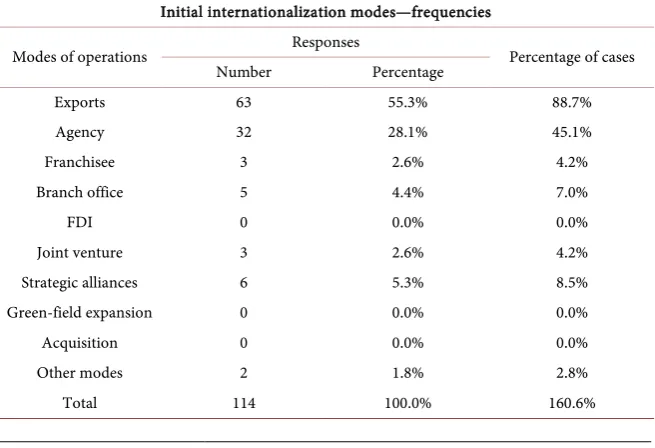
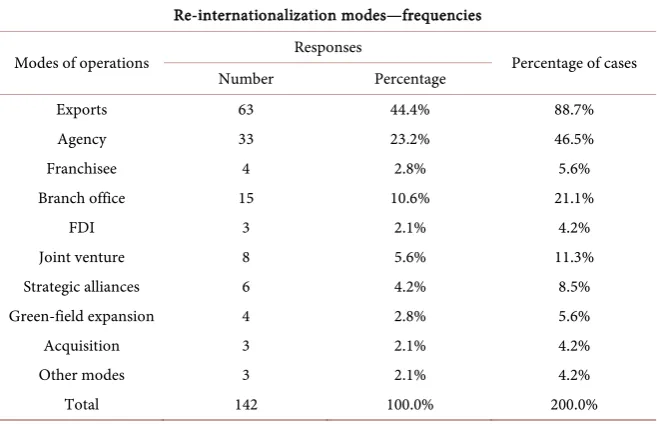
Table 2 and Table 3 show the collated responses from the survey that shows the frequencies of modes of international operations engaged by firms during the two periods of international operations, i.e. during initial internationalization and re-internationalization periods respectively.
Major observations from these responses are:
• During both the periods of internationalization majority of the firms engaged in direct exports as well as trading via agencies as their main modes of inter-national operations.
• There is a notable increase in firms operating own branches during re-inter- nationalization period (15 firms) as compared to initial internationalization period (5 firms), i.e. 21.1% firms during re-internationalization period as compared to only 7% firms during initial internationalization period.
• Joint ventures as a mode of operation also had a relatively substantial rise from 3 firms (during initial internationalization period) to 8 firms (during re-internationalization period), or 4.2% of firms to 11.3%.
• Green-field ventures as a mode of operation has risen from 0 firms (during initial internationalization period) to 4 firms (during re-internationalization period), or 0% to 5.6%.
• All other modes of operations were relatively similar during both the periods (with the difference being less than 5%).
opera-DOI: 10.4236/tel.2019.91017 229 Theoretical Economics Letters tions. The learning from initial internationalization helped firms to step into higher involvement modes of operations when they re-entered internationaliza-tion. This observation supports the Uppsala model of internationalization [13] [14], which says firms’ experiences and learning promote their raising of com-mitment in host nations over time.
4.2. Cross-Tabulation of Presence in No. of Countries v/s Modes of
International Operations
Table 4 and Table 5 show the cross-tabulated data for firms’ presence in No. of countries v/s the modes of operations during each period of internationalization based on the survey responses.
Major observations from this tabulation are:
• Relatively higher No. of firms had a presence in four or more countries dur-ing re-internationalization (56 of 71 firms) as compared to durdur-ing initial in-ternationalization (just 30 of 71 firms).
• During initial internationalization period, most firms concentrated on direct exports (63 firms of 71) and trading via agencies (32 of 71 firms) as the pri-mary modes of operations, with other modes of operations being very less in numbers.
[image:7.595.211.539.517.741.2]• Although during re-internationalization period firms continued in modes of operations such as direct exports (63 firms of 71) and trading via agencies (33 of 71 firms), high involvement modes of operations became prominent espe-cially for those firms which had a presence in more No. of countries. For in-stance, during re-internationalization, most firms that had a presence in four or more countries were engaged in higher involvement modes of operations such as own branches (14 among 15 firms that had branches were present in four or more countries), joint ventures (6 among 8), green-field ventures (4 among 4), and even acquisitions (3 among 3).
Table 2. Frequencies of modes of operations during initial internationalization period.
Initial internationalization modes—frequencies
Modes of operations Responses Percentage of cases
Number Percentage
Exports 63 55.3% 88.7%
Agency 32 28.1% 45.1%
Franchisee 3 2.6% 4.2%
Branch office 5 4.4% 7.0%
FDI 0 0.0% 0.0%
Joint venture 3 2.6% 4.2%
Strategic alliances 6 5.3% 8.5%
Green-field expansion 0 0.0% 0.0%
Acquisition 0 0.0% 0.0%
Other modes 2 1.8% 2.8%
DOI: 10.4236/tel.2019.91017 230 Theoretical Economics Letters
Table 3. Frequencies of modes of operations during re-internationalization period.
Re-internationalization modes—frequencies
Modes of operations Responses Percentage of cases
Number Percentage
Exports 63 44.4% 88.7%
Agency 33 23.2% 46.5%
Franchisee 4 2.8% 5.6%
Branch office 15 10.6% 21.1%
FDI 3 2.1% 4.2%
Joint venture 8 5.6% 11.3%
Strategic alliances 6 4.2% 8.5%
Green-field expansion 4 2.8% 5.6%
Acquisition 3 2.1% 4.2%
Other modes 3 2.1% 4.2%
[image:8.595.59.540.341.510.2]Total 142 100.0% 200.0%
Table 4. Cross-tabulation of presence in No. of countries v/s mode of operations during initial internationalization period.
Initial internationalization: cross tabulation of No. of countries v/s modes of operations
No. of countries
Initial internationalization modes
Total Exports Agency Franchisee Branch office FDI venture Joint Strategic alliances Greenfield Acquisition modes Other
1 9 1 0 0 0 1 0 0 0 2 11
2 17 7 1 2 0 1 2 0 0 0 19
3 10 6 1 1 0 1 2 0 0 0 11
4 8 6 0 0 0 0 1 0 0 0 9
5 9 3 0 2 0 0 1 0 0 0 9
6 1 1 1 0 0 0 0 0 0 0 1
7 or more 9 8 0 0 0 0 0 0 0 0 11
Total 63 32 3 5 0 3 6 0 0 2 71
Table 5. Cross-tabulation of presence in No. of countries v/s mode of operations during re-internationalization period.
Re-internationalization: cross tabulation of No. of countries v/s modes of operations
No. of countries
Initial internationalization modes
Total Exports Agency Franchisee Branch office FDI venture Joint Strategic alliances Greenfield Acquisition modes Other
1 4 1 0 0 0 0 0 0 0 0 5
2 4 1 0 0 1 1 0 0 0 0 5
3 4 1 0 1 1 1 1 0 0 0 5
4 7 6 1 4 0 1 1 1 0 0 10
5 8 5 0 2 0 0 0 0 0 2 9
6 9 5 0 2 1 1 2 1 0 0 10
7 or more 27 14 3 6 0 4 2 2 3 1 27
[image:8.595.56.538.554.742.2]DOI: 10.4236/tel.2019.91017 231 Theoretical Economics Letters This observation, i.e. going from low involvement modes of operations to high involvement modes of operations from initial internationalization to re-internationalization period for firms having a presence in more No. of coun-tries, also supports the Uppsala model of internationalization [13] [14]. In this case, it could be argued that, apart from learning and experiences acquired from initial internationalization, firms also accrued useful learning and experiences from their presence in more international territories. This learning helped firms to engage in higher involvement modes of operations during re-internationalization.
5. Conclusions and Synthesis
As this research is among the very first efforts that compare firms’ choices in modes of operations during re-internationalization as against that during initial internationalization, we expect the outcomes of this study to serve as a founda-tion for scholars engaging in deeper queries, apart from its contribufounda-tion toward international business management theory. For instance, case studies to under-stand the process of re-internationalization on how and why firms undertook various decisions at different stages of their initial through exit through re-entry stages, especially to understand the reasons why which they opted for higher volvement modes of operations during re-internationalization would be an in-teresting topic for future research. As the study was undertaken in an emerging economy context, i.e. amongst Indian firms, which might have some limitations on generalizability of the findings to a developed economy context, it threw up a noteworthy research agenda for replication of this study in a developed economy context to understand whether the patterns identified in this study were univer-sal or not.
We also expect the findings from this study to be useful for practitioners and policy-makers. From a managerial perspective, the findings that initial interna-tionalization experiences help firms in their subsequent re-internainterna-tionalization, as it enables them to go for higher involvement modes of operations during re-internationalization, should be motivating for managers, firstly not to be dis-appointed about initial failure attempts, and secondly and more importantly to invest in facilities such as knowledge management systems that record organiza-tional learning and experiences so as to make it available when required at a later stage. Managers should ideally be exploring and looking forward to future op-portunities in international markets rather than being constrained by residual negative mindshare from their initial failed internationalization attempts be-cause learning and experiences even from failed attempts can be helpful during re-internationalization.
DOI: 10.4236/tel.2019.91017 232 Theoretical Economics Letters the countries where they’re based at as well.
Conflicts of Interest
The author declares no conflicts of interest regarding the publication of this pa-per.
References
[1] Welch, C.L. and Welch, L.S. (2009) Re-Internationalisation: Exploration and Con-ceptualisation. International Business Review, 18, 567-577.
https://doi.org/10.1016/j.ibusrev.2009.07.003
[2] Mudambi, R. and Zahra, S.A. (2007) The Survival of International New Ventures.
Journal of International Business Studies, 38, 333-352.
[3] Crick, D. (2002) The Decision to Discontinue Exporting: SMEs in Two U.K. Trade Sectors. Journal of Small Business Management, 40, 66-77.
https://doi.org/10.1111/1540-627X.00040
[4] Welch, L.S. and Wiedersheim-Paul, F. (1980) Initial Exports—A Marketing Failure?
Journal of Management Studies, 17, 333-344.
[5] Bernini, M., Du, J. and Love, J. (2016) Explaining Intermittent Exporting: Exit and Conditional Re-Entry in Export Markets. Journal of International Business Studies, 47, 1058-1076. https://doi.org/10.1057/s41267-016-0015-2
[6] Dominguez, N. and Mayrhofer, U. (2017) Internationalization Stages of Traditional SMEs: Increasing, Decreasing and Re-Increasing Commitment to Foreign Markets.
International Business Review, 26, 1051-1063.
https://doi.org/10.1016/j.ibusrev.2017.03.010
[7] Figueroa, L.E.O., Osuna M.A.A. and Reynoso, C.F. (2014) Determinants of the In-ternationalization of the Firm: The Accelerated Model vs. the Sequential Model.
The International Journal of Business and Finance Research, 8, 81-93.
[8] Freeman, S., Deligonul, S. and Cavusgil, T. (2013) Strategic Re-Structuring by Born-Globals Using Outward and Inward-Oriented Activity. International Market-ing Review, 30, 156-182. https://doi.org/10.1108/02651331311314574
[9] Janjuha-Jivraj, S., Martin, L. and Danko, A. (2012) Internationalization of a “Born-Again Global”: How a Family-Led Crisis Enabled the Realization of Interna-tionalization Opportunities. Journal of Small Business and Entrepreneurship, 25, 201-215. https://doi.org/10.1080/08276331.2012.10593569
[10] Vissak, T. and Francioni, B. (2013) Serial Nonlinear Internationalization in Practice: A Case Study. International Business Review, 22, 951-962.
https://doi.org/10.1016/j.ibusrev.2013.01.010
[11] Khanna, T. and Palepu, K. (1997) Why Focused Strategies May Be Wrong for Emerging Markets. Harvard Business Review, 75, 41-51.
[12] Javalgi, R.G., Deligonul, S., Dixit, A. and Cavusgil, S.T. (2011) International Market Re-Entry: A Review and Research Framework. International Business Review, 20, 377-393. https://doi.org/10.1016/j.ibusrev.2010.08.001
[13] Johanson, J. and Vahlne, J. (1977) The Internationalization Process of the Firm—A Model of Knowledge Development and Increasing Foreign Market Commitments.
Journal of International Business Studies, 8, 23-32.
https://doi.org/10.1057/palgrave.jibs.8490676
DOI: 10.4236/tel.2019.91017 233 Theoretical Economics Letters
Model Revisited: From Liability of Foreignness to Liability of Outsidership. Journal of International Business Studies, 40, 1411-1431.
https://doi.org/10.1057/jibs.2009.24
[15] Mathur, A.N. (2012) Strategies for the Future: Understanding International Busi-ness. Random House, New Delhi.
[16] Fletcher, R. (2001) A Holistic Approach to Internationalisation. International Busi-ness Review, 10, 25-49. https://doi.org/10.1016/S0969-5931(00)00039-1
[17] Chailom, P. and Kaiwinit, S. (2010) The Effects of International Experience, Orga-nizational Learning for Export Activities, and Global Competitive Force on Export Marketing Strategy, Export Advantage, and Performance of Export Firms in Thail-and. International Journal of Business Strategy, 10, 156-166.
[18] Bell, J., McNaughton, R., Young, S. and Crick, D. (2003) Towards an Integrative Model of Small Firm Internationalisation. Journal of International Entrepreneur-ship, 1, 339-362. https://doi.org/10.1023/A:1025629424041
[19] Agyris, C. (1977) Double Loop Learning in Organizations. Harvard Business Re-view, 55, 115-125.
[20] Havila, V. and Wilkinson, I.F. (2002) The Principle of Conservation of Business Relationship Energy: Or Many Kinds of New Beginnings. Industrial Marketing Management, 31, 191-203. https://doi.org/10.1016/S0019-8501(00)00105-X
[21] Stam, E., Audretsch, D. and Meijaard, J. (2008) Renascent Entrepreneurship. Jour-nal of Evolutionary Economics, 18, 493-507.
https://doi.org/10.1007/s00191-008-0095-7
[22] Chetty, S. and Campbell-Hunt, C. (2004) A Strategic Approach to Internationaliza-tion: A Traditional versus a Born-Global Approach. Journal of International Mar-keting, 12, 57-81. https://doi.org/10.1509/jimk.12.1.57.25651
[23] Knight, G. (1996) The Born Global Firm: A Challenge to Traditional Internationa-lization Theory. Advances in International Marketing, 8, 11-26.