Influence of Twisting Degree and Number of
Cords on the Structure of Silk
Dilfuza Khudayberdieva, Nodira Amirova, Mavjuda Abdukarimova, S. Khazova, Nargiz Mirzahmedova
Tashkent Institute of Textile and Light Industry, Tashkent, Uzbekistan. E-mail: [email protected]
Received February 21st, 2011; revised April 1st, 2011; accepted April 29th, 2011.
ABSTRACT
Properties of the fibrous material which has oriented supermolecular formations are depended on such structural fac- tors as morphology, inter position of structure elements, and their interaction. Influence of processing on changing original structure of fibrous material during mechanical processing that causes deformation at loading is determined by peculiarities of its structure. Reversible and irreversible changes of structural elements in fibrous material causes changing of volume and sorption properties and will essentially influence on its chemical finishing processes. Influence of twisting degree and number of silk cords on structure and physical mechanical properties. Changing of supermo- lecular structure of thread in the process of its forming by X-ray graphic, sorption and focused beam electronic micro- scopic methods was researched.
Keywords: Twisting, Cord of Threads, Degree of Crystallinity, Volume Properties
1. Introduction
In mechanical technology at rewinding, twisting and weaving silk threads are subjected to deformation which finally causes reconstruction of not only separate filaments in threads but also of structural elements in amorphous and crystalline parts of supermolecular silk structure.
The analysis of a priori and periodic literary sources has shown that mainly the influence of twist and linear density of crape threads on mechanical and working prop- erties of crape fabrics were researched. The author of the work [1] researched physical-mechanical and working properties of crape threads samples with different linear density, twisting and number of cords. Changing the quantity of cords in crape threads with twist 2200 tw/m causes increasing of breaking load of the fabric, durabil- ity of angle fastening in the fabric, rubbing resistance and fabric capillarity, as filling of the fabric and its thickness increase. Increasing twists up to 3200 tw/m causes sig- nificant decrease of rubbing resistance of the fabric, and breaking load and durability of threads fastening in fab- rics change very little.
Using natural silk for making knitted goods, the influ- ence of cord and twist number on physical and mechanic- cal properties of silk threads were investigated in the work [2].
Increasing of twist up to 500 tw/m breaking load in- creases, the same conformity with law can be seen in changing cord of threads. These results are connected with the changes that take place in the structure of silk threads by the influence of mechanical forces in twisting.
H. Ito researched the influence of silkworm diet in aseptic conditions on silk composition and its properties. X-ray diffraction pattern and dyeing properties of the an artificial diet fibroin were nearly the same as those of the mulberry leaf diet fibroin. The artificial diet used in this study affects the structure and properties of sericin pro- teins, and a little those of fibroin proteins [3].
The works of scientists from Slovenia [4-6], both ex- perimental and theoretical, are devoted to researching the quality of coloring and reproduction the color depending on fabrics structure.
groups in polymer molecules of silk.
In the process of mechanical technology under the in- fluence of tension in fibrous materials changes of fibre surface and structure take place, they lead to the changes of cristallinity index [8].
Knitted goods made of cotton yarn with different type of spinning, yarn counts, twist factors and structures have various physical and mechanical quality indexes [9,10].
In literary sources there is no information about influ- encing the conditions of processes in mechanical tech- nology of textile materials on structural transformations of fibers on supermolecular level and influencing these changes on silk coloring.
2. Materials and Methods
The subjects of the research were: silk threads with dif- ferent twist and different number of cords (n): 1-Thread for han-atlas fabrics—total twisting 338 tw/m, linear density 3.22 tex; n = 2.3 direction of twist S; 2-Thread for shirt fabric—total twisting 700 tw/m, linear density 3.22 tex; n = 2.6 threads, direction of twist S; 3-Crape thread—total twisting 2000 tw/m, linear density 3.22 tex; n = 2.4 of thread, direction of twist S.
Twist was made on Composite Winder Type MT-CW- D/T machine. Conformance of obtained and set twists was determined on Twist Counter device. The obtained twist was fixed in steam medium within 10 - 20 minutes depending on thickness of winding threads on a bobbin in autoclave.
Physical and mechanical properties of threads were researched in an accredited educational-certification center “CentexUZ” in TITLI on AUTOGRAPH AG-1 devices.
The sorption of water steams was investigated with the help of Mc Ben spring tungsten scales with sensitivity 1.5 mg/mm at 25˚C ± 0.1˚C and residual pressure 10 - 5 mm. Hg. 5 parallel determinations were made. Relative mistake in measurement was 1.5%. The evaluation of magnitude pores radiuses, Å, was made according to the method [11].
According to isotherms of sorption magnitude of spe- cific surface was defined—Ssp, of silk. Ssp—of the silk was calculated according to Brunauer—Emmet—Teller (BET) equation according to the method.
Total volume of pores was calculated according to formulae:
W0 = a/ρ; where,
a—adsorbent mass taken at impregnation Р/P0 = 1
ρ—adsorbent density
Average radius of capillaries was calculated from the ratio
rn = 2W010–4/Ssp [11]
Radiographic investigation of the samples was made on X-ray diffractometer “DRON-3Н” with monochro-
matized Cu K—radiation at tension 22 kV and current power 12 mА which were chosen depending on the preparation. The samples were made by pressing poun- ded preparations in the form of tablets. The survey was made in the interval of 2θ = 10˚ - 35˚. Crystallinit de-grees (Dc) were determined according to German— Veidinger method. The evaluation of crystallinity de-grees was made according to the ratio of peak intensity for one of the main maximums the altitude of which was proportional to crystallinity degrees, to so-called amor-phous dispersal.
I I
Dc % 100 %
I
к а
к
where, Iк and Iа—intensity of crystal reflex and amor-phous dispersal, accordingly [12].
The research was made on focused beam electronic microscope REM-250. In order to exclude the electric charge which is sharply accumulated on non-conducting sample in scanning, the samples were covered with a thin film. For this, the sample was placed in high-vacuum evaporator VEP-4К and was covered with silver.
3. Experiment
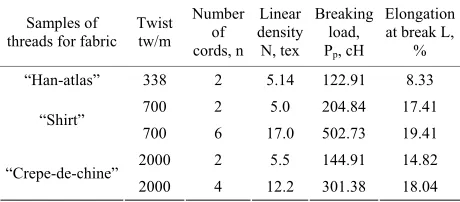
In initial stage of the research physical and mechanical properties of silk textile thread with different twist de- gree and cord of threads were investigated (Table 1).
With increasing of twist, the durability of the thread increases to some critical point, then strength properties decrease. Increasing of elementary threads in textile thread causes increasing of its durability.
For revealing changes in supermolecular structure volume and superficial properties of threads with differ-ent twist and number of threads cords using sorption, X-ray methods were researched, and external surface of the samples was researched by focused beam electronic microscopy.
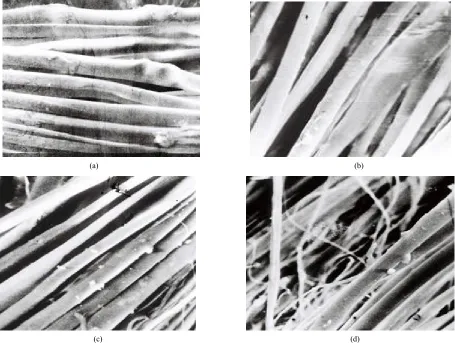
[image:2.595.308.538.620.721.2]REM-researching of the Silk samples showed the fol-lowing results: initial untwisted natural silk thread has a smooth surface (Figure 1), here and there slightly coarse with rare linear thin folds along the fiber axis.
Table 1. Physical and mechanical properties of silk textile threads with different degree of twist and cord of threads.
Samples of threads for fabric
Twist tw/m Number of cords, n Linear density N, tex Breaking load,
Рр, cН
Elongation at break L,
% “Han-atlas” 338 2 5.14 122.91 8.33
700 2 5.0 204.84 17.41 “Shirt”
700 6 17.0 502.73 19.41 2000 2 5.5 144.91 14.82 “Crepe-de-chine”
(a) (b)
[image:3.595.71.526.86.429.2]
(c) (d)
Figure 1. REM surveys of samples with different twist: (a) untwisted; twisted x; (b) With twist 338 tw/m; (c) With twist 700 tw/m; (d) With twist 2000 tw/m silk thread.
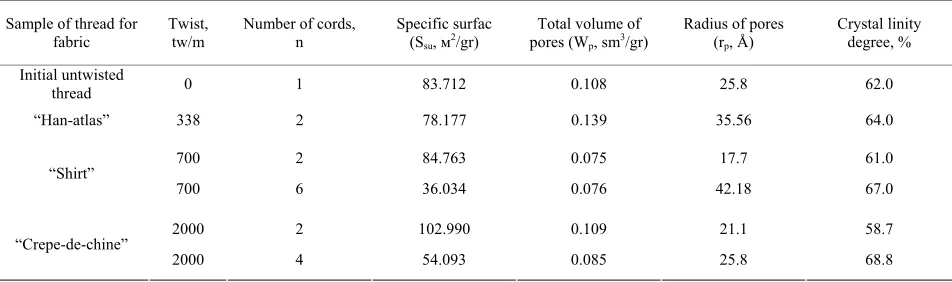
The silk thread which has twist 338 tw/m × 2 differs very little (Figures 1(a) and (b).) from initial silk by sur- face structure, but when twist increases (700 tw/m × 2) micro- and macro-defects appear on the surface (Figures 1(c) and (d)). Significant superficial change takes place at high twisting of textile thread. For the fabric of crape assortment (2000 tw/m × 2) twist can be seen clearly, practically we can’t see fibril elements (Figure 1(d)). When twist increases we can see significant superficial change and also micro- and macro-defects, twistedness, bends, breaks, elementary fibre fibrilization. Changing of thread surface, appearing of cracks and fractures un-doubtedly influence on volume properties of the threads. In connection with this sorption and volume properties of natural silk threads samples with different twist and cord were researched (Table 2).
According to the results of researching sorption prop- erties it was determined that in the result of twisting compared with initial untwisted silk all the samples of silk threads for corresponding fabrics with different cord of threads indexes of specific surface decreasing—Ssp,
and at the same time radius of pores—rп of the fiber in-creases. Changing of pores total volume—W0, Ssp and rп differs depending on the number of cords of threads. At the same number of filaments W0 and rп fibers increase (338 tw/m), then sharply decrease. Ssp at twisting degree of 338 tw/m decreases compared wilh initial silk, then at 700 and 2000 tw/m it increases again. If number of cords and twist degree are different at changing from 338 tw/m to 700 and 2000 tw/m Ssp, W0 decrease, and rп for threads 700 tw/m in 6 cords—is the largest.
Crystallinity degree of textile thread for defining structural changes in result of twisting was evaluated .
Comparing crtystallinity degree for the samples ob- tained by combining in two threads with different num- ber of twist its Cd decreases when number of twist in- creases. However, intensive twist with large number of threads causes increasing of crystallinity degree signify- cantly (Table 3).
4. Results and Discussion
Table 2. Water stems sorption by silk samples at 25˚C.
Water stems sorption in % by threads will different cards number Relative wetness of water
steams, %
initial 3.23 × 2S338 3.23 × 2S700 3.23 × 2S2000 3.23 × 6S700 3.23 × 4S2000
10 1.1 1.0 1.2 1.0 0.5 0.7
30 2.5 2.3 2.9 2.4 1.1 1.6
50 3.3 3.1 4.0 3.3 1.7 2.4
65 4.2 3.7 5.1 3.9 2.6 3.3
80 6.0 4.9 6.4 4.8 4.9 4.5
90 7.8 6.40 7.5 5.6 5.0 5.9
100 10.8 13.9 10.5 7.5 7.6 8.5
Table 3. Superficial and volume properties of silk threads.
Sample of thread for fabric
Twist, tw/m
Number of cords, n
Specific surfac (Ssu, м2/gr)
Total volume of pores (Wp, sm3/gr)
Radius of pores (rp, Å)
Crystal linity degree, %
Initial untwisted
thread 0 1 83.712 0.108 25.8 62.0
“Han-atlas” 338 2 78.177 0.139 35.56 64.0
700 2 84.763 0.075 17.7 61.0
“Shirt”
700 6 36.034 0.076 42.18 67.0
2000 2 102.990 0.109 21.1 58.7
“Crepe-de-chine”
2000 4 54.093 0.085 25.8 68.8
most important physical characteristics which stipulate the complex of structural-mechanical and sorption prop- erties of fiber material.
Extreme nature of dependence of textile threads twist and durability can be explained by increasing friction forces between fibers at twisting to the values that exceed fibers durability. At further of increasing yarn twisted- ness breaking of fibers increases because of twisting de- formation and pressing and in the result yarn durability decreases [13].
Textile thread must have system of submicroscopic pores that form developed inner surface with active cen- ters which provide diffusion and fixation of the dye dur- ing coloring. Effective free volume can change in the processing and chemical finishing of the fiber.
In initial silk undense packing of structural elements may take place because of steric obstacles of big side substitutes and also in the result of thermal motion of macromolecules.
Emptinesses that appear are approximately equal to the volume of statistic polypeptide segment cause undensity of packing in amorphous parts. The larger emptinesses and pores in the fiber are determined by the peculiarities
of packing different fibrillar structures on all levels of supermolecular formations of fibroin [14]. These correla- tions obviously change in the process of deformation, decrease or increase depended to loading regime. The changes are the result of the action of several opposite factors which cause:
Increasing or decreasing of pores sizes, that promote to appearance of micro and macro defects by the in- fluence of tension in the process of twist;
Crystallity degree and regulation of fibroin macro- moleciles, that promote to increasing intensity of in- termolecular interaction.
These facts allow to make the conclusion that the changes in supermolecular structure of twisted silk threads must influence on kinetic and thermodynamic characteris- tics in dyeing process.
On the basis of these data theinfluence of these changes on the quality of dyeing was researched. For dyeing active vinylsulfondyes Ostacolor Ostazin VR blue and yellow Ostazin VGR were used. The kinetics of dyeing threds samples with different twist, at 65˚C, 75˚C, 85˚C (Table 4) was investigated.
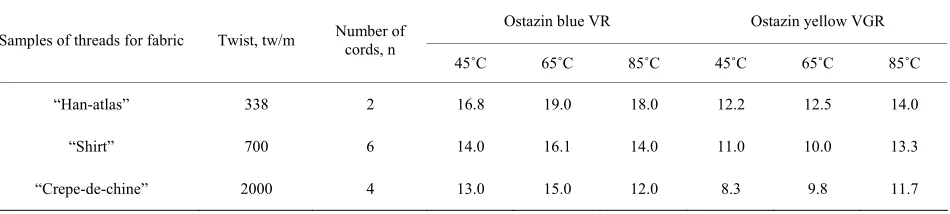
[image:4.595.61.537.294.435.2]the fiber in identical conditions of dyeing for all the samples showed that the filament “Han-atlas”338 kr/m × 2 absorbs more dye than “Shirt” and “Crepe-de- chine” of the same cord. Sorption of “Crepe-de-chine” thread (2000 tw/m × 4) is less than of “Shirt” (700 tw/m × 6) ones. The same effectcan be seen at fixation of the dye on the threads. Twist degree of threads doesn’t in-fluence significantly on the dye sorption, but the fixa-tion of the dye doubles with increasing degree of threads twist. On the basis of kinetic curves values of diffusion coefficients in dyeing process (Tables 5 and 6) were calculated.
Threads for “Han-atlas” have pores with a large radius and total pore volume, therefore the dye diffuses into the fiber easier. The values of the diffusion coefficient of dyeing “Han-atlas” threads are higher compared with other
samples. When temperature increase the diffusion coeffi- cient of dyeing Ostazin blue VR increases, then it de- creases a little, while the Ostazin yellow VGR uniformly increases. Differences between changes in diffusion co-efficient and the type of dye are probably connected with the structure of the molecule.
5. Conclusions
With increasing of twist thread durability of increases to some critical value and causes significant surface changes.
[image:5.595.64.539.315.443.2]In the result of twisting Ssp increases and at the same time rп of the fiber decreases. Conformity to some estab- lished law of Ssp and rп changes to some extent differs depending on the number of threads cords At high twist degree of (2000 tw/m) Ssp, W0 decrease and rп for threads changes little.
Table 4.Influence of dyeing temperature on the equilibrium sorption and fixation of the dye by silk threads with different twist degree and with the cord of 2 threads.
Ostazin blue VR Ostazin yellow VGR
338 tw/m 700 tw/m 2000 tw/m 338 tw/m 700 tw/m 2000 tw/m Temperature, ˚C
С* С** С* С** С* С** С* С** С* С** С* С**
45 17.0 12.9 16.4 12.6 14.1 10.2 13.6 10.5 13.5 9.9 12.4 8.95
65 17.9 14.4 17.8 14.05 17.8 14.0 15.8 13.5 15.4 13.4 15.2 13.2
85 16.0 10.6 14.5 8.6 12.5 7.0 13.6 10.8 13.1 10.8 13.0 10.2
[image:5.595.64.538.494.588.2]С* amount of sorbed dye gr/kg, С** of dye fixation gr/kg.
Table 5. Influence on equilibrium sorption and fixation of the dye by silk threads with different twist, and with cord of threads.
Ostazin blue VR Ostazin yellow VGR Thread sample with twist (tw/m) and the
number of cords
С* С** С* С**
338 × 2 16.65 4.95 16.6 4.1
700 × 6 15.85 5.85 15.2 5.2
2000 × 4 15.55 8.05 13.75 8.75
Table 6. Dependence of diffusion coefficient D·1012 m2/sec on twist degree and temperature of dyeing.
Ostazin blue VR Ostazin yellow VGR Samples of threads for fabric Twist, tw/m Number of cords, n
45˚C 65˚C 85˚C 45˚C 65˚C 85˚C
“Han-atlas” 338 2 16.8 19.0 18.0 12.2 12.5 14.0
“Shirt” 700 6 14.0 16.1 14.0 11.0 10.0 13.3
[image:5.595.65.540.617.724.2]Crystallinity degree of the thread with increasing twist at identical number of cords decreases. However inten- sive twist with large number of threads cord causes in- creasing of crystallinity degree, that makes difficult dye diffusion inside the fibre.
REFERENCES
[1] М. Ya. Mustafaeva, “Influence of Twisting and Linear Density of Crape Threads on the Properties of ‘Crepe- de-Chine’ Fabrics. Silk,” Tashkent 1984, No. 1, 1984, pp. 24-26.
[2] H. Alimova, “Non-Waste Less Technology of Silk Proc-essing,” Tashkent Science Publishing House, Tashkent, 1994, p. 309.
[3] H. Ito, T. Imamura, K. Uemura, M. Yoshida, H. Sasaki and N. Donkai, “New Diet, New Silk,” Textile Asia, Vol. 32, No. 10, 2000, pp. 26-29
[4] K. Dimitrovski, S. Jeler and М. KumarBarvno, “Oblik-ovanje Pestrih Tkanin. Interdisciplinalmost Barve-2.det,
Маribor,” Drustvo Koloristov Slovenije, Vol. 8, 2004, pp 455-475.
[5] T. N. Kocevar, “Optic no Mesanje barv na PovrSini Tkanine. Interdisciplinamost Barve-2.det, Interdisciplinal-most Barve-2.det, Маribor,” Drustvo koloristov Slovenije, Vol. 8, 2004, pp. 195-210.
[6] H. Gabrijelcic and K. Dimitrovski, “Influence of Yarn and Weft Thread Density on Color Values Woven Sur-faces,” Fibres & Textiles in Eastern Europe, Vol. 12, 2004, pp. 32-39
[7] B. M. K. Kushal, “Structure on Silk Indian Silk. I— Macroharoc-Terization and Ahalysis of Amino Acid Composition; II—Structure-Property Correlations; III— Effect on Dyeing Behavior,”Journal of Applied Polymer Science, Vol. 92, 2004, pp. 1080-1123
[8] D. S. Dai, “Mizi Fan Characteristic and Performance of Elementary Hemp Fibre,” Materials Sciences and Appli-cations, Vol. 1, No. 6, 2010, pp. 336-342.
[9] K. S. Dönmez, A. T. Özgüney, G. Özçelik and A. Özer-dem, “The Comparison of Cotton Knitted Fabric Proper-ties Made of Compact and Conventional Ring Yarns be-fore and after the Dyeing Process,” Textile Research Journal, Vol. 77, No. 4, 2007, pp. 233-241.
doi:10.1177/0040517507076745
[10] C. D. Kane, U. J. Patil and P. Sudhakar, “Studies on the Influence of Knit Structure and Stitch Length on Ring and Compact Yarn Single Jersey Fabric Properties,” Textile Research Journal, Vol. 77, No. 8, 2007, pp. 572-582.
doi:10.1177/0040517507078023
[11] S. Gregg and K. Sing, “Adsorption, Specific Surface, Porosity,” Мoscow, 1970.
[12] М. А. Martinov and K. А. Vylegzhanina, “Rentgenogra-phy of Polymers, L.” 1972.
[13] G. N. Kukin, А. N. Solovyev and А. I. Koblyakov, “Tex-tile materials science, M.” 1989.