http://dx.doi.org/10.4236/ti.2012.31006 Published Online February 2012 (http://www.SciRP.org/journal/ti)
Knowledge Transfer Processes in Product Development
—Theoretical Analysis in Small Technology Parks
Seppo Saari1, Harri Haapasalo2
1
Department of Technology, Kemi-Tornio University of Applied Sciences, Kemi, Finland
2
Department of Industrial Engineering and Management, University of Oulu, Oulu, Finland Email: [email protected], [email protected]
Received November 21, 2011; revised December 21, 2011; accepted December 30,2011
ABSTRACT
Large science parks and their knowledge transfer processes have been studied extensively while only a few papers on small parks exist. Characteristic to them is that the institutions and services are fewer than in the large ones. The main target of this paper is to create a framework to analyse further knowledge transfer processes in small technology parks. The framework resulting from the study has two main phases: the innovation enabler and product development process analyses. The innovation enabler analysis starts with a local innovation system and a technology park analysis, includ-ing links to other geographical levels, and links to sectoral innovation systems. It is continued with a social capital as-sessment and a network analysis. The product development process analysis explores the product development proc-esses as the targets of the knowledge transfer, and transfer of different types of knowledge through and from the local innovation system.
Keywords: Knowledge Transfer; Product Development Process; Technology Park; Innovation System
1. Introduction
The first technology parks in the world were founded in the 1950’s. Stanford Research Park, founded in the year 1951, is mentioned to be the first one of its kind. In January 2007, Silicon Valley employed 870,000 people [1]. In following decenniums, a large number of tech-nology, science, and research parks were founded in the United States and in Western Europe [2]. In the 1980’s and early 1990’s, many technology parks started in Finland and Sweden, also in the northern most parts of the countries including Oulu in Finland and Luleå in Sweden. Also the smaller towns, e.g., Kemi in Finland and Kalix in Sweden, started their activities.
Several definitions for technology parks are available in the literature and also within the web sites of technol-ogy park associations. The International Association of Science Parks defines the term “science park” in the fol-lowing way [3]: “A Science Park is an organisation man- aged by specialised professionals, whose main aim is to increase the wealth of its community by promoting the culture of innovation and the competitiveness of its asso-ciated businesses and knowledge-based institutions. To enable these goals to be met, a Science Park stimulates and manages the flow of knowledge and technology amongst universities, R & D institutions, companies and markets; it facilitates the creation and growth of innovation-based companies through incubation and spin-off processes;
and provides other value-added services together with high quality space and facilities.”
Even if most of the attention is paid on the large sci-ence or technology parks in large cities, they exist also in smaller towns. The aim is to renew regional economics to help the regions to survive structural changes, facili-tate the local firms’ access to follow the technological development, and to facilitate innovation activities. Where small towns are concerned, the services and related ac-tivities are limited when compared to large university cities. Usually the number of firms in a local cluster is small, local market is limited, and—even if there is a higher education institute—the knowledge base is limited. Various models exist. e.g., in the North of Finland there are 15 technology parks of various sizes, and a total of 17,000 jobs of which over half are in Oulu [4]. All of these 15 technology parks cooperate within the frame-work of the Multipolis netframe-work. The basic idea is spe-cialisation e.g., in research and special laboratory equip-ment, and cooperation in tasks that would be e.g., finan-cially difficult for one technology park to realise alone. One of the basic ideas is the knowledge transfer between the local clusters but especially from Oulu, the largest with strongest research and education resources, to the smaller centres [4].
various sources in the form of explicit and tacit knowl- edge, embedded in new skilled personnel, or subsystems. It can be expected that the technology park and the local innovation system—with their actors, services and net-works—have a role in the knowledge transfer to the firms’ product development processes. Personal contacts and social networks may promote or inhibit collaboration between organisations [5], and thus social capital has a role as a knowledge transfer enabler. The technology park—or the local innovation system—as a milieu, and social capital are two of the factors that enable interior- ganisational networking. The product development proc- ess involves various phases [6,7] where different kinds of external knowledge is needed, and transferred to.
Our study focuses on how the knowledge is transferred to the firms’ product development processes in the con-text of small technology parks with limited resources and services, and what the influence is of the local innovation system with its limitations. The main goal is to create understanding based on existing research, in order to study the functionality of the small technology parks, and the knowledge transfer processes inside them. Based on the former, our first research question is:
RQ1 What kind of factors affect knowledge transfer to firms’ product development processes from and through a local innovation system with incomplete services?
This main question will be consecutively operational- ised into smaller entities to outline more accurately the factors affecting on knowledge transfer.
Industries open their innovation activities and proc- esses and co-operate with external partners and consum- ers—in order to create an innovation system. This paper focuses on the management of product development pro- cess from a company perspective. However, after defin- ing the context, we would like to present a recent ap- proach—the context of open innovation. This recent de-velopment of knowledge regarding the user/customer/ consumers involvement on innovation processes [8,9] has a similar target as an entity as our original RQ1. Therefore the idea is to compare findings of existing lit- erature based on the framework (RQ1) to see:
RQ2 How the framework developed—RQ1—relates on concept of open innovation?
2. Frame for Theoretical Construct
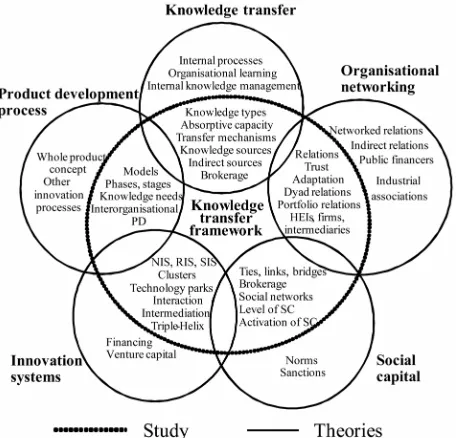
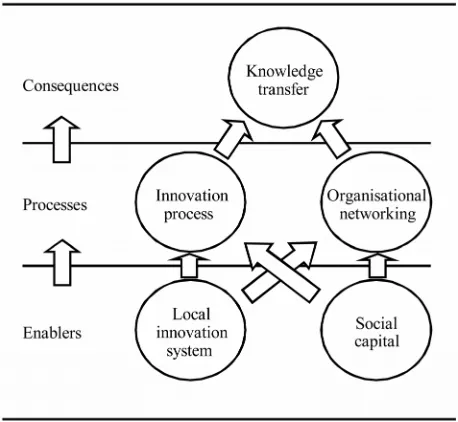
[image:2.595.310.538.86.305.2]Our theoretical frame of this study is based on five areas: innovation systems; social capital; product development process; networking; and the knowledge transfer process as a compilation “Figure 1”. The local innovation system including the technology park, and the local social capital are enablers determining the basic conditions and milieu that enable the knowledge transfer processes. The know- ledge is transferred in the product development process which determines what knowledge is needed in each of
Figure 1. The elements affecting knowledge transfer from and through a local innovation system to firms’ product development processes.
the phases. Interorganisational networking makes the knowledge transfer possible, and firms develop networks according to the needs and the enablers: the innovation system; and social capital. The knowledge transfer proc- ess, as a consequence, is the result of the enablers, needs, and networking.
The structure in itself consists of several theories that are included or excluded in our analysis. The use of dif-ferent theoretical fields in the study is limited to the level that is directly useful in the analysis in chapter 4.
3. Enablers and Processes for Knowledge
Transfer
3.1. Innovation Systems
Through innovation systems we search forthe role of the innovation system in enabling knowledge transfer to firms’ product development processes in small technol-ogy parks. The innovation system in which a firm oper-ates is an enabler for its innovative processes.
The first feature to be studied is the spatial scale of the focal technology park, or the local innovation system it is part of. In the reviewed literature, the technology park definition varies from one building to a whole city or town and from a park area to a whole county like the Silicon Valley. In most of the technology parks neither all the local actors participating in the firms’ product develop-ment processes nor all the local firms involved are lo-cated in the science park [10]. The spatial scale is the first step to be defined when a technology park is ana-lysed as an innovation system.
major effect on the operations. Ylinenpää [11] defines two main strategies: the incubation strategy, aiming for favourable conditions to create new start-up firms; and the attraction strategy trying to attract established and larger firms to locate knowledge-intensive divisions or units with the expertise and recruitment base that the local HEI (Higher Educational Institute) forms. The latter strategy may lead to a vertically oriented “firm constella-tion” instead of horizontal “network” structure [11], and thus the strategy choice may influence the product de-velopment processes. Also to understand the recent func-tionality of a technology park, its earlier history and de-velopment has to be known: every park has been founded in its own time and has same features in its development path as the others, even though not simultaneously [12]. A short analysis of the parks history and the development path of focal technology are an essential part of the frame.
According to the literature, other actors, e.g., suppor-tive services, have an important role in the product de-velopment processes of a firm in providing services re-lated on business infrastructure. In a technology park there are some specific actors that are founded to operate some specific activities. In some cases, the technology park itself takes care of several tasks: building and main-taining the premises; operating business hotel services; running the incubating services etc. There is anyhow a large variation between science parks [4]. To enable a proper analysis of the functions, activities and actors sho- uld be analysed in detail, but limited to knowledge-rel- ated matters. The role of KIBS (Knowledge intensive bu- siness services) and other intermediaries in an innovation system is to intermediate knowledge and information as well as to influence the structures and dynamics of the system [13-15]. Many organisations or parts of them may have the intermediating role even unconsciously [13]. The incubators’ role is to assist start-up firms and trans-fer or intermediate them the knowledge they need [16-18]. To identify the intermediaries and their roles, their acti- vities are analysed by applying some of the functions that Howells [14] has defined.
According to a number of studies, organisations oper-ating in interface are the most important partners for firms in their innovative activities [19-21]. The other firms include several different types of groups having different characteristics from the focal firm point of view. Customers are of the highest importance according to surveys amongst firms [20-25]. Local customers inside the “local innovation system” are of highest importance [26,27] followed by equipment, material, component, and subsystem suppliers [19-23]. The existence of local com- petitors allows both mutual knowledge transfer, joint knowledge transfer from third parties, and knowledge creation through joint participation in research progra- mmes [19,28]. An anchor tenant with a heavy investment
in R & D may have a major effect on local smaller firms [29]. Strategic and tactical alliances, and subcontracting in product development processes have become more and more usual in the globalising market with multi-techno- logical products [30]. Alliances, partnerships, and out-sourcing as forms of co-operation of individual tasks or projects are of high importance [25,29-36], and they should be considered as an essential part of the enabling factors in the local innovation system on the entity level.
The type and existence of higher education and re-search institutes varies between technology parks and local innovation systems. HEIs form the central source of qualified personnel. The knowledge base can be focused to fit better on the needs of local firms with the help of project-based learning, and theses are focused on firms’ needs [20,37-39]. The local degree and other education programmes are analysed to find out their roles. Local research has a significant value to the firms. [20,40-42]. The different models the institutions utilise for contract research, publicly funded research, study projects, li-censing etc. are of importance to understand their ena-bling roles.
A local innovation system does not work without con-necting links to broader geographic context: the regional, and national innovation systems. When defining the spa-tial boundaries of a regional innovation system, the main criterion is the high “coherence” or “inward orientation” with regard to product development processes instead of e.g., administrative boundaries [43]. In practice this can be interpreted so that a science park or a local innovation system can be part of a larger regional system, or have links to one or several regional systems [44]. The na-tional innovation system forms the boundary conditions in which the local actors operate. The national system should not be seen as a question of resource allocation but the dynamic features including learning, knowledge flows and relationships [45]. The maturity and function-ality of the “local innovation system” can be reflected to the knowledge space (creation of a regional innovation environment), the consensus space (a “triple helix” of linkages generate ideas and strategies), and the innova-tion space (realising goals, experiments, public venture capital). [46] The sectoral innovation system approach focuses on knowledge and technology domain, actors and networks, and institutions [47,48]—the same types of elements as the spatially defined innovation systems but focusing on one sector. The sectoral system can be local, national, or global, or it can have all these dimen-sions combined [48].
3.2. Social Capital
the negotiations and connections are dependent on inter-action between people working in those firms. Strong ties are important for social support. A weak tie is the oppo-site—a friend of a friend type of interaction—that is valuable as a source of novel information. [49,50] There- fore we search for the role of social capital in enabling knowledge transfer to firms’ product development proc-esses in small technology parks. Structural holes are po-tential connections that can be used to broker gaps in the network [50,51]. Brokerage across the structural holes provides a vision of options otherwise unseen [51]. Di-rect ties serve as sources of resources and information, indirect ties as sources of information, and structural holes between partners expand the diversity of informa-tion. Direct and indirect ties influence the innovation output positively, but an increasing number of structural holes decrease innovation output [52].
Social capital consists of social networks, norms, and sanctions that govern their characteristics. It has three basic components: a network; a cluster of norms, values and expectations shared by group members; and sanc-tions that help to maintain the norms and network. The sub-types of social capital are defined as bonding, brid- ging and linking. Bonding can be referred to strong ties and bridging to weak ties while linking is an even weaker connection including, e.g., norms like mutual respect [53]. Strong ties, high level of social capital, and proximity foster innovation and learning processes as total [54-60] while weak ties foster radical innovations [61]. Key per-sons are important to make networks efficient [56,62].
3.3. Product Development Process
Our main focus is on knowledge transfer to the product development processes of the firms in small technology parks. The product development process itself is not a primary object, but because of the type and sources of knowledge needed, the different parts of the product de-velopment process varies [63] and renders it necessary to analyse the product development process to some degree. Therefore, we need to understand what kind of knowl-edge is needed in various phases of product development processes in firms in small technology parks. There are several models to describe the product development proc-ess. The number and definition of stages varies to some degree. The fuzzy front end consists of the identification of the opportunity, idea generation and refinement, and idea evaluation [64]. Some involve the concept devel-opment in it, while others involve even the idea evalua-tion in the main product development process [6]. The concept development is followed by the technical design stages. The technical development is then followed by functional testing, validation and refinement, as well as production ramp-up and launch [6,7,64].
Firms rarely innovate alone [65] but seek collaboration
to share risks [66], and find complementary resources [66-69]. Users are a major source of knowledge [63, 69-72] as well as suppliers [73-75]. In addition to the mediating role, intermediaries may also have a role in tailoring new technologies [76]. The role of higher edu-cation and research institutes is emphasised [41,77-79] although in surveys they do not reside at the top of list [20,22,23]. The role of co-operation as outsourcing, alli-ances, and partnerships is rising [80-82] especially when incremental innovations are concerned. The attention should be first paid on the process and its stages. Sec-ondly, the knowledge needs in various stages should be analysed according to the knowledge type, source, and importance.
3.4. Interorganisational Networking
In current economy, no organisation is an island, and therefore we need to outline, how does interorganisa-tional networking function in knowledge transfer to firms’ product development processes in small technology parks? The basic level in an interorganisational relation-ship is a dyad one-to-one relation, where personal con-tacts and social capital are in an essential role [5]. Per-sonal contacts may either promote or inhibit exchange of information, assessment, negotiations and adaptation, and service production and transfer. Because of various factors, firms use managerial practices and processes to foster trust-building. The trust itself has three dimensions: competence; goodwill; and behaviour [83]. Reputation of treating counterparts fairly [84], cultural values, and norms are of importance [85]. A shared identity helps in developing mutual trust that assists in developing transp- arency, intent to mutual learning, and understanding each other better than formal agreements. On the other hand, too strong trust is argued to destroy creativity. Mutual trust and commitment; power dependencies; mutual in-tent; shared identity; and previous outcomes define the relationship atmosphere. Processes needed in for intera- ction are exchange; adaptation; and coordination. The support structure should cover the rewarding system; operational structure; and infrastructure [86].
con-stantly changing [81]. The whole network can be managed by using e.g., methods used in supply chain management, including business process integration etc [88,89].
Lambert [88] defines four types of business process links according to the importance of each actor to the firm: managed links; monitored links; non-managed links; and non-member links. In some cases also connected rela-tions are managed [87], which in practice means that the specified part of the relationship chain is closed [84]. In a full network mode, all the members are connected to each other in several different ways [87]. The ARA (Ac-tivities, Resources, Actors) model introduces the concept of the function of third parties that takes into considera-tion the influence of a relaconsidera-tionship to third parties, or how the firm is affected by a relationship between third parties [90,91]. The ARA model is argued to be a useful framework for understanding information exchange, where trust is a major transfer enabler [84-86,92-94].
3.5. Knowledge Transfer and Management
Several knowledge transfer and management theories are available in the literature. They deal mainly with knowl-edge management on the organisational level [95,96]. We need to study: how is knowledge transferred in and through the local innovation system to companies’ prod-uct development processes in small technology parks? Our interest is on the knowledge related processes in small technology parks including the transfer inside the local innovation system, and the knowledge transfer through the local innovation system to the product de-velopment processes of the firms. The amount in which a firm is capable to capture knowledge is dependent on its absorptive capacity which is not just a sum of the absorp-tive capacities of the individual persons, but includes the knowledge transfer functions. Difficulties may be caused, e.g., by centralised gatekeeper roles, the expertise of the individuals receiving the knowledge, the narrowness of expertise, or even by the “not-invented-here” syndrome [97]. The absorptive capacity is determined by mutual trust and power dependencies within the relationship, the mutual intent, receiver’s ability to capitalise on the trans- ferred knowledge, the organisational receptivity [98], the similarity of the knowledge bases of the firms, the or-ganisational support structures, and the compensation policies [99].
The knowledge needed to enhance the absorptive ca-pacity does not include just the substantive knowledge itself but also awareness of where the useful comple-mentary knowledge resides within and outside the or-ganisation: knowledge of who knows what; who can help with what problem; or who can exploit new information [97]. It has been found that age as well as educational and size effects influence the SME acquisition and as-similation of knowledge [100].
Knowledge transfer into a firm leads to organisational learning processes-that can be described with learning curves [101,102]—including the individual learning of the employees, coordination of work, incremental inno- vation of the process, and the effect of new tools [102]. Research and development expenditure influence in the slope of the learning curve [103]. Knowledge can be transferred by moving people, technology, or a structure to an organisation, or by modifying people (e.g. training), technology, and the structure of the recipient organisa- tion. If the knowledge is embedded in individuals, the extent of labour turnover may cause organisational for- getting [101].
There are two basic types of knowledge: tacit and ex- plicit. The tacit knowledge is the most difficult to trans- fer, but succeeds with the help of various types of col- laboration forms [95,104,105]. Lubit [104] lists solutions to accomplish it without transforming the knowledge to explicit form: working together with experts making ob- servations and learning from coaching; working in groups and networks including brainstorming etc.; re-cording learning histories by writing narratives of critical events such as a change initiative, a product launch, or an inno- vation including mistakes; and developing routines for dealing with various situations and spreading the rou-tines throughout the organisation. The explicit knowl-edge, e.g., in form of data, specifications, manuals, sci-entific formulae, or product can readily be transmitted formally and systematically [97,105].
3.6. Factors Affecting Knowledge Transfer to Firms’ Product Development Processes
Figure 2. The logic and hierarchy of the elements affecting knowledge transfer in a local innovation system to firms’ product development processes.
4. Comparing Open Innovation of the
Constructed Framework
4.1. Open Innovation as a Concept
The extent and type of innovation has been analyzed by researchers in the following ways (as collected by Dodgson et al. [106]: radical or incremental [107]; con-tinuous or disconcon-tinuous [108] or sustaining or disruptive [109]; change over life cycles [110]; modular or archi-tectural [111]; emergence of a dominant design [110]; and open or closed innovation strategies (Figures 3 and 4) [112].
Open innovation (OI) has been highlighted and dis-cussed as an important concept in understanding and analyzing the 21st century business and innovation envi- ronments [113]. As a whole, OI paradigm can be under- stood as the antithesis of the traditional vertical integra- tion model where internal research and development (R&D) activities lead to internally developed products. OI is the use of inflows and outflows of knowledge to accelerate internal innovation—product development proc-ess, and expand the markets for external use of innova-tion. [113].
4.2. Comparison of OI and Developed Framework
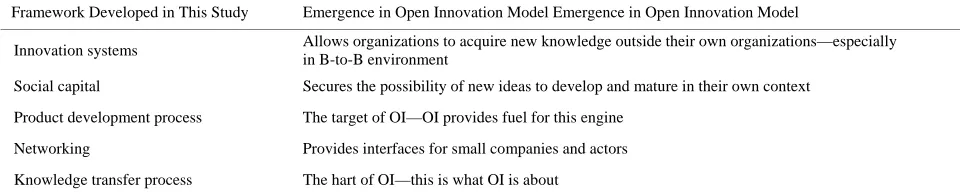
The OI model also involves a marked change in the adopted principles of innovation (see Tables 1 and 2). It is instructive to compare the Open Innovation Principles to the pieces of constructed framework.
[image:6.595.317.531.88.259.2]Since the first publication of Chesbrough’s Open In-novation in 2003 [112], the ideas of OI have become in- fluential among innovation managers in many industrial
Figure 3. Closed innovation model [112].
Figure 4. Open innovation model [112].
companies [114], however, not without some criticism. Like Dodgson et al. [106] note there is some controversy in the innovation literature as to how open companies should be towards external partners in their search for new innovations and in developing new routes to market [115,116]. Then Dodgson et al. [106] emphasizes that companies need to be careful in opening themselves to external partners for the following reasons: the danger of theft, managerial time demands and transaction costs, over-reliance on external partners, and slowing down of own internal innovation process due to increasing coor-dination costs.
[image:6.595.316.536.266.464.2]Table 1. Comparing the factors affecting knowledge transfer to firms’ product development processes in context of small technology parks into the principle of open innovation.
Open Innovation Principles [112] Framework Developed in This Study
Not all the smart people work for us. We need to work with smart people inside and outside our company.
Innovation system enables more than a single company can create; it promotes future competitiveness in certain areas.
The context of technology park is to co-operate; networking is a process of co-operation.
External R & D can create significant value; internal R & D is needed to claim some portion of that value.
Social capital enables companies to develop new products.
The roots of new ideas and models of thinking but also products are in interfaces.
We don’t have to originate the research to profit from it.
It is important that others are successful too, success in supporting areas is not a “zero sum game”.
Building a better business model is better than getting to market first.
To concentrate on own core competencies and let others concentrate on supporting competencies. Better possibilities to develop successful end products can be created.
If we make the best use of internal and external ideas, we will win.
By concentrating on developing our own organisational capabilities—we will be also beneficial for others.
We should profit from others’ use of our innovation project, and we should buy others’ IP whenever it advances our own business model.
Everything may not be necessary or needed in order to achieve on our own, instead of developing technology. We can acquire it from outside the company.
Again learn from others.
Table 2. Comparing the principle of open innovation into the factors affecting knowledge transfer to firms’ product devel-opment processes in context of small technology parks.
Framework Developed in This Study Emergence in Open Innovation Model Emergence in Open Innovation Model
Innovation systems Allows organizations to acquire new knowledge outside their own organizations—especially in B-to-B environment
Social capital Secures the possibility of new ideas to develop and mature in their own context
Product development process The target of OI—OI provides fuel for this engine
Networking Provides interfaces for small companies and actors
Knowledge transfer process The hart of OI—this is what OI is about
5. Discussion and Conclusions
The literature review confirms that there are very little studies on small technology parks. Knowledge is a nec- essity for innovations, new products and services. Small technology parks in remote locations have incomplete knowledge related services, and a small number of actors. In the innovation system study, the unit of analysis was the local innovation system with focus on the technology parks. On the other hand, the product development proc-esses and knowledge transfer were studied on the level of firms’ processes. Social capital and its effects should be studied both on company and innovation system level. The results of the study imply that neither research on innovation system level, research on the firms’ product development process level, nor on firms’ interaction within product development processes are adequate to explain how, where from, and what type of knowledge is trans-ferred to the firms’ product development processes.
A small technology park is not an adequate basic unit to study the knowledge transfer but also other local ac-tors have to be included, as well as links to regional, na-tional, and sectoral (industry or business specific) inno-vation systems. The main strategies—incubation, or at-traction—affect on the constellation of firms, and thus the knowledge transfer processes. Also the history of the
technology park has major influences on the choices that firms make, and also on the social capital and thus on networking between the firms. The local actors, their existence, and activities should be noted because they affect what types of firms locate in a technology park, how they transfer knowledge, and what type of knowl-edge is transferred. The Triple-Helix concept is usable in measuring of the overall functionality of a technology park but detailed exploration demands a more detailed study. Studies on social capital—especially from the so-cial network point of view—is necessary for the under-standing of networking among firms and other actors in a small technology parks. Further on, to understand the local social networking and social capital, also the ac-tions taken to foster social capital, have to be included in to the analysis.
[image:7.595.57.537.320.417.2]development processes, networking can be analysed by using data from the firms product development processes. To understand the knowledge transfer to a firm’s product development process, networking should be analysed both on dyadic and portfolio levels. A dyadic relationship with trust and adaptation tells usually about a long-term rela-tionship with also tacit knowledge transfer, while a port-folio relationship tells of managing competing relation-ships with weaker links and transfer of explicit knowl-edge or subsystems.
Finally, the purpose of open innovation is to provide more ideas on the product development process to get more success through products. In general, level industry is opening its innovation processes, through exchange and brokering of technology resources [106] and apply-ing social innovation. It is not important weather these practices are found through extensive literature search (innovation systems; social capital; product development process; networking; and the knowledge transfer process as a compilation) or from totally different approach of open innovation. It is however interesting to note that both of these approaches emphasises the same features. Based on Tables 1 and 2 you can find features of our framework from open innovation principles or the other way around.
REFERENCES
[1] C. O’Brian, “Downturn in Valley Jobs Seems to Be Over, Modest Gains Leave Economists Mildly Optimistic,” The Mercury News, 2007.
[2] Y. Zhang, “The Science Park Phenomenon: Development, Evolution and Typology,” International Journal of En-trepreneurship and Innovation Management,Vol. 5, No. 1-2, 2005, pp. 138-154.
[3] IASP, “International Association of Science Parks,” 2008. www.iasp.ws/publico/index.jsp?enl=1
[4] J. S. Jauhiainen, K. Ala-Rämi and K. Suorsa, “Multipolis- Teknologian, Osaamisen Ja Kehittämisen Yhteistyöver- kosto,” Sisäasiainministeriön Julkaisuja, Helsinki, 2004. [5] A. Halinen and A. Salmi, “Managing the Informal Side of
Business Interaction: Personal Contacts in the Critical Phases of Business Relationships,” Proceedings of the 17th IMP Conference, Oslo, Norway, 9-11 September, 2001.
[6] R. G. Cooper, “The Seven Principles of The Latest Stage- Gate Method Add Up to Streamlined, New-Product Idea- To-Launch Process,” Stage-gate Inc., 2006.
[7] K. T. Ulrich and S. D. Eppinger, “2 Product Design and Development,” 3rd Edtion, McGraw-Hill, Singapore, 2003. [8] S. Ogawa and F. T. Piller, “Reducing the Risks of New
Product Development,” MIT Sloan Management Review, Vol. 47, No. 2, 2006, pp. 65-71.
[9] M. Dodgson, D. Gann and A. Salter, “The Management of Technological Innovation—Strategy and Practice,”
Oxford University Press, New York, 2008.
[10] S.-A. Phillip and H.-C. Yeung, “A Place for R&D? The Singapore Science Park,” Urban Studies, Vol. 40. No. 4, 2002, pp. 707-732. doi:10.1080/0042098032000065263 [11] H. Ylinenpää, “Science Parks, Clusters and Regional
Development,” Luleå University of Technology, Sweden, 2001.
[12] T. Breshanan, A. Gambardella and A. Saxenian, “‘Old Economy’ Inputs for ‘New Economy’ Outcome: Cluster Formation in the New Silicon Valleys,” Industrial and Corporate Change, Vol. 10, No. 4, 2001, pp. 835-860. doi:10.1093/icc/10.4.835
[13] A. Smedlund, P. Ståhle and L. Köppä, “Välittäjäorganisa- atiot ja Jaettu Johtajuus,” In: M. Koskenlinna, A. Sme- dlund, P. Stähle, L. Köppä, M-L. Niinikoski, V. Valovirta, K. Halme, J. Saapunki, and J. Leskinen, Välittäjäorgani- saatiot-Moniottelijat Innovaatiota Edistämässä, Teknolo- giakatsaus, Tekes, Helsinki, 2005, pp. 19-52.
[14] J. Howells, “Intermediation and the Role of Intermediar-ies in Innovation,” Research Policy, Vol. 35, No. 5, 2006, pp. 715-728. doi:10.1016/j.respol.2006.03.005
[15] R. Coombs, M. Harvey and B. S. Tether, “Analysing Distributed Processes of Provision and Innovation,” In-dustrial and Corporate Change, Vol. 12. No. 6, 2003, pp. 1125-1155. doi:10.1093/icc/12.6.1125
[16] S. Saurio, “Generating Knowledge-Based Entrepreneur-ship: Pre- and Business Incubation in Finnish Polytech-nics,” FINPIN-Finnish Polytechnics Incubators Network, Hämeenlinna, 2004.
[17] S. Saurio, “Promoting Entrepreneurship and Business Incubator Operations in the Finnish Polytechnic Envi- ronment,” In: S. Saurio, Ed., Generating Knowledge-Based Entrepreneurship: Pre- and Business Incubation in Fin-nish Polytechnics, FINPIN-Finnish Polytechnics Incuba-tors Network, Hämeenlinna, 2004, pp. 23-28.
[18] L. Rothschilt and A. Darr, “Technological Incubators and the Social Construction of Innovation Networks: An Is-raeli Case Study,” Technovation, Vol. 25, No. 1, 2005, pp. 59-67. doi:10.1016/S0166-4972(03)00064-6
[19] E. von Hippel, “Cooperation between Rivals: Informal Know-How Trading,” Research Policy, Vol. 16, No. 6, 1986, pp. 291-302.
doi:10.1016/0048-7333(87)90015-1
[20] M. Nieminen and E. Kaukonen, “Universities and R & D Networking in a Knowledge-Based Economy, a Glance at Finnish Developments,” Sitra Reports Series 11, Sitra, Helsinki, 2001.
[21] K. Laursen and A. Salter, “Searching Low and High: What Type of Firms Use Universities as a Source of In-novation?” Research Policy, Vol. 33, No. 8, 2004, pp. 1201-1215. doi:10.1016/j.respol.2004.07.004
[22] M. Fritsch and R. Lukas, “Who Cooperates on R & D?” Research Policy, Vol. 30, No. 2, 2001, pp. 297-312. doi:10.1016/S0048-7333(99)00115-8
tional Innovation Systems, OECD, Paris, 2001, pp. 123- 142.
[24] A. Schibany and D. Schartinger, “Interaction between Universities and Enterprises in Austria: An Empirical Analysis at the Micro and Sector Levels,” In: Innovative Networks, Co-Operation in National Innovation Systems, OECD, Paris, 2001, pp. 235-252.
[25] G. A. Moore, “Crossing the Chasm, Marketing and Sell-ing Disruptive Products to Mainstream Customers,” Har- per Collins Publishers, New York, 2002.
[26] M. E. Porter, “Kansakuntien Kilpailuetu,” Otava, Keuruu, 1991.
[27] H.-C. Lai and J. Z. Shyu, “A Comparison of Innovation Capacity at Science Parks across the Taiwan Strait: The Case of Zhangjiang High-Tech Park and Hsinchu Sci- ence-Based Park,” Technovation, Vol. 25, No. 7, 2005, pp. 805-813. doi:10.1016/j.technovation.2003.11.004
[28] M. Soekijad and E. Andriessen, “Conditions for Knowl- edge Sharing in Competitive Alliances,” European Man- agement Journal,Vol. 21, No. 5, 2003, pp. 578-587. doi:10.1016/S0263-2373(03)00107-5
[29] A. K. Agrawal and I. Cockburn, “The Anchor Tenant Hypotheses: Exploring the Role of Large, Local, R & D- Intensive Firms in Regional Innovation System,” Interna- tional Journal of Industrial Organizations, Vol. 21, No. 9, 2003, pp. 1227-1253.
[30] R. Narula, “R & D Collaboration by SMEs: New Oppor-tunities and Limitations in the Face of Globalization,” Technovation, Vol. 24, No. 2, 2004, pp. 153-161. doi:10.1016/S0166-4972(02)00045-7
[31] J. McKenzie, “How to Share Knowledge between Com-panies, Examining Success Factors for Inter-Organiza- tional Relationships,” Knowledge Management Review, Vol. 8, No. 5, 2005, pp. 16-19.
[32] T. Vilkamo and T. Keil, “Technology Partnering in High- Velocity Environments—Lessons from a Case Study,” Helsinki University of Technology, Institute of Strategy and International Business, Working Paper Series 2000, Espoo, 2000.
[33] J. Howells, “The Knowledge Boundaries of the Firm and Sourcing for Innovation,” 13th IAMOT International Conference, Washington, 3-7 April 2004.
[34] I.-S. Fan, S. Russell and R. Lunn, “Supplier Knowledge Exchange in Aerospace Product Engineering,” Aircraft Engineering and Aerospace Technology,Vol. 72, No. 1, 2000, pp. 14-17. doi:10.1108/00022660010308624 [35] L. J. Bourgeois and K. M. Eisenhardt, “Strategic Decision
Processes in High Velocity Environment: Four Cases in the Microcomputer Industry,” Management Science, Vol. 34, No. 7, 1988, pp. 816-835. doi:10.1287/mnsc.34.7.816 [36] K. M. Eisenhardt, “Politics of Strategic Decision Making
in High-Velocity Environments: Toward a Midrange Theory,” Academy of Management Journal, Vol. 31, No. 4, 1988, pp. 737-770. doi:10.2307/256337
[37] F. K. Fink, “Problem Based Learning in Engineering Education—A Catalyst for Regional Industrial Develop-ment,” World Transactions on Engineering and Tech-nology Education, Vol. 1, No. 1, 2001, pp. 1-4.
[38] F. K. Fink, “How Can We Apply the Problem Based Learning Philosophy in Continuing Engineering Educa-tion? 6th UICEE Annual Conference on Engineering Education, Cairns, Queensland, Australia, 10th-14th Feb- ruary, 2003.
[39] E. Moesby, “Curriculum Development for Project-Ori- ented and Problem-Based Learning (POPBL) with Em-phasis on Personal Skills And Abilities,” Global Journal of Engineering Education, Vol. 9, No. 2, 2005, pp. 121- 128.
[40] L. Leydesdorff and H. Etzkowitz, “The Future Location of Research: A Triple Helix of University-Industry-Gov- ernment Relations II,” EASST Review, Vol. 15, No. 4, 1998, pp. 1-12.
[41] H. Etzkowitz and L. Leydesdorff, “The Triple Helix- University-Industry-Government Relations: A Laboratory for Knowledge Based Economy Development,” EASST Review,Vol. 14, No. 1, 1995, pp. 1-12.
[42] D. C. Mowery and N. S. Bhaven, “Universities in Na-tional Innovation Systems,” In: J. Fagerberg, D. Mowery and R. R. Nelson, Eds., The Oxford Handbook of Innova-tion, Oxford University Press, Oxford, 2005, pp. 209-239. [43] C. Edquist, “Systems of Innovation,” In: J. Fagerberg, D. Mowery and R. R. Nelson, Eds., The Oxford Handbook of Innovation, Oxford University Press, Oxford, 2005, pp. 181-208.
[44] P. Cooke, “Regional Innovation Systems—An Evolu-tionary Approach,” In: P. Cooke, M. Heidenreich and H.-J. Braczyck, Eds., Regional Innovation System—The Role of Governance in a Globalized World, Routledge, London, 2004, pp. 1-18.
[45] B.-A. Lundvall and S. Borrás, “The Globalising Learning Economy: Implications for Innovation Policy,” DG XII, Commission of the European Union, 1997.
[46] H. Etzkowitz, “The Triple Helix of University-Univer- sity-Government Implications for Policy and Evaluation,” Working Paper 2002-11, Institutet för Studier av Ut-bildning och Forskning, Stockholm, 2002.
[47] F. Malerba, “Sectoral Systems, How and Why Innovation Differs across Sectors,” In: J. Fagerberg, D. Mowery and R. R. Nelson, Eds., The Oxford Handbook of Innovation, Oxford University Press, Oxford, 2005, pp. 380-406. [48] F. Malerba, “Sectoral Systems of Innovation and
Produc-tion: Concepts, Analytical Framework and Empirical Evidence,” The Future of Innovation Studies Conference, Eindhoven University of Technology, Eindhoven, 22-23 September 2001, p. 4.
[49] M. S. Granowetter, “The Strength of Weak Ties,” Ameri-can Journal of Sociology, Vol. 78, No. 6, 1973, pp. 1360- 1380. doi:10.1086/225469
[50] W. Powell and S. Grodal, “Network of Innovators,” In: J. Fagerberg, D. Mowery and R. R. Nelson, Eds., The Ox-ford Handbook of Innovation, Oxford University Press, Oxford, 2005, pp. 56-85.
[51] R. S. Burt, “Structural Holes and Good Ideas,” The Ame- rican Journal of Sociology, Vol. 110, No. 2, 2004, pp. 349-399. doi:10.1086/421787
Innovation: A Longitudinal Study,” Administrative Sci- ence Quarterly, Vol. 45, No. 3, 2000, pp. 425-456. doi:10.2307/2667105
[53] D. Halpern, “Social Capital,” Polity Press, Cambridge, 2005.
[54] R, Landry, N. Amara and M. Lamari, “Social Capital, Innovation and Public Policy,” Canadian Journal of Pol- icy Research, Vol. 2, No. 1, 2001, pp. 73-79.
[55] H. Scarbrough, “Knowledge Management, HRM and the Innovation Process,” International Journal of Manpower, Vol. 24, No. 5, 2003, pp. 501-514.
doi:10.1108/01437720310491053
[56] A. K. Chakrabarti and M. D. Santoro, “Building Social Capital and Learning Environment in University-Industry Relationship,” International Journal of Learning and In- tellectual Capital, Vol. 1, No. 1, 2004, pp. 19-36. doi:10.1504/IJLIC.2004.004421
[57] T. Hellström and U. Malmquist, “Networked Innovation: Developing The AXE110 ‘Mini-Exchange’ at Ericsson,” European Journal of Innovation Management, Vol. 3, No. 4, 2000, pp. 181-189.
[58] T. Hellström, U. Malmquist and J. Mikaelsson, “Decen- tralized Knowledge, Managing Knowledge Work in a Software Engineering Firm,” The Journal of High Tech- nology Management Research, Vol. 12, No. 1, 2001, pp. 25-38. doi:10.1016/S1047-8310(00)00037-7
[59] M. Sobero, “Structural Contraints, Strategic Interaction and Innovative Processes: Measuring Network Effects in New Product Development Projects,” Journal of Mana- gement and Governance, Vol. 4, No. 3, 2000, pp. 239- 263. doi:10.1023/A:1026538513141
[60] O. Arndt and R. Sternberg, “Do Manufacturing Firms Profit from Intraregional Innovation Linkages? An Em-pirical Study Based Answer,” European Planning Studies, Vol. 8, No. 4, 2000, pp. 465-485. doi:10.1080/713666423 [61] T. Elfring and W. Huisink, “Network in Entrepreneurship:
The Case of High-Technology Firms,” Small Business Eco- nomics, Vol. 21, No. 4, 2003, pp. 409-422.
doi:10.1023/A:1026180418357
[62] T. Müller-Prothmann, A. Siegberg and I. Finke, “Inter- Organizational Knowledge Community Building: Sus- taining or Overcoming Organizational Boundaries?” Pro- ceedings of I-KNOW Conference, Graz, Austria, 29 June -1 July, 2005, pp. 256-266.
[63] M. P. Knudsen, “The Relative Importance of Interfirm Relationships and Knowledge Transfer for New Product Development Success,” Journal of Product Innovation Management, Vol. 24, No. 2, 2007, pp. 117-138.
doi:10.1111/j.1540-5885.2007.00238.x
[64] T. Apilo and T. Taskinen, ”Innovaatioiden Johtaminen,” Research Notes 2320, VTT, Espoo, 2006.
[65] A. Schibany and W. Polt, “Innovation and Networks: An Introduction to The Theme,” In: Innovation Networks,
Cooperation in National Innovation Systems, OECD,
Paris, 2001, pp. 7-14.
[66] D. Littler, F. Leverick and M. Bruce, “Factors Affecting the Process of Collaborative Product Development: A Study of UK Manufacturers of Information and Commu-
nication Technology Products,” Journal of Product In-novation Management, Vol. 12, No. 1, 1995, pp. 16-32. doi:10.1016/0737-6782(94)00025-B
[67] W. Becker and J. Dietz, “R & D Cooperation and Innova-tion Activities of Firms—Evidence for the German Ma- nufacturing Industry,” Research Policy, Vol. 33, No. 2, 2004, pp. 209-223. doi:10.1016/j.respol.2003.07.003 [68] Z. Emden, R. J. Calantone and C. Droge, “Collaborating
for New Product Development: Selecting the Partner with Maximum Potential to Create Value,” Journal of Product Innovation Management, Vol. 23, No. 4, 2006, pp. 330- 341. doi:10.1111/j.1540-5885.2006.00205.x
[69] B. Ebersberger and O. Lehtoranta, “Pattern of Innovative Activities among Finnish Firms,” VTT Publications 558, VTT, Espoo, 2005.
[70] E. von Hippel, “Democratizing Innovation,” The MIT Press, Cambridge, 2005.
[71] C. Lettl, C. Herstatt and H.-G. Gemünden, “Users as In- ventors and Developers of Radical Innovation,” The 20th
Annual IMP Conference, Copenhagen, Denmark, 2-4
September 2000.
[72] E. L. Olson and G. Bakke, “Implementing the Lead User Method in a High Technology Firm: A Longnitudinal Study of Intentions versus Actions,” Journal of Product Innovation Management, Vol. 18, No. 6, 2001, pp. 388- 395. doi:10.1016/S0737-6782(01)00111-4
[73] F. Wynstra and E. ten Pierick, “Managing Supplier In-volvement in New Product Development: A Portfolio Ap- proach,” European Journal of Purchasing & Supply Ma- nagement, Vol. 6, No. 1, 2000, pp. 49-57.
doi:10.1016/S0969-7012(99)00035-0
[74] J. L. Hartley, J. R. Meredith, D. McCutcheon and R. R. Kamath, “Supplier’s Contribution to Product Develop-ment: An Explanatory Study,” IEEE Transactions on En-gineering Management, Vol. 44, No. 3, 1997, pp. 258- 267. doi:10.1109/17.618077
[75] K. J. Petersen, R. B. Handfield and G. L. Ragatz, “A Model of Supplier Integration into New Product Devel- opment,” Journal of Product Innovation Management, Vol. 20, No. 4, 2003, pp. 284-299.
doi:10.1111/1540-5885.00028
[76] A. Tomes, R. Erol and P. Armstrong, “Technological Entrepreneurship, Integrating Technological and Product Innovation,” Technovation, Vol. 20, No. 3, 2000, pp. 115- 127. doi:10.1016/S0166-4972(99)00116-9
[77] H. Etzkowitz and L. Leudesdorf, “The Dynamics of In-novation: From National Systems and ‘Mode 2’ to a Tri-ple Helix of University-Industry-Government Relations,” Research Policy, Vol. 29, No. 2, 2000, pp. 109-123. doi:10.1016/S0048-7333(99)00055-4
[78] J. Simonen, “The Effects of R & D Cooperation and La-bour Mobility on Innovation,” Ph.D. Thesis, Acta Uni-versitas Ouluensis, University of Oulu, Oulu, 2007. [79] D. Nobelius, “Linking Product Development to Applied
Research: Transfer Experiences from an Automotive Com- pany,” Technovation, Vol. 24, No. 4, 2004, pp. 321-334. doi:10.1016/S0166-4972(02)00073-1
Outsourcing,” Technovation, Vol. 26, No. 5-6, 2006, pp. 672-681. doi:10.1016/j.technovation.2005.02.004
[81] S. Kumar and T. Snavely, “Outsourcing and Strategic Alliances for Product Development: A Case of Banta Digital Group,” Technovation, Vol. 24, No. 12, 2004, pp. 672-681. doi:10.1016/S0166-4972(03)00062-2
[82] R. K. Perrons and K. Platts, “Outsourcing Strategies for Radical Innovations: Does Industry Clockspeed Make Difference?” Journal of Manufacturing Technology Mana- gement, Vol. 16, No. 8, 2005, pp. 842-863.
[83] K. Blomqvist and P. Ståhle, “Building Organisational Trust,” 16th Annual IMP Conference, Bath, UK, 7-9 September, 2000.
[84] U. Andersson, D. Blankenburg-Holm and M. Johanson, “Moving or Doing? Knowledge Flow, Problem Solving, and Change in Industrial Networks,” Journal of Business Research, Vol. 60, No. 1, 2007, pp. 32-40.
doi:10.1016/j.jbusres.2006.09.010
[85] P. H. Andersen and P. R. Christensen, “Inter-Partner Learning in Global Supply Chains: Lessons From NOVO Nordisk,” European Journal of Purchasing & Supply Management, Vol. 6, No. 2, 2000, pp. 105-116.
doi:10.1016/S0969-7012(99)00021-0
[86] H. Nieminen, “Organizational Receptivity—Understand- ing the Inter-Organizational Learning Ability,” Electronic Journal of Knowledge Management, Vol. 3, No. 2, 2005, pp. 107-118.
[87] T. Ritter, I. F. Wilkinson and W. J. Johnston, “Managing in Complex Business Networks,” Industrial Marketing Management, Vol. 33, No. 3, 2004, pp. 175-183.
doi:10.1016/j.indmarman.2003.10.016
[88] D. M. Lambert, M. S. Cooper and J. D. Pagh, “Supply Chain Management: Implementation Issues and Research Opportunities,” The International Journal of Logistics Management, Vol. 9, No. 2, 1998, pp. 1-19.
doi:10.1108/09574099810805807
[89] D. M. Lambert, “Supply Chain Management,” In: D. M. Lambert, Ed., Supply Chain Management, Supply Chain Management Institute, Sarasota, 2006, pp. 1-24.
[90] H. Håkansson and I. Snehota, “Developing Relationships in Business Networks,” Routledge, London, 1995. [91] D. Ford, L.-E. Gadde, H. Håkansson and I. Snehota,
“Managing Networks,” 18th IMP Conference, Perth, Australia, 11-13 December 2002.
[92] S. Denize, K. E. Miller and L. Young, “Information Ex-change: An Actor, Activity and Resource Perspective,” 16th Annual IMP Conference, Bath, UK, 6-9 September 2000.
[93] L. Araujo and S. Kerndrup, “The Division of Labour and Industrial Networks,” 17th Annual IMP Conference, Oslo, Norway, 9-11 September, 2001.
[94] J. Ojansalo, “Management of Innovation Networks—Two Different Approaches,” The 20th Annual IMP Conference, Copenhagen, Denmark, 2-4 September 2004.
[95] I. Nonaka and N. Konno, “The Concept of ‘Ba’: Building a Foundation for Knowledge Creation,” California Man-agement Review, Vol. 40, No. 3, 1998, pp. 40-54.
[96] C. Gray, “Absorptive Capacity, Knowledge Management and Innovation in Entrepreneurial Small Firms,” Inter- national Journal of Entrepreneurial Behaviour & Re-search, Vol. 12, No. 6, 2006, pp. 345-360.
doi:10.1108/13552550610710144
[97] M. W. Cohen and D. E. Lewinthal, “Absorptive Capacity: A New Perspective on Learning and Innovation,” Admin-istrative Science Quarterly, Vol. 35, No. 19, 1990, pp. 128-152. doi:10.2307/2393553
[98] M. Nieminen and E. Kaukonen, “Universities and R&D Networking in a Knowledge-Based Economy, a Glance at Finnish Developments,” Sitra Reports Series 11, Sitra, Helsinki, 2001.
[99] P. J. Lane and M. Lubatkin, “Relative Absorptive Capac-ity and Interorganisational Learning,” Strategic Manage-ment Journal, Vol. 19. No. 5, 1998, pp. 461-477. doi:10.1002/(SICI)1097-0266(199805)19:5<461::AID-S MJ953>3.3.CO;2-C
[100]C. Gray, “Absorptive Capacity, Knowledge Management and Innovation in Entrepreneurial Small Firms,” Inter- national Journal of Entrepreneurial Behaviour & Re-search,Vol. 12, No. 6, 2006, pp. 345-360.
doi:10.1108/13552550610710144
[101]L. Argote, “Organizational Learning: Creating, Retaining and Transferring Knowledge,” Kuwer Academic Publish- ers, Norwell, 1999.
[102]G. Fioretti, “A Connectionist Model of The Organiza- tional Learning Curve,” Computational and Mathemati-cal Organization Theory, Vol. 13, No. 1, 2007, pp. 1-16. doi:10.1007/s10588-006-9003-6
[103]M. B. Lieberman, “The Learning Curve and Pricing in the Chemical Processing Industries,” The Grand Journal of Economics, Vol. 15, No. 2, 1984, pp. 213-228.
doi:10.2307/2555676
[104]R. Lubit, “Tacit Knowledge and Knowledge Management: The Keys to Sustainable Competitive Advantage,” Or- ganizational Dynamics, Vol. 29, No. 4, 2001, pp. 164- 178.
[105]I. Nonaka, K. Umemote and D. Senoo, “From Informa-tion Processing to Knowledge CreaInforma-tion: A Paradigm Shift in Business Management,” Technology in Society, Vol. 18, No. 2, 1996, pp. 203-218.
doi:10.1016/0160-791X(96)00001-2
[106]E. von Hippel, “Democratizing Innovation,” MIT Press, Cambridge, 2005.
[107]C. Freeman, “The Economics of Industrial Innovation,” Pinter, London, 1974.
[108]M. L. Tushman and P. Anderson, “Technological Discon-tinuities and Organizational Environments,” Administra-tive Science Quarterly, Vol. 31, No. 3, 1986, pp. 439-465. doi:10.2307/2392832
[109]C. M. Christensen, “The Innovator’s Dilemma: When New Technologies Cause Great Firms to Fail,” Harvard Business School Press, Boston, 1997.
[111]R. M. Henderson and K. B. Clark, “Architectural Innova- tion: The Reconfiguration of Existing Product Technolo- gies and the Failure of Established Firms,” Administrative Science Quarterly, Vol. 35, No. 1. 1990, pp. 9-30. doi:10.2307/2393549
[112]H. W. Chesbrough, “Open Innovation: The New Impera- tive for Creating and Profiting from Technology,” Har- vard Business School Press, Boston, 2003.
[113]H. W. Chesbrough, W. Vanhaverbeke and J. West, “Open Innovation: Researching a New Paradigm,” Oxford Uni-versity Press, Oxford, 2006.
[114]J. F. Christensen, M. H. Olesen and J. S. Kjær, “The
In-dustrial Dynamics of Open Innovation—Evidence from the Transformation of Consumer Electronics,” Research Policy, Vol. 34, No. 10, 2005, pp. 1533-1549.
doi:10.1016/j.respol.2005.07.002
[115]L. Dahlander and D. Gann, “How Open Is Innovation,” In: J. Bessant and T. Venables, Eds., Creating Wealth from Knowledge, Edward Elgar, Cheltenham, 2007, pp. 61-79. [116]C. E. Helfat, “Open Innovation: The New Imperative for