ISSN Online: 2327-5901 ISSN Print: 2327-588X
DOI: 10.4236/jpee.2018.611001 Nov. 7, 2018 1 Journal of Power and Energy Engineering
Parameter Analysis and Numerical Simulation
of Hydrogen Production by Steam Reforming of
Dimethyl Ether
Lei Guo
*, Cong Li
School of Mechanical and Automotive Engineering, Shanghai University of Engineering Science, Shanghai, China
Abstract
Hydrogen production through dimethyl ether steam reforming is an attrac-tive option for mobile applications of hydrogen fuel cells. Hydrogen is a ma-jor trend in the future of energy development. It is not only pollution-free, but also has a high energy density. Therefore, research on hydrogen fuel cells is particularly important. In this paper, a numerical research on dimethyl ether steam reforming reaction in a reactor has been presented using a com-putational fluid dynamics. A three-dimensional reactor model developed by the commercial software COMSOL (version 5.2a) was used to simulate the reaction characteristics by modifying reforming conditions. The simulation results indicate the temperature distribution, mass distribution, and reveal the dependency of dimethyl ether reforming reaction rate on temperature, pressure, the length of the reactor. The yield of H2 and conversion of dime-thyl ether with different mass ratios and inlet temperature (200˚C, 300˚C, 400˚C, 500˚C) were examined. The governing equations in the model include conservations of mass, momentum, energy and chemical species.
Keywords
Dimethyl Ether, Steam Reforming, Computational Fluid Dynamics Modeling, Simulation
1. Introduction
As a result of rapid consumption of non-renewable energy, hydrogen is a fuel that is regarded as having the most development potential for this century be-cause of its clean, efficient, and renewable characteristics. As a new type of port-able power supply, hydrogen is the ideal fuel for PEMFC [1] [2] [3]. Among the various hydrocarbon feeds, for the advantages of high energy density, non-toxicity,
How to cite this paper: Guo, L. and Li, C. (2018) Parameter Analysis and Numerical Simulation of Hydrogen Production by Steam Reforming of Dimethyl Ether. Journal of Power and Energy Engineering, 6, 1-11.
https://doi.org/10.4236/jpee.2018.611001
Received: October 24, 2018 Accepted: November 4, 2018 Published: November 7, 2018
Copyright © 2018 by authors and Scientific Research Publishing Inc. This work is licensed under the Creative Commons Attribution International License (CC BY 4.0).
DOI: 10.4236/jpee.2018.611001 2 Journal of Power and Energy Engineering easy availability, safe storage, dimethyl ether (DME) is considered to be one of the ideal sources of hydrogen for FCV [4].
Several studies on kinetic models of DME steam reforming and steam re-forming (SR) reaction have been presented [5]. Feng et al. [6] presented a kinetic rate of total combustion of DME based on copper-based catalyst. Seunghyeon Choi et al. investigated the DME ATR reaction with different types of precious metal (Pt, Rh, Ru)-supported CGO catalysts [7]. Derek Creaser et al. developed a global kinetic model for the autothermal reforming of dimethyl ether (DME) over a Pd-Zn/Al2O3 catalyst on a cordierite monolith [8]. M.H. Akbari et al. pre-sented a numerical investigation of catalytic autothermal reforming of methane in a surface microreactor [9]. Francis A. Elewuwa et al. presented a computa-tional parametric analysis of DME steam reforming in a large scale Circulating Fluidized Bed (CFB) reactor [10] [11]. Chang-Feng Yan et al. designed a mi-cro-reactor with catalyst coated on nickel foam support to enhance the heat and mass transfer during dimethyl ether (DME) steam reforming, and investigated the effect of Cr promoter on performance of steam reforming of dimethyl ether in a metal foammicro-reactor [12] [13]. Manoj Kumar Moharana developed an ethanol-based distributed hydrogen production device of the order of 1 kW us-ing steam reformus-ing of ethanol [14].
In this paper, a simpler kinetic equation was used to replace the previous complex kinetic equations to better describe and analyze the reaction mechanism of hydrogen production from dimethyl ether steam reforming, a three-dimensional SR reactor model was developed to investigate the influence of variation para-meters on the performance of reactor. The effects of temperature of reactant gas, steam to DME ratio on the hydrogen production of outlet, DME conversion and average outlet temperature of reformer bed were analyzed.
2. Numerical Model
2.1. Model
The simulated reactor consists of following dimensions: catalytic bed, insulating jacket. There formation chemistry occurs in a catalytic bed, and the reactant gas flow through the inlet of the reactor. The reactor had a diameter of 30 mm and a length of 150 mm.
2.2. Model Assumptions
The reaction flow was assumed to be steady, laminar and incompressible. The gas mixture was supposed to be an ideal gas. The mixture consists of six species: DME, CO, H2, CO2 and H2O. A three-dimensional model has been constructed end used in this analysis.
2.3. Governing Equations
DOI: 10.4236/jpee.2018.611001 3 Journal of Power and Energy Engineering The flow of gaseous species through the reformer bed is described by Darcy’s Law [15]
0 sr p κ ρ η ∇ ⋅ − ∇ =
(1)
In the above equation, ρ denotes the gas density, η is the viscosity, κ is the permeability of the porous medium, and Psr is the pressure in the reformer bed.
The equation [15] for the average temperature distribution in the porous bed is given by
(
)
sr(
)
(
)
p t sr sr p f sr
T
Q C k T C u T
t
ρ ∂ ρ
= + ∇ ⋅ − ∇ + ⋅∇
∂ (2)
The volumetric heat capacity of the bed is expressed as follows [15]
(
p)
(
p)
(
1)
(
p)
t f s
C C C
ρ =ε ρ + −ε ρ (3)
Here, the indices “f” and “s” denote fluid and solid phases, respectively, and ε is the volume fraction of the fluid phase. Furthermore, Tsr is the temperature and ksr is the thermal dispersion of the reformer bed. Q represents a heat source, and u is the fluid velocity.
The mass-balance equations [15] for the model are the Maxwell-Stefan diffu-sion and convection equations at steady state as
(
)
1
n
T
i i i ij j j j i
j
p T
R u D x x D
p T
ρω ρω ω
=
∇ ∇
= ∇ ⋅ − ∇ + − −
∑
(4)In the equation above, ρ denotes the density, ωi is the mass fraction of species i, xj is the molar fraction of species j, Dij is the ij component of the multicompo-nent Fick diffusivity. Di denotes the generalized thermal diffusion coefficient, T is the temperature, and Ri is the reaction rate.
2.4. Chemical Kinetics
Steam reforming of DME involves many reactions with different rates, in this paper, following reactions are analyzed:
DME hydrolysis
3 3 2 3
CH OCH +H O⇔2CH OH ∆ = +H 24.5KJ mol (5)
MeOH steam reforming
3 2 2 2
CH OH H O+ ⇔3H +CO ∆ = +H 49.1KJ mol (6)
Water gas shift
2 2 2
CO H O+ ⇔CO +H ∆ = −H 41.17 KJ mol (7)
In this paper, the kinetic models of total DME reforming reactions used in this study are given as follows
1) Dimethyl ether hydrolysis into methanol
(
2 22)
DME H O
1 2
H O H O 1
ky y
R
K y
=
DOI: 10.4236/jpee.2018.611001 4 Journal of Power and Energy Engineering where, y was the mole fraction, k was the rate constant.
2) Methanol steam reforming reaction
(
)
32 1 s R CH OH
R = −ε ρk C (9)
where, ρs was catalyst density, kR was the reforming rate constant, CCH OH3
was the molar concentration of methanol,
ε
was porosity. 3) Water-gas shift(
2 2 2)
4 WGS WGS CO H O CO H eq
R =C k p p −p p K (10)
where, kWGS and Keq were the rate constant and the equilibrium constant of
the WGS reaction.
For the reaction of DME hydrolysis, the rate constant K can be calculated by Arrhenius equation as follows.
E RT
K Ae= − (11) To avoid correlation between the pre-exponential factors and activation energies of the Arrhenius equation, the rate constant k at an average temperature T of 300˚C and the activation energy were used as fitting parameters. Thus, for parameter fit-ting purposes, the Arrhenius equation was reformulated, equation is as follows
1
1 m1 A 1 1
m
E k k
R T T
= −
(12)
The calculation of A is given by
1 1 A m E RT k A e
= (13)
The formula of adsorption equilibrium constant is as follows
adsj
H 1 1
exp
j mj
m
K K
R T T
∆
= −
(14)
where ∆′jk is adsorption enthalpy, Kmj was the adsorption equilibrium constant at the average temperature.
2.5. Boundary Conditions
The inlet and outlet boundary conditions describe a pressure drop across the bed. All other boundaries are impervious, corresponding to the condition [15]
0
sr
p n κ η
− ∇ ⋅ = (15)
Convective heat transport at the outlet is assumed to be dominant [15]
(
sr sr)
0n k T⋅ ∇ = (16)
At the outlet, the convective flux condition is used [15]:
(
)
1 0
n T
i j ij j j j
p T
n D x x D
p T
ρω = ω
∇ ∇
⋅ − ∇ + − − =
DOI: 10.4236/jpee.2018.611001 5 Journal of Power and Energy Engineering
3. Solution Method
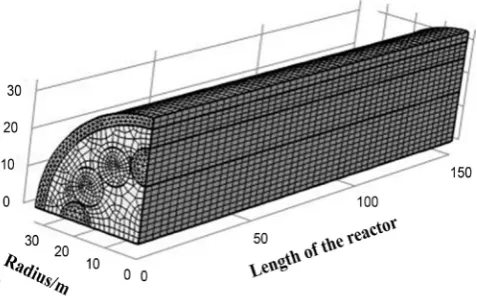
[image:5.595.256.495.555.705.2]In order to solve the non-linear equations, a computational fluid dynamics (CFD) code was developed based on the finite volume method using the SIMPLE algorithm for the coupling of pressure and velocity domains. As is shown in
Figure 1, the simulated fluidized porous zone is 0.15 m in length and 0.033 m in radius. The shell is 0.003 m in thickness. The maximum element size is 0.015 m, and minimum element size is 0.0075 m.
4. Results and Discussion
4.1. Experiment and Validation
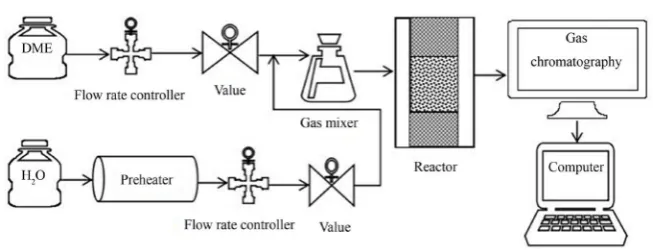
To verify the availability of the simulation model, an experiment for DME auto-thermal reforming was set up. The system was shown in Figure 2, the water measured by the metering pump is fully vaporized in the evaporator, and the air, DME and water were preheated to 500 degrees. Then, the mixed gas flowed into the reactor through a mass flow controller, and the reactor was filled with a CuO/ZnO/Al2O3 + ZSM5 catalyst. Finally, the reactants and products flowed in-to gas chromain-tography (GC-9900) linked in-to a computer so as in-to measure com-ponents.
The most important performance indexes of dimethyl ether reforming reac-tion mainly include dimethylether conversion rate, producreac-tion rate of hydrogen. The DME conversion and the hydrogen yield are defined as follows
DME conversion: DME,in DME,out
DME
DME,in
100%
F F
X
F −
= × (18)
Hydrogen production: 0
i i
F Y
F v =
⋅ (19)
Compared to the experimental reactor, the performance of the reactor used in the simulation is analyzed. The operating conditions are equal to those of simu-lations. The ratio of steam to DME varied from 1 to 4, the inlet temperature was 773 K. The DME conversion and volume content of H2 were shown in Table 1 and Table 2 respectively. The result of the experiment was approximate to the
DOI: 10.4236/jpee.2018.611001 6 Journal of Power and Energy Engineering
Figure 2. Schematic diagram of experimental.
Table 1. Comparison of experimental and simulated values of DME conversion.
DME conversion
Steam:DME = 0.5:0.5 Steam:DME = 0.75:0.25 DME conversion Steam:DME = 0.8:0.2 DME conversion
Simulated data 18.27% 42.88% 54.79%
[image:6.595.210.538.341.402.2]Experimental data 17.28% 41.53% 53.18%
Table 2. Comparison of experimental and simulated values of H2 production.
H2 production
Steam:DME = 0.5:0.5 Steam:DME = 0.75:0.25 H2 production Steam:DME = 0.8:0.2 H2 production
Simulated data 17.22% 42.74% 52.41%
Experimental data 16.34% 41.21% 51.68%
result of simulation, the lower hydrogen production of experiment was probably due to hydrogen spillover or hydrogen leak. The experiment temperature was lower than the theoretical value may be caused by the incomplete adiabatic, and the wall heat dissipation. The comparison between the data collected by the ex-periment and the simulation results verified that the present simulation can de-scribe the reforming reaction in details.
4.2. Study of Parameters
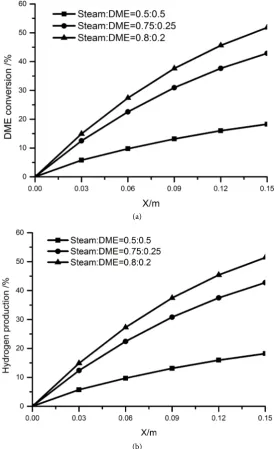
In this section, the influence of parameters including H2O/DME molar ratio, the inlet temperature of mixture gas on the reaction rate has been analyzed. The si-mulation results indicate the temperature distribution of the reactor, DME con-version and hydrogen production of the reforming reaction. The simulation conditions were as follows: the ratio of steam to DME is 3, Figure 3 was the temperature distribution of the reactor. The inlet mixture gas temperature of the reformer bed was 750 K, and decreases along the reaction bed because of the endothermic hydrolysis reaction, finally, the average outlet temperature of re-former bed was 683 K.
DOI: 10.4236/jpee.2018.611001 7 Journal of Power and Energy Engineering
[image:7.595.231.484.91.270.2]Figure 3. The temperature distribution of the reactor.
Figure 4. The pressure distribution of the reforming reactor.
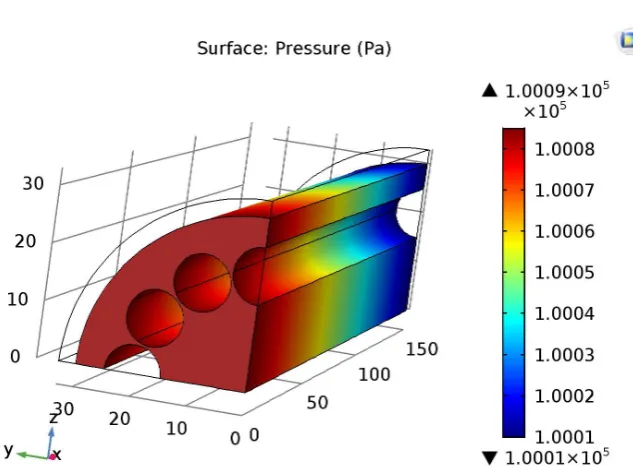
reaction is 8 × 10 − 4 Pa, which is much lower than 10% of the pressure drop in the reforming reactor. Since the pressure drop within the system is very low, it is feasible to assume that the gas is ideally incompressible at the beginning of the model establishment.
4.3. Effects of Temperature
[image:7.595.211.528.292.525.2]DOI: 10.4236/jpee.2018.611001 8 Journal of Power and Energy Engineering (a)
[image:8.595.239.506.73.521.2](b)
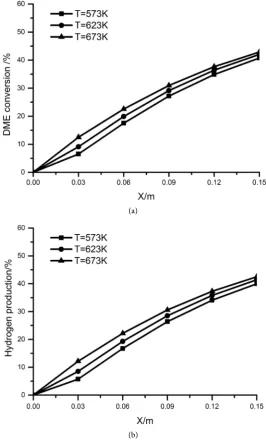
Figure 5. DME conversion and Hydrogen production as a function of heat tubes inlet temperature along the axial length: (a) DME conversion (b) Hydrogen production.
seen from Figures 3-5, as the temperature at the inlet of the reactor increases, the conversion of dimethyl ether and the yield of hydrogen are significantly im-proved. This is due to the hydrogen production of dimethyl ether by steam re-forming. Generally, it is an endothermic reaction. Appropriately increasing the inlet temperature is beneficial to increase the forward reaction rate of the reac-tion, and the reaction proceeds toward the direction of hydrogen producreac-tion, thereby improving the conversion efficiency of dimethyl ether and the yield of hydrogen.
The water ether molar ratio is a major operating parameter that affects the hydrogen production of dimethyl ether by steam reforming. Figure 6(a) and
DOI: 10.4236/jpee.2018.611001 9 Journal of Power and Energy Engineering (a)
[image:9.595.235.510.73.523.2](b)
Figure 6. DME conversion and Hydrogen production as a function of steam to DME ra-tio (a) DME conversion (b) Hydrogen producra-tion.
DOI: 10.4236/jpee.2018.611001 10 Journal of Power and Energy Engineering positive reaction, which in turn affects the conversion of dimethyl ether and the hydrogen yield.
5. Conclusions
In this study, catalytic steam reforming of DME is simulated using a three-dimensional CFD model. The simulation model introduced in software COMSOL (version 5.2a) can reveal the temperature distributions in the reactor and the hydrogen production and DME conversion properly. On the basis of the model, we investigated the DME SR reaction on different temperatures, various ratios of steam to DME.
The model can accurately describe the reaction mechanism of hydrogen pro-duction from dimethyl ether steam reforming. At the same time, the established reaction kinetic equation is simple, but from the simulation results, the dimethyl ether obtained by using this kinetic equation can be seen. Ether conversion and hydrogen yield are relatively low. Therefore, on the basis of the simplicity of the kinetic equation, how to improve the reaction efficiency is the place to be stu-died in the follow-up work.
Acknowledgements
This work was supported by Natural Science Foundation of China under Grant NO. 51505275.
Conflicts of Interest
The authors declare no conflicts of interest regarding the publication of this paper.
References
[1] Nicoletti, G., Arcuri, N., Bruno, R., et al. (2015) A Technical and Environmental Comparison between Hydrogen and Some Fossil Fuels. Energy Conversion and Management, 89, 205-213. https://doi.org/10.1016/j.enconman.2014.09.057
[2] Yuan, X.Z., Li, H., Zhang, S.S., Martin, J., Wang, H.J., et al. (2011) A Review of Po-lymer Electrolyte Membrane Fuel Cell Durability Test Protocols. Journal of Power Sources, 196, 9107-9116. https://doi.org/10.1016/j.jpowsour.2011.07.082
[3] Isono, T., Suzuki, S., Kaneko, M., et al. (2000) Development of a High-Performance PEFC Module Operated by Reformed Gas. Journal of Power Sources, 86, 269-273.
https://doi.org/10.1016/S0378-7753(99)00441-3
[4] Hoang, D.L. and Chan, S.H. (2004) Modeling of a Catalytic Autothermal Methane Reformer for Fuel Cell Applications. Applied Catalysis A: General, 268, 207-216.
https://doi.org/10.1016/j.apcata.2004.03.056
[5] Li, C., Gao, Y., Wu, C.S., et al. (2015) Modeling and Simulation of Hydrogen Pro-duction from Dimethyl Ether Steam Reforming Using Exhaust Gas. International Journal of Energy Research, 39, 1272-1279. https://doi.org/10.1002/er.3330
[6] Feng, D.M., Wang, Y., Wang, D., Wang, J., et al. (2009) Steam Reforming of Dime-thyl Ether over CuO-ZnO-Al2O3-ZrO2 + ZSM-5: A Kinetic Study. Chemical
Engi-neering Journal, 146, 477-485. https://doi.org/10.1016/j.cej.2008.11.005
DOI: 10.4236/jpee.2018.611001 11 Journal of Power and Energy Engineering
Precious Metal Catalysts. Journal of Power Sources, 307, 351-357.
https://doi.org/10.1016/j.jpowsour.2015.12.068
[8] Creaser, D., Nilsson, M., Pettersson, L.J., Dawody, J., et al. (2010) Kinetic Modeling of Autothermal Reforming of Dimethyl Ether. Industrial & Engineering Chemistry Research, 49, 9712-9719. https://doi.org/10.1021/ie100834v
[9] Akbari, M.H., Ardakani, A.H.S., Tadbir, M.A., et al. (2011) A Microreactor Model-ing, Analysis and Optimization for Methane Autothermal Reforming in Fuel Cell Applications. Chemical Engineering Journal, 166, 1116-1125.
https://doi.org/10.1016/j.cej.2010.12.044
[10] Elewuwa, F.A. and Makkawi, Y.T. (2015) Hydrogen Production by Steam Reform-ing of DME in a Large Scale CFB Reactor. Part I: Computational Model and Predic-tions. International Journal of Hydrogen Energy, 40, 15865-15876.
ttps://doi.org/10.1016/j.ijhydene.2015.10.050
[11] Elewuwa, F.A. and Makkawi, Y.T. (2016) A Computational Model of Hydrogen Production by Steam Reforming of Dimethyl Ether in a Large Scale CFB Reactor. Part II: Parametric Analysis. International Journal of Hydrogen Energy, 41, 19819-19828.
https://doi.org/10.1016/j.ijhydene.2016.08.072
[12] Yan, C.F., Ye, W., Guo, C.Q., Huang, S.L., Li, W.B., Luo, W.M., et al. (2014) Nu-merical Simulation and Experimental Study of Hydrogen Production from Dime-thyl Ether Steam Reforming in a micro-Reactor. International Journal of Hydrogen Energy, 39, 18642-18649. https://doi.org/10.1016/j.ijhydene.2014.02.133
[13] Yan, C.F., Hai, H., Hu, R.R., Guo, C.Q., Huang, S.L., Li, W.B., Wen, Y., et al. (2014) Ef-fect of Cr Promoter on Performance of Steam Reforming of Dimethyl Ether in a Metal Foam Micro-Reactor. International Journal of Hydrogen Energy, 39, 18625-18631.
https://doi.org/10.1016/j.ijhydene.2014.02.152
[14] Moharana, M.K., Peela, N.R., Khandekar, S., Kunzru, D., et al. (2011) Distributed Hydrogen Production from Ethanol in a Microfuel Processor: Issues and Challenges.
Renewable and Sustainable Energy Reviews, 15, 524-533.
https://doi.org/10.1016/j.rser.2010.08.011