ISSN Online: 2169-2645 ISSN Print: 2169-2637
Exergetic Efficiencies Evaluation of Flows and
Operations on the Mechanical Extraction
Process of Jatropha curcas Oil
Rolf Nirahina Rakoto Harifidy, Hery Tiana Rakotondramiarana
Institute for the Management of Energy (IME), University of Antananarivo, Antananarivo, Madagascar
Abstract
Jatropha curcas oil is one of the most promising renewable energy sources for
rural areas due to its ease of production, which can be used as an alternative to diesel and fuel oil. The development of sustainable energy has been the is-sue of the discussion about biofuel production given the considerable con-sumption amount of fossil fuel during the transformation process. And any production process that consumes a lot of energy records a significant de-struction of useful energy, which leads to thermodynamic inefficiencies of the process. Besides, the focus on environmental safety is gradually shifting to-wards energy efficiency in industrial processing. Exergetic analysis is an effec-tive tool for measuring the performance of a production process since exergy is a quantity that measures energy quality. This study assesses the scale of re-source degradation in Jatropha oil mechanical extraction processes and finds improving possible pretreatments options for more efficient production. Data from experiments combined with existing databases have permitted to estab-lish the exergy flow balance at each stage of production. The process exergetic yield varies from 29.85% to 35.41% according to the chosen pretreatment process. Mass exergy accounts for 67% of incoming flows and, for outgoing flows, more than 60% is associated with the mass exergy generated by the process waste. The uncertainties analysis on the results was used to validate model results, and to visualize the minimum values for the most unfavorable cases and the maximum values when all the parameters are at their optimum values.
Keywords
Jatropha Oil, Extraction Process, Exergetic Efficiency, Pretreatment, Mass Exergy
How to cite this paper: Harifidy, R.N.R. and Rakotondramiarana, H.T. (2019) Ex-ergetic Efficiencies Evaluation of Flows and Operations on the Mechanical Extraction Process of Jatropha curcas Oil. Open Jour-nal of Energy Efficiency, 8, 1-20.
https://doi.org/10.4236/ojee.2019.81001
Received: December 6, 2018 Accepted: January 15, 2019 Published: January 18, 2019
Copyright © 2019 by author(s) and Scientific Research Publishing Inc. This work is licensed under the Creative Commons Attribution International License (CC BY 4.0).
http://creativecommons.org/licenses/by/4.0/ Open Access
1. Introduction
Several research works on biodiesel production have recently focused on opti-mizing the transformation process [1]-[7] as well as on the selection of the most appropriate raw material [8]-[14]. Currently, the improvement of the process energy efficiency and the reduction of various component energy inefficiencies capture the interest of researchers [15]-[20]. Interest in the use of Jatropha cur-cas has developed over the last decade [21] [22] [23] [24].
Growing consumption of fossil fuel products leads to the search for alternative fuels limiting global warming and environmental pollution to meet energy de-mand. Biodiesel is one of the most prominent renewable fuels nowadays. Bio-diesel has similar properties with Bio-diesel fuel. It can be mixed with Bio-diesel fuel or can be used directly in most diesel engines without major engine modifications. The other advantage is that biodiesel has lower sulfur content, with an upper limit of 10 mg/kg biodiesel, in accordance with European biodiesel standard (EN 14214).
Biodiesel from jatropha oil is a reliable source of energy that is efficient and conducive to sustainable economic development [25] [26]. Hence jatropha was choosen as raw material of the present study.
Jatropha curcas plantation can produce 2 to 5 tons of dry seed/ha/year. The
yield varies according to the type of culture, by seeds or by cuttings; the climatic conditions as well as the management technologies used [27] [28]. Jatropha cur-cas seeds were analyzed to contain about 35% to 40% oil, or 1.75 tons/ha after extraction [27] [29] [30] [31]. White kernel contains all the oil. Moreover, it was reported from critical analysis of seeds in previous studies that Jatropha curcas
seeds contain 6.6% moisture, 18.2% protein, 38% fat, 17.3% carbohydrate, 15.5% fiber and 4.5% ash. Oil contains about 21% saturated fatty acids and 79% unsa-turated fatty acids [31].
As this kind of oil is inedible, its production should not affect the food securi-ty problem [32]. In addition, jatropha grows well on dry, marginal, and non-agricultural land, which does not compete with land required for food pro-duction and nature conservation [26] [29] [32]. Jatropha oil is considered more environmentally friendly raw material for energy production than any other food-related crop, such as palm, rapeseed, soybean or sunflower [29] [32].
While being converted to biodiesel, jatropha oil has a high potential of pro-duced biofuel from vegetable oil as its properties are well improved and subse-quently suitable for replacing fossil fuels [27] [33].
Most people in rural areas do not have access to energy sources in developing countries. An approach to provide the required energy is to enable the genera-tion of energy from local resources. Jatropha oil is one of the most promising renewable and independent energy sources in rural areas due to the ease of its production [25] [26] [34]. The literature review on plantations and physi-co-chemical properties details the unexploited potential of jatropha. This infor-mation will be useful as it can serve as a reference in the framework of this study.
However, during the transformation processes, there are always losses and irre-versibility which will directly affect the potential of the raw material. These data on degradations on raw materials have been infringed on the aforementioned studies to better focus on the transformation process improvement. In our case study, we will attach the same importance to transformation processes and raw material degradation.
There are commonly 4 kinds of oil extraction from seeds according to the used method, namely: solvent extraction, mechanical extraction, enzymatic ex-traction and aqueous exex-traction. For rural areas, mechanical exex-traction with screw press or hydraulic press is considered as the best way. It is adopted be-cause of its lower initial and operational cost as well as its ease of use by un-skilled workforce. Besides, the produced oil is relatively good quality compared to that obtained from chemical extraction process. Additionally, residual cake may be used for other purposes [35]. However, there is a disadvantage. The me-chanically extracted oil amount is less than that obtained from solvent extrac-tion. While it was reported that solvent extraction with n-hexane could recover about 70% - 99% of oil, a maximum of 60% to 80% is reported for mechanical extraction [29]. Pressure applied, pressing temperature and pressing time are important process parameters, as well as pretreatments such as moisture ad-justment, shrinkage of shells, reduction of size or heat treatment [36]. Jatropha seeds and jatropha kernel pressed at higher pressures and/or temperatures pro-vide higher oil yield [37]. All different types of extraction and treatment me-thods cited were conducted to have the possible best oil yield. The present study will therefore add complements to define the most efficient process taking into account the environmental impact.
Exergetic analysis goes further in the energy optimization of industrial processes than the purely thermal approach on which traditional energy analyses are based. Exergy combines the first and second law of thermodynamics to lo-cate and quantify inefficiencies in an industrial process, taking into account not only the energy losses, but also the quality losses of this energy [38]. As results, these inefficiencies can be reduced and the performance of the process can be improved. Any production process consuming a lot of energy records a signifi-cant destruction of useful energy (exergy), which leads to thermodynamic ineffi-ciencies [39]. The cost of energy in most industries is between 20% and 80% of variable cost [39] [40] [41]; therefore, reducing the energy intensity of any busi-ness would make it a sustainable busibusi-ness [39]. Exergy can also be defined as the maximum theoretical useful work that can be achieved when a system is ther-modynamically balanced with its environment, resulting in interactions between the system and the environment.
Screw presses and oil expellers have been used since the first century of our era. Previously, the Greeks developed it for pressing olives. This method is still widely used by small, medium and large scale companies for vegetable oil extrac-tion. In most parts of the world, especially in remote areas without access to electricity, Jatropha curcas oil is generally extracted from screw presses
ing on diesel engines. This is preceded by a heat treatment at about 60˚C - 70˚C and gives 47.2% oil yield [10]. However, oil extraction rate of Jatropha curcas
seeds is low for this technology. Solvent extraction method can result high oil yield in comparison to mechanical one. Indeed, the first enables to reach an ex-traction yield of approximately 99.3% of the oil contained in the seeds while the latter allows only 75% to 85% of yield. Nevertheless, solvent extraction consumes a lot of energy due to longer extraction time compared to that related to me-chanical press [6].
So far, exergetic analyzes on jatropha oil extraction focused on the oil extraction steps and the improvement of the methods to be used. This is important, but not enough, because we must also integrate the effective use of natural resources.In order to use the most efficient technology for extracting oil for biodiesel produc-tion, an exergy analysis must be performed. Exergy analysis is an effective way to detect the true magnitude of thermodynamic imperfections in the performance of various unit operations within the process to be improved.
Screw presses are currently designed for a continuous extraction process [42] [43]. The investment cost and the processing time are both reduced. However, main disadvantages are high heat production due to friction of the machine parts, which increases operating costs [44], added to that the destruction of re-sources because the heat is released into the environment without recovery. Part of heat lost in the environment contributes to the exothermic destruction of waste and emissions.
Currently, focus on environmental safety is shifting towards energy efficiency in industrial processing [39]. In reality, there is no process consistent with the first law of thermodynamics (which states that energy is conserved in all processes), but in almost all processes, there is a generation of entropy leading to destruction of exergy or the quality of energy. Therefore, energy concept is unre-liable to justify the thermodynamic feasibility of a production process.
General exergy balance involving a mass transfer linking entropy generation and exergy destruction is given by [45]:
0
in out dest gen
Ex − Ex =Ex =T S =I
∑
∑
(1) where∑
Exin represents total incoming exergy,∑
Exout total outgoing exergy,dest
Ex destruction of total exergy, T S0 gen entropy generation, and I
irreversibil-ity, respectively.
Equation (1) can be rewritten as Equation (2) involves exergy due to heat/work interactions [45]:
, , 0
heat work mass in mass out dest gen
Ex − Ex + Ex − Ex =Ex =T S
∑
∑
∑
∑
(2) wherework
Ex =W
∑
0 1
heat
T
Ex Q
T
= −
∑
∑
(2b),
mass in i i
i in
Ex = m Ex
∑
∑
(2c),
mass out i i
i out
Ex = m Ex
∑
∑
(2d)Equation (2a) defines exergy of the system due to work production. This can be calculated from heat capacities and standard chemical energies of flows en-tering or leaving the system.
Equation (2b) also defines quality of energy in the system. Q represents ther-mal load of the system with T0 the ambient temperature (298 K) while T denotes
the system temperature (K).
Equations (2c) and (2d) define physical exergy of input and output resources, respectively.
Consideration of mass exergy is more important in this study as the scope of the study extends from the drying process to oil extraction.
For real processes, exergy at input always exceeds that at exit of a system. This imbalance is due to irreversibility, also called destruction of exergy, and is represented as a function of entropy generation. The exergy value of a steady stream of fluid entering or exiting a part of a process is the minimum amount of energy that can be obtained from flow to bring it into equilibrium with the en-vironment [38] [46] [47] [48]. With an enthalpy change of
(
H−H0)
and anentropy change of
(
S−S0)
at a reference temperature T0 equal to 298 K, thephysical exergy can be computed using Equation (3):.
(
0)
0(
0)
ph
Ex = H−H −T S−S (3)
With real irreversible processes, there is always increasing entropy resulting from the dissipative effects of energy within the production system. This loss of generated exergy is released into the environment or destroyed during the process [38] [46] [49] [50]. Minimizing entropy generation within system would, however, reduce exergy losses (in heat form and other emissions to the envi-ronment), resulting in a sustainable thermodynamic system. Sustainability of an industrial process is characterized by three main factors, namely: the social, economic and environmental aspects [51] [52]. Thermodynamic efficiency eval-uation combines the economic and environmental aspects of sustainability. The quality of energy that dissipates into the environment due to irreversibility is clearly quantified in the exergy analysis. The exergetic analysis thus makes it possible to evaluate the thermodynamic inefficiencies real extent of industrial processes, to establish the main causes of these inefficiencies and to associate more fully their obtaining costs with the internal flows and productions [51] [52] [53].
In 1995, the International Organization for Standardization [54] published the Guide of Measurement Uncertainty Expression on its behalf and six other inter-national organizations. The de facto interinter-national standard recommended for the expression of uncertainty measurement to classify type A or B uncertainties
using the evaluation method [statistic (A) or otherwise (B)].
Schenck [55] quotes S. J. Kline as defining an experimental uncertainty as “what we think the error would be if we could measure it by calibration”. Un-certainty analysis is a powerful tool. When used in planning and designing expe-riences. The experimental result is not directly measured but is determined by combining several measured variables.
There is no perfect measure. All measures of a variable contain inaccuracies. Because it is important to understand these inaccuracies if we have to perform experiments or if we simply have to use values that have been determined expe-rimentally, we need to carefully define the concepts involved.
Our approach is an appropriate scientific tool to evaluate the thermodynamic durability of a production process. This study assesses resource degradation ex-tent in jatropha oil extraction processes and identifies possible improvement op-tions for efficient production. A comparison of degree of resources degradation and yields at each level of the process will be analyzed.
Pretreatment and oil extraction with screw press are used as case studies. Ex-ergy destruction and efficiency at each transformation stage are compared.
Exergetic analysis is also a thermodynamic sustainability tool that is used here to quantify the emission and waste streams of the studied process [52] [56], as it is always measured on the reference environment basis.
Uncertainty analyses will be conducted on results to better understand the distribution of probability densities of the process yields.
2. Materials and Methods
2.1. Materials
Jatropha curcas seeds used in the experimentation were collected from Mahabo,
Menabe region, Madagascar. The ripe fruits were harvested and dehulled ma-nually in February 2018. They were locally dried in sun, stored in woven poly-propylene bags ventilated at temperature between 28˚C and 35˚C with a relative humidity ranging from 65% to 75% for three months. After being transported to Antananarivo, the seeds were stored at ambient temperature between 15˚C and 25˚C and a relative humidity between 70% and 80%. The seeds were shelled and analyzed for weight fraction, initial moisture, and total oil content (see Table 1). Seeds were subjected to energy conditioning, dehulling and heating treatments before being pressed. Pretreated kernels were directly used in pressing experi-ments to reduce storage time influence on oil yield.
2.2. Process Description and System Limit for
Jatropha curcas
Oil
Extraction
For each batch, seeds undergo different pretreatment levels in order to evaluate each step of the process (Figure 1). Jatropha curcas seeds are cleaned after ex-traction of the bags for removing foreign substances such as pebbles and leaves, and other seeds amassed during drying. This process is done using a rice
nower. As this step does not require a lot of energy, it is not considered to be part of system’s limit in this study.
2.2.1. Drying
Moisture content is a determining factor in Jatropha curcas seeds storage and pretreatment. Seeds are well dried before being bagged so that it does not de-grade during storage period.
[image:7.595.209.538.263.420.2]Before performing the experiment, an initial moisture content calculation of seeds is done. For that purpose, 100 g of seeds are placed in an oven at a temper-ature of 150˚C. They are weighed every 30 minutes until constant weight is ob-tained. The moisture content is calculated using the following formula:
Table 1. Chemical exergy of the main flow.
Stream name Unit Quantity Standard chemical exergy (MJ/kg) exergy (MJ) Chemical Combustion exergy efficiency (MJ)
Jatropha seeds before
treatment kg 5.00 17.73 89
Dried Jatropha seeds kg 4.42 20.30* 90 31.17%
Jatropha kernel kg 1.56 12.60* 20 70.30%
Jatropha Shell kg 2.86 16.93* 48 3.40%
Jatropha cake kg 0.75 20.25* 15 66.70%
Jatropha oil kg 0.97 37.00 36
[image:7.595.263.484.447.705.2]*Obtained from [62].
Figure 1.Jatropha curcas oil extraction system limits.
100
ki kf
ki
m m M
m
−
= × (4)
where M is the moisture content (%), m mass in (g), and subscripts k, i, f are for kernel, initial and final, respectively.
Oil recovery increases from a low moisture content of 1% (wb) to a maximum value at moisture contents between 4% and 5% (wb) for all applied pressures
[37] [57]. Optimum moisture content for maximum oil yield during extraction
process is 5% at low pressure [58]. During the drying process, 1 kg batches are oven dried at 30˚C, 65˚C, 80˚C. Table 1 indicates seeds initial moisture content at the bag outlet. Drying is performed until 5% moisture content is reached in the jatropha kernels.
2.2.2. Dehulling
In experiments to study the effect of shell removal, the mean weight of samples (shells and kernels) was approximately 7 g for each seeds. The indicated percen-tage of shell removal is the shell removed percenpercen-tage from the original sample. 0% elimination means that experiment uses 100% seed which is corresponding to 35.5% (weight basis) of shell content; while 100% removal means that experi-ment uses 100% kernels which corresponds to 0% of shell content. Oil recovery was calculated on oil content and undehulled sample weight basis. Jatropha shell, not containing oil, was removed and evaluated in mass rejected with the cake. Experiments were performed with 0%, 20%, 40%, 60%, 80% and 100% of shell removal. Unless otherwise indicated, the process consists of complete se-paration of kernel and shell. Seeds cracking is carried out using mechanical cracking rollers manufactured for this purpose. The shell-kernel sorting for re-moving all the shells is done manually.
2.2.3. Preheating
Heat treatment on Jatropha curcas seeds is necessary in order to deform their cell structures to agglomerate or flocculate oil droplets into the kernels. This process helps improve cells permeability in seeds by reducing seeds oil viscosity for more efficient extraction. Reducing seed size increases oil yield efficiency be-sides.
The various effects of heat treatment on the process are observed with differ-ent heating temperature levels.
Given the oil quality degradation, with heat treatments of the order of 80˚C (increase of acidity, main cause of metallic elements abrasion), temperature stage 0˚C, 40˚C, 60˚C, 80˚C were selected.
2.2.4. Oil Extraction with Mechanical Screw Press
Experiment is carried out with a Cotter rotary screw press with a production ca-pacity of 15 kg/h. It is powered by 2.2 kW electric motor. Shelled and heat treated Jatropha curcas seeds are introduced into the screw press, which consists of helical thread rotating in a fixed perforated cylinder called a cage or barrel
[42] [43]. The cake is forced through cage. Expelled oil flows through cylinder packing bars perforation, while the deoiled residue is discharged through an annular orifice.
The methods used for mechanical Jatropha curcas oil extraction in this study are those commonly used, as reported in the literature [59] [60].
The expelled oil may contain residue that can be removed using a decanter and a filter. Then oil is pumped into filter to remove remaining solids and fines to produce clear oil prior storage. Cake is valued with the shell because they can be used for other uses.
2.3. Calculation for Physical and Chemical Exergy
In a biomass such as Jatropha curcas seeds, exergy is mainly stored in chemical exergy form [22]. Chemical exergy refers to the maximum amount of work that can be achieved when a substance is brought to the environmental state, in dead state, due to its chemical composition or process, involving heat transfer and substance exchange only with the environment. The chemical exergy of Jatropha
curcas seeds (composed of 6.20% moisture, 38% fat, 17% carbohydrates and
15.50% fiber and 5.30% ash) and Jatropha curcas oil (composed of 14.2% pal-mitic acid [61], 6.9% stearic acid [28], 44% oleic acid, 34.3% linoleic acid and 0.6% other acids) were calculated on the basis of their heat capacity values given by [62]
0
fuel LHV
ε
= ∗β
(5)where 0
fuel
ε
represents standard chemical exergy of biomass, LHV the lowerheating value of fuel, and β the weighting factor which takes into account in-formation conveyed by biomass or fuel; their values are indicated in the
litera-ture [61] for most fuels. The chemical exergy of Jatropha curcas oil can also be
calculated from the standard chemical energy composition method obtained from the literature [53].
The chemical exergy for each pure substance, organic and utilities was com-puted using their standard chemical energies Exch i, taken [39] [62] according
to Equation (6):
0
, ,
ch i fo i i ch i
Ex = ∆G +
∑
v Ex (6)where Exch i, , 0
,
ch i
Ex , ∆Gfo and vi are the chemical exergy of specie i, stan-dard chemical exergy of species i, Gibb’s free energy of formation of species i
and the molar ratio of species i, respectively.
The Chemical exergy of organic substances not listed by Ayres [39] and
Szar-gut [60] can be estimated using the contribution method of the group, based on
information on their molecular structure by the determination of absolute en-tropy and enthalpy formation values at standard conditions.
The physical exergy of each stream is thus calculated using Equation (7) [47]
[48] [62]. The thermodynamic properties of each stream can be obtained from
the literature or a database of reliable software such as Aspen plus. For a
cal process, the exergy associated with a multi-component material flow is di-vided into chemical and physical energies; hence, an equation for the total exer-gy of a system is defined by:
, , ,
mass i ch i ph i
Ex =Ex +Ex (7)
As indicated above, each term is determined separately and systematically for each stage of the oil production. The overall efficiency of the exergy process is defined by [63]:
Out total
in
Ex
Ex
η
=∑
∑
(8)where
∑
ExOut is the total exergy of output resources or products and∑
Exinis the total exergy of input resources.
2.4. Uncertainty Analysis
The uncertainty analysis is conducted with the @RISK software which enriches Microsoft Excel with an expert modeling and uncertainty analysis capability. The modeling represents the actual situation for its analysis. Entries values result from variable experiments; hence, the importance of uncertainty calculations on our research results.
Probability distributions provide a quantified uncertainty presentation me-thod of a variable, @RISK uses it to describe the uncertain values of Excel spread-sheets and to present the results. There are several forms and types of distribu-tions, each describing a range of possible values and probability. All distribution types use a set of arguments to specify a range of real values and probability dis-tributions. The normal distribution, used in the present case, is defined by an average and a standard deviation resulting from the experimental data.
2.4.1. Development of a Model
The model is calculated on an Excel spreadsheet based on experimental averages. The variable nature of the input data prompts us to perform a simulation to de-termine the range and probabilities of all possible result outcomes.
2.4.2. Identification of Uncertainty
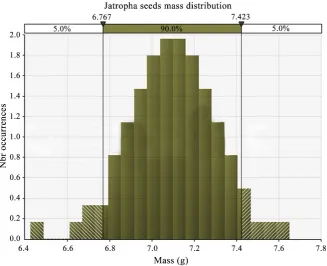
Measurements of variables are influenced by a number of elementary error sources such as calibration errors, errors caused by changes in ambient temper-ature, humidity, pressure, vibration, instability in the phenomenon of “balance” to measure. With each experimental measurement, we could draw a histogram, which shows the fraction of N total measurements which is shown in Figure 2. This allows us to visualize the distribution of N total measured values for the case of the mass of a jatropha seed. An average value is calculated, as is a stan-dard deviation, which is an indicator of the width of the distribution.
When identifying uncertain values in Excel spreadsheet, we must determine whether the variables are correlated or not. Those considered here are indeed “correlated”. In @RISK, the Corrmat function is used to identify correlated va-riables. It is extremely important to correctly identify correlations between them.
Figure 2. Jatropha curcas seeds mass distribution.
2.4.3. Model Analysis with Simulation
Once uncertain values in spreadsheet cells entered and the outputs of the analy-sis identified, we have an Excel spreadsheet that can be processed with @RISK. It uses Monte Carlo simulation to execute the uncertainty analysis. In this sense, simulation refers to the method by which possible outcomes distribution results from the computer executing repeated calculations of the spreadsheet, based on a set of different values each time, randomly selected from the probability dis-tributions introduced in the cells values and formulas. The computer basically tries all the valid combinations of the input variables to simulate all possible outcomes, as if we were analyzing hundreds or even thousands of hypothetical scenarios at the same time.
2.4.4. Output Variables
Like all other uncertainty analysis models, input values and output results are composed of large database. The @RISK uncertainty analysis produces its results on cells defined as inputs and outputs of the Excel worksheet. These results are the probability distributions of the values that may occur. At first glance, they correspond to the ordinary Excel analysis results carried out with the averages.
3. Results and Discussion
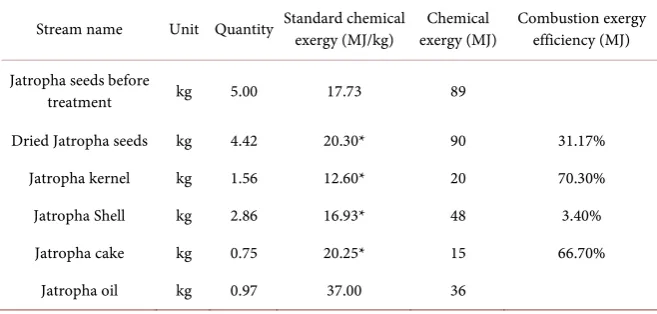
The chemical energies of the main material streams in the extraction process as well as the exergy efficiency in combustions are presented in Table 1. The quan-tities in this table represent the mass flow at each unit operation. Thus, 5 kg of fresh grain Jatropha curcas after drying decomposes into 1.56 kg of kernel with a
moisture content of 5% and 2.86 kg of shell. A maximum oil quantity of 0.97 kg can be extracted from this unit mass with 0.75 kg cake mass load.
Seeds, kernels, shell, and cake are, in their unprocessed state, used for com-bustion. They are evaluated in the present study by taking into account their ex-ergy yields in heat production processes.
In order to perform uncertainty analysis on the exergetic efficiency of the process, the results are transcribed according to distribution functions.
In Figure 2, the unit mass distribution of Jatropha grains tends to have a
larg-er numblarg-er of measured values near the sample mean 7.1 g and exponential de-creasing number of measured values as one moves away from the average. The respective minimum and maximum experimental masses of 6.42 g and 7.65 g are retained by the simulator after 100 iterations, with minimal modifications re-sulting from transformation into normal distribution however. The curve asymmetry is also low −0.138, hence the validation of the normal distribution law selected for the unit masses of dried seeds.
The drying heat treatments were carried out at calculated times of 8 h 35 min, 5 h 26 min and 3 h 05 min for drying at 30˚C, 65˚C and 80˚C, respectively, to obtain 5% of moisture content (Table 2). The exergy destroyed to obtain the same moisture content varies according to the treatment temperatures. Drying at 80˚C is the most interesting as it allows achieving high exergy efficiency. The treatment at 65˚C is the most exergetive during this unit drying process with the destruction of 58.27 MJ. This is due to the fact that the drying time is longer while the temperature remains high enough. However, while heat treatments at high temperatures being acidifying for the extracted oil [62], it is more assured to carry out a treatment at lower temperature with a longer duration of treat-ment. Given the choice of the rotary press which works in continuous cycle, a long drying time would be penalizing for the entire oil production cycle. It is necessary to acquire a larger dryer or production and storage space to feed the press therefore.
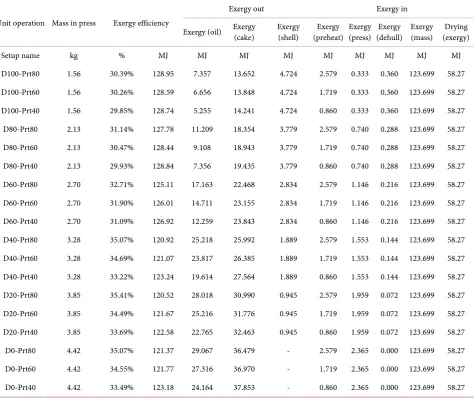
Dependent variables such as input for starting materials press feed, outgoing exergies for oil, cake, shell as well as inputs in mass, labor and heat exergy are shown in Table 3.
The exergy destructions related to the incoming flows are functions of unit process parameters step. To achieve dehulling levels of 100%, 80% and 40%, re-quired exergetic resources are 0.36, 0.29 and 0.14 MJ respectively. Compared to each other, his data relate a constant according to dehulling level. Quantitatively, it is very small and even negligible compared to the mass exergy of inputs.
The exergy used by the press for the mechanical oil extraction of the oil de-pends on the dehulling level. A small percentage of shelled seeds implies a larger mass of inputs. Both values are inversely proportional. It must be taken into consideration also that the kernels are softer than the seeds. Which is disadvan-tageous compared to electrical exergy consumed for the unitary pressing process. Exponential increase of the energy demanded by the press is noted with
0.33 MJ to process 1.56 kg of kernels while 1.96 MJ for 3.85 kg of mixture of seeds and kernels shelled at 20%. This increase in consumption is largely com-pensated by a higher oil yield due to greater pressure in the cage of the screw press. In the transformation process, this operation is the second least consum-ing of exergy while it greatly influences the overall efficiency.
Table 2. Total exergy destruction during drying process.
Unit operation: Drying
Masse unit 5 kg
Temp (˚C) Drying time Exergy (MJ)
30 8h35 42.49
65 5h26 58.27
80 3h05 40.70
Table 3. Extraction process exergy flows summary.
Unit operation Mass in press Exergy efficiency
Exergy out Exergy in
Exergy (oil) Exergy (cake) Exergy (shell) (preheat) Exergy Exergy (press) (dehull) Exergy Exergy (mass) (exergy) Drying
Setup name kg % MJ MJ MJ MJ MJ MJ MJ MJ MJ
D100-Prt80 1.56 30.39% 128.95 7.357 13.652 4.724 2.579 0.333 0.360 123.699 58.27 D100-Prt60 1.56 30.26% 128.59 6.656 13.848 4.724 1.719 0.333 0.360 123.699 58.27 D100-Prt40 1.56 29.85% 128.74 5.255 14.241 4.724 0.860 0.333 0.360 123.699 58.27 D80-Prt80 2.13 31.14% 127.78 11.209 18.354 3.779 2.579 0.740 0.288 123.699 58.27 D80-Prt60 2.13 30.47% 128.44 9.108 18.943 3.779 1.719 0.740 0.288 123.699 58.27 D80-Prt40 2.13 29.93% 128.84 7.356 19.435 3.779 0.860 0.740 0.288 123.699 58.27 D60-Prt80 2.70 32.71% 125.11 17.163 22.468 2.834 2.579 1.146 0.216 123.699 58.27 D60-Prt60 2.70 31.90% 126.01 14.711 23.155 2.834 1.719 1.146 0.216 123.699 58.27 D60-Prt40 2.70 31.09% 126.92 12.259 23.843 2.834 0.860 1.146 0.216 123.699 58.27 D40-Prt80 3.28 35.07% 120.92 25.218 25.992 1.889 2.579 1.553 0.144 123.699 58.27 D40-Prt60 3.28 34.69% 121.07 23.817 26.385 1.889 1.719 1.553 0.144 123.699 58.27 D40-Prt40 3.28 33.22% 123.24 19.614 27.564 1.889 0.860 1.553 0.144 123.699 58.27 D20-Prt80 3.85 35.41% 120.52 28.018 30.990 0.945 2.579 1.959 0.072 123.699 58.27 D20-Prt60 3.85 34.49% 121.67 25.216 31.776 0.945 1.719 1.959 0.072 123.699 58.27 D20-Prt40 3.85 33.69% 122.58 22.765 32.463 0.945 0.860 1.959 0.072 123.699 58.27
D0-Prt80 4.42 35.07% 121.37 29.067 36.479 - 2.579 2.365 0.000 123.699 58.27
D0-Prt60 4.42 34.55% 121.77 27.316 36.970 - 1.719 2.365 0.000 123.699 58.27
D0-Prt40 4.42 33.49% 123.18 24.164 37.853 - 0.860 2.365 0.000 123.699 58.27
[image:13.595.64.539.322.728.2]Preheating requires less time but remains one of the most penalizing factors in assessing the exergetic efficiency of the process. It was evaluated with the great-est quantity of materials, that is, 0% dehulling, to retain the most unfavorable case possible. A maximum exergy quantity of 2.58 MJ is recorded for the treat-ment of 4.42 kg of grain at 80˚C and 1.72 and 0.86 MJ respectively for 60˚C and 40˚C.
Inputs mass exergy is 123.70 MJ. It was evaluated from Jatropha curcas dried seeds chemical exergy product taking into account its exergy yield during its use in combustion. Despite the change in mass flow rates at the press, the exergy at the beginning of the process remains unchanged, consisting of the whole seeds of dried jatropha. The shells, not passing through the pressing circuit, are eva-luated with the other outputs. Taking into account the mass makes it possible to better apprehend the flow of exergy within the process. The only drying opera-tion is responsible for the 41% degradaopera-tion of seed exergy. Drying methods permitting moisture recovery could further increase the production process effi-ciency. On the other hand, a high moisture content of seeds to be processed would reduce the final exergy yield more. This calls for expanding the limits of process to the sun drying before storage.
The main output of the process is the exergy of the extracted oil. It depends on the production parameters. From Table 3, a low extracted oil level, with an exergy of 5.25 MJ, can be offset by a higher cake exergy of 14.24 MJ and 35.29 MJ shells exergy. As result, a general exergetic efficiency of 128.74 MJ at rate of 29.85% was obtained.
Changes of various parameters enable to identify the optimal operational pa-rameters for jatropha oil production process. The settings are: preheating of the seeds with a level of dehulling of 20% at 80˚C to obtain a maximum exergetic yield of 35.41% and 35.04% to 40% of seeds shelled at the same temperature.
However, treatments at 80˚C are not recommended for reasons of increased acidity of the oil at the outlet, it is better to choose treatments at 60˚C with 34.69% and 34.49% respectively yield at 40% and 20% of kernel.
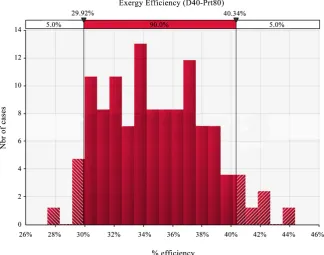
An uncertainty analysis is performed to validate all the results. Figure 3 and
Figure 4 show the distributions of probability densities for pretreatments at
80˚C with 20% and 40% dehulling.
According to Figure 3 the trend of the results increases progressively up to 39% and then fall rapidly. The proportion is asymmetrical. It can be inferred that the probability of values of exergetic yield resulting between 30% and the average 35.6% may occur more often than the values between the average and 38%. Unlike Figure 3, in Figure 4, the probability density is concentrated to-wards the front. The probability of having results above the average 34.90% is thus greater. The reduction of the numbers of cases up to 40% of exergetic yield decreases gradually. These results can be explained by the fact that the dehulling level affects 5 parameters out of 8 (oil, cake, shell, press, dehull exergy) allowing computing the exergetic efficiency. An increase level of dehulling also indicates an increase in the separation of input materials. Each input or output has its own
probability densities. Hulls and kernels separation allow having more constant results because there are fewer materials in interaction during the pressing process. The parameter change interdependence during the simulation makes
Figure 3. Process exergy efficiency probabilities density with 20% dehulling and preheating at 80˚C.
Figure 4. Process exergy efficiency probabilities density with 40% dehulling and preheating at 80˚C.
[image:15.595.211.536.434.689.2]the below-average results more important for the dehulling at 20%. By decreas-ing the percentage of interdependent elements in the calculation, the results for unfavorable cases combination regress. That result allows guiding the choice towards a dehulling rate of 40%.
4. Conclusions
The exergetic analysis of the production process of Jatropha curcas oil was con-ducted by widening the process boundaries and taking into account the mass exergy of inputs and outputs throughout the present study. It can be inferred from the results that the maximum oil yield is not significant for a production process with high exergetic efficiency. The only drying operation is responsible for the destruction of 46% of incoming exergies. The choice of the processing temperature makes it possible to reduce this rate considerably. This parameter is however dependent on the equipment used. In this case study, a long drying time at low temperatures destroys less exergy than the treatment in a medium time with a medium temperature. This is due to seeds drying curve which is not linear.
The mass effect generates 67% of incoming exergy and even, for outgoing flows, more than 60% is due to the exergy generated by the waste. The uncer-tainties analysis allows us directing treatments choice on processes with similar yields. It also enables to glimpse the minimum values of exergy efficiency for the most unfavorable cases that may occur as well as the maximum value when all the parameters are at their optimum values. On the other hand, it is a way to va-lidate the results according to their probability of realization. The improvement to be done would be to use the cakes and shells during the drying operation with a considerable improvement in the means of their uses to affect the overall effi-ciency of the process. Looking for other uses for waste treatments also would be another alternative to having a more exergy efficient process.
Conflicts of Interest
The authors declare no conflicts of interest regarding the publication of this pa-per.
References
[1] Balat, M. and Balat, H. (2010) Progress in Biodiesel Processing. Applied Energy, 87, 1815-1835.https://doi.org/10.1016/j.apenergy.2010.01.012
[2] Lee, H.V., Yunus, R., Juan, J.C. and Taufiq-Yap, Y.H. (2011) Process Optimization Design for Jatropha-Based Biodiesel Production Using Response Surface Metho-dology. Fuel Processing Technology, 92, 2420-2428.
https://doi.org/10.1016/j.fuproc.2011.08.018
[3] Leung, D.Y.C., Wu, X. and Leung, M.K.H. (2010) A Review on Biodiesel Production Using Catalyzed Transesterification. Applied Energy, 87, 1083-1095.
[4] Sahoo, P.K. and Das, L.M. (2009) Process Optimization for Biodiesel Production from Jatropha, Karanja and Polanga Oils. Fuel, 88, 1588-1594.
https://doi.org/10.1016/j.fuel.2009.02.016
[5] Santori, G., Di Nicola, G., Moglie, M. and Polonara, F. (2012) A Review Analyzing the Industrial Biodiesel Production Practice Starting from Vegetable Oil Refining.
Applied Energy, 92, 109-132.https://doi.org/10.1016/j.apenergy.2011.10.031 [6] Shahid, E.M. and Jamal, Y. (2011) Production of Biodiesel: A Technical Review.
Renewable and Sustainable Energy Reviews, 15, 4732-4745. https://doi.org/10.1016/j.rser.2011.07.079
[7] Yusuf, N.N.A.N., Kamarudin, S.K. and Yaakub, Z. (2011) Overview on the Current Trends in Biodiesel Production. Energy Conversion and Management, 52, 2741-2751.https://doi.org/10.1016/j.enconman.2010.12.004
[8] Demirbas, M.F. (2011) Biofuels from Algae for Sustainable Development. Applied Energy, 88, 3473-3480.https://doi.org/10.1016/j.apenergy.2011.01.059
[9] Li, Z.X., Yang, D.P., Huang, M.L., Hu, X.J., Shen, J.G., Zhao, Z.M., et al. (2012)
Chrysomya megacephala (Fabricius) Larvae: A New Biodiesel Resource. Applied Energy, 94, 349-354. https://doi.org/10.1016/j.apenergy.2012.01.068
[10] Maceiras, R., Rodrí guez, M., Cancela, A., Urréjola, S. and Sánchez, A. (2011) Ma-croalgae: Raw Material for Biodiesel Production. Applied Energy, 88, 3318-3323. https://doi.org/10.1016/j.apenergy.2010.11.027
[11] Marchetti, J.M. (2012) A Summary of the Available Technologies for Biodiesel Production Based on a Comparison of Different Feedstock’s Properties. Process Safety and Environmental Protection, 90, 157-163.
[12] Martín, C., Moure, A., Martín, G., Carrillo, E., Domínguez, H. and Parajó, J.C. (2010) Fractional Characterisation of Jatropha, Neem, Moringa, Trisperma, Castor and Candlenut Seeds as Potential Feedstocks for Biodiesel Production in Cuba.
Biomass and Bioenergy, 34, 533-538. https://doi.org/10.1016/j.biombioe.2009.12.019
[13] Ong, H.C., Mahlia, T.M.I., Masjuki, H.H. and Norhasyima, R.S. (2011) Comparison of Palm Oil, Jatropha curcas and Calophyllum inophyllum for Biodiesel: A Review.
Renewable and Sustainable Energy Reviews, 15, 3501-3515. https://doi.org/10.1016/j.rser.2011.05.005
[14] Qiu, F., Li, Y., Yang, D., Li, X. and Sun, P. (2011) Biodiesel Production from Mixed Soybean Oil and Rapeseed Oil. Applied Energy, 88, 2050-2055.
https://doi.org/10.1016/j.apenergy.2010.12.070
[15] Behera, S.K., Srivastava, P., Tripathi, R., Singh, J.P. and Singh, N. (2010) Evaluation of Plant Performance of Jatropha curcas L. under Different Agro-Practices for Op-timizing Biomass—A Case Study. Biomass and Bioenergy, 34, 30-41.
https://doi.org/10.1016/j.biombioe.2009.09.008
[16] Deng, X., Fang, Z., Hu, L.Y. and Yu, C.L. (2011) Production of Biodiesel from Ja-tropha Oil Catalyzed by Nanosized Solid Basic Catalyst. Energy, 36, 777-784. https://doi.org/10.1016/j.energy.2010.12.043
[17] Juan, J.C., Kartika, D.A., Wu, T.Y. and Hin, T.Y.Y. (2011) Biodiesel Production from Jatropha Oil by Catalytic and Non-Catalytic Approaches: An Overview. [18] Ofori-Boateng, C., Keat Teong, L. and Jitkang, L. (2012) Comparative Exergy
Ana-lyses of Jatropha curcas Oil Extraction Methods: Solvent and Mechanical Extraction Processes. Energy Conversion and Management, 55, 164-171.
https://doi.org/10.1016/j.enconman.2011.11.005
[19] Pandey, K.K., Pragya, N. and Sahoo, P.K. (2011) Life Cycle Assessment of Small-Scale High-Input Jatropha Biodiesel Production in India. Applied Energy, 88,
4831-4839. https://doi.org/10.1016/j.apenergy.2011.06.026
[20] Yee, K.F., Wu, J.C.S. and Lee, K.T. (2011) A Green Catalyst for Biodiesel Production from Jatropha Oil: Optimization Study. Biomass and Bioenergy, 35, 1329-1338. https://doi.org/10.1016/j.biombioe.2011.01.017
[21] Foidl, N., Foidl, G., Sanchez, M., Mittelbach, M. and Hackel, S. (1996) Jatropha curcas L. as a Source for the Production of Biofuel in Nicaragua. Bioresource Tech-nology, 58, 77-82. https://doi.org/10.1016/S0960-8524(96)00111-3
[22] Lu, H., Liu, Y., Zhou, H., Yang, Y., Chen, M. and Liang, B. (2009) Production of Biodiesel from Jatropha curcas L. Oil. Computers and Chemical Engineering, 33, 1091-1096. https://doi.org/10.1016/j.compchemeng.2008.09.012
[23] Parawira, W. (2010) Biodiesel Production from Jatropha curcas: A Review. Scientif-ic Research and Essays, 5, 1796-1808.
[24] Tamalampudi, S., Talukder, M.R., Hama, S., Numata, T., Kondo, A. and Fukuda, H. (2008) Enzymatic Production of Biodiesel from Jatropha Oil: A Comparative Study of Immobilized-Whole Cell and Commercial Lipases as a Biocatalyst. Biochemical Engineering Journal, 39, 185-189. https://doi.org/10.1016/j.bej.2007.09.002
[25] Kumar, A. and Sharma, S. (2008) An Evaluation of Multipurpose Oil Seed Crop for Industrial Uses (Jatropha curcas L.): A Review. Industrial Crops and Products, 28, 1-10.
[26] Makkar, H.P.S. and Becker, K. (2009) Jatropha curcas, a Promising Crop for the Generation of Biodiesel and Value-Added Coproducts. European Journal of Lipid Science and Technology, 111, 773-787. https://doi.org/10.1002/ejlt.200800244 [27] Tewari, J.P., Dwivedi, H.D., Pathak, M. and Srivastava, S.K. (2007) Incidence of a
Mosaic Disease in Jatropha curcas L. from Eastern Uttar Pradesh. Current Science, 93, 1048-1049.
[28] Valdes-Rodriguez, O.A., Sánchez-Sánchez, O., Pérez-Vázquez, A. and Ruiz-Bello, R. (2011) Soil Texture Effects on the Development of Jatropha Seedlings—Mexican Variety “piñón manso”. Biomass and Bioenergy, 35, 3529-3536.
[29] Achten, W.M.J., Verchot, L., Franken, Y.J., Mathijs, E., Singh, V.P., Aerts, R., et al. (2008) Jatropha Bio-Diesel Production and Use.
[30] de Oliveira, J.S., Leite, P.M., de Souza, L.B., Mello, V.M., Silva, E.C., Rubim, J.C., et al. (2009) Characteristics and Composition of Jatropha gossypiifolia and Jatropha curcas L. Oils and Application for Biodiesel Production. Biomass and Bioenergy, 33, 449-53.https://doi.org/10.1016/j.biombioe.2008.08.006
[31] Vaknin, Y., Ghanim, M., Samra, S., Dvash, L., Hendelsman, E., Eisikowitch, D., et al. (2011) Predicting Jatropha curcas Seed-Oil Content, Oil Composition and Pro-tein Content Using Near-Infrared Spectroscopy-A Quick and Non-Destructive Method. Industrial Crops and Products, 34, 1029-1034.
https://doi.org/10.1016/j.indcrop.2011.03.011
[32] Pinzi, S., Garcia, I.L., Lopez-Gimenez, F.J., DeCastro, M.D.L., Dorado, G. and Do-rado, M.P. (2009) The Ideal Vegetable Oil-Based Biodiesel Composition: A Review of Social, Economical and Technical Implications. Energy and Fuels, 23, 2325-2341. https://doi.org/10.1021/ef801098a
[33] Pramanik, K. (2003) Properties and Use of Jatropha curcas Oil and Oiesel Fuel Blends in Compression Ignition Engine. Renewable Energy, 28, 239-248.
https://doi.org/10.1016/S0960-1481(02)00027-7
[34] Francis, G., Edinger, R. and Becker, K. (2005) A Concept for Simultaneous Wastel-and Reclamation, Fuel Production, Wastel-and Socio-Economic Development in Degraded
Areas in India: Need, Potential and Perspectives of Jatropha Plantations. Natural Resources Forum, 29, 12-24. https://doi.org/10.1111/j.1477-8947.2005.00109.x [35] Olajide, J.O., Igbeka, J.C., Afolabi, T.J. and Emiola, O.A. (2007) Prediction of Oil
Yield from Groundnut Kernels in an Hydraulic Press Using Artificial Neural Net-work (ANN). Journal of Food Engineering, 81, 643-646.
https://doi.org/10.1016/j.jfoodeng.2006.06.007
[36] Gutiérrez, L.F., Ratti, C. and Belkacemi, K. (2008) Effects of Drying Method on the Extraction Yields and Quality of Oils from Quebec Sea Buckthorn (Hippophaë rhamnoides L.) Seeds and Pulp. Food Chemistry, 106, 896-904.
https://doi.org/10.1016/j.foodchem.2007.06.058
[37] Willems, P., Kuipers, N.J.M. and De Haan, A.B. (2008) Hydraulic Pressing of Oil-seeds: Experimental Determination and Modeling of Yield and Pressing Rates.
Journal of Food Engineering, 89, 8-16. https://doi.org/10.1016/j.jfoodeng.2008.03.023
[38] Keenan, J.H. (1951) Availability and Irreversibility in Thermodynamics. British Journal of Applied Physics, 2, 183-192. https://doi.org/10.1088/0508-3443/2/7/302 [39] Ayres, R.U., Turton, H. and Casten, T. (2007) Energy Efficiency, Sustainability and
Economic Growth. Energy, 32, 634-648. https://doi.org/10.1016/j.energy.2006.06.005
[40] Poredoš, A. and Kitanovski, A. (2002) Exergy Loss as a Basis for the Price of Ther-mal Energy. Energy Conversion and Management, 43, 2163-2173.
https://doi.org/10.1016/S0196-8904(01)00156-X
[41] Rosen, M.A. and Dincer, I. (2003) Exergy-Cost-Energy-Mass Analysis of Thermal Systems and Processes. Energy Conversion and Management, 44, 1633-1651. https://doi.org/10.1016/S0196-8904(02)00179-6
[42] Evon, P., Vandenbossche, V., Pontalier, P.Y. and Rigal, L. (2009) Aqueous Extrac-tion of Residual Oil from Sunflower Press Cake Using a Twin-Screw Extruder: Fea-sibility Study. Industrial Crops and Products, 29, 455-465.
https://doi.org/10.1016/j.indcrop.2008.09.001
[43] Okoye, C.N., Jiang, J. and Hui, L.Y. (2008) Design and Development of Secondary Controlled Industrial Palm Kernel Nut Vegetable Oil Expeller Plant for Energy Saving and Recuperation. Journal of Food Engineering, 87, 578-590.
https://doi.org/10.1016/j.jfoodeng.2007.01.030
[44] Appelqvist, L.-A. and Ohlson, R. (1972) Rapeseed Cultivation, Composition, Processing and Utilization. Elsevier, Amsterdam.
[45] Cornelisse, R. (1997) Thermodynamics and Sustainable Development: The Use of Exergy Analysis and the Reduction of Irreversibility. Ph.D. Thesis, University of Twente.
[46] Dewar, R.C. (2005) Maximum Entropy Production and the Fluctuation Theorem.
Journal of Physics A: Mathematical and General, 38, 371-381. https://doi.org/10.1088/0305-4470/38/21/L01
[47] Kotas, T.J. (1985) Examples of Thermal and Chemical Plant Analysis. Butterworths, London.
[48] Sussman, M.V. (1980) Standard Chemical Availability. Chemical Engineering Progress, 76, 37-39.
[49] Georgescu-Roegen, N. (1971) The Entropy Law and the Economic Process (Ger-man). Harvard University Press, Cambridge.
https://doi.org/10.4159/harvard.9780674281653
[50] Gibbs, J.W. (1878) On the Equilibrium of Heterogeneous Substances. American Journal of Science, 2, 382-404. https://doi.org/10.2475/ajs.s3-16.96.441
[51] Berthiaume, R., Bouchard, C. and Rosen, M.A. (2001) Exergetic Evaluation of the Renewability of a Biofuel. Exergy: An International Journal, 1, 256-268.
https://doi.org/10.1016/S1164-0235(01)00029-2
[52] De Meester, B., Dewulf, J., Janssens, A. and Van Langenhove, H. (2006) An Im-proved Calculation of the Exergy of Natural Resources for Exergetic Life Cycle As-sessment (ELCA). Environmental Science and Technology, 40, 6844-6851. https://doi.org/10.1021/es060167d
[53] Dos Santos, M.T. and Park, S.W. (2009) Exergy and Sustainable Development for Chemical Industry Revisited. Computer Aided Chemical Engineering, 27, 1923-1928. https://doi.org/10.1016/S1570-7946(09)70711-4
[54] Iso (1995) Guide to the Expression of Uncertainty in Measurement.
[55] Schenck, H. (1979) Theories of Engineering Experimentation. McGraw-Hill, New York.
[56] Hermann, W.A. (2006) Quantifying Global Exergy Resources. Energy, 31, 1685-1702. https://doi.org/10.1016/j.energy.2005.09.006
[57] Subroto, E., Manurung, R., Heeres, H.J. and Broekhuis, A.A. (2015) Mechanical Ex-traction of Oil from Jatropha curcas L. Kernel: Effect of Processing Parameters. In-dustrial Crops and Products, 63, 303-310.
https://doi.org/10.1016/j.indcrop.2014.06.018
[58] Mpagalile, J.J. and Clarke, B. (2005) Effect of Processing Parameters on Coconut Oil Expression Efficiencies. International Journal of Food Sciences and Nutrition, 56, 125-132. https://doi.org/10.1080/09637480500082058
[59] Erickson, D.R., Pryde, E.H. and Brekke (1980) Handbook of Soy Oil Processing & Utilization. American Oil Chemists Society.
[60] Karaj, S. and Müller, J. (2011) Optimizing Mechanical Oil Extraction of Jatropha curcas L. Seeds with Respect to Press Capacity, Oil Recovery and Energy Efficiency.
Industrial Crops and Products, 34, 1010-1016. https://doi.org/10.1016/j.indcrop.2011.03.009
[61] Edem, D.O. (2002) Palm Oil: Biochemical, Physiological, Nutritional, Hematologi-cal, and Toxicological Aspects: A Review. Kluwer Academic Publishers, Dordrecht. [62] Morris, D.R., Steward, F.R. and Szargut, J. (1994) Technological Assessment of
Chemical Metallurgical Processes. Canadian Metallurgical Quarterly, 33, 289-295. https://doi.org/10.1179/cmq.1994.33.4.289
[63] Rivero, R. and Garfias, M. (2006) Standard Chemical Exergy of Elements Updated.
Energy, 31, 3310-3326. https://doi.org/10.1016/j.energy.2006.03.020